AI Lending & Loan-Origination Software Development
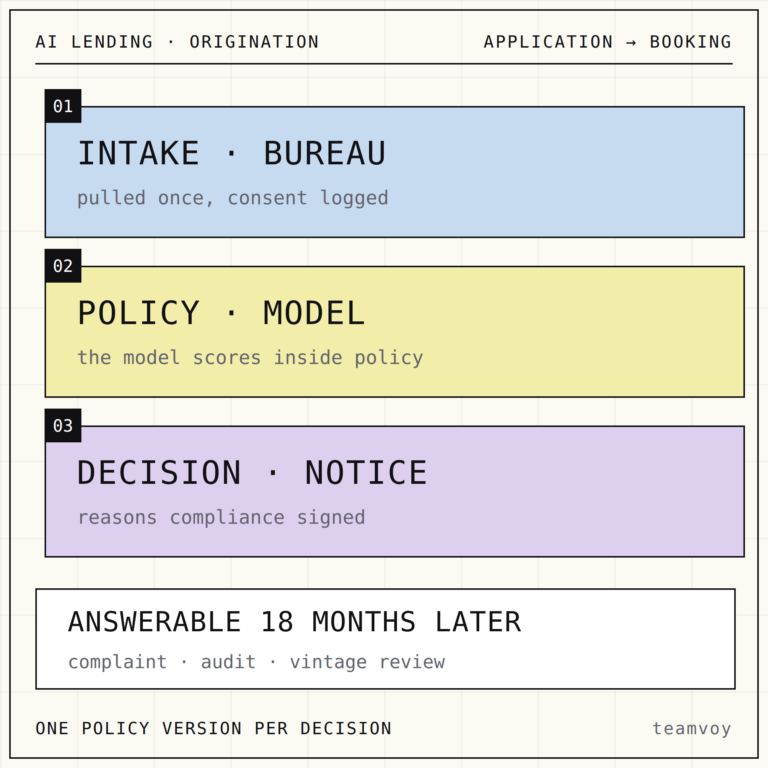
We build the decision path behind a loan application: intake and deduplication, bureau and open banking pulls with consent recorded, affordability derived from raw transactions, a versioned credit policy that the model feeds rather than overrides, and a decline notice that names the real reasons. It runs against the origination system and core you already have rather than replacing them.
Trusted by engineering teams.


Teamvoy has delivered engineering work for Nasdaq, Panasonic, Afriland First Bank, and 50+ other companies since 2013.

Verified B2B client reviews from fintech, insurance, healthcare, and hi-tech engagements.

A B2B review platform that connects businesses with verified software solutions providers.

Transparent platform where current and former employees share company reviews and interview experiences.
Lending and Origination Services We Offer
Six offerings. Each is scoped and estimated separately, and a lender automating a first product usually needs three or four of them rather than all six.

Application Intake and Identity
Applications arriving from a broker, a branch, a partner or your own front end are normalised into one record and matched against existing customers and files already in flight. The deduplication runs before any bureau call, because two applications from the same borrower in the same week should cost one pull and produce one decision.
– Omnichannel intake
– Customer and application dedup
– Identity and KYC checks
– Broker and partner APIs
– Save and resume flows
Bureau, Open Banking and Document Ingestion
External data fetched once per application, with consent, permissible purpose and the exact payload retained beside the decision it fed. Retries carry the original request key, because a timeout that leaves a borrower with two hard inquiries on their credit file becomes a complaint you have to answer in writing.
– Bureau integrations
– Open banking connections
– Consent and purpose logging
– Document capture and extraction
– Idempotent retries and caching
Affordability and Attribute Engineering
Raw transactions and tradelines turned into the attributes your policy actually names: income stability, disposable income, existing commitments, each carrying the window it was calculated over and the derivation that produced it. An affordability figure that cannot be recomputed from the stored inputs is a figure you cannot defend, so we keep the inputs rather than only the result.
– Income and expenditure derivation
– Transaction categorisation
– Attribute versioning
– Reproducibility testing
– Bureau attribute mapping
Policy and Model Decisioning
Knockouts, credit policy and pricing held as an effective-dated rule set a credit officer can read, with the model scoring inside the boundaries the policy sets rather than around them. Champion and challenger run side by side, so a proposed policy change is measured against real applications before it is allowed to decide any of them.
– Versioned rule sets
– Knockout and eligibility rules
– Scorecard and model integration
– Champion and challenger
– Pricing and limit assignment
Underwriter Workbench and Exceptions
The screen an underwriter actually works in: the file, the attributes that moved the decision, the policy rules that fired, and the documents behind each of them. Exceptions are captured with the authority that granted them and the rule they departed from, so the exception rate is a monthly number your credit committee reads rather than a surprise in a vintage review.
– Referral queues and routing
– Evidence and document views
– Exception capture and authority
– Four-eyes approvals
– Underwriter throughput reporting
Adverse Action, Fair Lending and Vintage Feedback
Decline reasons generated from a mapping your compliance function has reviewed, notices produced inside the window the rules allow, and approval outcomes monitored across segments. The booked loan keeps its link to the policy version and attribute set that produced it, so portfolio performance can be attributed to a specific policy change instead of estimated after the fact.
– Reason code mapping
– Notice generation and timing
– Segment outcome monitoring
– Policy version attribution
– Vintage and roll rate feeds

Lending Software Success Stories



Why choose Teamvoy for lending software?
Four things that are true of how we build a credit decision path, two of which cost us something.
The engineers who scope the work build the work.
No handover from a pre-sales team to a delivery team. The person who tells you what the work will cost is the person who then has to make that estimate true.
Costs us: we cannot start faster than we can staff, so we turn down work that needs a squad this month.
You own the source code from the first commit.
The repository is yours, in your organisation, from day one. Not transferred at the end, not held until the final invoice clears.
Costs us: we give up the lock-in that comes from holding a repository, so we have to be re-chosen every quarter.
Credit policy is versioned, effective-dated data. Not a code deployment.
Your credit officers change a threshold themselves, and every decision replays against the policy that was in force on the day it was made. A rule set that only engineering can edit turns each policy change into a release, and turns each audit question into an archaeology exercise across old branches.
Decline reasons come from a mapping your compliance function signed, not from a model output.
A ranked list of features is not a set of principal reasons, and shipping one as the other is how lenders end up rewriting notices under supervision. We build the mapping from decision factors to notice language, and the evidence behind it, then hand it to your credit and compliance functions to review and own.
One loan application, six layers
It reads as a form, a score and an answer. Between submission and a booked or declined decision are six handovers, and every one of them has to be reconstructable long afterwards.
Intake, deduplication and external data pulls
An application arriving from a broker, a branch or your own front end becomes one record, matched against existing customers and against files already in flight. Every bureau, open banking and document pull hangs off that record once, with consent and permissible purpose recorded and the payload retained beside the decision it fed.
Breaks when the same borrower applies twice in a week through two channels, and two decisions are made independently on two different sets of data. Breaks again when a timeout is retried without the original request key, and the borrower ends up with two hard inquiries on their file and a complaint you cannot answer cleanly.
Attribute derivation and affordability
Transactions and tradelines become the attributes the policy names, each carrying the window it was calculated over and the derivation that produced it.
Breaks when income is inferred from a window that happened to contain a bonus, and the figure cannot be recomputed once that window has rolled past.
Policy and model decisioning
Knockouts and credit policy run as an effective-dated rule set, with the model scoring inside the boundaries the policy sets rather than around them.
Breaks when a policy change ships as a code deployment, so nobody can say which version of the policy declined an applicant last March.
Underwriter referral and exceptions
Referred files reach a human together with the rules that fired and the evidence behind them, and any exception is recorded against the rule it departed from.
Breaks when exceptions are agreed in conversation and stored as ordinary approvals, so the exception rate stays invisible until the portfolio starts behaving differently.
Offer, disclosure and adverse action
Terms, pricing, the required disclosures and the decline reasons are produced from the decision itself, inside the window the rules allow.
Breaks when reason codes are lifted from the top features of a model rather than from the factors that decided the case, which is the version a regulator will read back to you.
Booking, funding and the loop back into credit
The decision lands in the core and servicing systems keeping its link to the policy version and the attributes, and outcomes return as they mature.
Breaks when the booked record loses that link, so a vintage review can see which loans went bad but not which policy version approved them.
Three ways to start
Three ways to start working with Teamvoy on outcome-based AI. No long discovery. No sales process. No forms to fill. Every engagement starts with a real technical conversation, and every engagement is priced to a result. We move as fast as the situation needs.
Decision Path Review
Two engineers trace one credit product from application intake to booking and mark every point where the decision could not be reproduced afterwards. You keep the decision path map, the policy reconciliation list and the reproducibility gaps whether or not we build anything.
One Product, Decisioned
One credit product runs in shadow against your current process, in your environment: intake and deduplication, bureau and open banking pulls with consent logged, derived affordability attributes, a versioned policy set, an underwriter queue and mapped decline reasons. Your credit function reads the disagreement report before anything is automated.
Call a CTO
Fifteen minutes with the engineer who would do the work. Bring the product that still needs a human on every file, and you get an answer on what is actually stopping it, including the answer that it is a policy problem rather than a software one.

Could you name
which policy version declined that applicant?
We engineer for:
What our lending engineers work in.
Services and APIs


Decision orchestration


Credit models and explainability

Document and language models


Data and reporting


Systems we originate inside
What changes when a decline has to be explained eighteen months later.
These rows are the questions worth putting to any vendor quoting origination work, including us.
Bring the product you cannot decision automatically.
Talk to a Chief Technology Officer on the first call.