- Fintech technology consulting partners split into four kinds: regulated-systems engineering partners, strategy consultancies who advise then hand off, greenfield product studios, and staffing marketplaces supplying capacity.
- We assess every firm on five criteria: named regulator experience, accountability after go-live, capacity to take over code someone else wrote, AI depth at the data layer, and senior technical lead ownership.
- Since 17 January 2025, DORA requires EU financial entities to register every ICT third-party arrangement, so your consultant is now an auditable entry in a regulatory filing.
- Published rates run 25 to 49 dollars offshore, 60 to 140 dollars for dedicated teams, 150 to 199 dollars for US consultancies, and 200 to 400 dollars for senior independents.
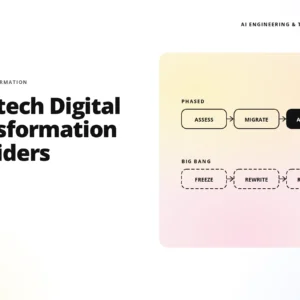
- Default to stabilising a legacy core, not rewriting it. Rewrite only when the core cannot meet a regulatory or scale requirement at any sensible cost.
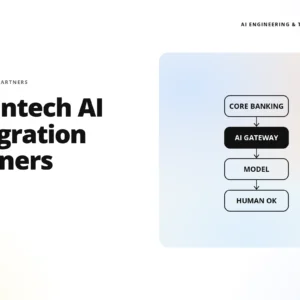
- Fintech AI stalls at the write-access boundary. Any agent that can post to a ledger needs circuit breakers, spend caps, and action audit logs in the first sprint.
Q1. Which Kinds Of Fintech Technology Consulting Partners Are Worth Shortlisting In 2026?
Fintech technology consulting partners fall into four kinds: regulated-systems engineering partners who take ownership of a live platform, global strategy consultancies who advise and hand off, product studios who build greenfield fintech apps, and staffing marketplaces who supply capacity. Teamvoy sits in the first kind, with 150+ delivered projects since 2013 and multi-year engagements across banking and fintech and insurance.
Choosing a fintech technology consulting partner is not a procurement task. It is a decision about who touches your ledger, your payment rails, and your audit trail. Get it wrong and the cost surfaces years later, inside a regulator’s findings letter. This guide describes kinds of engineering partners, not a ranked league table. Each kind is assessed on named regulator experience, accountability after go-live, capacity to take over code someone else wrote, AI depth at the data layer, and senior technical lead ownership. It is written for CTOs, technical founders, and IT directors carrying a live platform. Read it accordingly.
⚠️ One disclosure before the list
I run Teamvoy, so I am inside this category, not above it. Most competing lists put their own firm first without saying so. I put Teamvoy first too, and I am telling you why, so you can discount it.
What I can offer instead is a rubric you can use on any firm, including mine. Apply it in your next three vendor calls. If a firm fails four of the five criteria, the rate does not matter.
Our Evaluation Criteria
📋 What each criterion actually tests
- Named regulator and standards experience. Which regimes has the firm delivered under, and for whom. Since 17 January 2025, EU financial entities must log every ICT third-party arrangement in a DORA Register of Information, so this is now an auditable answer, not a marketing line.
- Accountability after go-live. Whether the proposal ends at a recommendation or at a running system, and who is on the escalation path in month six.
- Capacity to take over code someone else wrote. Whether the firm can read, document, and stabilise an undocumented core without proposing a rewrite first, which is the core question behind any legacy software recovery plan.
- AI depth at the data layer and legacy core. Whether AI work reaches production with spend caps and audit trails, or stops at a read-only demo.
- Senior technical lead ownership. Whether one named senior engineer owns the system, or juniors cycle through a staffing contract.
💰 Why pricing is not a criterion here
Engineering services are custom-quote everywhere. A published hourly band tells you almost nothing about total cost across a three-year engagement.
What moves total cost is rework. As one engineer put it, “almost right passes code review, almost right ships to production,” and the bill arrives six months later.
Who This Guide Is For
- CTOs who inherited a payments or banking platform after a vendor underdelivered or exited, and who need it stable before they need it modern.
- Technical founders sitting on a fintech core that works but resists change, with an AI roadmap expected by the board.
- Enterprise IT directors inside a regulated environment facing a DORA, PCI-DSS, or PSD2 deadline with no spare internal capacity.
The Partners Covered In This Guide
This roster covers ten engineering partners. Each exists for a different situation.
- Teamvoy: Best for a regulated fintech or insurance platform already in production that needs stabilising and modernising without a rewrite.
- Vention: Best for a funded fintech scaling an existing product with a large blended engineering bench behind it.
- DOOR3: Best for a mid-market financial services firm replacing an internal system with heavy user-experience debt.
- HatchWorks AI: Best for a fintech team adding AI-assisted delivery to an existing product roadmap.
- Dualboot Partners: Best for a fintech carve-out or post-acquisition platform that needs a team assembled fast.
- Orases: Best for a US financial services operator replacing spreadsheets and internal tooling with custom software.
- SOLTECH: Best for a regional financial services firm that wants a nearby team and a long support relationship.
- Valere: Best for a fintech founder validating a new product line before committing an internal team.
- NineTwoThree AI Studio: Best for a fintech testing a single AI use case with a defined success metric.
- JetRockets: Best for a lean fintech product team needing senior full-stack capacity on an existing codebase.
Master Comparison Table
| Company Name | Best For | Engagement Model | Industry Depth & Compliance Coverage |
|---|---|---|---|
| Teamvoy | Regulated fintech or insurance platform in production needing stabilisation and modernisation without a rewrite | Long-term partner (multi-year), senior technical lead owns the system | Banking, fintech, insurance, healthcare; PCI-DSS, SOC 2, HIPAA, GDPR, BaFin, PSD2, DORA scope |
| Vention | Funded fintech scaling an existing product with a large engineering bench behind it | Staff augmentation plus dedicated teams | Fintech and enterprise software; named regulator scope not publicly detailed per firm |
| DOOR3 | Mid-market financial services firm replacing an internal system with heavy UX debt | Project-and-exit with support retainers | Financial services, enterprise IT; compliance scope varies by engagement |
| HatchWorks AI | Fintech team adding AI-assisted delivery to an existing roadmap | Nearshore dedicated teams | Financial services and healthcare claimed; regulator-specific delivery not publicly detailed |
| Dualboot Partners | Fintech carve-out or post-acquisition platform needing a team assembled fast | Dedicated teams, build-operate-transfer | Fintech and private-equity-backed software; compliance scope varies by engagement |
| Orases | US financial services operator replacing spreadsheets and internal tooling | Project-and-exit with managed support | Financial services, logistics, healthcare; SOC 2 and HIPAA work claimed per project |
| SOLTECH | Regional financial services firm wanting a nearby team and long support | Project plus ongoing support retainer | Financial services and healthcare; regulator scope not publicly detailed |
| Valere | Fintech founder validating a new product line before committing internal staff | Project-and-exit, product studio | Fintech and consumer products; regulated-delivery depth not publicly detailed |
| NineTwoThree AI Studio | Fintech testing one AI use case with a defined success metric | Project-and-exit, AI studio | Fintech and healthcare AI builds; named regulator scope not publicly detailed |
| JetRockets | Lean fintech product team needing senior full-stack capacity on an existing codebase | Staff augmentation and dedicated teams | Fintech, real estate, logistics; compliance coverage varies by engagement |
⭐ How to read the cards below
Every card applies the same five criteria, in the same order. Where a firm’s position is not publicly documented, the card says so rather than guessing.
Facts come from each firm’s own public claims and from review platforms, dated at retrieval. If a criterion is unproven for your use case, ask about it directly, or start from a written IT audit of your own system first.
Teamvoy
- Named regulator and standards experience: PCI-DSS, SOC 2, HIPAA, GDPR, BaFin, PSD2, and DORA scope in delivery.
- Accountability after go-live: senior technical lead stays on the system past launch.
- Capacity to take over code someone else wrote: core practice, including undocumented cores.
- AI depth at the data layer and legacy core: data layer and core assessed before model selection.
- Senior technical lead ownership: one named senior engineer owns the system, backed by the team.
- Multi-bank internet banking platform delivery across seven banks.
- Trade surveillance work spanning 30 financial institutions.
- Insurance platform serving 34M+ prospects.
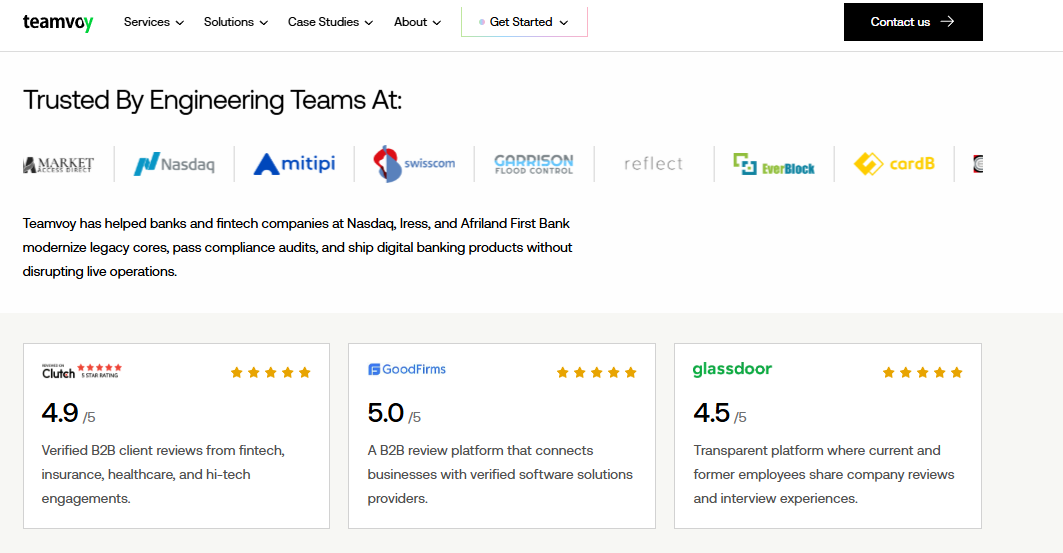
- Named clients include Nasdaq, Market Access Direct, OSL, and Panasonic Avionics.
- Iress engagement ran from proof of concept through to scale over multiple years.

Vention
- Named regulator and standards experience: fintech delivery claimed; specific regulator scope not publicly detailed.
- Accountability after go-live: varies by engagement; support is contracted separately.
- Capacity to take over code someone else wrote: handled, though the firm leads with build capacity.
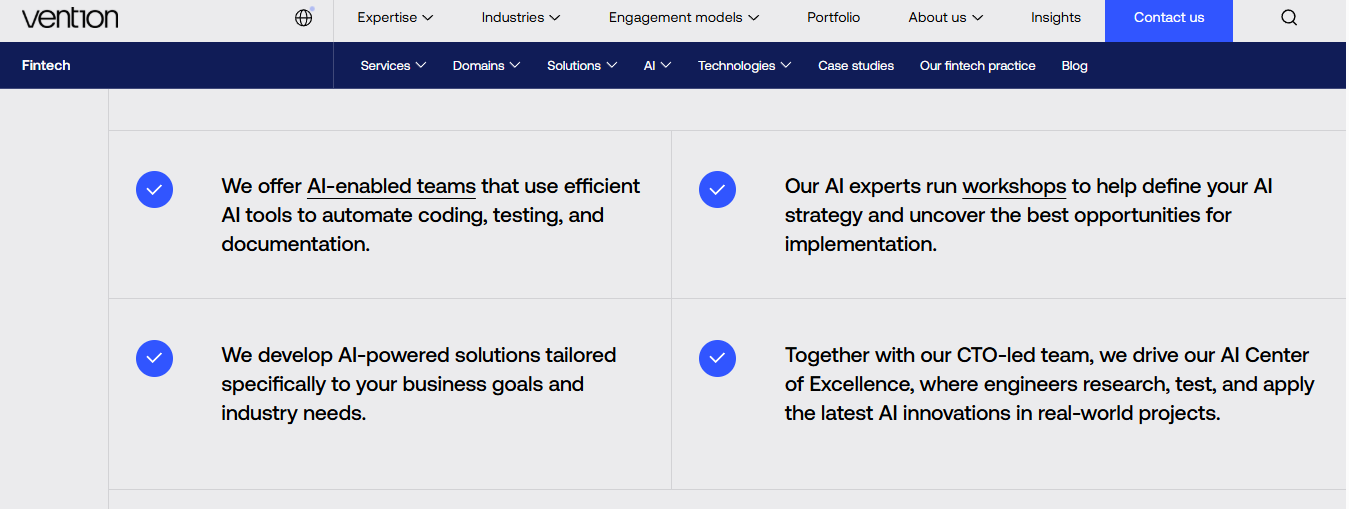
- AI depth at the data layer and legacy core: AI and data services offered; production depth varies by team.
- Senior technical lead ownership: varies by engagement; bench scale is the primary offer.
- Appears in independent fintech consulting roundups alongside Accenture and Itexus.
- Long-running venture and startup practice serving funded product teams.
- Publicly claimed fintech, healthcare, and enterprise software portfolio.
✅ Where to take this next
Score your current shortlist against the same five criteria before the next call, including any firm already under contract. Most readers find one criterion where nobody scores well, and it is usually accountability after go-live.
If the blocker sitting under all of this is a core that resists change, that is a technology modernization conversation, not a procurement one. Teamvoy runs that first read as a scoped assessment, and you can talk to a technical lead about what your platform actually needs.
📌 How to read the rest of the roster
The eight cards below apply the same five criteria, in the same order as the first two. Facts come from each firm’s own site and its public review-platform profile, retrieved 17 August 2026.
Where a firm has not publicly documented its regulator scope, the card says exactly that. Guessing at someone else’s compliance history is the fastest way to mislead a reader who is about to sign a DORA-registered contract.
DOOR3

- Named regulator and standards experience: financial services clients served; specific regulator scope not publicly detailed.
- Accountability after go-live: support and maintenance offered as a separate service line.
- Capacity to take over code someone else wrote: enterprise application modernization is a stated core practice.
- AI depth at the data layer and legacy core: AI and data modernization offered; production depth varies by engagement.
- Senior technical lead ownership: consultative model; lead structure varies by project.
- Independent consultancy operating continuously since 2002.
- New York headquarters with a Kyiv delivery centre.
- Long enterprise application and Drupal heritage documented publicly.
HatchWorks AI
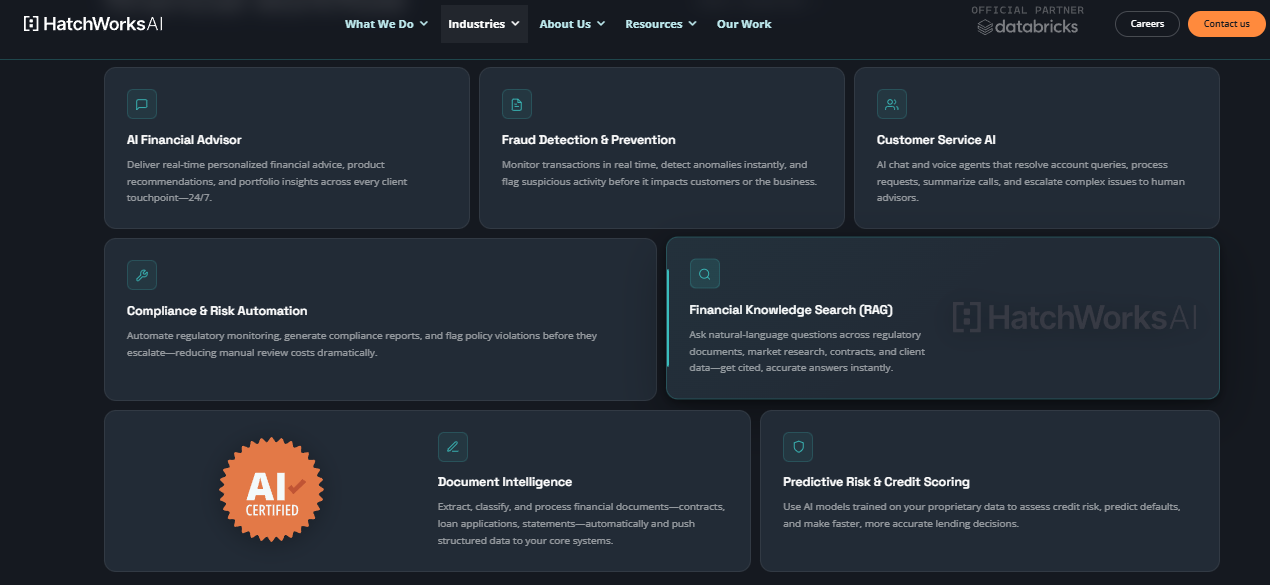
- Named regulator and standards experience: financial services and healthcare claimed; regulator scope not publicly detailed.
- Accountability after go-live: dedicated team model; ownership continues while the contract runs.
- Capacity to take over code someone else wrote: Brownfield Analysis Engine is built for exactly this.
- AI depth at the data layer and legacy core: documented AI-assisted SDLC with a human confirmation gate.
- Senior technical lead ownership: three-person pod structure rather than a single named owner.
- Published GenDD primitives, including a brownfield analysis approach for legacy discovery.
- Nearshore teams in US-overlapping time zones.
- Public guidance on evaluating a partner’s documented SDLC for AI-assisted work.
Dualboot Partners
- Named regulator and standards experience: financial services vertical served; specific regulator scope not publicly detailed.
- Accountability after go-live: managed pod model, vendor assembles and runs the team.
- Capacity to take over code someone else wrote: legacy modernization and API integration are stated practices.
- AI depth at the data layer and legacy core: AI-driven delivery claimed across product and data services.
- Senior technical lead ownership: pod leadership rather than one named senior engineer.
- Over 200 clients reported across startup, mid-market, and enterprise buyers.
- AWS Advanced Tier Services Partner status.
- Stated industry coverage includes financial services and private equity.
Orases
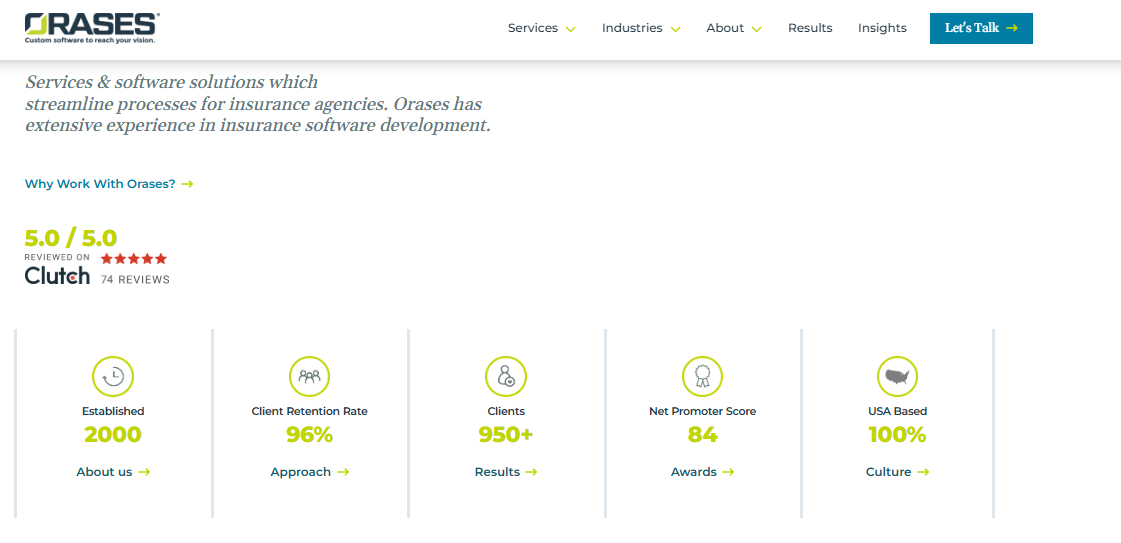
- Named regulator and standards experience: SOC 2 and HIPAA work claimed per project; fintech regimes not publicly detailed.
- Accountability after go-live: managed support offered after delivery.
- Capacity to take over code someone else wrote: integrations and modernization are listed services.
- AI depth at the data layer and legacy core: AI consulting and custom agents offered; data strategy included.
- Senior technical lead ownership: account-led structure; named engineer ownership not publicly claimed.
- Continuous operation since 2000 with a Maryland headquarters and DC office.
- Published hourly band of $150 to $199 on its Clutch profile.
- Named brand clients across media and consumer goods.
SOLTECH
- Named regulator and standards experience: financial services and healthcare work claimed; regulator scope not publicly detailed.
- Accountability after go-live: ongoing support retainers are a standard offer.
- Capacity to take over code someone else wrote: maintenance and modernization handled; depth varies by stack.
- AI depth at the data layer and legacy core: AI development and consulting listed; production evidence limited publicly.
- Senior technical lead ownership: consulting plus staffing blend; ownership depends on contract type.
- Long-running Atlanta practice with a national client base.
- Published hourly band of $150 to $199 on its Clutch profile.
- Technology consulting, data engineering, and Salesforce integration in stated services.
Valere
- Named regulator and standards experience: not publicly detailed for financial regulation.
- Accountability after go-live: project-based; ongoing ownership varies.
- Capacity to take over code someone else wrote: handled case by case; not a headline practice.
- AI depth at the data layer and legacy core: AI delivery is the core offer, with reported accuracy gains on chatbot work.
- Senior technical lead ownership: studio model rather than named senior lead.
- One client reported a 50% improvement in chatbot response accuracy.
- Vetted provider status across Clutch, G2, and AWS.
- Portfolio spanning private-equity portfolio companies and enterprise buyers.
NineTwoThree AI Studio
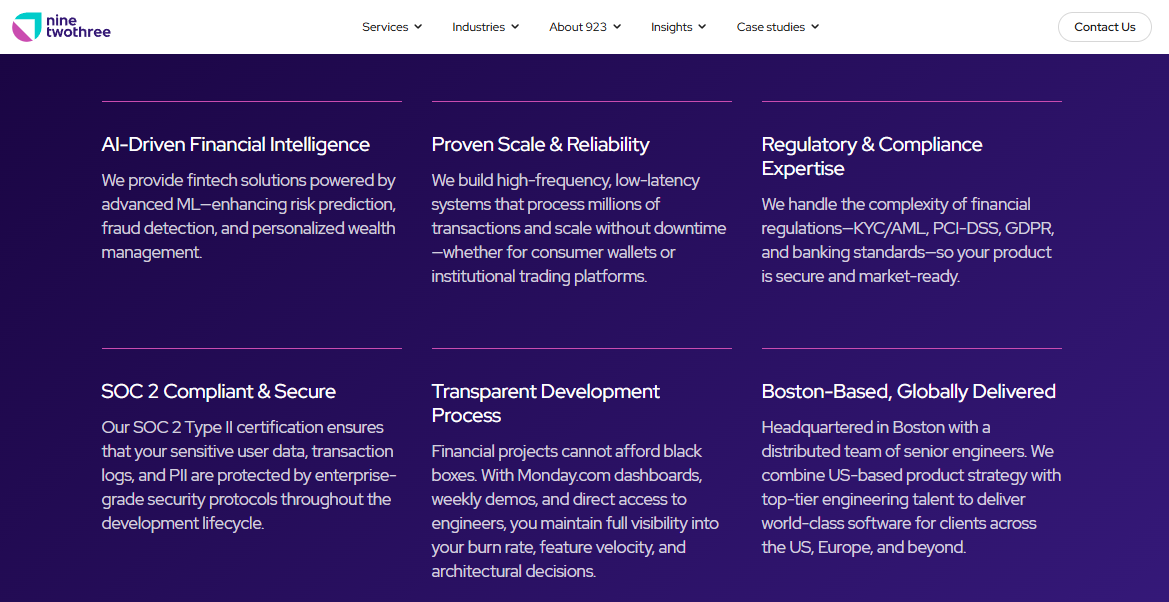
- Named regulator and standards experience: fintech among served industries; regulator scope not publicly detailed.
- Accountability after go-live: project-and-exit with optional continuation.
- Capacity to take over code someone else wrote: possible, though greenfield AI builds are the focus.
- AI depth at the data layer and legacy core: strong AI specialisation, including computer vision and ML systems.
- Senior technical lead ownership: direct principal access reported at this firm size.
- 150+ projects delivered since 2012 across fintech, healthcare, and logistics.
- Published hourly band of $100 to $149.
- Inc. 5000 listing and repeated Clutch category rankings.
JetRockets
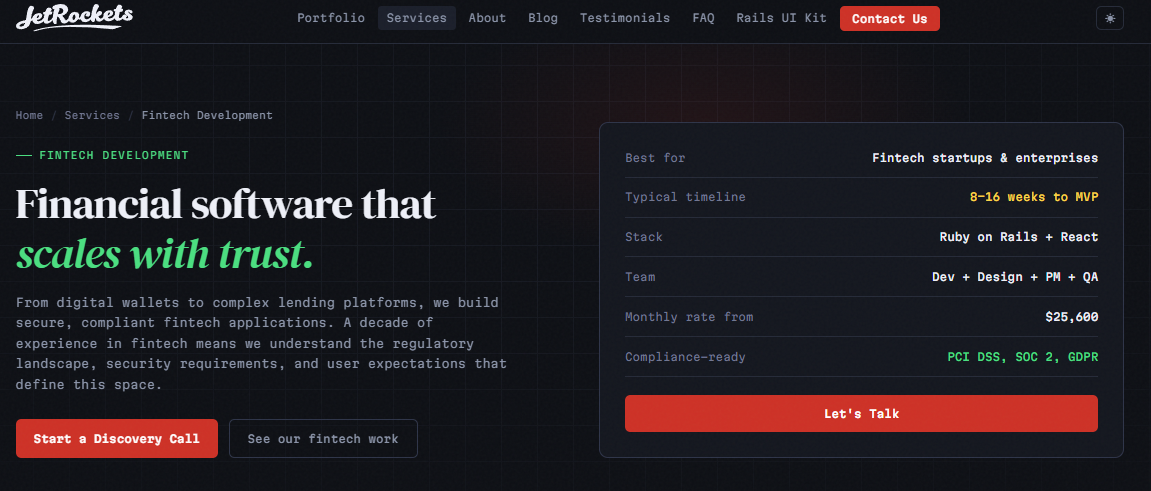
- Named regulator and standards experience: fintech product work delivered; regulator scope not publicly detailed.
- Accountability after go-live: maintenance continues on delivered products.
- Capacity to take over code someone else wrote: modernizing and scaling existing web applications is a stated focus.
- AI depth at the data layer and legacy core: AI integrated where it produces measurable business value.
- Senior technical lead ownership: CTO-led engagements at a small team size.
- 15+ years of continuous Ruby on Rails development.
- Fintech product work including trading and simulation tooling.
- Repeated Clutch category recognition for Rails development.
✅ What to do with this roster on Monday
Take the five criteria and score your current shortlist honestly, including any firm already under contract. Most readers find one criterion where nobody scores well, and that gap is usually accountability after go-live.
Then ask each firm the same question: which named regulator regime have your engineers actually delivered under, and on whose platform. The answers separate the list faster than any rate card, and they matter most when you are building regulator-ready AI in fintech.
Teamvoy sits in the first kind described here, and the honest limit is worth stating: a 70-person team is wrong for a several-hundred-engineer programme, and where a core cannot meet a regulatory requirement at sensible cost, the answer is a rebuild, not a rescue. Our own case studies across banking, insurance platforms, and trading systems show which of those two calls we made each time.
If the shortlist exercise leaves you unsure whether your core needs stabilising or replacing, that question is answerable in days rather than months. A scoped AI consulting conversation or a written system read will settle it, and you can speak to a senior engineer without a sales process attached.
Q2. What Does Fintech Technology Consulting Cover, And How Is It Different From Fintech Software Development?
Fintech technology consulting is advisory work combining product strategy, regulated-systems architecture, and compliance sequencing. The consultant decides what to build, which rules apply, and in what order. A development company builds it. Firms doing both compress discovery and delivery, which matters when PCI DSS, PSD2, KYC/AML, and DORA have to shape the architecture instead of forcing a later rebuild.
The Plain Definition
📋 What the work actually includes
Consulting covers four things: which licences and rules apply, what the system architecture should be, which build sequence avoids rework, and how the data layer supports it all. That is the whole job.
Everything else marketed as fintech consulting is a subset of those four. KYC means know your customer, the identity checks a regulated firm must run before onboarding.
⚖️ Advise versus build, and why it matters
The split decides who carries risk when the design meets production. Ask which one you are paying for before the first invoice, not after.
| Scope you buy | What you get | Who owns the outcome |
|---|---|---|
| Advisory only | Architecture, compliance map, roadmap | You, and your internal team |
| Build only | Working software against a given spec | Split, and usually contested |
| Advise plus build | Design carried through to production | The partner, if the contract says so |
Where The Sequence Breaks
⚠️ One concrete example from a payments build
A team ships a card feature, then decides on tokenisation. Tokenisation replaces card numbers with substitute values, so raw data never sits in your database.
Decide that after the ledger schema is set, and you rewrite the schema. I have seen that single ordering mistake cost a quarter of engineering time.
🧩 Integration is the real bottleneck
Model choice gets the attention. The nervous system, meaning integrations and data plumbing, decides whether anything reaches production, which is why system integration work usually decides the timeline.
Teamvoy starts every fintech engagement at the data layer and the legacy core, before any model, framework, or roadmap discussion. We ask what the data looks like on a bad day, not a good one.
What The 2026 Market Actually Says
💰 Named, dated numbers instead of vague growth
Gartner forecasts global enterprise IT spending in banking and investment services at $857.5 billion in 2026, up 9.5%. That is the budget pool consultants are quoting into.
KPMG’s Pulse of Fintech, using PitchBook data to 31 December 2025, reports $116 billion invested across 4,719 deals, against $95.5 billion across 5,533 the prior year.
❌ Where the published market sizes disagree
Fortune Business Insights puts the fintech market at $394.88 billion in 2025, rising to $460.76 billion in 2026. Mordor Intelligence is cited at $194 billion with an 18.97% CAGR.
Both are quoted confidently in vendor listicles. I show both scopes rather than pick the flattering one, because the definitions behind them differ and neither publishes a reconciliation.
⏰ What that means for your budget
More money, fewer deals, means capital is concentrating in fewer, larger platforms. Consulting demand is shifting from launching new products to fixing and scaling existing ones, which is the pattern behind the current tech debt avalanche.
If you are buying advisory work in that market, ask for evidence of production delivery, not slideware. The demo-to-production gap is where budgets die.
Teamvoy runs its readiness audit in that order: architecture first, data layer second, model or framework last. Across 150+ delivered projects since 2013, the engagements that stalled almost always stalled at integration, not at model selection.
Q3. What Do DORA, PCI DSS v4.0.1, And PSD2 Change About Choosing A Partner?
Since 17 January 2025, EU financial entities must record every ICT third-party arrangement in a DORA Register of Information, with mandatory contractual clauses and documented exit plans. Since 31 March 2025, the 51 future-dated PCI DSS v4.0.1 requirements are ordinary, testable requirements. Teamvoy delivers inside DORA, PCI-DSS, PSD2, SOC 2, HIPAA, and GDPR scope across banking and fintech platforms.
DORA Made Vendor Choice A Filing
📄 What Article 28(3) puts on you, not the vendor
DORA is the EU Digital Operational Resilience Act. It applies to financial entities, and it became applicable on 17 January 2025.
Article 28(3) requires you to maintain a register of every contractual arrangement with an ICT third-party provider. That register is submitted to your national competent authority, in a machine-readable reporting format.
✅ The contract clauses to check before signing
Article 30 sets the mandatory clauses. Missing any of them makes the arrangement a finding waiting to happen.
- Full description of services, plus locations where data is processed.
- Subcontractor disclosure, including who may support critical functions.
- Access, inspection, and audit rights for you and your regulator.
- Exit plan with a transition period, so you can leave without an outage.
- Incident reporting and cooperation duties.
PCI DSS v4.0.1 Is A Competence Test
🔐 Three requirements that separate real from claimed
The 51 future-dated requirements stopped being best practice on 31 March 2025. They are now tested like any other requirement.
Ask candidates about three specifically. Their answers reveal whether an engineer or a salesperson is talking.
| Requirement | What it demands | What a weak answer sounds like |
|---|---|---|
| 8.4.2 | Multi-factor authentication for all non-console access into the cardholder data environment | “We follow best practices” |
| 6.4.3 | Inventory, authorise, and monitor every script on the payment page | “The front end is out of scope” |
| 11.6.1 | Weekly detection of unauthorised change to payment page headers and content | “Our WAF handles that” |
⚠️ Eligibility does not equal compliance
A certificate on a website proves the firm passed something once. It does not prove your build will pass.
I ask a blunter question on these calls: which of your clients has been through a QSA assessment, and what failed the first time. A QSA is a qualified security assessor, the auditor who signs off PCI DSS.
What To Put In The Contract
📝 Five clauses worth the negotiation time
PSD2, the EU payment services directive, adds strong customer authentication duties on top of all this. Those obligations stay yours, whoever writes the code, and they shape how you approach regulator-ready AI in fintech.
- Named subcontractors, with notification before any change.
- Audit and inspection rights, extended to your regulator.
- A written exit plan, with data return format and timeline.
- Incident notification windows that match your own reporting duties.
- Documentation deliverables specified as acceptance criteria, not goodwill.
Teamvoy writes engagement documentation to survive an audit rather than to close a sale, across BaFin, PSD2, DORA, SOC 2, PCI-DSS, HIPAA, and GDPR scope. In twelve years, no regulator has ever asked me for a proposal deck. They ask for evidence trails, and our IT audit services are built around producing them.
Q4. Rescue Or Rewrite: How Should A Partner Handle A Legacy Fintech Core?
Default to stabilising. Rewrite only when the existing core cannot meet a regulatory or scale requirement at any sensible cost. Routing traffic away from the old system one capability at a time, with both running, keeps the business live and preserves rollback. Teamvoy has delivered this pattern on banking platforms across seven banks and trade surveillance for 30 institutions.
The Situation Most CTOs Inherit
🏗️ A core built by three teams who all left
The system works. Nobody can explain why. Documentation stopped two vendors ago.
A legacy modernization here is closer to renovating an occupied building than building a new one. The tenants keep paying rent while you replace the plumbing, which is exactly the problem updating systems nobody understands sets out to solve.
❌ Why the rewrite proposal arrives first
A rewrite is easier to scope and easier to sell. It is also where most fintech modernization budgets go to die.
The honest exception matters: if the core cannot meet a regulatory requirement at any sensible cost, rebuild. I have told clients that, and lost the smaller engagement by saying it.
The Failure Modes That Only Appear At Cutover
⚠️ Two milliseconds that exhaust a connection pool
The database cutover succeeds. Then the application gridlocks.
A synchronous write across two cloud availability zones adds roughly two milliseconds to every commit. Under load, that penalty compounds until the connection pool is empty, which is why cloud optimization belongs in the migration plan, not after it.
🔌 The vendor who whitelisted your old IP
Payment processing dies for a reason nobody documented. A third-party vendor only accepts traffic from your old on-premises IP address.
The fix is routing that vendor’s address range back down the original private link. You cannot plan for this, so you must discover it before cutover, not during.
The Resolution: Strangle, Do Not Replace
🧱 Identical interface, different tables underneath
The pattern that works keeps the interface frozen. Users see the same screens, same colours, and same button positions.
Behind that surface, one capability at a time moves to normalised tables, with writes going to both systems. Nobody on the floor notices, which is the point.
⏰ Two tests to run before you touch anything
Both tests find hidden dependencies that monitoring windows miss, like monthly batch jobs and audit exports.
- Isolate suspected unused servers at the network level for 48 to 72 hours, and see who screams.
- Block inbound traffic while keeping the server running for three to seven days, so timeouts expose callers without losing system state.
If a data centre lease or vendor contract expires within 60 days, do not refactor. Rehost first, then modernise once the deadline is gone, and treat the rest as a staged technology modernization programme.
What Clients Say About Takeover Work
I can confidently say that we would not be where we are today without Teamvoy's support.
Their technical expertise was top class.
Teamvoy takes systems over mid-flight and stabilises them before proposing any structural change, which is the reverse order of a rewrite-first proposal. The engagement that reached scale over multiple years started as a proof of concept, not a rebuild.
Q5. Where Does AI Actually Pay Off In Fintech, And Why Do So Many Pilots Stall?
Fintech AI pays off when it is scoped to one funded use case with a measurable baseline, such as fraud triage, credit decisioning, or document review. It stalls at the write-access boundary. Teamvoy scopes spend caps, circuit breakers, and action audit logs into the first sprint of any agent work that can write to a system of record.
The Pilot That Demoed Well And Died
❌ Why read-only assistants always ship
A read-only assistant summarises policy documents. It cannot move money, so nobody blocks it. That is why it reaches a demo in three weeks.
The moment an agent can post to a ledger, adjust a limit, or price a discount, the engineering bar changes completely. Most pilots never budget for that second system.
💸 The cost mechanism nobody models
Agent frameworks resend the whole conversation history on every turn. Token spend grows quadratically, not linearly, so a 20-step loop costs far more than twice a 10-step run.
One widely reported incident involved an agent stuck in a retry loop with a CRM tool overnight. Six hours of the same failed action produced roughly $4,200 in API charges, because no hard circuit breaker existed.
Where The Money Actually Is
💰 The adoption numbers, dated
Gartner expects more than 80% of banks to have adopted generative AI by 2026, up from around 5%. Budget is not the constraint.
KPMG’s Pulse of Fintech reports AI-driven fintech funding rising from $12.1 billion to $16.8 billion year on year, with total fintech investment at $116 billion. Money is arriving faster than delivery discipline.
✅ Three controls to name in the statement of work
Teamvoy treats these as first-sprint items, not hardening tasks for later. Each one is cheap to build early and expensive to retrofit, which is why they belong in any AI agent development scope from day one.
- A hard circuit breaker that stops the loop after N failed attempts.
- A spend cap per run and per day, enforced outside the agent’s own logic.
- An action audit log that records what the agent did, not just what it said.
Scoping That Survives A Board Review
⭐ One use case, one baseline metric
Pick one process with a number you already measure. Fraud triage time, manual review queue length, or document turnaround all work.
Without a baseline, you cannot prove value, and the pilot dies in the next budget cycle. Explainability belongs in the same scope, because a regulated decision needs a reason attached.
⚠️ Where AI adds risk faster than value
An unstable stack with a dirty data layer is the wrong host for AI. Adding a turbocharger to an engine that already misfires does not make it faster, and that is the first thing any honest AI integration assessment should tell you.
I could be reading this too strongly, but the pattern across the audits I have run is consistent. The blocker is almost never model choice.
Judging A Partner’s Code Discipline
📋 The three-question pull-request standard
Every delivery team now uses AI assistance. Published benchmarks show AI-generated pull requests averaging 10.8 issues, against 6.4 in human-written code.
Ask any candidate these three questions about their own review process:
- Does the change reuse existing abstractions, or invent new ones?
- Does it follow repository conventions?
- Can the engineer explain it without reading the model’s comments?
If they cannot explain why the code works without the annotations, it is not ready for a payments path. The same discipline sits behind the security risks of vibe-coded software.
Teamvoy applies the same review standard to AI-assisted and hand-written code, because the engineer carrying the pager has to read both. Across 150+ delivered projects, the failures I remember were never model failures. They were integration failures nobody owned.
Q6. What Does An Engagement Cost, And Which Engagement Model Fits Your Situation?
Published rates run roughly $25 to $49 an hour for offshore product studios, $60 to $140 for dedicated European and North American teams, and $150 to $199 for established US consultancies. Senior independent consultants reach $200 to $400. Teamvoy opens most engagements with a short fixed-scope readiness audit or a two-week bounded sprint.
Why Quotes Cannot Be Compared
💰 The rate band tells you almost nothing
Two firms quote the same hourly rate. One delivers with three senior engineers, the other with eight juniors and a manager.
Engineering services are custom-quote everywhere, so published bands are directional only. Rework, not rate, drives total cost across a three-year engagement, a point covered in more depth in our AI integration cost guide.
📋 Observed bands, retrieved 17 August 2026
| Provider type | Published band | What you are buying |
|---|---|---|
| Offshore product studio | $25 to $49 per hour | Capacity, thin architecture ownership |
| Nearshore or European dedicated team | $60 to $140 per hour | Time-zone overlap, blended seniority |
| US consultancy | $150 to $199 per hour | Onshore accountability, higher overhead |
| Senior independent consultant | $200 to $400 per hour | Judgment, no delivery capacity |
The Structure Question Matters More
⏰ Match the model to the situation
Buying the wrong structure is more expensive than paying the wrong rate. An outage does not need a discovery phase.
| Your situation | Structure that fits | What it delivers |
|---|---|---|
| Production incident, unclear cause | Fixed-scope audit, days not weeks | Written risk read and next action |
| Compliance deadline in 6 to 12 months | Long-term partner, named lead | Auditable delivery through go-live |
| Known feature, internal team stretched | Bounded paid sprint | One shipped milestone |
| Ongoing capacity gap | Staff augmentation | Hands, with architecture still yours |
⚠️ Three accountability questions before signing
Ask who is named on the on-call rotation after go-live. Ask whether the proposal ends at a recommendation or a running system.
Then ask whether the senior engineer in this meeting will be on the team in month six. The honest answers separate the shortlist faster than pricing does, and the same test applies when you choose an AI vendor for fintech.
The Build Versus Buy Trap
💸 The integration bill nobody quotes
Building your own integration layer makes you responsible for every API schema, field mapping, authentication flow, and retry rule. That job never ends.
Only build it if you have a dedicated platform team and your core systems are genuinely unique. Otherwise, you have hired yourself into permanent maintenance, and IT cost optimization becomes a permanent line item.
✅ Why a short paid audit beats a long free proposal
A free proposal is written from your description of the system. A paid audit is written from the system itself.
Teamvoy prices its readiness audit at a fixed scope for that reason, and the trade-off is real: three to five days surfaces architecture and risk, not a full remediation plan. A two-week sprint ships a meaningful first milestone, not a finished platform, which is the delivery shape behind our AI modernization sprints.
What Clients Say About Delivery Structure
We were impressed with the technical management, adherence to process, and technical capability of the engineers.
We work with them for over 2 years, and they have been very reliable and timely in providing us quality development services.
Q7. How Do You Vet A Partner Before Signing, And Spot The Wrong One In The First 60 Days?
Ask which named regulator regimes they have delivered under and for whom, who owns the system after go-live, and how they document a codebase they did not write. Then watch four signals: the pitch engineer disappears, documentation lags code, estimates arrive without assumptions, and the first proposal is a rewrite. Teamvoy answers these questions in a 30-minute technical call with an engineer.
Ten Questions For The Next Vendor Call
📋 Track record and accountability
Weak answers here sound like categories. Strong answers sound like specific platforms and specific auditors.
- Which named regimes have your engineers delivered under, and on whose platform? Weak: “we follow best practices.”
- Who is on the escalation path in month six? Weak: “our support team.”
- Does this proposal end at a recommendation or a running system? Weak: “both, depending.”
- Who reads the existing code first, and for how long? Weak: “our architects will review.”
- What documentation do you deliver as acceptance criteria? Weak: “we document as we go.”
🔐 Contract and control questions
The last one matters most. A partner who will not refuse anything has not understood your system yet.
- Will you name your subcontractors, and notify us before changes? Required under DORA Article 30.
- Will you accept audit and inspection rights, extended to our regulator?
- What is your written exit plan, including data return format?
- What spend and blast-radius controls do you put on AI components?
- What would you refuse to do on our platform in month one?
The Four Signals In The First 60 Days
⚠️ What to watch, and what to do
Each signal is recoverable if raised in week two. Together they predict the engagement you already had once.
| Signal | What you observe | The intervention |
|---|---|---|
| Pitch engineer gone | New names on standups, no handover note | Ask for the named lead in writing |
| Documentation lags code | Merged features, empty README updates | Make docs an acceptance criterion |
| Estimates without assumptions | A number, no stated dependencies | Reject until assumptions are listed |
| Rewrite proposed first | Month-one deck proposing a rebuild | Ask for the stabilisation option instead |
🧠 The tribal knowledge problem
One on-call engineer restarted a server six times on an AI tool’s advice. The real cause was a connection pool exhausted by a batch cron job.
A senior engineer read the logs and knew in 30 seconds. That knowledge lives in people, and no partner can produce it in week one.
What I Got Wrong
❌ An honest one from our side
Teamvoy once inherited a platform and started stabilisation before finishing the dependency map, because the client was in pain and wanted movement. We found a monthly batch job the hard way, in production.
Now the map comes first, even when it costs three days of visible progress. I would rather be slow in week one than surprised in week five, and that sequence now runs through every data migration engagement we take on.
What Clients Say About Taking Over
The care and interest they showed are what makes Teamvoy special.
We're impressed with their involvement in processes and quick completion of work.
Teamvoy is often the second or third partner on a system, which is why the first deliverable is an honest read of what the previous team left behind. If you are holding a platform you did not build, tell me what is breaking and I will tell you whether it needs stabilising or replacing. Start with a look through the field notes if you would rather read first, or see who you would actually be working with.