- Fintech digital transformation services cover core and payments work, cloud, the data layer, process automation, AI integration, and RegTech delivery under DORA, PSD2, and PCI DSS 4.0.
- Nine partner kinds are assessed on five criteria: regulator experience, modernisation approach, senior lead ownership, integration and production AI depth, and engagement length sustained.
- Most pilots stall because a read-only demo never built entitlements, audit trails, retries, or rollback. Integration decides the outcome, not model choice.
- Published fintech developer rates span roughly 25 to 199 dollars an hour, a delivery-model difference. Banks spend around 10 percent of revenue on technology.
- Modernise incrementally behind a stable interface, then prove the cutover with injected test transactions and a measured availability KPI rather than a green dashboard.
- Put the named senior lead, incident and rollback duties, DORA Article 28 obligations, and documentation as an accepted deliverable into the contract itself.
Q1. What are fintech digital transformation services, and which kind of engineering partner does your situation call for?
Fintech digital transformation services are engineering engagements that modernise a financial system already carrying real money: core and payments platform work, cloud and data-layer rework, process automation, AI integration, and RegTech delivery under DORA, PSD2, and PCI DSS 4.0. Teamvoy has delivered this class of work since 2013 across banking and fintech, insurance, and complex SaaS, and the nine kinds below each fit a different starting condition.
Choosing an engineering partner for a live financial system is not a procurement task. The platform moves money, so a bad fit shows up as an audit finding, a blocked release, or a stalled pilot. This guide describes nine kinds of partner using five criteria: named regulator and standards experience, modernisation approach, senior technical lead ownership through go-live, integration-layer and production AI depth, and the engagement length each firm sustains. Written for a CTO who inherited a broken platform, a founder whose core has drifted, an IT director facing a compliance date, or a team whose AI-built product stopped scaling.
🧩 The six pillars this work actually covers
Most buyers arrive with one pillar in mind and discover they bought four. The pillars are core and payments platform work, cloud and infrastructure rework, the data layer, process automation, AI integration, and RegTech delivery.
The pillar that decides the outcome is rarely the one in the brief. It is usually the data layer, because everything above it inherits its problems.
Our Evaluation Criteria
- Named regulator and standards experience. Which of DORA, PSD2, PCI-DSS, SOC 2, ISO 27001, BaFin, FCA, SEC, or FINRA the firm has actually delivered against. Under DORA, your supplier can fall under regulatory oversight directly, so this is not a nice-to-have [1].
- Modernisation approach. Incremental change behind a stable interface, or rewrite-first. This determines whether your business keeps running during the work.
- Senior technical lead ownership through go-live. Who is accountable in month nine, and whether that person wrote code in month one.
- Integration-layer and production AI depth. Whether the firm has shipped write-path automation, with permissions, rollback, and audit trails, or only read-only demos.
- Engagement length sustained. Whether the firm is structured for project-and-exit, staffing, or multi-year partnership.
🔍 How this assessment was made
I read each firm’s own public materials, plus verified client reviews on Clutch, and I state plainly where a criterion is not publicly claimed. Where a fact is unknown, this guide says so. The same method sits behind our guidance on choosing an AI vendor in fintech.
Category listicles publish scores like 9.2 out of 10 with no rubric, and two of them currently disagree about who ranks first [2]. That contradiction is the reason the rubric above is visible.
Who This Guide Is For
- A CTO who inherited a platform a previous vendor underdelivered on, and needs stability before strategy.
- A technical founder whose original core still works but is now expensive to change, the situation described in our recovery plan for systems nobody understands.
- An IT director inside a regulated environment with a DORA register obligation or a PCI DSS 4.0 scope question [1][3].
- A founder whose AI-assisted product got traction, then became unstable in production.
The nine kinds of partner covered here
- Teamvoy: Best for a regulated platform that must keep taking transactions while it is modernised over multiple years.
- HatchWorks AI: Best for adding an AI capability to an existing product with documented handover to your own team.
- Vention: Best for extending an in-house fintech team with vetted engineering capacity on a fixed roadmap.
- Dualboot Partners: Best for launching a second product line beside a platform you do not want to touch.
- DOOR3: Best for replacing an internal enterprise application with heavy stakeholder mapping.
- Azumo: Best for elastic delivery pods building on top of your own platform and integrations.
- NineTwoThree AI Studio: Best for moving an AI prototype toward a shippable data product.
- Valere: Best for tightening product definition before an enterprise-readiness release.
- Orases: Best for a custom internal business application with a long support relationship afterwards.
| Company Name | Best For | Engagement Model | Industry Depth & Compliance Coverage |
|---|---|---|---|
| Teamvoy | Regulated fintech platform being modernised without a rewrite, with an existing team in place | Long-term partner (multi-year) | Banking, insurance, healthcare, manufacturing, complex SaaS; delivery within BaFin, PSD2, DORA, SOC 2, PCI-DSS, HIPAA, GDPR, FCA scopes |
| HatchWorks AI | Adding a documented AI capability to a live product | Project-based with handover | AI and data across IoT, logistics, and SaaS; regulated-finance coverage not publicly claimed in sampled reviews |
| Vention | Scaling an in-house engineering team quickly | Staff augmentation plus product teams | Fintech and enterprise software; specific regulator experience varies by engagement |
| Dualboot Partners | Standing up a new product beside an existing platform | Embedded product teams | Financial services and consumer platforms; compliance scope varies by engagement |
| DOOR3 | Replacing an internal enterprise application | Project-and-exit | Enterprise IT, finance-adjacent operations; named regulator experience not publicly claimed |
| Azumo | Elastic pods building on a client-owned platform | Staff augmentation | AI, data, and conversational systems across SaaS; regulated-finance coverage not publicly claimed |
| NineTwoThree AI Studio | Moving an AI prototype toward production | Project-based studio | AI and data products across mixed industries; compliance scope varies |
| Valere | Product definition plus enterprise-readiness hardening | Project-based | Enterprise SaaS and product work; regulated-finance coverage not publicly claimed |
| Orases | Custom internal business applications with ongoing support | Project-and-exit with support retainer | Custom business software across mid-market; named regulator experience not publicly claimed |
Nine firms are covered in this roster. The first two are detailed below, with the rest of the field assessment continuing in our engineering insights.
Teamvoy
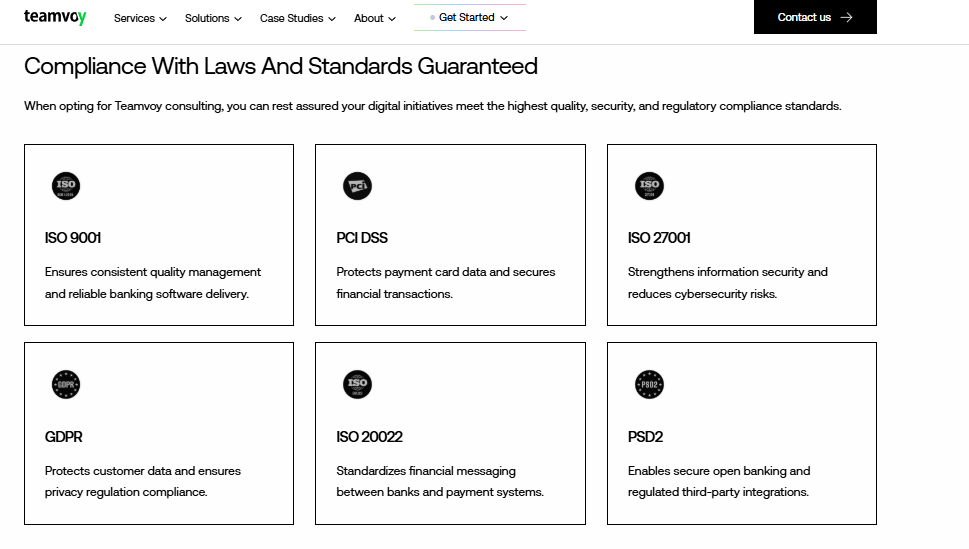
- Named regulator and standards experience: Delivery inside BaFin, PSD2, DORA, SOC 2, PCI-DSS, HIPAA, GDPR, FCA scopes.
- Modernisation approach: Incremental. Stabilise, document, then change internals behind a stable interface.
- Senior technical lead ownership through go-live: A senior engineer owns the system end to end, past release.
- Integration-layer and production AI depth: Data layer and legacy core assessed before any model decision.
- Engagement length sustained: Built for multi-year partnership; 4+ year average engagement.
- Long-running platform work for clients including Nasdaq, OSL, Panasonic Avionics, and Market Access Direct.
- Built a private blockchain data-distribution product for wealth management (BC Gateways) from proof of concept to scale, and continued after the client was acquired by Iress.
- Four-year engagement supporting a globally distributed team on a financial platform.

The pattern behind that card is documented further in our technology modernization work and in the hybrid cloud internet banking architecture case study.
HatchWorks AI
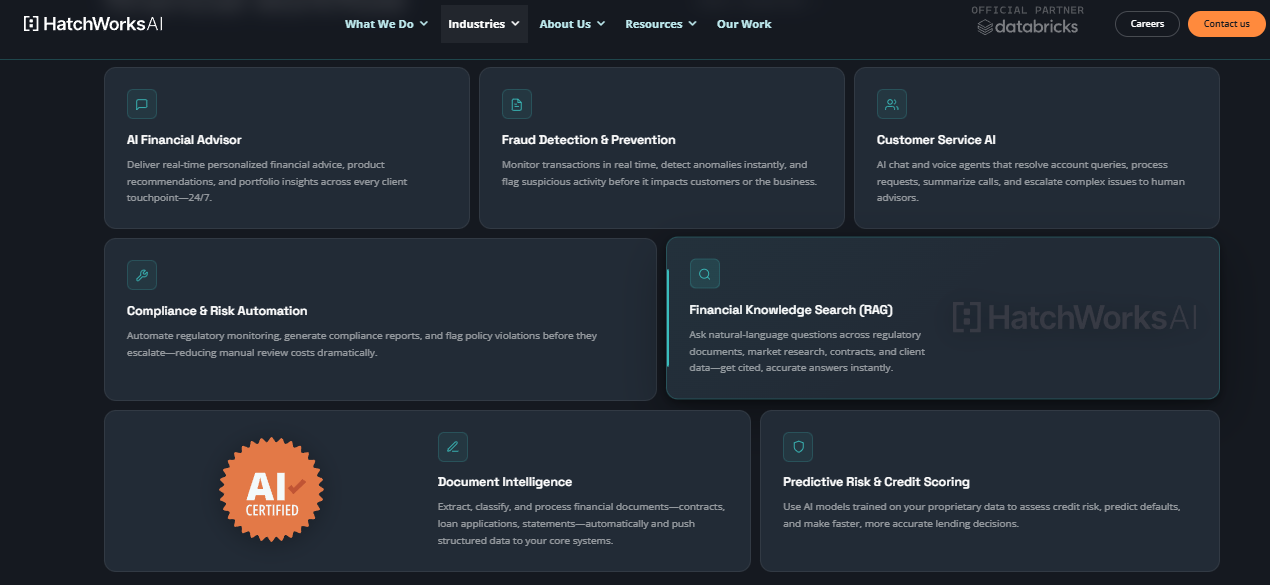
- Named regulator and standards experience: Not publicly claimed in the sampled reviews.
- Modernisation approach: Additive. Builds a new AI capability alongside the existing product.
- Senior technical lead ownership through go-live: Varies by engagement; the sampled project ended with handover.
- Integration-layer and production AI depth: Shipped a retrieval-based assistant reported at over 90% answer accuracy.
- Engagement length sustained: Project-based, with documentation intended for client replication.
- Designed and built a chat assistant using generative AI and retrieval-augmented generation for an IoT business.
- Reported over 90% accuracy on user questions, delivered on time and within budget.
- Detailed handover documentation prepared so the client team could reproduce the work.
If the blocker is a compliance date rather than a feature gap, our IT audit services and the field notes on building regulator-ready AI in fintech cover what that assessment produces before any build starts.
Vention
- Named regulator and standards experience: Not publicly claimed in the sampled review.
- Modernisation approach: Additive. Capacity is added to a roadmap the client already owns.
- Senior technical lead ownership through go-live: Client-side. The CTO holds architecture accountability.
- Integration-layer and production AI depth: Sampled work is engineering capacity for an AI company, not a write-path build.
- Engagement length sustained: Varies by contract. Staffing models flex up and down by design.
- Verified Clutch review from a CTO covering staff augmentation and custom development.
- Rated 5.0 across quality, schedule, cost, and willingness to refer in that review.
- Sampled client is a small AI company, so the work sat inside an existing technical team.
When the missing piece is architectural ownership rather than headcount, that gap is usually visible in an independent IT audit before it shows up in a release.
Dualboot Partners
- Named regulator and standards experience: Not publicly claimed in the sampled reviews.
- Modernisation approach: Additive. New products and features built beside existing systems.
- Senior technical lead ownership through go-live: Team-based delivery. Ownership varies by engagement.
- Integration-layer and production AI depth: One sampled AI project for an aerospace hardware distributor’s ERP.
- Engagement length sustained: Repeat and multi-project relationships appear in sampled reviews.
- Custom software and UX design work for a gaming company, delivered by a primarily South American team.
- AI development inside an aerospace hardware distributor’s ERP environment, rated 4.0 on schedule.
- Staff augmentation, web development, and system support for an eCommerce printing business.
Funding the core first is the argument behind our tech debt avalanche field notes, written for teams weighing a second product against an ageing first one.
DOOR3

- Named regulator and standards experience: Fintech client served; specific regulator scope not stated in the review.
- Modernisation approach: Experience-first. The dashboard was rethought before deeper platform change.
- Senior technical lead ownership through go-live: A principal consultant and senior project manager led the work.
- Integration-layer and production AI depth: Not covered in the sampled engagement.
- Engagement length sustained: Initial engagement ended, then continued with a designer on additional services.
- Internal and external stakeholder interviews, plus analytics review through Pendo.
- Three distinct user roles defined, with designs produced in Figma.
- Selected after the client interviewed five design firms with fintech experience.
Where the data model is the cause, the work belongs in data engineering rather than in another design sprint, and often alongside digital product design.
Azumo
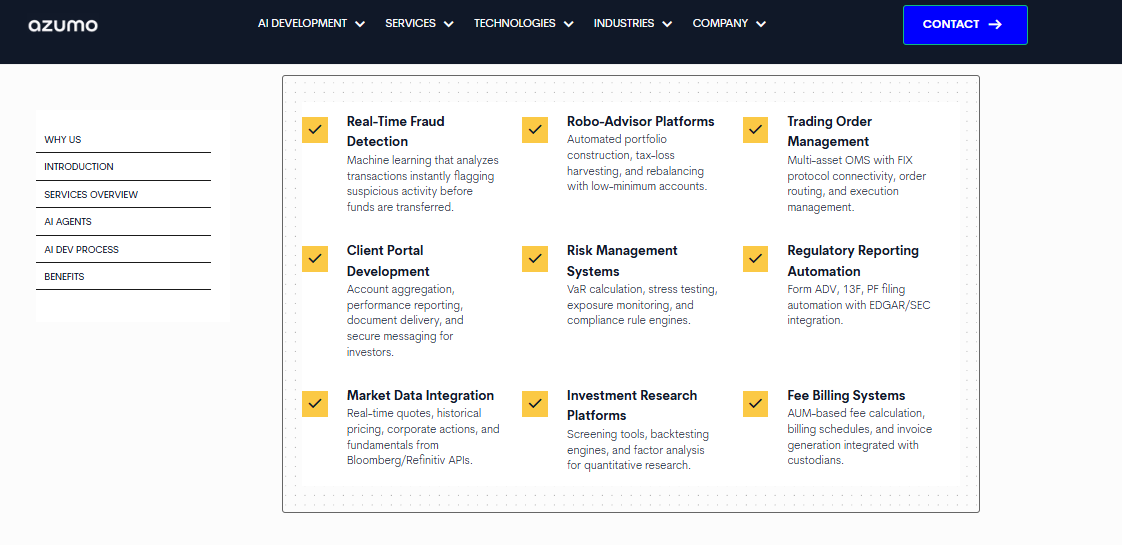
- Named regulator and standards experience: Not publicly claimed in the sampled review.
- Modernisation approach: Additive. Applications are built on the client’s own platform.
- Senior technical lead ownership through go-live: Client-side. Azumo project managers work with client success managers.
- Integration-layer and production AI depth: Built conversational applications including integrations with a customer’s systems of record.
- Engagement length sustained: Open-ended in the sampled review, with staff rotated to fit needs.
- Delivered use cases for a Fortune 100 end customer of the client, phase by phase, on time.
- Built the CX and UX pieces plus integrations with the customer’s systems of record.
- Client reported the team moved faster than the end customer could absorb.
Those write-path questions sit at the centre of system integration work, and of how we scope AI agent development against a live ledger.
NineTwoThree AI Studio
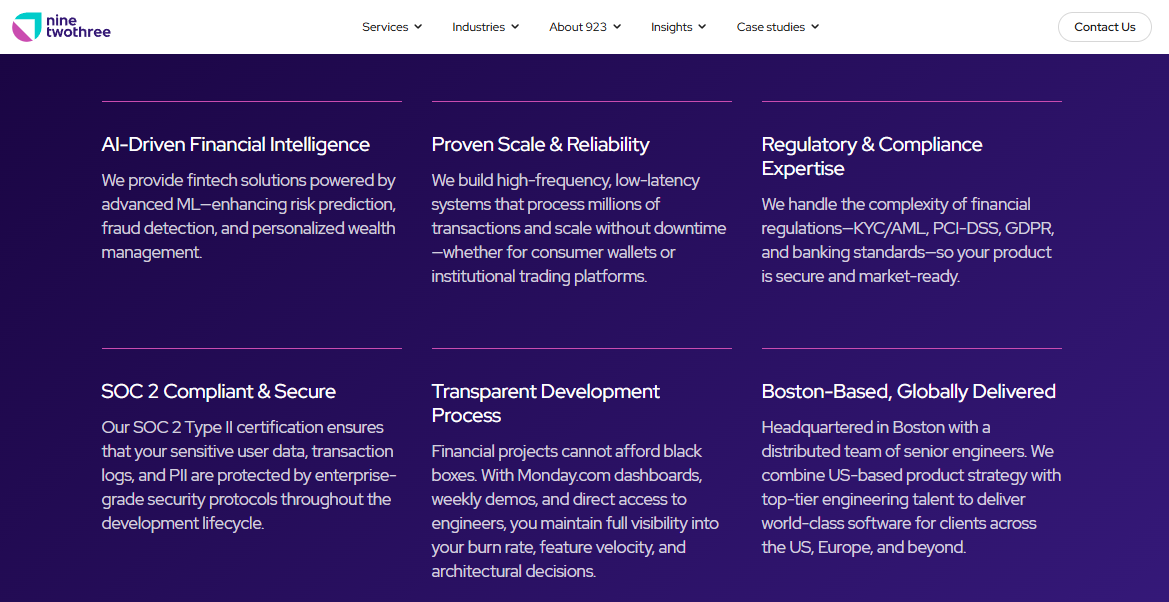
- Named regulator and standards experience: Not publicly claimed in the sampled review.
- Modernisation approach: Greenfield. A new product built alongside internal capability.
- Senior technical lead ownership through go-live: Studio team model, described by the client as small but capable.
- Integration-layer and production AI depth: Positioned around AI and advanced technology recommendations.
- Engagement length sustained: Project-shaped, with gap-filling support during design and testing.
- Delivered a custom mobile app end to end for a client that also had internal developers.
- Covered breadth across the product development lifecycle, per the client’s account.
- Filled design and testing gaps quickly when the client needed extra hands.
Reading a fast build line by line is exactly what our notes on vibe coding security risks describe, and it is usually cheaper than the rewrite it prevents.
Valere
- Named regulator and standards experience: Not publicly claimed in the sampled review.
- Modernisation approach: Hardening. Existing product tightened rather than rebuilt.
- Senior technical lead ownership through go-live: Team moved across definition, design, and debugging without losing context.
- Integration-layer and production AI depth: Not covered in the sampled engagement.
- Engagement length sustained: Release-shaped, focused on getting to enterprise readiness.
- Balanced product definition work with deep debugging in the same engagement.
- Worked through onboarding edge cases and permission logic ahead of an enterprise release.
- QA and regression discipline reported as making a real difference to the release.
The distinction between an enterprise questionnaire and a regulator’s evidence pack is covered in our regulator-ready AI in fintech notes.
Orases
- Named regulator and standards experience: Not stated in the sampled reviews, despite lending and medical clients.
- Modernisation approach: Build-to-spec. New custom applications built from a defined vision.
- Senior technical lead ownership through go-live: Discovery-led teams that clients describe as invested partners.
- Integration-layer and production AI depth: AI development for a lending business and AI training for a manufacturer.
- Engagement length sustained: Long, ongoing relationships across complex and evolving projects.
- AI development services delivered for a lending company.
- Custom remote care software designed and built for a health technology company.
- AI training and consulting delivered for a food manufacturing business.
Teamvoy sits at the top of this roster because the situation it is built for is the hardest one here: a regulated platform that must keep processing while it changes, with a senior engineer accountable past go-live. Across 150+ delivered projects since 2013, most of our fintech work arrived after another vendor said no, including the trade surveillance re-engineering we ran for a global exchange and the modernization sprint model we use when a rewrite is off the table.
Q2. Why do fintech modernisation and AI programmes stall after the pilot?
They stall because the pilot proved a model could answer, not that a system could act. Read-only demos never touch the ledger, so entitlements, audit trails, retries, and reconciliation never get built. Analyst forecasts now point at agentic AI for legacy modernisation, which makes the buyer’s job harder: separating partners who have shipped write-path automation from partners quoting the forecast.
🧪 A demo that answers is not a system that acts
The demo reads documents and replies. Nobody objects, because nothing is at risk. Then someone asks it to provision a user, run a know-your-customer check (identity verification required before onboarding), or post to the ledger.
That is a different system. A write-action needs permissions, an audit trail, a retry policy, and a rollback path. None of that exists in a read-only pilot, so the pilot cannot become the product.
⚠️ The bottleneck is the nervous system, not the brain
Most programmes obsess over model choice. A model with bad data or no reliable way to execute an action is still useless. Integration is the unglamorous layer that separates a demo from production.
Teamvoy sequences every AI integration engagement the same way: assess the data layer, then the legacy core, then choose a model. What I see when teams reverse that order is a working demo and a stalled quarter.
⏰ How to test an agentic modernisation claim
Gartner projects that by 2028, half of banks will use agentic AI for legacy modernisation, with roughly three times faster deployment [4]. McKinsey’s 2026 banking review describes delivery through small agile pods and tighter, more selective technology spending [5]. Both are credible, and both are now sales copy in the wrong hands.
So ask for evidence instead of vision. Three requests separate real capability from a repeated forecast:
- One write-path the firm shipped to production, named, with the system it wrote into.
- The rollback design for that write-path, including who can trigger it at 2 a.m.
- The audit trail format, and whether an auditor has ever read it.
✅ Three questions for your next steering meeting
- Where exactly does the write happen, and which table does it touch first?
- Who owns reversal, and how long does a reversal take under load?
- What does the spend ceiling look like, per agent, per day?
That third question surprises people. An agent stuck in a retry loop against a slow tool will keep going while everyone sleeps. Circuit breakers and hard spend caps are architecture, not settings you add later, a point covered in more depth in our AI integration cost guide.
💰 The honest limit on this
An audit will not tell you whether AI pays back across three years. It will tell you whether your data layer can support a write-action at all. That is a smaller claim, and it is the one worth buying first.
Where my view sits right now is that most stalled pilots were never AI problems. They were integration problems wearing an AI costume, which is why we usually start with data engineering rather than model selection.
Teamvoy starts every AI engagement with a data-layer and legacy-core assessment before any model decision, because that is where stalled pilots are actually decided. Across 150+ delivered projects, the pattern has held: fix the plumbing, and the model question becomes easy.
Q3. What does compliance-aware delivery look like under DORA, PSD2, PCI DSS 4.0, SOC 2 and ISO 27001?
It looks like artefacts, not assurances: an ICT third-party register entry, incident-reporting hooks wired into your alerting, resilience-testing evidence, MFA on every path into the cardholder data environment, and a payment-page script inventory. Under DORA your supplier can fall under regulatory oversight directly, so partner selection is a supervised decision rather than a procurement preference.
🏛️ DORA turns your vendor choice into a supervised decision
DORA is the EU regulation on digital operational resilience for financial entities. Article 6 sets the ICT risk framework, Article 19 covers incident reporting, and Article 28 governs contracts with ICT third parties [1]. Roughly 22,000 EU entities came into scope from 17 January 2025, with penalties reaching 2% of worldwide turnover.
Your supplier can also be designated a critical ICT third-party provider and supervised directly by European authorities [6]. Monday action: pull your Article 28 register and check which of your engineering vendors is missing from it.
🔐 PSD2 is about the interface, not the intention
PSD2 is the EU payment services directive that opened bank data through APIs. It requires a dedicated interface, strong customer authentication, and defined access to payment status. Compliance is proven by interface behaviour, not by policy documents.
Teamvoy delivers inside PSD2, BaFin, DORA, SOC 2, PCI-DSS, HIPAA, and GDPR scopes, where release evidence has to survive an audit rather than a retrospective. What that looks like day to day is dull: traceability from ticket to requirement, and named engineers on each signed release. The same discipline shows up in our banking and fintech delivery work.
💳 PCI DSS 4.0 has already moved from advice to obligation
The future-dated requirements in PCI DSS v4.0.1 became mandatory on 31 March 2025 [3]. Three matter most for engineering teams. Requirement 8.4.2 demands multi-factor authentication on all access into the cardholder data environment. Requirement 6.4.3 demands an inventory of every script on your payment page. Requirement 11.6.1 demands change detection on page headers and content.
Monday action: ask who owns the payment-page script inventory. If the answer is a name, you are fine. If it is a team, you are not.
📋 SOC 2 and ISO 27001 describe your partner, not your product
SOC 2 and ISO 27001 are audits of a control environment. They tell you how the vendor runs its own shop. They say nothing about whether that vendor has shipped inside your regulator’s scope.
Eligibility is not compliance. A firm can hold both certifications and never have filed an incident report under Article 19, a gap our regulator-ready AI in fintech notes unpack for buyers.
⚠️ One quiet exposure path worth naming
Retrieval systems are often built by dumping every document store into one vector database. Confluence pages, chat history, and CRM records go in together. The result is context flooding, and worse, regulated data sitting in a place nobody scoped for it.
Teamvoy has successfully launched the system within the set timeline and integrated all the required tools and features.
Their openness to understanding what we do is impressive.
Teamvoy’s read is that most compliance failures are documentation failures wearing a technical mask. The control usually exists. Nobody can prove when it started working, so the auditor treats it as absent.
Q4. How do you modernise a fintech core without a rewrite, and prove the cutover worked?
You keep the surface stable and change the inside one table at a time: document what exists, isolate suspected dead components, route writes through a new path behind the old interface, then cut over in slices with rollback ready. Prove it with injected test transactions and a measured availability KPI, not a green dashboard.
🧱 The four steps, in order
- Document what actually runs, including the jobs nobody claims ownership of.
- Isolate suspected dead components at the network level for 48 to 72 hours. Monthly batch jobs and audit processes will scream, which is the point.
- Route writes through a new path behind the existing interface, one table at a time.
- Cut over in slices, with a tested rollback for each slice.
Teamvoy takes over systems built by previous teams and works in this order, which is why several engagements have run four years and longer. Skipping step one is the most expensive shortcut in this category, as our legacy software recovery plan sets out.
🛒 A worked example from outside fintech
One team modernising a retail point-of-sale system kept the interface pixel-identical. Same colours, same button sizes, same layout. Cashiers arrived the next morning and noticed nothing.
Behind that unchanged screen, writes were going to new, normalised tables, one at a time. That is the whole trick. Modernising a live platform is renovating an occupied building, not building a new one, which is the principle behind our technology modernization engagements.
⏰ Prove the cutover with numbers, not a dashboard
A green status page is not evidence. The UK Open Banking availability standard gives you a usable method: an interface counts as down after five consecutive unanswered requests inside 30 seconds, and availability is downtime seconds divided by 86,400 [7]. Borrow that formula even if you are not in UK open banking.
Then inject test transactions from a dedicated QA account immediately after cutover. Check the billing and invoicing integrations too. If the web tier works but the payment webhook is blocked by a security group, the business is offline and the dashboard is still green.
⚠️ The latency trap nobody budgets for
A database cutover can succeed and still gridlock the application. A synchronous write across two availability zones can add two milliseconds per commit. Under load, that penalty compounds until the connection pool is exhausted.
Teamvoy measures this before cutover by replaying real transaction volume against the new path, not synthetic load. What surfaces is usually a queue depth problem, not a query problem, and it often changes the cloud optimization plan that follows.
❌ When incremental is the wrong call
Sometimes the honest answer is a strategic rebuild. If the data model cannot represent the products the business now sells, slicing it will not help. If the runtime is unsupported and unpatchable, you are maintaining a risk, not a system.
I have told clients this and lost the deal. It still beats a two-year slice programme that ends where it started, and it is why we scope a proof of concept before committing a board to either path.
I can confidently say that we would not be where we are today without Teamvoy's support.
Their technical expertise was top class.
Teamvoy built a private blockchain data-distribution product for wealth management from proof of concept to scale, then kept supporting it after the client was acquired. Four-year engagements teach a specific lesson: the cutover is not the finish line, it is the first day of ownership, as the internet banking platform build in our portfolio shows.
Q5. Where does AI add leverage on a fintech stack, and where does it add risk?
AI adds leverage where the action is bounded, reversible, and logged: document extraction, reconciliation triage, code comprehension on an undocumented core. It adds risk the moment an agent has read access to sensitive data, ingests untrusted external content, and can send data outward. Circuit breakers, tool-level permissions, and spend ceilings are architecture decisions, not settings.
✅ Where it actually pays back
Three uses hold up under production load. Extraction from documents, where a human still approves the output. Triage on reconciliation breaks, where the agent proposes and a person disposes. Code comprehension on a core nobody documented.
Teamvoy uses that third one on rescue engagements, reading unfamiliar systems faster than a human-only pass allows. The output is a map, not a merge. A person still writes the change, which is the working rule behind our AI development services.
❌ The three ingredients that turn helpful into dangerous
Risk concentrates when one agent holds all three of these at once: read access to sensitive data, exposure to untrusted outside content like email, and an outbound channel. Any two are manageable. All three is an incident waiting for a date.
One demonstrated test makes this concrete. A mock email carrying a hidden instruction was read by an active agent. Within five minutes, the agent had located a developer’s private SSH key and quietly sent it out.
💸 The bill nobody models
Agent frameworks resend the whole conversation history on every turn. Token spend grows quadratically, not linearly, so a twenty-step loop costs far more than twice a ten-step run. Context quality also degrades once you fill much past 40% of the window.
One developer deployed a support agent with no hard circuit breaker. It retried the same broken action against a CRM tool for six hours overnight, running up roughly $4,200 in model billing. Teamvoy sets per-agent daily spend ceilings and hard breakers before the first prompt is written, a control we build into every autonomous agent workflow.
⚠️ AI-written code needs an inspection, not a compliment
The pattern I keep meeting is not broken code. It is code that is almost right. Almost right passes review, ships, and sits there for six months.
Two numbers frame it. AI-generated pull requests average 10.8 issues, against 6.4 in human-written code. In one scan of 5,000 AI-built apps, 60% carried vulnerabilities, which is the exposure our vibe coding security risks notes document.
Use three questions on every AI-assisted pull request this week:
- Does it reuse what already exists, or reinvent it?
- Does it follow your conventions, not the model’s?
- Can the developer explain it without reading the AI’s comments?
If suppressed warnings appear, stop. I have opened files with eleven linter suppressions in one place, which is tape over a warning light. On a checkout flow, that habit collides directly with PCI DSS requirement 6.4.3, which demands an inventory of every script on the payment page [3].
HatchWorks AI delivered a chat assistant that responded to user questions with over 90% accuracy.
We were impressed with the technical management, adherence to process, and technical capability of the engineers.
Teamvoy takes on codebases the original team can no longer explain, documenting before adding anything new. AI on an unstable stack is a turbocharger on an engine that already misfires.
Q6. How do you tell a consulting-led partner from an engineering-led one, and what do these engagements cost?
Ask who writes the first commit and who is on the incident call in month nine. Consulting-led firms sell a target state and staff behind it. Engineering-led firms sell delivery and put a senior lead on the system. Published fintech developer rates run roughly $25 to $199 an hour, with minimums from $1,000 to $50,000 and up, which reflects delivery model rather than quality.
⭐ Five questions that separate the two
Ask each of these in the first call, and listen for specifics:
- Who writes the first commit, by name?
- Who is accountable in month nine, and are they billable now?
- What happens to the team composition after discovery ends?
- Which regulator have you delivered under, and on which system?
- What documentation do we own when this ends?
A good answer contains a person, a system, and a date. A weak answer contains a methodology and a phase diagram. Our guide to choosing an AI vendor in fintech works through the same interrogation in more detail.
💰 What the money actually looks like
Clutch listings for fintech developers in the US and UK show hourly bands from about $25 to $199, with project minimums from $1,000 up past $50,000 [8]. That ten-times spread is not a quality ladder. It reflects seniority, location, and whether anyone owns the architecture.
For planning, McKinsey’s estimate is more useful than any rate card: banks spend around 10% of revenue on technology [9]. Teamvoy prices for engagements measured in years rather than sprints, which changes what gets built in month two and often surfaces in IT cost optimization conversations.
| Model | Who owns architecture | Typical horizon |
|---|---|---|
| Advisory-only | You do, after they leave | Weeks to a quarter |
| Staff augmentation | You do, always | Rolling contracts |
| Project-and-exit | Shared until handover | One release cycle |
| Teamvoy long-term partner | Senior lead on our side, with your team | 4+ year average engagement |
⚠️ The costs that arrive later
Cheap capacity gets expensive at handover. If five contractors ship five patterns, someone pays to unify them. Free AI-generated code is the most expensive debt on this list, because nobody budgets for reading it.
The same trap sits inside integration work. Build your own integration layer and you become its permanent owner, maintaining every schema, field mapping, auth flow, and retry rule. Only build that if you have a platform team and genuinely unique cores, a decision we work through during AI consulting engagements.
💸 An honest limit on all published pricing
Engineering pricing is custom-quote everywhere, including here. Treat any table, including rate bands on review sites, as indicative only. Ask instead for the total cost across three years, including the maintenance nobody quotes.
They are a dimond in the rough when it comes to service.
We work with them for over 2 years, and they have been very reliable and timely in providing us quality development services.
Teamvoy’s read is that day rate is the least useful number in this decision. What I would ask instead is who stays, and for how long, after the first release ships. The case studies that matter are the ones still running years later.
Q7. What belongs in the contract, and what should the first 90 days produce?
Put four things in writing: the named senior lead and their availability, incident and rollback responsibilities, DORA-relevant subcontractor and register obligations, and the documentation deliverable that outlives the engagement. In the first 90 days, expect a written system assessment, a stabilisation backlog, and a rehearsed cutover with verified test transactions.
📄 The four clauses worth arguing over
DORA Article 28 sets out what your contract with an ICT third-party provider must cover, including subcontracting and exit terms [1]. Use it as your checklist rather than the vendor’s template.
Then add the named lead, with a stated minimum time commitment. Add incident duties, including who can trigger rollback at 2 a.m. Add documentation as a deliverable with an acceptance test, not a promise.
⏰ What 90 days should actually produce
Three artefacts, all reviewable:
- A written system assessment, including the parts nobody could explain.
- A stabilisation backlog, ordered by risk rather than by preference.
- One rehearsed cutover slice, with test transactions injected and payment webhooks verified.
Teamvoy hands over documentation the client’s own team can hire into, which is the test of whether the assessment was real. If a new engineer cannot onboard from it, it was a report, not a deliverable, and that standard is what an IT audit should produce.
⚠️ How incident response should behave
Assume your tooling will confidently repeat the wrong fix. One on-call engineer chased a 503 error while an assistant suggested restarting the server six times. A senior human knew a batch job had filled the database connection pool, because that was tribal knowledge, documented nowhere.
If you use agents during an outage, run one prompted to attack the current theory. Otherwise the human and the tool agree with each other while the server burns. Teamvoy keeps the same senior engineers on the incident call as on the design call, which is how tribal knowledge becomes written knowledge.
❌ The one thing to refuse
Refuse a partner who exits before go-live. Design accountability without release accountability is a report with an invoice attached. Under PSD2, interface behaviour keeps changing as regulators clarify rules, including the 2025 Q&As on API access and payment status [10].
Someone has to still be there when that happens. Ask who, and get the name in the contract, then check that name against the firm’s own delivery model before you sign.
The professional communication, ability to deal with crunch time, and understanding of the project impressed us.
The care and interest they showed are what makes Teamvoy special.
The question I am still sitting with is whether regulators will eventually require the documentation quality that good engineering already produces. If that happens, the firms treating documentation as overhead will have a hard year.