AI Productionization for Fintech (Pilot to Production)
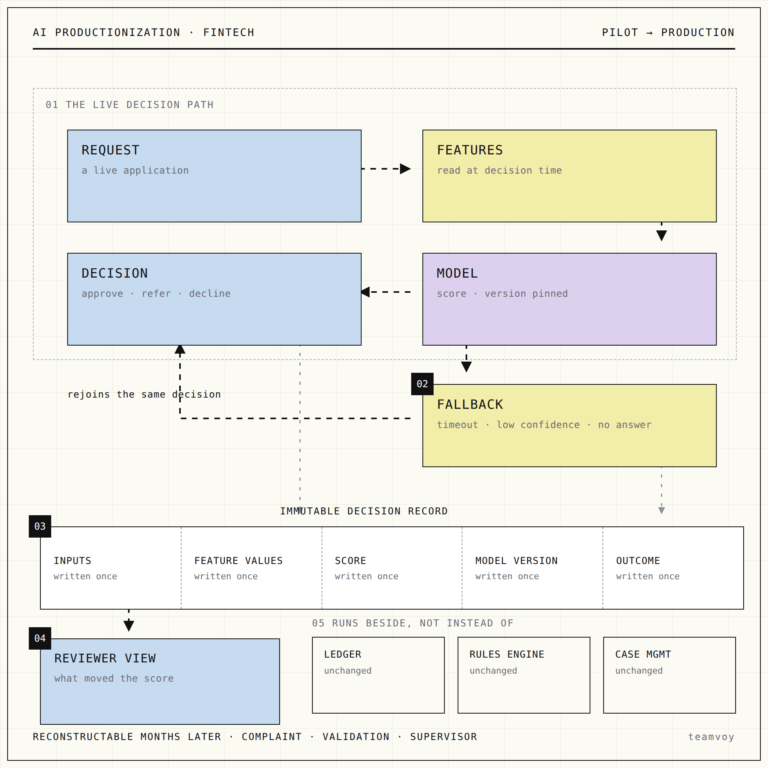
We take a fintech AI pilot that works in a notebook and put it on the live decision path: features read at decision time, a defined fallback for when the model does not answer, an immutable decision record, and a reviewer who can see what moved the score.
Trusted by engineering teams.


Teamvoy has delivered engineering work for Nasdaq, Panasonic, Afriland First Bank, and 50+ other companies since 2013.

Verified B2B client reviews from fintech, insurance, healthcare, and hi-tech engagements.

A B2B review platform that connects businesses with verified software solutions providers.

Transparent platform where current and former employees share company reviews and interview experiences.

AI Productionization Services for Fintech
Six offerings. Each is scoped and estimated separately, and a pilot that has stalled usually needs two or three of them rather than all six.
Inference Path Engineering
The request path around the model: a decision identifier that makes retries safe, a latency budget with defined behaviour when it is exceeded, and a cost per decision you can put in front of finance. We write the fallback for each decision type before the model is wired in, because that is the conversation that decides whether your risk function will let it go live at all.
– Idempotent decision handling
– Latency budgets and timeouts
– Fallback per decision type
– Batching and cost per decision
– Load and failure testing
Feature and Data Plumbing
Features read as they stood at decision time rather than recomputed from a warehouse that has since moved on, with point-in-time correctness tested against a backfill of real history. This is where pilot accuracy usually goes, and discovering it before go-live costs far less than discovering it inside a model validation review.
– Point-in-time feature reads
– Feature store integration
– Backfill and replay testing
– Training and serving parity
– Late-arriving data handling
Evaluation and Shadow Deployment
Golden sets, an offline evaluation harness, and a shadow run against live traffic where the model decides nothing but every disagreement with your current process is recorded. Promotion out of shadow is a gate with written criteria agreed before the run starts, rather than a meeting at the end of it.
– Golden and regression sets
– Offline evaluation harness
– Shadow traffic running
– Disagreement analysis
– Promotion gate criteria
Decision Records and Explainability
An append-only record holding the inputs, the model version, the thresholds in force and the reason codes, written once per decision. A complaint or a supervisory question arriving eight months later is answered by reading that record, not by rerunning a model that has been retrained twice since.
– Immutable decision log
– Model version pinning
– Reason code generation
– Adverse action support
– Reconstruction and replay
Human Review and Case Workflows
The surface an analyst actually works in: the score, the features that moved it, the customer context, and a capture of what they decided and why. Overrides are stored as labelled data rather than as free-text comments, because the override rate is the fastest signal that a threshold is set wrong.
– Reviewer evidence views
– Override capture and labelling
– Case routing and queues
– Reviewer throughput tracking
– Case management integration
Monitoring, Drift and Retraining Control
Monitoring built for outcomes that arrive late: chargebacks, first-payment defaults and complaints land months after the decision, so input drift is watched continuously while performance is reconciled as labels mature. Retraining is a gated release with a rollback path, not a job on a schedule.
– Feature and score drift
– Delayed label reconciliation
– Retraining approval gates
– Rollback and version pinning
– Cost and latency dashboards
One automated decision, seven layers
It looks like a score returned in under a second. Between the customer action and a record you could defend a year later are seven handovers, and the model is only one of them.
01. Request capture and idempotency
02. Feature assembly at decision time
03. Model call and fallback
04. Policy overlay and thresholds
05. Human review handoff
06. Decision record and adverse action
07. Feedback, drift and the retraining gate
AI Productionization Success Stories
Check out our product and experience design case studies. Learn how we’ve helped businesses like yours launch stunning solutions and succeed in target markets.

Eliminating the 90% Noise: How Teamvoy Re-Engineered Trade Surveillance Software for a Global Exchange

AI-Native Engineering for Faster Time-to-Market

High-Performance Web Platform for Scalable Trade Surveillance
Why choose Teamvoy to take a fintech pilot live?
Four things that are true of how we put a model onto a live decision path, two of which cost us something.

01. The engineers who scope the work build the work
No handover from a pre-sales team to a delivery team. The person who tells you what the work will cost is the person who then has to make that estimate true. Costs us: we cannot start faster than we can staff, so we turn down work that needs a squad this month.
02. You own the source code from the first commit
The repository is yours, in your organisation, from day one. Not transferred at the end, not held until the final invoice clears. Costs us: we give up the lock-in that comes from holding a repository, so we have to be re-chosen every quarter.
03. Nothing goes live before it has disagreed with your current process in shadow
The decision path runs against live traffic while deciding nothing, and every case where the model and your existing process differ is recorded and read by a human. Promotion criteria are written before the shadow run begins, so the decision to automate is made against evidence rather than against enthusiasm at the end of a quarter.
04. We build the controls. Your risk function classifies the system and signs it off
Whether your use case is high risk under the EU AI Act, and whether the model clears your model risk policy, are determinations for your compliance function and your second line. We build what those obligations require in engineering terms, logging, human oversight, data governance records and technical documentation, and we write that split into the statement of work rather than letting it blur.

Could you show a reviewer
which model version made that decision?
Three ways to start
Three ways to start working with Teamvoy on outcome-based AI. No long discovery. No sales process. No forms to fill. Every engagement starts with a real technical conversation, and every engagement is priced to a result. We move as fast as the situation needs.
Production Readiness Review
Two engineers read the pilot, its evaluation set, its latency profile and the decision path it would join, then list what stands between it and shadow traffic. You keep the gap list, the fallback proposals and the control mapping whether or not we build anything afterwards.
One Decision Path in Shadow
A single decision path runs in shadow against live traffic in your environment: features read at decision time, a defined fallback, immutable decision records, a reviewer view, and a report on every disagreement with your current process. Nothing is automated until your risk function has read that report.
Call a CTO
Fifteen minutes with the engineer who would do the work. Bring the pilot that has not shipped, and you get an answer on what is actually holding it, including the answer that the model is not the problem.
What changes when the pilot has to survive a Monday morning.
These rows are the questions worth putting to any vendor quoting production AI work in a regulated business, including us.
What our production AI engineers work in.
Models we put behind a latency budget


Orchestration and durability


Serving and inference


Evaluation and monitoring


Data and features


Systems we decide inside
We engineer for:
Bring the pilot that has not shipped.
Talk to a Chief Technology Officer on the first call.