
- Generative AI in fintech product design puts a model in one named workflow and designs the review around it.
- Generative AI produces artifacts; predictive AI scores outcomes. The regulatory treatment differs.
- Data governance and audit logging are build requirements, not launch-week additions.
- Pick one workflow with a measurable baseline before picking a model.
- Trust UX beats model accuracy for adoption in regulated financial products.
- Buying wins when the workflow is standard and the differentiation lives elsewhere.
Generative AI changes a fintech product much earlier than most teams expect. It usually starts with a promising prototype. A workflow that took fifteen minutes now takes seconds. The model understands the context, generates a useful response, and the obvious reaction is: this works.
But does it work as a product? What exactly should AI own in the workflow? Should it generate, summarize, recommend, or act? What does the user need to see before trusting the result? When does a human step in? How do you catch an answer that sounds right but is wrong? Can an action be reversed? Can you explain six months later what the model did and why?
And there is a more basic question teams often skip: should generative AI be in this workflow at all? This is what generative AI in fintech product design comes down to: using generative models inside financial product workflows while designing the experience around how their outputs are understood, reviewed, corrected, and controlled.
That is a different job from adding an LLM to an existing product. You are introducing probabilistic outputs into products where trust, accuracy, security, and recoverability matter. That changes the workflow itself. What does AI do? What stays deterministic? What remains with a human? What data can the model access? What evidence should the user see? Where does automation stop?
So the process should not start with choosing a model. It starts with choosing the right workflow, defining what AI should and should not do, understanding the data, designing the human role, and deciding how success will be measured. This guide walks through that process step by step, from the first use case and product experience to validation, compliance, rollout, cost, and build versus buy.
| Step | Action | What it produces | Watch out for |
|---|---|---|---|
| 1 | Align stakeholders, define the business case | A one-page case with a baseline metric and a target | A goal stated as “improve efficiency” with no number attached |
| 2 | Assess technical feasibility and data readiness | A data inventory and a gap list with owners | Training data that carries PII nobody has classified |
| 3 | Map workflows, design the interface | Journey map plus wireframes showing the AI step | Designing the model output before designing the human decision around it |
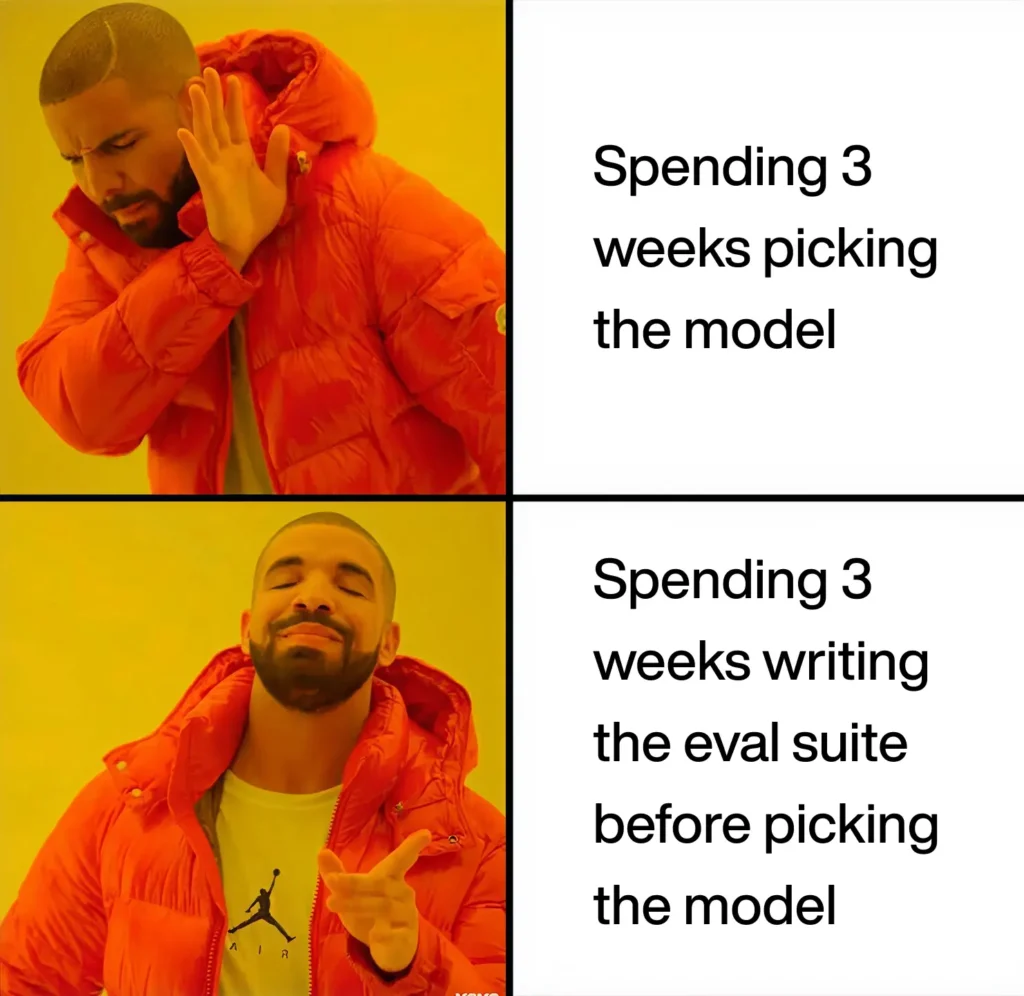
| 4 | Select, train and validate models | A validated model with an eval suite and a bias report | Choosing a model before writing the evals that judge it |
| 5 | Prototype and test in short cycles | A working prototype tested with real users | Usability testing with the team that built it |
| 6 | Compliance and risk management | Documented controls, audit trail, model card | Treating compliance as a review at the end |
| 7 | Incremental rollout and monitoring | A live feature with drift alerts and a rollback path | Shipping to 100% of users on day one |
Written for CTOs, VPs of Engineering and heads of product at fintech firms who have a working prototype and an unclear path to production. Every regulation that applies is named, every cost is a real dollar range with the reason it moves, and the build-versus-buy section says out loud when buying wins. Every section reads alone, out of order.
Overview: Generative AI in FinTech Product Design
Integrating generative AI into fintech product design means embedding a model inside one specific product workflow and building the controls that let it operate under supervision. Common first workflows are KYC document review, dispute and chargeback drafting, and agent assist in support. The integration work is roughly 20% model and 80% everything else: data pipelines, evals, audit logging, human review paths and the interface that shows a user what the model did.
That ratio is the part teams get wrong. A prototype proves the model can produce the artifact. Production asks a different question: can you show a regulator, six months later, why a particular output was produced, and can a customer challenge it. Those are design problems long before they are engineering problems.
The distinction matters for scoping. Fintech product design covers the whole discipline of shaping financial products around user behavior, information architecture and trust; our fintech product design fundamentals guide covers that ground. This piece covers the narrower question of what changes when a generative model sits in the middle of one of those flows. Generative AI in fintech product design is that narrower discipline, and it has its own failure modes.
- The output is probabilistic. The same input can produce a different artifact tomorrow. Interfaces built on deterministic assumptions break quietly.
- The audit surface grows. Every inference becomes a record you may need to reproduce. Step 6 covers exactly what that record has to hold.
- The human role moves. The person stops doing the work and starts approving it, which is a different job with different failure modes. The main one is automation bias, where reviewers approve what they should have caught.
The fintech product design process changes shape here: scope the first feature to a workflow where you already measure something. Handling time, first-contact resolution, document review throughput, onboarding drop-off. A workflow with a number attached gives you a way to tell whether the integration worked, and a way to defend the spend.
The Evolution of Generative AI in FinTech
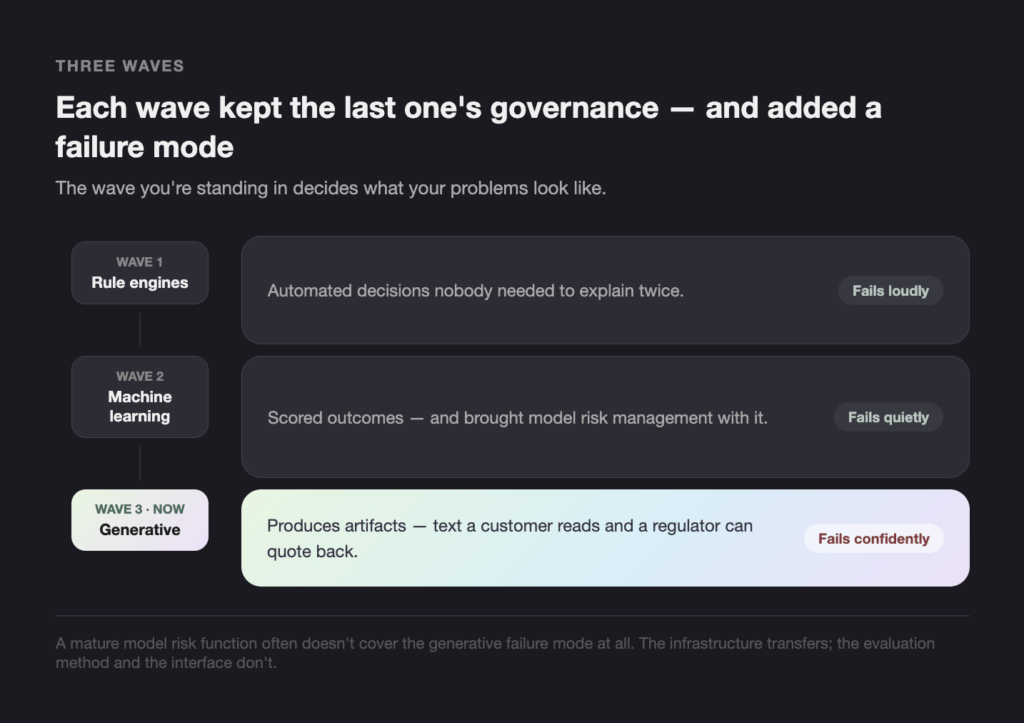
Generative AI in fintech arrived in three waves, and the wave a team is standing in decides what its problems look like. Rule engines automated decisions nobody needed to explain twice. Machine learning scored outcomes and brought model risk management with it. Generative models produce artifacts, which is the first wave where the output is text a customer reads and a regulator can quote back.
Each wave kept the governance of the one before it and added a new failure mode. Rule engines fail loudly and predictably. Scoring models fail quietly and systematically, which is why validation exists. Generative models fail confidently, one output at a time. A team that inherits a mature model risk function is often surprised that it does not cover this failure mode at all.
The practical consequence is that experience with predictive AI helps less than it looks like it should. The infrastructure transfers. The data pipelines, the monitoring, the audit posture, the relationship with the second line of defense all carry over. The evaluation method does not, and neither does the interface, because a score needs a threshold and an artifact needs a reader.
Market Growth and Adoption Trends
Inference costs for capable models fell by roughly an order of magnitude between 2023 and 2026, which moved per-transaction economics from impossible to arguable. Model quality crossed the threshold where a drafted artifact is worth reviewing rather than rewriting. And McKinsey’s June 2023 estimate that generative AI could add $200–340 billion annually across banking gave boards a number to plan against.
The gap between evaluation and deployment is where the interesting story sits. Generative AI in financial services is now common somewhere in the organization at most large firms. Far fewer have it inside a regulated, customer-facing workflow with a documented control, which is the only version that produces the value in the estimate above. Our analysis of why AI pilots stall before production puts the usual cause at governance debt rather than model quality.
Read the adoption numbers with that split in mind. A survey reporting that most banks “use” generative AI is usually counting internal pilots and staff productivity tools alongside production customer workflows, and those are different commitments with different costs. The number that matters for planning is how many features are live, monitored and documented, and that number is much smaller than the headline.
Key Drivers of Generative AI Adoption in FinTech
Four forces are pushing generative AI onto fintech product roadmaps: per-case operational cost in document-heavy work, a rising volume of regulatory documentation, consumer expectations set by consumer apps rather than by banks, and agent assist becoming table stakes in support. The first two are cost arguments and survive a downturn. The second two are revenue arguments and lose their funding when budgets tighten.
- Operational cost. Document-heavy workflows (KYC refresh, dispute packets, complaint handling) carry per-case labor that scales linearly with volume. This is where the arithmetic works first.
- Regulatory workload. Rules keep arriving. Generative systems help draft and cross-reference control documentation, which is one of the few applications where the reviewer is an internal expert rather than a customer.
- Consumer expectation. Customers compare a bank’s dispute flow against a consumer product that answers in seconds. That comparison sets the expectation regardless of what the core banking system can support.
- Competitive floor. Agent assist has moved from advantage to table stakes in support. Being absent is now visible.
A business case built only on the second pair is the one that gets cancelled in month four, so anchor it on a workflow where the per-case arithmetic works on its own.
What has not changed is the supervisory bar. SR 11-7 was written in 2011 and applies to a 2026 language model without amendment.cluded: carrier-side core systems such as Guidewire, Duck Creek and Sapiens, which are policy administration platforms rather than agency CRMs, and general-purpose project tools sometimes marketed as CRMs without a contact data model behind them.
Generative AI vs. Predictive AI in FinTech
Predictive AI scores an outcome; generative AI produces an artifact. A credit model returning a default probability is predictive. An assistant drafting the adverse-action notice that follows is generative. Generative AI vs predictive AI is the distinction that drives regulatory treatment: the scoring model sits squarely inside model risk management and fair-lending rules, while the drafting assistant is usually governed as a content and disclosure control. Most fintech products now run both, connected.
Generative AI vs predictive AI is a distinction the vendor pitch tends to blur, and buyers inherit the blur. Teams conflate them because the pitch conflates them. A single platform sells “AI for lending” and the buyer inherits two unrelated risk profiles under one contract. Separating them at design time is what keeps the compliance conversation tractable later.
| Dimension | Predictive AI | Generative AI | What changes for the product team |
|---|---|---|---|
| Output | A score, class or ranking | Text, code, a document, a summary | Generative output needs a review step; a score needs a threshold |
| Evaluation | Precision, recall, AUC against labeled data | Faithfulness, groundedness, human preference | You have to build the eval suite; there is no accuracy number to quote |
| Failure mode | Systematic bias against a group | Confident fabrication in a single output | Bias is found in aggregate, fabrication is found per-instance |
| Regulatory anchor | SR 11-7, ECOA/Reg B adverse action, fair lending | Disclosure, record-keeping, consumer communication rules | Different reviewers, different evidence |
| Reproducibility | Deterministic given inputs and version | Varies unless temperature and seed are pinned | Pin the parameters or you cannot reproduce a decision |
| Cost profile | Training-heavy, inference-cheap | Training-light, inference-expensive | Unit economics scale with usage, not with model size |
The practical consequence: a generative feature needs a review path, and a predictive feature needs a challenger model. Building one and governing it as the other is the most expensive mistake available in this category, because it is usually found during an examination rather than during a sprint.
Retrieval-augmented generation sits between them and confuses the picture further. A RAG system retrieves records deterministically and then generates over them. Govern the retrieval as a data-access control and the generation as a content control. Treating the whole thing as one component makes both halves harder to defend.
Prerequisites to Integrate Generative AI into Your Fintech Product Design
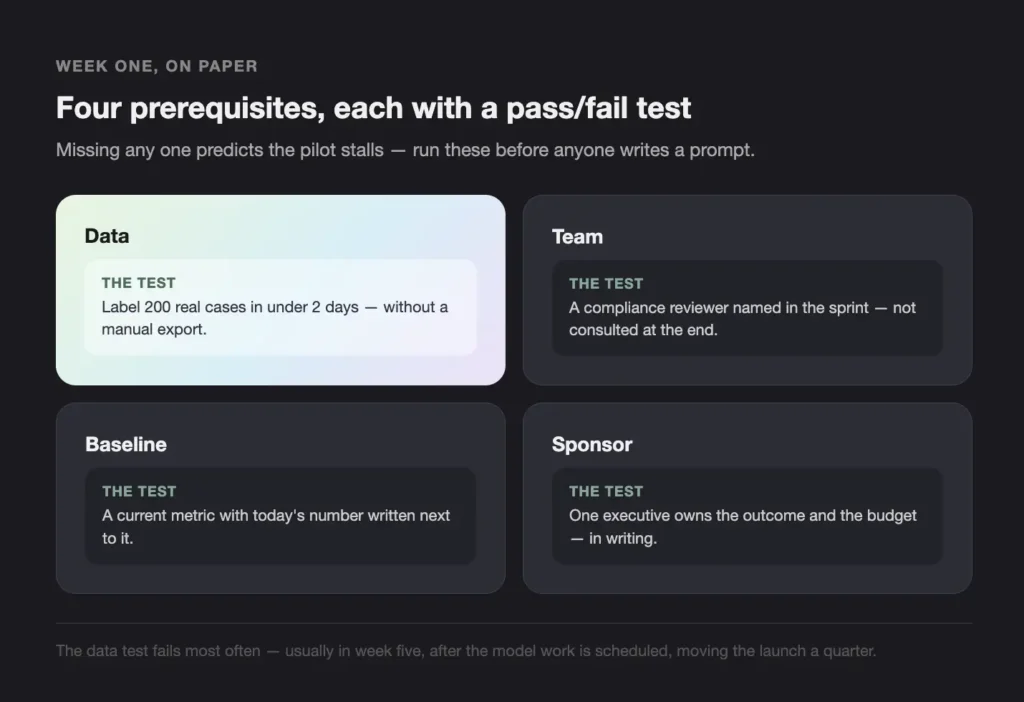
Four prerequisites, each with a pass/fail test. Data: can you produce a labeled sample of the workflow’s inputs and correct outputs, at least 200 cases, without a manual export? Team: do you have a compliance reviewer named on the project, not consulted at the end? Baseline: is there a current metric with a number? Sponsor: does one executive own the outcome and the budget? Missing any one of the four predicts the pilot stalls.
The data test is the one that fails most often. Teams discover mid-build that the historical record they planned to train and evaluate against lives across three systems, carries unclassified PII, and has no consistent labeling of what a good outcome looked like. That discovery arrives in week five, after the model work has already been scheduled, and it moves the launch date by a quarter. Run the four tests in week one, on paper, before anyone writes a prompt.
Run them in this order:
- Pull 200 real cases from the workflow and label the correct outcome for each. If that takes more than two days, the data problem is your project.
- Name the compliance reviewer and put them in the sprint, not on the distribution list.
- Write down the current metric with today’s number next to it.
- Get one executive to own both the outcome and the budget in writing.
Data foundations. You need a classified inventory: what fields exist, which are personal data, which are subject to retention limits, and who approves their use for model training or retrieval. Anonymization before it reaches a vendor endpoint is a design decision with cost attached, so make it early. Where a workflow touches card data, PCI DSS scope questions decide the architecture before the model does.
The cross-functional team. Engineering and data science are the obvious half. The half that decides whether the feature ships is a compliance officer with authority, a designer who will own the review interface, and a domain expert from the operations team who does the work today. That last role is the most commonly skipped and the most useful, because they know which cases are hard, and hard cases are where the model fails.
Stakeholder alignment. Write the business case as a one-page document naming the workflow, the baseline metric, the target, the regulatory owner and the kill criteria. Kill criteria matter: a project without a stated condition for stopping runs until the budget ends.
Step-by-Step Guide: How to Integrate Generative AI into Your Fintech Product Design
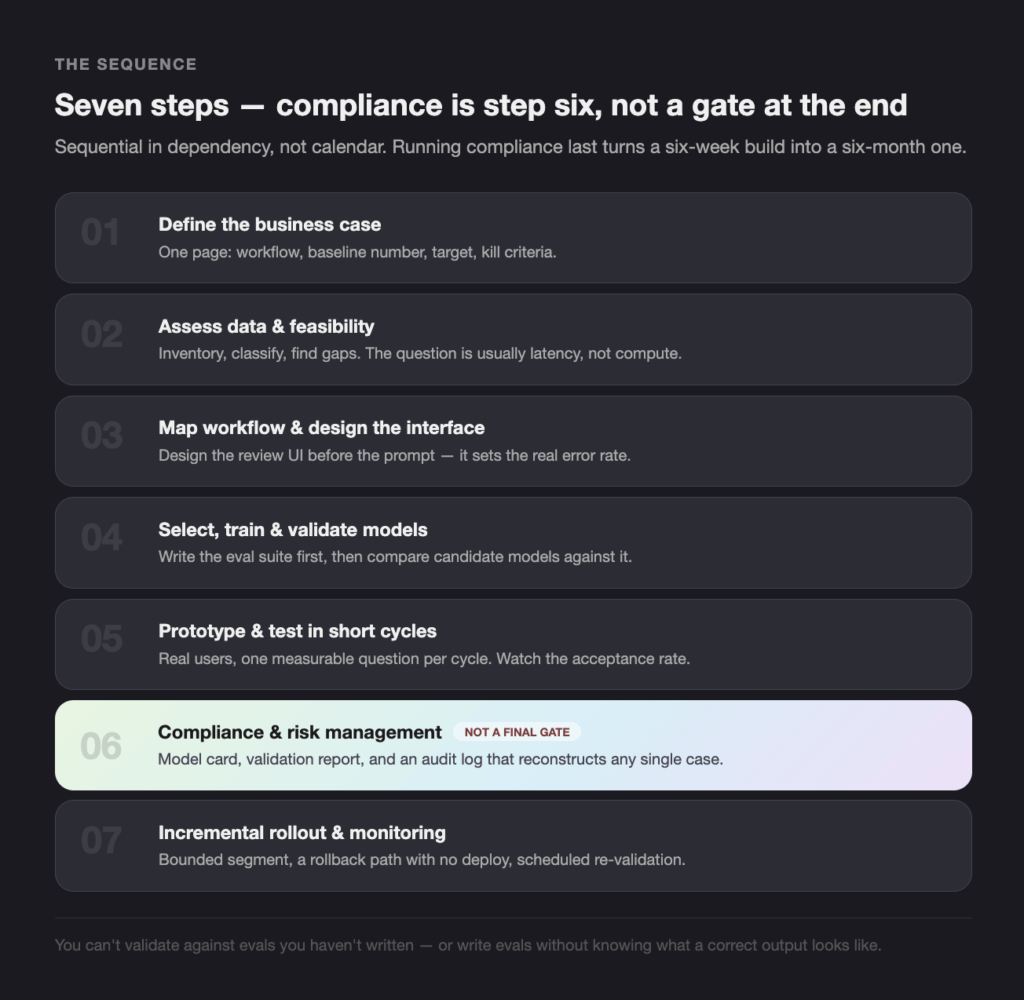
Seven steps, in order: define the business case, assess data and feasibility, map the workflow and design the interface, select and validate the model, prototype in short cycles, document compliance controls, then roll out incrementally with monitoring. Compliance is step six of seven, not a gate at the end. Running it as a final review is what turns a six-week build into a six-month one.
Teams tend to run this backwards, and the pattern is consistent enough to name. The model gets picked in week one because that is the interesting decision, the interface gets designed around whatever the model produces, and compliance reads the whole thing in week ten. Reversing that order is most of what separates a six-week build from a six-month one.
The steps are sequential in dependency, not in calendar. Steps 3 and 4 overlap heavily in practice, and step 6 starts producing documents during step 2. What cannot move is the order of dependency: you cannot validate a model against evals you have not written, and you cannot write evals without knowing what a correct output looks like in the workflow.
1. Align stakeholders and define the business case
Get product, compliance, design and engineering into one room and leave with a single page. Name the workflow, the baseline number, the target, and what you will stop doing if the target is missed. Vague objectives such as better experience or more efficiency cannot be tested, and therefore cannot be defended in a budget review.
Value mapping and impact-effort ranking work well here. Two hours with the operations team who handle the workflow today usually produces a better shortlist than a quarter of strategy work.
Output: a one-page business case with a baseline metric, a target, a named regulatory owner and kill criteria.
2. Assess technical feasibility and data readiness
Inventory the data, classify it, and find the gaps. Check whether the systems involved expose an API you can call in the request path, or whether the workflow is batch by nature. Review encryption, access control and retention against your existing obligations before selecting a vendor, because vendor choice constrains where data can be processed.
The infrastructure question is usually latency, not compute. A model that answers in four seconds is fine in a back-office review queue and unusable in a checkout flow.
Output: a technical readiness report, a data inventory with classifications, and a gap list with owners and dates.
3. Map workflows and design the interface
Start with how the work runs today, then mark where the model sits and what the human does on either side. Design the review interface before the prompt. The interface decides whether reviewers catch errors or rubber-stamp them, and that single behavior determines the feature’s real error rate more than model quality does.
Show the source. Where the output is grounded in retrieved records, put the records next to the draft. Patterns from fintech UX design for neobanks transfer well here, particularly around progressive disclosure of detail.
Output: journey maps and wireframes showing the AI step, the review step and the escalation path.
4. Select, train and validate the models
Write the eval suite first: 100–300 real cases with expected outputs, scored by the domain expert from step 2. Then compare candidate models against it. Cost, latency, data residency and the vendor’s retention policy narrow the field faster than benchmark scores do. Our note on generative AI implementation covers the selection mechanics in more detail.
Test for disparate outcomes on the same protected characteristics you would test a scoring model against, even where the output is a draft rather than a decision. A drafting assistant that writes warmer letters to one group is a fair-lending problem wearing a different hat.
Output: a validated model with a versioned eval suite, a bias report and pinned inference parameters.
5. Prototype and test in short cycles
Get a working prototype behind the real interface and in front of the people who do the work, rather than the people who built it. Two-week cycles, one measurable question per cycle. Track how often reviewers accept a draft unchanged. An acceptance rate above roughly 95% usually means reviewers have stopped reading, which is a failure that looks like a success.
Run a security pass in the same cycle. Prompt injection through customer-supplied content is a live attack path in any workflow that ingests documents or messages.
Output: a tested prototype, an acceptance-rate baseline, and a logged list of failure cases.
6. Compliance and risk management
Produce the artifacts a reviewer will ask for: a model card, the validation report, the control description, the audit-log specification, and the human-oversight procedure. Map each to the framework it satisfies. Our guide to building regulator-ready AI in fintech covers the documentation set in full.
The audit log is the artifact people underbuild. Store the prompt, the retrieved context, the model version, the parameters, the output and the reviewer decision, keyed so a single case can be reconstructed on request.
Output: documented controls, a model card, an audit-log implementation, and sign-off from the named regulatory owner.
7. Incremental rollout and ongoing monitoring
Ship to a bounded segment first (one region, one product, one queue) with a rollback path that does not require a deploy. Monitor output quality against the eval suite on a schedule, not only at launch. Watch drift in the inputs as much as in the outputs; a change in what customers write reaches you before a change in what the model writes.
Set the review cadence in the runbook. Quarterly re-validation is a reasonable default for a customer-facing generative feature in a regulated product.
Output: a live feature with a bounded audience, drift alerts, a rollback path and a scheduled re-validation date.
Designing User-Centric FinTech Experiences with AI
Three patterns carry most of the trust load: confidence disclosure, which shows how sure the system is and on what basis; reversible action, where anything the model initiates can be undone by the user within a stated window; and a visible human path, a route to a person that takes one click and states the response time. Explanations help, but users trust what they can undo more than what they can read.
Watch what happens when a fraud hold lands on a legitimate transaction. The customer does not want an explanation of the model. They want the hold lifted, and they want to know how long that takes. Trust in financial products is mostly a function of recoverability, and interfaces built around explanation alone keep missing this.
![infographic titled'Users trust what they can undo more than what they can read,' showing three trust patterns: Confidence disclosure, Reversible action, Visible human path."]}**Oops** I included extra punctuation. Let me correct. Here's the final set:](https://teamvoy.com/wp-content/uploads/2026/08/TRUST-UX-1024x661.webp "TRUST UX - Teamvoy")
The patterns that hold up in production:
- Confidence disclosure. State the basis rather than a percentage. “Drafted from your March statement and two prior disputes” tells a user more than “87% confidence” and is harder to misread.
- Reversible action. Any automated action gets an undo with a stated window. Where reversal is impossible, as with a sent payment, require confirmation before rather than explanation after.
- The visible human path. One click, with the expected response time on the button. Hiding it behind a chat loop is the fastest way to lose a customer who is already anxious.
- Provenance next to output. Show the retrieved records beside the generated text. This helps reviewers more than it helps customers, and reviewers are the ones catching errors.
- Consistent labeling. Mark AI-generated content the same way in every surface. Inconsistent labeling reads as concealment even where nothing is concealed.
- Graceful uncertainty. Where the model is out of its depth, saying so and routing onward beats producing a confident answer. Users forgive a system that knows its limits.
Two anti-patterns worth naming. The first is over-automation: acting without confirmation on anything a user would call material, which trades a small time saving for a large trust cost. The second is decorative explainability: a “why did I see this” link that returns generic text. A weak explanation is worse than none, because it signals the team knows the answer matters and chose not to give one.
Design for the reviewer as carefully as for the customer. The internal interface is where error rates are actually set, and it is the part of fintech UX design that never appears in a portfolio. It is also the part our fintech product design practice spends the most time on.
Avoiding Common UX Pitfalls in AI-Powered FinTech Products
The most common failure is scope: a feature defined as “AI for customer service” rather than “draft first responses in the billing queue”, which produces something that demos well, has no baseline to prove value against, and fails its first governance review. Everything else on this list is downstream of that one decision. Narrowing the scope fixes more than any other single change.
Five failure modes worth planning against:
- Governance retrofit. Audit logging bolted on after launch takes longer and costs more than building it in week one, and the feature sits idle while it happens. Build the log before the prompt.
- Automation bias in review. Reviewers stop reading and start approving. Detect it by tracking unchanged-acceptance rate and by seeding known-bad cases into the queue.
- Silent quality drift. Inputs change, outputs degrade, and nobody notices because the eval suite ran once at launch. Schedule it.
- Over-automation. The system acts on something material before the user has a chance to weigh in. Whatever time that saves, the trust it costs when the action turns out wrong is larger.
- Onboarding friction from verification. Adaptive verification helps, with lighter checks for low-risk profiles and more for high, but tuning the thresholds against fraud outcomes takes months of live data. Plan for that lag.
Several of these overlap with the pattern in our writeup of the most common fintech design mistakes, which is unsurprising: adding a model to a product amplifies whatever design discipline already exists.
One trade-off this approach does not solve. Running compliance in parallel from step one makes the first feature slower than a team that skips it, measurably so, often by four to six weeks. The payback arrives on the second and third features, when the control framework is reusable. If your organization judges the first project on speed alone, that framing will work against you, and the honest move is to negotiate the measure before the project starts rather than to cut the governance work.
Business Benefits of Generative AI Integration
Generative AI pays back in four places in a fintech product: per-case cost in document-heavy operations, response time in support and disputes, recall in fraud and transaction monitoring, and conversion where personalization is grounded in data the firm already holds. The gains are measurable only where the workflow had a baseline before the model arrived, which is why step one of the process is a number rather than a goal.
Every benefit below has a condition attached. Benefits without conditions are the reason so many business cases survive the pitch and fail the review.
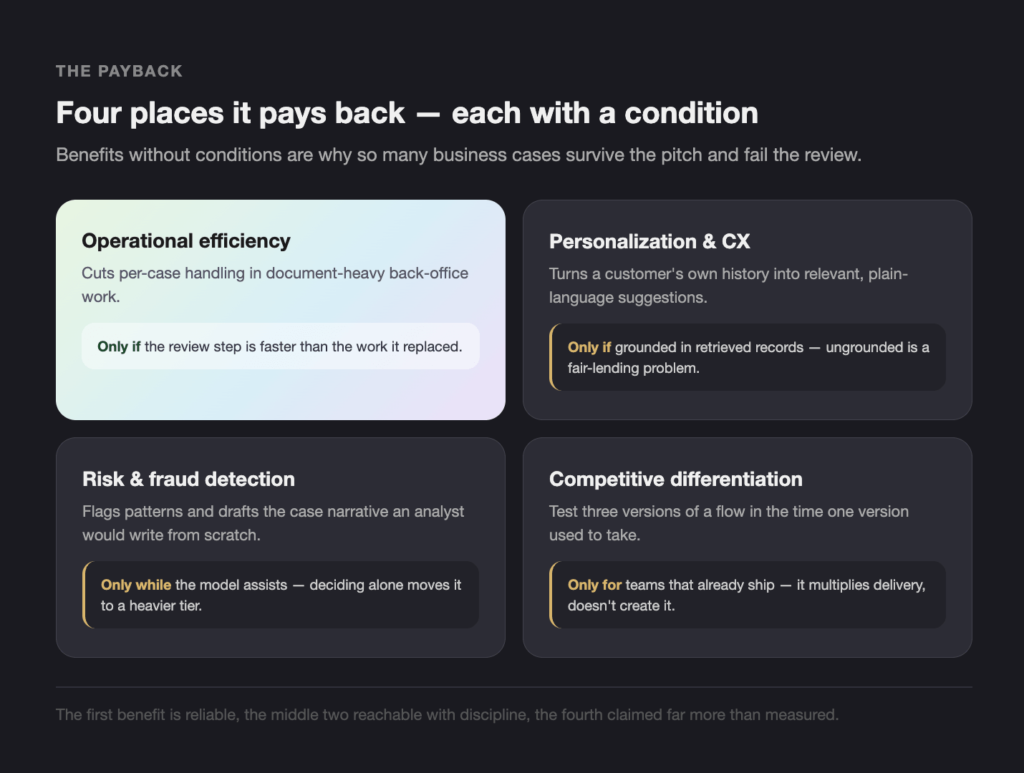
Operational efficiency and cost savings. Automating repetitive back-office work (reconciling transactions, assembling loan files, drafting first-pass responses) cuts per-case handling time and lets experienced staff spend their day on exceptions. Condition: the saving is real only if the review step is faster than the work it replaced. A draft that takes as long to check as it would have taken to write saves nothing and adds a model to govern.
Personalization and customer experience. This is where “recommend” earns its place as a fourth AI role alongside generate, summarize and act: turning a customer’s own transaction history into relevant product suggestions and plain-language explanations at the moment of decision. The condition is the same one that governs the other three roles. Personalization grounded in retrieved records is useful. Personalization generated from a customer profile without retrieval is a fair-lending problem waiting to be found.
Risk management and fraud detection. Models flag unusual patterns in real time and draft the case narrative a human analyst would otherwise write from scratch, which shortens the queue and improves the consistency of what gets escalated. Condition: the model assists the analyst. The moment it decides alone, the feature moves into a heavier regulatory tier and the economics change.
Competitive differentiation. Faster prototyping lets a product team test three versions of a flow in the time one used to take, but only for teams that already ship. Generative AI does not fix a delivery problem; it multiplies whatever delivery capability already exists, for better or worse.
The honest summary is that the first benefit is reliable, the second and third are reachable with discipline, and the fourth is a second-order effect that gets claimed far more often than it is measured.
Regulatory and Compliance Requirements for Generative AI in FinTech
For a US fintech, four instruments do most of the work. SR 11-7 governs model risk management and validation. NYDFS Part 500 sets cybersecurity requirements for New York-licensed firms. GDPR covers any EU resident’s data. PCI DSS constrains architecture wherever card data enters the flow. The EU AI Act adds risk classification for products sold into the EU.
The examiner’s first question is rarely about the model. It is about who signed off on it, what they saw when they did, and whether you can produce that record now. Teams that treat AI compliance in fintech as a document written after the build discover that the document has to describe decisions nobody wrote down.
The mistake is reading this list as a compliance checklist to run at the end. Each instrument has a design consequence, and the consequences conflict with each other often enough that resolving them late means rebuilding.
| Framework | What it governs | Applies when | Design consequence |
|---|---|---|---|
| SR 11-7 (Fed/OCC) | Model development, validation, governance | Bank or bank-partnered institution using models in decisions | Independent validation, documented assumptions, ongoing monitoring, a named model owner |
| ECOA / Reg B | Adverse action reasons in credit decisions | Model influences a credit decision | Specific, accurate reasons; a generic reason code fails |
| NYDFS Part 500 | Cybersecurity program, access control, incident reporting | NY-licensed financial firms | MFA, access reviews and 72-hour incident notification cover the AI stack too |
| GDPR | Personal data processing, automated decisions | Any EU resident’s data | Lawful basis for training data, and Article 22 rights where the decision is automated |
| PCI DSS | Cardholder data handling | Card data enters the workflow | Keep card data out of prompts and vendor logs, or bring the vendor into scope |
| EU AI Act (2024/1689) | Risk classification and obligations by tier | Product placed on the EU market | Creditworthiness assessment is high-risk: conformity assessment, logging, human oversight |
| DORA | ICT risk and third-party oversight | EU financial entities and their providers | Register of information on your AI vendors, exit plans, resilience testing |
| NIST AI RMF 1.0 | Voluntary risk-management practice | Any US firm wanting a defensible framework | Useful spine for mapping controls when no rule names your use case |
Two practical notes. First, vendor contracts carry regulatory weight, because data retention, sub-processor lists and audit rights are compliance controls rather than procurement details. Second, a generative feature that only assists an internal reviewer sits in a much lighter tier than one that produces a customer-facing decision. Where the schedule is tight, ship the assistive version and earn the decision version later.
Cost of Generative AI Integration in FinTech
A first production generative AI feature in a regulated fintech workflow runs roughly $110,000–$220,000 for a customer-support-style assistant and $320,000–$1.1M for a transaction-monitoring workflow, over three to six months. Run costs add $2,000–$25,000 a month depending on volume. Data readiness and regulatory tier drive the spread, not model choice.
The number that surprises people is that the model is the cheap part. Inference on a well-scoped workflow is often under $2,000 a month at pilot volume. The cost lives in data work, evals, audit logging, the review interface and validation documentation. Our published cost of production AI in fintech breakdown puts integration first and regulator-readiness second, with eval and monitoring setup the line teams underbudget most.
Rough split of a first build:
- Data preparation and access work, 25–35%. Classification, pipelines, anonymization, retrieval index. Highest variance line in the budget.
- Model integration and evals, 15–20%. Writing the eval suite is a domain-expert task and gets underestimated.
- Interface and review design, 20–25%. The review UI is a real product surface, not an admin screen.
- Audit logging and monitoring, 10–15%. Cheap to build early, expensive to retrofit, which is the pattern in the opening of this piece.
- Validation and documentation, 10–20%. Scales with regulatory tier. Internal assist is light; credit decisioning is not.
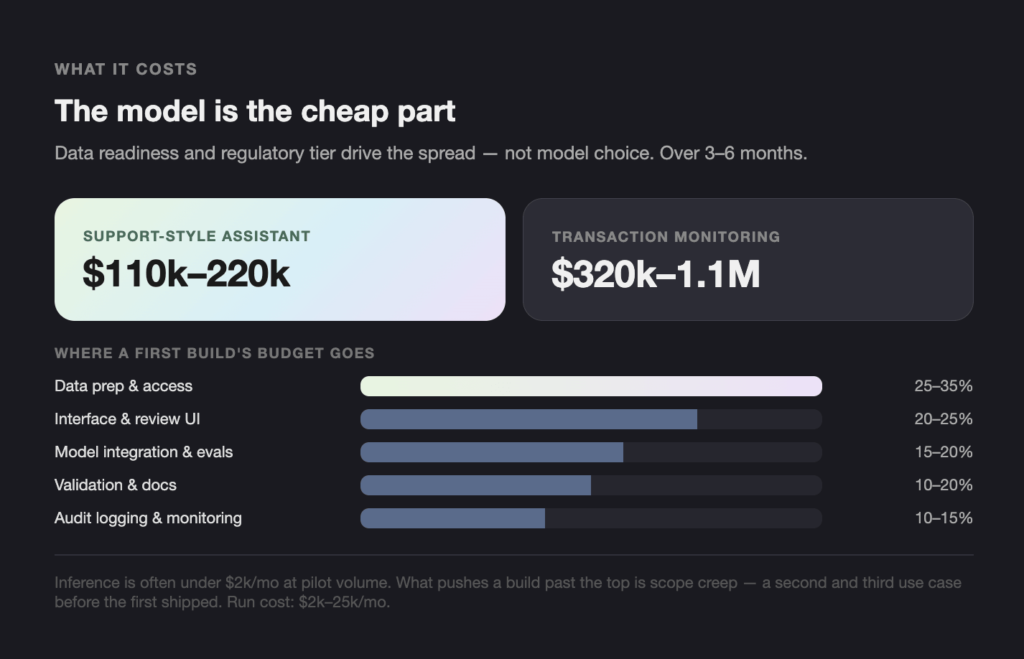
Generative AI implementation cost keeps running after launch. Hold four lines in the model: inference per case, human review time per case, re-validation each quarter, and vendor price changes. What pushes a build past the top of the range is nearly always the same thing. The workflow was not scoped to one queue, and the feature grew a second and third use case before the first one shipped. Generative AI implementation cost is a scoping number long before it is an engineering number.
Custom vs. Off-the-Shelf AI Solutions for FinTech
Buy when the workflow is standard, the differentiation lives elsewhere, and the vendor will sign the data terms you need. Build when the workflow encodes something proprietary, such as your underwriting criteria, your dispute taxonomy or your risk appetite, or when data residency rules rule out the vendor. Most fintechs should buy the model and build the surrounding system, which is where the defensible work sits regardless.
The framing “custom versus off-the-shelf” hides the real decision. Build vs buy is settled at the layer, not at the model. Almost nobody trains a foundation model. The choice is between an application-layer vendor that owns the workflow and a build on top of a hosted model from OpenAI, Anthropic, Google, AWS Bedrock or Azure OpenAI. Those are different commitments with different failure modes.
| Criterion | Custom build | Off-the-shelf | Which wins |
|---|---|---|---|
| Time to first production use | 3–6 months | 4–10 weeks | Off-the-shelf, clearly |
| Fit to a proprietary workflow | Exact | Approximate, configured | Custom |
| Regulatory evidence | You own every artifact | Depends on vendor cooperation | Custom, unless the vendor is mature |
| Cost at low volume | Higher | Lower | Off-the-shelf |
| Cost at high volume | Lower per case | Per-seat or per-call pricing compounds | Custom |
| Data residency and retention control | Full | Contractual | Custom |
| Ongoing maintenance burden | Yours | Vendor’s | Off-the-shelf |
| Switching cost later | Moderate | High once workflows are embedded | Custom |
The middle path works for most teams: a hosted model, your own retrieval and prompts, your own logging and review interface. You keep the evidence and the workflow logic, and you skip the part nobody should be doing themselves.
For vendor evaluation, the questions that separate serious providers are about retention, sub-processors, model-version pinning and audit rights rather than benchmark scores. Our AI vendor decision framework for fintech has the full question set. Where a vendor will not pin a model version, treat every output as unreproducible and plan the compliance story around that.
Emerging Trends: Agentic AI and Autonomous Systems in FinTech
Agentic systems act across multiple steps without a prompt for each one: checking a balance, initiating a transfer, opening a case, notifying a customer. The design problem moves from output quality to authorization and reversal: what the agent may do without asking, what it must confirm, and how a completed action gets undone. Model quality becomes secondary to the permission model around it.
The demo that sells agentic AI in fintech always shows the happy path. An agent notices an anomaly, opens a case, drafts the notice and closes the loop while the operator watches. The question that demo never answers is what happens on the step where it was wrong, and who gets to undo it.
The fintech applications are real and narrow. Continuous transaction monitoring that escalates rather than acts. Reconciliation across systems where every step is reversible. Case preparation that assembles a packet for a human to file. Our overview of AI agents in finance covers the use-case set.
Three design rules that hold up:
- Bound the blast radius. A dollar limit, a time window, a whitelist of destinations. Enforce it in the system, not the prompt.
- Announce before acting. For anything material, tell the user what is about to happen with time to stop it. Confirmation after the fact is a notification, not consent.
- Log the plan, not only the actions. When an agent chains six steps, the reconstruction question is why it chose that sequence.
Regulatory treatment of agentic AI in fintech is still settling. Where an agent initiates payments or affects credit availability, assume the strictest reading of the existing rules and design to it.
Conclusion
Generative AI in fintech product design is a governance problem wearing an engineering costume. The model is rarely the constraint. Scope, data access, audit evidence and the interface a reviewer works in decide whether a feature reaches production and whether it survives its first examination.
- Scope to one workflow with a number attached, and write the kill criteria before the code.
- Build the audit log and the review interface first; retrofitting them costs several times more.
- Settle build vs buy at the layer: buy the model, build the system around it, and say plainly when buying the whole thing wins.
If you are working through this now, our generative AI integration services team can review the workflow you have picked and tell you what it will take to get that feature past a model risk review.