
Key takeaways:
The Comparison of AI Agent Development Platforms and Companies Leading the USA Market in 2026 highlights the rapid growth and evolving landscape of agentic AI systems that autonomously manage complex workflows across industries. Understanding platform capabilities, integration challenges, and the importance of collaboration is essential for enterprises aiming to leverage AI agents effectively.
- Ruby on Rails' concise syntax and robust gems like ruby-openai simplify AI API integration without complex microservices.
- Managing AI model context through layered documentation enhances AI-assisted development and prevents common pitfalls.
- Building AI agents in Rails involves state management and tool calls, supported by protocols like MCP and techniques like Retrieval-Augmented Generation.
- Teamvoy's framework combines modernization with intelligent automation to deliver scalable and maintainable AI-powered Rails applications.
- AI integration in Rails leads to automation, improved user experience, data-driven decisions, and faster development cycles.
| Topic | Key Insight | Why It Matters | Action Item |
|---|---|---|---|
| Ruby on Rails Syntax | Concise and expressive, reducing token usage for AI models | Enables efficient AI-assisted programming | Use Ruby for clearer AI code integration |
| AI API Integration Gems | Gems like ruby-openai provide easy access to AI services | Simplifies adding AI features without extra microservices | Incorporate these gems for AI functionalities |
| AI Model Context Management | Layered documentation organizes context for AI models | Prevents errors and improves AI understanding of codebase | Develop detailed, layered documentation |
| AI Agent Development | MCP servers and RAG techniques aid in managing state and context | Supports complex AI workflows within Rails apps | Implement MCP and RAG for AI agents |
| Background Processing | Sidekiq and Active Job absorb slow, failure-prone model calls | Keeps request latency predictable under load | Move every model call off the request cycle |
| Teamvoy Intelligent Automation | Framework merges modernization with AI automation for scalable Rails apps | Ensures maintainability and efficient AI feature delivery | Adopt Teamvoy’s framework for AI integration |
| Business Benefits | AI enhances automation, user experience, and data insights | Drives innovation, reduces costs, and accelerates development | Leverage AI to improve business outcomes |
AI in Ruby on Rails
AI in Ruby on Rails unlocks new possibilities for developers to build intelligent, efficient, and user-friendly applications. Ruby on Rails offers a developer-friendly environment with expressive syntax and robust API integration capabilities, making it well-suited for embedding AI features directly into web applications. In this article, we explore how AI integrates with Ruby on Rails, practical strategies for implementation, building AI agents, Teamvoy’s proprietary framework, and the tangible business benefits of this approach.
Understanding AI in Ruby on Rails
Ruby on Rails provides an expressive syntax and strong API integration tools that align perfectly with AI integration needs. Its concise and readable code style allows developers to write clear and maintainable AI-powered features within Rails applications. This expressiveness also benefits AI-assisted programming, as large language models (LLMs) can process Ruby code more efficiently due to fewer tokens used per function compared to more verbose languages.
Rails’ ecosystem boasts many gems that facilitate smooth consumption of AI services via HTTP APIs, enabling seamless integration without the complexity of additional microservices. This capability makes Rails a practical choice for incorporating AI functionalities such as natural language processing, recommendations, and automation directly into applications (Sean Goedecke, 2026).
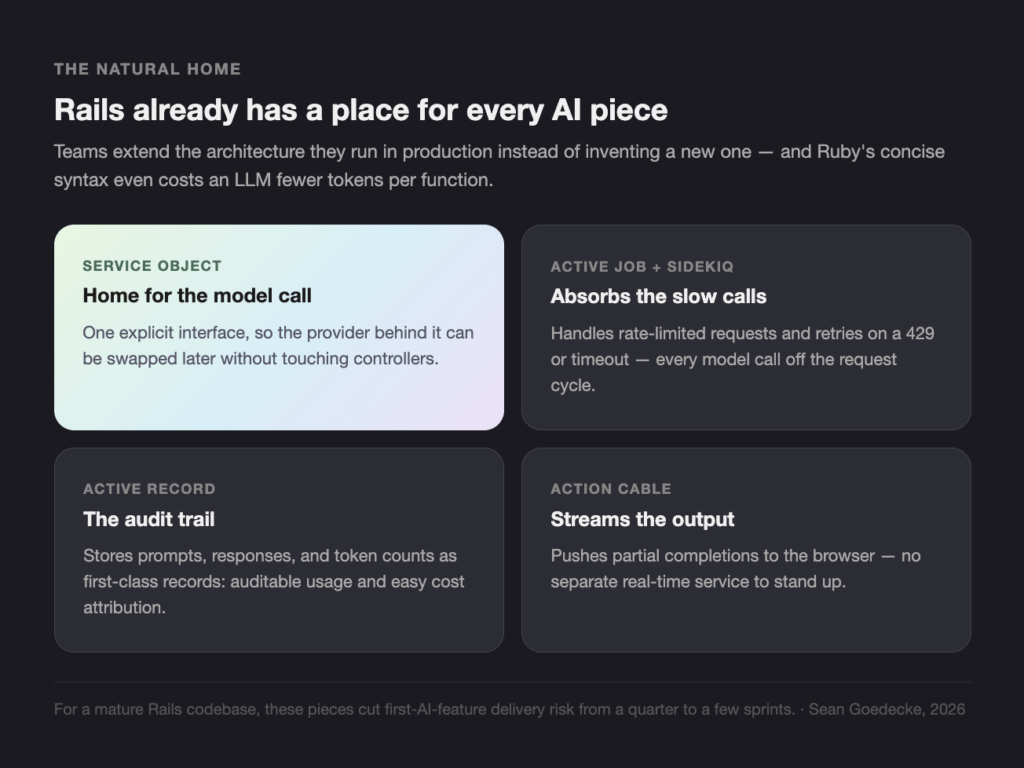
The structural advantages go beyond syntax. Rails conventions give an AI feature a natural home: a service object for the model call, an Active Job class for anything slow or rate-limited, and RSpec or Minitest coverage for the parts that must stay deterministic. Teams extend the architecture they already run in production instead of inventing a new one.
Rails also handles the unglamorous parts of production AI well. Active Record stores prompts, responses, and token counts as first-class records, which makes usage auditable and cost attribution straightforward. Sidekiq absorbs retries when a provider returns a 429 or a timeout. Action Cable streams partial completions to the browser without a separate real-time service. For teams already running a mature Rails codebase, these pieces reduce the delivery risk of a first AI feature from a quarter to a few sprints.
For a structured approach, developers can refer to our AI integration framework, which outlines a systematic method to embed AI within Rails apps effectively. Teams that want the work delivered rather than documented can review our Ruby on Rails development services.
Practical AI Integration Strategies in Ruby on Rails
Integrating AI into Rails applications involves connecting to AI APIs using Ruby gems, managing AI model context, and building layered documentation to guide AI-assisted coding. Gems like ruby-openai provide convenient interfaces to popular AI APIs, enabling developers to implement features such as chatbots, text generation, and embeddings efficiently.
Effective AI integration requires managing the AI model’s context window thoughtfully. This means organizing application context, dependencies, and coding patterns into layered documentation so AI models understand the codebase accurately. According to experienced Rails developers, layered context includes:
- A technical foundation outlining application architecture and dependencies.
- Documentation of coding standards and common patterns.
- Detailed feature-specific guides.
This approach ensures AI-assisted development is effective, especially in brownfield Rails projects, and prevents common pitfalls caused by insufficient context (Mario Alberto Chávez, 2026).
A workable delivery sequence for a first production feature looks like this:
- Pick one narrow, high-frequency task – support ticket triage, document summarization, or field extraction from uploaded PDFs.
- Wrap the provider call in a single service object with an explicit interface, so the model behind it can be swapped later without touching controllers.
- Move the call into Active Job with a retry policy and a hard timeout. No model call belongs in a request cycle.
- Persist the prompt, the response, the model version, and the token count. Without this record you cannot debug quality regressions or forecast spend.
- Add an evaluation set of 30–50 real examples with expected outputs, and run it in CI before every prompt change.
- Ship behind a feature flag to a small user segment, then widen once error rates and cost per request are known.
Step 5 is the one teams skip most often. Prompt changes look harmless and behave like code changes: without a regression suite, a small wording edit can quietly break an extraction path that worked for months.
Cost control deserves the same discipline. Caching embeddings and routing simple classification work to a smaller model cuts monthly inference spend without a measurable drop in quality, though smaller models need tighter prompts and more evaluation coverage.
Our proprietary Teamvoy Intelligent Automation Framework builds on these strategies to combine intelligent automation with modernization in Rails apps.
Building AI Agents with Ruby on Rails
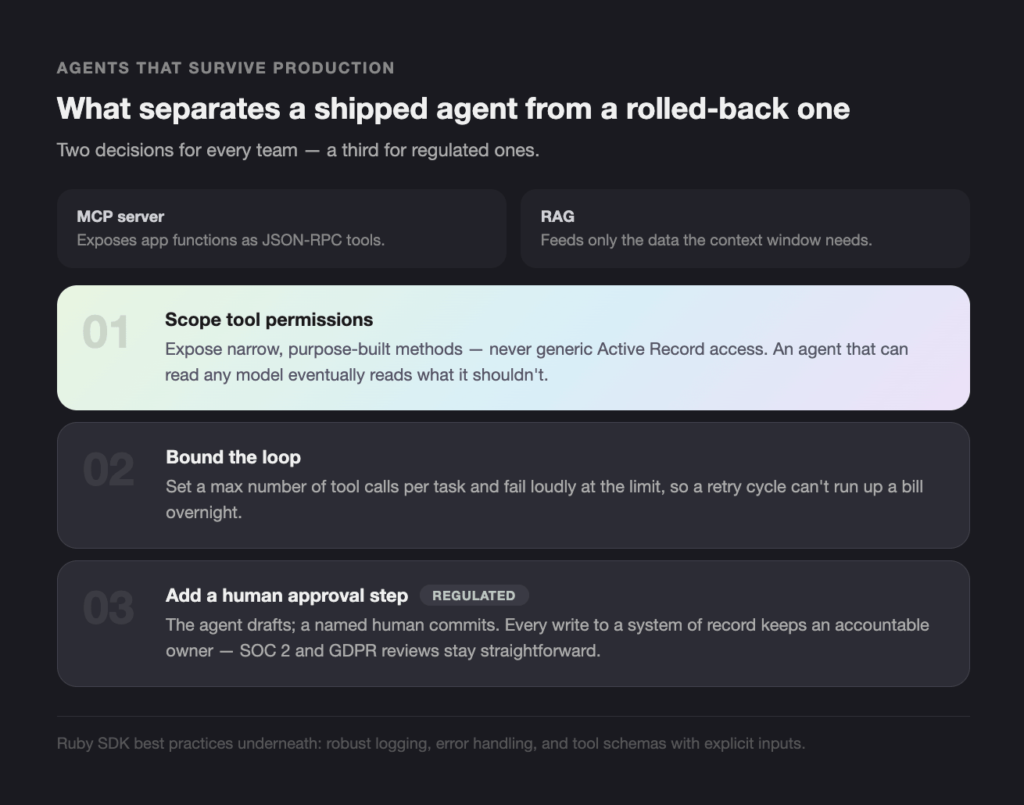
Developing AI agents in Rails requires precise handling of tool calls, state management, and context control. The Model Context Protocol (MCP) server plays a central role by exposing application functions and resources through JSON-RPC interfaces, allowing AI agents to interact programmatically with the application environment.
State and context management are critical for maintaining coherent AI conversations and workflows. Retrieval-Augmented Generation (RAG) techniques enhance AI capabilities by retrieving relevant information from vector databases or embeddings, feeding only necessary extracted data to the models to respect their context window limits.
Ruby SDKs for AI integration encourage robust logging, error handling, and clear tool documentation with input schemas. On the client side, best practices include flexible configuration management and effective use of chat completions to maintain responsiveness and accuracy (Dieter S., 2026).
Two design decisions separate agents that survive production from those that get rolled back. The first is scoping tool permissions: an agent that can read from any Active Record model will eventually read something it should not, so expose narrow, purpose-built methods rather than generic database access. The second is bounding the loop – set a maximum number of tool calls per task and fail loudly when the agent hits it, instead of letting a retry cycle run up a bill overnight.
Regulated teams add a third: an approval step. In fintech and insurance workflows, the agent drafts and a named human commits. That single boundary keeps SOC 2 and GDPR reviews straightforward, because every write to a system of record still has an accountable owner.
Learn more about this approach in our AI integration framework.
AI Integration Framework Teamvoy’s Approach
The AI agent platform market in 2026 is characterized by significant innovation and specialization. Notable trends incluTeamvoy’s Intelligent Automation Framework offers a structured methodology for embedding AI into Ruby on Rails applications, focusing on combining modernization with intelligent automation. The framework consists of components that enable:
- Seamless API integration using Ruby gems and tailored adapters.
- Layered context management to optimize AI model effectiveness.
- Automation of repetitive workflows and processes within Rails apps.
- Scalability and maintainability through modular design and best practices.
By merging modernization strategies with AI-driven automation, Teamvoy ensures Rails applications remain flexible and future-proof while delivering cutting-edge AI capabilities. This framework helps businesses achieve faster development cycles and more reliable AI features without sacrificing code quality or performance.
In practice, engagements start with a short assessment of the existing codebase: Rails and Ruby versions, test coverage, background job infrastructure, and where the data an AI feature would need actually lives. That last point decides most timelines. A Rails 7 application with a clean schema and a working job queue can ship a first AI feature in weeks. A Rails 4 monolith with business logic spread across callbacks needs a modernization pass first, and pretending otherwise is how AI pilots stall. Explore practical AI integration strategies that embody this approach.
Business Benefits of AI Integration in Ruby on Rails
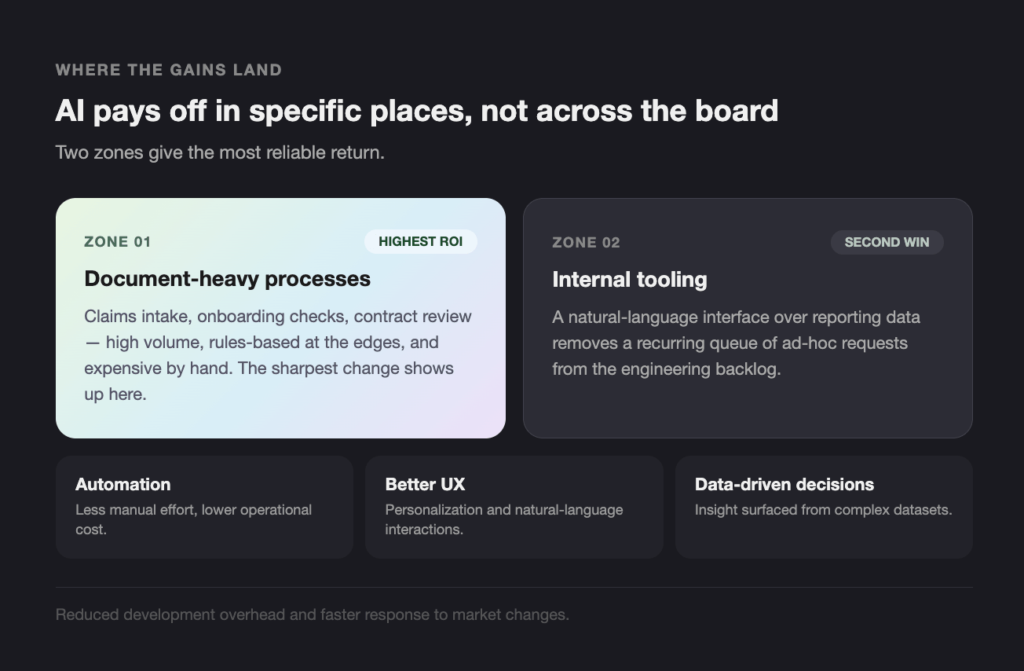
Integrating AI into Rails applications delivers significant business advantages. Automation of workflows reduces manual effort and operational costs, while AI-powered features enhance user experiences through personalized recommendations and natural language interactions. Moreover, AI enables data-driven decision-making by uncovering insights from complex datasets.
These benefits accelerate innovation, giving businesses a competitive edge as they modernize technology stacks. Companies that adopt AI in Rails apps find they can reduce development overhead and respond faster to market changes.
The gains show up in specific places rather than across the board. Document-heavy processes – claims intake, onboarding checks, contract review – see the sharpest change, because the work is high volume, rules-based at the edges, and expensive when handled entirely by people. Internal tooling is the second reliable win: a natural-language interface over reporting data removes a recurring queue of ad-hoc requests from the engineering backlog.
Our work with clients shows that effective AI integration results in measurable improvements in efficiency and customer satisfaction, supporting sustainable growth and digital transformation. For more details, see our insights on AI in Ruby on Rails.
Conclusion
Integrating AI into Ruby on Rails applications is not just a technical upgrade; it’s a strategic move that unlocks new capabilities and business value. With Teamvoy’s expertise and frameworks, Rails developers can harness the power of AI responsibly and effectively. Whether you are enhancing existing applications or building new intelligent features, AI in Ruby on Rails offers a practical and scalable path forward.
For further learning, explore the ruby-openai gem which has over 10 million downloads and is widely adopted for AI API integration. Additionally, review Teamvoy’s own ruby-on-rails-agent-skills repository, an open collection of agent skills for working with Ruby on Rails codebases. Together, these resources and our proprietary frameworks position Ruby on Rails as a powerful platform for AI-driven software development.
Also, consider how to transition legacy Ruby on Rails apps to AI-enabled architectures to maximize your AI integration efforts effectively. If you want that assessed against your own codebase, our Rails engineering team can review it with you.