- Nine engineering companies build custom risk assessment software, and each fits a different situation: a compliance deadline, a legacy risk core, an unstable AI-built prototype, or a greenfield scoring engine.
- The keyword is ambiguous. Most ranking pages answer SDLC project-risk assessment rather than software that assesses business risk, which wastes shortlist calls.
- Published build costs range from about 18,000 dollars for a modular MVP to 500,000 dollars or more for real-time machine-learning risk engines, driven by scoring logic, integrations, and reporting scope.
- ISO 31000 supplies the process and is not certifiable. The NIST RMF supplies mandated controls. DORA Article 6 demands a documented ICT framework reviewed annually plus a third-party register.
- Risk software is an integration product first. Data layer, then legacy core, then model. A score built on an unreconciled feed becomes an audit finding, not a feature.
- For a platform under active supervision, incremental modernisation usually beats a rewrite: document observed behaviour, scream-test dependencies, then replace subsystems behind an unchanged interface.
Q1. Which Companies Build Custom Risk Assessment Software in 2026?
Nine engineering companies build custom risk assessment software, and each one fits a different situation: a regulated platform facing a compliance deadline, a legacy risk core that cannot be rewritten, an AI-assisted prototype that has hit production limits, or a greenfield scoring engine. Teamvoy has delivered 150+ projects across banking, insurance, and healthcare since 2013, with a named senior technical lead on every engagement.
Choosing a partner to build risk assessment software is a decision you live with for years. The system ends up holding your risk register, your scoring logic, and your audit trail. If the build is wrong, your supervisor usually finds out before you do. This guide describes each company against five criteria: named regulator experience, engagement model and accountability after go-live, senior technical lead ownership, capacity to take over code someone else wrote, and proof of production risk work. It is written for CTOs, technical founders, and IT directors inside banking, insurance, or healthcare who are shortlisting partners right now.
Our Evaluation Criteria
⭐ What I actually check before a shortlist call
- Named regulator and standards experience. Has the firm shipped inside DORA, PCI-DSS, HIPAA, SOC 2, or GDPR scope? A risk platform that cannot produce evidence is a finding waiting to happen.
- Engagement model and accountability after go-live. Project-and-exit, long-term partner, or staff augmentation. Risk systems fail in year two, not week six.
- Senior technical lead ownership. One named senior engineer owning the architecture, or a rotating bench of juniors.
- Capacity to take over a system someone else built. Can the team read undocumented code and stabilise it without a rewrite?
- Proof of production risk work. Shipped scoring engines and registers, not conference demos.
✅ Why these five and not fifteen
I dropped pricing on purpose. Engineering services are custom-quote everywhere, so a pricing column would create false comparability. I also dropped star scores, because a 4.9 average tells you nothing about DORA readiness.
Who This Guide Is For
- The CTO who inherited a risk platform from a vendor that underdelivered or exited, and now owns the reporting obligation.
- The technical founder whose original risk core still works but has become expensive to change.
- The enterprise IT director with a compliance deadline they did not set, usually DORA, PCI-DSS, or HIPAA.
The Nine Companies Covered
This roster covers nine companies in total.
- Teamvoy: Best for regulated risk platforms and legacy risk cores that must keep reporting during modernisation
- Achievion Solutions: Best for validating a scoring model as a POC before committing to a full platform build
- Vention: Best for scaling a dedicated engineering team onto an in-flight fintech platform
- DOOR3: Best for complex internal enterprise systems where the workflow, not the model, is the hard part
- HatchWorks AI: Best for AI-assisted delivery on a greenfield risk product with an in-house product owner
- Orases: Best for long-lived internal operations platforms inside US mid-market companies
- Sidebench: Best for enterprise and healthcare product builds needing design and engineering together
- Scopic: Best for maintaining and extending a risk product over many years with a distributed team
- NineTwoThree AI Studio: Best for adding a machine-learning scoring layer to an existing data platform
Master Comparison Table
| Company Name | Best For | Engagement Model | Industry Depth & Compliance Coverage |
|---|---|---|---|
| Teamvoy | Regulated risk platforms and legacy risk cores that cannot be rewritten | Long-term partner (multi-year), senior technical lead owns the system | Banking, fintech, insurance, healthcare, manufacturing, logistics, complex SaaS; delivery inside BaFin, PSD2, DORA, SOC 2, PCI-DSS, HIPAA, GDPR scope |
| Achievion Solutions | Proving a risk scoring model works before funding a platform | Project-and-exit, POC to MVP | AI and data science across health data, education, and design; regulated-industry coverage not publicly claimed |
| Vention | Adding senior capacity to an in-flight fintech or enterprise build | Staff augmentation and dedicated teams | Fintech, healthcare, retail, logistics; compliance handled inside the client’s own framework |
| DOOR3 | Complex internal enterprise systems and workflow-heavy tooling | Project-and-exit, with retained support options | Financial services, legal, nonprofit, enterprise IT; regulated coverage varies by engagement |
| HatchWorks AI | Greenfield AI-assisted product delivery with a strong client product owner | Long-term partner, nearshore squads | Fintech, healthcare, logistics; compliance scope varies by engagement |
| Orases | Long-lived internal operations and reporting platforms | Long-term partner, US-based | Manufacturing, healthcare, sports, government-adjacent; HIPAA-aware work, broader regulated coverage varies |
| Sidebench | Enterprise and healthcare products where design and engineering ship together | Project-and-exit, product studio model | Healthcare, public sector, enterprise; HIPAA-aware, wider financial regulation not typically core |
| Scopic | Maintaining and extending an existing risk product over many years | Long-term partner, fully distributed | Healthcare, engineering software, manufacturing; regulated financial coverage not typically core |
| NineTwoThree AI Studio | Bolting a machine-learning scoring layer onto existing data | Project-and-exit, AI studio model | Fintech, healthcare, media; compliance handled with client counsel |
⚠️ One honest limit on this table
Compliance coverage is the column people misread. A firm that has shipped one HIPAA project is not the same as a firm that treats audit evidence as a build artifact. Ask for the evidence trail, not the logo.
💰 What the buy-side floor looks like
Gartner’s 2025 Magic Quadrant for GRC Tools, Assurance Leaders, sets the configurable-platform baseline your custom build has to beat. If a partner cannot tell you why building beats configuring, that is your answer.
Teamvoy
- Named regulator and standards experience: Delivery inside BaFin, PSD2, DORA, SOC 2, PCI-DSS, HIPAA, and GDPR scope.
- Engagement model and accountability after go-live: Long-term partner, 4+ year average engagement, no project-and-exit handoff.
- Senior technical lead ownership: One named senior engineer owns the architecture through production.
- Capacity to take over a system someone else built: Vendor rescues and stabilisation are a core motion, not an exception.
- Proof of production risk work: Long-running regulated platforms where downtime is a reportable event.
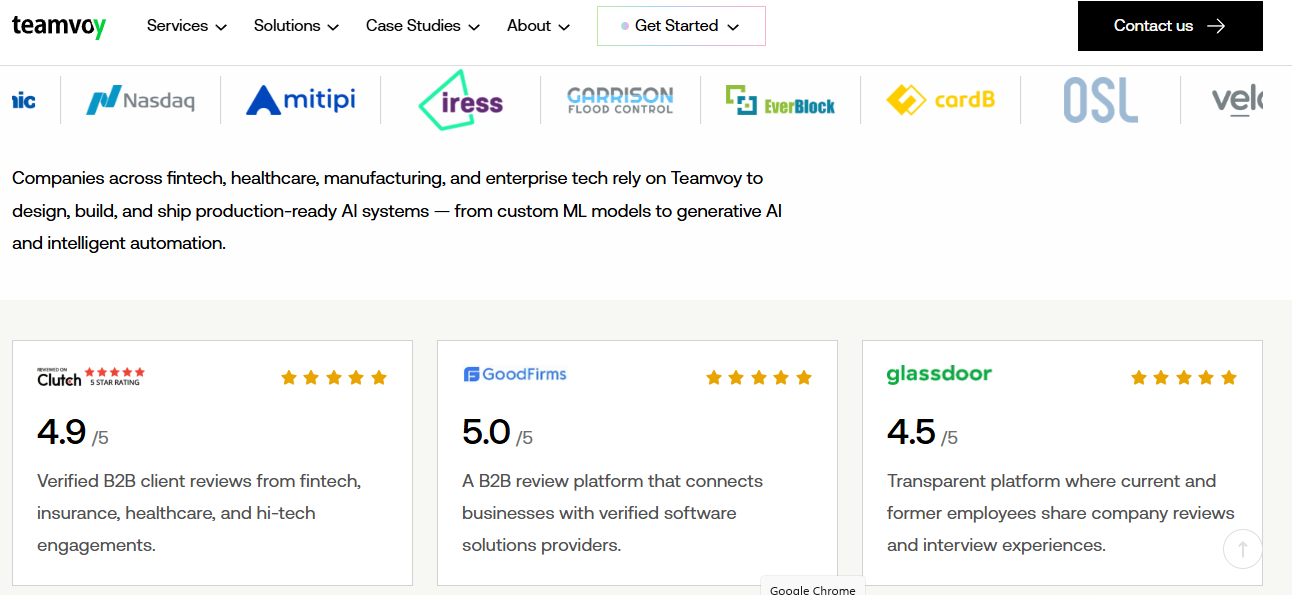
- Named client work includes Nasdaq, OSL, Panasonic Avionics, and Market Access Direct.
- 150+ delivered projects since 2013, with 50+ clients and 70+ engineers.
- Verified client reviews on Clutch and GoodFirms describe multi-year engagements, including a four-year partnership at Bitspark and a scale-and-post-acquisition engagement at Iress.

Achievion Solutions
- Named regulator and standards experience: Not publicly claimed for financial regulation; client work includes health data products.
- Engagement model and accountability after go-live: Project-and-exit, scoped around a POC or MVP milestone.
- Senior technical lead ownership: Project manager leads; a named senior architect owning the system is not publicly claimed.
- Capacity to take over a system someone else built: Not a stated specialism; the pattern in client reviews is new builds.
- Proof of production risk work: Data science and scoring algorithm work, at pilot rather than regulated-production scale.
- Delivered a POC then an MVP for an AI platform, with a beta run of over 150 users, per a verified 2023 Clutch review.
- Built a data science recommendation algorithm in Python for an education nonprofit, delivered February 2024.
- Delivered an MVP, beta, and website for a health data product, per a verified March 2026 Clutch review.
Vention

- Named regulator and standards experience: Fintech and healthcare delivery is claimed; specific regulator scope is handled inside the client’s own framework.
- Engagement model and accountability after go-live: Staff augmentation and dedicated teams, so accountability stays with your CTO.
- Senior technical lead ownership: Seniority is matched to the role you request, not owned by a fixed architect.
- Capacity to take over a system someone else built: Strong on adding capacity to a live build, less positioned on stabilising an abandoned one.
- Proof of production risk work: Broad fintech portfolio, with risk-specific platform work not separately published.
- 20+ years in the market, with delivery centres spread across three regions.
- Clutch independently verified the business as legally registered and financially sound.
- 95 verified client reviews averaging 4.9 stars, per the Clutch profile.
DOOR3

- Named regulator and standards experience: Financial services and enterprise IT work is present; regulated scope varies by engagement.
- Engagement model and accountability after go-live: Project-and-exit, with retained support available.
- Senior technical lead ownership: Principal consulting model, with a CTO and design leadership in-house.
- Capacity to take over a system someone else built: Enterprise modernisation is within scope, framed as consultancy rather than rescue.
- Proof of production risk work: Workflow-heavy internal systems, rather than published risk scoring engines.
- Operating continuously since 2002, one of the longer-running independent consultancies in New York.
- Leadership includes a founder, CTO, chief design officer, and a managing director in Ukraine.
- Published five-star review volume on Clutch across custom software and UX work.
HatchWorks AI

- Named regulator and standards experience: Fintech and healthcare clients are served; regulator scope varies by engagement.
- Engagement model and accountability after go-live: Long-term nearshore squads, with the client product owner steering.
- Senior technical lead ownership: Engineering leadership is in-house; per-system architect ownership is not publicly claimed.
- Capacity to take over a system someone else built: Positioned around new delivery velocity more than stabilisation.
- Proof of production risk work: AI and data delivery work, without published risk platform case detail.
- Named the number one AI services company by Clutch, per its own about page.
- Eight offices across six countries with English-fluent, US time zone teams.
- Outside growth investment in 2024, which is a reasonable proxy for delivery traction.
Orases
- Named regulator and standards experience: Healthcare, manufacturing, and energy work is present; HIPAA-aware, wider financial regulation not core.
- Engagement model and accountability after go-live: Long-term US-based partner, with ongoing support offered.
- Senior technical lead ownership: Founder-led firm with a stated radically transparent process.
- Capacity to take over a system someone else built: Enterprise application work suggests capability, though rescue is not the headline motion.
- Proof of production risk work: Operations and reporting platforms rather than published risk scoring systems.
- Operating since 2000, with named brand work including the NFL, NPR, and Kimberly-Clark.
- Clutch Global award recognition in 2024 and 2025.
- Founder and CEO Nick Damoulakis has led the firm through its full history.
Sidebench

- Named regulator and standards experience: Healthcare and public sector work is the visible strength; financial regulation is not core.
- Engagement model and accountability after go-live: Project-and-exit studio engagements.
- Senior technical lead ownership: Not publicly claimed as a per-system commitment.
- Capacity to take over a system someone else built: Not a stated specialism.
- Proof of production risk work: Not publicly claimed for risk assessment platforms specifically.
- Studio positioning built around product strategy alongside build.
- Healthcare and public sector delivery experience is the recurring theme in its market presence.
- Verified detail beyond that is thin in public sources, so I am not going to fill the gap with guesses.
Scopic

- Named regulator and standards experience: Healthcare and engineering software presence; financial supervision is not the core territory.
- Engagement model and accountability after go-live: Long-term partner model, fully distributed.
- Senior technical lead ownership: Team-based structure; a named per-system architect is not publicly claimed.
- Capacity to take over a system someone else built: Long-tail maintenance work is a genuine strength.
- Proof of production risk work: Broad portfolio breadth rather than published risk platform depth.
- 1,000+ projects delivered across 13+ industries, per its Clutch profile.
- 250+ person team spanning six continents.
- Sustained high review volume across Clutch, GoodFirms, and DesignRush.
NineTwoThree AI Studio
- Named regulator and standards experience: Fintech and healthcare clients are served; compliance is handled with client counsel.
- Engagement model and accountability after go-live: Studio model, scoped per product with defined delivery.
- Senior technical lead ownership: Senior engineering and certified product management are claimed on the team.
- Capacity to take over a system someone else built: Positioned around new AI builds more than legacy stabilisation.
- Proof of production risk work: Production LLM and ML systems, including scoring-adjacent products.
- 4.9 out of 5 across 41 Clutch reviews, with 36 verified by Clutch directly.
- Recent verified work includes a production-ready LLM chatbot for a sports-tech client.
- Ranked the top Boston agency on Clutch for five consecutive years.
Teamvoy takes on the risk platforms in this category that already carry a live reporting obligation, where the system must keep reporting while it changes. That is the reason the roster starts there rather than ranking anyone.
Q2. What Is Custom Risk Assessment Software, and What Does Building One Actually Cost?
Custom risk assessment software encodes a framework, usually ISO 31000 or the NIST RMF, into a risk register, scoring engine, treatment workflow, audit-ready reporting, and continuous monitoring. It is not SDLC project-risk assessment. Published build costs run from about $18,000 for a modular MVP to $500,000 or more for real-time machine-learning risk engines.
The five modules every build needs
A risk register is simply the list of your risks, with an owner and a status on each one. A scoring engine turns each risk into a number. A treatment workflow tracks what you decided to do about it.
Reporting turns all of that into something an auditor can read. Continuous monitoring keeps the numbers fresh instead of frozen at last quarter. ISO 31000:2018 defines that whole loop as identify, analyse, evaluate, treat, and monitor.
⚠️ The two meanings of your search term
Search “risk assessment software development” and most results answer a different question. They cover risk to your software project, things like scope creep and missed deadlines. That is a real topic, and it is not this one.
You are looking for software that assesses risk for your business. Teamvoy sees this confusion cost buyers real time on shortlist calls, because vendors answer the wrong reading and everyone nods along for twenty minutes.
✅ The feature floor a custom build has to clear
Before you build, price the alternative honestly. Configurable platforms already ship a risk register with custom scoring dimensions and custom columns. Gartner’s 2025 Magic Quadrant for GRC Tools, Assurance Leaders, is the buy-side baseline your build must beat.
Build when your risk taxonomy, your data sources, or your reporting genuinely differ from what those tools support. Otherwise you become the permanent owner of every API schema, field mapping, and retry rule. One build-versus-buy analysis puts it plainly: only build if you have a dedicated platform team and your core systems are truly unique.
Why published costs disagree by 25 times
| Build type | Reported cost | What drives it |
|---|---|---|
| Modular credit risk MVP | From $18,000 | Few integrations, fixed scoring rules |
| AI-enabled credit risk platform | Up to $95,000 | Model layer, more data sources |
| Real-time ML risk engine | $50,000 to $500,000+ | Latency targets, live scoring, scale |
Four things move the number: how complex the scoring logic is, how many systems you integrate, how much regulatory reporting you owe, and who owns it afterwards. Teamvoy quotes risk platform work against the second-year cost, not the launch cost, because year two is where these systems quietly become untrusted.
💰 The running cost nobody puts in the estimate
If any part of your platform uses AI agents, token spend does not grow in a straight line. Agent frameworks resend the whole accumulated log on every turn, so a twenty-step loop costs far more than twice a ten-step run. It grows quadratically.
One developer deployed an agent that hit an infinite retry loop with a CRM tool. With no hard circuit breaker in place, it repeated the same broken call for six hours overnight and burned roughly $4,200. Ask Teamvoy to set a token ceiling and a circuit breaker before any agentic component goes near production.
⏰ The honest trade-off
Sometimes the right answer is to configure a platform and build only a thin integration layer. I have said that on first calls and lost the larger scope. It was still the correct call.
Teamvoy scopes risk platform work against second-year ownership cost rather than first-release cost, because that is the number that decides whether the system is still trusted at the next audit.
Q3. Which Frameworks and Regulations Must the Software Encode?
ISO 31000:2018 is non-certifiable guidance defining the identify, analyse, evaluate, treat, and monitor process. The NIST RMF is a control-mandated seven-step lifecycle built on SP 800-37 Rev.2. DORA Article 6 requires financial entities to hold a documented ICT risk framework reviewed at least annually, plus a register of third-party arrangements. Each obligation maps to a specific product feature.
Where the two big frameworks disagree
ISO 31000 gives you a process and a vocabulary. It does not certify you, and it does not tell you how to quantify anything. That flexibility is useful, and it is also a trap.
The NIST RMF is the opposite. It runs seven steps from Prepare to Monitor, tied to a control catalogue, and NIST finalised SP 800-18r2 in June 2026. Teamvoy builds the scoring scale as a configurable object for exactly this reason, because a fixed five-by-five matrix cannot serve both regimes.
⚠️ Eligibility does not equal compliance
Naming a framework in your product tour is not compliance. The auditor asks for evidence, not intent. Every obligation below has to land as a screen, a field, or an export.
| Obligation | Source | What the build needs |
|---|---|---|
| Identify, analyse, evaluate, treat, monitor | ISO 31000:2018 | Register plus staged workflow states |
| Seven-step control lifecycle | NIST RMF, SP 800-37 Rev.2 | Control mapping and continuous monitoring |
| Documented ICT risk framework, reviewed at least annually | DORA Article 6 | Versioned framework document with review dates |
| Risk tolerance, identification, mitigation, monitoring | DORA RTS 2024/1532 | Configurable tolerance thresholds per risk class |
| Register of third-party arrangements | ESAs draft RTS | Vendor register as a first-class data object |
| Management-body accountability, asset management, encryption | CSSF guidance, 2026 | Role-based sign-off and asset inventory |
The DORA detail development content skips
Most build guides mention DORA and move on. The delegated regulation is where the work actually sits. It requires financial entities to determine risk tolerance levels, then identify, mitigate, and monitor against them.
Systemic entities also face threat-led penetration testing on a multi-year cycle. That is not a compliance checkbox. It shapes how you log, how you version, and how you prove what the system did last March.
✅ What changes by sector
- HIPAA work pushes you toward field-level access control and a full access audit log.
- PCI-DSS pushes cardholder data out of the risk platform entirely, usually via tokenisation.
- SOC 2 pushes evidence collection into an automated, continuous job rather than an annual scramble.
- BaFin and FCA scopes push toward documented governance and named accountability inside the product.
Teamvoy has delivered inside BaFin, PSD2, DORA, SOC 2, PCI-DSS, HIPAA, and GDPR scopes, and the pattern is consistent: teams that treat the audit trail as a feature ship faster than teams that bolt it on later.
⏰ The trade-off worth naming
Building for every framework at once slows you down badly. Pick the regime that actually binds you, build for that, and keep the scoring layer configurable. Where my view sits right now is that configurability, not coverage, is what saves you at the next regulatory change.
Teamvoy writes the audit trail into the build rather than documenting it afterwards, which is why compliance-blocked features tend to unblock faster on those engagements.
Q4. What Breaks When Risk Software Gets Write Access to Production Systems?
Read-only risk dashboards fail quietly. Systems with write access to ledgers and risk models fail expensively: prompt injection, uncapped retry loops, and context flooding all produce output that is plausible rather than correct. Almost right passes code review and ships, then sits in the codebase until an auditor or an incident finds it.
The shift nobody priced in
A read-only risk bot that gives a wrong answer wastes an hour. A system that writes to your ledger or updates a risk score is a different animal. It changes the record that decisions get made on.
Roughly 95% of enterprise generative AI pilots have failed to return a measurable dollar. So teams are pushing past read-only tools into systems with write access. Teamvoy stages that access in three steps: read, then propose, then execute behind a circuit breaker.
❌ Why “almost right” costs more than wrong
Completely wrong gets caught. Tests fail, the build breaks, and someone throws the code away that afternoon. Almost right passes review, ships, and sits in production for six months.
By the time anyone notices, the fix has compounded into a number nobody budgeted. Plausible is the most dangerous word in software engineering. On a risk engine, plausible is also the exact output shape a language model produces best.
⚠️ Two failure modes to test for on Monday
Prompt injection is a hidden instruction buried inside data your system reads. One CEO demonstrated it live: he sent an agent a mock email with hidden commands. Within five minutes, the agent found a developer’s private SSH key and quietly sent it out.
The second is context flooding. Once you fill past roughly 40% of a context window, output quality drops. Load a pile of tool definitions dumping raw JSON and identifiers, and your whole workflow runs in that degraded zone.
Learned scoring versus the five-by-five grid
Most risk platforms score with a static likelihood-by-impact matrix. It is easy to explain and easy to defend. It is also blunt, and it does not learn from what actually happened.
Peer-reviewed work applying a neuro-fuzzy model to security risk across each development phase points the other way. NIST SP 800-30 remains the reference for the assessment process itself. Teamvoy’s read is that learned scoring belongs on top of a clean data layer, never as a substitute for one.
✅ What to demand before granting write access
- A hard circuit breaker with a spend and retry ceiling, tested by someone deliberately trying to trip it.
- Deploy an angry agent, one prompted specifically to poke holes in the primary agent’s conclusion.
- Full input provenance, so you can prove which feed produced which score.
- A staged rollout where the system proposes changes for a human to approve first.
- A written rollback path that does not depend on the original author being awake.
I could be wrong on how fast this settles down. The pattern I keep seeing is that the model is rarely the problem. The data layer and the permission boundary are.
Teamvoy treats write access as a staged permission with a hard circuit breaker, because a risk engine that acts wrongly is worse than one that reports late. That staging is part of how we scope AI integration on live systems.
Q5. Where Should the Risk Data and Integration Layer Live?
Risk assessment software is an integration product first. It reads from core banking, policy administration, claims, HRIS, and vendor systems, and its output is only as defensible as those feeds. Dumping every document into a vector database and hoping the model reasons over it produces context flooding, not risk analysis.
The integration layer is the product
Everyone argues about model choice. That argument is mostly noise. A capable model still fails when it gets bad data or cannot execute an action reliably.
The overlooked bottleneck is not inference cost or evaluation frameworks. It is integration. That is the line between a demo and a system your auditor accepts.
⚠️ Vendor data is a first-class feed, not an attachment
Under the ESAs’ technical standards for DORA, third-party arrangements must be held in a register. Gartner’s 2025 Market Guide for Third-Party Risk Management Technology Solutions treats that vendor data as its own domain.
So your vendor feed is not a spreadsheet someone emails quarterly. It is a live source with an owner, a schema, and a refresh cadence. Teamvoy scopes the data layer and the legacy core before any model decision, because a score built on a stale feed becomes a finding rather than a feature.
Why “dump everything into a vector database” fails
Plenty of teams tried the shortcut. They pushed their Confluence pages, Slack history, and CRM exports into a vector database, which is a store that finds text by meaning rather than keywords. Then they hoped the model would work it out.
That is like copying your whole hard drive into memory and asking the processor to find one byte. You do not get reasoning. You get thrashing and a flooded context window.
✅ What good retrieval looks like on a risk platform
- Scope retrieval per risk domain, not across the whole document estate.
- Reconcile the numbers before scoring, never after.
- Store the source system, record ID, and timestamp beside every retrieved fact.
- Keep the register as structured data, and use retrieval only for the narrative around it.
- Refresh on a schedule tied to the source system, not to your release cycle.
Teamvoy measures readiness here by tracing one live risk score back to every upstream record that produced it. If that trace breaks, the model layer waits.
💰 The lineage question that decides your audit
Data lineage means being able to show where a number came from and what changed it. NIST’s RMF makes continuous monitoring a named step in the lifecycle, not an optional extra.
An auditor rarely challenges your scoring formula. They challenge the input. Ask Teamvoy to build the provenance trail alongside the register, because retrofitting lineage into a live platform costs several times more than including it.
⏰ Where my view sits right now
I have watched capable AI risk features stall because the data underneath them was never reconciled. The model demo looked fine. The production number disagreed with finance, and trust went in one afternoon.
I could be reading this too strongly, since our engagements skew toward regulated systems that were already under pressure. What surfaces in Teamvoy’s client work is consistent, though: data layer first, legacy core second, model third.
Teamvoy scopes the data layer and the legacy core before any model decision, and on regulated platforms that ordering has been the difference between a feature that ships and a pilot that quietly ends.
Q6. How Do You Evaluate a Risk Software Partner, and What Are the Warning Signs?
Evaluate on five things: named regulator experience, who the accountable technical lead is, whether the firm stays past go-live, whether it can read code it did not write, and whether it has shipped a production risk system rather than a demo. Then review a sample pull request: does it reuse, does it follow conventions, can the engineer explain it unaided.
The five-step method you can run this week
- Ask which named regulator scope the firm has delivered inside, then ask for the evidence artifact it produced.
- Ask who owns the architecture, by name, and whether that person stays through production.
- Ask what happens in year two, including who runs the annual framework review.
- Hand over a small piece of undocumented code and ask them to explain it.
- Ask for one shipped risk or scoring system, not a slide about capability.
Teamvoy publishes verified client reviews on Clutch and GoodFirms, including a four-year engagement at Bitspark and a multi-year engagement at Iress that continued after acquisition. The same pattern shows up across our delivered engagements.
⭐ What long engagements actually prove
I can confidently say that we would not be where we are today without Teamvoy's support.
We were impressed with the technical management, adherence to process, and technical capability of the engineers.
A CTO reviewing another firm’s engineers is a useful signal. That reader knows what a weak bench looks like.
⚠️ Read one pull request before you sign anything
Ask three questions of any code sample. Does it reuse what already exists? Does it follow your conventions? Can the engineer explain it without reading the AI’s own comments?
That third question is the one that fails people. AI-generated pull requests carry around 10.8 issues each, against 6.4 in human-written code. Speed without review capacity just moves the work into next year.
❌ The four warning signs, and the question that exposes each
- The accountable engineer never joins a call. Ask: who owns this architecture, and will they be on the next call?
- Frameworks are named but features are not. Ask: which screen satisfies DORA Article 6’s annual review?
- No plan exists after go-live. Ask: who maintains this in month twenty?
- The timeline assumes a rewrite. Ask: what breaks if we cannot take the system down?
Gartner’s 2025 TPRM Market Guide is a useful cross-check on whether a firm understands the vendor-risk side at all.
💸 A balanced look at what goes wrong
Even well-reviewed firms have soft spots, and the honest reviews say so plainly.
Achievion Solutions offered average project management; it wasn't stellar.
Read the four-star reviews before the five-star ones. They tell you what the engagement actually feels like in month four.
✅ The tooling caveat
AI tooling is genuinely useful. Night vision goggles do not give you more soldiers, though. They make trained soldiers more effective, and they are dangerous on someone who never carried a weapon.
Teamvoy puts the delivering engineers in the room during evaluation, so the accountability question gets answered before contracts rather than after. That is also how we run a vendor selection conversation in fintech.
Q7. Can a Legacy or AI-Built Risk System Be Fixed Without a Rewrite?
Yes, and for a risk platform under active supervision a rewrite is usually the higher-risk option. The workable path is incremental: document what the system actually does, isolate dependencies before touching them, then replace subsystems behind an unchanged interface while reporting continues uninterrupted.
The situation you are probably in
An IT director once described the moment they accepted the rewrite was not coming. The risk core still ran. Nobody left in the building could explain why it worked.
That is a renovation of an occupied building, not a new build. The tenants are your reporting obligations, and they do not move out for eighteen months.
⚠️ Why supervision makes a rewrite worse
CSSF guidance for DORA entities places accountability on the management body, alongside asset management and change control. Those duties do not pause while you rebuild.
A parallel rewrite means running two versions of the truth. Teamvoy’s rescue work starts by documenting how the system actually behaves, because two disagreeing risk numbers is a worse position than one imperfect number.
✅ The sequence that works
- Document observed behaviour, not intended behaviour.
- Run a scream test: isolate suspected dead components at the network level for 48 to 72 hours. Hidden monthly batch jobs and audit processes surface fast.
- Apply the strangler fig pattern, named after the tree that grows around its host and gradually replaces it.
- Keep the interface identical while the back end changes underneath.
- Normalise one table at a time, with reporting verified after each step.
One team modernising a legacy point-of-sale system rebuilt the exact same screens, same colours, same button sizes. Staff noticed nothing. The writes went to entirely different tables. That is modernisation without a rewrite in practice.
⏰ The small things that break big migrations
A database cutover can succeed and still gridlock the application. A synchronous write across two availability zones can add two milliseconds per commit. That penalty compounds until the connection pool is exhausted.
Tribal knowledge is the other gap. One on-call engineer restarted a server six times on AI advice. A senior engineer read the logs for thirty seconds and named the real cause: a full database connection pool.
❌ The honest limit
Sometimes a rewrite is the right call. If the data model itself is wrong, incremental work just spreads the error further. Peer-reviewed work on risk assessment across project sizes supports matching the method to the system, not to preference.
Teamvoy will say that on the first call rather than the sixth month. A three-to-five day audit surfaces the decision. It does not fix the system.
Their technical expertise was top class.
We're impressed with their involvement in processes and quick completion of work.
Teamvoy takes on production outages, vendor rescues, and compliance-blocked features, which is why the documentation step comes before anyone proposes an architecture.
The open question I am still sitting with is whether AI-assisted rescue work will shorten the documentation phase or just make it look shorter. If you are living inside one of these systems right now, I would genuinely like to hear which way it is going for you.