
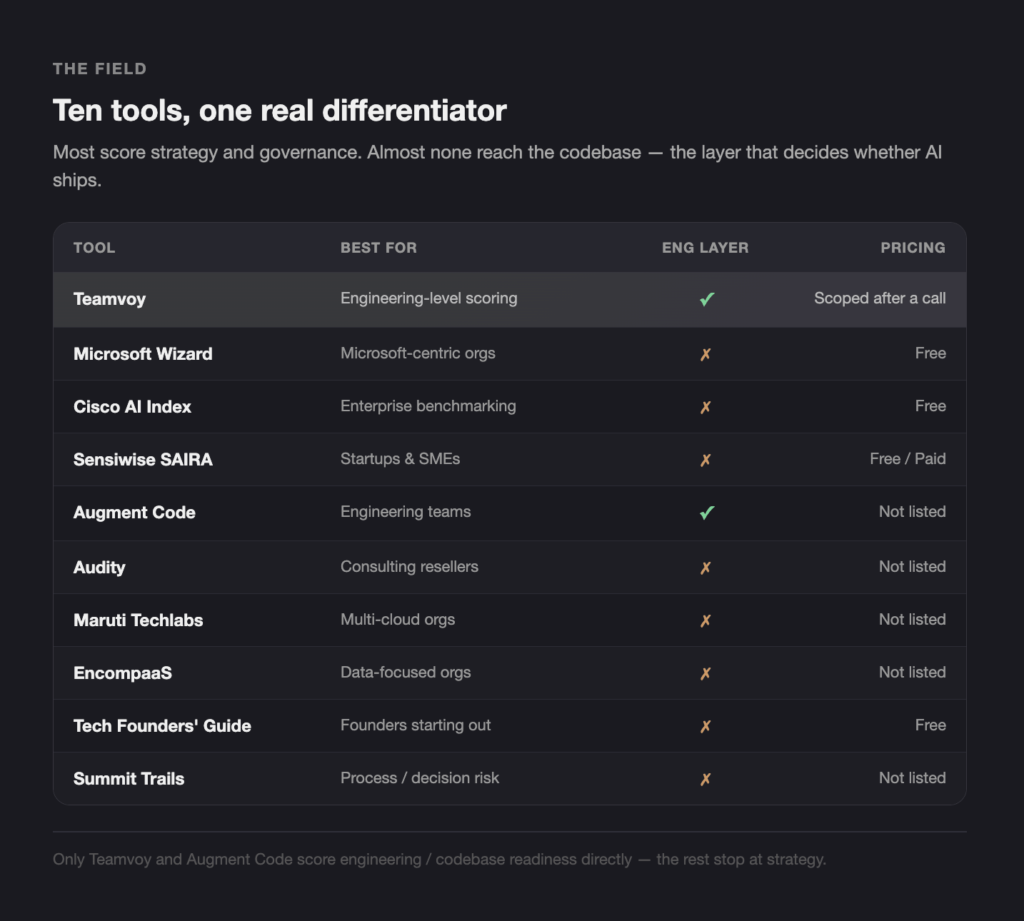
AI readiness assessment tools score an organization’s preparedness for AI adoption across strategy, data, infrastructure, governance and culture, then return a report of gaps and next steps. The tools differ mainly in whether that report reaches engineering-level detail or stays at the strategy level. Teamvoy compared ten of them, including its own, against those criteria.
- Over 85% of AI projects stall without a proper readiness assessment
- Only 13% of organizations are fully prepared for AI adoption
- The best tools cover strategy, data, infrastructure, governance and culture — the strongest ones also score codebase and engineering readiness, which most skip
- Pricing splits into three tiers: free self-serve, freemium, and scoped engagements priced after a call
- A useful assessment converts its score into a phased roadmap, not just a number
At a Glance: Best AI Readiness Assessment Tools
The best AI readiness assessment tools give a clear read on an organization’s preparedness across strategy, data, infrastructure, governance and culture, which helps a business avoid the kind of AI project failure that shows up only after budget is already spent. Picking the right one comes down to whether it delivers actionable next steps, reaches engineering-level detail, and scales with the size of the organization running it.
- Effective tools assess engineering readiness and codebase health, not just business strategy — most competitors skip this
- Cloud and hybrid support is a real differentiator for scalability and team collaboration
- Tools split by business size: startup-friendly free tiers versus enterprise-grade benchmarking
- The strongest tools convert results into a prioritized AI adoption roadmap, not just a score
| Name | Best For | Key Features | Strengths | Limitations | Pricing |
|---|---|---|---|---|---|
| Teamvoy AI Readiness Assessment | Organizations needing engineering-level scoring, not just a strategy survey | Strategy, data, infrastructure, culture, governance, codebase health, decision-readiness, cloud/hybrid support | Combines business and engineering assessment; scores against your actual repositories | Consulting-style engagement, not self-serve | Fixed fee, scoped after a technical call |
| Microsoft AI Readiness Wizard | Microsoft-centric environments | Business strategy, technology/data, AI experience, culture | Free, tailored next steps, leadership focus | Generic outside the Microsoft ecosystem | Free |
| Cisco AI Readiness Index Assessment | Large enterprises wanting peer benchmarking | Strategy, infrastructure, data, governance, talent, culture | Comprehensive benchmarking against thousands of companies | No engineering/codebase layer | Not publicly listed |
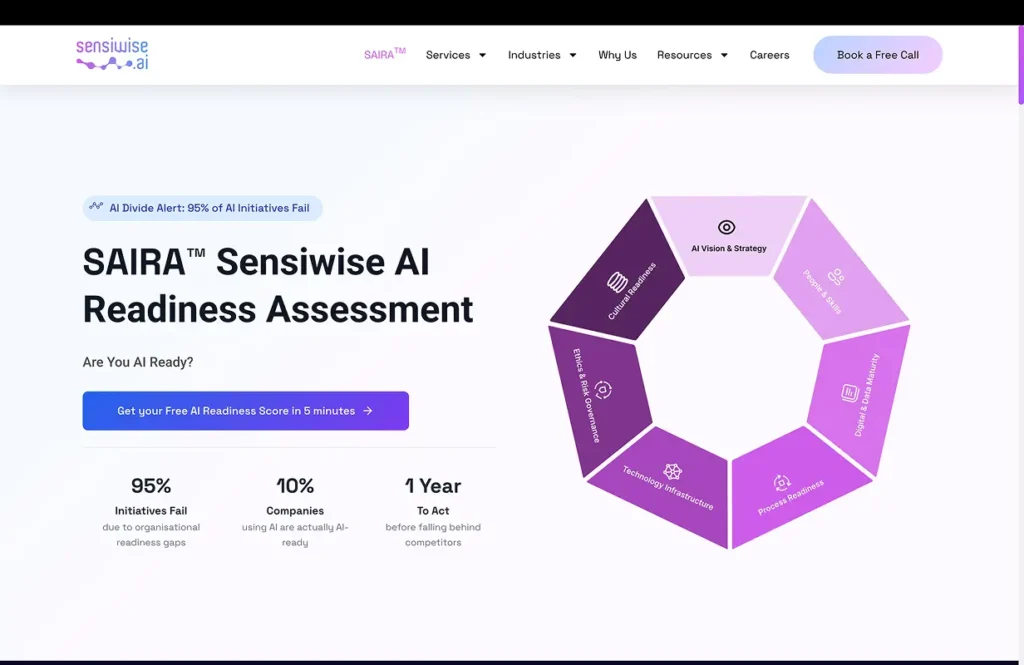
| Sensiwise SAIRA | Startups and SMEs | Seven pillars including ethics and process, hybrid/multi-cloud support | Free basic tier, custom roadmaps | Full diagnostic sits behind a paywall | Free/Paid |
| Augment Code AI Engineering Readiness Framework | Engineering teams | Codebase health, test coverage, delivery workflows | The only tool here scoring engineering readiness exclusively | No business-strategy layer at all | Not publicly listed |
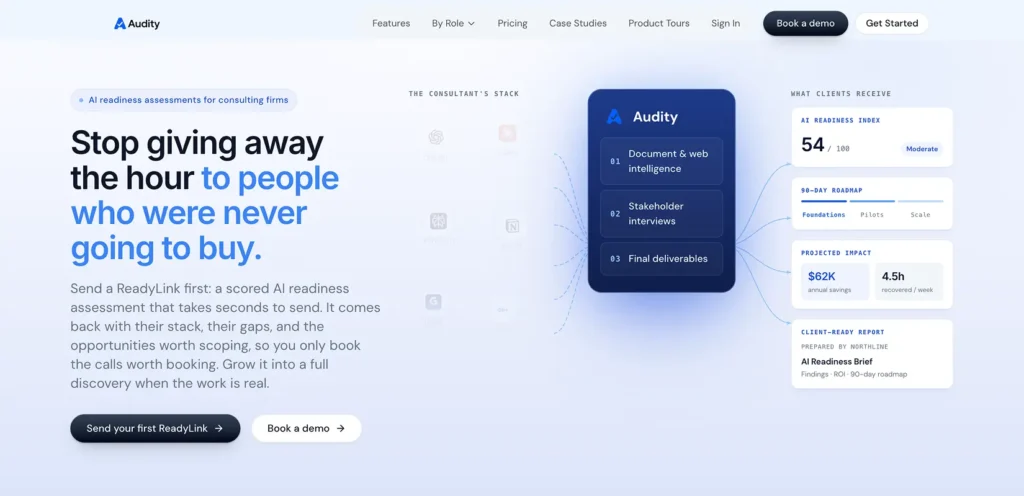
| Audity AI Readiness Platform | Consulting firms reselling assessments | Scored readiness, gap analysis, ROI projections, client-ready reports | White-label, repeatable across clients | Built for resellers, not direct buyers | Not publicly listed |
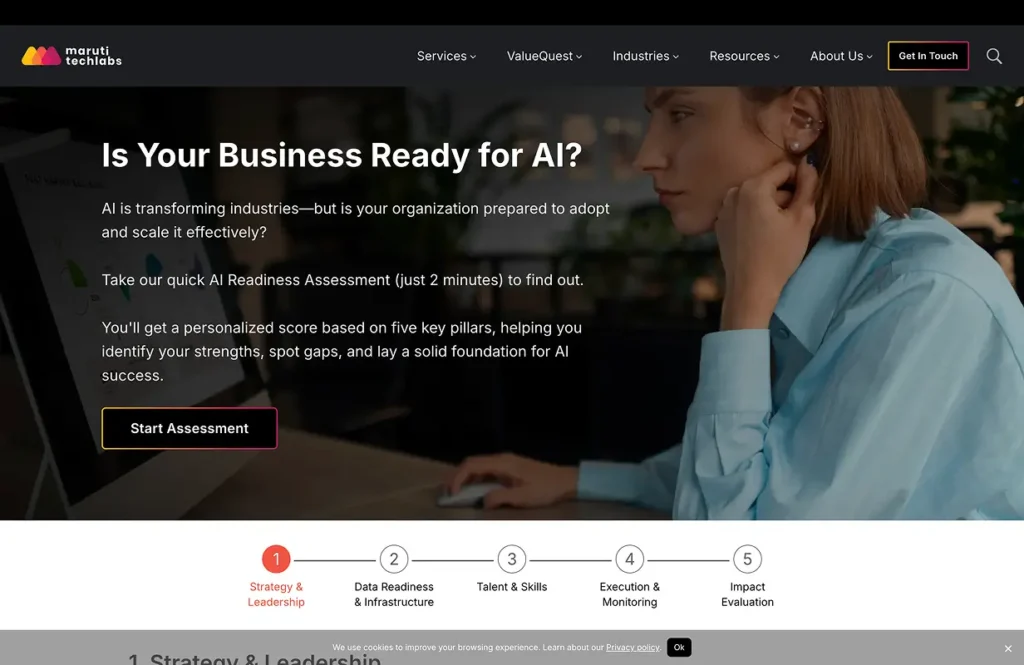
| Maruti Techlabs AI Readiness Assessment | Multi-cloud organizations | Skills, data, infrastructure, governance, cloud integration | Strong multi-cloud and hybrid scoring | Less differentiated for single-cloud teams | Not publicly listed |
| EncompaaS AI Data Readiness Assessment | Data-focused organizations | Data discovery, mapping, quality | Five-question survey, fast | Scores data only — no strategy or infrastructure | Not publicly listed |
| The Tech Founders’ Startup/SME Guide | Founders who don’t know where to start | Tool matchmaker based on size, budget, technical setup | Free, five-minute routing decision | Not a direct assessment tool | Free |
| Summit Trails Decision-Readiness Assessment | Organizations whose real risk is process, not infrastructure | Task-level automation fit, decision-readiness | Scores whether teams will act on AI output, not just technical readiness | Less focus on technical/infrastructure detail | Not publicly listed |
AI is changing how businesses work, but most companies aren’t ready to get real value from it. The best AI readiness assessment tools help you find out if your organization is ready for AI, show you what needs fixing, and guide you to results. In this guide, we at Teamvoy compare the top tools, explain what makes one worth using, and set out what an assessment needs to check differently for a regulated fintech versus an AI-native startup selling into one. You’ll see why choosing the right AI readiness assessment tool matters more than ever in 2026.
Why AI Readiness Assessments Matter in 2026
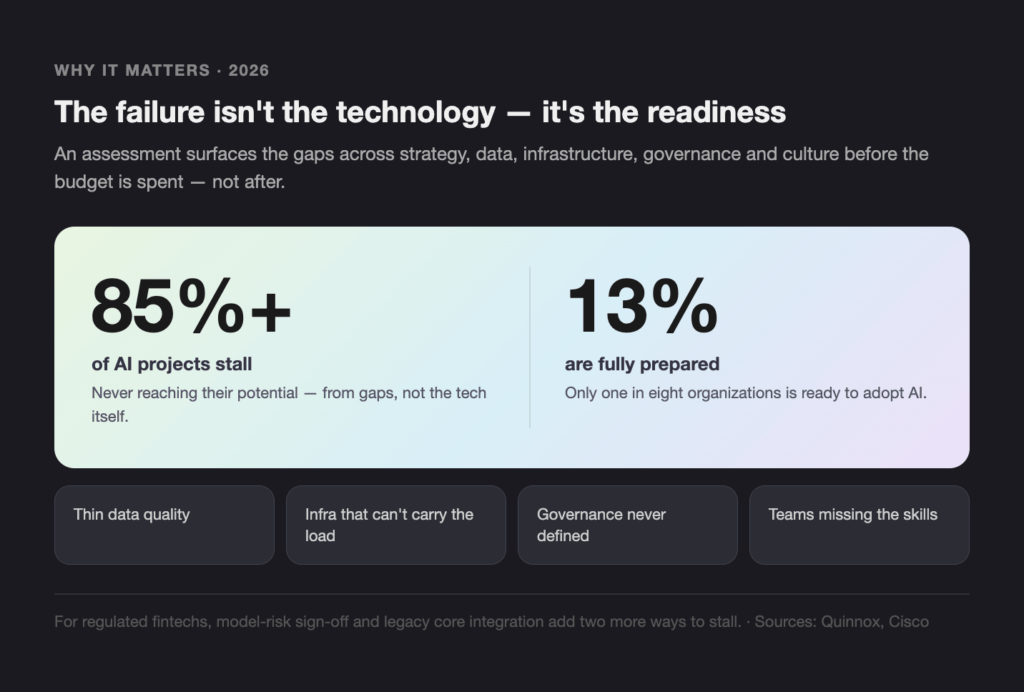
In 2026, an AI readiness assessment is what stands between a company and a stalled AI initiative. Over 85% of AI projects fail to reach their full potential because of gaps in infrastructure, data hygiene, governance, or expertise — not because the underlying AI technology doesn’t work. An assessment surfaces those gaps across strategy, technology and culture before the budget is spent, not after.
Most organizations want the outcome AI promises, but the reality is blunter: over 85% of AI projects never deliver as expected (Quinnox). The reasons repeat across companies — thin data quality, infrastructure that can’t carry the load, governance that was never defined, and teams without the skills the project assumed. Those are the same gaps that stall AI initiatives inside regulated fintechs specifically, where model risk sign-off and legacy core integration add two more ways for a project to stall before it starts.
An AI readiness assessment fixes this by:
- Checking strategy, data, infrastructure, culture and governance against what an AI initiative actually requires
- Showing where the organization is strong and where it will hit a wall
- Sequencing next steps so budget goes to the blocking gaps first, not the easy ones
An assessment is more than a checkbox before a board presentation. It’s a map, and it’s what keeps a team from repeating the mistakes that stall most AI work before it ships.
How We Evaluated AI Readiness Assessment Tools
We evaluated AI readiness assessment tools on coverage of five core pillars — strategy, data, infrastructure, governance, culture — plus how actionable the output is, how well it scales across business sizes, and whether it reaches engineering and codebase detail or stops at strategy. The criteria draw on Teamvoy’s own experience deploying AI and running modernization projects for organizations of different sizes.
With this many tools claiming to be the best AI readiness assessment tool, surface features don’t tell you much. Teamvoy’s evaluation is shaped by work modernizing legacy systems and shipping AI into production systems — not by scoring a demo.
Evaluation criteria:
- Readiness pillars. Does the tool cover strategy, data, infrastructure, governance and culture?
- Actionable output. Does it return next steps, or just a score?
- Engineering fit. Does it assess the codebase and team skills, or only business strategy?
- Cloud and hybrid support. Does it handle AWS, Azure, Google Cloud and hybrid setups?
- Scalability. Does it work for a 20-person startup and a 2,000-person enterprise?
- Regulated-industry fit. Does it score model risk, audit trail, or data residency, or does “governance” stop at an internal policy question?
- AI-native fit. Does it check eval coverage, multi-tenancy isolation, or SOC 2 readiness, or does it assume the buyer is adopting AI rather than building and selling it?
We also checked whether each tool connects its output to a real roadmap, since a score with no sequenced next step is a report nobody acts on.
The last two criteria matter because a tool built for a generic enterprise buyer will score “governance” or “security” as satisfied without ever asking the specific questions a fintech’s model risk team or an AI-native startup’s enterprise prospect will ask. None of the ten tools in this comparison were built with either buyer as the primary audience — which is exactly the gap covered in the two sections that follow.
AI Readiness Assessment Frameworks vs. Tools
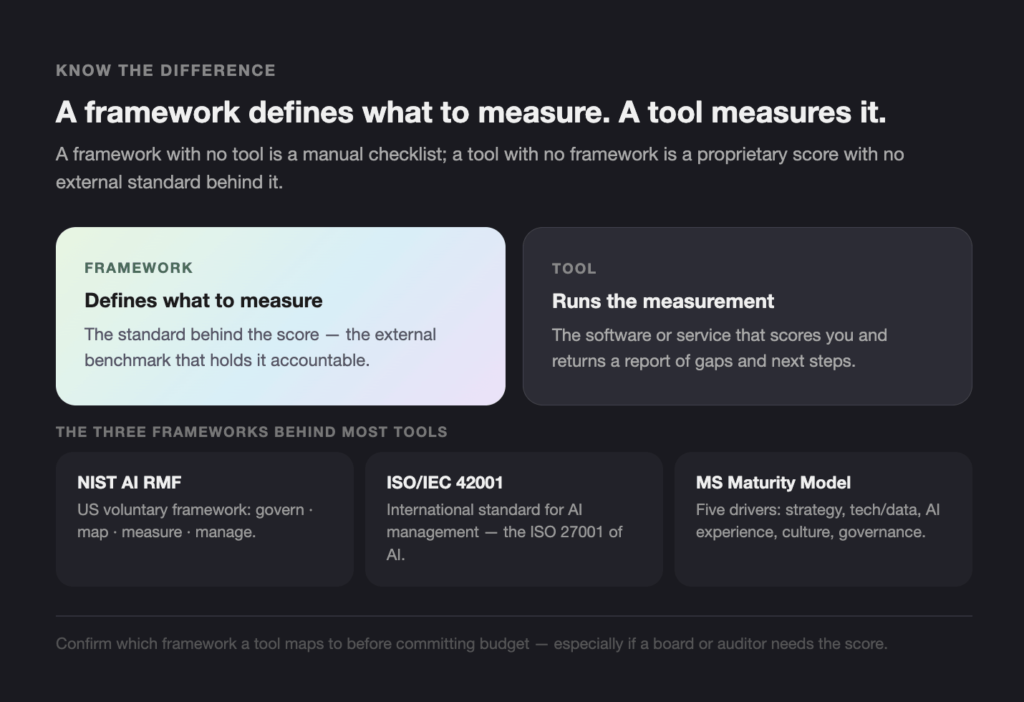
An AI readiness assessment framework defines what to measure. An AI readiness assessment tool is the software or service that measures it. The distinction matters for a buyer: a framework with no tool behind it is a checklist someone has to run manually, and a tool with no named framework behind it is a proprietary scoring system with no external standard holding it accountable.
Three frameworks sit behind most of the tools in this comparison:
- NIST AI Risk Management Framework (AI RMF) — the US government’s voluntary framework for managing AI risk across govern, map, measure and manage. Read it at nist.gov.
- ISO/IEC 42001 — the international standard for AI management systems, the AI equivalent of ISO 27001 for information security.
- Microsoft’s AI Maturity Model — the five-driver model (business strategy, technology/data, AI experience, culture, governance) behind the Wizard reviewed below.
Some tools score against a named framework explicitly — Cisco’s Index is built on its own benchmarking model, and Microsoft’s Wizard follows Microsoft’s own maturity drivers. Others, like Sensiwise SAIRA and Teamvoy’s own assessment, build pillars from a blend of NIST AI RMF principles and internal engineering criteria without claiming formal certification against a single standard. Neither approach is wrong, but a buyer who needs a score to satisfy a board or an auditor should confirm which framework, if any, it maps to before committing budget.
AI Readiness for Regulated Fintech: What an Assessment Has to Cover
A generic AI readiness assessment checks strategy, data, infrastructure, governance and culture. A fintech assessment has to check those same five pillars against a sixth layer none of the ten tools in this comparison are built around: regulatory evidence.
For a bank, payments company, lender or insurer, “governance” doesn’t stop at an internal policy document. It has to produce evidence a regulator or an auditor will accept:
- Model risk management — documentation that maps to SR 11-7-style model validation: who approved the model, what it was tested against, and how drift gets monitored after deployment.
- Audit trail — a record of every model decision that touched a real transaction, retained and retrievable, not just logged and forgotten.
- Data residency and GDPR — where training and inference data physically sits, and whether a model provider outside the EU ever touches EU customer data.
- EU AI Act risk classification — whether the AI feature falls into a “high-risk” category under the Act, which changes the documentation burden before deployment, not after.
- SOC 2 and PCI DSS evidence — proof the AI layer doesn’t create a new gap in controls that were already passing an audit before AI touched the workflow.
- FFIEC and NYDFS Part 500 — for US banks and NY-regulated financial entities, examiner expectations for third-party risk and cybersecurity that now extend to AI vendors and AI-generated decisions.
None of the ten tools compared in this guide score against this layer directly — they’re built for a general enterprise audience, not a regulated one. A fintech that runs one of them still needs a second pass mapping the readiness score to what its risk and compliance function will actually be asked to produce.
Talk to a CTO about a regulated-industry AI readiness assessment →
AI Readiness for AI-Native Startups: Evals, Multi-Tenancy and SOC 2
AI-native startups face a different readiness question than an enterprise adopting AI internally — not “can we deploy AI safely,” but “is our product ready to sell into an enterprise buyer who will ask about all of this in security review.” None of the ten tools compared in this guide are built for that specific buyer.
An AI-native company’s readiness assessment needs to score:
- Eval harness maturity — whether the model or agent has automated evaluation covering multi-step paths, not just a spot-check before each release.
- RAG infrastructure — for any product built on retrieval, whether the pipeline handles document versioning, access control at the chunk level, and stale-index detection.
- Multi-tenancy isolation — whether one customer’s data, prompts, or fine-tuning artifacts can leak into another’s session, the question every enterprise security review asks first.
- Production monitoring — observability on every model and tool call, so a bad output can be traced to the input that caused it rather than discovered by a customer first.
- SOC 2 readiness — whether the security posture the product needs to close an enterprise deal actually exists, or is still aspirational in a pitch deck.
A startup that scores well on the ten tools above but hasn’t been assessed against this list can still lose an enterprise deal in security review, because none of those tools ask the questions a large enterprise security team will. Teamvoy’s assessment covers this ground for AI-native companies specifically, folding it into the codebase-health and decision-readiness pillars rather than treating enterprise-readiness as a separate, later project.
The 10 Best AI Readiness Assessment Tools in 2026
This section reviews the top 10 AI readiness assessment tools for 2026, comparing their pillars, cloud integration and what makes each one a fit for a specific kind of buyer — from a startup running its first free check to an enterprise that needs a codebase-level review before an AI feature ships.
1. Teamvoy AI Readiness Assessment
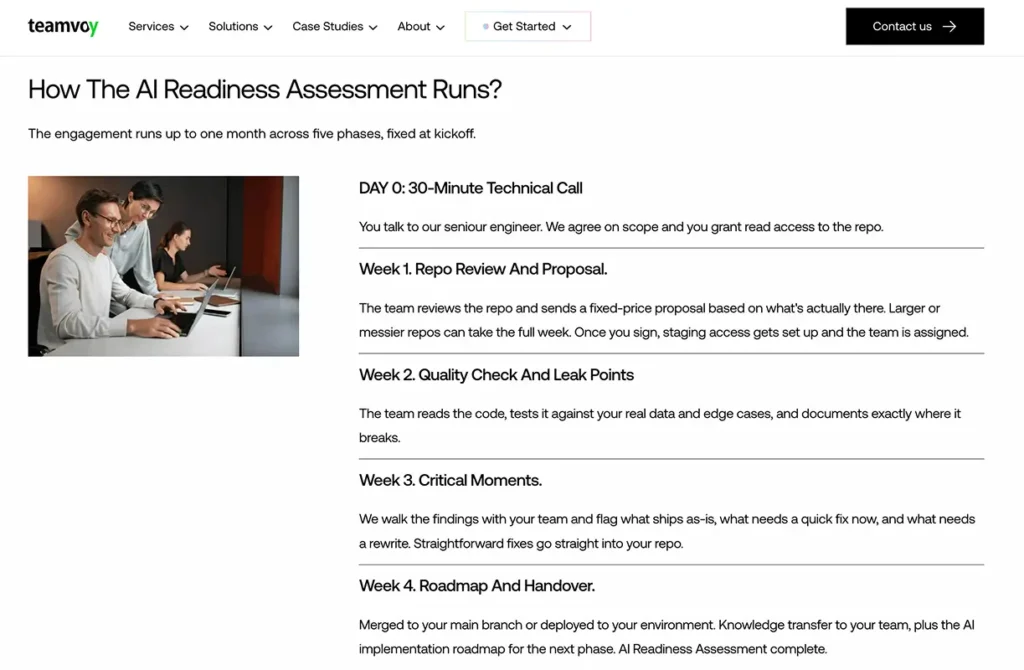
Teamvoy’s assessment scores strategy, data, infrastructure, governance and culture alongside two areas most tools in this list skip: codebase health and decision-readiness — whether the organization can actually act on what the assessment finds. The review runs against your repositories and architecture, not a questionnaire, so the score reflects what an engineer would find reading the code rather than what a team self-reports.
The assessment covers:
- Strategy, data, infrastructure, culture and governance
- Codebase quality and engineering workflows
- Decision-readiness: whether the business can act on the findings
- Cloud and hybrid integration
Teams that need a broader modernization effort after the assessment can move into an AI Modernization Sprint, Teamvoy’s delivery model for shipping the fixes an assessment identifies. For a fintech running core-banking or payments infrastructure, that typically means data lineage and legacy integration surface first; for an AI-native startup, it’s usually eval coverage and multi-tenancy isolation. For more on modernizing the systems underneath, see Legacy Systems Modernization: Choosing Swift vs Objective-C.
Request an AI readiness assessment →
2. Microsoft AI Readiness Wizard
Microsoft’s AI Readiness Wizard is a free, self-serve diagnostic built around five drivers: business strategy, technology and data, AI experience, culture and governance. It asks a structured set of questions, then returns tailored next steps weighted toward leadership alignment and continuous evaluation rather than technical implementation detail.
The Wizard’s real strength shows for organizations already running on Microsoft’s stack — Azure, Microsoft 365, Copilot — where its recommendations map directly onto tools the team already owns. Outside that ecosystem the advice stays generic enough to apply anywhere, which is also its limit: it won’t tell you whether your specific codebase or data pipeline can carry the AI feature you’re planning (Microsoft).

3. Cisco AI Readiness Index Assessment Tool
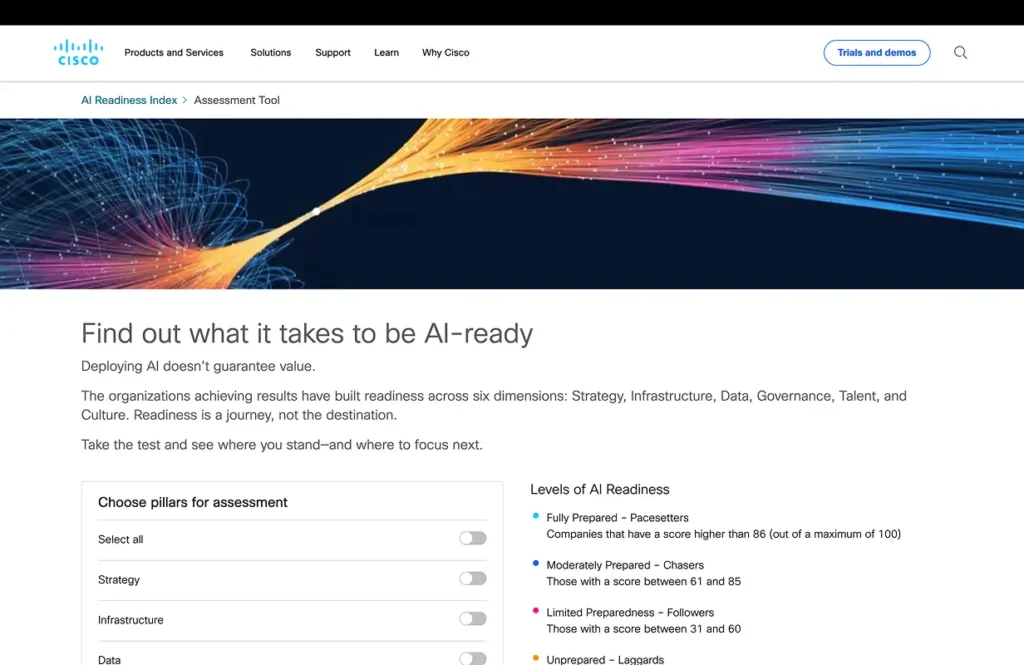
Cisco’s AI Readiness Index benchmarks an organization against six pillars: strategy, infrastructure, data, governance, talent and culture. It’s free and self-serve, and Cisco backs it with survey data across thousands of companies — the source of the “only 13% fully prepared” figure cited earlier in this guide (Cisco).
That benchmarking depth is the advantage: a score arrives with a peer comparison, not just a number in isolation. The trade-off is scope — the Index measures readiness at a strategic level and doesn’t touch codebase or engineering delivery capacity, so an enterprise using it to satisfy a board conversation still needs a technical assessment before an AI feature ships.
4. Sensiwise SAIRA
SAIRA’s free tier runs a quick baseline assessment; the paid tiers go deeper across seven pillars, including two most competitors skip entirely — ethics and process maturity — alongside the standard strategy, data, infrastructure, governance and culture set.
It’s built for startups and SMEs rather than enterprise procurement cycles: setup is fast, the roadmap output is scoped to a small team’s actual capacity, and hybrid and multi-cloud environments are supported without extra configuration. The free-to-paid path also lets a team validate the tool’s fit before committing budget to the deeper diagnostic.
5. Augment Code AI Engineering Readiness Framework
Augment Code’s framework is the only tool in this comparison built exclusively around engineering readiness — codebase health, test coverage and delivery workflow maturity — with no business-strategy layer at all. That’s a deliberate scope choice, and it fills a real gap: Augment Code’s own research found 88% of organizations already use AI in some form, but fewer than 20% track results for generative AI specifically, which points at a measurement problem inside engineering, not strategy (Augment Code).
Pair it with a strategy-level tool like Microsoft’s or Cisco’s rather than relying on it alone — it won’t tell you whether the business case for AI holds up, only whether the codebase can support what you’re planning to ship. See also How to Build AI Development Workflow: Tips and Use Cases.
6. Audity AI Readiness Platform
Audity is built for consulting firms that need to run the same diagnostic across multiple clients and hand back a branded, client-ready report. It scores readiness, runs a gap analysis, and projects ROI — the projection is the piece most tools in this list skip, and the reason firms choose Audity over a generic survey tool.
The white-label positioning is also its limit for a direct buyer. If you’re assessing your own organization rather than reselling the assessment to clients, the repeatable-diagnostics framing adds overhead you don’t need.
7. Maruti Techlabs AI Readiness Assessment
Maruti Techlabs built its assessment around cloud integration specifically — skills, data, infrastructure and governance are all scored with an explicit eye on how they hold up across AWS, Azure, Google Cloud and hybrid deployments, rather than assuming a single-cloud environment.
That focus makes it a strong fit for organizations already running multi-cloud infrastructure and planning to keep AI workloads distributed the same way. Organizations on a single cloud, or without a multi-cloud roadmap, will find less differentiated value here than in a tool with broader pillar coverage.
8. EncompaaS AI Data Readiness Assessment
EncompaaS narrows its scope deliberately to data: discovery, mapping and quality, delivered through a five-question survey that takes minutes rather than the hour-plus most full assessments require. It doesn’t score strategy, infrastructure or codebase readiness at all.
That narrow scope is the right trade for a specific situation: an organization that already knows its strategy and infrastructure are AI-ready but is genuinely unsure whether its data is clean, governed and accessible enough to train or feed a model. For anyone earlier in the process, it answers one question well rather than the whole one.
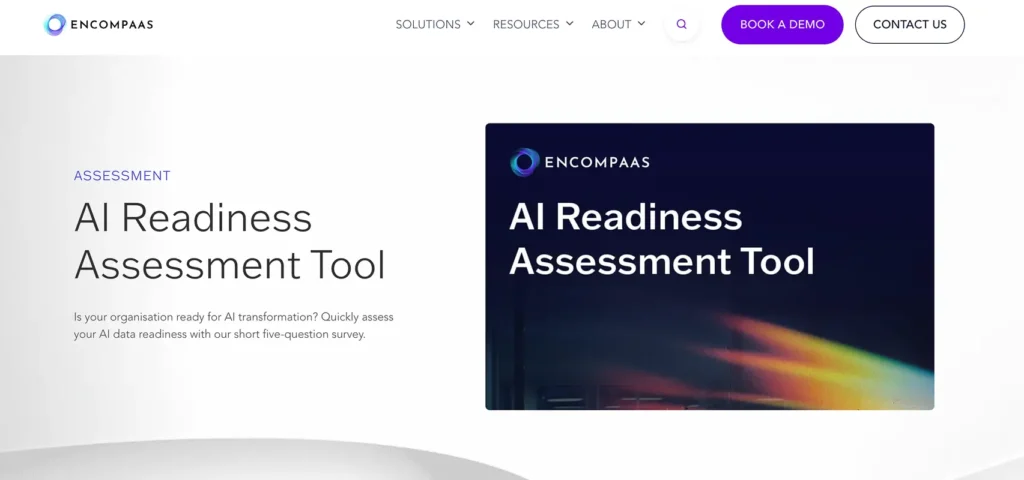
9. The Tech Founders’ Startup/SME AI Readiness Guide
This isn’t an assessment tool itself — it’s a free matchmaker guide that routes a founder to the right tool based on company size, budget and technical setup. For a startup or SME that doesn’t know where to start among the nine actual tools in this comparison, that routing function has real value: it turns a research problem into a five-minute decision.
The trade-off is depth. Because it recommends other tools rather than running its own diagnostic, it can’t replace a real assessment — treat it as the first step, not the last one.
10. Summit Trails Decision-Readiness Assessment
Summit Trails asks a different question than the other nine tools: not “is your organization technically ready for AI,” but “will your team actually act on what an AI system recommends.” It scores task-level automation fit and decision-readiness — whether the processes and people around a workflow can absorb an AI-driven recommendation without stalling at the human handoff.
It’s the right complement to a technical assessment for organizations whose real risk isn’t infrastructure but process: teams that have shipped AI pilots before and watched the output get ignored rather than acted on.
- Coverage of all core readiness pillars, not just one or two
- Actionable guidance and a sequenced roadmap, not just a score
- Support for cloud and hybrid environments
- Engineering and codebase assessment, for organizations planning technical AI adoption
- Scalability across business sizes, from a 20-person startup to a global enterprise
Only 13% of organizations globally are fully prepared for AI adoption (Cisco), so choosing a tool that fits the actual context matters more than picking the best-known name. Notably, 75% of AI “Pacesetter” businesses report staff proficiency in AI, versus just 16% of everyone else (Cisco) — a gap an assessment is built to close.
AI Readiness Assessment Checklist: Score Yourself First
Before paying for any tool on this list, score the organization against these eight questions. This is a reader self-check spanning the areas most tools in this list measure between them — it isn’t a restatement of any single vendor’s own scoring methodology, including Teamvoy’s. A “no” on more than two means a formal assessment will find real gaps — useful information, not a reason to skip it.
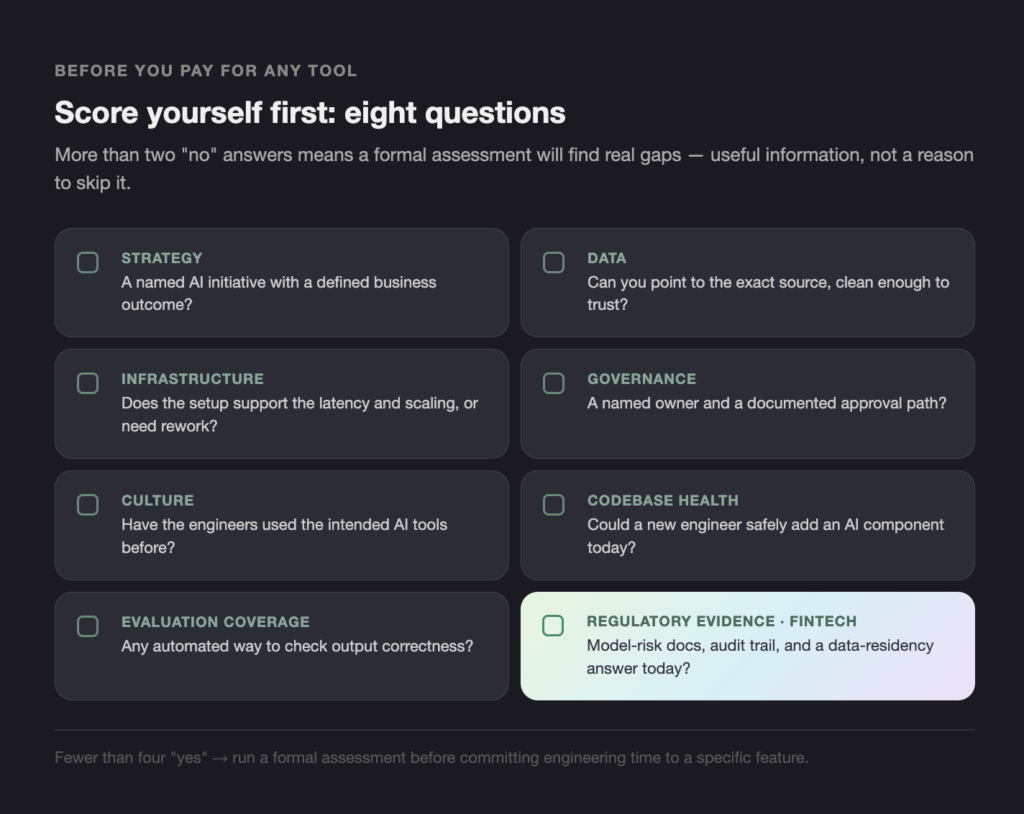
- Strategy — Is there a named AI initiative with a defined business outcome, or is “we’re exploring AI” the extent of the plan?
- Data — Can the team point to the specific data source an AI feature would read from, and confirm it’s clean enough to trust?
- Infrastructure — Does the current cloud and deployment setup support the latency and scaling an AI feature needs, or would it need rework first?
- Governance — Is there a named owner for AI decisions, with a documented approval path, or does responsibility sit nowhere specific?
- Culture — Have the engineers who’d build the feature used the intended AI tools and frameworks before, or would this be a first attempt under deadline pressure?
- Codebase health — Would a new engineer joining today understand the codebase well enough to safely add an AI component, or is onboarding already a multi-week process?
- Evaluation coverage — Is there any automated way to check whether a model or agent’s output is correct, or does correctness get checked by a person reading the output?
- Regulatory evidence (fintech and regulated industries only) — Can the organization produce model risk documentation, an audit trail, and a data residency answer today, or would all three need to be built from scratch?
An organization scoring “yes” on six or more of these is closer to production-ready than most of the tools reviewed above will assume by default. Fewer than four “yes” answers points toward a formal assessment before committing engineering time to a specific AI feature — the gap analysis from a paid or free tool above will do faster and more completely what this checklist does as a first pass.
Engineering and Codebase Readiness: Overlooked but Critical
Most AI readiness assessments overlook engineering and codebase health, which is often what actually determines whether an AI initiative moves past the pilot stage. Codebase quality, test coverage and review capacity decide whether a team can ship an AI feature safely, and tools that skip this layer miss the most common reason production AI stalls.
The gap shows up in the data: 88% of organizations already use AI in some form, but fewer than 20% track real results for generative AI (Augment Code) — a measurement failure that starts with engineering, not strategy.
AI projects most often stall after the pilot for three reasons:
- The codebase is too tangled to hold a new AI component safely
- Test coverage is thin, so every change risks breaking something else
- The engineering team is overloaded or missing the specific skills the project needs
Assessing engineering readiness matters as much as assessing business strategy, which is why Teamvoy builds codebase checks and workflow reviews into its own assessment rather than treating them as a separate add-on. Skip this step and even a well-funded AI plan risks becoming shelfware. For more on the delivery model that follows an assessment, see AI Modernization Sprints: The Only Way to Modernize Without Losing Control.
Cloud Integration and Scalability in AI Readiness Assessments
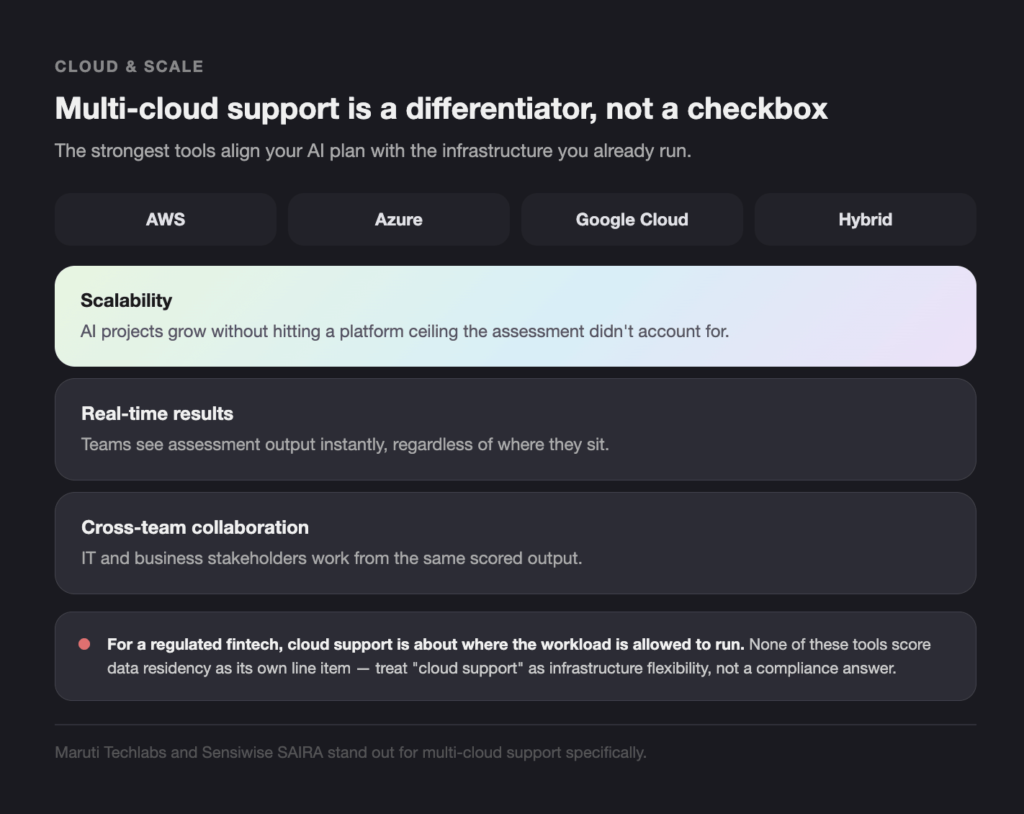
Cloud integration is a real differentiator among AI readiness tools, not a checkbox feature. The strongest tools support AWS, Azure, Google Cloud and hybrid environments, which lets an organization align its AI adoption plan with the infrastructure it’s already running rather than the infrastructure the tool assumes.
Modern organizations rarely run on one cloud, or purely on-premise. The tools compared here that support AWS, Azure, Google Cloud and hybrid setups give three concrete advantages:
- Scalability — AI projects can grow without hitting a platform ceiling the assessment didn’t account for
- Real-time results — teams see assessment output instantly, regardless of where they sit
- Cross-team collaboration — IT and business stakeholders work from the same scored output
Maruti Techlabs and Sensiwise SAIRA stand out in this comparison for multi-cloud support specifically, which speeds up AI adoption for organizations that have already committed to a distributed cloud strategy.
For a regulated fintech, cloud support isn’t only about scale — it’s about where the workload is allowed to run. A tool that scores infrastructure readiness without asking whether inference happens inside a customer’s own VPC, or whether a model provider processes EU customer data outside the EU, is missing the question a fintech’s compliance function will ask first. None of the tools compared here score data residency as its own line item; treat “cloud and hybrid support” in this list as infrastructure flexibility, not a compliance answer.
Choosing the Right AI Readiness Tool for Your Business Size
Selecting the right AI readiness assessment tool depends on organization size, technical maturity and what question actually needs answering. Startups and SMEs benefit from accessible tools with a low-cost or free entry point; enterprises usually need deeper customization, peer benchmarking and integration with existing governance frameworks.
Startups and SMEs need simplicity, fast insight and cost control. Sensiwise SAIRA and The Tech Founders’ guide are built for exactly that — quick setup, a roadmap scoped to a small team’s capacity, and no enterprise procurement overhead.
Enterprises typically need:
- Customization for complex, multi-team workflows
- Peer benchmarking against named industry standards
- Integration with existing governance and compliance tooling
How to choose an AI readiness assessment provider comes down to matching scope to the actual open question. A strategy-level tool like Cisco’s or Microsoft’s Wizard answers whether leadership and data governance are aligned; an engineering-level tool like Augment Code’s or Teamvoy’s answers whether the codebase can support what’s planned. If the real question is broader than AI — whether the entire technology estate is sound — an IT audit answers that, with AI readiness as one section inside it rather than the whole scope. Picking the right tool for the actual situation saves time and avoids a mismatch that shows up only after budget is spent.
Business size isn’t the only axis that matters, either. A regulated fintech and an AI-native startup selling into enterprise buyers both need more than the ten tools above provide by default — one needs the regulatory-evidence layer covered in “AI Readiness for Regulated Fintech” above, the other needs the eval-and-multi-tenancy layer covered in “AI Readiness for AI-Native Startups.” Neither gap shows up on a generic readiness scorecard until someone asks for the evidence specifically.
Turning Assessment Results into an AI Adoption Roadmap
An AI readiness assessment is most valuable when its results turn into concrete action. The strongest tools return a gap analysis and prioritized recommendations, so an organization can sequence next steps, allocate resources, and build a phased roadmap rather than filing the report away.
A readiness score means little unless it guides what happens next. The best tools, including Teamvoy’s own assessment, turn results into a real plan by:
- Naming gaps and strengths explicitly, not just scoring them
- Prioritizing fixes by business impact, not by what’s easiest to fix first
- Building a phased AI adoption roadmap with sequenced milestones
- Linking technical findings to business outcomes a non-technical stakeholder can act on
That sequencing is the difference between a stalled pilot and a rollout that ships. For more on building the roadmap itself, see AI Transformation Roadmap for Enterprises. For the broader framework an enterprise readiness review should cover before the board signs off on budget, see Enterprise AI Readiness Assessment.
Common Mistakes When Running an AI Readiness Assessment
An assessment only pays for itself if the organization avoids a handful of predictable mistakes that turn a useful diagnostic into a shelved report.
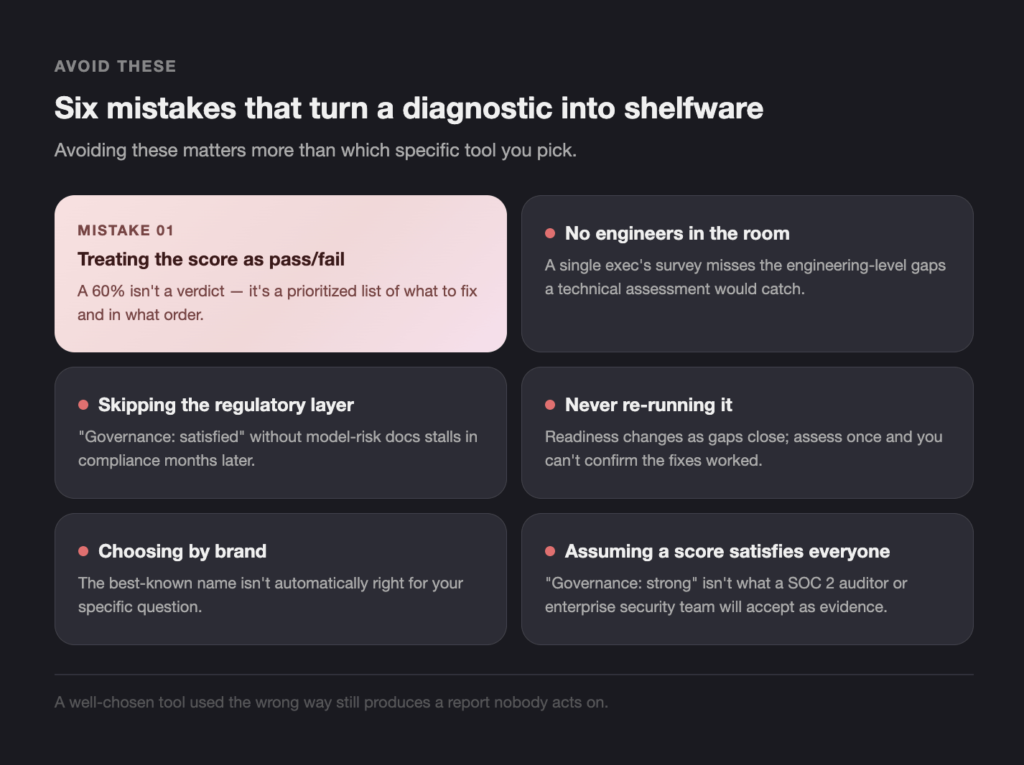
Treating the score as a pass/fail gate instead of a roadmap input. A 60% readiness score isn’t a verdict — it’s a list of what to fix and in what order. Organizations that wait for a perfect score before starting anything delay a project that could have shipped with three specific fixes made first.
Running the assessment without the engineers who’ll build the feature in the room. A strategy-level survey completed by a single executive misses the engineering-level gaps a technical assessment would catch, and vice versa. The strongest results come from combining both perspectives, which is why tools that score codebase health alongside strategy tend to produce more actionable output.
Skipping the regulatory layer at a regulated company. A fintech that runs a generic assessment and treats “governance” as satisfied without checking model risk documentation, audit trail retention, or EU AI Act classification will pass the assessment and then stall in a compliance review months later — the same failure the assessment was supposed to prevent, just moved downstream.
Not re-running the assessment after the first round of fixes. Readiness changes as gaps close. An organization that assesses once, fixes the top three findings, and never checks again has no way to confirm the fixes worked or to catch what the first pass didn’t have visibility into.
Choosing the tool by brand recognition instead of scope. The best-known name in AI readiness assessment isn’t automatically the right one for a specific question — see “How do you choose an AI readiness assessment provider” below for the actual selection criteria.
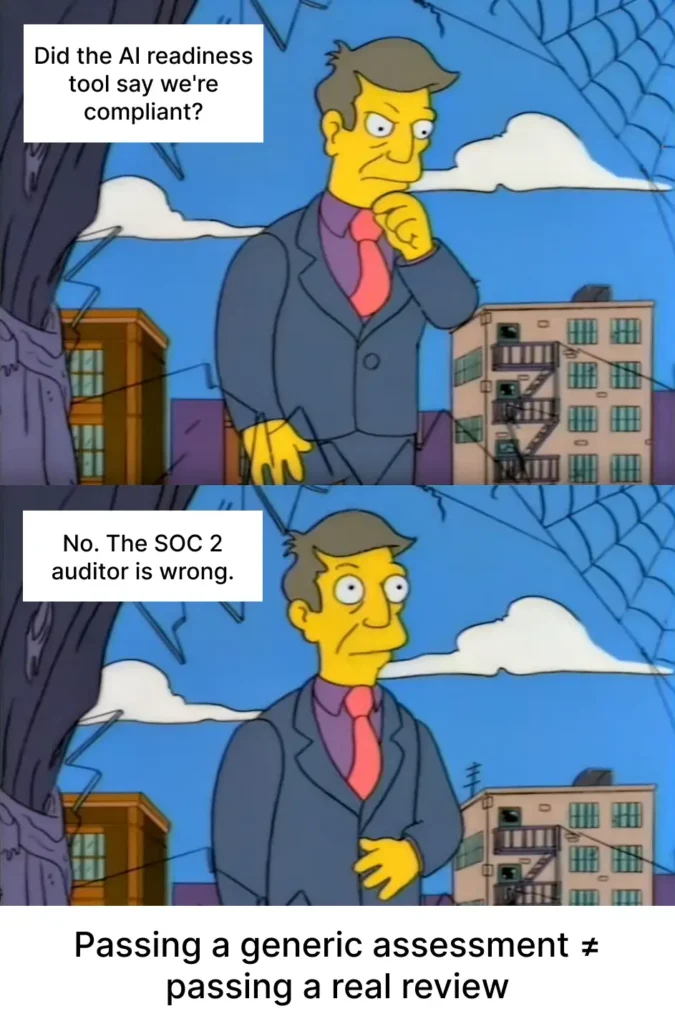
Assuming a passing score satisfies a downstream reviewer it was never built for. A general tool’s “governance: strong” rating means the organization has a policy in place — it doesn’t mean a model-risk committee, a SOC 2 auditor, or an enterprise security team will accept that policy as evidence. Confirm what the score actually needs to satisfy before treating it as a green light.
Avoiding these six mistakes matters more than which specific tool gets chosen, because a well-chosen tool used the wrong way still produces a report nobody acts on.
Conclusion
The path to successful AI adoption starts with knowing where an organization actually stands. The best AI readiness assessment tools compared here surface the current state, name what’s missing, and point toward a result rather than a report that sits unread. Teamvoy builds this kind of assessment specifically for regulated fintechs and AI-native companies preparing to scale — the two situations where a generic tool’s output stops being enough. A fintech gets the regulatory evidence layer covered above folded into governance; an AI-native startup gets the eval and multi-tenancy checks a security review will actually run. Neither is a separate add-on, because neither buyer can treat “readiness” and “audit-ready” or “enterprise-ready” as different questions. The right assessment tool is the first step, and it’s worth choosing deliberately rather than defaulting to whichever tool comes up first in search.