

- Claude Enterprise customers can now read what they're depending on: Anthropic's amended S-1 of 2026-11-10 discloses about $900.9 billion in compute and infrastructure commitments against $33.2 billion of revenue for the nine months to 2026-09-30. About $70.7 billion of that spend falls due within twelve months.
- The same filing shows a board where a trust with no economic stake elects the majority of directors, and a single founder share carries 50.1% of the vote. Whether that's reassuring or alarming depends on which number you weight, and the answer for most teams running Claude is quieter than the headlines suggest.
Your team runs Claude in production. Prompt caching is tuned, tool-use schemas are stable, and Claude Code is in the daily workflow. Then the model vendor files a prospectus that puts its balance sheet, its compute obligations, and its board structure in public for the first time. What in that filing should change how you manage the dependency?
What is Claude Enterprise, and what does the IPO change for it?
Claude Enterprise is Anthropic’s organization-wide plan: chat, Claude Code, Cowork, connectors, SSO, SCIM, audit logs, and admin controls under one identity and one policy, per claude.com (accessed 2026-11-16). The Anthropic IPO changes none of those features on day one. What it changes for Anthropic enterprise customers is visibility: the vendor behind the plan becomes a reporting company with audited financials and a public ownership structure you can read.
Think about how strange the old arrangement was. The company behind the model your product calls in production had never shown you its books. You had a SOC 2 report, a contract, and a pricing page. On that basis you routed production traffic, tuned caching, and built agent workflows around one vendor’s tool-use semantics. Now there’s a prospectus. This article reads the amended S-1 (Amendment No. 2, filed 2026-11-10) the way a procurement or platform team would: as an AI vendor risk file. If you’re following the Anthropic IPO as an investor, most of the coverage is already written for you. If you’re the person who signed off on the dependency, this one’s for you.
The offering mechanics are context, not the story. Per the S-1/A-2, Anthropic is offering 825,000,000 Class A shares at a filed range of $70.00 to $78.00, on the Nasdaq Global Select Market under the symbol ANT. CNBC reported on 2026-11-10, citing sources, that pricing is expected on 2026-11-18 and trading on 2026-11-19 (CNBC). Those two dates aren’t in the filing and Anthropic hasn’t confirmed them, so treat them as reported. The offering had not priced at the time of writing, and this article states no final price.
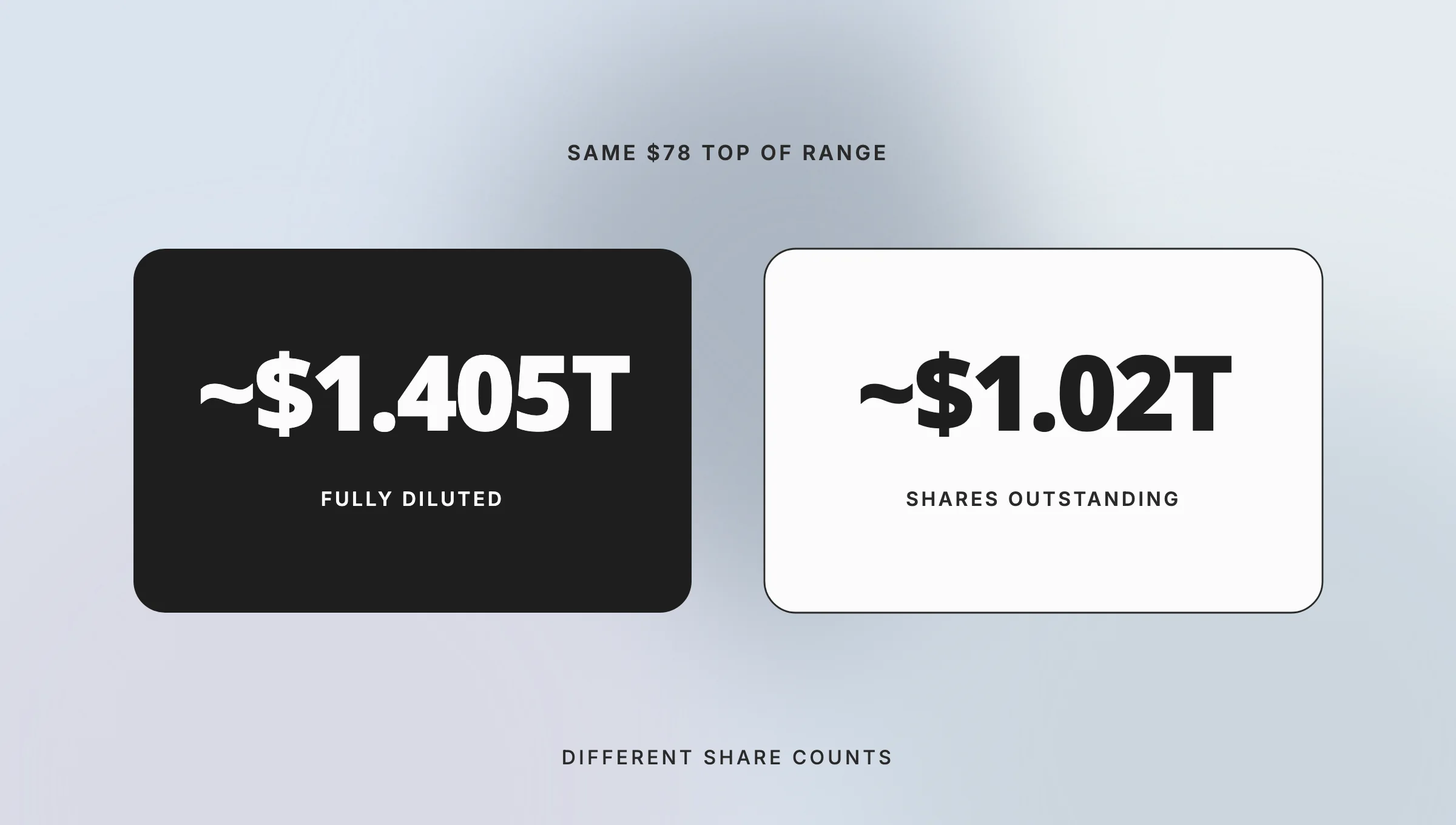
Valuation gets quoted two ways, and sloppy coverage mixes them. At the $78 top of the range, CNBC puts the fully diluted valuation at about $1.405 trillion (2026-11-10). On shares outstanding after the IPO and the concurrent private placement, stockanalysis.com puts it at about $1.02 trillion. Same range, different share counts. Both are arithmetic, not a verdict on the business. For reference, Anthropic’s prior private round closed in May 2026 at a $965 billion post-money valuation, per Anthropic’s own announcement (2026-05-28). The number a customer should care about isn’t the valuation. It’s what the company has promised to spend to earn it.
What did the S-1 actually disclose about compute?
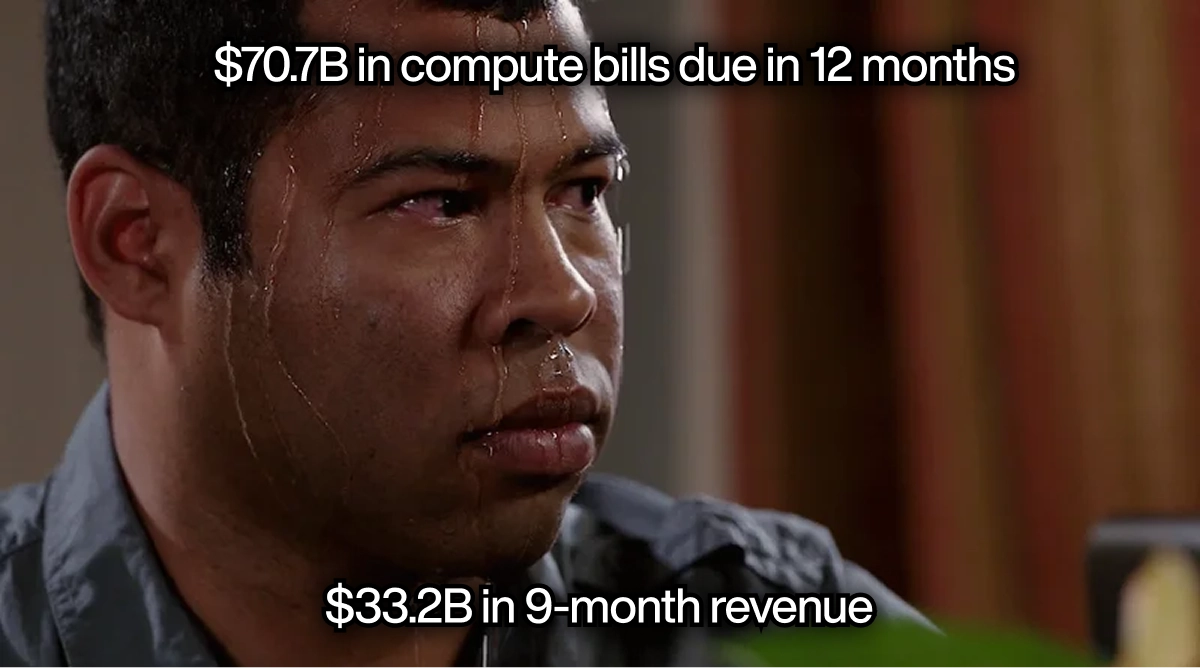
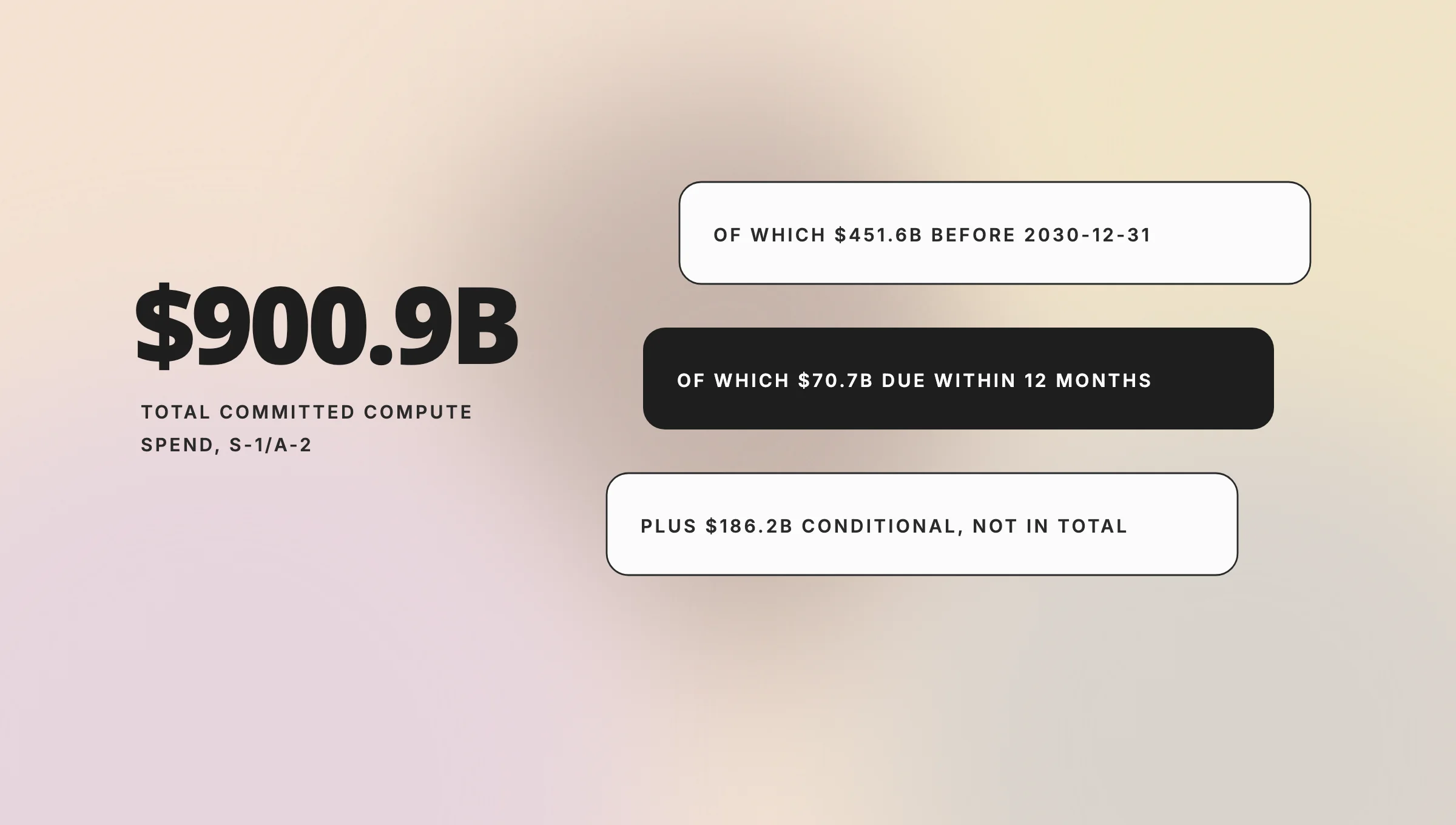
The S-1/A-2 discloses about $900.9 billion of aggregate committed spend, substantially all of it compute and infrastructure, as of and subsequent to 2026-09-30. Of that, about $451.6 billion is expected before 2030-12-31 and substantially all the remainder between 2031 and 2045. About $70.7 billion falls due in the twelve months after 2026-09-30. Revenue for the nine months to the same date was $33.242 billion.
Put those two figures side by side. $900.9 billion of commitments against $33.2 billion of nine-month revenue is roughly 27 times. The sharper comparison is the near one: $70.7 billion falls due inside twelve months, more than double the revenue the company booked in the nine months before it. That’s the number the Anthropic IPO coverage leads with, and it deserves a careful read rather than a reflex. It’s a bet. A large one, placed on capacity your product will run on, and you weren’t in the room. Four details in the filing change what it means for you.
| Disclosure (S-1/A-2, filed 2026-11-10) | Amount | What it is |
| Aggregate committed spend | ~$900.9 billion | Purchase commitments plus leases, including short-term commitments and leases not yet commenced |
| Expected before 2030-12-31 | ~$451.6 billion | Roughly half the total, inside four years |
| Due in the 12 months after 2026-09-30 | ~$70.7 billion | The near-term cash obligation |
| With exercisable termination rights or conditions precedent | ~$186.2 billion | Can be ended if counterparty financing, facilities, or regulatory approvals don’t land |
| Variable-dollar arrangements, excluded from the $900.9B | $150–175 billion (estimate) | Usage-based compute with no fixed commitment |
| Contractual-obligations table at 2026-09-30 | $320.0 billion | $313.8 billion of it purchase commitments, mainly cloud hosting minimums |
First, the total includes leases that haven’t commenced and commitments that stretch to 2045. The contractual-obligations table, a narrower cut as of 2026-09-30, totals $320.0 billion, with $313.8 billion in purchase commitments, mainly cloud hosting minimums. Same filing, different fence around the same spend.
Second, about $186.2 billion sits in arrangements Anthropic or its counterparties can end if financing, facilities, or regulatory approvals don’t land. Conditional capacity. Roughly a fifth of the headline is optional on both sides.
Third, the $900.9 billion isn’t the ceiling. On top of it, the filing estimates another $150 billion to $175 billion in variable-dollar compute arrangements with no fixed commitment. The fixed figure is the floor.
Fourth, the architecture behind the spend is deliberately mixed. The S-1/A-2 names AWS Trainium, Google TPUs, NVIDIA GPUs, and AMD GPUs, managed as a “single, fungible pool.” It also describes “Anthropic Direct,” where Anthropic buys its own accelerators and runs them in dedicated data centers built to its spec and operated by others. The first such data center entered service in 2026. A significant share of the $900.9 billion relates to it, and the company expects that share to grow. Named arrangements in the filing include Amazon, where Anthropic committed to spend at least $110.0 billion between May 2026 and April 2036 regardless of actual usage, non-cancelable except on Amazon’s uncured material breach. They also include the SpaceXAI arrangements, up to $120.5 billion over terms extending into 2029, which either party may cancel on 90 days’ written notice once initial non-cancelable periods ending in January 2027 and March 2027 have passed.
Then look at who’s writing checks on the other side of the table. Per the S-1/A-2, Google ($10.0 billion), NVIDIA ($10.0 billion), AMD ($2.5 billion), Broadcom ($1.0 billion), Micron ($1.0 billion), Microsoft ($1.0 billion), and TSMC ($500 million) have agreed, severally and not jointly, to buy $26.0 billion of non-voting Class N stock at the IPO price. The Google TPUs, NVIDIA GPUs, and AMD GPUs the filing names in its compute architecture come from companies on that list. The suppliers behind the commitments are also putting equity in. Read that however you like. The filing makes the relationship explicit, which is more than most model vendors have ever shown a customer.
So the books are open, and the bet is enormous. The first thing anyone asks next is whether they’ll be the one paying for it.
Does a $900.9 billion commitment mean Claude API prices go up?
The filing doesn’t say that, and this article won’t predict it. What the S-1/A-2 discloses is the scale of Anthropic’s obligations and its take-or-pay exposure. Pricing for the Claude Enterprise plan and the API is a commercial decision Anthropic makes on its own schedule. The current rate card already states that “price and plans are subject to change at Anthropic’s discretion,” per claude.com/pricing (accessed 2026-11-16).
Picture the version of this you’d experience. A rate-card update lands in a changelog. Your team doesn’t read it, because rate cards don’t page anyone. Then the invoice arrives, and the agent workflow that ran fine at last quarter’s rates has moved your per-feature cost without a single line of your code changing. That scene isn’t a prediction about Anthropic. It’s what “subject to change at Anthropic’s discretion” means in operational terms, and it’s true of every API vendor you already pay.
Here’s what the filing does let you reason about. Anthropic reports that revenue grew 1,127% year over year for the three months ended 2026-09-30, while compute and infrastructure expenses grew 382% over the same period. The company presents that gap as evidence that its compute is getting more efficient per dollar of revenue. Maybe. That’s Anthropic’s framing in its own prospectus, not an independent finding, and a company selling shares has every incentive to present its cost curve well.
The useful question for a platform team isn’t “will prices rise” but “what happens to my unit economics if they do.” You can answer that one today, with your own data: tokens per feature, cache hit rates, the ratio of input to output, and which workloads could tolerate a smaller model. The Opus vs Sonnet comparison covers how much of a typical workload can move down a tier without a quality hit. Knowing that number before a price change is cheaper than learning it from the invoice.
Take-or-pay cuts the other way too. A vendor that has committed to $70.7 billion of capacity in the next twelve months (S-1/A-2) has a reason to keep that capacity utilized, and idle accelerators don’t earn back their commitment. Which direction that pushes list prices isn’t something the filing discloses, and it isn’t something a buyer should assume. What the filing does disclose, in detail, is who gets to make that call.
Who controls Anthropic after the IPO?
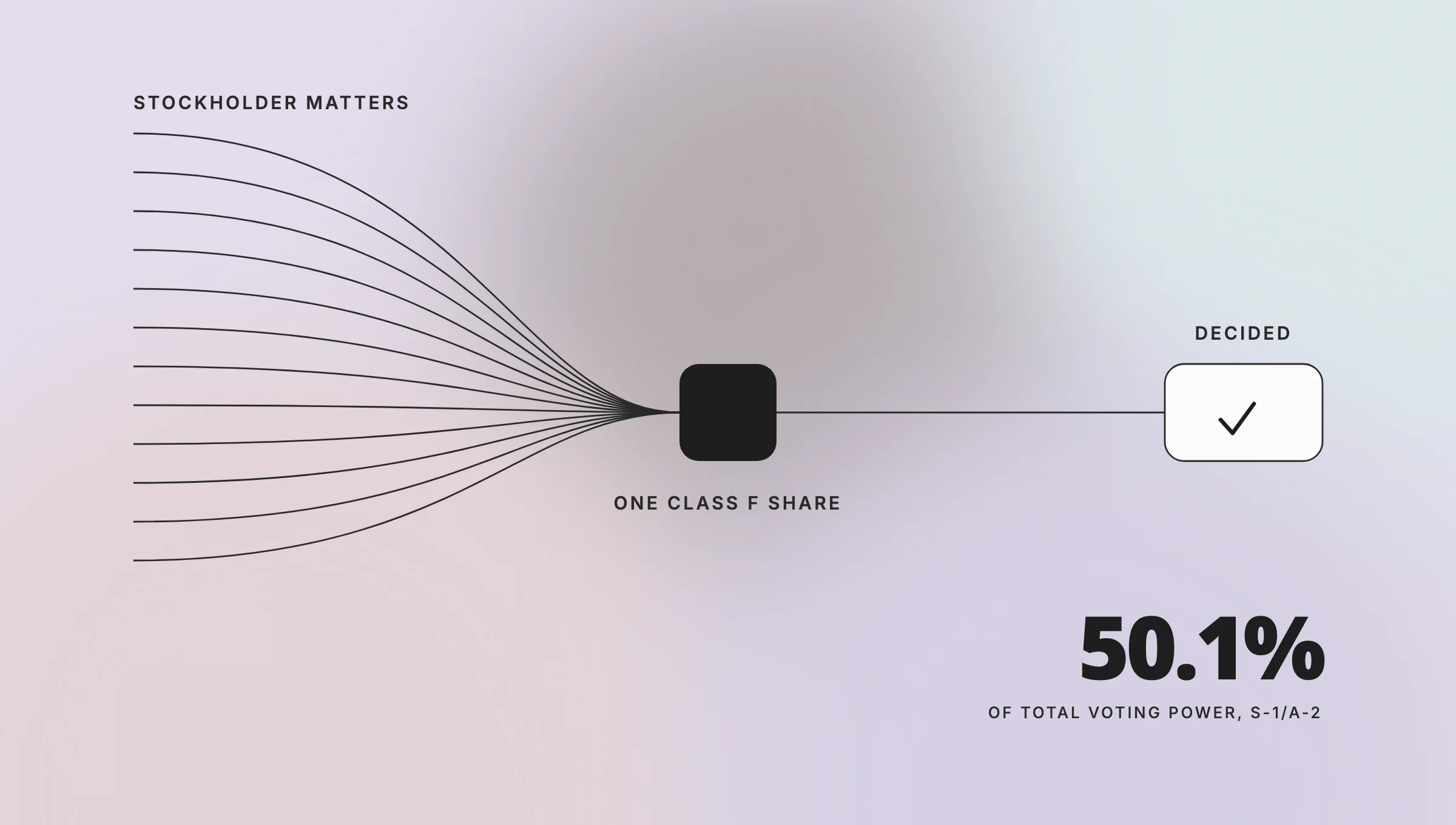
Public shareholders don’t control Anthropic’s board, and the S-1/A-2 is direct about it. Anthropic is a Delaware public benefit corporation, and the majority of its directors are elected by the Long-Term Benefit Trust through Class T stock. A single Class F share held by a founder LLC carries 50.1% of total voting power on stockholder matters, including the election of the non-Class-T directors. Class T and Class F carry no economic rights.
Class A buyers get one vote per share. They also get outvoted, every time, by a single share held by a founder LLC, while the board majority is chosen by a trust that owns no part of the economics. For an engineering leader, that matters because it sets who decides on model policy, pricing, and product direction when those decisions conflict with short-term shareholder return. Here’s the ownership stack as the filing describes it.
| Class (S-1/A-2) | Held by | Voting | Economic rights |
| Class A | Public investors after the IPO | 1 vote per share, not convertible | Yes |
| Class N | Strategic business partners (the $26.0B private placement) | None; converts to Class A on transfer to an unaffiliated third party | Yes |
| Class E | Employees, excluding co-founders | Limited | None |
| Class T | Long-Term Benefit Trust | Elects and removes the Class T directors, who constitute a majority of the board; no other votes | None |
| Class F | Founder LLC (Dario Amodei, Daniela Amodei, and five other co-founders) | 50.1% of total voting power on matters submitted to stockholders | None |
Three facts carry the weight. The LTBT trustees are independent and financially disinterested, and through Class T they elect the board majority. The founders’ single Class F share can decide any stockholder vote on its own. And Anthropic qualifies as a “controlled company” under Nasdaq’s corporate governance rules, per the S-1/A-2, a status that permits exemptions from some of the exchange’s board-independence requirements.
As a public benefit corporation, Anthropic’s board must balance three things: stockholder pecuniary interests, the interests of those materially affected by its conduct, and its stated public benefit. The filing words that benefit as “the responsible development and maintenance of advanced AI for the long-term benefit of humanity.” That’s a legal duty, not a slogan. And a customer running production on the model is squarely among those materially affected by its conduct.
Here’s where that stops being abstract. Your production system calls a dated model version, as it should. One morning the lifecycle page shows a deprecation date for it, and your evaluation suite reports that the successor behaves differently on three of your tool-use paths. The decision that put that date on the page came from a company whose board public shareholders didn’t elect, under a charter that tells that board to weigh your interests against its stated public benefit. The filing gives you the clause to cite when you ask how that weighing happened. It doesn’t tell you how the clause will be used. You didn’t get a vote on that, and the structure says you won’t.
What changes for your vendor-risk assessment?
The one new thing is that you can now monitor your model vendor like any other public supplier. Before the Anthropic IPO, a Claude Enterprise buyer had a SOC 2 report, a contract, and press releases. After it, you have an audited balance sheet, quarterly reports on Form 10-Q, an annual Form 10-K with risk factors, and Form 8-K filings for material events. Two weeks ago none of that existed for Anthropic; the S-1/A-2 is the first installment.
That shifts an AI vendor risk assessment from inference to reading. Picture the audit. The reviewer asks how you oversee a critical third-party provider, and last year the honest answer for your model vendor was a SOC 2 letter and a press release. This year you can hand over a commitments note, a risk-factor list the vendor wrote about itself, and a log of what changed quarter to quarter. Same dependency. Different evidence. Here’s what the public-company toolkit gives you, and what it doesn’t.
| Signal | Where it lives | What it tells a Claude Enterprise customer |
| Compute obligations and their timing | 10-K and 10-Q commitments notes | Whether the $70.7B-in-12-months profile (S-1/A-2) grows, shrinks, or shifts out |
| Revenue mix and concentration | 10-K and 10-Q | How dependent the vendor is on the segment you buy from |
| Material contracts and terminations | 8-K | Whether a named compute arrangement (Amazon, SpaceXAI) changes |
| Governance changes | 8-K and proxy statements | Changes to the LTBT, Class F, or board composition |
| Risk factors | 10-K | Anthropic’s own list of what could go wrong, updated annually |
A few things the filings won’t give you. They won’t disclose model lifecycle decisions, rate limits, or the pricing of a specific plan. They won’t tell you about an outage until it’s material enough to report. And they arrive on a quarterly lag, so a filing is a confirmation, not an early warning. For operational signals you still need your own telemetry: error rates per model version, latency distributions, and spend against budget. The filings tell you what the vendor committed to. Your dashboards tell you what it delivered.
The practical move is to add Anthropic to the same supplier-monitoring routine you’d apply to a cloud provider or a payments processor. Subscribe to EDGAR filings for Anthropic, PBC (CIK 0002130357), read the commitments note each quarter, and record what changed. For regulated teams, DORA’s ICT third-party risk provisions expect evidence of ongoing oversight of critical providers, and SOC 2 and ISO 27001 vendor-management controls ask for the same thing in a lighter form. A public filing is the cheapest evidence there is. If your organization doesn’t yet have a structured way to score model vendors, an AI readiness assessment is the place that scoring usually starts.
Which brings the argument to its last step. You can see the size of the bet now, and you can watch it move. The remaining decision is what to change about how you carry it.
What should you actually do this quarter?
For most teams, the right response to this prospectus is not a migration, and it’s not a provider-neutral abstraction layer. A gateway project is real engineering cost. It strands the features you chose Claude for, like prompt caching behavior, tool-use semantics, and Claude Code integration, and the lowest-common-denominator interface it forces costs more in output quality than it buys in optionality. That advice runs against the interest of any consultancy that bills for re-architecture, including this one. It’s still correct.
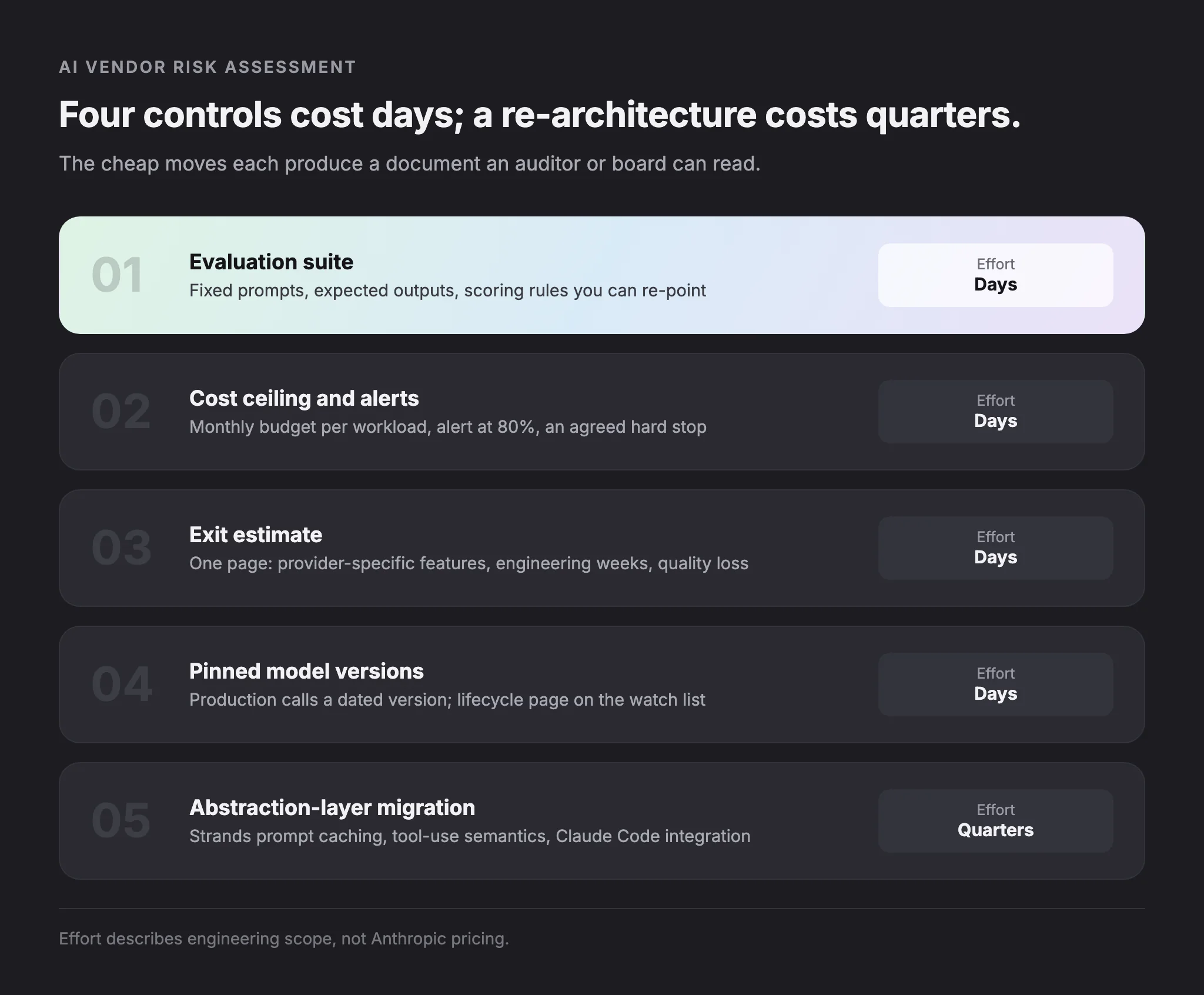
Say that part plainly, because the incentive is real. The expensive answer to this filing is the one a vendor would love to sell you: a quarter or two of re-platforming, a gateway, a second provider behind it, and a retainer to keep it all level. Teamvoy bills for that kind of work. We’d still tell you not to buy it off the back of a prospectus, because the exposure the S-1 reveals is cheaper to price than to engineer away. The honest moves are smaller. Each takes days, not quarters, and each produces a document your AI vendor risk assessment can cite to an auditor or a board.
- Build an evaluation suite you could re-point. A fixed set of prompts, expected outputs, and scoring rules that runs against your current model version. The suite is the asset; the provider is a parameter. Without one you can’t measure a vendor change, and you can’t credibly estimate a migration either.
- Set a cost ceiling with alerts. A monthly budget per workload, an alert at 80%, and a hard stop you’ve agreed on in advance. If Claude Enterprise pricing or API rates change, the alert fires before the invoice does.
- Write an exit estimate. One page: which features are provider-specific, how many engineering weeks a switch would take, and what quality you’d expect to lose. The point isn’t to execute it. The point is that the number exists, so the next vendor conversation is about a known cost rather than a feared one.
- Pin model versions and track lifecycle announcements. Production should call a dated model version, not an alias that moves. The day that version gets a deprecation date, you want to learn it from a watch list, not from a changed answer in production. Put Anthropic’s model lifecycle page on the same watch list as the SEC filings.
- Read your contract against the filing. Check the price-change notice period, the data-retention terms, and the termination clauses in your enterprise or API agreement. Compare them with the risk factors Anthropic itself discloses in the S-1/A-2.
- Decide where a second provider is worth it, narrowly. A fallback for one latency-critical or compliance-critical path can be justified. A second provider for everything, through an abstraction layer, rarely is. Teams that moved from pilot to production already know the cost of broad platform changes. The enterprise AI adoption piece covers why most of them stall at that step.
The trade-off is plain. Fewer abstractions mean more exposure to one vendor’s decisions; more abstractions mean paying today for optionality you may never use, in a currency of quality you can’t easily get back. The filing changes the information you have, not the arithmetic. For a team that has already tuned caching, tool use, and agent workflows on Claude, the exposure is cheaper to carry and monitor than to engineer away. Carry it with your eyes open. That’s the whole change.
Claude Enterprise: Conclusion
Anthropic’s S-1 doesn’t tell a Claude Enterprise customer whether the vendor will raise prices, change models, or keep its commitments. It tells you something no model vendor had shown you before: the size of the bet, who placed it, and who decides what happens next. You’re carrying a share of that bet whether you read the filing or not. Reading it is the only optional part. Read the commitments note each quarter, keep an evaluation suite and a cost ceiling, write the exit estimate you hope never to use, and spend the rest of your engineering budget on the product.
Talk to Teamvoy About Your AI Vendor Risk
If you want a second set of eyes on your Claude dependency, Teamvoy’s AI consulting team reviews model-vendor exposure the way this article does: price it first, then decide what’s worth engineering. You get an evaluation suite, cost controls, an exit estimate, and a written recommendation on where a second provider earns its cost, and where it doesn’t. Bring your current architecture and your contract; the first conversation is about what you’re already running, not what you should buy.