
- Sonnet 5.5 is the balance point for fast, interactive production work.
- All current Claude models list a 1M-token context window and 128K maximum output.
- Opus 5.5 lists moderate latency; Sonnet 5.5 is fast; Haiku 5.5 is fastest.
- Tune effort before switching models; Anthropic calls it the better lever.
- Measure cost per accepted task, not token price alone.
Opus vs Sonnet is a routing decision, not a ranking. As of October 22, 2026, Anthropic positions Claude Opus 5.5 for long-running agentic coding and knowledge work, Claude Sonnet 5.5 as the best combination of speed and intelligence, and Claude Haiku 5.5 for high-volume, latency-sensitive tasks. Opus costs exactly twice Sonnet per token at list price (4/20 vs 2/10 per million tokens). The right choice is the model that delivers the lowest cost per accepted task on your own evaluation set, after you tune the effort parameter.
Opus vs Sonnet: Key Differences
Capability depth against price and latency is the trade. Claude Opus 5.5 is built for long-running agentic coding and knowledge work. Claude Sonnet 5.5 trades some depth for faster responses at half the token price. Claude Haiku 5.5 handles classification, extraction, and routing at the lowest price and latency. Claude Fable 5.1 sits above Opus for the most demanding reasoning. All four figures below come from Anthropic’s models overview, retrieved October 22, 2026.
The comparison most teams still carry in their heads covers Opus 4.6, Sonnet 4.6, and Haiku 4.5. Those versions are no longer Anthropic’s current lineup, so any “one-fifth the cost” or “200K context” claim describes a product that has moved on. The claude sonnet vs opus vs haiku question in late 2026 looks like this:
| As of 2026-10-22 | Claude Fable 5.1 | Claude Opus 5.5 | Claude Sonnet 5.5 | Claude Haiku 5.5 |
|---|---|---|---|---|
| Model ID | claude-fable-5-1 | claude-opus-5-5 | claude-sonnet-5-5 | claude-haiku-5-5 |
| Anthropic’s positioning | Demanding reasoning and long-horizon agentic work | Long-running agentic coding and knowledge work | Best combination of speed and intelligence | High-volume, latency-sensitive tasks |
| Comparative latency | Slower | Moderate | Fast | Fastest |
| Context / max output | 1M / 128K | 1M / 128K | 1M / 128K | 1M / 128K |
| List price, input / output per MTok | $10 / $50 | $4 / $20 | $2 / $10 | from $0.10 / $0.50 |
| Default effort | high | medium | high | medium |
| Retirement commitment | Not sooner than 2027-09-01 | Not sooner than 2027-09-22 | Not sooner than 2027-09-28 | Not sooner than 2027-10-07 |
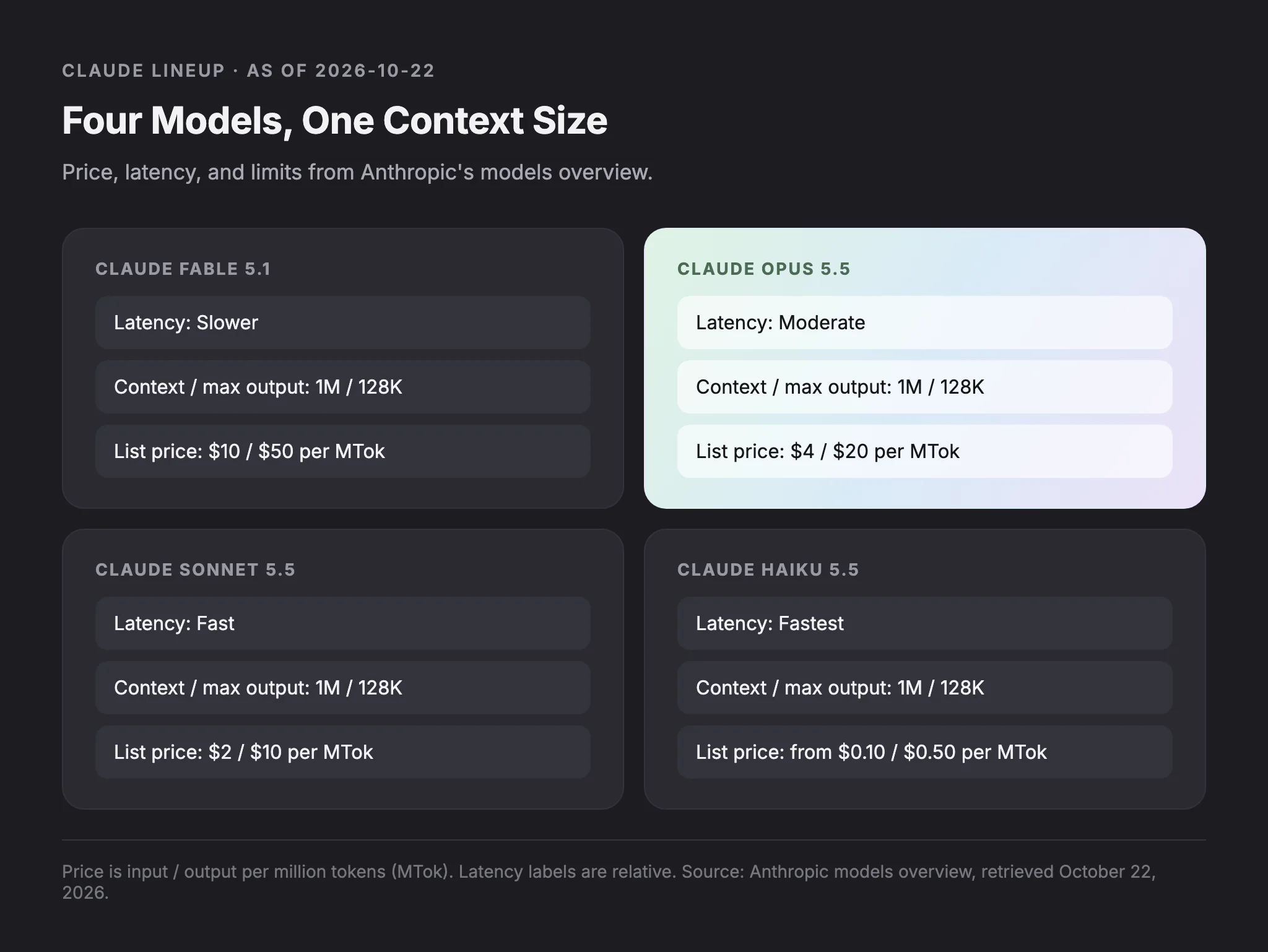
output list prices run from $10 $50 per million tokens fable 51 to from $010 $050 haiku 55 and
latency from slower to fastest
Latency labels are relative; Anthropic notes that actual latency depends on prompt length, output length, and thinking effort. For the provider-level choice, read Teamvoy’s Anthropic vs OpenAI comparison.
How We Evaluated: Criteria for Model Selection
Six criteria decide a real deployment: capability on your own tasks, cost per accepted task, latency under production load, context and output limits, effort tuning headroom, and fit with existing automation and governance. This guide applies them to Anthropic’s first-party documentation retrieved October 22, 2026. It reports no Teamvoy test results and reuses no third-party benchmark tables.
Weighting changes by workload. A customer-facing assistant puts latency and cost first. A refactor agent puts task completion and review effort first. A nightly extraction pipeline puts throughput and batch pricing first. Teamvoy’s AI integration services page covers the integration side.
One criterion is new since the 4.x generation. Anthropic’s choosing a model guide says that tuning the effort parameter is often a better lever than switching models. Opus 5.5 and Haiku 5.5 default to medium effort; Sonnet 5.5 and Fable 5.1 default to high. A sonnet vs opus comparison that ignores effort compares two settings, not two models.
Performance Benchmarks: Opus vs Sonnet
Public benchmark tables are the weakest evidence you can bring to this decision. Scores are version-specific, test-date-specific, and rarely reproducible against your prompts, data, and tooling. This article publishes no third-party numbers. Anthropic’s own guidance, retrieved October 22, 2026, is to evaluate models on your actual prompts and data and to consider cost per task, which the protocol below does.
The old Opus 4.6 versus Sonnet 4.6 tables describe superseded versions. Anthropic’s optimizing for cost and intelligence guide asks a different question: which model completes the task acceptably at the lowest total cost.
Enterprise evaluation protocol
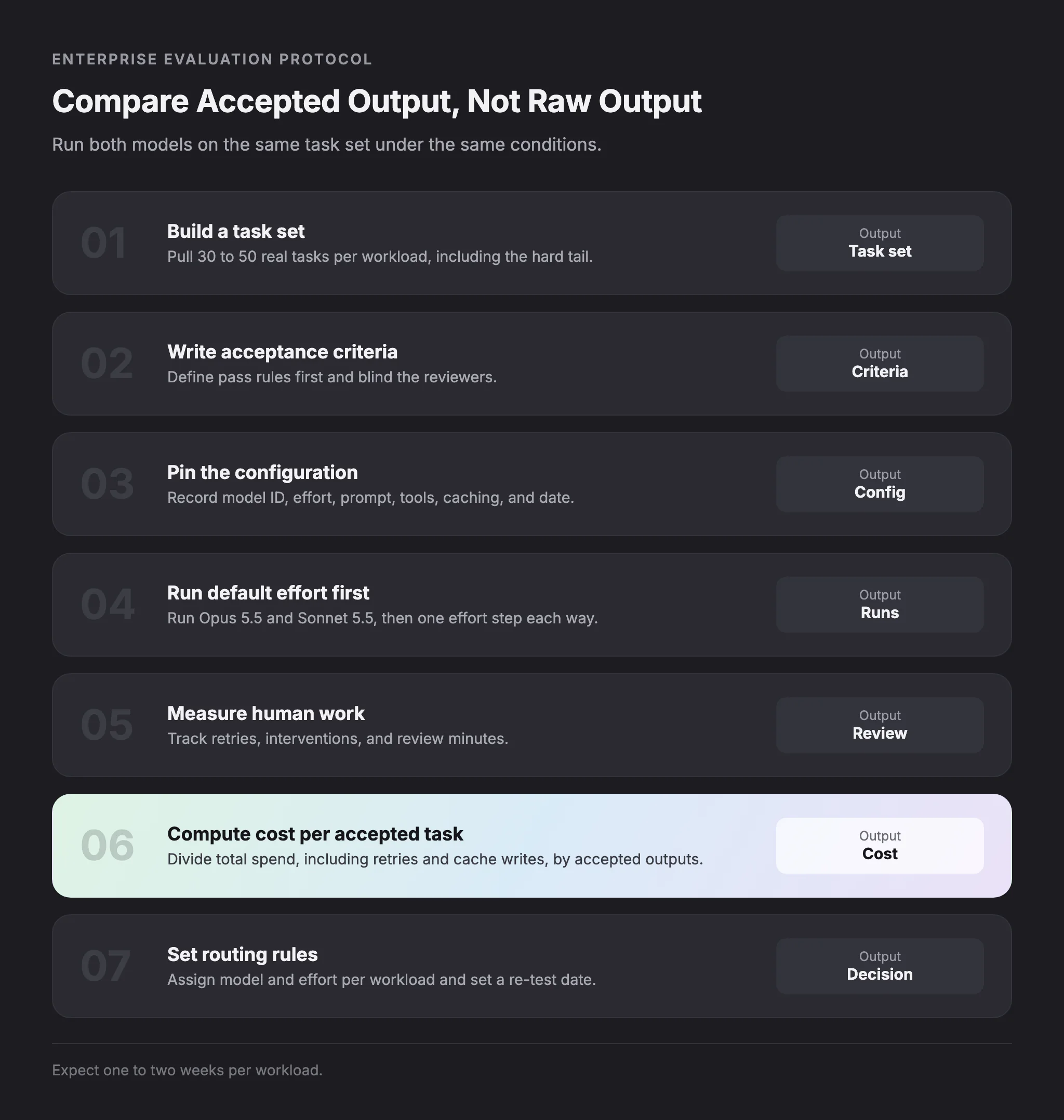
Run both models on the same task set under the same conditions, then compare accepted output, not raw output.
- Build a task set from production. Pull 30 to 50 real tasks per workload, including the hard tail.
- Write acceptance criteria before running anything. Tests pass, schema validates, or a reviewer approves. Blind the reviewers to the model.
- Pin the configuration. Record model ID, effort level, system prompt, tools, caching, and date. Aliases drift; IDs do not.
- Run Opus 5.5 and Sonnet 5.5 at default effort first. Then run each one step higher and lower. Effort often closes a gap that looked like a model gap.
- Measure retries, interventions, and review minutes. A cheaper model that needs two retries and ten minutes of review per task is not cheaper.
- Compute cost per accepted task. Divide total spend, including retries and cache writes, by the outputs that passed step 2.
- Set routing rules and a re-test date. Assign each workload a model and effort level, and re-run when Anthropic ships a new version or changes prices.
Expect one to two weeks per workload. Slower than a benchmark roundup, and it produces a number your finance team can use.
routing rules
Expect one to two weeks per workload. Slower than a benchmark roundup, and it produces a number your finance team can use.
Cost Comparison: Opus vs Sonnet
Opus 5.5 costs exactly twice Sonnet 5.5 at list price: $4 input and $20 output per million tokens against $2 and $10, per Anthropic’s pricing page retrieved October 22, 2026. Applying those rates to Anthropic’s example volume of 50,000 input and 15,000 output tokens gives $0.50 on Opus and $0.25 on Sonnet, list-price arithmetic on tokens only, with no caching.
| List price, 2026-10-22 | Claude Opus 5.5 | Claude Sonnet 5.5 | Claude Haiku 5.5 |
|---|---|---|---|
| Base input per MTok | $4.00 | $2.00 | $0.10 (prompts up to 100K tokens); $0.50 above 100K |
| Output per MTok | $20.00 | $10.00 | $0.50 (up to 100K); $2.50 above 100K |
| Cache read per MTok | $0.20 (5% of input) | $0.10 (5% of input) | $0.01 (up to 100K) |
| Batch API | 50% off input and output | 50% off input and output | 50% off input and output |
| Fast mode | $8 / $40 per MTok | Not offered | Not offered |
| Worked example: 50K in + 15K out, no cache | $0.20 + $0.30 = $0.50 | $0.10 + $0.15 = $0.25 | $0.005 + $0.0075 = $0.0125 |
Three details change the invoice more than the headline ratio. First, Haiku 5.5’s low price applies only to prompts up to 100,000 tokens; above that, input rises to $0.50 and output to $2.50 per million tokens. Opus and Sonnet keep one price across the full 1M window. Second, cache reads on Opus 5.5 and Sonnet 5.5 cost 5% of base input, so a stable system prompt cuts repeated input cost by the same proportion on either model. Third, the Batch API halves input and output for asynchronous work.
The claude opus vs sonnet price gap is a 2:1 ratio on tokens, not on outcomes. If Opus completes in one pass a task that Sonnet needs two attempts and a human review to finish, the Sonnet run costs more. Teamvoy’s cost of AI implementation breakdown shows where model spend sits in a project budget.
Subscription plans are a separate category. Anthropic’s plans page, retrieved October 22, 2026, lists Pro at 20permonth(17 billed annually) and Max from $100 per month. Those are seat prices, not API token rates, and they don’t belong in an API cost model.
Technical Features: Context Windows and Output
Opus 5.5, Sonnet 5.5, and Haiku 5.5 all list a 1M-token context window and a 128K-token maximum output in Anthropic’s models overview as of October 22, 2026. Context size no longer separates the two models. What separates them is reasoning per token, speed, and what the long-context tokens cost.
Long context pays off in repository review, documentation drafted from source, and multi-step agent runs that must hold earlier tool results. Opus and Sonnet charge one per-token rate across the full window. Haiku 5.5 switches to its higher rate on prompts over 100,000 tokens, so a 400K-token Haiku prompt costs $0.50 per million input tokens, a quarter of Sonnet’s rate rather than a twentieth.
Effort is the second technical feature worth a line in your design document. Anthropic’s effort documentation describes it as a per-request trade between intelligence, latency, and cost within one model. Raising Sonnet 5.5 effort for a hard step is cheaper to test than a model migration.
Switching Between Opus and Sonnet
Claude Code switches models with one flag, one slash command, or one environment variable, per Anthropic’s model configuration docs retrieved October 22, 2026. Launch with claude –model opus, change mid-session with /model sonnet, or set ANTHROPIC_MODEL for a session. The model field in settings JSON and ANTHROPIC_DEFAULT_MODEL (v2.1.236 or later) set the default for new sessions.
The aliases matter more than the commands. opus, sonnet, and haiku resolve to the newest version on the Anthropic API: Opus 5.5, Sonnet 5.5, and Haiku 5.5 today. opusplan runs Opus in plan mode and Sonnet for execution, for teams who want deeper planning without paying Opus rates for every edit. fable and best route to Fable 5.1 where available.
Aliases resolve differently on third-party clouds. As of October 22, 2026, the same docs list sonnet resolving to Sonnet 4.5 and haiku to Haiku 4.5 on Amazon Bedrock and Google Cloud’s Agent Platform, and opus resolving to Opus 4.6 on Microsoft Foundry. Pin the version with a full model ID such as claude-opus-5-5, or set ANTHROPIC_DEFAULT_OPUS_MODEL and ANTHROPIC_DEFAULT_SONNET_MODEL, so an alias change cannot move production traffic. Minimum versions: Opus 5.5 needs Claude Code v2.1.280, Sonnet 5.5 v2.1.284, Haiku 5.5 v2.1.293.
Two behaviors catch teams out. A choice made with /model is saved as the default for new sessions, while –model and ANTHROPIC_MODEL apply to one session only. And a switch reaches subagents that inherit the main session model, so a mid-session move to Opus changes the cost of every parallel task. Teamvoy’s Claude Code vs GitHub Copilot guide covers rollout controls.
Selecting the Right Claude Model for Enterprise Use
Route by workload, not by project. Anthropic’s docs, retrieved October 22, 2026, describe two starting paths: capability-first, which starts most workloads on Opus 5.5 and moves to Fable 5.1 only if evals at xhigh or max effort still fall short, and efficiency-first, which starts on Haiku 5.5 and upgrades only on measured capability gaps. Sonnet 5.5 is the balance point, not an automatic default.
| Workload | Start on | Move up when | Move down when | What to measure |
|---|---|---|---|---|
| Long-running agentic coding (multi-file refactor, migration) | Opus 5.5 at medium | Evals fail at xhigh/max: Fable 5.1 | Sonnet 5.5 passes the same task set at lower cost | Tasks accepted per run, review minutes |
| Interactive coding and daily development | Sonnet 5.5 at high | Plan quality limits output: opusplan or Opus 5.5 | Haiku 5.5 handles the simple edits | Time to merge, retries |
| Customer-facing assistant, chat, support | Sonnet 5.5 | Escalation rate stays high on hard tickets | Haiku 5.5 resolves the simple tier | p95 latency, resolution rate |
| Classification, extraction, routing, triage | Haiku 5.5 (Batch API where async) | Precision gap on edge cases: Sonnet 5.5 | Rarely | Precision/recall, cost per record |
| Analysis, synthesis, decision memos | Opus 5.5 | Multi-hour long-horizon tasks: Fable 5.1 | Sonnet 5.5 at high matches reviewer scores | Reviewer acceptance, factual errors |
| Prompts over 100K tokens at volume | Sonnet 5.5 or Opus 5.5 | Reasoning depth needed: Opus 5.5 | Only if Haiku’s >100K rate still wins | Cost per accepted task at real prompt size |
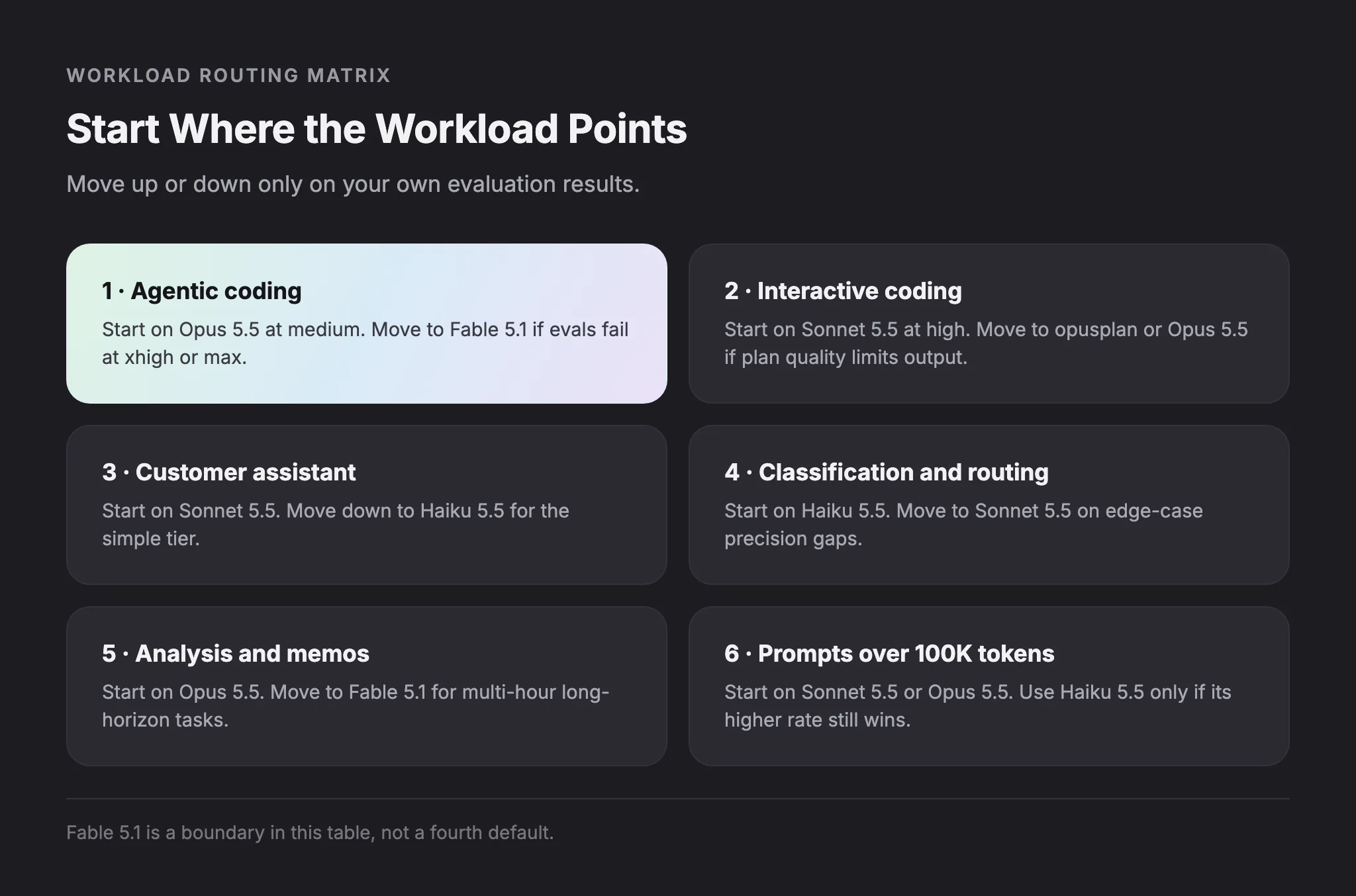
Fable 5.1 is a boundary in this table, not a fourth default. At 10/50 per million tokens and slower comparative latency, it earns its place only where Opus 5.5 at higher effort still fails your evals.
The trade-off against Teamvoy’s own interest is plain. A team with an evaluation set, acceptance criteria, and existing model governance can run this protocol in two weeks and will not need outside help to choose between Opus and Sonnet. Outside support pays off when the evaluation set does not exist, when routing has to be built into a pipeline with observability and fallbacks, or when compliance requires audit logs for every model decision. Teamvoy’s playbook on building AI agents into your CI/CD pipeline covers the pipeline side.
Enterprise AI Model Selection Checklist
Work through these five checks for each workload before you commit a model and effort level to production. Together they turn the opus vs sonnet question into a documented routing decision your security, finance, and engineering leads can all read.
- Define the workload and its failure cost. A wrong architecture recommendation justifies Opus; a misrouted support ticket rarely does.
- Budget on cost per accepted task at production volume. Use list prices dated October 22, 2026, apply the cache and Batch API discounts you will earn, and include retries.
- Set the latency ceiling. Interactive surfaces push toward Sonnet 5.5 or Haiku 5.5; asynchronous pipelines can absorb Opus 5.5’s moderate latency.
- List integration and governance points. Pinned model IDs, recorded effort levels, prompt-injection controls, audit logs, and data residency. Teamvoy’s piece on AI in DevOps covers where human review stays mandatory.
- Assign a model and effort per workload, then date it. Record the decision, the evidence, and the next review date.
If you want help building the evaluation set, routing layer, and observability around that decision, start with Teamvoy’s AI integration services and then contact Teamvoy with your workload list.