

- Enterprise AI infrastructure got its loudest definition from the one vendor with the most to gain from it: NVIDIA's glossary calls an AI factory "specialized computing infrastructure" whose "primary product is intelligence, measured by token throughput" (NVIDIA Glossary, retrieved 2026-11-13). The week that definition's chief evangelist left the company, the hardware didn't change, and neither did the problem on your side: tokens are an output, and nobody budgets for outputs.
- What you budget for is the seven layers between your data and a reliable answer, who owns each one, and which of them you should never own at all. Most mid-market teams get the layer order wrong, and the error only shows up when the monthly bill or the first incident arrives.
Your team has a working prototype, a cloud bill that doubled last quarter, and a board asking whether you need “an AI factory.” The vendor decks answer with racks. Your finance team answers with a budget line. So what does enterprise AI infrastructure actually need to contain before a model can run in production without surprising anyone?
What is enterprise AI infrastructure?
Enterprise AI infrastructure is the full set of compute, data, model, serving, observability and governance systems a company runs so that AI models can be trained or adapted, deployed, monitored and controlled in production. It spans more than GPUs: it includes the pipelines that feed models, the services that answer requests within a latency budget, the telemetry that shows cost and quality, and the policies that decide who can ship what.
The phrase matters because the industry has two different things in mind when it says “AI.” One is the model, and the other is everything that lets a model earn money or save it. The second category is where most enterprise effort goes, and it’s where most failures sit. A model that scores well in a notebook and times out under production load is a serving problem. A chatbot that leaks a customer record is a data-access problem. A pilot that costs five times its forecast is a FinOps problem. Those are all enterprise AI infrastructure problems, and none of them is solved by a faster chip.
| Component | What it does | Typical failure when it’s missing |
| Accelerated compute | Runs training, fine-tuning and inference on GPUs or other accelerators, owned or rented | Workloads queue behind each other; inference latency drifts with load |
| Data pipeline and lineage | Ingests, cleans, versions and traces the data models consume | Model quality degrades silently; nobody can explain an answer |
| Model layer | Hosted or self-hosted foundation models, fine-tuned variants, embeddings | Vendor lock-in; one API change breaks several products |
| Inference serving | Routes requests, batches them, caches results, enforces timeouts | Cost per request grows faster than traffic |
| Observability | Captures tokens, latency, cost, quality signals, drift | Problems reach customers before engineers |
| Governance | Access control, approvals, audit trail, policy enforcement | Regulators and auditors ask questions nobody can answer |
| Team and operating model | Defines ownership, SLOs, budget and release process | Everything above exists, and nobody is on call for it |
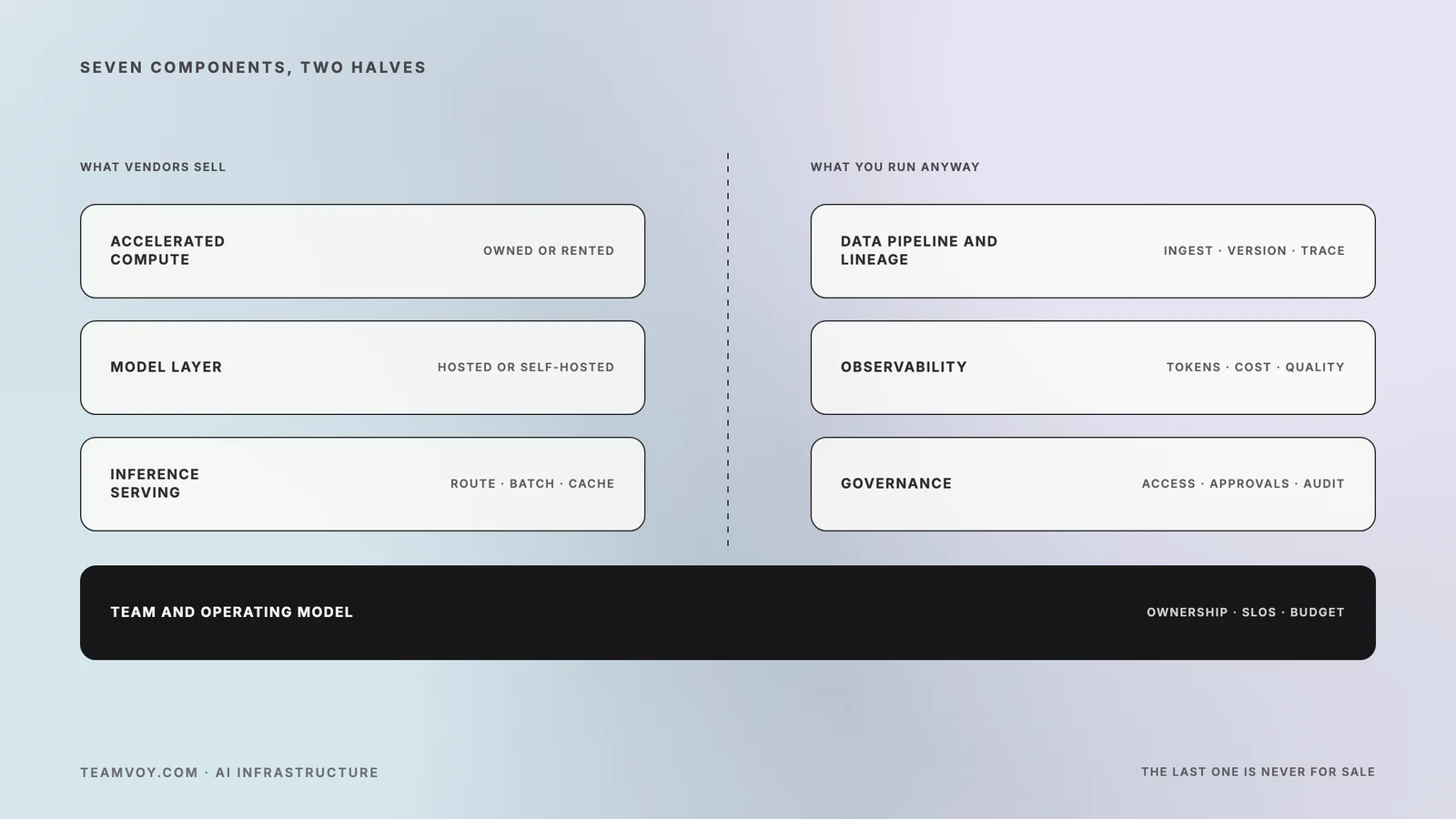
A useful way to read the table: the top rows are what vendors sell, and the bottom rows are what you’ll end up running regardless of who you buy from. An AI infrastructure architecture that documents only the top rows is a purchase order, not a design.
What does “AI factory” actually mean?
“AI factory” is NVIDIA’s term for computing infrastructure that manages “the entire AI life cycle, from data ingestion to training, fine-tuning, and high-volume AI inference,” with intelligence “measured by token throughput” as its product (NVIDIA Glossary, retrieved 2026-11-13). It’s a vendor framing, not an industry standard, but it’s a good one because it forces the question of what the factory produces and what each unit of output costs.
Jensen Huang spent years turning that metaphor into NVIDIA’s core pitch: data goes in, tokens come out, and the economics of the plant are measured in throughput per watt and cost per token. NVIDIA’s own AI-factory writing frames the metrics that way: tokens per second, tokens per watt, cost per token, utilization and uptime (NVIDIA Blog, “What Is an AI Factory?”
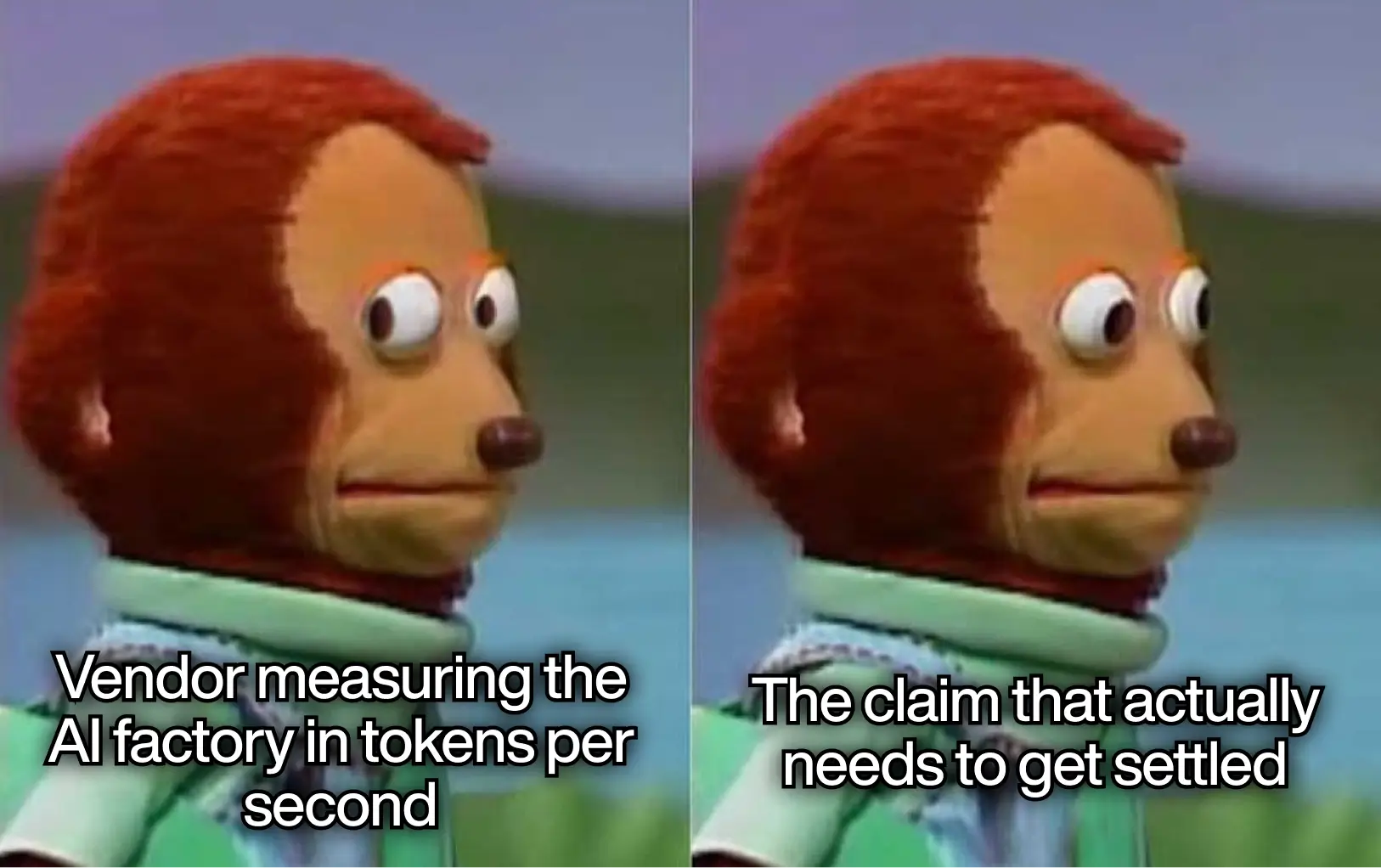
The metaphor holds for the purchasing conversation and breaks in the operating one. A factory has a product with a price. Tokens have a cost but rarely a price; the price belongs to the claim that got settled, the invoice that got matched, the ticket that got closed. Your enterprise AI infrastructure should be measured on those outcomes, with token throughput as an internal efficiency metric, not the headline.
Two disambiguations save a lot of wasted meetings. First, an AI factory in this sense is infrastructure and an operating model; it isn’t AI on a factory floor. If your question is machine vision on a line or predictive maintenance, that’s a different article: see AI automation in manufacturing. Second, “Factory AI” is also the name of at least one software company; this article has nothing to do with it.
Where NVIDIA’s definition is useful, and where it isn’t
The NVIDIA AI factory definition is useful in exactly one way: it ties infrastructure spend to a measurable output. Most enterprise AI programs fund inputs (licenses, headcount, GPU hours) and never define the output unit. Borrow that discipline.
Where the definition stops being useful is the implied shape. NVIDIA sells the compute layer, so an NVIDIA AI factory starts with accelerated compute and builds upward. Your company sells something else, so your AI factory architecture should start with the workload and its service-level objective and build downward, deciding at each layer whether to own it, rent it or ignore it. The rest of this guide follows that order.
How is an AI factory different from a data center?
A data center is a general-purpose facility that runs many kinds of workloads; an AI factory is a stack specialized for one class of workload, where the dominant costs are accelerator utilization, data movement and per-request inference. NVIDIA draws the line on optimization for AI inference performance and energy efficiency (NVIDIA Glossary, retrieved 2026-11-13). For most enterprises the practical difference sits in operations, not buildings.
A traditional data center workload is usually bounded: a request takes a predictable number of CPU cycles, and capacity planning follows from traffic. An inference workload is elastic in the worst direction. One user prompt can trigger a retrieval step, three model calls, a tool invocation and a second model call to summarize the result, and the length of each step depends on the input. Cost scales with how the application is written, not only with how many people use it.
That changes four things in the operating model:
- Capacity planning moves from requests to tokens and accelerator-seconds. A spike in prompt length is a capacity event even when user counts are flat.
- Utilization becomes a first-class metric. An idle GPU costs the same as a busy one, so batching, scheduling and queue design decide the bill.
- Quality is a runtime property. A database either returns the row or it doesn’t; a model returns something every time, and the something can be wrong. Monitoring has to measure correctness, not only availability.
- The failure domain includes third parties. If your model layer is an external API, their incident is your incident, and your SLO depends on a contract you didn’t write.
You don’t need a building, a rack or an NVIDIA invoice to have those four problems. A company running a retrieval-augmented support assistant on rented cloud GPUs has an AI factory in every operational sense, whether or not anyone calls it one.
What are the layers of an AI factory architecture?
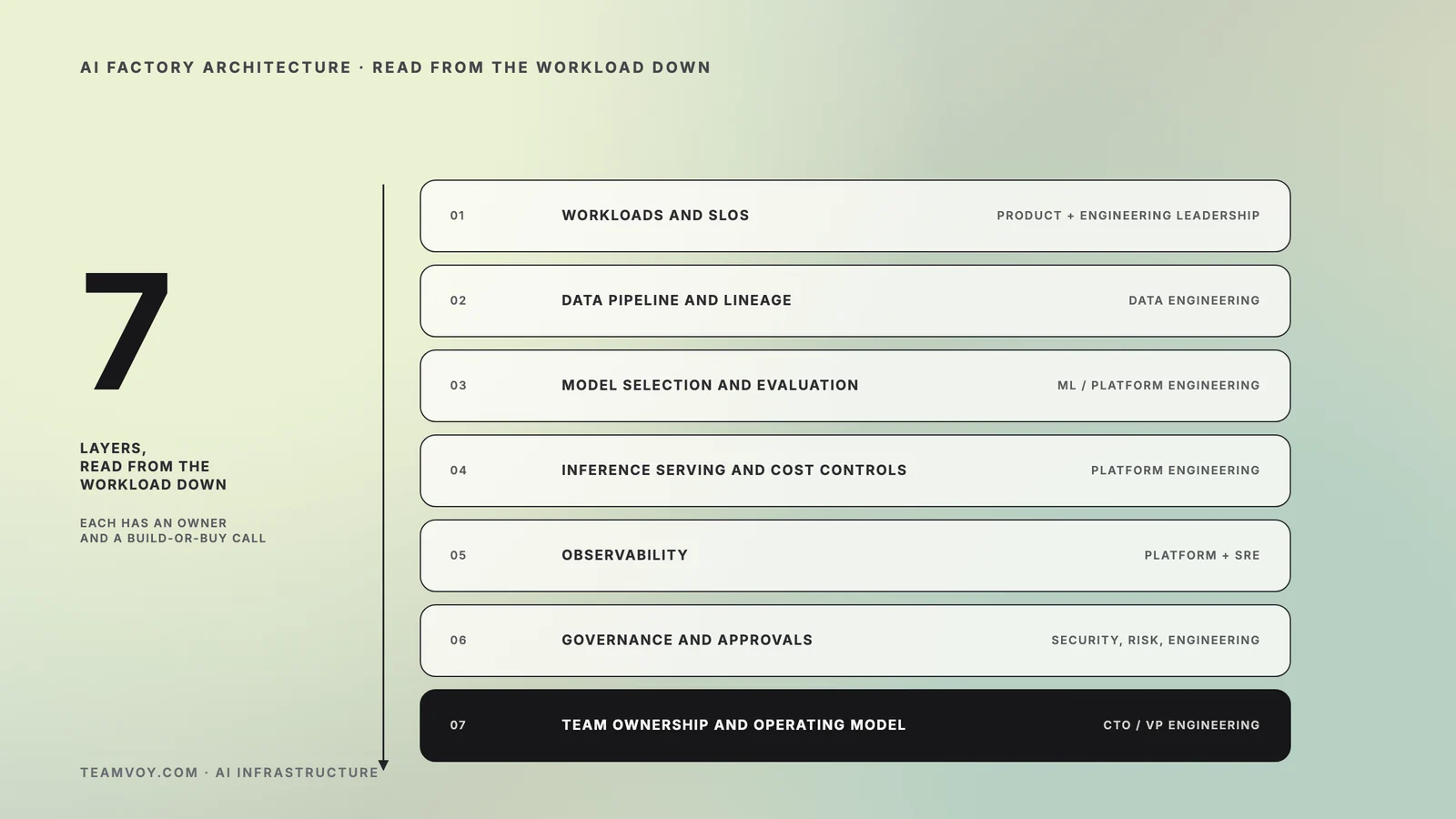
A practical AI factory architecture has seven layers, read from the workload down: workloads and SLOs, data pipeline, model selection and evaluation, inference and cost controls, observability, governance and approvals, and team ownership. Each layer has an owner, an SLO and a build-or-buy decision. Most published AI infrastructure architecture diagrams come from vendors, and they tend to describe the bottom three or four layers in detail and leave the top three to you, which is why so many deployments stall after the hardware arrives. Treat the list below as the checklist your AI infrastructure architecture has to cover, whoever ends up running each layer.
| Layer | Question it answers | Typical owner | What breaks without it |
| 1. Workloads and SLOs | Which use cases run, with what latency, accuracy and cost targets? | Product + engineering leadership | Infrastructure sized for nothing in particular |
| 2. Data pipeline and lineage | Where does the data come from, who may see it, and can we trace an answer back? | Data engineering | Silent quality decay; compliance exposure |
| 3. Model selection and evaluation | Which model, hosted where, judged by what test set? | ML / platform engineering | Decisions made on demos instead of measurements |
| 4. Inference serving and cost controls | How are requests routed, batched, cached, capped? | Platform engineering | Runaway spend; latency that varies by hour |
| 5. Observability | What do we see per request, per feature, per tenant? | Platform + SRE | Blind incidents; no basis for optimization |
| 6. Governance and approvals | Who can change a prompt, a model or a data source, and how is it recorded? | Security, risk, engineering | Unreviewed changes in production; audit gaps |
| 7. Team ownership and operating model | Who’s on call, who holds the budget, who signs off on releases? | CTO / VP Engineering | A platform everyone uses and nobody runs |
Layer 1: workloads and SLOs
Start with a short list of workloads and a service-level objective for each: p95 latency, an accuracy or acceptance-rate target measured on a fixed evaluation set, and a cost ceiling per request or per task. A claims-triage assistant and an internal code-search tool share almost no infrastructure requirements, and designing one platform for both before either is defined is how companies buy capacity they never use.
Layer 2: data pipeline and lineage
The model only knows what the pipeline gives it. That means ingestion with access controls preserved from the source system, versioned datasets, and lineage that can answer “which documents produced this answer?” for any production response. Retrieval-augmented generation makes this layer the actual product: the quality of a RAG system is mostly the quality of its chunking, indexing and permission filtering, and those are data-engineering tasks, not model tasks.
Layer 3: model selection and evaluation
Pick models by running your evaluation set against candidates, including at least one smaller or cheaper option than the one the demo used. Treat the evaluation set as a versioned asset with an owner. Fine-tuning belongs here as a decision, not a default: it trades portability and simplicity for task performance, and the trade only pays off when retrieval and prompt design have already been pushed as far as they go.
Layer 4: inference serving and cost controls
This layer turns a model into a service with a budget. It includes request routing (which model handles which request class), batching, caching of repeated prompts and embeddings, token limits, per-tenant quotas and hard spend caps. It’s also where self-hosting earns or loses its keep: a serving stack you run yourself gives you control over batching and scheduling, and it gives you a reliability and security surface you now own.
Layer 5: observability
Every request should emit the model used, prompt and completion token counts, latency per step, the retrieved documents, the cost, and whatever quality signal you can capture, such as user feedback, a judge model’s score or a downstream acceptance event. The specific metrics are in the observability section below. Tooling options for this layer are compared in the best LLMOps tools.
Layer 6: governance and approvals
Prompts, system instructions, retrieval sources, tool permissions and model versions are all production configuration and should move through the same review and rollback path as code. Governance here is less about committees and more about making the dangerous change impossible to make casually.
Layer 7: team ownership and operating model
The platform needs a named owner with a budget, an on-call rotation and the authority to say no to a workload that doesn’t meet its SLO. Without this layer the other six decay within two quarters because nobody is paid to maintain them.
Where do the real costs and bottlenecks sit?
The dominant costs in enterprise AI infrastructure sit in three places: accelerator time (owned or rented), data engineering labor, and the operational overhead of running inference as a reliable service. The bottlenecks sit one layer away from where teams expect them: in data access and evaluation rather than in model capability, and in utilization and request design rather than in raw GPU count.
The research for this article found no third-party cost or ROI statistic worth citing; the numbers that rank for these queries are vendor case-study percentages, and they don’t transfer. What transfers is the mechanism. Read the following as an illustrative model, not a benchmark.
Compute: utilization decides the bill
An accelerator you own costs the same whether it’s at 20% or 90% utilization. An accelerator you rent by the hour has the same property inside the hour. The cost lever is therefore scheduling: batching requests, right-sizing the model to the task, and routing low-stakes requests to smaller models. Teams that only track “GPU hours” and never track “useful tokens per GPU hour” can’t see this lever at all.
Data engineering: the invisible majority
Most of the engineering hours in a production AI system go into data: extraction from source systems, permission mapping, chunking and indexing, evaluation-set construction and refresh. Those hours rarely appear in the “AI budget” because they’re billed as data or integration work. Integration with existing systems of record is its own discipline; see AI integration services for how that layer is usually scoped.
Inference: the cost that scales with product decisions
Inference cost tracks the application’s design more closely than its user count. The table below shows how an illustrative request budget changes with ordinary design choices. The figures are made up to show the arithmetic; they are not measurements.
| Design decision (illustrative) | Effect on tokens per request | Effect on p95 latency | Mitigation |
| Full conversation history resent on every turn | Grows linearly with turn count | Grows with history length | Summarize or truncate history; cache stable prefixes |
| Retrieval returns 20 chunks instead of 5 | 3–4× prompt tokens | Longer prefill | Rerank, then pass fewer, better chunks |
| Agent loop with no step cap | Unbounded | Unbounded | Hard step and token caps per task |
| Largest model for every request | Highest cost per token | Highest | Route by request class; reserve the large model for hard cases |
| No response cache | Every repeated question paid in full | No gain | Cache by normalized prompt and retrieval set |

Inference SLOs: what “reliable” has to mean
An inference SLO needs at least four numbers. Teams that set only latency discover the others during an incident.
| SLO dimension | Example target (illustrative) | How it’s measured | Who owns it |
| Latency | p95 under a fixed threshold per request class | Per-step timing in traces | Platform engineering |
| Availability | Successful responses over total, including upstream API failures | Synthetic probes + request logs | SRE |
| Quality | Acceptance rate or judge score on a sampled set, per release | Offline evaluation set + online sampling | ML engineering + product |
| Cost | Cost per task within a ceiling, per tenant and per feature | Token accounting per request | Platform + finance |
The SLO table is also the budget conversation in disguise. A quality target that can only be hit with the largest model, a latency target that forbids batching, and a cost ceiling that assumes both: those three can’t all be true, and it’s better to find out in a planning document than in production.
Should you build, buy, or go hybrid, layer by layer?
For most mid-market companies, the right answer is hybrid with a strong lean to buying the lower layers: rent accelerated compute and use hosted or managed model endpoints, buy or adopt open-source observability and serving tooling, and build the layers that encode your business — workloads, data pipeline, evaluation sets, governance rules and the operating model. Owning more of the stack buys independence and control at the price of a permanent platform-engineering, reliability, security and FinOps burden.
That is also the trade-off that runs against the commercial interest of any AI development firm, Teamvoy included. A services company earns more when you build more. The honest version of the advice is that a managed platform usually wins when your differentiation lives in the application and the data, not in the serving layer, and that describes most companies outside the model-provider business. Where a build decision is right, it’s because the workload has constraints a managed service can’t meet: data residency, latency at the edge, cost at sustained high volume, or a model you need to control end to end for regulatory reasons.
| Layer | Default for mid-market | When to build instead | Hidden cost of building |
| Accelerated compute | Rent (cloud GPUs, managed endpoints) | Sustained high utilization, residency rules, or edge latency | Capacity planning, hardware refresh, idle time |
| Data pipeline and lineage | Build on standard tooling | Always partly built; it’s your data | Permission mapping, refresh jobs, lineage upkeep |
| Model layer | Buy (hosted APIs, open-weight models on managed infra) | Regulated data, extreme volume, or a task hosted models fail | Model ops, security patches, evaluation across upgrades |
| Inference serving and cost controls | Hybrid: managed gateway plus your routing and caps | Multi-model routing at scale, strict latency budgets | On-call for the serving path; batching and scheduling tuning |
| Observability | Adopt open-source or commercial tools | Rarely | Instrumentation debt if skipped |
| Governance and approvals | Build on existing CI/CD and IAM | Always; policy is yours | Review load, audit evidence |
| Team ownership | Build | Always | Headcount, retention, on-call |
A second trade-off cuts the other way. Buying the model layer means your product quality, latency and unit cost move when a vendor changes a model version, a price or a rate limit. The mitigation is architectural, not contractual: keep the model behind an interface you own, keep your evaluation set ready, and prove you can switch before you need to. Working through that decision for a specific stack is the kind of question AI consulting engagements exist to answer, and it’s also a question a capable internal platform lead can settle in a few weeks with the tables above.
How do you manage concentration risk across GPU, cloud and model vendors?
Concentration risk in enterprise AI infrastructure is the degree to which one vendor’s roadmap, pricing, capacity or leadership can change your unit economics or availability without your consent. The mitigations are portability at the model interface, at least one tested alternative for each critical dependency, and observability that tells you within hours, not quarters, when a vendor change has shifted your cost or quality.
The week of 2026-11-12 was a reminder that this risk is real at every tier. NVIDIA’s Board accepted Jensen Huang’s resignation on 2026-11-11 and announced it on 2026-11-12, appointing CFO Colette Kress as interim CEO and director Harvey Jones as Chair (NVIDIA Newsroom, 2026-11-12; SEC Form 8-K, filed 2026-11-12). NVIDIA’s Board said it expects “the company’s operations, customer commitments and product roadmap to continue without interruption” (same release). That’s NVIDIA’s statement, and it may well hold. The point for your architecture is that your plan shouldn’t depend on it holding, for NVIDIA or for any other vendor.r fine-tune it.
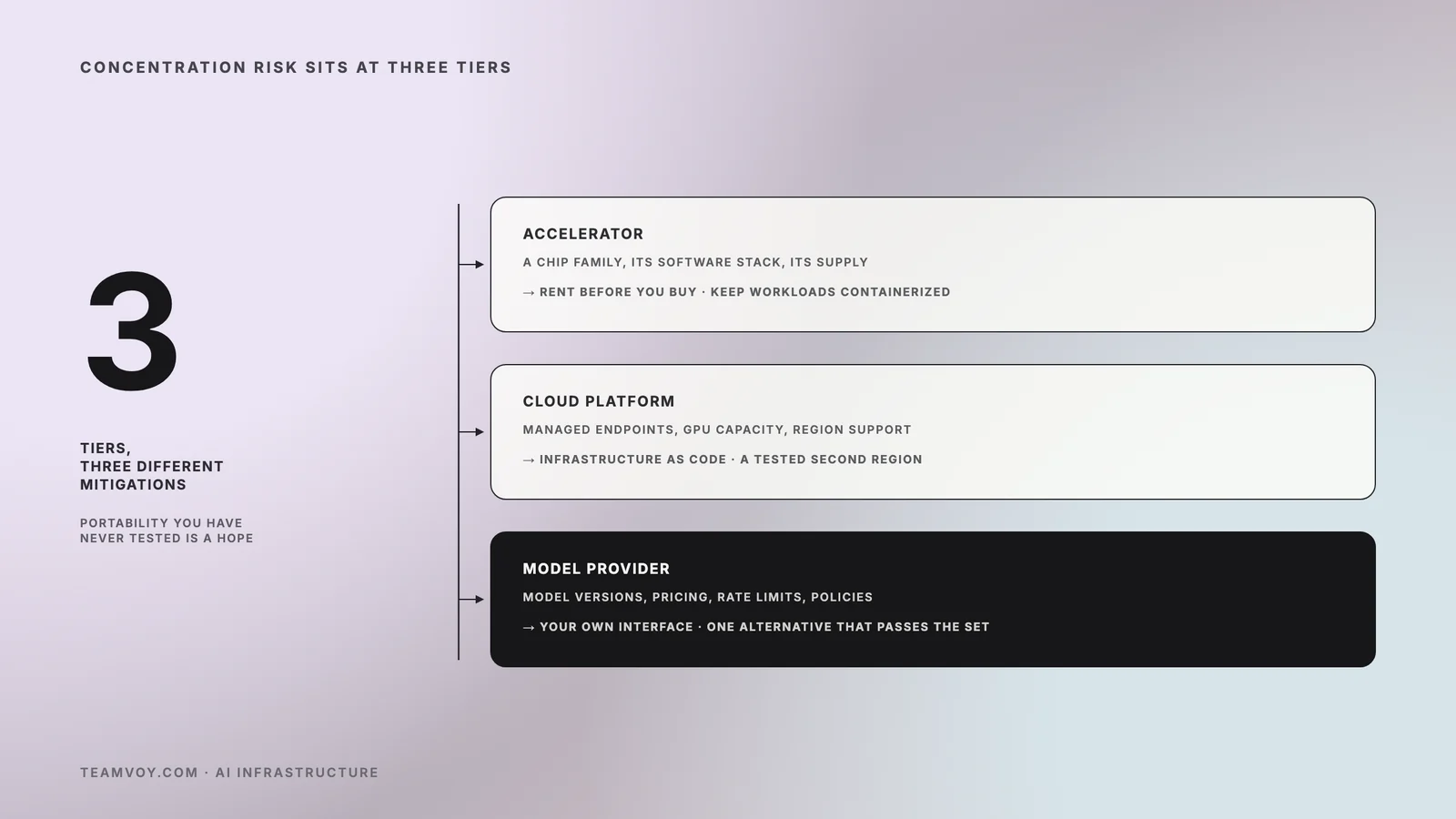
Concentration risk sits at three tiers, and each has a different mitigation:
| Tier | What you depend on | What can change | Practical mitigation |
| Accelerator | A chip family, its software stack, its supply | Availability, pricing, software compatibility across generations | Don’t couple application code to accelerator-specific APIs; rent before you buy; keep workloads containerized |
| Cloud platform | Managed endpoints, GPU instance availability, region support | Quotas, instance retirement, regional capacity | Infrastructure as code; a tested deployment on a second region or provider for the critical path |
| Model provider | Model versions, pricing, rate limits, content policies | Any of them, with weeks of notice or none | Model behind an interface you own; versioned evaluation set; at least one alternative model passing the set |
Portability is a test, not a slide
A portability claim you’ve never exercised is a hope. The practical test: can you redeploy your critical inference path on a different model, in a different region, in under a working week, with the evaluation set passing? If the answer is “in theory,” you have concentration risk. Running that test once a quarter is cheaper than discovering the answer during a vendor incident.
Observability is how you notice
Vendor changes rarely announce themselves in your P&L. A model version update that shifts your acceptance rate by a few points, or a pricing change that moves your cost per task, shows up first in per-request telemetry and only later in the invoice. That’s why the observability layer sits below in this guide, and above most teams’ priority list in practice.
What should AI observability measure?
AI observability should measure, per request and per feature, the model and version used, prompt and completion tokens, latency per pipeline step, retrieved sources, cost, and a quality signal such as acceptance, feedback or a judge score. Aggregated by tenant, feature and release, those fields let you answer the three questions that matter: what did this cost, did it work, and what changed.
Traditional observability tells you a service is up and fast. AI observability has to add “and it answered correctly, with the right sources, at the expected price,” because a model can be up, fast and wrong. The matrix below is the minimum.
| Metric | Why it matters | Where it’s captured | Who looks at it |
| Model and version per request | Attributes quality and cost shifts to releases | Gateway or SDK | Platform, ML |
| Prompt and completion tokens | The unit of cost; detects prompt bloat | Gateway | Platform, finance |
| Latency per step (retrieval, model, tools) | Finds the slow step, not just the slow request | Traces | SRE |
| Retrieved sources per answer | Explains answers; detects permission leaks | Retrieval service logs | ML, security |
| Cost per request and per task | Ties spend to features and tenants | Derived from tokens × price | Finance, product |
| Quality signal (acceptance, feedback, judge score) | The only metric that says it worked | App events + sampled evaluation | Product, ML |
| Drift against the evaluation set | Catches silent degradation after any change | Scheduled evaluation runs | ML |
| Safety and policy events | Blocked requests, PII hits, tool-permission denials | Guardrail layer | Security |
Two rules make the matrix useful. First, every metric needs a dimension for feature and tenant, or you’ll know the platform is expensive and not which product is responsible. Second, the quality signal needs a fixed evaluation set that runs on every model, prompt or retrieval change; online feedback alone is too noisy and too late. Measuring business outcomes beyond the platform is a separate exercise: see AI transformation success metrics.
How do you govern data, models, prompts and agents?
Govern AI systems by treating every component that changes model behavior as production configuration: data sources, prompts, model versions, tool permissions and agent policies all move through version control, review, staged rollout and rollback. Add an audit trail that records who changed what and which requests were affected, and define approval thresholds by risk class rather than by committee calendar.
The failure mode governance prevents is casual change. A prompt edited in a dashboard at 4 p.m. on a Friday, a retrieval source added without a permission check, an agent granted a new tool because the demo needed it. None of those feel like deployments, and all of them are.
A working governance checklist for enterprise AI infrastructure:
- Data sources: each source has an owner, a permission model carried through to retrieval, a retention rule and a documented reason for inclusion.
- Prompts and system instructions: versioned, reviewed, tested against the evaluation set, rolled out in stages, revertible in minutes.
- Models: a register of approved models and versions per risk class; upgrades gated by the evaluation set; deprecations scheduled, not discovered.
- Tools and agents: least-privilege permissions per tool; step and spend caps per task; human approval for any action that moves money, data or access.
- Access and audit: per-request records of user, tenant, model, sources and policy decisions, retained long enough to answer an auditor.
- Risk classification: a short rubric that places each workload in a tier (internal assist, customer-facing, regulated decision) with the review path each tier requires.
- Incident path: a named owner and runbook for “the model is producing bad outputs,” which is a different incident from “the service is down.”
Regulatory frameworks will shape the thresholds. Which ones apply depends on your sector and markets, and the article doesn’t try to list them; the architecture above is designed so that whichever obligations apply, the evidence already exists.
Who should own the enterprise AI platform?
The enterprise AI platform should have one accountable owner in engineering, typically reporting to the CTO or VP Engineering, with a small platform team that runs layers 4 through 6 and a service relationship with the product and data teams that own layers 1 through 3. Ownership includes the budget, the on-call rotation and the authority to decline workloads that don’t meet the platform’s SLOs.
The two common alternatives both fail in predictable ways. Ownership by a data science group produces excellent models and no serving reliability; ownership by a central IT function produces reliable infrastructure that no product team wants to use. The platform team model works because it puts a product mindset on an internal service: the customers are internal teams, the roadmap is their backlog, and the SLOs are the contract.
At mid-market scale, the platform team is often two to four people and the “team” for some layers is one named person with a backup. That’s fine. What isn’t fine is zero named people, which is the state most AI programs are in after the pilot phase.
How should a mid-market company sequence this?
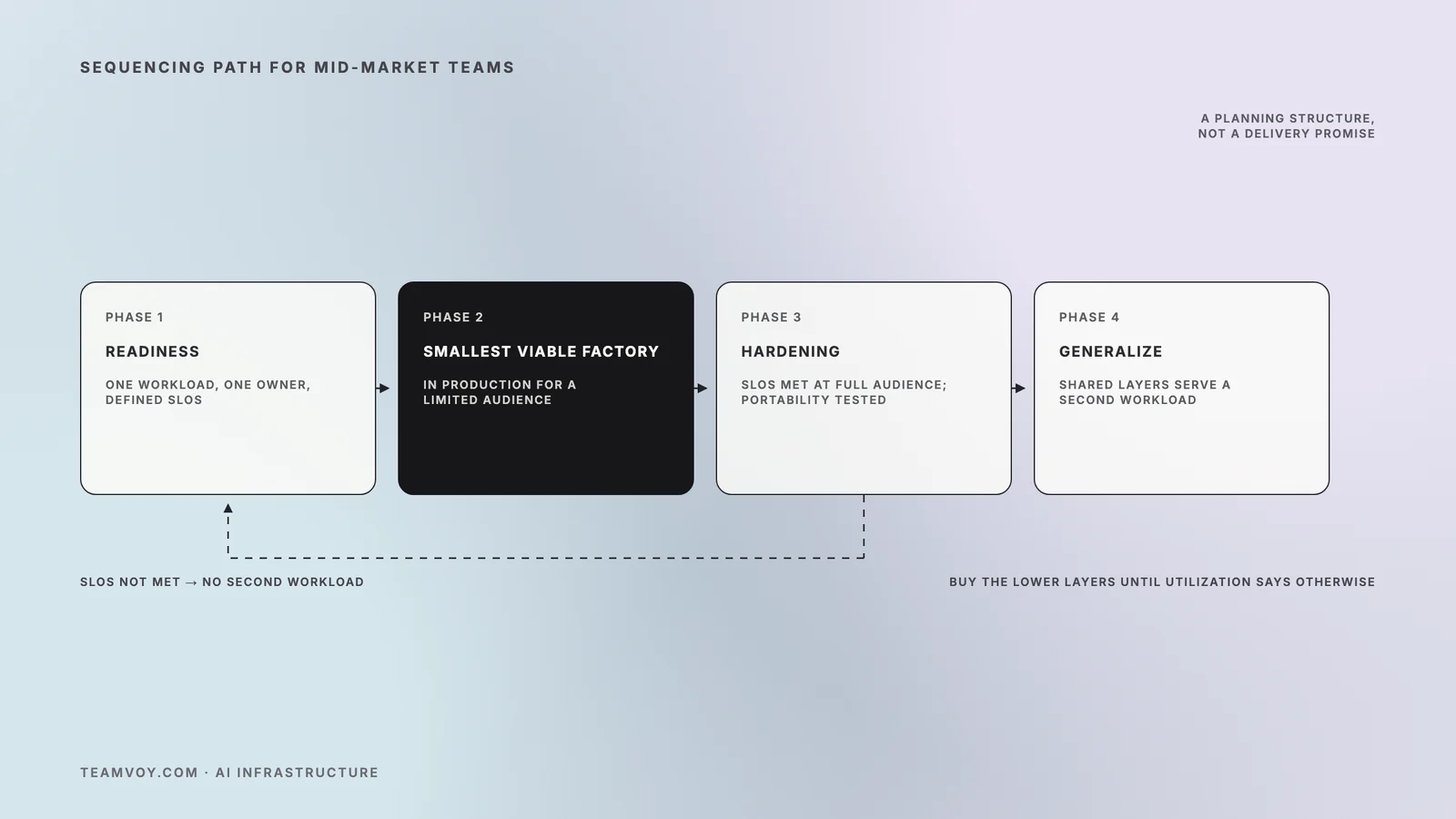
Sequence enterprise AI infrastructure from the workload down: pick one production workload with a measurable outcome, define its SLOs, build the data pipeline and evaluation set for that workload alone, serve it through a managed gateway with cost caps, instrument it fully, and only then generalize the platform to a second workload. Buy the lower layers until utilization or constraints justify owning them.
The sequence below is a planning structure, not a delivery promise. Durations depend on data access, team availability and how much of the stack already exists.
| Phase | Goal | What exists at the end | What to resist |
| 1. Readiness (weeks 0–4) | One workload, one owner, defined SLOs, data access confirmed | Workload brief, evaluation set v1, risk tier, cost ceiling | Starting with the platform instead of the workload |
| 2. Smallest viable factory (weeks 4–8) | Workload in production for a limited audience | Pipeline, hosted model behind your interface, gateway with caps, per-request telemetry, approval path | Fine-tuning before retrieval and prompts are exhausted |
| 3. Hardening (weeks 8–12) | SLOs met at full audience; portability tested once | Dashboards by feature and tenant, drift runs, rollback drill, second-model evaluation pass | Adding a second workload before the first meets its SLOs |
| 4. Generalize (quarter 2) | Platform serves two or more workloads with shared layers | Model register, governance rubric, platform team charter, budget by feature | Owning compute before utilization data says so |
The phase-1 work is where most of the risk gets removed, and it’s mostly discovery: which systems hold the data, who’s allowed to see it, what “correct” means for the workload and how it’ll be measured. If you want a structured version of that step before committing budget, an AI readiness assessment covers the same questions.
The smallest viable AI factory
For one workload, the smallest viable enterprise AI infrastructure is: a permission-aware data pipeline into a vector or hybrid index, a hosted model behind an interface you own, a gateway that enforces token and spend caps, per-request telemetry with a quality signal, a versioned evaluation set, and a review path for prompt and source changes. No owned GPUs, no custom serving stack, no fine-tuning. Everything in that list is either a managed service or a few weeks of integration work, and it already gives you an AI infrastructure architecture with all seven layers in a form you can grow.
Conclusion
Enterprise AI infrastructure is a seven-layer operating model, not a hardware order, and the layers that decide whether it pays off are the ones vendors don’t sell: workload definitions, data pipelines with permissions, evaluation sets, cost controls, observability and a named owner. NVIDIA’s AI factory framing is worth borrowing for one discipline, measuring output per unit of cost, and worth setting aside for its implied shape. Start with one workload, buy the lower layers, prove portability before you need it, and let utilization data, not a keynote, tell you when to own more.
Talk to Teamvoy About Enterprise AI Infrastructure
If you’re deciding what to build, what to buy and who should own each layer, Teamvoy’s engineers can work through the architecture with your team against your workloads, data and constraints. See AI development services for how an engagement is scoped.