
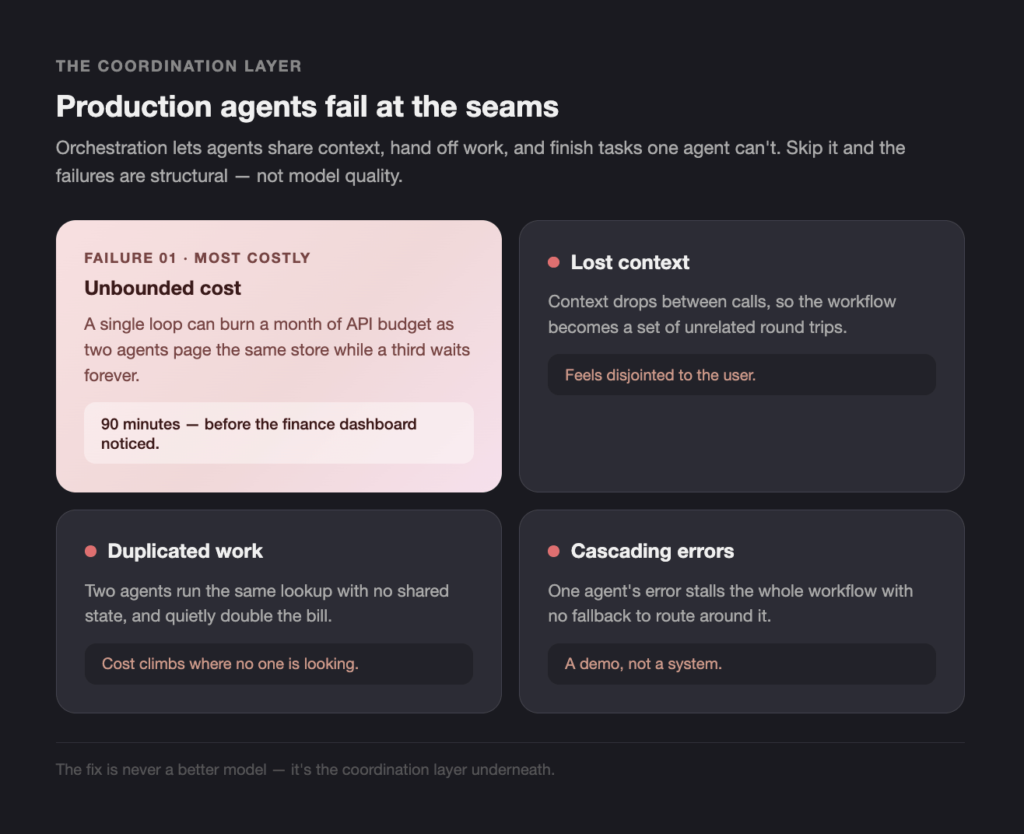
The demo worked on Tuesday. On Wednesday, it burned through a month of API budget in ninety minutes, because two agents were paging the same document store in a loop while a third waited on a message that never arrived. Nobody noticed until the finance dashboard did. I have watched some version of this happen on three engagements in the last twelve months, in three different domains, with three different vendors. The pattern is always the same. The fix is not a better model. It is the coordination layer underneath.
- AI agent orchestration is the coordination layer that lets multiple agents share context, hand off work, and finish tasks a single agent cannot.
- Production systems fail at the seams: lost context, duplicated work, unrecoverable errors, unbounded cost. Model quality is rarely the cause.
- Five patterns cover most workflows: sequential, concurrent, group chat, handoff, and magnetic. Pick per task.
- Orchestration infrastructure has to solve state, communication, fault tolerance, and horizontal scale.
- Frameworks like LangChain and IBM Granite structure profile, memory, planning, and action inside each agent.
- Measure agents with BLEU, precision, recall, and F1 score, wired to a dashboard the day the agent ships.
- Bring in a partner when the domain is high stakes or the team lacks recent multi-agent production experience.
| Topic | Key insight | Why it matters | Action item |
|---|---|---|---|
| AI agent orchestration | Coordinates multiple agents through shared context and workflow | Enables scalable, reliable enterprise AI systems | Implement multi-agent orchestration for complex workflows |
| Orchestration patterns | Sequential, concurrent, group chat, handoff, and magnetic each carry trade-offs | Lets you fit the workflow to the business need | Pick the pattern per task, not per project |
| Infrastructure challenges | State, communication, fault tolerance, scale are the four hard ones | System reliability and performance at scale depend on it | Invest in orchestration infrastructure early |
| Frameworks and evaluation | Profile, memory, planning, action modules; BLEU, precision, recall, F1 for metrics | Supports both build and continuous improvement | Standardize on a framework; wire metrics from day one |
| Business benefits | Better automation outcomes, fault isolation, collaboration, user experience | Drives operational efficiency and customer satisfaction | Use orchestration to scale AI beyond the first feature |
| Pattern | How it runs | Best fit | Trade-off |
|---|---|---|---|
| Sequential | Output of agent A feeds agent B, in order | Document review, staged approvals | Higher latency, strong accuracy control |
| Concurrent | Agents work in parallel on independent subtasks | Data enrichment, fan-out research | Synchronization and result merge cost |
| Group chat | Agents share one conversation, decide together | Strategic planning, cross-domain diagnosis | Higher token cost, harder to audit |
| Handoff | Router hands the task to a specialist agent | Tiered customer support, tool routing | Adds a routing agent as a single point of failure |
| Magnetic | Agents iterate with feedback loops | Adaptive coaching, live monitoring | Hardest to bound cost and stop conditions |
Introduction
The Tuesday demo story is a composite of three real incidents I have seen inside client teams this year. Different domains, different vendors, same shape. The team shipped one useful AI feature, felt the confidence come back, wired a second agent in beside it, and watched the system stop making sense somewhere in the second sprint. Every one of them was solvable, and none of them was a model problem. AI agent orchestration is a live problem inside every enterprise team that has shipped one useful AI feature and is now trying to ship the second, third, and fourth. Single-agent systems break as soon as the task needs planning across tools, memory across sessions, or expertise from more than one domain. This post is for the CTO, head of AI, or staff engineer who owns the agent stack and has to decide which coordination pattern to run, what infrastructure to build under it, which framework to standardize on, and how to prove the agents work in production. Everything below is patterns Teamvoy has run inside healthcare, finance, and SaaS deployments, not a hype primer.
What is AI agent orchestration and why does it matter?
AI agent orchestration is the discipline of coordinating multiple AI agents so they share context, delegate work, and finish tasks a single agent cannot. It is what turns “we called an LLM in production” into a system your team can operate. Unlike a solo agent, an orchestrated set of agents exchange messages, keep shared state, and hand off subtasks with the goal of a coherent workflow from request to result.
Orchestration matters because the failure modes at scale are structural, not model-quality problems. Context gets dropped between calls. Two agents do the same lookup and double the bill. One agent’s error cascades into a stalled workflow. IBM reports that 79% of users are comfortable sharing sensitive data with AI agents when governance and orchestration are in place, which puts the trust win in numbers (IBM).
For teams putting agents in front of customers, this coordination layer is the difference between a demo and a system that survives its first regulator conversation. See our AI integration services for how we scope this in production.
How does context sharing hold a multi-agent workflow together?
Context sharing lets each agent build on the last one’s output instead of repeating it. In customer service, a triage agent passes conversation history and account state to a specialist agent, so the specialist opens with signal instead of “how can I help you?” Without shared context, the workflow is a set of unrelated calls that feel disjointed to the user and cost the company multiple round trips.
How do orchestrated agents plug into tools and APIs?
Most useful AI agent work happens outside the model call: retrieving data, running a transaction, drafting a document. Orchestration mediates those tool calls so an agent can act, log the action, and pass the result on. Frameworks like LangChain and IBM Granite package this pattern so the LLM does the reasoning while the framework handles authenticated tool access, retries, and audit.
Which multi-agent orchestration patterns should you pick?
Five multi-agent orchestration patterns cover most real workflows: sequential, concurrent, group chat, handoff, and magnetic. Each one makes a different trade between latency, coordination cost, and fault tolerance. Choose per workflow, not per project.
- Sequential. Agents run in order. Output of one becomes the input of the next. Fits document review, multi-step approvals, and any workflow where step N depends on N-1.
- Concurrent. Agents run in parallel on independent subtasks. Fits data enrichment across sources, or research fan-out. Requires a merge step and a synchronization contract.
- Group chat. Multiple agents share one conversation and decide together. Fits strategic planning or cross-domain diagnostics. Costs more tokens and is harder to audit.
- Handoff. A router agent classifies the request and passes it to a specialist. Fits tiered customer support and tool routing. The router itself becomes a single point of failure that needs its own eval suite.
- Magnetic. Agents iterate with feedback loops, adjusting the plan as new signal arrives. Fits adaptive coaching, live monitoring, and any workflow where the target moves. Hardest to bound cost and stop conditions.
Pattern choice shapes system design, latency budget, and user experience. A handoff pattern routes customer queries to the specialist that will resolve fastest. A concurrent pattern accelerates a research workflow that would otherwise take minutes.
The pattern I recommend starting with, almost every time, is handoff. It is the easiest to explain to the business, the easiest to evaluate (one router, N specialists, each testable in isolation), and the easiest to add a human review step to. Once a team is on their second or third agent workflow, they usually reach for concurrent for the fan-out cases and group chat for the diagnostic ones. Magnetic is where I have seen the most projects overreach on the first try. It is the pattern that looks the most impressive in a keynote and the hardest to bound in production. Save it for workflow number three.
What does orchestration infrastructure actually need to do?
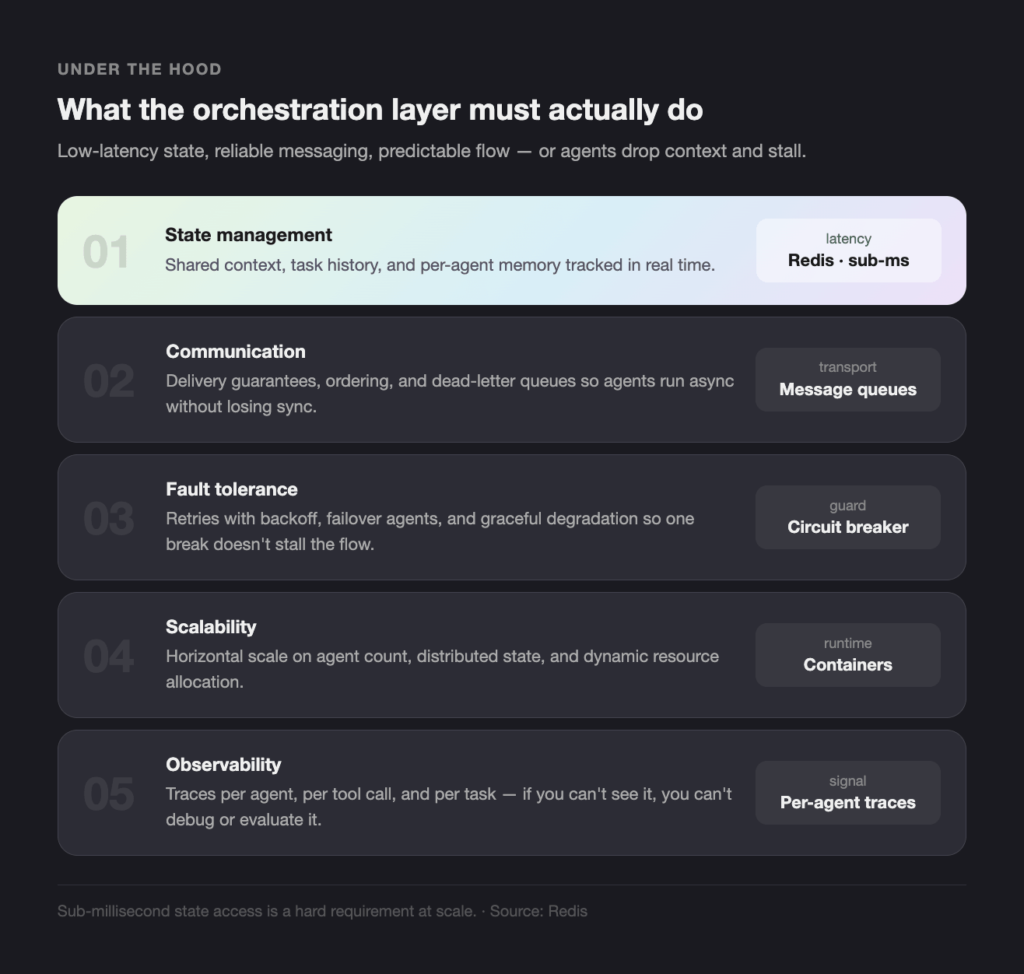
Orchestration infrastructure has to give you low-latency state, reliable messaging, and predictable execution flow. Without those three, agents drop context, duplicate work, and take the workflow down when any one call fails. The infrastructure requirements are concrete:
- State management. Shared context, task history, and per-agent memory tracked in real time. Redis and similar in-memory stores are used because agent workflows are latency-sensitive; sub-millisecond state access is a hard requirement at scale (Redis).
- Communication. Message delivery guarantees, ordering, and dead-letter queues. Event-driven or message-queue architectures let agents run asynchronously without losing coordination.
- Fault tolerance. Retries with backoff, failover agents, graceful degradation, and a circuit breaker so one broken agent does not stall the workflow.
- Scalability. Horizontal scale on agent count, distributed state, and dynamic resource allocation. Cloud-native and container orchestration platforms underpin the serious deployments.
- Observability. Traces per agent, per tool call, and per task. If you cannot see which agent did what and at what cost, you cannot debug or evaluate the system.
How do you keep state and context consistent across agents?
Loss of context is the most common failure mode in a multi-agent workflow. Agents produce and consume information that a central or distributed state store has to track and update in real time. Version the state. Attach it to a task ID. Confirm that every agent reads the same snapshot before it acts.
How do you make agent communication reliable?
Use protocols that guarantee delivery and ordering. Message queues and event streams let agents work asynchronously while staying synchronized. Idempotent handlers prevent duplicate action when a retry lands twice.
How do you handle faults without cascading them?
Detect fast, contain fast, degrade gracefully. Retry the recoverable, route around the broken, log the rest. Alert on the specific failure mode, not on aggregate error rate. Every agent has a fallback: a deterministic path, a cached prior answer, or a human review queue.
The rule I have written on the wall of every AI project I have led: no agent ships to production without a documented fallback path. Not a “we will add it later.” Not a “the model is reliable enough.” Written down, tested, alerted on. The one time I let a client argue their way past that rule was the one time we had a 4am call about a stuck queue that no human path could drain.
Which AI agent frameworks structure autonomous agents?
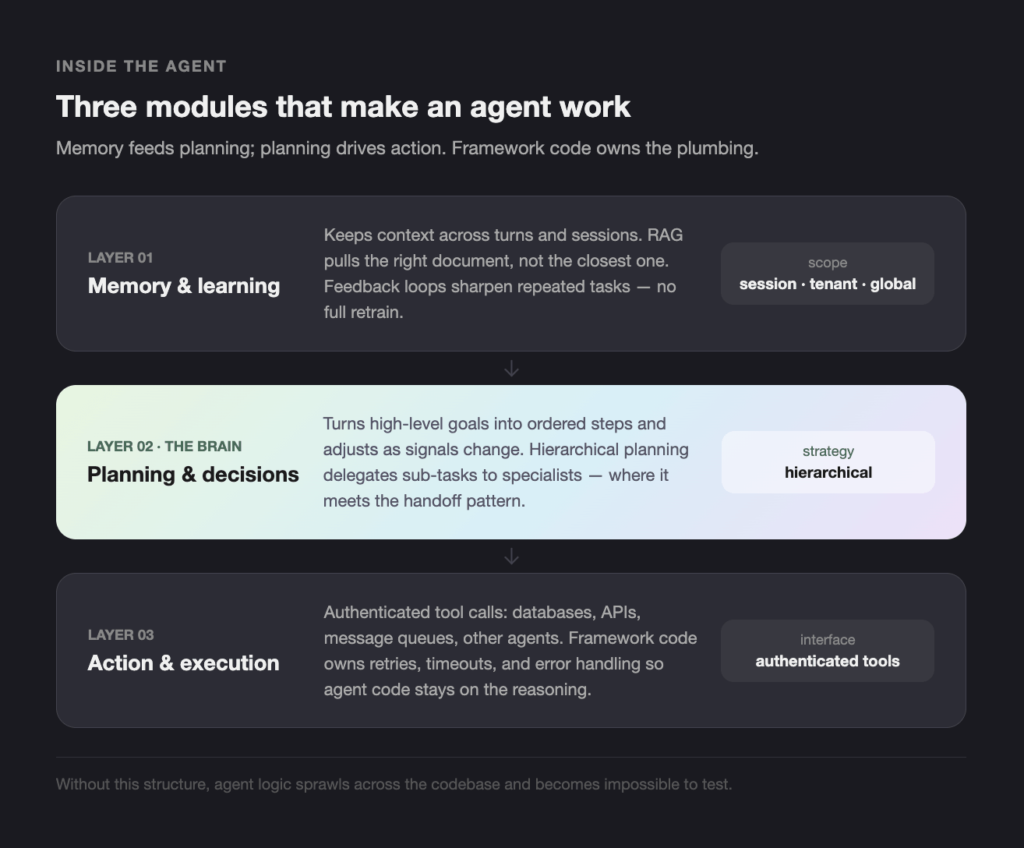
An AI agent framework structures how each autonomous agent handles four things: profile, memory, planning, and action. Without that structure, agent logic sprawls across the codebase and is impossible to test.
- Profile. Defines the agent’s identity, role, domain knowledge, and access rights.
- Memory. Short-term buffer for the current task, long-term store for facts and outcomes.
- Planning. Breaks a goal into steps and adjusts as feedback arrives.
- Action. Executes tool calls, API requests, or messages to other agents.
LangChain, IBM Granite, and similar frameworks package these components. Granite adds security and governance controls that matter in healthcare, finance, and other regulated domains. LangChain is the widest-adopted starting point for tool integration and agent composition.
How do memory and learning improve agent performance?
Memory modules let agents keep useful context across turns and sessions. Retrieval-augmented generation lets an agent pull the right document, not the closest one. Feedback loops let the agent improve on the tasks it repeats, without a full retrain.
How do agents plan and decide?
Planning modules turn high-level goals into ordered steps and adjust when signals change. Hierarchical planning delegates sub-tasks to specialists, which is the pattern that meets the handoff orchestration pattern in the middle.
How do agents actually execute?
Through authenticated tool calls: databases, APIs, message queues, other agents. Framework code owns retries, timeouts, and error handling so the agent code stays focused on the reasoning step. See our approach to building autonomous agents for the pattern in production.
How do you build and evaluate autonomous agents?
Building an autonomous agent is four decisions: profile, memory, planning, action. Evaluating one is another four: measure, monitor, log, iterate. Skip either half and the agent will drift or hallucinate in production.
Practical steps:
- Define the agent’s profile and access scope before writing any code.
- Choose memory scope: session, per-tenant, or global, with an explicit retention policy.
- Pick a planning strategy that matches the task complexity. A single-step task does not need hierarchical planning.
- Wrap every action behind an authenticated tool interface with retries and audit.
- Evaluate with the metrics that fit the task: BLEU for generation quality, precision and recall for classification and retrieval, F1 score to balance both.
- Log inputs, outputs, model, cost, and confidence for every call. This is the audit trail regulators ask for and the dataset the eval loop needs.
Continuous evaluation is the point at which most agent programs fail. Ship one metric per agent, wired to a dashboard, alerting on drift. For the production pattern behind this loop, see LLM observability and evals for fintech.
A fintech client of ours ran their first classification agent for six weeks with no eval loop wired in. Nobody noticed the F1 score had slid from 0.89 to 0.72 until a support engineer flagged that the same ticket type kept coming back mislabeled. The fix was a two-day rebuild of the eval harness against a labeled sample of that month’s tickets. The lesson was that the metric has to be running the day the agent ships, not the day someone complains. We now wire the eval dashboard before we merge the first agent PR. Every time.ost-launch, we transfer knowledge and stay available for on-call. For a scoped first step, see the Teamvoy AI Readiness Assessment: two weeks, fixed scope, working code merged to your repo. What to push back on in a vendor quote: any multi-month “discovery phase” that ends in a slide deck, any proposal that names juniors on delivery, any pricing model without a locked scope.
Where does AI agent orchestration deliver measurable value?
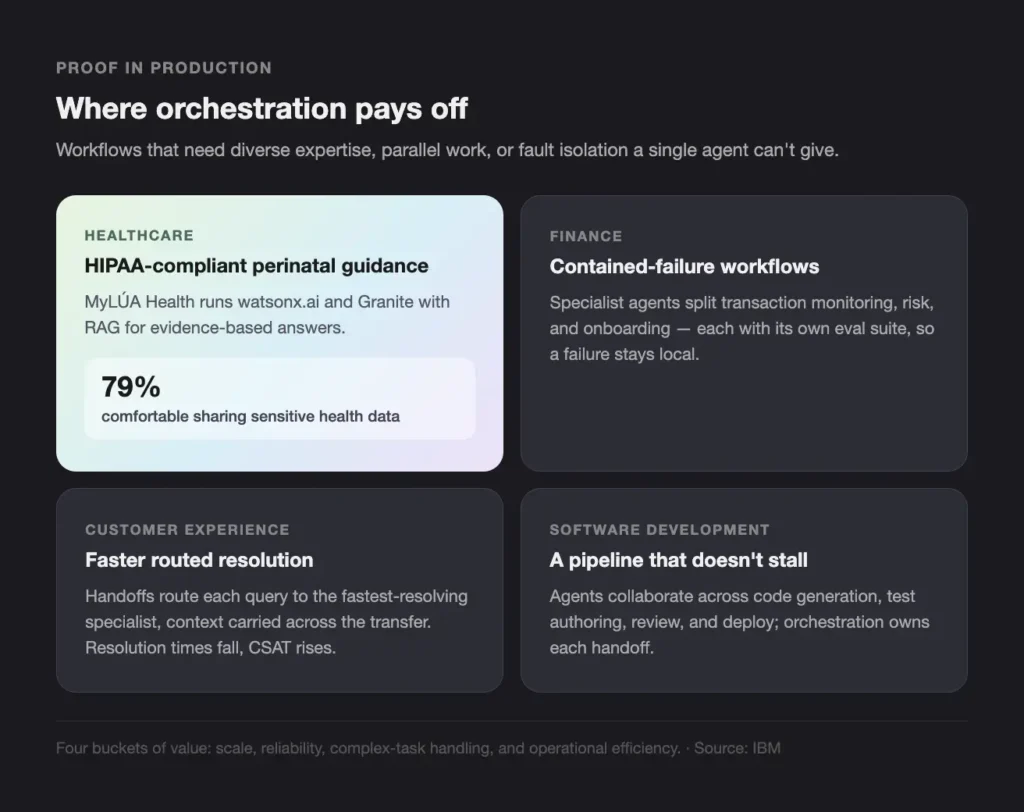
AI agent orchestration pays off in workflows that need diverse expertise, parallel work, or fault isolation that a single agent cannot provide. The measurable business benefits fall into four buckets: scale, reliability, complex-task handling, and operational efficiency.
Software development. Autonomous agents collaborate across code generation, test authoring, review, and deploy. Orchestration owns the handoff so the pipeline does not stall. See building AI agents into your CI/CD pipeline for the playbook.
Healthcare. MyLÚA Health uses IBM watsonx.ai and Granite with retrieval-augmented generation to deliver evidence-based, HIPAA-compliant perinatal guidance. 79% of users reported comfort sharing sensitive health data with the orchestrated system (IBM).
Finance. Specialist agents split transaction monitoring, risk assessment, and onboarding. Each agent has an eval suite. Failures stay contained to the affected workflow.
Customer experience. Multi-agent handoffs route queries to the specialist that resolves fastest, with context carried across the transfer. Resolution times fall; CSAT rises.
Software development. Autonomous agents collaborate across code generation, test authoring, review, and deploy. Orchestration owns the handoff so the pipeline does not stall. See building AI agents into your CI/CD pipeline for the playbook.
When should you bring in a partner for the orchestration build?
Bring in a partner when the domain is high stakes, the team lacks recent production multi-agent experience, or a compliance date is closer than your team’s current velocity supports. Do it in-house when the team has shipped agent workflows before, the use case is well scoped, and the workflow is not on a regulator’s radar.
Signals it is time to bring in help:
- The stack has a working prototype but no observability, no eval harness, and no runbook.
- The domain is regulated (healthcare, finance, insurance) and the audit trail is not there yet.
- The first attempt at orchestration ended in a monolith of prompt strings and no reproducibility.
- The team has never operated more than one agent in production.
Push back on any vendor quote that names juniors on delivery, treats orchestration as a slide-deck exercise, or refuses to lock scope for the first phase. The engineer who scopes the work should write the code, own the review, and stay on the call when the system is live. That is the rule I run every Teamvoy engagement by, and it is the one I would apply to any partner you consider, us included. For a scoped starting point, see the AI Readiness Assessment: two weeks, fixed price, working code merged to your repo, plus the orchestration roadmap for the phases that follow. See our full write-up on choosing an AI implementation partner for what to weigh.
Conclusion
AI agent orchestration is what turns a single working AI feature into an AI system your team can operate at scale. Pick the pattern for the workflow, build the infrastructure that keeps state and communication reliable, standardize on a framework that structures profile, memory, planning, and action, and evaluate every agent with metrics that fit the task. The result is a system that scales, degrades gracefully, and holds up under audit.
- Pattern first, framework second, infrastructure underneath, evaluation across the whole loop.
- Start with sequential or handoff. Move to the harder patterns only when the workflow demands it.
- Ship metrics with every agent. No metrics, no production.
If the next agent workflow is on your roadmap, book a call with a Teamvoy engineer or scope a starting point with an AI Readiness Assessment.