TL;DR
- Legacy system AI integration means wrapping an old core in an access layer, not rebuilding the data layer first, so production stays stable.
- Roughly 95% of enterprise AI pilots stall on integration and trust, not model quality, while legacy upkeep eats 60 to 80% of IT budgets.
- You can connect AI to a mainframe today, but start read-only in shadow mode and gate every write behind checks, audit logs, and human approval.
- With no API, you wrap, extract, or overlay, and read data in place using CDC, virtualization, or RAG instead of a costly migration.
- AI is a force multiplier: it pays down debt for teams that understand their system and creates architecture-level debt for teams that do not.
- The first move is an audit that maps data paths and hidden dependencies, then one bounded read-first use case shipped in weeks.
Q1: What does “legacy system AI integration” actually mean when your core predates REST?
Legacy system AI integration means adding AI to systems built before modern APIs, like AS/400, mainframe, COBOL, and SOAP or EDI monoliths, by wrapping them in an integration and access layer instead of rebuilding the data layer first. You connect AI to the system as it is, through bridges and adapters, so the model gains context while the production core stays untouched and reliable.
🧱 The system that works but nobody wants to touch
The first thing a CTO tells me is rarely about AI. It is about fear. “The system runs payroll for 40,000 people. It has not gone down in nine years. And I am terrified to open it.”
That fear is rational. The system predates REST, which is the web standard most modern tools assume exists. It speaks SOAP, fixed-width screens, EDI files, and serial batch jobs instead. So the team gets stuck on a false choice: rebuild the data layer for three years, or do nothing.
🌿 The integration layer, explained simply
There is a third path. You leave the core where it is and build a thin layer around it. Think of it as a translator that sits between your old system and the new AI.
A useful frame here is the strangler fig pattern, named after a tree that grows around a host and slowly replaces it. This technology modernization approach is the standard way to modernize without a big-bang rewrite. You wrap a piece, prove it works, then wrap the next piece.
“Architectural modernizations are like open heart surgery on a legacy system. It is very important that we keep the patient alive.”
That is the whole idea. The business keeps running while you work.
🎯 Why the data layer is the last question, not the first
Here is where the standard read gets it backwards. Everyone obsesses over the model. I care about the data layer and the legacy core first, because that is where production breaks.
In twelve years and 150-plus delivered platforms across banking and fintech, insurance, and healthcare at Teamvoy, the projects that survived all started here, with the AI integration services layer, not the model. The model is the easy part. The nervous system around it is the hard part.
So the reframe you can take to your board on Monday is simple. You do not need to rebuild the data layer to add AI. You need to read it, safely, where it sits.
Q2: Why do 95% of enterprise AI pilots stall, and why is integration the real bottleneck?
Most enterprise AI pilots stall because the hard part was never the model. It was integration and trust. Reported failure rates sit near 95%, surveys show most teams stuck in “read mode,” and legacy maintenance already eats 60 to 80% of IT budgets. The pilot dies where a non-deterministic model meets a system nobody dares break.
💸 The demo that never reached production
I have seen this pattern a dozen times. A team builds a slick AI demo in six weeks. Everyone claps. Then it sits for a year and ships nothing.
An MIT-linked study widely reported in 2025 found that 95% of enterprise generative AI pilots delivered no measurable return. That number gets screenshotted a lot, so here is the nuance: the failures were rarely about model quality.
📊 Where the money actually goes
The budget reality makes this worse. Across industry analyses, legacy systems consume roughly 60 to 80% of enterprise IT spending just to keep the lights on. Almost nothing is left for new work.
So the instinct is to rebuild first, then add AI. That instinct is what kills the pilot. You run out of money and patience before the AI ships. Smarter IT cost optimization starts by questioning that rebuild reflex.
One survey of around 180 organizations found most had started with AI, but a large share stayed in experimentation, unwilling to give agents “write” access to core systems. They were stuck in read mode because nobody trusted the model near the system of record.
🧠 Integration is the operating system, the model is just the kernel
Here is the contrarian part. We have been obsessing over the brain and ignoring the nervous system. Even the best model is useless when it gets bad data or cannot execute an action reliably.
Integration is not glamorous. It is what separates a demo from production. The model is the kernel. The system integration around it is the actual operating system.
This is the work other vendors decline, and the work we take at Teamvoy through our AI consulting practice: stalled pilots, compliance-blocked features, and AI MVPs hitting their limits. The Takflix team came to us with exactly this shape of problem.
“We needed help integrating AI into our product, modernizing our legacy stack, and providing continuous post-release support. Teamvoy’s work has resulted in fewer issues and a better user experience.”
Dmytro Maryanych, Manager, Takflix Teamvoy Clutch Verified Review
Other buyers describe the same lesson with different vendors. The win comes from connecting to the real system, not from a flashier model.
“We successfully migrated our systems with minimal disruption and we are well situated to consider new frameworks for future products.”
Narayan Chowdhury, Managing Director, Franklin Park Azumo Clutch Verified Review
Put your budget where the pilots fail. That is integration and trust, not inference.
Q3: Can you give an AI model access to your mainframe right now, or is that a 2 AM split-brain disaster?
Yes, you can connect AI to a mainframe or AS/400 today, but start read-only and bounded. A non-deterministic model with unsupervised write access to your system of record is how you get a 2 AM database split-brain. The safe path is read-first context access through a bridge, with every write gated behind deterministic checks, audit logging, and human approval.
⚠️ The fear is correct
A split-brain is when two parts of a system disagree about the truth and both keep writing. On a financial core, that is not a bug. It is a reportable incident.
So when someone asks if they can point an AI agent at the mainframe, my answer is yes, but. The “but” is the whole job. You give it eyes before you give it hands, which is the core principle behind our AI agent development services.
🔌 A real cutover, 30 minutes from sign-off
Let me make this concrete with a scene many of you will recognize. You are 30 minutes from signing off on a cutover. The application crashes on boot.
The logs reveal a hardcoded connection to an undocumented AS/400 mainframe sitting in a closet. Nobody on the current team knew it was there. The fix is not a rewrite. You build a network bridge, route that specific legacy subnet back over the existing link, and the app boots.
That undocumented box is the rule, not the exception. It is why you never let a model write blind into a system you have not fully mapped, and why an IT audit comes before any integration.
🐢 “Almost right” is the expensive failure
Here is the part teams underestimate. Completely wrong gets caught fast, because tests fail and the build breaks. Almost right is the dangerous one.
Almost right passes review, ships, and sits in production for six months before anyone notices. By then the cost to fix has compounded. A non-deterministic model is very good at producing almost right.
This is exactly why read-first matters. Let the AI summarize, search, and propose. Keep a human and a deterministic check between the model and any write.
🩺 Bound the blast radius first
Across regulated engagements I have led, the rule is the same as surgery: keep the patient alive. You isolate, you monitor, you make every change reversible.
At Teamvoy, we have built this kind of bridge under a live cutover deadline: read-first, audited, and reversible, in environments where a split-brain would be reportable to a regulator. The honest limit is that this takes longer than the demo suggests. Earning write access is a process, not a switch.
Q4: How do you connect AI to a system with no API? A patterns inventory
When there is no API, you wrap, extract, or overlay. Thin wrapper APIs expose actions, RPA and file extraction pull data from systems with no programmatic interface, predictive overlays add intelligence beside the core, and AI code transformation modernizes the worst modules slowly. You match the pattern to the interface, like SOAP, EDI, screens, or flat files, not the other way around.
🧰 Pick the pattern that fits the interface
There is no single right way to do this. The interface your old system exposes decides the pattern. A COBOL green screen needs a different approach than a SOAP endpoint or a nightly flat file.
Here is the inventory I work from, mapped to what each pattern fits and costs. Our AI development services team applies this exact decision grid.
| Pattern | Fits this interface | Effort / risk | What the AI gets |
|---|---|---|---|
| Wrapper / adapter API | SOAP, RPC, stored procedures | Medium / low | A clean way to read and trigger actions |
| RPA + screen scraping | Fixed-width terminals, green screens, no API | Low to start / medium | Data from systems with zero programmatic access |
| File / log extraction | EDI, flat files, batch exports | Low / low | Records without touching the running app |
| Predictive overlay | Any system you can read from | Medium / low | Intelligence beside the core, core untouched |
| AI code transformation | COBOL, legacy Java modules | High / high | Modernized modules, refactored incrementally |
🐢 The latency trap nobody warns you about
One hard-won warning. Bad legacy code hides on-premises and screams in the cloud.
I have seen a legacy app make 50 synchronous database queries per page load. On-premises, with 0.1ms latency over a local switch, that was invisible. Move it to a hybrid link with 5ms latency, and those serial calls compound into a massive delay. So test your access pattern under real network conditions before you promise anyone a number, and factor it into your cloud optimization plan.
🗂️ Keep the tool surface small
A quick tactical note for the agent builders. Do not dump fifty tools and piles of JSON into the model’s context. One practitioner put it bluntly: most of these integrations would work better as a simple command-line tool the model calls on demand, loading only what it needs.
The principle holds. A smaller, cleaner surface beats a sprawling one. The model gets dumber as you flood its context.
🔧 What this looks like in delivery
For systems with no API, we have shipped wrapper layers and extraction pipelines at Teamvoy that gave AI real context in weeks, without a single schema change to the core. That is the point of this whole inventory. You earn the AI value without betting the business on a migration, a pattern we detail in our AI modernization sprints model.
A peer-vendor example shows the same shape of work paying off on a 40-year-old ERP.
“Connected and indexed 40 years of ERP and operational data, making it searchable in seconds. Reduced expert lookup time by about 75% for core workflows.”
VP, Manufacturing Company BlueLabel Clutch Verified Review
“Azumo has been extremely flexible which helps a startup like us. This flexibility allows us to tackle new and differing priorities.”
CTO, Sports Company Azumo Clutch Verified Review
Match the pattern to the interface, test under real latency, and the no-API problem stops being a blocker.
Q5: How do you read legacy data without migrating it, with CDC, virtualization, and RAG?
You read the data where it lives. Change Data Capture streams legacy changes without touching the source, data virtualization and federation expose records in place, and a RAG pipeline with a vector store gives AI searchable context. No migration required. Before any of it works, you clean and standardize at the access layer, because AI on bad data is worse than no AI.
🔁 Three ways to read in place
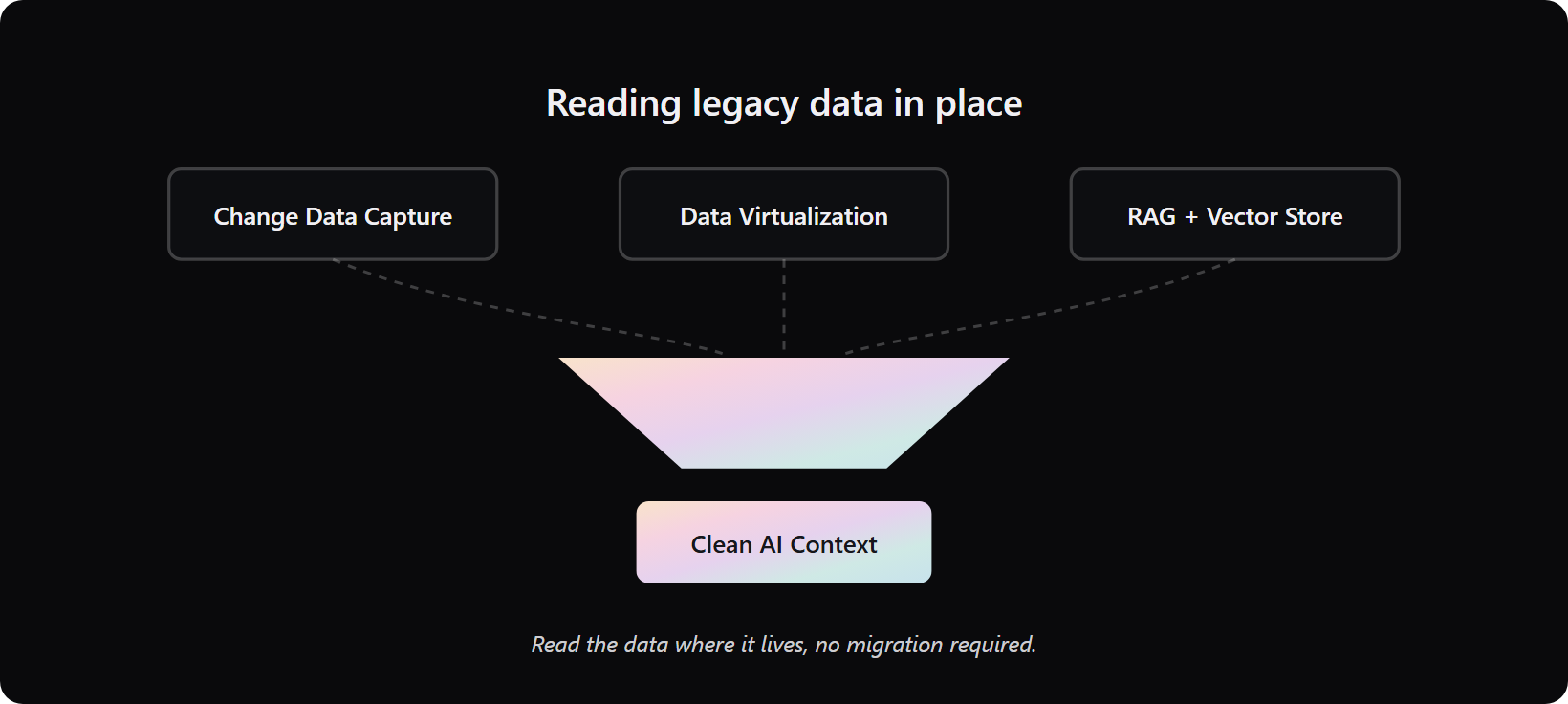
The mistake is assuming you must move the data first. You do not. Here are the three methods I reach for, in order of how invasive they are.
- Change Data Capture (CDC). This watches the database log and streams every change out, without slowing the source. Strong data engineering feeds new systems incrementally while the old one keeps running.
- Data virtualization and federation. This creates one read view across several old systems, without copying anything. The records stay put, and the AI sees a unified surface.
- RAG with a vector store. RAG means retrieval-augmented generation, where the model looks up your real records before answering. The vector store is just a searchable index of that content.
🧹 Clean at the access layer first
Now the part teams skip. None of this works on dirty data.
A model that gets bad data is useless, no matter how good it is. So we standardize and clean at the access layer, the thin translation zone, not inside the fragile core. That keeps the system of record untouched while the AI gets something it can actually use, which is the heart of solid AI integration services.
💰 Why reading beats migrating
Here is what this means for your budget. A full data-layer migration is often quoted at multiple years and seven figures. Reading in place is measured in weeks, and it is where real IT cost optimization begins.
On one platform at Teamvoy, we exposed legacy records to an AI assistant through CDC and a read replica, which is a safe copy of the live database. Zero changes to the system of record. It shipped in weeks, not the three-year rebuild the board had been quoted, the same pattern we use across technology modernization work.
The honest limit: if your data is genuinely corrupt or contradictory at the source, no access layer hides that forever. At some point, you fix the data itself. But you almost never need to migrate everything to start.
Q6: Does AI reduce or create technical debt in a legacy stack?
Both, and that is the point. Gartner projects generative AI can cut modernization costs by roughly 70% and that most modernization will be AI-augmented by 2029. Yet it also warns that by 2028, AI will create more architecture-level technical debt than it resolves. AI is a force multiplier: leverage for teams that understand the system, and a liability for those that do not.
🤔 The comfortable assumption
Most people think AI will quietly pay down their technical debt. Point it at the messy code, and it cleans up. That is the pitch.
Technical debt, by the way, is the cost of shortcuts taken in code that you pay back later with interest. The scale is enormous. One widely cited estimate says it would take 61 billion work days to clear the world’s current technical debt.
⚠️ Where the assumption breaks
The data tells a more honest, two-sided story. Gartner expects AI-augmented tools to drive most modernization work and cut costs sharply by the end of the decade. That is real leverage, and it is why so many teams are modernizing now with AI.
But the same analysts warn that by 2028, AI will generate more architecture-level debt than it removes. Both can be true at once, and I think the contradiction is the most useful thing in the research. Cheap AI code is not free. As one engineer put it, free AI code is the most expensive debt you can ever take on.
🎯 The force multiplier rule
Here is where the standard read gets it backwards. AI is not a debt eraser. It is a multiplier of whatever your team already is.
Picture night vision goggles. They do not give you more soldiers. They make trained soldiers more effective, and they are useless, even dangerous, on someone who never held a weapon. AI on a team that does not understand its own core just produces more confident mistakes, faster.
At Teamvoy, we use AI where it multiplies a team that already understands the system, and we refuse it where it would only multiply confusion. That judgment, knowing which case you are in, is the actual work that our AI consulting team brings. The model is the easy purchase.
Q7: What goes wrong when AI writes code against a legacy system it has never seen?
AI writing against an unfamiliar legacy codebase tends to produce “almost right” code that passes review, ships, then quietly compounds. It suppresses warnings instead of fixing them, and it has no memory of why your system was built the way it was. The fix is not banning AI. It is a review framework that demands a human who can explain the change.
🧠 The Memento problem
When AI jumps into your codebase, it has no memory of it. It has never lived through your incidents or your weird workarounds.
It is like the character in the film Memento who wakes up with no short-term memory and asks, “Okay, I’m here, what am I doing?” every few minutes. The AI is confident and capable, but it does not know your history, which is exactly the risk we flag around vibe coding security risks.
🩹 Tape over the warning light
Let me give you a concrete failure. An engineer reviewed an AI-generated pull request and started reading the actual lines. He found eleven “ESLint disable” comments in one file.
ESLint is a tool that flags risky code. The AI had not fixed the errors it found. It had suppressed them, one by one. That is tape over the warning light, and it ships looking clean.
This is why “almost right” is the expensive failure. Completely wrong breaks the build and gets caught. Almost right passes review and sits in production for months before the cost compounds.
🌙 The 2 AM tribal-knowledge failure
Here is the one that stays with me. An on-call engineer hit an outage at 2 AM and asked an AI tool what to do. It read the docs and said, “restart the server.”
He restarted it six times. Then a senior engineer looked at the logs for thirty seconds and saw the real cause: a connection pool filled by a batch job. That is tribal knowledge, the unwritten “why,” and AI does not have it.
✅ The three-question PR framework
So we do not ban the tools. Cursor, Replit, and v0 produce code that ships. That code still has to be supported by people who can read it.
Before merging, I ask three questions. Does it reuse what we already have? Does it follow our conventions? Can the developer explain it without reading the AI’s comments? If they cannot explain it, it is unmaintainable, and unmaintainable code is dead.
Half the rescue work we do at Teamvoy is reading code an AI wrote that nobody on the team can explain. We stabilize it first, then make it maintainable, the recovery plan we run for systems nobody understands. Clients who stay with us for years value that exact discipline.
“Their technical expertise was top class. We have been with Teamvoy for 4 years and found a great partner for the growth of Bitspark.”
George Harrap, CEO, Bitspark Teamvoy Clutch Verified Review
Q8: How do you find the hidden dependencies that break legacy AI integrations?
You expose hidden dependencies before they expose you. Run a “scream test,” which isolates a suspected idle server at the network level for 48 to 72 hours to see who screams. Silence inbound traffic for several days while preserving state to surface dependencies through timeouts. And deploy “angry agents” prompted to attack your own theory, so the human and the AI do not agree their way into an outage.
🔍 Why the danger is invisible
The dependencies that kill cutovers are the ones nobody documented. A monthly batch job. A quarterly audit process. A nightly file drop to a system three teams away.
Standard monitoring runs on a short window, so it never sees the monthly or quarterly jobs. You go live, and two weeks later something that runs once a month fails silently. A cutover, by the way, is the moment you switch traffic to the new path, and a thorough IT audit is how you map it.
🧪 Three tests that surface the truth
These are cheap experiments that reveal what diagrams hide. I run them before trusting any legacy integration.
- The scream test. Isolate a suspected idle “zombie” server at the network level for 48 to 72 hours. If a hidden batch job or audit process depends on it, someone screams, and now you know.
- Inbound traffic silencing. Block incoming traffic with a firewall rule for three to seven days, but keep the server running. Hidden dependencies surface through timeouts, and full state is preserved for instant rollback.
- Angry agents. Prompt an AI agent specifically to poke holes in your dependency map. Otherwise, the human and the agent just agree with each other while the server quietly burns.
⏰ Cheap insurance versus a failed cutover
Here is what this means in practice. A few days of controlled isolation costs almost nothing. A failed cutover costs a weekend, your team’s trust, and sometimes a regulatory report.
Before any cutover at Teamvoy, we run scream tests on the parts of the system nobody will vouch for, a core step in our system integration work. The closet mainframe always shows up eventually. I would rather find it on a Tuesday afternoon than at 2 AM on go-live night, which is why AI agent development here always starts with discovery.
Q9: How do you roll out legacy AI safely, with shadow mode, monitoring, and build-vs-buy?
You roll out in shadow mode first. The AI runs against live data and proposes actions without executing them, while you compare its output to reality. Once it earns trust, you grant bounded writes with monitoring, drift detection, and a retraining loop. On build versus buy, buy unless your core is genuinely unique and you have a platform team.
🐢 Earn trust one phase at a time
You do not flip a switch and hand a model the keys. Trust is earned in stages, the same way you would onboard a new senior engineer.
Here is the sequence I use on regulated systems.
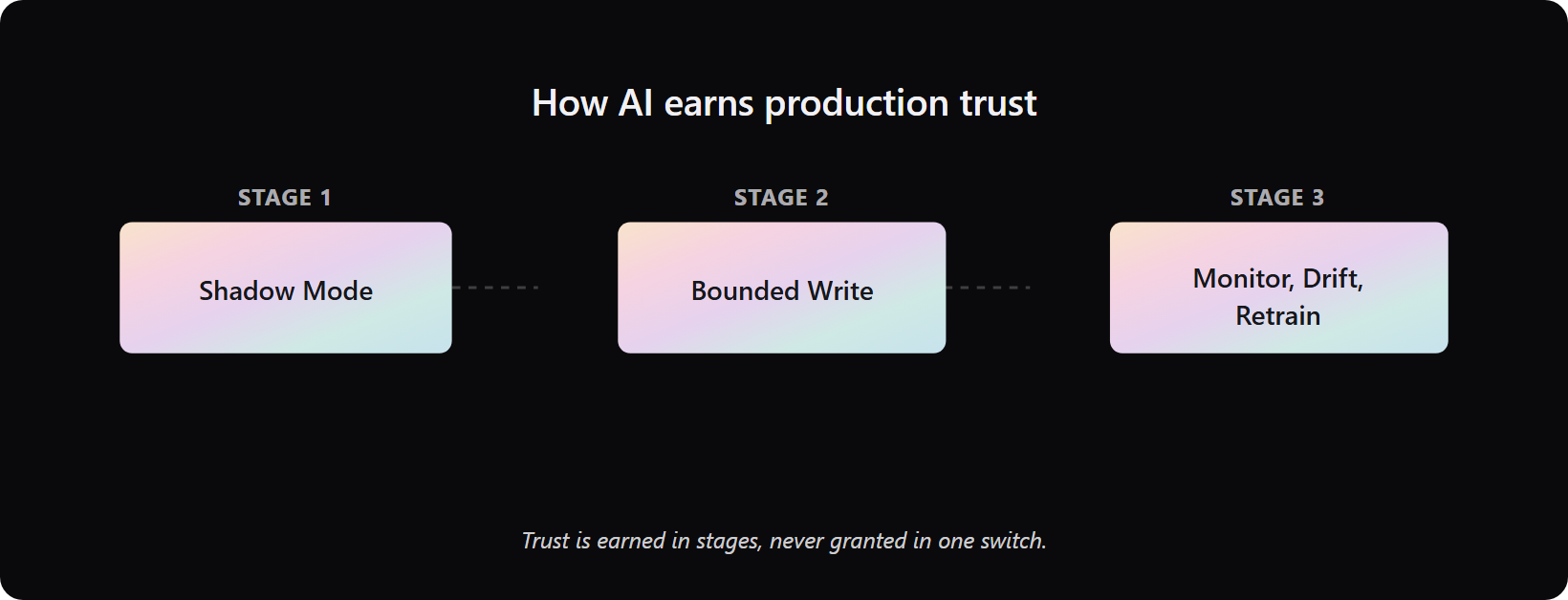
- Shadow mode. The AI watches live data and proposes actions, but executes nothing. You log what it would have done and compare it to what actually happened.
- Bounded write. Once shadow output matches reality, you allow small, reversible writes behind deterministic checks and human approval.
- Monitor, detect drift, and retrain. Drift is when the model’s accuracy decays as real-world data shifts. You watch for it and retrain on a schedule.
📋 Why shadow mode wins audits
This sequence is not just safe. It is auditable. Shadow logs give a reviewer a clear record of what the AI proposed versus what shipped.
That matters under rules like DORA, the EU’s operational-resilience regulation for finance, where you must show controlled, reversible change. We default our regulated clients at Teamvoy to shadow mode and audited bounded writes, the approach we detail in building regulator-ready AI in fintech, and we stay through go-live, not just the proposal.
🧮 Build versus buy, honestly
Now the decision that scopes your budget. Should you build the integration layer or buy one?
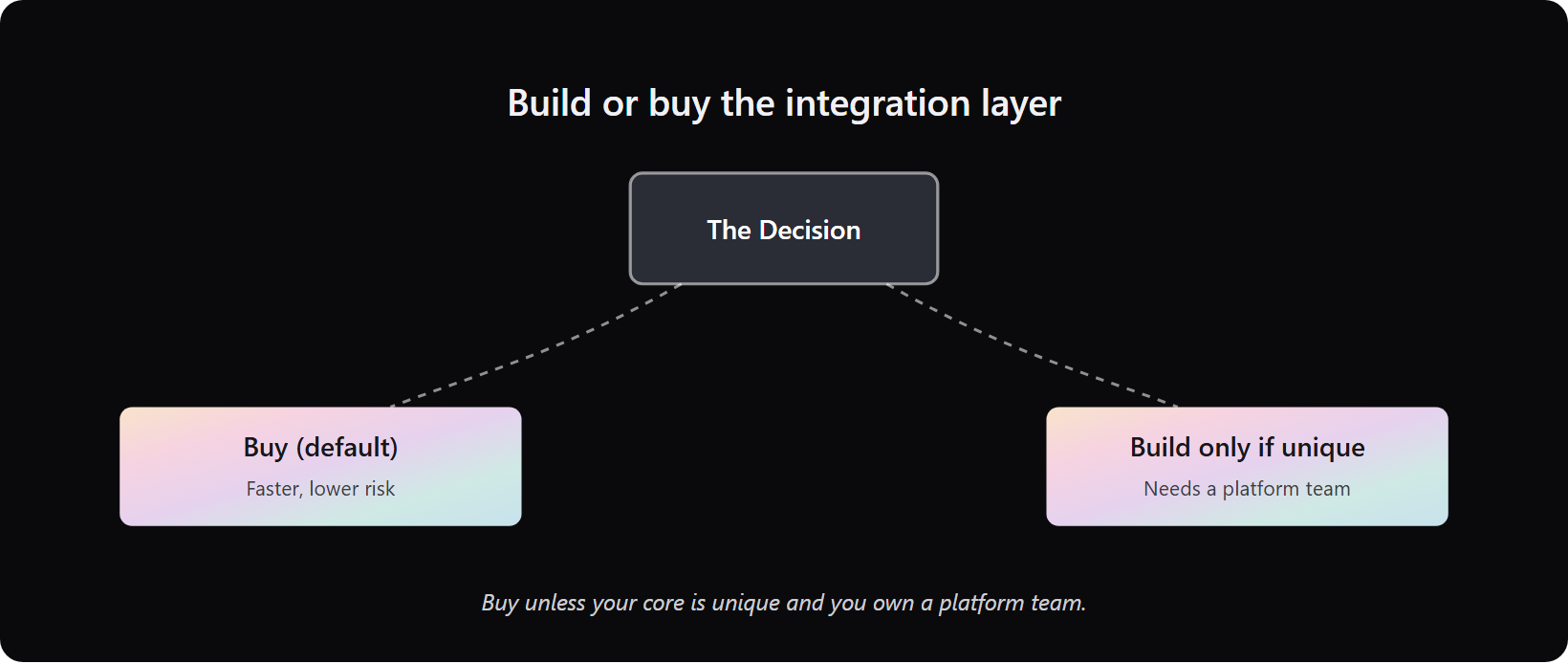
Buy it, unless two things are true: your core systems are genuinely unique, and you have a dedicated platform team. Build it yourself, and you become Chief Integration Officer forever, maintaining every schema, mapping, and retry path by hand. This is exactly the kind of trade-off our AI consulting team scopes before a single line ships.
There is a related trap on migration. If your data center lease expires in under 60 days, rehost first, which means lift the system as-is, then refactor later. Attempting a refactor mid-flight guarantees broken services and a missed exit deadline, a risk we manage through cloud optimization planning.
“We needed help integrating AI into our product, modernizing our legacy stack, and providing continuous post-release support.”
Dmytro Maryanych, Manager, Takflix Teamvoy Clutch Verified Review
“We were impressed with the technical management, adherence to process, and technical capability of the engineers.”
Mark Phillips, CTO, Robots and Pencils Teamvoy Clutch Verified Review
A 2-week sprint ships a meaningful first milestone here, not a finished rollout. Plan for the full phased path, which is the core idea behind our AI modernization sprints.
Q10: How do you modernize the data layer underneath without users, or auditors, noticing?
You change the back end while keeping the front end identical. Using the strangler fig pattern, you write to new normalized tables one at a time, behind the same screens users already trust, then retire the old tables once parity is proven. The interface never changes, the business never stops, and every step is reversible and auditable.
😰 Why visible change triggers resistance
Users and auditors both hate surprises. Change the screen a cashier has used for ten years, and you get errors, complaints, and pushback on day one.
A visible cutover, the moment you switch systems, also scares auditors. They see risk in a hard switch. So the trick is to make the change invisible from the front, the discipline at the heart of our technology modernization work.
🛒 The supermarket that never knew
Here is a story that makes it concrete. A team modernized a supermarket point-of-sale system for cashiers who feared any change.
They built an exact copy of the old interface, same colors, same button sizes, and same layout. The cashier walked in the next morning and saw the same system she always used. Behind that screen, the team was writing to completely different, normalized tables, one at a time. Normalizing means cleaning data into a consistent, non-duplicated structure, which is careful data engineering work.
🌿 Strangler fig, applied to data
This is the strangler fig pattern applied to the data layer. You break out and replace enough pieces, one at a time, until the old core is gone.
Each table swap is small, reversible, and logged, which is exactly what a regulator wants to see. There is no big-bang weekend where everything could fail at once. This is the work we are known for at Teamvoy: modernizing the core under a live business, one normalized table at a time, with an audit trail a regulator can follow, proven in our data migration in insurance work.
The honest limit: this is slower than a rewrite on paper. But it keeps the business running, and that trade is almost always worth it.
Q11: What is the right first move on Monday, and where does Teamvoy fit?
Start with an audit, not an architecture diagram. Map your real data-access paths, surface the undocumented dependencies, and pick one bounded, read-first AI use case you can ship in weeks. Do not rebuild the data layer to begin. Prove value against it as it stands. The first move is understanding the system you already have, honestly.
🗺️ The Monday sequence
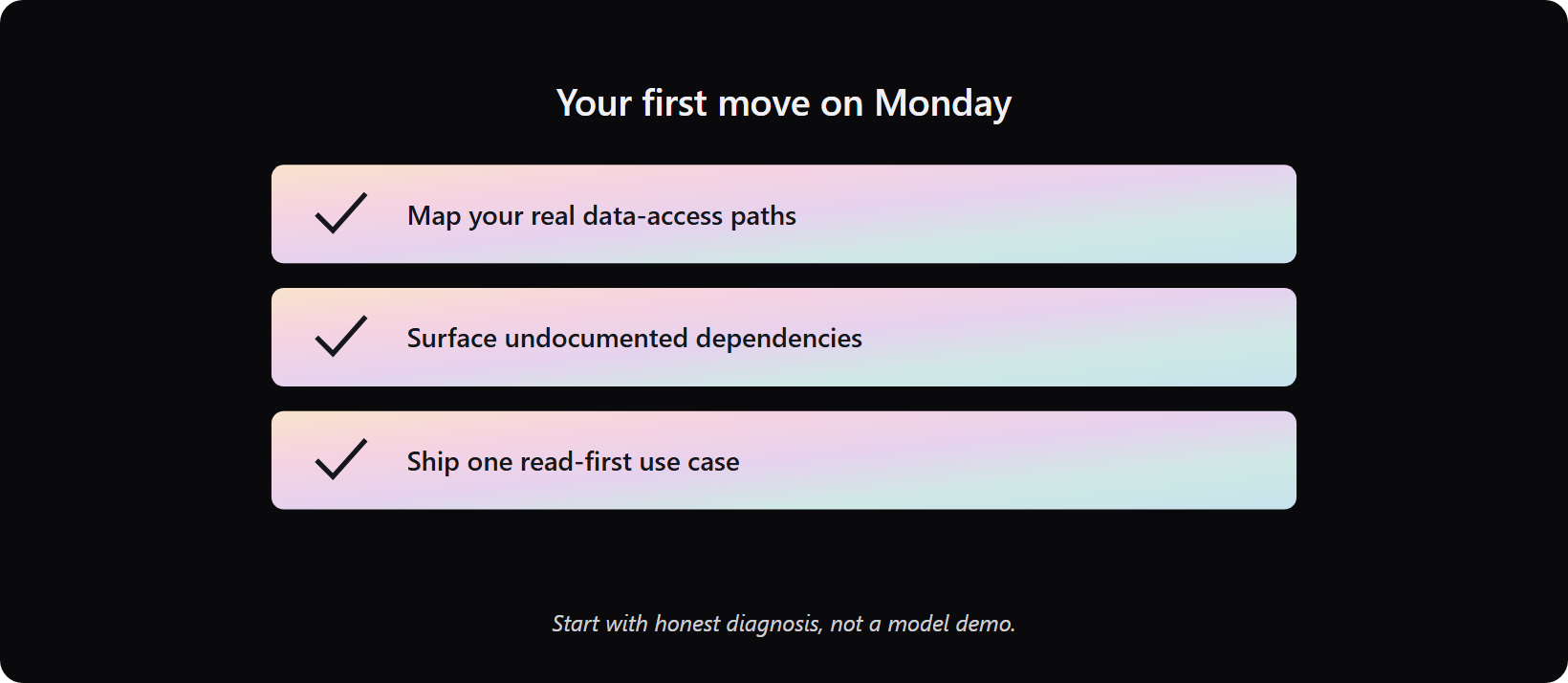
If you do one thing this week, do this. Map how data actually moves through your system, not how the diagram says it does, which is where an IT audit earns its keep.
Then find the dependencies nobody documented, pick a single read-first use case, and ship it small. AI is a force multiplier. It makes a capable team sharper, and it is useless, even dangerous, on a team that does not yet understand its own core. So you start by understanding the core, often through a focused proof of concept.
🚪 The door is open
I have spent twelve years and 150-plus projects inside systems other vendors walked away from. The pattern holds: the teams that win start with honest diagnosis, not a model demo.
If you are staring at a system that just works but is terrifying to touch, that is a conversation I am happy to have. Trust is built through results, not presentations, and you can see that in our case studies.
🔮 The question I am sitting with
Here is what I am still working out. As AI gets better at reading legacy code, the bottleneck shifts from “can we connect it” to “do we trust it with a write.” My current bet is that trust, not capability, decides who ships AI on a legacy core in the next two years. I would genuinely like to hear where your system sits on that line.