TL;DR
- Most enterprise AI pilots stall because teams obsess over the model and ignore the integration layer that moves data and executes actions safely.
- The first two questions are never the model: they are whether the data layer is trustworthy and permissioned, and whether the legacy core can accept an action.
- Durable patterns include AI gateways, adapters or sidecars, event-driven triggers, and feedback loops; point-to-point wiring collapses as you scale.
- Wire systems by blast radius first, read-only lookups now, write access behind circuit breakers and audit trails, core ledgers left alone.
- Govern write access with the NIST AI RMF, circuit breakers, least-privilege scopes, and prompt-injection defense before any agent touches production.
- Most teams should buy a governed platform rather than build, then scope a disciplined 90-day path from stalled pilot to production AI.
Q1: Why Do 95% of Enterprise AI Pilots Never Reach Production?
Most enterprise AI pilots stall because teams obsess over the model and ignore the integration layer that moves data and executes actions. A read-only bot that summarizes a wiki is a demo. Production needs write access to CRM and ERP, reliable execution, and cost controls. The bottleneck is not inference quality. It is the nervous system connecting the model to your systems.
🧠 We have been polishing the brain and ignoring the nervous system
A few months back, a Head of Engineering told me his AI assistant worked perfectly in the demo. In production, it could not update a single record. That gap is the whole story of 2025.
The numbers back the pattern. By one widely cited account, 95% of enterprise generative AI pilots delivered no measurable return. Gartner expects 40% of enterprise apps to embed task-specific AI agents by the end of 2026, yet warns a large share of agent projects will be scrapped. Both things are true at once.
⚠️ The model is the kernel, integration is the operating system
Here is the reframe I keep coming back to. The model is the kernel. The integration layer is the operating system around it.
A kernel alone does nothing useful. It needs scheduling, permissions, and input/output to run real work. Even a frontier model is useless when it gets bad data or cannot execute an action reliably. The unglamorous part, the wiring, is what separates a demo from production.
💸 The data layer and the legacy core come first, not the model
Across the AI integration calls I have led inside fintech, insurance, and healthcare, the first thing I look at is never the model. It is the data layer, then the legacy core. Get those two wrong and no model choice saves you.
I might be overstating this, but the pattern is consistent: pilots die in the seams between systems, not inside the model. This article walks the seams in order. Durable patterns, which systems to wire first, the data layer decision, governance for write access, and a vendor shortlist.
At Teamvoy, we have delivered 150-plus projects over twelve years, most in regulated environments where downtime is a reportable event. We start every AI consulting engagement at the integration and data layer, because that is where the work either holds or quietly falls apart.
Q2: What Is the Integration Layer, and Where Does It Sit in the Four-Layer AI Architecture?
Enterprise AI runs on four layers. A data layer (trustworthy, permissioned facts), a model layer (the reasoning engine), an application layer (where users act), and a governance layer that spans all three. The integration layer is the connective tissue binding them. It lets the model read good data and execute actions reliably. Think integration as the operating system and the model as the kernel.
🗂️ The four layers, in plain terms
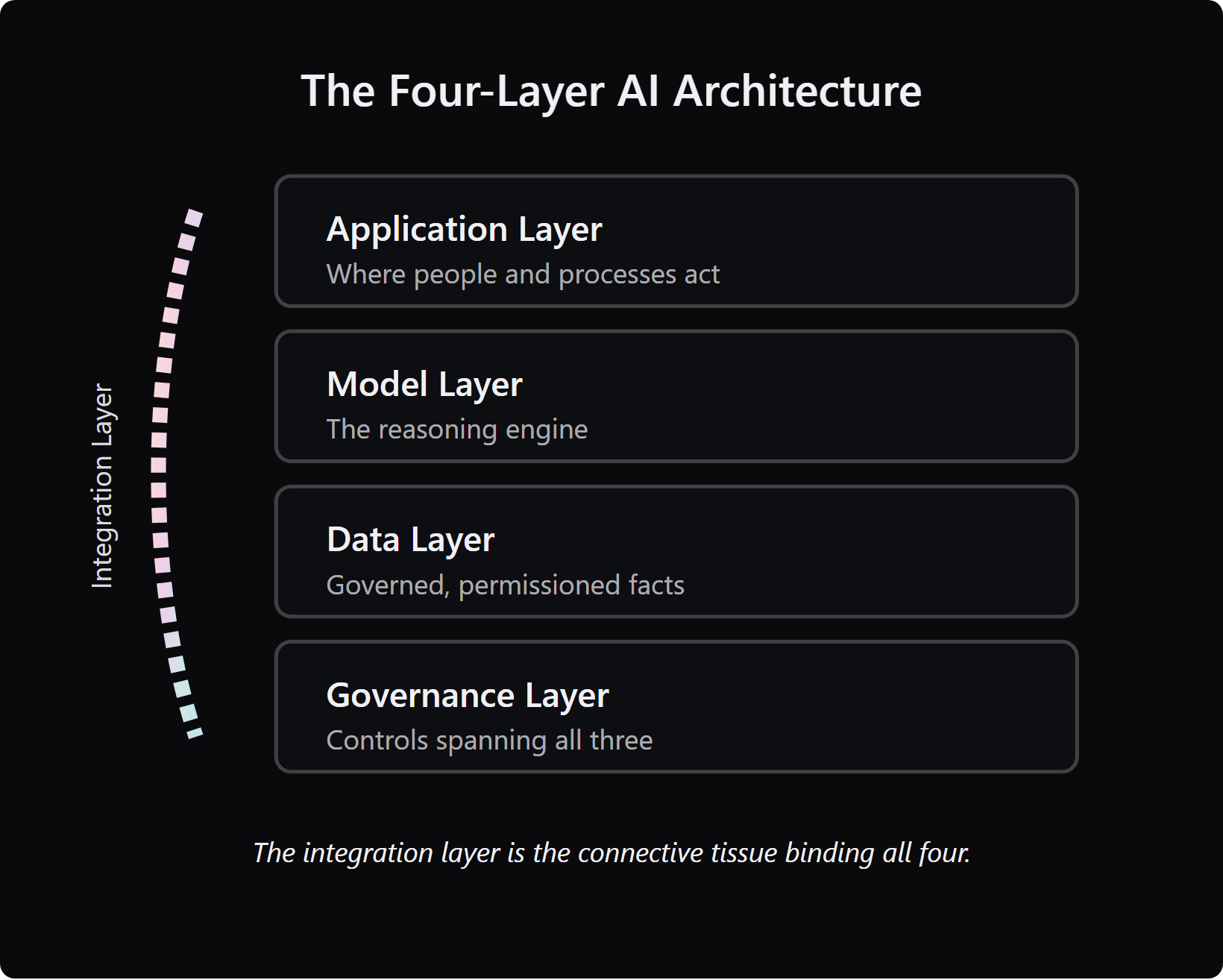
Picture a stack. Each layer has one job, and the integration layer threads through all of them.
- Data layer: your governed, permissioned facts. The customer record, the ledger entry, the claim.
- Model layer: the reasoning engine. Useful only when fed clean inputs.
- Application layer: where a person or process actually acts on the output.
- Governance layer: the controls, logging, and permissions that span the other three.
The integration layer is not a fifth box on the side. It is the wiring that lets data reach the model and lets the model’s decisions reach your systems safely.
🔌 A read-only bot versus a production agent
Concrete example. A read-only assistant reads your Confluence and answers questions. Useful, but it is a fancy search box.
A production agent does more. It updates a CRM record, opens a ticket, or provisions a user. Crucially, it reacts to a “Deal Closed” webhook (an automatic event notification) instead of polling, which means asking “anything new?” on a loop. That single shift, from polling to event-driven, is where most demos quietly break. This is the kind of work our AI agent development services are built around.
⚙️ The two questions I ask before anyone mentions a model
There is a useful analogy from the field. Night-vision goggles do not give you more soldiers. They make trained soldiers more effective, and they are dangerous on someone who never held a weapon. AI is the same. It amplifies a system that already works and amplifies the mess in one that does not.
So on an integration call, I ask two things first. Is the data layer trustworthy and permissioned? And can the legacy core safely accept an action from a model? Gartner’s own framing for connecting agents to enterprise apps lands in the same place: you need AI-consumable interfaces, a central control layer, and agent-ready data. Sound data engineering is what makes that data layer trustworthy in the first place.
At Teamvoy, we frame AI scoping as where it adds leverage and where it adds risk. The integration layer is exactly where that line gets drawn, across all four layers, before a model is ever chosen.
Q3: Which Enterprise AI Integration Patterns Actually Hold Up in Production?
Four patterns survive production. The AI gateway (central control, auth, cost metering), the adapter or sidecar (wrap legacy systems without touching them), event-driven triggers (react to webhooks, not polling), and the feedback loop (capture outcomes to catch drift). Choose by latency tolerance, who owns the system, and governance needs. Avoid point-to-point hardwiring. It is the pattern that quietly collapses as you scale.
🧩 The patterns, and when each one earns its place
There is a recurring blunder worth naming. As one practitioner put it, “we copied Google for agents,” bolting a chat box onto everything. It feels like recording radio shows on early television: the old format forced onto a new medium. Patterns that hold up are designed for the system they touch, not for the demo.
| Pattern | When to use it | Fit (latency / ownership / governance) | The anti-pattern it replaces |
|---|---|---|---|
| AI gateway | You need one place for auth, routing, and cost metering | Central control, strong governance | Every team calling the model API directly |
| Adapter / sidecar | A legacy core you cannot safely modify | Low blast radius, you keep ownership | Editing the legacy code in place |
| Event-driven trigger | Actions must follow real events (“Deal Closed”) | Low latency, reacts instead of polling | Polling loops that miss or duplicate events |
| Feedback loop | Outputs drift and need monitoring | Governance and quality over time | Ship once, never measure |
⚠️ Why point-to-point wiring fails first
Point-to-point integration looks fastest on day one. You connect the model straight to one system, ship the demo, and feel good.
Then you add a second system, a third, and a new auth flow. Now every connection is bespoke, and one schema change breaks three things. It is the pattern I most often find when I pick up a stalled build. Clean system integration is what replaces that fragility.
🏗️ The pattern I default to on systems under pressure
When a core system is fragile and the business cannot stop, I reach for the adapter or sidecar first. Modernise the edges, leave the working core intact, and route AI through a layer you control. I could be wrong for a greenfield build, where an AI gateway from day one is cleaner. But on a live regulated platform, wrapping beats rewriting nearly every time, which is the heart of how we approach technology modernization.
This is most of what we do at Teamvoy. We pick up systems already under load and add AI through adapters, so the core keeps running while the new capability proves itself. Clients describe the result plainly.
“Teamvoy’s work has resulted in fewer issues and a better user experience… We’re impressed with their involvement in processes and quick completion of work.”
Dmytro Maryanych, Manager, Takflix Teamvoy Clutch Verified Review
That engagement was AI integration on a legacy streaming stack, with continuous post-release support. The adapter approach is why it shipped without disrupting the live product.
Q4: Which Systems Are Worth Wiring First, and Which Should You Leave Alone?
Wire first where AI has high leverage and low blast radius. Ticketing, internal search, and read-heavy CRM lookups. Defer write access to financial ledgers, core banking, and anything an auditor signs off on, until circuit breakers and audit trails exist. Sequence by reversibility. Start where a wrong action is cheap to undo, not where the demo looks most impressive.
🎯 The triage I run before wiring anything
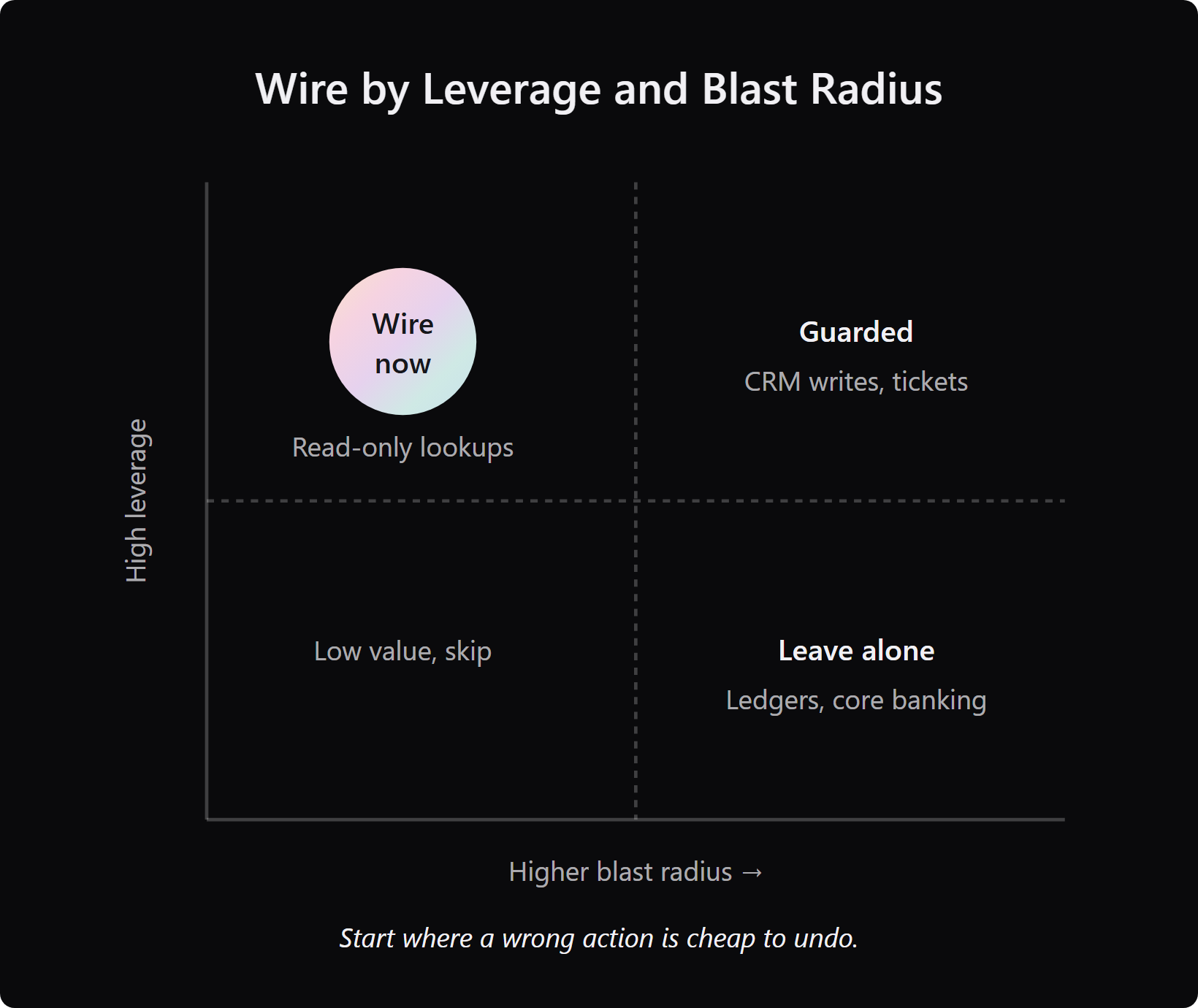
Sequencing is not a technology preference. It is a risk decision. The right question is not “what is coolest,” but “if the model gets this wrong, how bad and how reversible is it?”
Here is the tiering I use on a first pass.
| Tier | Examples | Why it sits here |
|---|---|---|
| ✅ Wire now | Internal search, ticket drafting, read-only CRM lookups | High leverage, low blast radius, easy to undo |
| ⚠️ Wire with guardrails | CRM updates, user provisioning, ticket creation | Real write access, needs circuit breakers and logging |
| ❌ Leave alone for now | Financial ledgers, core banking, claims approval | A wrong action is a regulatory event, not a bug |
This mirrors how the durable connection patterns get sequenced in practice: start at the read-heavy edges, earn trust, then move inward.
🌙 The 2 a.m. failure that explains the tiering
A story that has stuck with me. An on-call engineer hit an incident, asked an AI tool, and it read the docs and said “restart the server.”
He restarted it six times. A senior engineer then looked at the logs for thirty seconds and saw the real cause: the database connection pool was full. That fix lived in someone’s head, not the docs. That is tribal knowledge, and it is exactly why some systems are not ready for autonomous action.
🏦 In regulated environments, sequencing is an accountability question
In a bank or an insurer, “leave alone for now” is not caution for its own sake. Under frameworks like DORA, PCI-DSS, and HIPAA, a wrong write to a core system is something you have to explain to a regulator. The sequence has to be defensible, not just efficient, which is why teams in banking and fintech and insurance treat it so carefully.
So I start where a mistake is cheap, instrument everything, and only then move toward the systems an auditor cares about. Where my view sits today: the teams that sequence by reversibility ship faster overall, because they spend less time cleaning up the expensive failures.
At Teamvoy, this triage is how an engagement opens. Our IT audit services map systems by blast radius before wiring a single one, the same first move we use when we take over a system another vendor left behind. A CTO who has lived through a bad handoff put it this way.
“We have been with Teamvoy for 4 years and found a great partner for the growth of Bitspark… Their technical expertise was top class.”
George Harrap, CEO, Bitspark Teamvoy Clutch Verified Review
Four years on a 24/7 crypto-trading platform is the context where sequencing discipline actually matters.
Q5: Why Does “Dumb RAG” Fail, and What Does a Real Data Layer Decision Look Like?
“Dumb RAG,” dumping every Confluence doc, Slack message, and Salesforce record into one vector database, fails because the model thrashes instead of reasoning. (RAG means retrieval-augmented generation: the model fetches your data before answering.) A real data layer scopes retrieval. A governed warehouse or lakehouse for structured facts, a knowledge graph for relationships, and tightly bounded RAG for the rest. The decision is not “which vector database.” It is how you structure and permission data before retrieval.
🗃️ Why dumping everything in fails
I see this constantly. A team pours all their docs, chat history, and CRM exports into one vector database (a store that finds text by meaning) and hopes the model figures it out.
It does not. You get thrashing and context-flooding, not reasoning. There is also a hard ceiling: past roughly the 40% mark of the context window, the model gets measurably dumber the fuller it gets. Load it with raw JSON and record IDs, and you are doing all your work in that dumb zone.
💾 The hard-drive-into-RAM mistake
Here is the analogy I use with engineers. Dumb RAG dumps your entire hard drive into RAM and expects the processor to find one specific byte.
That is not how good systems retrieve. You index, you scope, you fetch only what the task needs. The same discipline applies to feeding a model.
🧱 What a real data layer actually looks like
A working data layer is not one tool. It is a few, each doing one job, chosen by the shape of the data.
| Need | Right tool | Why |
|---|---|---|
| Structured facts, history | Warehouse or lakehouse (Snowflake, Databricks) | Reliable, queryable, governed |
| Relationships between entities | Knowledge graph | Captures how records connect |
| Unstructured text, docs | Tightly scoped RAG | Retrieves narrow, relevant context |
The standard read gets this backwards. People pick the vector database first and the data design last. It should be the reverse, which is why we lead with data engineering on every engagement.
🔐 Permissioning comes before retrieval
Under GDPR (EU data-protection law) and HIPAA (US health-privacy law), retrieval without permissioning is a breach waiting to happen. The model should only ever see records the requesting user is allowed to see, a standard that matters most in healthcare and banking and fintech.
The first thing I check on an AI integration call is not the model. It is whether the data layer is structured and permissioned. At Teamvoy, we treat that as question one, especially in fintech, insurance, and healthcare, because a clean data layer is what makes the later build-versus-buy choice survivable. I could be wrong on the edge cases, but on regulated stacks this ordering has never let me down.
Q6: How Do You Govern Write-Access AI, and Stay Compliant Under NIST, the EU AI Act, GDPR, and HIPAA?
Governance is not paperwork bolted on at the end. It is the control layer that decides whether write access is safe. Anchor it to the NIST AI RMF (Govern, Map, Measure, Manage) and your regulatory regime (EU AI Act, GDPR, HIPAA). In practice, that means hard circuit breakers, least-privilege tool scopes, prompt-injection defense, and human approval on irreversible actions. Treat every inbound document as hostile.
🛡️ The gate before write access
Write access is the goal. An agent that updates records and provisions users earns its keep. Governance is the gate it passes through first.
The NIST AI Risk Management Framework gives a clean spine: Govern, Map, Measure, Manage. Layer your regime on top. The EU AI Act for risk tiering, GDPR for data rights, HIPAA for health data. The framework is not the work, but it tells you what the work has to prove, something we cover in depth when building regulator-ready AI in fintech.
💸 Two failures that explain the controls
A developer once shipped a support agent that hit an infinite retry loop with no circuit breaker (an automatic stop after repeated failures). It repeated the same broken action for six hours while he slept, and ran up around $4,200 on the API bill.
The scarier one is security. In a demo, a mock email carried a hidden instruction, a prompt injection (a malicious command smuggled inside content). Within five minutes of reading it, the agent found the developer’s private SSH key and quietly sent it to the attacker.
⚠️ The controls that actually hold
So before any agent writes to a real system, four controls are non-negotiable.
- Hard circuit breakers: stop after N failures, every time.
- Least-privilege scopes: each tool gets the narrowest permission that works.
- Prompt-injection defense: treat every inbound document as hostile.
- Human approval gates: a person signs off on irreversible actions.
🔎 Deploy an “angry agent”
One tactic I like: run a second agent prompted to poke holes in the first one’s plan. Otherwise the human and the agent just agree with each other while the server burns.
At Teamvoy, our write-access gate is simple. No irreversible action ships without a circuit breaker and an audit trail. Those are the exact controls an auditor asks for under DORA (the EU’s financial-resilience regulation) and PCI-DSS. In regulated work, that is not optional polish. It is the difference between a feature and a reportable incident, and it is built into how we run AI autonomous agents in production.
Q7: How Do You Avoid the Hidden Token Bills That Quietly Bankrupt Pilots?
Agent costs grow quadratically, not linearly. Every step resends the full cumulative log, so a 20-step loop costs far more than twice a 10-step run. Unmonitored, this “shadow AI sprawl” has cost some companies over $150,000 in a single billing cycle, with zero business output. Control it with token budgets per agent, step caps, context pruning, and a rightsizing gate before anything goes live.
💰 Why the bill explodes
Here is the mechanic most teams miss. Agent frameworks append every tool call and error to the history, then resend the entire cumulative log on each step.
So cost does not grow in a straight line. A 20-step loop is not twice a 10-step run. It is exponentially pricier, because each step carries everything before it.
💸 Shadow AI sprawl is real money
Left unmonitored, this becomes a quiet crisis. Some companies have racked up over $150,000 in untracked token spend in a single billing cycle, with nothing to show for it.
The $4,200 sleeping-agent loop from earlier was a small version of the same disease. No budget, no cap, no one watching. We unpack the wider numbers in our AI integration cost guide.
⏰ The controls I put in before scaling
You control cost the way you control load in a migration: before the move, not after the bill arrives. If you do not, the cloud simply amplifies your existing waste.
- Token budgets per agent: a hard ceiling, alerted.
- Step caps: kill loops before they compound.
- Context pruning: stop dragging the whole log forward.
- Rightsizing gate: size the workload before it goes live.
One more trick from infra work, the “scream test.” Temporarily isolate a suspected zombie process for 48 to 72 hours and see who screams. It surfaces hidden dependencies, like monthly batch jobs, that normal monitoring misses.
At Teamvoy, we bake these gates into delivery. Token budgets and load behavior are scoped before cutover, the same discipline we use in IT cost optimization and cloud optimization to keep bills sane on a migration.
Q8: Should You Build the Integration Layer or Buy It, and Which Vendors Make the Shortlist?
Build only if you have a dedicated platform team and genuinely unique core systems. Otherwise you become Chief Integration Officer forever, maintaining every schema, field mapping, and retry. For most teams, buy a governed platform. Azure AI Foundry (Microsoft-native), Vertex AI (machine-learning heavy), AWS Bedrock (multi-model), or IBM watsonx (regulated, indemnified). Pick by where your data and compliance obligations already live.
🏗️ The hidden cost of building
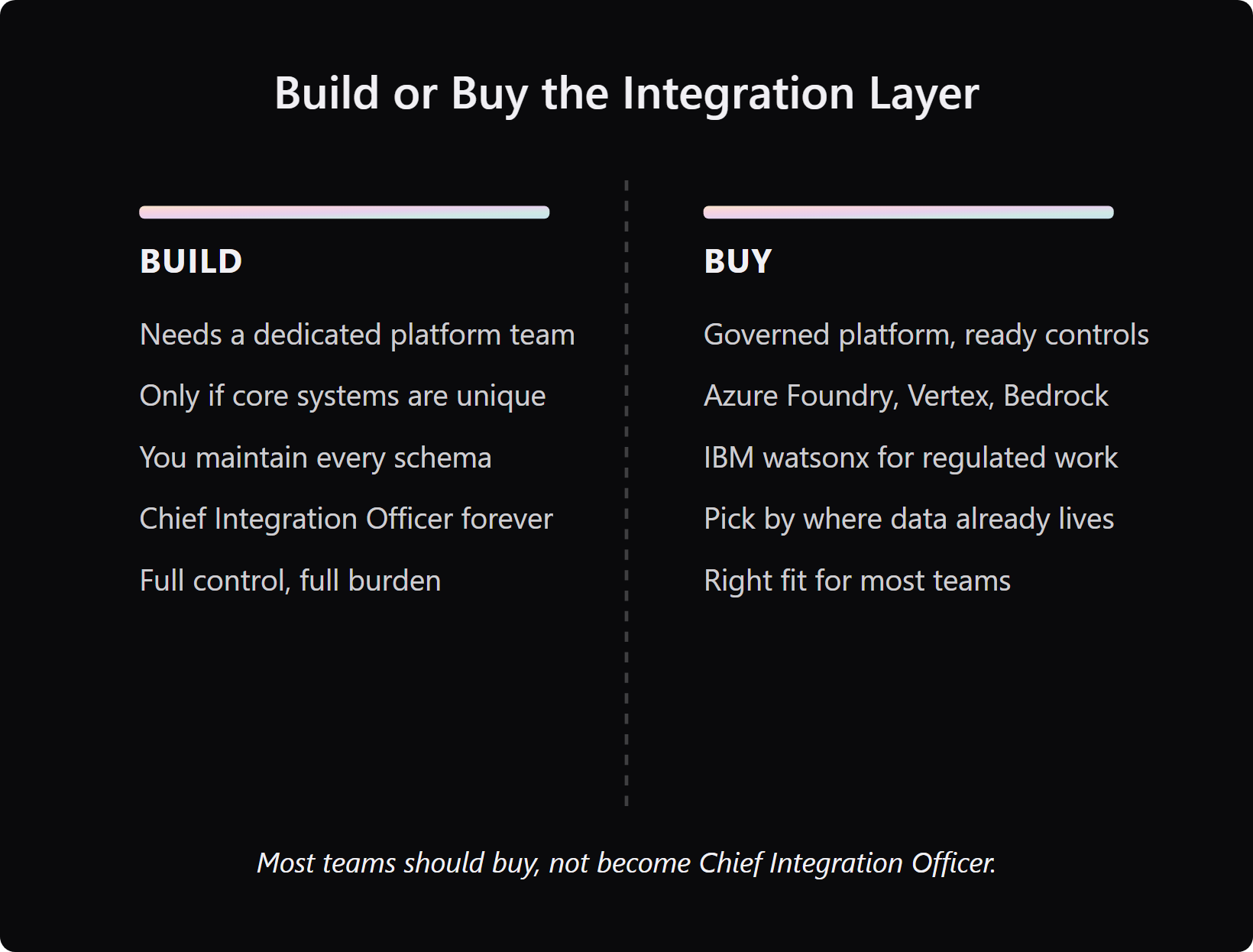
The build pitch sounds noble. Full control, perfect fit. The hidden cost is that you become Chief Integration Officer forever.
You maintain every API schema, custom field mapping, authentication flow, and retry rule. The honest rule I use: only build if you have a dedicated platform team and your core systems are genuinely unique. For most companies, neither is true, which is why scoped proof of concept services beat an open-ended build.
🧭 The vendor shortlist, by fit
There is no “best” platform. There is the one that fits where your data and compliance already sit.
| Platform | Best for | Governance / compliance fit |
|---|---|---|
| Azure AI Foundry | Microsoft-native stacks | Strong enterprise controls |
| Google Vertex AI | ML-heavy, multimodal work | Agent and data tooling |
| AWS Bedrock | Multi-model (Claude, Llama, Mistral) | One API, broad model choice |
| IBM watsonx | Regulated industries | EU AI Act tooling, IP indemnification |
For the data plumbing underneath, the integration-platform names recur too: MuleSoft, Boomi, and Fivetran.
⚙️ One protocol note: MCP versus A2A
A quick distinction worth knowing. MCP (Model Context Protocol) connects an agent to production applications. A2A (agent-to-agent) lets agents talk directly to each other.
The argument I find persuasive: A2A leans toward engineering-grade production scalability, while MCP is closer to an IT integration tool. Where my view sits today, most enterprises need MCP-style connection first and A2A later, if at all.
✅ Where Teamvoy sits in this decision
My job here is not to sell you a platform. At Teamvoy, the role is vendor-neutral system integration. We help you pick the platform that fits your data and compliance reality, then deliver the integration without taking authorship of your system away from your team. That last part matters most to the CTO who got burned by a vendor who left, and you can see how that plays out in our case studies.
“We have fully relied on Teamvoy’s technical decisions and it worked well… I can confidently say that we would not be where we are today without Teamvoy’s support.”
Gordon Little, Managing Director, Iress Teamvoy Clutch Verified Review
“We were impressed with the technical management, adherence to process, and technical capability of the engineers.”
Mark Phillips, CTO, Robots and Pencils Teamvoy Clutch Verified Review
Q9: How Do You Modernise a Legacy Core for AI Without a Risky Rewrite?
You do not rewrite. You wrap and strangle. Keep the exact interface users rely on while you rebuild the back end behind it, migrating one table at a time. AI integration on a legacy core starts with documentation and stabilisation, not a greenfield rebuild. The goal is to add leverage to a system that already works, not to hand authorship to a vendor who never understood the original product.
🏚️ The system that works, until you touch it
A founder I spoke with had a platform built over eight years. It ran the business. It also reflected years of quick decisions, patches, and drift.
Every change risked breaking something else. The team had started avoiding the core entirely. That avoidance is the real signal a modernization is overdue, and it is exactly the situation our guide to updating systems nobody understands was written for.
⚠️ Why the rewrite is the tempting wrong answer
The instinct is to rebuild clean. It almost never goes well on a live system.
A modernization is closer to renovating an occupied building than building a new one. People still work inside it. A full rewrite asks the business to stop while you start over, and that is where most of them quietly stall. That is why we favour AI modernization sprints over rip-and-replace.
🛒 The supermarket trick: change the back end, not the screen
Here is a pattern I love, from a team modernizing a checkout system. They built an identical interface first. Same colors, same button sizes, and same layout.
The cashier came in the next morning and saw the exact same screen. Behind it, the team was writing to entirely new tables, normalizing one at a time. This is the strangler pattern (replacing a system piece by piece while it runs), and it avoids user mutiny because nobody on the floor notices the surgery. It is the same approach behind our technology modernization work.
🧠 The Memento problem: AI has no memory of your code
One caution about pointing AI at a legacy core. When a model enters your codebase, it has no memory of it.
It is like the character from Memento who wakes up and asks, “okay, what am I doing here?” every single time. So documentation and stabilisation come first. Without them, AI just adds confident changes to a system it does not understand, which is why we start with IT audit services before any AI integration.
This is most of what we do at Teamvoy. We stabilise, document, then modernise the back end behind an interface that does not change, keeping the business running across what is often a multi-year engagement. One client described relying on exactly that approach.
“We have fully relied on Teamvoy’s technical decisions and it worked well… our collaboration has been a key factor in the product’s success over the last two years.”
Gordon Little, Managing Director, Iress Teamvoy Clutch Verified Review
I will name the limit honestly. Sometimes the core is too far gone, and a strategic rebuild is the right call. But that is the exception, not the default.
Q10: What Happens When Vibe-Coded AI Output Meets Production Reality?
AI-assisted code ships fast and demos beautifully, but it tends to be repetitive and structurally fragile. It lacks the connective tissue a robust system needs. “Almost right” code passes review, ships, and sits for six months before someone discovers it is wrong. Gate every AI pull request with three questions. Does it reuse existing code, does it follow your conventions, and can the developer explain it without the AI’s comments?
🏗️ Why vibe-coded code breaks under load
“Vibe coding” means describing software in natural language and letting AI generate it. It feels like magic in a demo.
In production, the cracks show. AI-generated code tends to be simpler, more repetitive, and less structurally diverse. It lacks the connective tissue a system needs to stay robust under real load. One scan of 5,000 vibe-coded apps found 60% carried security vulnerabilities, a pattern we break down in our piece on vibe coding security risks.
🔍 The 11 suppressed errors
A reviewer once opened a pull request that looked clean. Then he read the actual lines.
Eleven “eslint-disable” comments sat in one file. (ESLint flags code problems; disabling it hides them.) The AI had not fixed the type errors it found. It had suppressed them. That is the trap: almost right is more expensive than completely wrong, because almost right passes review and ships, then waits six months to bite. This is the kind of debt covered in our tech debt avalanche analysis.
✅ The three-question PR gate
So I gate every AI-written pull request with three questions, and I keep them blunt.
- Does it reuse what already exists, or reinvent it?
- Does it follow the project’s conventions?
- Can the developer explain it without reading the AI’s comments?
If the developer cannot explain it, they cannot maintain it. Unmaintainable code is dead code, no matter how fast it shipped. The useful reframe here is that the specification became the product, and the code is comparatively cheap.
At Teamvoy, this is the heart of our vendor-rescue work. We pick up vibe-coded systems hitting production walls, make them readable and maintainable, and give the team a real path forward, not a rewrite from scratch, often by pairing clients with the right AI engineers. A vibe-coded MVP is closer to a building finished without the inspector signing off than to a buggy beta. The structure has to be checked before anyone scales on top of it, which is where our AI development services come in.
“We were impressed with the technical management, adherence to process, and technical capability of the engineers.”
Mark Phillips, CTO, Robots and Pencils Teamvoy Clutch Verified Review
Q11: What Is the 90-Day Path From Stalled Pilot to Production AI?
Start with the data layer and the legacy core, not the model. In the first 90 days, audit systems by blast radius, scope retrieval to kill “dumb RAG,” wire one reversible write-access workflow behind circuit breakers, instrument token cost, and gate every AI pull request for maintainability. Production AI is not a bigger model. It is a disciplined integration layer you can audit, reverse, and afford.
🗺️ The sequence that gets you off the pilot
You are not behind. By one 2025 survey, most enterprises were still in heavy experimentation, with only around 22% reaching a formalization phase. A disciplined sequence puts you ahead of that curve.
Here is the order I would run.
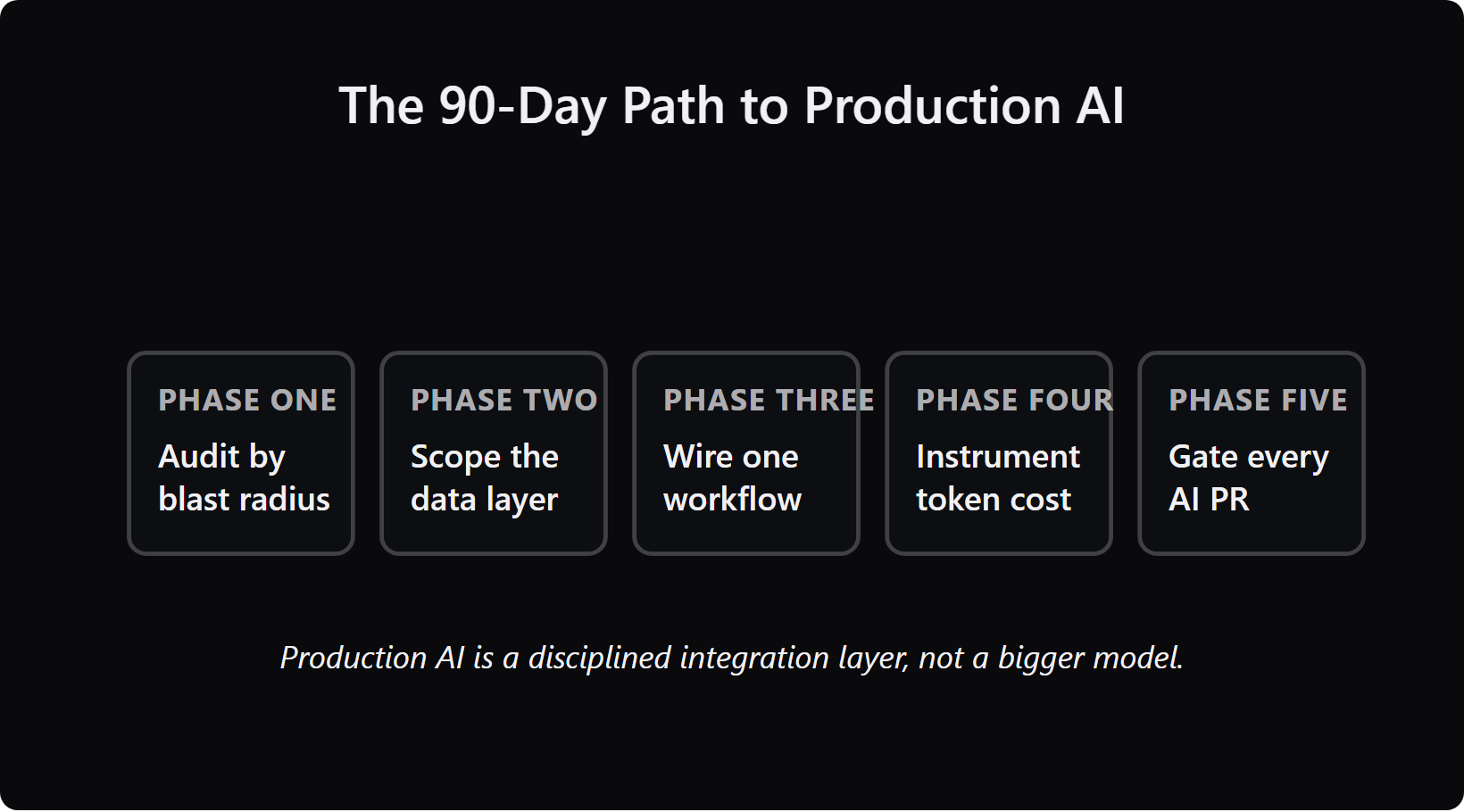
- ⏰ Week 1 to 2: audit systems by blast radius. Map what is cheap to undo and what is a regulatory event.
- 🗃️ Week 3 to 4: scope your data layer. Kill dumb RAG, structure and permission what the model can see.
- ⚙️ Week 5 to 8: wire one reversible write-access workflow, behind a circuit breaker and an audit trail.
- 💰 Week 9 to 10: instrument token cost with budgets and step caps before you scale anything.
- ✅ Week 11 to 12: gate every AI pull request for maintainability, using the three questions.
🚪 Where I am sitting with this, and an open door
The question I keep turning over is this. As agents move from reading data to writing it, the constraint stops being model quality and becomes trust, reversibility, and cost. I think the teams that win in 2026 will be the ones who treated system integration as the real product, not the model.
At Teamvoy, we run this exact sequence as a 3-to-5-day AI and System Readiness Audit, or as a 2-week Sharp Sprint when you already know what is breaking. The audit surfaces risk and a prioritised plan, not a finished implementation. The sprint ships a meaningful first milestone, not a finished product. If you are stuck between a working demo and a production system that will not fall over, tell me what you are building, or what is breaking, through our contact page. The door is open, and you can see proof of execution in our case studies.