

Website redesign cost in 2026 typically range from $5,000 for small-business sites to well over $120,000 for complex enterprise projects. Most mid-market businesses can expect to invest between $20,000 and $30,000. These costs depend on features, integrations, and business goals. With the rise of intelligent automation and technology modernization, new strategies can help control costs and maximize your investment.
- Website redesign cost in 2026 spans from $3,000 for basic sites to $1200,000+ for advanced enterprise builds
- Main cost drivers include page templates, custom features, integrations, content migration, and timeline
- Business size, scope, and complexity have a direct impact on pricing
- AI and automation can meaningfully reduce costs for certain projects
- Ongoing maintenance and media production are essential expenses to plan for
- Working with technology modernization experts like Teamvoy helps you budget wisely and avoid hidden fees
| Topic | Key Insight | Why It Matters | Action Item |
|---|---|---|---|
| Website Redesign Cost | Costs range from $3,000 to $250,000+ depending on business size and project complexity | Helps set realistic budgets and expectations | Define project scope and get detailed quotes |
| AI and Automation Impact | Automates repetitive tasks, reducing cost and timeline for smaller projects | Optimizes resource use and improves ROI | Identify automation opportunities with technology experts |
| Cost Drivers | Number of templates, custom features, integrations, content migration, and timeline affect cost | Understanding drivers prevents budget overruns | Prioritize must-have features and plan content migration carefully |
| Ongoing Expenses | Maintenance, media production, and content creation add significant recurring costs | Ensures website remains secure, engaging, and up-to-date | Budget for ongoing support and media needs |
| Redesign Frequency | Recommended every 2 to 5 years to align with evolving technology and business goals | Keeps website effective and competitive | Plan regular redesigns and continuous improvements |
how much does it cost to redesign a website In 2026?
In 2026, website redesign costs start at around $3,000 for basic small-business sites and can exceed $120,000 for complex enterprise projects. Most mid-market business websites fall in the $40,000 to $100,000 range. The final price depends on the number of pages, design complexity, required features, and choice of provider.
When we work with clients at Teamvoy, the first question is usually, “How much will a website redesign really cost?” The answer, as you might expect, covers a wide spectrum. For a basic refresh of a small business website, costs can start as low as $2,500 (IT Path Solutions, 2026). For more standard small business sites, expect to invest between $15,000 and $40,000 (Clique Studios, 2026). Mid-market websites, which often feature more pages and integrations, typically fall between $40,000 and $100,000. Enterprise projects, with custom architecture and unique business logic, regularly exceed $100,000 and can go far higher (Clique Studios, 2026).
- Small business websites: 10-20 pages, basic CMS, limited integrations
- Mid-market sites: 30-75 pages, enhanced design, advanced features, more integrations
- Enterprise websites: 100+ pages, custom architecture, multiple systems integrated, scalability needs

How much does it cost to rebuild a website?
A rebuild replaces the underlying platform and the design, and costs 20–40% more than a redesign on the same page count. The extra covers data modeling, integration rework, and a migration path for content that was structured for the old CMS. Choose a rebuild when the current platform blocks something you need, and a redesign when it does not.
Website revamp cost
A revamp keeps the platform and information architecture, but changes the visual layer. It costs $5,000–$25,000 for most business sites, because discovery is short and migration is minimal. The website revamp cost stays low precisely because nothing structural changes. A revamp is the right call when analytics show the content works and the presentation does not. It is the wrong call when the site’s problems are structural, since a new skin on a broken sitemap produces a better-looking version of the same conversion rate.
Small Business Website Redesigns: Typical Scope and Deliverables.
For small businesses, a website redesign is often about refreshing the brand, improving usability, and ensuring mobile compatibility. These projects usually involve a custom homepage, several interior page templates, mobile responsiveness, basic SEO, a content management system (CMS) like WordPress or Webflow, and basic post-launch support. Content migration is typically straightforward, as the number of pages is limited. Integrations at this level are usually simple, such as embedding a contact form, linking to social media, or connecting to an email marketing service like Mailchimp. The design is often based on pre-existing templates, with customizations to match the brand’s colors, typography, and imagery. While the budget is lower, the impact on customer perception and conversion can be significant, as even small improvements to navigation and performance can make a big difference for local businesses or startups.
Mid-Market Website Redesigns: Enhanced Features and Customization
Mid-market businesses require more capable solutions. These sites often support multiple product or service lines, regional offices, or departments, and may require advanced integrations with CRM systems like Salesforce, marketing automation platforms, or e-commerce modules. The design process is more collaborative, often involving stakeholder interviews, user research, and custom UI/UX design tailored to specific audience segments. Content migration becomes more complex, especially if the existing site has grown organically over time with inconsistent page structures or outdated assets. At this level, additional features such as gated content, advanced analytics, event calendars, and blog sections are common. Security and compliance requirements may also increase, especially for companies operating in regulated industries. The investment in strategy, design, and development ensures the site not only looks great but also drives measurable business outcomes.
Enterprise Website Redesigns: Custom Architecture and Integrations
Enterprise-level website redesigns are complex undertakings that often span several months and involve cross-functional teams. These projects may require custom architecture to support high traffic volumes, multilingual content, global user bases, and integration with multiple backend systems (such as ERP, HRIS, and proprietary business applications). Accessibility compliance (such as WCAG 2.1 AA), advanced SEO strategies, and custom user roles and permissions are standard requirements. Content migration can be a major project in itself, involving thousands of pages and assets, automated scripts, and manual quality assurance. Design and development teams must collaborate closely with IT, marketing, legal, and security departments to ensure the site meets all organizational needs. Scalability, performance optimization, and disaster recovery planning are critical. The higher investment reflects the need for a durable digital platform that supports ongoing business growth and innovation.
Why these prices matter
Understanding these ranges is critical for planning and ROI. Underestimating your website redesign cost can derail your digital strategy and lead to rushed, compromised solutions. Our role at Teamvoy is to align your goals, technology, and budget, so you get a result that lasts — without financial surprises.
Real-World Pricing Examples
- Startup Portfolio Site: A technology startup seeking a simple portfolio site with a blog and contact form might spend $7,500 to $12,000. This covers a few page templates, light branding, and a quick turnaround.
- Growing SaaS Company: A SaaS business needing demo scheduling, customer onboarding, and a knowledge base could expect costs between $50,000 and $120,000, depending on the level of automation, integrations, and custom UI.
- Global Nonprofit: An international nonprofit requiring multilingual support, donation processing, and event management could see budgets in the $100,000–$250,000 range, reflecting the need for custom development and rigorous testing.
What drives website redesign cost?
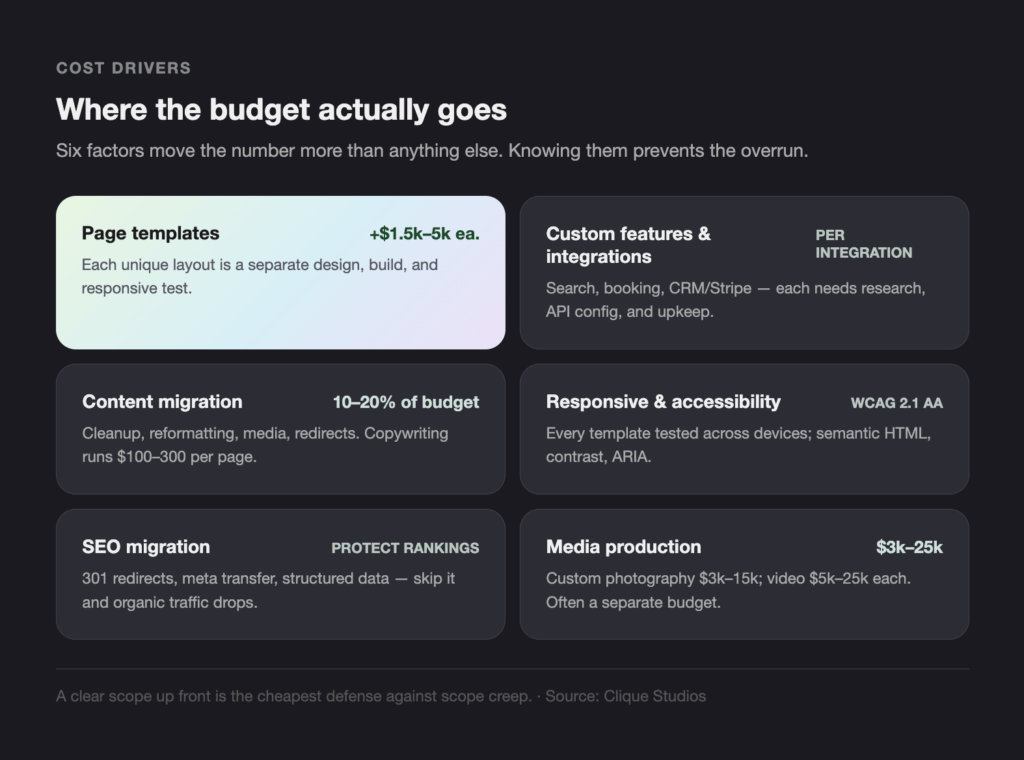
Website redesign costs are shaped by several key factors: number of unique page templates, custom features, third-party integrations, content migration complexity, responsive design, accessibility compliance, SEO migration, and project timeline. Understanding these drivers helps you budget accurately and avoid unexpected expenses.
Every element of a website redesign influences the final price. Here’s how we break down the main cost drivers at Teamvoy:
1. Number of unique page templates
Each unique template (homepage, product detail, blog post, etc.) requires separate design and development effort. More templates mean more time, testing, and cost.
How Page Templates Affect Scope
A template is a reusable layout for a specific type of content. For example, a homepage, product page, service page, blog post, and landing page each require their own design and coding. The more unique templates your site needs, the more design and development hours are required. Each template must be wireframed, designed, built, tested for responsiveness, and integrated into the CMS. For small sites, 3–5 templates may suffice, but larger sites can require 15 or more. Each additional template can add $1,500–$5,000 to the total project cost, depending on complexity.
2. Custom features and integrations
Adding custom functionality — like advanced search, booking engines, or interactive dashboards — increases both development time and cost. The same goes for integrating third-party platforms, such as CRMs, payment processors, or marketing tools.
Examples of Custom Features
- E-commerce functionality: Shopping carts, product filtering, custom checkout flows
- User portals: Secure logins, dashboards, order tracking
- Booking and scheduling: Appointment booking engines, calendar integrations
- Interactive tools: ROI calculators, product configurators, live chat
Each integration with third-party software (like Salesforce, HubSpot, or Stripe) requires research, API configuration, testing, and ongoing support. Complex integrations may require custom middleware or data synchronization, which can significantly increase both upfront and ongoing costs.
3. Content migration complexity
Migrating old content to a new site is rarely simple. If your content is structured inconsistently or spread across multiple platforms, the migration process can be labor-intensive. Copywriting new pages? Plan for $100–$300 per page (Clique Studios, 2026).
Content Migration Challenges
- Data cleanup: Removing outdated or duplicate content
- Reformatting: Adjusting content to fit new templates and design
- Media migration: Transferring images, videos, and downloadable files
- SEO preservation: Setting up redirects, updating meta data, and maintaining URL structures
Automated tools can assist, but manual review and editing are often required to ensure quality and consistency. For large sites, content migration can consume 10–20% of the overall project budget.
4. Responsive design and accessibility
Designing for mobile and ensuring accessibility compliance are now standard, but they add to the overall effort. Skipping these steps can reduce costs upfront but risk user engagement and even legal issues later.
The Importance of Mobile and Accessibility
With over half of web traffic coming from mobile devices, responsive design is non-negotiable. Ensuring your site works reliably on all screen sizes requires additional design and development time, as each template must be tested and optimized for various devices. Accessibility is equally critical. Compliance with standards like WCAG 2.1 AA ensures your site is usable by people with disabilities and reduces legal risk. Building accessible sites involves semantic HTML, keyboard navigation, color contrast checks, and ARIA attributes. These practices add up-front cost but pay dividends in usability and inclusivity.
5. SEO migration
Preserving your search rankings during a redesign means careful planning and configuration. Overlooking SEO can lead to costly traffic drops.
SEO Migration Best Practices
- URL mapping: Setting up 301 redirects from old URLs to new ones
- Meta data transfer: Migrating titles, descriptions, and schema markup
- Technical SEO: Ensuring proper use of header tags, alt text, and structured data
- Performance optimization: Improving load times and mobile scores
A dedicated SEO migration plan can prevent loss of organic traffic and ensure your investment delivers ongoing value. SEO specialists may be needed for audits, strategy, and implementation, adding to the overall project cost.
6. Project scope and timeline
Urgent timelines or unclear project scopes tend to inflate costs, as more resources are needed to meet deadlines or resolve misunderstandings mid-project.
Managing Scope and Timeline
A well-defined project scope reduces the risk of scope creep, where new requirements emerge mid-project and increase costs. Rushed timelines may require additional staff or overtime, raising the budget. Clear communication, documentation, and project management tools help keep projects on track and within budget.
7. Media production
Custom photography ($3,000–$15,000) and video ($5,000–$25,000 per video) are often overlooked but can greatly enhance your brand (Clique Studios, 2026).
The Role of High-Quality Media
Professional photography and video content can dramatically improve a website’s visual appeal and engagement. Stock images are cost-effective but may not reflect your brand’s unique story. Investing in custom media ensures authenticity and can increase conversions. Video production, including explainer videos, testimonials, or product demos, requires planning, scripting, shooting, and editing. These assets often require a separate budget but can set your website apart in crowded markets..
Website redesign cost by business size
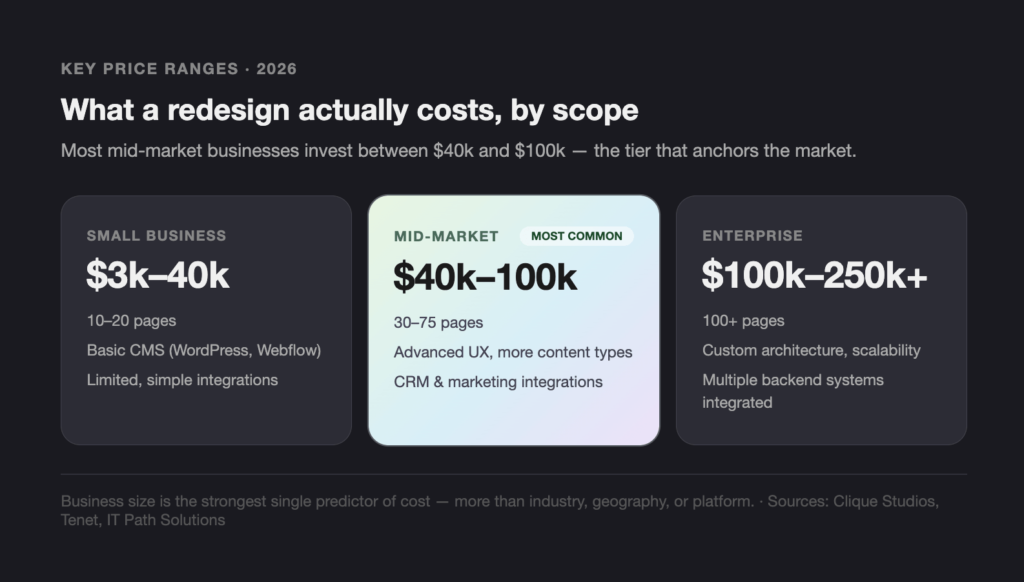
The cost of a website redesign scales with business size. Small businesses can expect to pay $3,000–$15,000 for template-based sites, while mid-market projects typically range from $40,000–$100,000. Enterprise redesigns often exceed $80,000 due to custom architecture, integrations, and scalability needs.
Business size is consistently the strongest single predictor of website redesign cost — more so than industry, geography, or platform choice. Here are the typical spending tiers:
- Small businesses: $3,000–$15,000. These projects usually involve template-based designs, a limited number of features, and little to no custom integration (Tenet, 2026).
- Mid-market companies: $40,000–$100,000. This tier covers advanced UX, more content types, and integration with third-party systems.
- Enterprises: $80,000 and above. At this level, expect custom architecture, complex integrations, scalable infrastructure, and rigorous compliance needs (Tenet, 2026).
Why do bigger businesses pay more?
Larger organizations have more stakeholders, higher security and compliance requirements, and a need for systems that scale. Projects for these businesses demand thorough planning, custom workflows, and extensive testing, all of which add to the website redesign cost.
Small Business Redesigns: Budget-Conscious Solutions
Small businesses often prioritize cost-effective solutions. Many turn to template-based platforms like Squarespace, Wix, or WordPress with premium themes. These platforms offer a fast, affordable route to a modern site, but customization is limited. For businesses needing a unique brand experience or specific integrations, a custom redesign is still possible within the $10,000–$20,000 range by focusing on essential features and using open-source technologies. Some small businesses also choose to work with freelancers, which can lower costs but may require more hands-on management and oversight.
Mid-Market Redesigns: Balancing Customization and ROI
Mid-market companies typically have more complex needs, including multi-location support, integration with sales and marketing platforms, and custom lead generation forms. They may require a more capable CMS, such as Drupal or a headless CMS, to manage diverse content types. The design process often involves workshops, competitor analysis, and prototype testing. These businesses benefit from partnering with specialized agencies that cover discovery, strategy, design, development, launch and post-launch support under one contract. The investment is justified by improved user experience, higher conversion rates, and the ability to scale as the business grows.
Enterprise Redesigns: Strategic Digital Transformation
For enterprises, website redesigns are part of broader digital transformation initiatives. These projects often involve multiple departments, each with unique requirements. Features like single sign-on, role-based access, data privacy compliance (GDPR, CCPA), and integration with legacy systems are common. Enterprise websites may also require custom workflows for content approval, localization for global audiences, and disaster recovery planning. The higher cost reflects the need for extensive planning, documentation, quality assurance, and ongoing support. Enterprises often engage in long-term partnerships with digital agencies or consultants to ensure continuous optimization and innovation.
The impact of AI and automation on website redesign cost
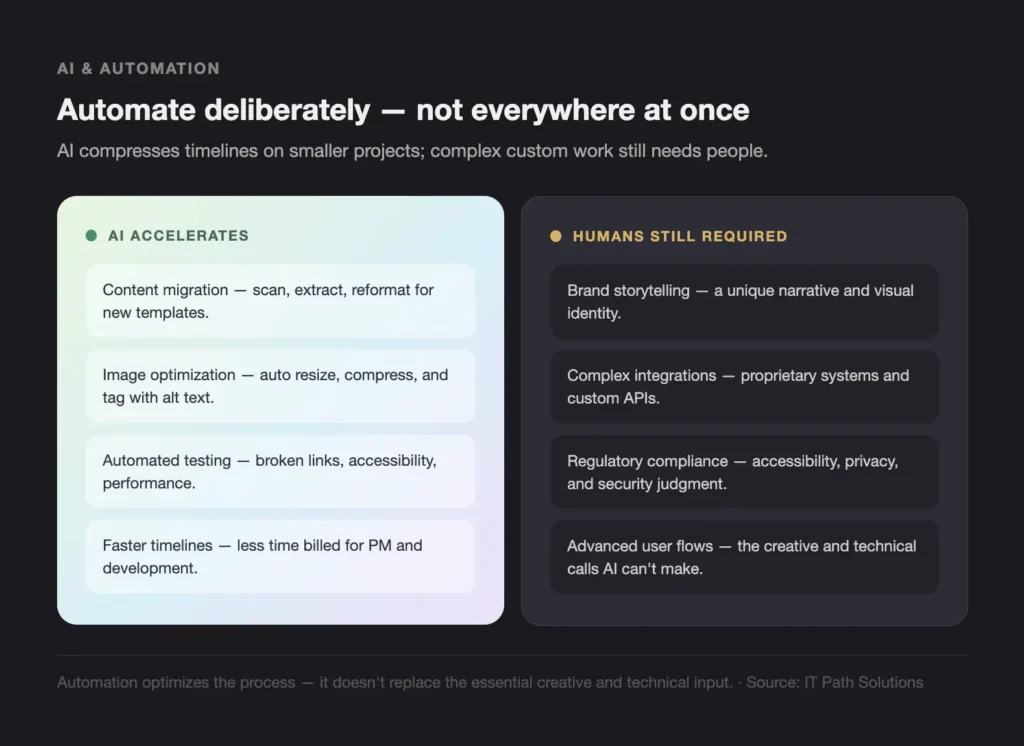
AI and automation are changing website redesigns by reducing repetitive tasks and compressing timelines, especially for smaller projects. While basic sites benefit from cost savings, complex custom development still requires significant investment. Applying automation deliberately — not everywhere at once — can optimize resource allocation and improve ROI for most redesigns.
At Teamvoy, our work sits at the intersection of technology modernization and AI-driven engineering, which shapes how we think about automation in a redesign specifically. Here’s what that means for your project and your budget:
How AI and automation lower costs
- Automating repetitive tasks: Content migration, image optimization, and even some aspects of design can now be handled by AI tools. This reduces manual labor, minimizes errors, and speeds up delivery.
- Accelerating timelines: Faster execution means less time billed for project management and development. For smaller sites, these savings can be significant.
AI can reduce costs and timelines for smaller projects (IT Path Solutions, 2026). For example, auto-generating alt text for images or automating basic content formatting saves dozens of hours.
- Content migration: AI-powered tools can scan existing websites, extract content, and reformat it for new templates. This is especially useful for large blogs or news sites.
- Image optimization: AI can automatically resize, compress, and tag images for SEO and accessibility.
- Chatbots and customer support: Integrating AI chatbots can enhance user experience and reduce support costs.
- Personalization: AI algorithms can analyze user data to deliver personalized content or product recommendations, increasing engagement and conversions.
- Automated testing: AI can run automated tests to identify broken links, accessibility issues, or performance bottlenecks, speeding up the QA process.
Where automation reaches its limits
For complex, highly customized projects, human expertise remains irreplaceable. AI can assist, but custom integrations, advanced user flows, and unique branding elements still require skilled professionals. Automation optimizes the process here — it doesn’t replace the essential creative and technical input.
Human Expertise in Custom Development
- Brand storytelling: Crafting a unique brand narrative and visual identity requires creativity and strategic thinking.
- Complex integrations: Connecting to proprietary systems or building custom APIs often demands custom coding and deep technical knowledge.
- Regulatory compliance: Interpreting and implementing legal requirements for accessibility, privacy, and security goes beyond what AI tools can automate.
The value of modernization consulting
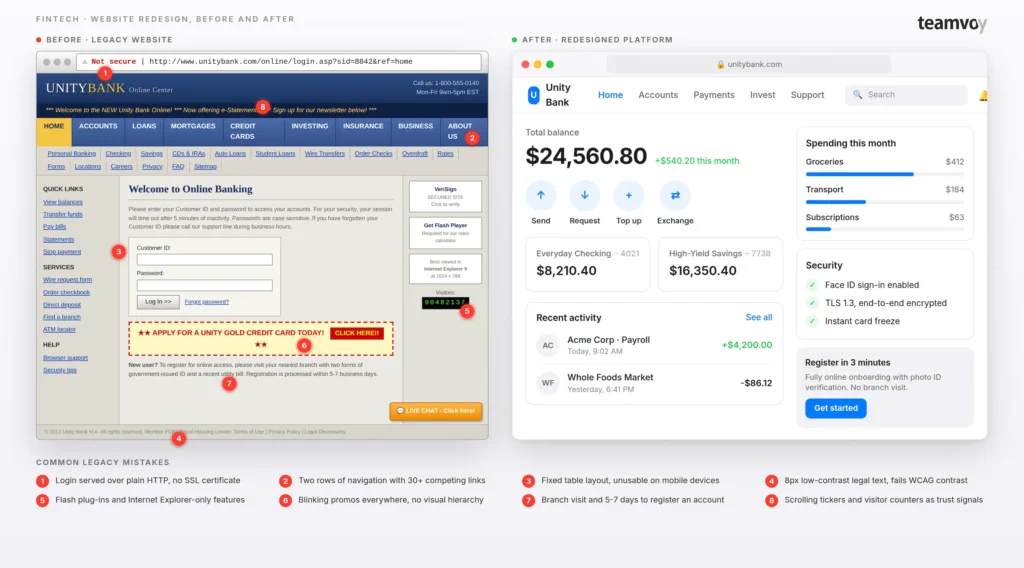
Consulting with technology experts — especially those specializing in modernization and automation — surfaces insights and tools that can drive down costs. A modernization-focused review identifies which parts of a redesign are ready for automation, and where a hands-on approach is still vital. Teamvoy runs this kind of assessment as part of its broader application modernization services, which is worth a look if your redesign is really part of a larger platform or legacy-system decision, not just a visual refresh.
Strategic Modernization Services
- Process audits: Identifying inefficiencies in current workflows and recommending automation opportunities
- Technology stack evaluation: Recommending platforms and tools that support scalability and integration
- Change management: Supporting teams as they adopt new tools and processes, ensuring a smooth transition
Partnering with a modernization consultant can help you plan for growth and avoid the technical debt that leads to higher costs down the line. For more on modernization strategy, see Legacy Platform Modernization, comparing their pillars, cloud integration and what makes each one a fit for a specific kind of buyer — from a startup running its first free check to an enterprise that needs a codebase-level review before an AI feature ships.
Additional website redesign expenses to budget for
Beyond core redesign costs, businesses should budget for custom photography, video production, ongoing maintenance (15-20% of build cost annually), and content creation. These additional expenses can significantly impact the total investment and should be included in your project planning.
When planning your website redesign cost, it’s easy to forget about the extras that make a site effective and sustainable. Here are the most common add-ons:
- Custom photography: $3,000–$15,000 (Clique Studios, 2026)
- Video production: $5,000–$25,000 per video
- Copywriting: $100–$300 per page
- Ongoing maintenance: 15–20% of the build cost annually (Clique Studios, 2026)
Ignoring these expenses can lead to budget overruns or underwhelming results. Ongoing maintenance, for example, ensures your website stays secure, fast, and up-to-date as technology and user expectations evolve.
Ongoing Maintenance: The Hidden Cost of Ownership
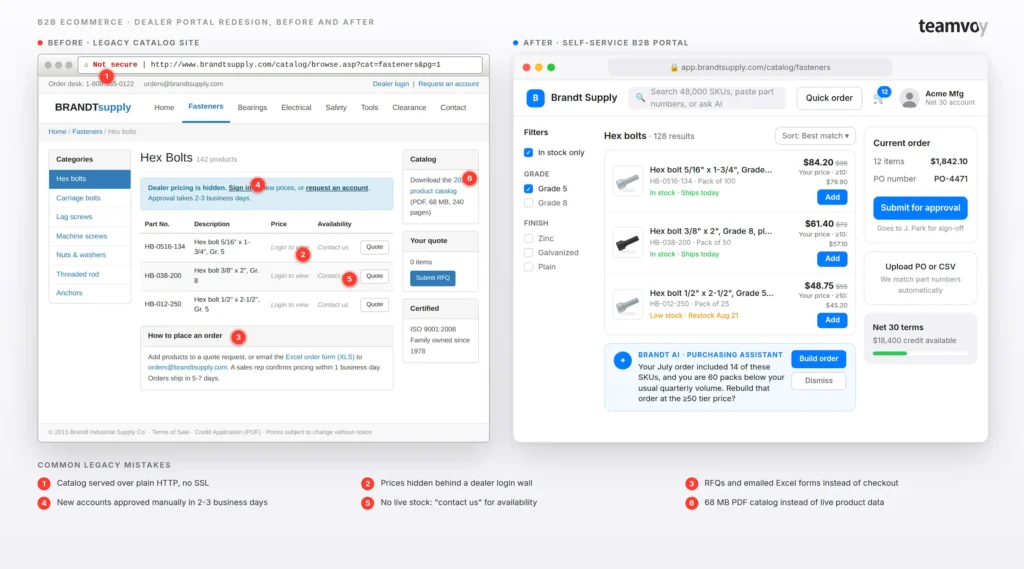
Many businesses overlook the recurring costs of website ownership. Maintenance includes:
- Security updates: Regular patches to protect against vulnerabilities
- Performance monitoring: Ensuring fast load times and uptime
- CMS updates: Keeping your content management system current
- Bug fixes and minor enhancements: Addressing issues as they arise
A typical maintenance contract costs 15–20% of the initial build cost per year. Investing in ongoing support reduces the risk of downtime, data breaches, and lost revenue.
Media Production: Enhancing Engagement and Conversion
High-quality media assets are essential for modern websites. Custom photography and video build trust and differentiate your brand. For product-based businesses, professional images and explainer videos can increase sales. For service providers, staff photos and client testimonials humanize the brand. Budgeting for media production ensures your site tells a compelling story and supports marketing campaigns across channels.
Content Creation: Fueling SEO and User Experience
Copywriting is often underestimated in scope and cost. Each page requires unique, persuasive copy that aligns with SEO best practices and brand voice. For large sites, the cost of content creation can rival design and development. Investing in professional writers helps ensure your message resonates and drives conversions.
Additional Costs to Consider
- Hosting and infrastructure: Reliable hosting is critical for performance and security. Costs vary based on traffic and features.
- Licensing fees: Premium plugins, themes, or third-party services may require annual fees.
- Training and documentation: Staff may need training on the new CMS or workflows.
- Analytics and reporting tools: Advanced analytics platforms may require setup and subscription fees.
How to budget for your website redesign
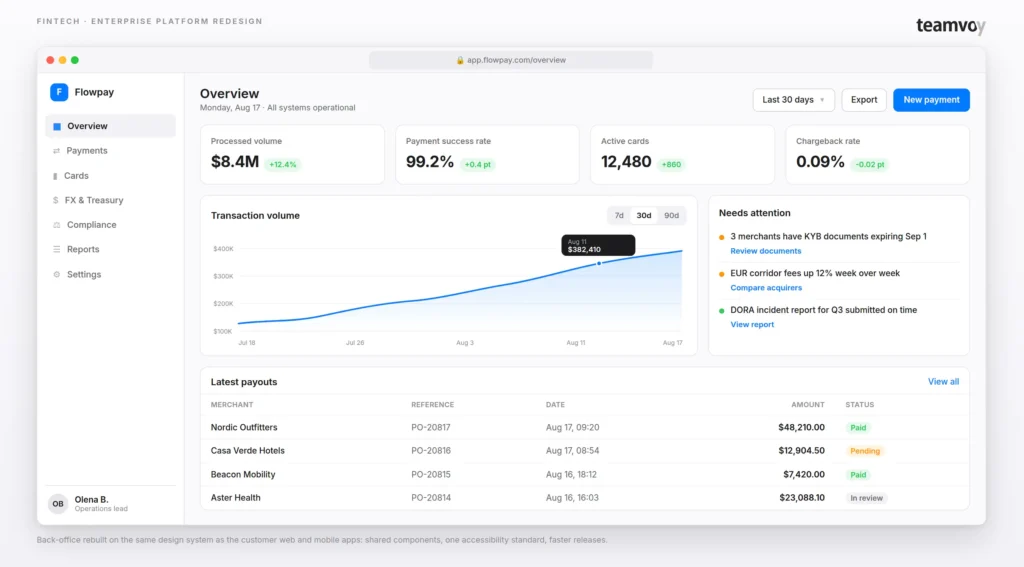
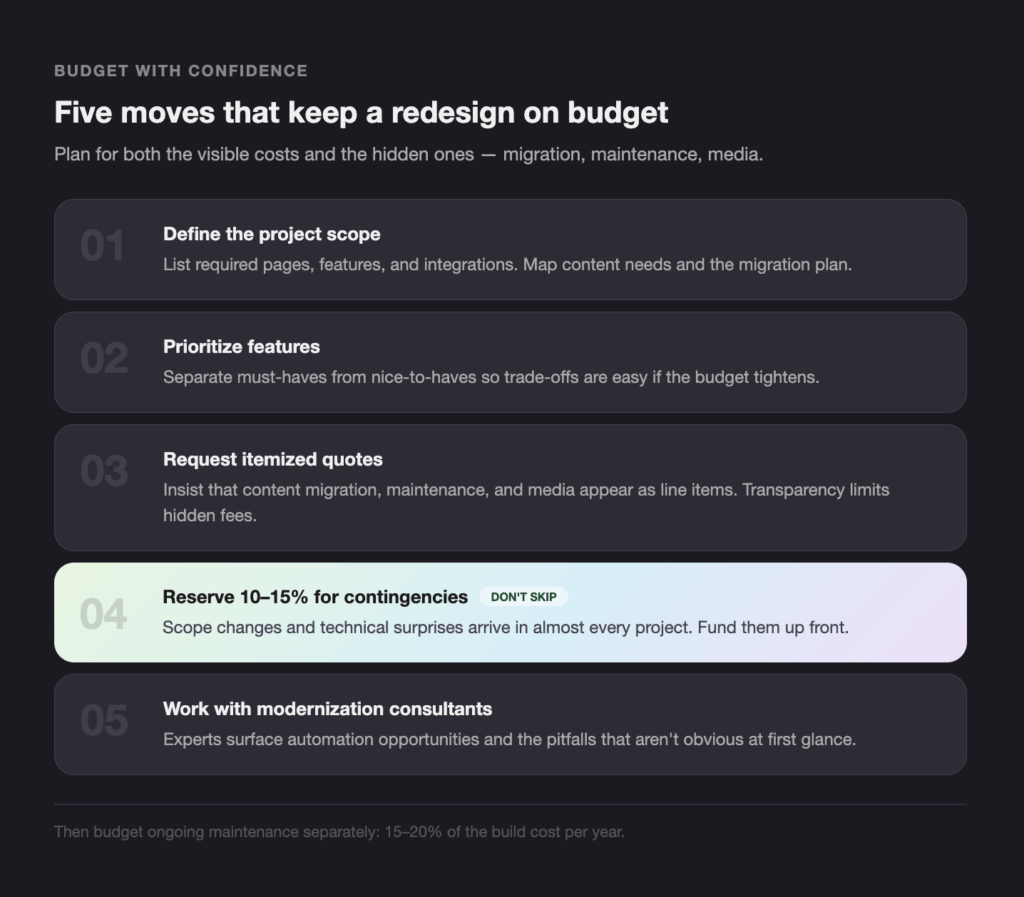
To budget effectively for a website redesign, define your project scope, prioritize must-have features, and get detailed quotes from providers. Factor in both visible and hidden costs, such as content migration and ongoing support. Consulting with technology modernization experts can help you avoid surprises and maximize ROI.
Setting a realistic budget starts with clear goals and a prioritized list of features:
- Define the project scope: List required pages, features, and integrations. Map out content needs and migration plans.
- Prioritize features: Separate must-haves from nice-to-haves to make smart trade-offs if needed.
- Request detailed quotes: Insist on itemized proposals that include content migration, maintenance, and media production. This transparency limits hidden fees.
- Plan for contingencies: Reserve 10–15% of the budget for unexpected needs or scope changes.
- Work with technology consultants: Experts in modernization can help you identify automation opportunities and avoid common pitfalls that aren’t obvious at first glance.
Following these steps helps you budget with confidence, avoid costly surprises, and ensure your investment delivers lasting value.
Creating a Detailed Website Redesign Budget
A comprehensive budget should include:
- Discovery and strategy: Workshops, user research, and competitor analysis
- Design and prototyping: Wireframes, design mockups, and interactive prototypes
- Development: Front-end and back-end coding, CMS setup, integrations
- Content: Migration, copywriting, and editing
- Testing and QA: Usability, accessibility, and performance testing
- Launch and post-launch support: Go-live planning, monitoring, and bug fixes
- Maintenance: Ongoing updates and support
Vendor Selection: Freelancers vs. Agencies
- Freelancers: Lower cost, but require more project management and may lack specialized skills. Best for small projects or tight budgets.
- Agencies: Higher cost, but cover the full project — design through post-launch support — plus project management and strategic input. Ideal for mid-market and enterprise projects.
Requesting proposals from multiple providers can help you compare capabilities and pricing. Look for transparency, clear communication, and a track record of successful redesigns.
Budgeting for the Unexpected
Scope changes, new requirements, or technical challenges can arise during any project. Setting aside a contingency fund (10–15% of the total budget) ensures you can address these issues without compromising quality or delaying launch.
How often should you redesign your website?
Websites should be redesigned every 2 to 5 years, depending on changes in technology, user expectations, and business goals. Regular updates help ensure optimal performance, security, and alignment with your brand’s evolving needs.
Most businesses should plan for a website redesign every 2 to 5 years. The right timing depends on:
- Shifts in digital trends and user behavior
- Advances in technology and security standards
- Changes in your business strategy or product lines
Regular redesigns keep your website effective and prevent issues that can hurt customer trust or search rankings.
Signs It’s Time for a Redesign
- Outdated design: If your site looks dated compared to competitors, users may question your credibility.
- Poor mobile experience: With mobile traffic dominating, a non-responsive site can drive users away.
- Slow performance: Long load times hurt SEO and conversions.
- Difficult content management: If your team struggles to update content, productivity suffers.
- Security vulnerabilities: Older platforms may no longer receive updates, increasing risk.
- Brand changes: Rebranding, new services, or mergers often require a fresh digital presence.
Balancing Redesign and Continuous Improvement
While a full redesign every few years is common, continuous improvement is also valuable. Regularly updating content, adding new features, and optimizing performance can extend the life of your site and spread costs over time. Many businesses adopt an agile approach, making incremental changes based on user feedback and analytics.t pass.
Conclusion
Website redesign cost in 2026 reflects your business’s digital ambitions, technology needs, and the complexity of your vision. By understanding the key cost drivers and applying modern tools like AI and automation where they genuinely help, you can get more value for your investment. At Teamvoy, we focus on transparency, modernization, and smart automation to help clients plan scalable, future-ready websites that support real business growth. Contact us, If you’re ready to rethink your website, let’s plan your redesign for results that pay dividends for years to come.