- Nine engineering partners cover custom wealth builds in 2026, and each fits a different system state: stabilise and modernise, redesign workflows, add AI features, or ship a first version.
- Seven of the nine publish no named financial-regulator experience, which filters most shortlists to two or three firms before anyone takes a call.
- Published cost bands disagree by five times because vendors scope different integration surfaces. Integrations run $5,000 to $20,000 each, and data APIs add $3,000 to $15,000 annually.
- Three regimes shape the build directly: amended Reg S-P with a 3 June 2026 date for smaller entities, FINRA's 2026 vendor GenAI diligence, and DORA Article 30 contract clauses.
- McKinsey puts early AI agent gains at 3% to 5% annually, not the 10 to 15 hours per adviser per week that vendor material claims. We flag that gap rather than resolving it.
- Most wealth firms need modernisation, not a build or a buy, and rescues start with reading and documenting the system rather than rewriting it.
Q1. Which engineering partners are worth evaluating for custom wealth management software in 2026?
Nine engineering partners cover custom wealth management builds in 2026, and each fits a different situation. Teamvoy suits regulated wealth platforms that need stabilising and modernising without a rewrite, backed by a multi-year wealth-tech engagement with Iress. Others fit greenfield product design, staff augmentation, or AI feature work. Match the partner to your system’s current state, not to a ranking.
Choosing an engineering partner for a wealth platform is a risk decision, not a procurement task. The system holds client positions, fee logic, audit trails, and reconciliation history. A weak choice surfaces in year two, not month two, usually during an audit. Every partner here is described by the situation it fits, using five criteria. Those criteria cover regulator experience, integration depth, technical ownership, engagement model, and the ability to inherit a system someone else built. This guide is written for CTOs, technical founders, and IT directors who are carrying a live platform decision they cannot undo cheaply or quickly.
Our Evaluation Criteria
⭐ What I actually check before recommending anyone
- Named regulator and standards experience. Has the firm delivered under SEC, FINRA, DORA, SOC 2, or GDPR? Reg S-P now sets a dated notification duty, with smaller entities due by 3 June 2026, and building regulator-ready systems in fintech starts with that calendar.
- Custodian and market-data integration depth. Wealth platforms live or die on the data engineering layer. This asks whether the firm has normalised a book of record before, not whether it can call an API.
- Senior technical lead ownership. One named senior engineer accountable for the system, versus a rotating pool. FINRA’s 2026 report expects a firm to know who touches its data.
- Engagement model and post-delivery accountability. Project-and-exit, staff augmentation, or long-term partner. DORA Article 30 also requires exit support to be written into the contract.
- Capacity to inherit a system someone else built. Can the firm read, document, and stabilise an existing codebase without demanding a rewrite? That is the core question behind any technology modernization engagement.
⚠️ One criterion I deliberately left out
Pricing is not a criterion here. Every firm on this list quotes custom, so a price column creates false comparability. Cost is driven by integration count, and that belongs in a separate discussion.
Who This Guide Is For
- Burned CTOs who inherited a wealth platform after a vendor underdelivered, exited, or made the system worse, and now need a recovery plan for systems nobody understands.
- Technical founders sitting on a wealth-tech core that worked at ten advisers and now buckles at two hundred.
- Enterprise IT directors inside an RIA, bank, or insurer with a DORA or Reg S-P deadline already on the calendar, where banking and fintech delivery experience is not optional.
- Senior engineers running partner selection on behalf of a non-technical CEO or a board.
The Nine Partners Covered
- Teamvoy: Best for a regulated wealth platform that needs stabilising and modernising while it keeps running.
- DOOR3: Best for a wealth or fintech product where the interface and workflow are the problem, not the backend.
- Vention: Best for scaling an existing engineering team fast on a platform that already has direction.
- Azumo: Best for adding AI features and integrations onto a platform that already works.
- Dualboot Partners: Best for a net-new product line where discovery and design come before the build.
- HatchWorks AI: Best for a scoped, documented AI assistant on top of existing wealth documentation.
- NineTwoThree AI Studio: Best for an early-stage wealth product moving from concept to first shipped version.
- Orases: Best for a mid-market firm replacing a manual back-office process with an internal system.
- Valere: Best for a backend migration where the front end also needs rebuilding.
| Company Name | Best For | Engagement Model | Industry Depth & Compliance Coverage |
|---|---|---|---|
| Teamvoy | Regulated wealth platform needing modernization without a rewrite, with an existing team in place | Long-term partner (multi-year) | Banking, insurance, healthcare, manufacturing, complex SaaS; delivery under BaFin, PSD2, DORA, SOC 2, PCI-DSS, SEC, FINRA, HIPAA, GDPR, FCA, NHS Digital |
| DOOR3 | Wealth or fintech product where adviser and client workflows are the bottleneck | Project-and-exit, principal-consultant-led teams | Financial services and enterprise UX; verified fintech delivery for Luma Financial Technologies; named regulatory scope not publicly claimed |
| Vention | Scaling delivery capacity on a platform with direction already set | Staff augmentation | Broad cross-industry technology staffing; regulated-industry compliance scope not publicly claimed per-engagement |
| Azumo | Adding AI features and integrations to a platform that already runs in production | Long-term partner (open-ended team supply) | AI, SaaS, and conversational applications; named financial regulator coverage not publicly claimed |
| Dualboot Partners | A net-new product line needing discovery, design sprints, then build | Project-and-exit with embedded product owner | Gaming, consumer, and commercial software; named financial regulator coverage not publicly claimed |
| HatchWorks AI | A scoped GenAI assistant over existing documents, with handover documentation | Project-and-exit | AI consulting and development across IoT, logistics, and IT; named financial regulator coverage not publicly claimed |
| NineTwoThree AI Studio | Early-stage wealth product moving from concept to first shipped version | Project-and-exit | AI and mobile product studio work; named financial regulator coverage not publicly claimed |
| Orases | Mid-market firm replacing a manual back-office process with a custom internal tool | Project-and-exit | Custom business software across mid-market sectors; named financial regulator coverage not publicly claimed |
| Valere | Backend migration paired with a front-end rebuild | Project-and-exit | Backend migration and product engineering for IT and technology firms; named financial regulator coverage not publicly claimed |
💰 Why the compliance column is mostly blank
Nine partners are covered in the roster below. Only a few publish named regulator experience, and I have not filled that column with guesses. If a firm has delivered under FINRA supervision, it will say so and its clients will confirm it. Silence is information, and an independent IT audit will surface the same gaps faster than a sales call will.
Teamvoy
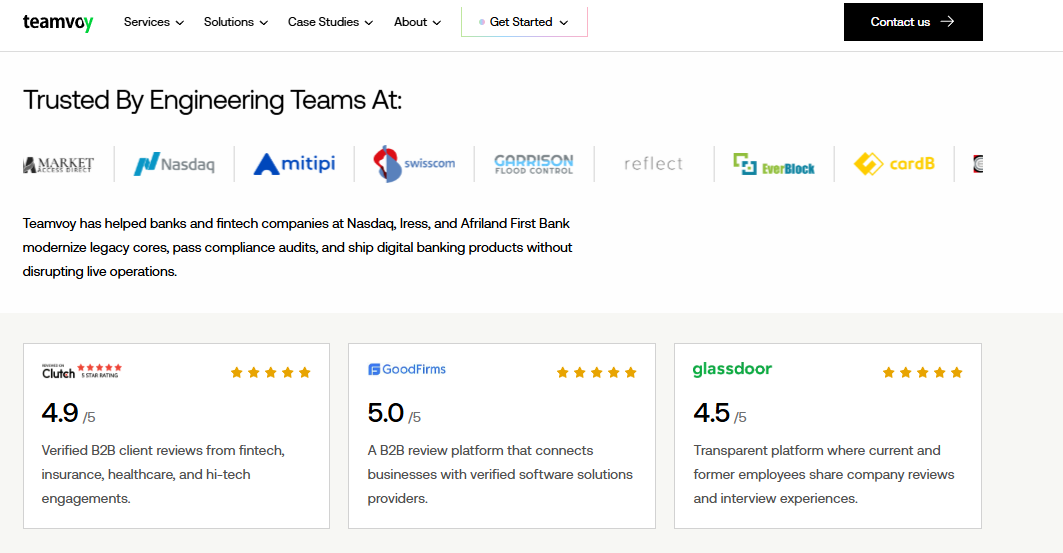
- Named regulator and standards experience: Delivery under BaFin, PSD2, DORA, SOC 2, PCI-DSS, SEC, FINRA, HIPAA, GDPR, FCA, NHS Digital.
- Custodian and market-data integration depth: Built a wealth-sector data distribution product from proof of concept to production scale.
- Senior technical lead ownership: One named senior engineer owns the system end to end, with the team behind them.
- Engagement model and post-delivery accountability: Long-term partner, 4+ year average, system ownership continues after launch.
- Capacity to inherit a system someone else built: Core practice. Stabilise, document, then modernise while the business keeps running.
- Built BC Gateways, a private blockchain product addressing data distribution inefficiency across wealth management, from proof of concept through MVP to production scale.
- Continued running that platform for two further years after the client company was acquired by Iress.
- Twelve-plus years of continuous operation, 150+ delivered projects across banking, insurance, healthcare, manufacturing, retail, logistics, and complex SaaS.

✅ Where a long engagement actually pays back
The Teamvoy card above is worth reading against your own timeline. A wealth platform does not fail in the build phase. It fails in year three, when the people who made the decisions have moved on and nobody can explain the reconciliation logic. That is the argument for system integration work that is documented as it happens.
DOOR3
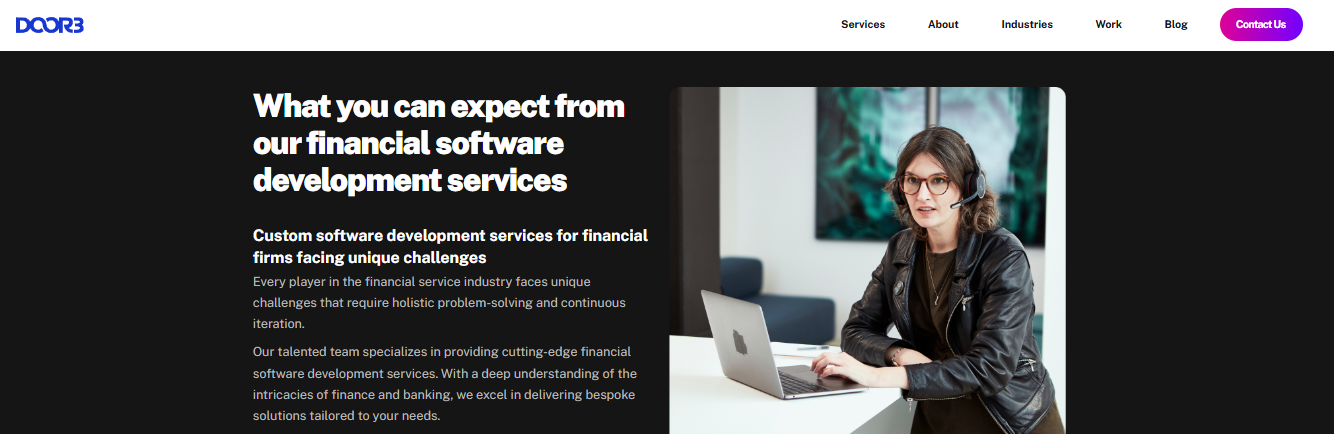
- Named regulator and standards experience: Not publicly claimed. Financial services delivery is verified, specific regulatory scope is not.
- Custodian and market-data integration depth: Not publicly claimed. Reviewed work centres on interface and workflow, not the data layer.
- Senior technical lead ownership: A principal consultant is involved by default, and clients are advised to ask who is on the proposed team.
- Engagement model and post-delivery accountability: Project-and-exit, scoped around a defined design and build outcome.
- Capacity to inherit a system someone else built: Not publicly claimed for wealth platforms specifically.
- Delivered UI/UX design for Luma Financial Technologies, a financial services firm, reviewed and verified on Clutch at 5.0 overall.
- Reviewed engagements span financial services, large-scale retail, and small web-app clients, indicating a range of project sizes.
- Clients report the principal consultant stays involved rather than handing off after the pitch.
⭐ Two cards in, the pattern is already visible
One firm is built for systems that must keep running under supervision. The other is built for products that must become usable. Those are different problems, and buying the wrong one costs a year. If the interface is the bottleneck, digital product design is the spend. If the model sits on top of an unstable core, AI integration services without a data-layer assessment will not hold.
⭐ How to read the remaining seven
The first two cards covered the two clearest situations: a platform that must keep running under supervision, and a platform nobody wants to use. The seven below sit in narrower slots. Most are strong at one thing, and the review record shows exactly which thing.
None of them publish named financial-regulator experience. That is not a criticism. It is a filter, and it should shorten your shortlist fast if you carry a Reg S-P or DORA deadline, or if you are weighing a full legacy platform modernization against a staged build.
⚠️ Where I stopped short of a claim
I have written “Not publicly claimed” more often than a normal listicle would. Verified client reviews only prove what the reviewer describes. Inventing custodian counts or compliance certifications for a firm would make this document useless to you.
Vention
- Named regulator and standards experience: Not publicly claimed for SEC, FINRA, or DORA work.
- Custodian and market-data integration depth: Not publicly claimed.
- Senior technical lead ownership: Varies by engagement. Ownership typically stays with the client’s own lead.
- Engagement model and post-delivery accountability: Staff augmentation. Accountability for the system remains in-house.
- Capacity to inherit a system someone else built: Depends entirely on the individual engineers assigned.
- Positions itself around dedicated engineering teams rather than fixed-scope project delivery.
- Public positioning covers a broad technology range rather than a single regulated vertical.
- No verified client review for this firm appears in the review sources compiled for this guide.
💰 When more hands is the wrong purchase
Capacity and judgement are different constraints, and they carry different price tags. If your roadmap is settled, hiring AI engineers into an existing plan is efficient. If nobody can explain why the reconciliation job runs at 03:00, that is an IT audit problem before it is a hiring problem.
Azumo
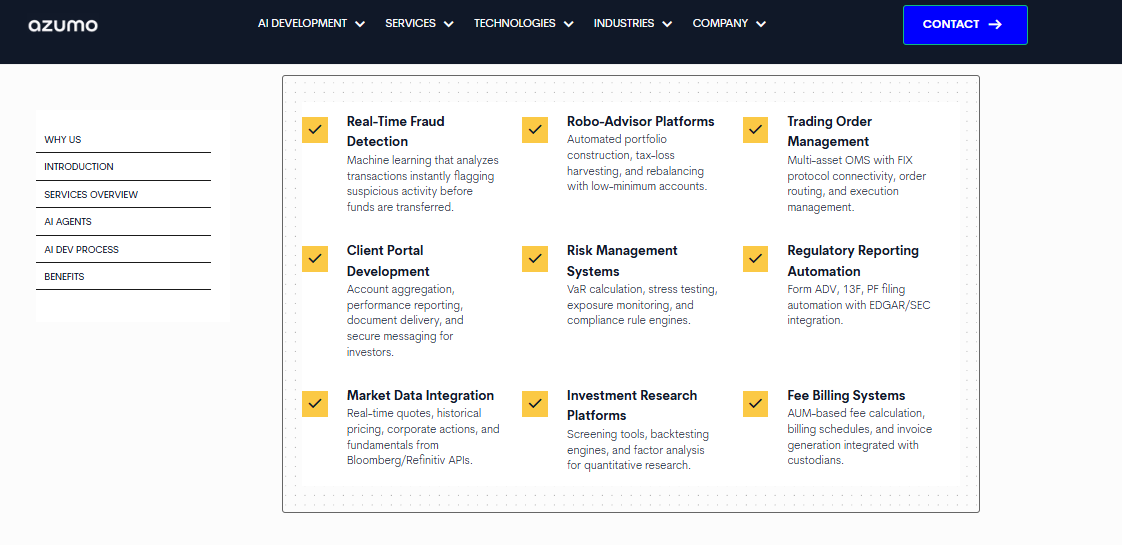
- Named regulator and standards experience: Not publicly claimed. Verified work sits in AI and SaaS, not regulated finance.
- Custodian and market-data integration depth: Not publicly claimed. Verified integration work is with client systems of record.
- Senior technical lead ownership: Project managers work directly with client counterparts. Personnel are swapped when a skills gap appears.
- Engagement model and post-delivery accountability: Long-term team supply, open-ended rather than fixed-scope.
- Capacity to inherit a system someone else built: Verified strength is building on the client’s existing platform.
- Delivered conversational applications on the client’s platform for a Fortune 100 end customer, including UX and integrations with systems of record.
- Met timelines across each phase of a multi-phase engagement with no defined end date.
- Replaced personnel when a knowledge or fit gap was identified, without stalling project progress.
Dualboot Partners
- Named regulator and standards experience: Not publicly claimed.
- Custodian and market-data integration depth: Not publicly claimed.
- Senior technical lead ownership: A product owner is embedded alongside the client’s product manager.
- Engagement model and post-delivery accountability: Project-and-exit, scoped around a launch.
- Capacity to inherit a system someone else built: Not publicly claimed. Verified work is net-new product creation.
- Ran a series of design sprints to define both the initial solution and future product iterations before any build work started.
- Executed the design to a standard the client’s own design director rated highly, then partnered with in-house engineering to build.
- Supplied a product owner who worked directly alongside the client’s product manager throughout.
⏰ Discovery versus stabilisation
Sequencing decides which of these two spends is correct. A new advisory product justifies sprints and a proof of concept before anyone writes production code. A platform already dropping trades needs the opposite order, which is why modernization sprints exist for firms that cannot afford a rewrite.
HatchWorks AI
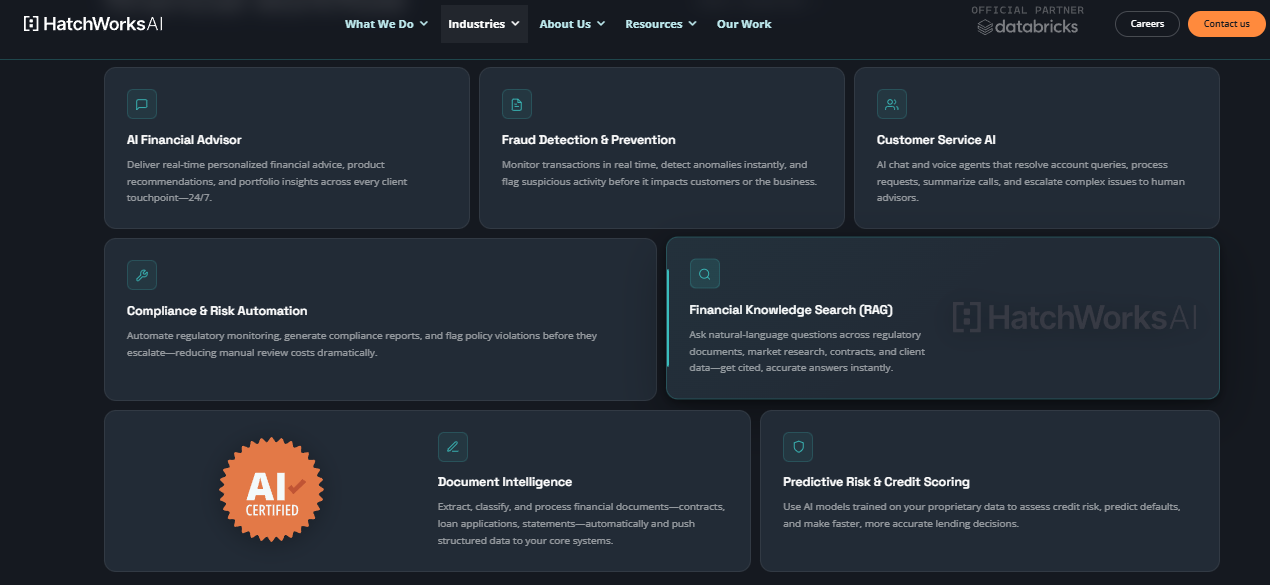
- Named regulator and standards experience: Not publicly claimed.
- Custodian and market-data integration depth: Not publicly claimed.
- Senior technical lead ownership: Small assigned teams. Ownership model beyond the engagement is not publicly claimed.
- Engagement model and post-delivery accountability: Project-and-exit, with handover documentation as a deliverable.
- Capacity to inherit a system someone else built: Not publicly claimed.
- Proposed and built a chat assistant using generative AI and retrieval-augmented generation for an IoT and fleet client.
- Reported 90%+ accuracy on user question responses, delivered on time and on budget.
- Produced handover documentation detailed enough for the client to replicate the work internally.
NineTwoThree AI Studio
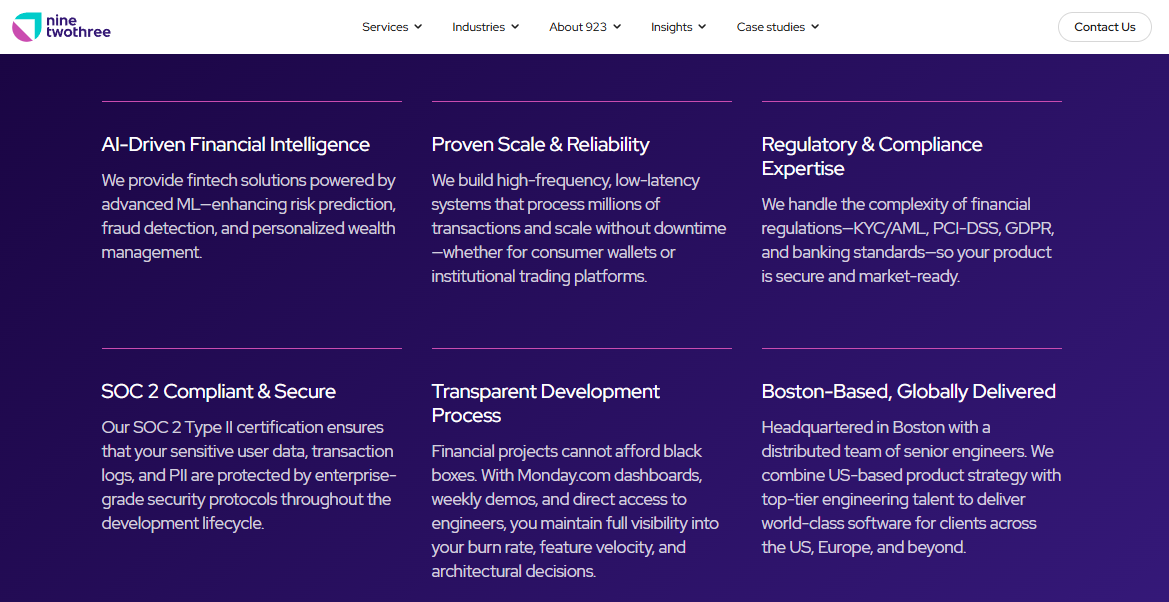
- Named regulator and standards experience: Not publicly claimed, though one verified client is a financial services research firm.
- Custodian and market-data integration depth: Not publicly claimed. One client reported building historical data structures during the project.
- Senior technical lead ownership: Reviewed as a small team covering every phase rather than a single named owner.
- Engagement model and post-delivery accountability: Project-and-exit, oriented around shipping a first version.
- Capacity to inherit a system someone else built: Not publicly claimed.
- Delivered custom software for PRC Macro, a political and investment research firm in financial services.
- Built AI and API work for a fleet maintenance company, including support while the client’s historical data was structured.
- Took a security company from concept to a finished custom mobile app, covering UX and testing gaps.
✅ The data layer decides the outcome
Two cards in a row surface the same blocker, and it is never the model. Historical records that never tracked change over time will stall any AI feature, which is why data platform modernization usually precedes the interesting work. A short AI readiness assessment tells you which of the two you are actually buying.
Orases
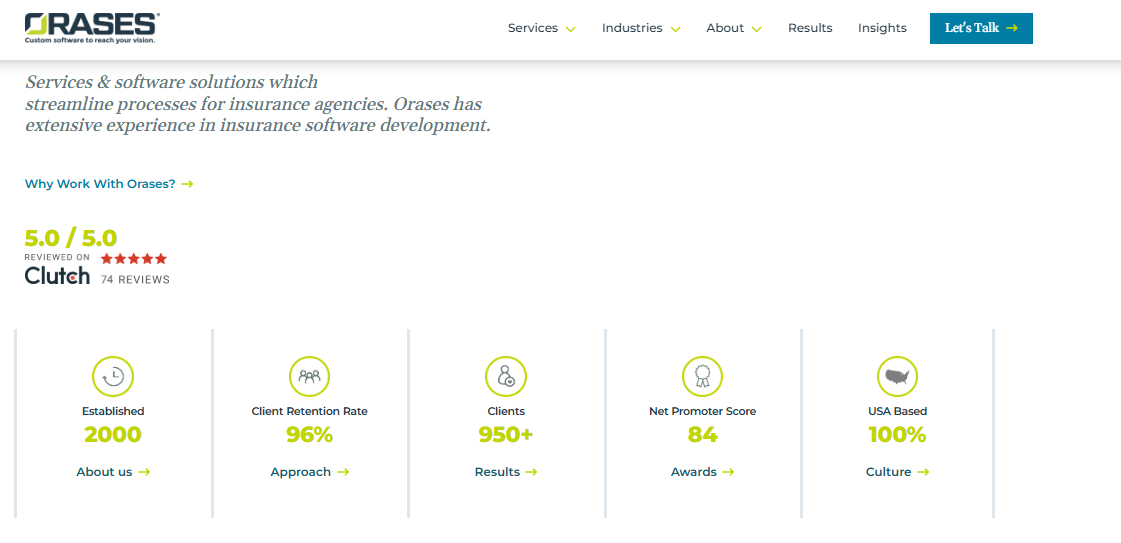
- Named regulator and standards experience: Not publicly claimed. One verified client operates in lending.
- Custodian and market-data integration depth: Not publicly claimed.
- Senior technical lead ownership: Clients describe consistent teams and in-depth scoping sessions rather than a named lead.
- Engagement model and post-delivery accountability: Project-and-exit, with clients reporting multi-project continuity.
- Capacity to inherit a system someone else built: Not publicly claimed.
- Delivered AI development services for a lending company, reviewed at 5.0 overall.
- Built custom remote care software for a health tech company across a complex, evolving project.
- Delivered AI training and consulting for a food manufacturing business, indicating range beyond pure build work.
Valere
- Named regulator and standards experience: Not publicly claimed.
- Custodian and market-data integration depth: Not publicly claimed.
- Senior technical lead ownership: Not publicly claimed in the sources reviewed.
- Engagement model and post-delivery accountability: Project-and-exit, scoped around a migration outcome.
- Capacity to inherit a system someone else built: Verified migration work indicates experience with existing backends.
- Delivered a backend migration alongside software development and a UX/UI redesign for GetOnyx, a technology company.
- Reviewed at 5.0 overall on quality, schedule, cost, and willingness to refer.
- Verified engagement covers both infrastructure change and user-facing redesign in a single scope.
✅ What the roster actually tells you
Seven of these nine firms do not claim named financial-regulator experience. That single fact narrows most wealth shortlists to two or three names before anyone takes a call.
The second filter is accountability after launch. Most cards above describe project-and-exit or staffing structures, and both leave system ownership with you, along with every cloud optimization decision the platform inherits later.
Teamvoy sits in the narrow slot where neither of those is true: multi-year engagement, one named senior lead owning the system, and delivery under SEC, FINRA, DORA, and SOC 2 conditions. The BC Gateways platform, built for wealth-sector data distribution, ran for two years past the client’s acquisition by Iress, and comparable work sits in our case studies.
Q2. What does custom wealth management software development cover, and which modules are worth building?
Wealth management software development is the process of designing and building platforms that let advisory firms run the full client lifecycle: onboarding, account aggregation, portfolio management, financial planning, reporting, billing, and compliance. It can ship as one unified system or as focused modules. Build custom where your fee logic, reconciliation, or client experience is the product. Buy the rest.
The module taxonomy every guide converges on
Almost every published guide lists the same eight building blocks. Account aggregation pulls positions from custodians. Portfolio analytics measures performance and drift, meaning how far a portfolio has moved from its target mix.
The rest are planning, rebalancing, reporting, billing, CRM, and compliance. Teamvoy has found that firms can usually name these eight in a meeting, then struggle to say which two actually differentiate them, which is the first thing any system integration scope has to settle.
⭐ The rule I use to decide
Build where the logic is yours. Buy where the logic is the industry’s. A goals-based planning engine is industry standard, so buying it is rational.
Your fee schedule is not standard. Neither is the way you reconcile two custodians who disagree about a trade date.
| Module | Usual call | Why |
|---|---|---|
| Financial planning | Buy | 92% of planning-offering practices already run third-party planning software |
| CRM and document vault | Buy | Mature market, low differentiation |
| Fee and billing engine | Build | Firm-specific tiers, breakpoints, and household rollups |
| Multi-custodial reconciliation | Build | Nobody else owns your data mismatches |
| Client portal | Build or heavily customise | This is what clients actually see |
| Estate and stock-option planning | Assess | Adoption sits at 45% and 41%, so tooling is thinner |
💰 A fee engine nobody sells off the shelf
Here is a real shape I see often. A firm charges tiered fees, discounts by household, waives on held-away assets, and prorates mid-quarter transfers.
No product expresses that cleanly. So an operations person maintains a spreadsheet, and that spreadsheet becomes the actual system of record, which is the classic trigger for technology modernization work.
⚠️ Where AI modules go wrong first
Firms scoping an AI search tool often plan to dump everything into a vector database, which stores documents so a model can retrieve them. Compliance manuals, Slack history, and client notes all go in together.
That does not produce reasoning. It produces flooding, where the model retrieves plausible fragments and answers confidently from the wrong document, a failure pattern covered in more depth in our note on enterprise RAG architecture.
✅ Find the spreadsheets first
Before scoping anything, list every spreadsheet your operations team refuses to delete. Each one marks a gap between two systems.
That list is a better requirements document than most discovery phases produce. It is also free.
Teamvoy scopes module-level builds against those spreadsheet workarounds first, because that is where a firm’s real logic lives before anyone writes a requirement. The BC Gateways work for wealth-sector data distribution started from exactly that kind of gap, and sits alongside our other banking and fintech engagements.
I can confidently say that we would not be where we are today without Teamvoy's support.
No the only problem we faced during our project was data. Mainly that we had not set up our data to track historical changes over time making it difficult to analyze.
Q3. What does a wealth management platform cost to build, and how long does it take?
An MVP runs $40,000 to $200,000 over three to six months. A mid-complexity build with custodian integrations and KYC/AML runs $100,000 to $400,000 over four to twelve months. Enterprise multi-custodial platforms with trading and risk analytics run $300,000 to $600,000 or more over nine to eighteen months. Integration count moves those numbers more than feature count does.
The three tiers, with published ranges
| Build tier | Typical cost | Typical timeline |
|---|---|---|
| MVP: core portfolio view, basic reporting | $40,000 to $200,000 | 3 to 6 months |
| Mid-complexity: custodian feeds, KYC/AML, billing | $100,000 to $400,000 | 4 to 12 months |
| Enterprise: multi-custodial, trading, risk analytics | $300,000 to $600,000+ | 9 to 18 months |
⭐ Why quotes differ by five times
Published 2026 figures do not agree. One guide puts a full platform at $96,000 to $181,000. Another puts the range at $40,000 to $600,000 and above.
Both are honest. They are scoping different integration surfaces, and neither says so on the pricing page. Our own breakdown of what $40K buys versus $250K exists for the same reason.
💰 Integration is where the money actually goes
Published benchmarks put each integration at $5,000 to $20,000. Market-data APIs add $3,000 to $15,000 per year, and normalising a book of record starts around $30,000.
Teamvoy prices custodian and market-data integrations as discrete line items rather than folding them into one platform figure. That is the line that compounds across a four-year engagement, and it is where data engineering scope should be itemised.
⏰ The running costs most quotes omit
Build cost is a one-time number. Data licences, custodian feed fees, and hosting are annual, and they arrive whether the roadmap moves or not.
AI features add a cost shape most finance teams have never modelled. Agent loops resend the whole conversation history on every step, so a 20-step run costs far more than twice a 10-step run.
⚠️ The overnight bill problem
One widely reported incident involved a support agent stuck in a retry loop with no circuit breaker. It repeated the same failing action for six hours overnight and produced roughly $4,200 in API charges.
That is not a model problem. It is a missing spend limit, and it belongs in your build requirements, not your incident review. Recurring spend of that kind is usually a IT cost optimization question long before it is an engineering one.
✅ What to ask before you accept a quote
- Price per integration, and how many are in scope.
- Annual data and feed costs, listed separately from build.
- What happens to cost if a custodian changes its file format.
- Hard spend ceilings on any AI component.
Teamvoy has delivered 150+ projects across banking, insurance, and complex SaaS, and the pattern holds. The overruns are almost never in the features. They are in the data plumbing nobody itemised.
Q4. Which regulations shape a wealth management build and the partner contract?
Three regimes shape the build directly. Amended SEC Regulation S-P requires incident response and customer notification, with smaller entities compliant by 3 June 2026. FINRA’s 2026 Oversight Report extends vendor diligence to a vendor’s own generative AI use. DORA, applicable since 17 January 2025, mandates a Register of Information and Article 30 contract clauses for EU financial entities.
Reg S-P: notification becomes a build requirement
The SEC adopted the amendments on 16 May 2024. Larger entities had to comply by 3 December 2025, and smaller entities by 3 June 2026.
That turns incident response into architecture. You need event logging that can reconstruct what was accessed, when, and for which clients.
⭐ FINRA now asks about your vendor’s AI
FINRA’s 2026 report treats third-party generative AI use as a diligence item. Firms are expected to know whether a vendor feeds their data into open-source AI tools.
Teamvoy delivers inside SEC, FINRA, SOC 2, PCI-DSS, HIPAA, and GDPR environments, and the practical effect is simple. Every merged change has a named reviewer attached to it, which is the same discipline behind building regulator-ready AI in fintech.
⚠️ The pattern that makes AI risky here
Security researchers describe a dangerous combination: read access to sensitive data, processing of untrusted outside content, and an outbound channel. Any two are manageable. All three together create real exposure.
An AI advisory assistant reading client records, ingesting external market commentary, and emailing summaries hits all three. That is worth catching at design time, and it is a standing item in every AI integration review we run.
💰 DORA turns compliance into contract language
DORA applied from 17 January 2025 across EU financial entities. Articles 28 to 30 require an ICT risk strategy, pre-contract due diligence, a Register of Information, and specific contract terms.
Article 30 is the clause list. Audit rights, data location, sub-contracting disclosure, and exit support all have to be written down.
✅ What to check in your contract this week
- Incident notification duties, with timelines that match Reg S-P.
- A clause barring ingestion of your data into open-source AI tools.
- Named audit rights and data-location terms.
- Documented exit support, including code and knowledge handover.
- A named individual accountable for delivery, not a team inbox.
⏰ Certificates are not evidence
A SOC 2 report proves controls existed during an audit window. It does not prove your platform was built under them.
What auditors actually accept is dated change records, named reviewers, and decisions written down when they were made. That is a daily habit, not a document you buy, and an independent IT audit will show you which habit your team currently has.
Teamvoy produces that evidence during delivery rather than reconstructing it before an audit, across 150+ projects in regulated environments. It is slower in week one and considerably faster in year three.
Q5. Why do wealth management AI pilots stall, and what does the evidence actually show they deliver?
Pilots stall because read-only demos never needed write access to the client ledger. Production does, and that brings audit trails, reconciliation, rollback, and regulator-facing explainability the pilot budget never covered. McKinsey puts early AI agent gains at 3% to 5% annually, not the 10 to 15 hours per adviser per week circulating in vendor material.
The pilot that worked and never shipped
You have probably seen this one. The assistant answered questions about fund documents. Everyone in the demo nodded. Then it never reached advisers.
Industry reporting suggests roughly 95% of enterprise generative AI pilots produced no measurable financial return, against something near $40 billion of global investment. That is a sobering ratio for any board conversation, and it mirrors the pattern behind most enterprise AI implementation challenges.
⚠️ Read-only is a different animal
A read-only assistant answers questions. If it is wrong, someone shrugs. Nothing changed in the ledger.
A system with write access rebalances a portfolio or updates a client record. Now you need approval flows, rollback, and an auditable reason for every action. Teamvoy treats that boundary as the real project start, because everything expensive sits on the write side.
⭐ The bottleneck is plumbing, not the model
Model choice gets the attention. Integration gets the budget overrun. Even a strong model is useless when it reads stale data or cannot execute an action reliably.
I have watched teams spend six weeks comparing models and two days on the data layer. The first two questions on any AI consulting call should be the data layer and the legacy core.
💰 What the analyst numbers actually say
McKinsey estimates AI agents deliver 3% to 5% annual productivity improvement in early use cases. A separate estimate puts 30% to 40% adviser gen-AI adoption by 2034, yielding 6% to 12% time savings.
Vendor material often claims 10 to 15 hours saved per adviser per week. I cannot reconcile that with the analyst range, so I am flagging the gap rather than picking a side.
⏰ Where the value lands
McKinsey’s more recent work suggests AI efficiency accrues as provider capacity, not as lower client fees. That matters for your business case.
If you budgeted the pilot expecting fee compression to justify it, the maths will not hold. Capacity gains are real. They just show up as headcount you did not have to hire, which is why AI success metrics should be set before the pilot, not after.
✅ Three questions before you fund pilot two
- Does this need write access, and who approves each write?
- Where does the data come from, and who owns its accuracy?
- What is the hard spend ceiling if the system loops?
Teamvoy’s first deliverable on AI work inside a regulated stack is an assessment of the data layer and the legacy core. A model cannot outperform the ledger it reads from, and no amount of prompt work fixes that.
Where my view sits right now is somewhere uncomfortable. I think most stalled pilots were not AI failures at all. They were integration projects that nobody scoped, funded, or staffed as integration projects, which is exactly the case for treating legacy system AI integration as its own discipline.
Q6. How do you vet a wealth management development partner before signing?
Request a SOC 2 Type II or ISO 27001 report dated within twelve months, confirm how the partner’s own delivery pipeline uses generative AI, review the DORA Article 30 clauses in the contract, verify custodian integration references, and secure source-code ownership plus a tested exit plan. Six questions separate a partner from a staffing vendor.
The six questions, and the answers that should worry you
- Show me your SOC 2 Type II or ISO 27001, dated. Worrying answer: “We follow those principles.”
- How does your team use generative AI in delivery? Worrying answer: “We don’t.” Almost everyone does.
- Which contract clause covers our data and open-source AI tools? Worrying answer: silence, then a follow-up email.
- Name the senior engineer accountable for this system. Worrying answer: a team name, not a person.
- Which custodians have you integrated, and can I call that client? Worrying answer: a logo wall.
- What does exit look like? Worrying answer: “That won’t happen.”
⭐ Why question two is new
FINRA’s 2026 report expects firms to assess a vendor’s own generative AI use as part of diligence. Contract language barring your data from open-source AI tools is now standard practice.
Teamvoy assigns a named senior technical lead who reviews every merged change, which is what makes that question answerable with a person rather than a policy PDF. The same logic runs through our guide on choosing an AI vendor in fintech.
⚠️ “Almost right” is the expensive failure mode
Completely wrong code gets caught. Tests fail, builds break, someone fixes it. Almost-right code passes review and ships.
It then sits in the codebase for six months. By the time anyone notices, the fix costs far more than the feature ever did, and that is how a tech debt avalanche starts.
✅ The three-question review test
Ask any partner how they review AI-assisted code. A good answer covers three checks: does it reuse existing patterns, does it follow your conventions, and can the developer explain it without reading the model’s comments?
Reported data puts AI-generated pull requests at an average of 10.8 issues, against 6.4 in human-written code. That is not a reason to ban the tools. It is a reason to demand the review.
💰 The counterpoint worth hearing
AI-assisted delivery is not disqualifying. Unreviewed AI-assisted delivery is. Cursor, Replit, and similar tools produce code that ships perfectly well.
That code still has to be supported in production by people who can read it. That is the whole test, and it is a people question, not a tooling question, as the record on vibe coding security risks keeps showing.
We were impressed with the technical management, adherence to process, and technical capability of the engineers.
DOOR3 does a great job of understanding what you need at the beginning to put together the right team. If you're looking to hire them, ask questions about the type of team they're proposing.
Teamvoy answers each of these six with a named person and a dated artefact, including source-code ownership resting with the client from day one. Bring a sceptic to that call. Agreeable meetings produce agreeable contracts.
Q7. Should you build, buy, or modernise, and what happens when the previous vendor has already left?
Buy when your workflows match the vendor’s assumptions. Build when custodian coverage, fee logic, or client experience is the product. Modernise when the system already carries the business, which is where most wealth firms actually sit. Teamvoy has run that third path across 150+ delivered projects, starting with a written system map before any architectural change.
Three paths, matched to system state
| Your situation | The call | Why |
|---|---|---|
| No system yet, standard workflows | Buy | Your differentiation is elsewhere |
| Product-defining logic, no system | Build | Nobody sells your fee schedule |
| A system already runs the business | Modernise | A freeze costs more than the code |
⚠️ The failure mode I see most
A firm scopes a rewrite while the existing platform still processes every trade. The plan assumes an eighteen-month parallel run that nobody has funded.
Modernising a live platform is closer to renovating an occupied building than constructing a new one. The tenants stay. That constraint drives everything about enterprise architecture modernization.
⭐ The technique that avoids user mutiny
One approach I keep returning to came from a retail modernisation. The team rebuilt the backend while keeping the interface pixel-identical, same colours, same button sizes.
Staff arrived the next morning and saw the same system. Underneath, records were being written to new tables, normalised one at a time.
⏰ The 2 AM problem nobody documents
Here is a scene most Burned CTOs recognise. A 503 error at 2 AM, and the AI assistant suggests restarting the server. Six times.
A senior engineer looks for thirty seconds and knows the database connection pool is full because of a nightly batch job. That is not in any runbook. It is tribal knowledge, and it walked out with the last team, which is the whole subject of updating systems nobody understands.
✅ The rescue sequence
- Read the code. Do not touch it in week one.
- Map live dependencies, including scheduled jobs and audit exports.
- Run a scream test: isolate suspected dead services for 48 to 72 hours and see who screams.
- Document the failure paths that actually page someone.
- Only then propose architecture changes.
Teamvoy begins rescues with a written system map and a documented failure inventory, delivered before any change is proposed. Step three catches monthly processes that standard monitoring windows miss entirely.
💰 The honest trade-off
Modernisation without a rewrite is not always possible. Sometimes the right answer is a staged rebuild, and I would rather say that in week one than month nine, which is the argument behind our AI modernization sprints.
The signal is usually data, not code. If the schema cannot express what the business now does, patching around it just buys time.
Their technical expertise was top class.
They are so good at what they do I hope to work with them for years and years into the future.
Teamvoy took the BC Gateways wealth platform from proof of concept to production, then kept running it for two years after the client was acquired by Iress. That is the part I would want to ask any partner about, and comparable proof sits in our trade surveillance re-engineering work for a global exchange.
Not what they built. What they were still supporting three years later.