Claims Processing Automation Software Development
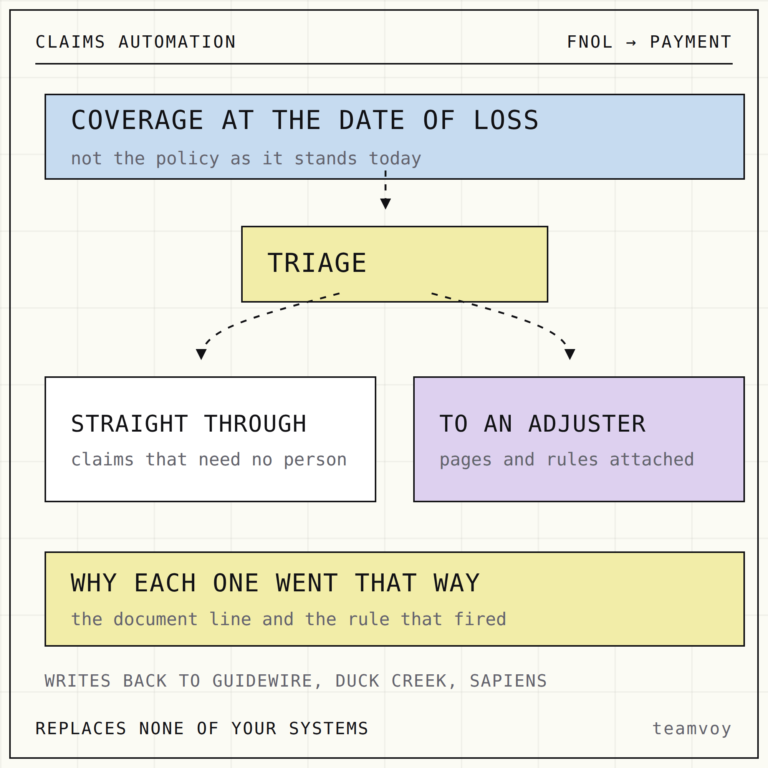
We build the layer that runs between first notice of loss and payment: intake, document extraction, coverage checks at the date of loss, triage, adjudication and the write-back to your claims system. It runs against Guidewire, Duck Creek, Sapiens or whatever you already have, and replaces none of them.
Trusted by teams at:


Teamvoy has delivered engineering work for 150+ companies.

Verified B2B client reviews from fintech, insurance, healthcare, and hi-tech engagements.

A B2B review platform that connects businesses with verified software solutions providers.

Transparent platform where current and former employees share company reviews and interview experiences.

Claims Automation Services We Offer
Six offerings. Each is scoped separately, and each one can be the whole engagement.
FNOL Intake and Triage
First notice arrives by portal, phone, broker email or EDI and becomes one structured claim with one identifier. Intake is idempotent on the loss rather than on the message, so a broker who resends an attachment does not open a second claim against the same policy.
– Multi-channel FNOL capture
– Duplicate loss detection
– Severity and complexity triage
– Claim routing rules
– EDI and broker intake
Claims Document Extraction
Invoices, estimates, police reports, medical bills and loss photos read into typed fields with a confidence score on each field. Anything under the threshold routes to a person with the page and the crop attached, instead of moving downstream as an established fact.
– Invoice and estimate extraction
– Medical bill parsing
– Loss photo assessment
– Handwriting and fax handling
– Confidence threshold routing
Coverage and Eligibility Verification
Automated checks against the policy as it stood on the date of loss: endorsements, deductibles, limits, sub-limits and exclusions. The lookup is versioned on the loss date rather than the current term, which is the difference between a correct coverage answer and a plausible one.
– Date-of-loss policy lookup
– Endorsement and exclusion checks
– Deductible and limit application
– Eligibility and benefit checks
– Coordination of benefits
Straight-Through Adjudication
Rules and models that settle the claims which should not need a person and refer the ones that should. The straight-through band is defined on claim characteristics rather than amount alone, so a small claim carrying a liability or subrogation question still reaches an adjuster.
– Straight-through banding
– Reserve setting logic
– Rules and model orchestration
– Referral criteria design
– Decision audit trail
Adjuster Workbench and Correspondence
The screen where a referred claim is decided, showing the extracted fields, their source pages and the rules that fired together. Denial and coverage letters are generated from the same rule version that produced the decision, so the reason in the letter matches the reason in the file.
– Adjuster review queues
– Evidence and provenance panels
– Denial and coverage letters
– Correspondence templates
– Appeal and reopen handling
Payment, Write-Back and Recovery
Payment issue, reserve movement and write-back to the policy administration system and the ledger, with subrogation and salvage referrals raised at close. Write-backs are idempotent and reconciled, because a retry after a timeout is how duplicate payments happen.
– Payment issue and reconciliation
– Reserve release and write-back
– Subrogation referral
– Salvage and recovery tracking
– Leakage and cycle-time reporting
What Our Clients Say
The care and interest they showed are what makes Teamvoy special. The system contributes to company sales, which is the best metric of success. Teamvoy was excellent in terms of project management and were extremely responsive while coming up with creative solutions.

Arnon Rosan, CEO & Founder, EverBlock Systems, LLC
Teamvoy has successfully launched the system within the set timeline and integrated all the required tools and features. The collaborative team led regular meetings, delivered on time, and communicated effectively. Their proactive problem-solving approach and commitment to innovation stand out.

Jim Hill, Director of Marketing & Business Development, Market Access Direct, LLC
Teamvoy’s support and expertise have been integral in helping the client build and scale their product. An agile partner, they manage their tasks well and are consistent in delivering according to schedule. Their strong understanding of blockchain and the quality of their work make them stand out

Gordon Little, Managing Director, Iress
The game had a huge impact on the client’s business and helped display the exhibition. Teamvoy utilizes project management tools to ensure a smooth workflow. The team us understanding, hard-working, and experienced.

Dr. Christian Stein, CEO, MeinObject
We work with them for over 2 years, and they have been very reliable and timely in providing us quality development services. Their creative input and talented team helped us build a better product!

Nazar Fedorchuk, CEO & Founder, Senstone

Do you know which step in a claim
actually costs the days?
One claim, seven layers
A claimant reports one loss. Between that notice and the payment sit seven handovers, and each one fails in a way a demo never reaches.

01. Intake and first notice
The notice arrives by portal, phone, broker email or EDI and becomes one claim record with one identifier, attached to one policy. Breaks when: the same loss is reported through two channels, the broker email and the claimant portal, and two claim numbers open against one policy before anyone compares them.
02. Coverage verification
The policy is read as it stood on the date of loss: endorsements, deductibles, limits, sub-limits and exclusions in force at that moment. Breaks when: the lookup returns the current policy version instead of the version in force at the loss date, so coverage is confirmed against terms that did not exist when the loss happened.
03. Document ingestion and extraction
Invoices, estimates, reports, bills and photos are read into typed fields, each carrying a confidence score and a pointer to the page it came from. Breaks when: confidence is high on clean PDFs and quietly low on a phone photograph of a faxed invoice, and with no threshold routing the wrong amount travels on as fact.
04. Duplicate and fraud triage
The claim is checked against prior claims, industry databases and red-flag rules, and referred to the special investigation unit where it scores. Breaks when: the same invoice is submitted under two claim numbers with its line items reordered, and deduplication keyed on the document hash never sees it.
05. Adjudication and reserve
Rules and models produce a pay, deny or refer outcome with an indemnity and expense reserve, and a straight-through path for the claims that need no person. Breaks when: the straight-through band is defined on claim amount alone, so a small claim with a liability or subrogation question auto-pays and the recovery is gone.
06. Adjuster review and correspondence
Referred claims reach an adjuster with the extracted fields, their source pages and the rules that fired, and the decision letter is generated from that decision. Breaks when: the letter template has drifted from the rule version that produced the denial, so the reason the claimant is given cannot be traced back to the rule that fired.
07. Payment, write-back and recovery
Payment is issued, the reserve moves, the claims system and the ledger are updated, and subrogation and salvage referrals are raised at close. Breaks when: the payment clears, the write-back to the claims system times out, the job retries, and the reserve is released twice or a second payment goes out.
Why choose Teamvoy for claims processing automation?
Four positions we hold on claims work, each with the thing it costs us to hold it.

The engineers who scope the work build the work.
No handover from a pre-sales team to a delivery team. The person who tells you what the work will cost is the person who then has to make that estimate true. Costs us: we cannot start faster than we can staff, so we turn down work that needs a squad this month.
You own the source code from the first commit.
The repository is yours, in your organisation, from day one. Not transferred at the end, not held until the final invoice clears. Costs us: we give up the lock-in that comes from holding a repository, so we have to be re-chosen every quarter.
Every automated decision names the document line and the rule it came from.
The claim file carries the extracted field, the page it was read from, the confidence at the time and the rule version that fired. That is what an adjuster needs before accepting a machine answer, and what your complaints team needs when a denial is challenged a year later. Costs us: capturing provenance on every field costs throughput, and the first weeks go into plumbing that a demo would skip.
We ship the fallback path before the automated one.
Every automated step has a confidence threshold below which the claim routes to a person, and a switch that returns a whole claim type to manual handling without a deploy. Nothing settles without review until you have watched it run in parallel against your adjusters. Costs us: our first release does less than a proof of concept, and we will not quote a straight-through rate before we have seen your documents.
Claims Automation Success Stories
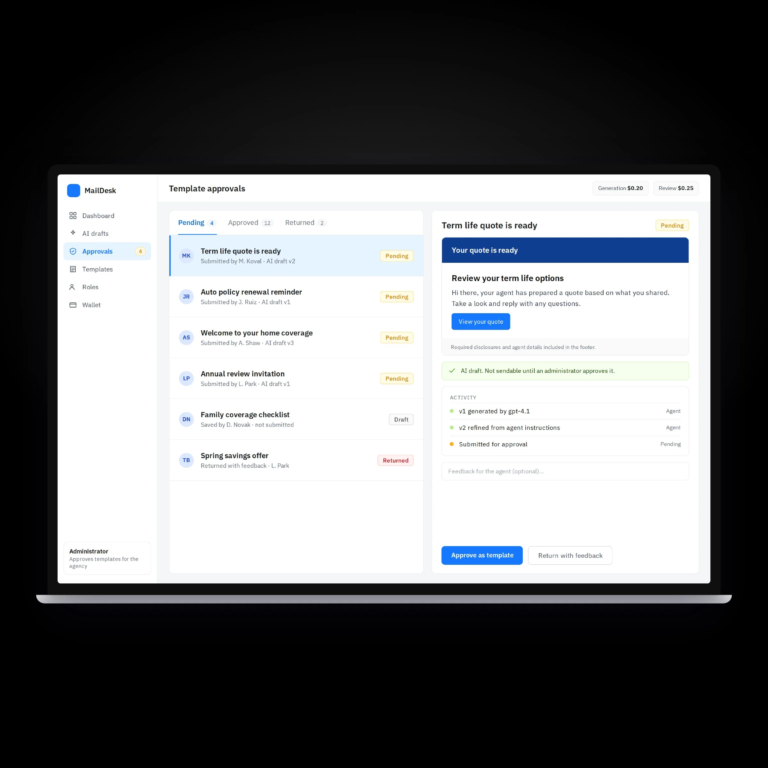
Insurance Marketing Compliance for AI Email: Human Approval Before Send
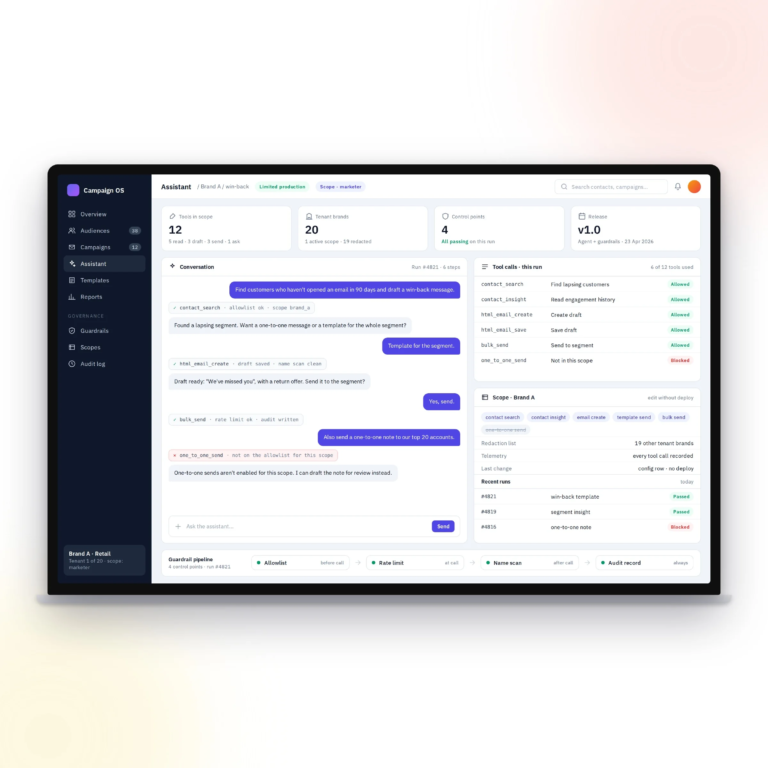
AI Agents for CRM: 12 Tools, 20 Tenants, 1 Release
AI for Insurance Agents: Ten OpenAI Capabilities Across a Twenty-Brand CRM
Three ways to start
Ordered by commitment. The first ends in a document you keep whether or not we build anything.
Claim Path Teardown
We take a sample of your closed claims and count what actually happened to them: touches per claim, where the waiting sat, which documents carried the decisive fields. You keep a written findings document ranking automation candidates by volume and touch count, with an extraction feasibility read per document type.
One Claim Type, Running in Parallel
One claim type on one line of business, built in your environment: intake, coverage check, extraction, triage, an adjudication proposal, a draft decision letter and the write-back. It runs alongside your adjusters, who keep deciding, so you compare before anything is switched on.
Fifteen Minutes with a CTO
Bring one claim file that took too long, with its documents and its touch history. You get an engineer read on which steps could have run without a person, and no follow-up sequence.
We engineer for:
What our claims automation engineers work in.
Document and vision

Extraction models and evaluation


Workflow and orchestration


Data platform


Core insurance and payer integrations
Cloud and runtime


Send us one claim file.
Talk to a Chief Technology Officer on the first call.