






























1. What should you have ready before asking for quotes?
Vendors price what you describe. When something is missing, each vendor fills the gap with its own assumption, and the quotes stop being comparable.
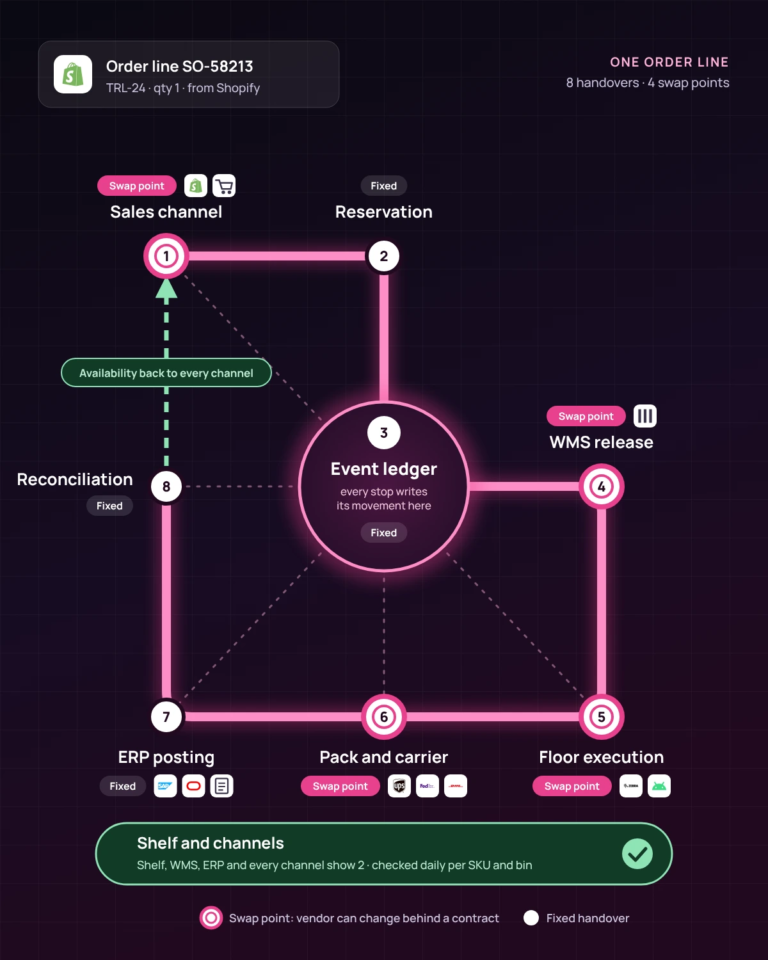
- Every system that touches stock, and which one is the source of truth for on-hand, available and reserved quantities.
- The flows you need, such as receiving, order-to-ship, transfers, returns and cycle counts, and which direction each one runs.
- Order and line volume on a normal day and on your busiest day of the year.
- How many sites and 3PLs are in scope now, and which ones are planned.
- Who on the floor will sign off the scan workflows and test them on shift.
- The date that actually matters: a peak freeze, a new site opening or the end of a WMS contract.
2. Which details change the scope and the price?
2.1 How many sites, 3PLs and stock statuses are involved?
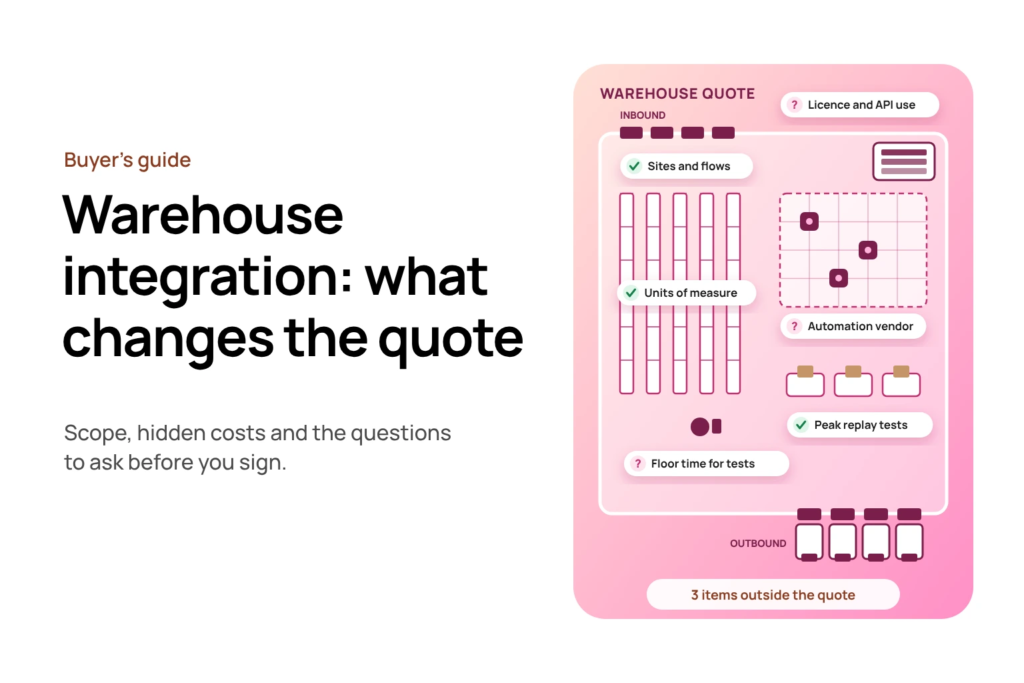
Each site and each 3PL brings its own interface and its own idea of what available means.
Ask the vendor: Is every site in scope, or only the first one?
2.2 Does every channel need real-time availability?
Real-time feeds need queues, safety stock rules and monitoring. A scheduled feed is cheaper but tends to oversell at peak.
Ask the vendor: Which channels oversell today, and how fast must availability update?
2.3 Do your units of measure match across systems?
Eaches, inner packs, cases and pallets often differ between ERP and WMS, and a missing conversion multiplies stock by the pack size.
Ask the vendor: Who owns the pack hierarchy, and is cleaning it up included?
2.4 Do you track lots, serial numbers or expiry dates?
Lot and serial capture adds scans, label fields and traceability reports, and regulated goods add their own data requirements.
Ask the vendor: Which items need lot or serial capture, and at which steps?
2.5 What automation is on the floor, or planned?
Robots, AutoStore and conveyors come with their own control software and their own vendor’s interface rules.
Ask the vendor: Have you integrated with this automation vendor before, and who provides the test rig?
2.6 Do your retail customers send routing guides?
Retailer label and ASN rules are specific to each retailer, and mistakes are usually charged back weeks after the shipment.
Ask the vendor: Which retailer guides are in scope, and how is label compliance tested?
2.7 How are returns handled?
Returns need inspection outcomes, grading and a rule for whether the unit goes back into sellable stock.
Ask the vendor: Are returns and restocking in scope?
2.8 Is there a safe place to test?
A test WMS, test handhelds and label printers are often separate purchases, and testing on the live floor slows shipping.
Ask the vendor: Who provides the test WMS, devices and printers?
3. Which costs often sit outside the quote?
A quote can be accurate and still leave things out, like a removal firm that prices the van but not the packing. Check each of these.
3.1 Do your ERP and WMS licences cover integration traffic?
You pay the software vendor. SAP, for example, can license documents such as goods movements that outside systems create in it, and some SaaS products limit or charge for API use.
Ask the vendor: Have you checked what our licences allow before designing the flows?
3.2 What will EDI and shipping platforms cost each month?
You pay these vendors. EDI networks have often charged by data volume, and shipping platforms often charge per label or per shipment.
Ask the vendor: What will these cost us at our peak volume?
3.3 Who pays for the automation vendor’s side?
Robotics and conveyor vendors usually charge for their own interface and commissioning work.
Ask the vendor: Is the automation vendor’s work in their quote, ours or yours?
3.4 How much floor time will testing and cutover take?
Wall-to-wall counts, scan workflow tests and training happen on paid shifts, sometimes with shipping slowed.
Ask the vendor: How many shifts of floor time does the plan assume?
3.5 Who supports the flows after go-live?
Support is usually quoted separately, if at all.
Ask the vendor: How many weeks are included, and who is on call during the first peak?
3.6 Who pays when a WMS or carrier update breaks a flow?
Fixes after vendor updates are usually billed as change requests.
Ask the vendor: Are upgrade tests part of the build, or extra each time?
4. How do you compare providers?
Most providers can make two systems exchange stock levels. These questions show how each one handles what happens on a busy day.
4.1 What happens if the same scan arrives twice?
A common answer: the system checks for errors. What to look for: every movement carries a key and can be applied only once, and here is the replay test.
4.2 How will you know the ERP matches the shelf?
A common answer: stock is synced every night. What to look for: daily comparison per SKU and location across WMS, ERP and channels, sent to the inventory controller.
4.3 How will cutover avoid stopping shipping?
A common answer: cutover over a weekend. What to look for: a shadow run beside the live floor, a date outside peak and a rehearsed rollback.
4.4 Where will the mapping logic live?
A common answer: inside the provider’s platform. What to look for: in your repository and your platform account.
4.5 Who made this estimate?
A common answer: a pre-sales team. What to look for: the engineer who will build it, after a walk of your floor.
5. What should you clarify before signing?
- How reconciliation and support during the first peak are covered, not only the connectors.
- Acceptance criteria that include short picks, cancellations after release and duplicate scans.
- Your WMS and ERP licences, EDI fees and test environment.
- Whose account holds the code, mappings and event ledger.
- That a site lead signs off the scan workflows before building starts.
6. Where does Teamvoy stand on each of these?
Our readiness audit marks every item in sections 2 and 3 as included, excluded or provided by you, before any build is priced. You can then compare our proposal with anyone else’s line by line, and nothing turns up later as a surprise change request.