



























FIXED SCOPE
AI & System Readiness Audit

Architecture review, risk surface, prioritised action plan. No obligation.

PAID - 2 WEEKS
Sharp Sprint

Fixed scope, senior engineers, working software. Skip the long discovery.

Contact us

Accounting Software Integration Services

We connect your billing, payments and product to QuickBooks Online, Xero, Sage Intacct, NetSuite and Business Central, for your own books or as a native integration your customers switch on. Pushing an invoice through the API is the easy part. We take responsibility for the hard part: every payment, fee and refund posts once, to the right account and tax code, and each payout matches its bank line.

Trusted By Engineering Teams:

grey stylized letter 'm' logo
osl company logo
white logo on a black background centered on a solid banner
iress company logo
velory — ai-assisted development and integration client of teamvoy
neopenda — wearable medical iot development client of teamvoy
swisscom logo: abstract red and blue symbol beside the lowercase blue 'swisscom'.
reflect logo: lowercase gray wordmark
panasonic — enterprise cms and serverless software client of teamvoy.
nasdaq — capital markets ai engineering client of teamvoy
mitipi — iot smart home device development client of teamvoy
garrison flood control — ai voice assistant and automation client of teamvoy
everblock — 3d web configurator development client of teamvoy
cardb — fintech crypto payments development client of teamvoy
afriland first bank — hybrid cloud banking platform client of teamvoy

Teamvoy has delivered engineering work for Nasdaq, Panasonic, Afriland First Bank and 50+ other companies since 2013.

4.9 /5

Verified B2B client reviews from fintech, insurance, healthcare, and hi-tech engagements.

5.0 /5

A B2B review platform that connects businesses with verified software solutions providers.

4.7 /5

Transparent platform where current and former employees share company reviews and interview experiences.

Accounting Software Integration Services We Offer

Three delivery tracks, each scoped and priced on its own.

Integration architecture and posting design

Teamvoy designs how your transactions become accounting entries: which object each event creates, summary or detail posting, clearing accounts for payouts, tax codes per region and how each company’s chart of accounts is mapped. Lock dates and API metering are designed for before the first flow is built.

Native integrations and sync build

Teamvoy builds the integrations into QuickBooks Online, Xero, Sage Intacct, NetSuite and Business Central, for your own books or as a native integration inside your product. Every write carries an idempotency key and a replay test from its first pull request.

Reconciliation, monitoring and support

Teamvoy runs the integrations in production: sync health per connected company, alerts on expired tokens and disconnections, daily count and amount checks against the ledger, and a replay path when a posting is rejected.

What Our Clients Say

The care and interest they showed are what makes Teamvoy special. The system contributes to company sales, which is the best metric of success. Teamvoy was excellent in terms of project management and were extremely responsive while coming up with creative solutions.

Teamvoy has successfully launched the system within the set timeline and integrated all the required tools and features. The collaborative team led regular meetings, delivered on time, and communicated effectively. Their proactive problem-solving approach and commitment to innovation stand out.

Teamvoy’s support and expertise have been integral in helping the client build and scale their product. An agile partner, they manage their tasks well and are consistent in delivering according to schedule. Their strong understanding of blockchain and the quality of their work make them stand out

The game had a huge impact on the client’s business and helped display the exhibition. Teamvoy utilizes project management tools to ensure a smooth workflow. The team us understanding, hard-working, and experienced.

We work with them for over 2 years, and they have been very reliable and timely in providing us quality development services. Their creative input and talented team helped us build a better product!

×
tablet displaying cad engineering drawing of industrial equipment

Need to validate your accounting integration architecture?

Flow inventory, posting rules review, API cost profile and a prioritised fix list. Fixed scope, no obligation.

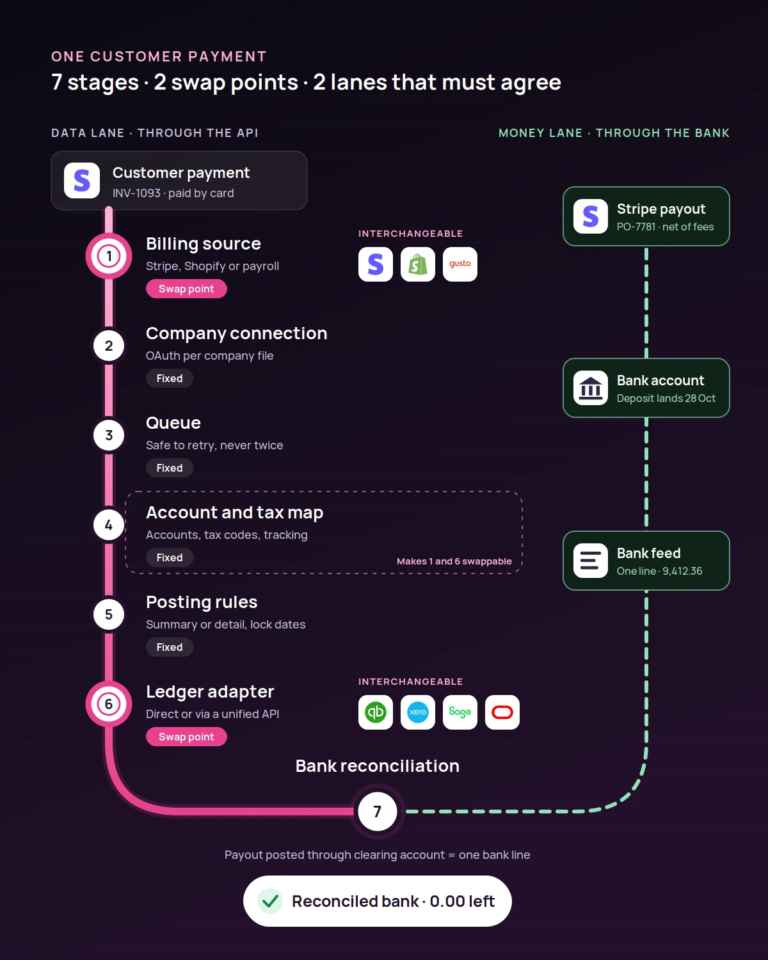
One Customer Payment, Seven Stages – And The Two Places It Can Change

A customer pays an invoice by card, and days later the payout lands in your bank net of fees and refunds. Follow it through all seven stages, from the billing system to a reconciled bank line, then see which two can change without a rebuild. Select any stop.

one customer payment through seven stages, from billing source to ledger adapter, with the bank payout lane joining at bank reconciliation

01. Billing and payment source. Source swap

What happens:
Stripe, Chargebee, Shopify or your own product records the invoice, the payment, the fee and later the payout, each with its own ID and timestamp. Nothing about the accounting platform is known here.

What fails:
A payment event that arrives before the invoice it pays. A partial refund raised against a sale from last month. A payout that bundles charges from two different months.

What can change:
Swap point. Moving from one billing platform to another changes the events coming in, not the accounting rules, because every source maps to the same internal model.

02. Company connection and tokens. Fixed layer

What happens:
Each set of books is a separate company with its own OAuth connection, scopes and refresh token. The integration knows which company file every event belongs to, and notices when someone disconnects it.

What fails:
Two workers refreshing the same token at once, so one invalidates the other. A customer who connects their test company instead of their live one. A connection that lapses after weeks without use and fails silently.

What can change:
Not a swap point. One token store with refresh locking and disconnect alerts serves every platform behind it.

03. Queue and idempotency. Fixed layer

What happens:
Each event lands in a durable queue keyed by its source ID, so a slow or rate-limited accounting API delays a posting rather than losing or duplicating it.

What fails:
A retry after a timeout that creates the same invoice twice. Rate limits hit during a backfill, so live postings stall behind history. A dead-letter queue that nobody reads.

What can change:
Not a swap point. This is what makes retries safe, whichever platform sits downstream.

04. Account and tax mapping. Fixed layer

What happens:
Each event is mapped to a customer record, an income or expense account, a tax code and any tracking category, class or location, using the mapping that company's accountant approved.

What fails:
An account archived by the accountant that the mapping still points to. A tax code that is valid in the UK file but not the Australian one. The same customer created twice because names differ by one character.

What can change:
Not a swap point – this is the layer that makes the others swappable. Every source and every ledger maps to this model, never directly to each other.

05. Posting rules. Fixed layer

What happens:
Decides what each event becomes: an invoice per sale or one summary journal per day, how fees and refunds are booked, which exchange rate applies, and what happens when the target period is locked.

What fails:
A refund dated into a period the accountant has locked, rejected the morning after close. Tax rounded per line in your system and per invoice in the ledger, leaving cents that never reconcile. A foreign-currency payment booked at the wrong date's rate.

What can change:
Rules change when the business does. Holding them here makes a new region or a switch to summary posting a configuration change, not a rewrite.

06. Accounting platform adapter. Ledger swap

What happens:
Writes the result to QuickBooks Online, Xero, Sage Intacct, NetSuite or Business Central, directly or through a unified API, stores the ledger's document ID and writes the status back to the source.

What fails:
A write the ledger accepted but whose response timed out. Read calls spent on polling that now count against a metered API allowance. A field that exists in one platform and not another, such as classes in QuickBooks and tracking categories in Xero.

What can change:
Swap point. Adding Xero next to QuickBooks, or moving from a unified API to a direct one, is a new adapter behind the same contract rather than a new integration.

07. Payout and bank reconciliation. Fixed layer

What happens:
The payout is posted through a clearing account as gross payments minus fees and refunds, so it equals exactly one line in the bank feed. Daily checks compare counts and amounts per company against the ledger.

What fails:
Fees netted off revenue so the payout never matches anything. A chargeback that arrives months after the sale. A dropped posting that nobody notices until the accountant asks why the bank does not reconcile.

What can change:
Tooling. Reconciliation tables and traces are plain data, so the monitoring backend can change without touching a single flow.

Why Choose Teamvoy For Accounting Software Integration?

Eight reasons. The first two cost us something to make, which is why no competitor can copy them by close of business.

The mapping layer is the product.

It keeps your billing platform and your accounting platforms replaceable, one connected company at a time.

  • The engineers named in the proposal write the code.
    Named, with their history, in the contract. No substitution without your written agreement.
    Costs us: it caps how fast we can scale headcount.

  • Finance joins in week one – and you keep the posting rules pack
    Your controller or external accountant reviews the account mapping, tax treatment and clearing accounts before code is written. You keep the mapping, the posting rules and the test evidence, so a change of accountant or auditor does not mean re-explaining the integration.
    Costs us: we decline engagements where nobody from finance will sign off the mapping

  • Tested against a used set of books, not an empty sandbox
    Every flow runs against sandbox companies seeded with the awkward parts: archived accounts, locked periods, foreign-currency customers and partial refunds. An empty sandbox proves the API call works; a used set of books proves the posting does.

  • Baseline before build
    We ask what the number is today and who owns it before we write anything. No baseline, no engagement – because without one the outcome is asserted at the end rather than proven.

  • API costs designed, not discovered
    QuickBooks Online now meters read calls and Xero prices by connections and data volume. We design the sync around webhooks, change tracking and caching, and show you the expected usage profile before go-live, so the platform bill is a forecast rather than a surprise.

  • Built for the person reconciling, not only the engineer
    Every posting carries the source invoice, payment and payout IDs in its reference, so anyone reconciling in Xero or QuickBooks can trace a line back without opening your database. Record-keeping and privacy rules are constraints at mapping time.

  • Full ownership, not staff augmentation.
    We take responsibility for architecture and production behaviour rather than for filling seats. You are not managing our delivery on top of your own.

  • We tell you when a connector or a unified API is enough
    If you need read-only data from many platforms, a unified API such as Codat, Merge or Rutter can ship faster than five direct integrations. If your books only need one daily summary journal, a packaged connector may do. We say so in the audit, while the choice is still cheap.

Accounting Software Integration Success Stories

Integration, fintech and modernization engagements where money movement and the books had to agree on every record.

Related Services

Accounting software integration rarely arrives on its own. These are the engagements that most often sit either side of it.

System Integration

Runs alongside.
When the same payment also has to reach your CRM, support desk and data warehouse, this is the engagement that owns the failure path across every system, not only the books.

Application Modernization

Comes first.
When billing logic lives in an older in-house system that cannot emit a clean event per payment or refund, the accounting side is not the constraint. We open that system up first so the integration has something reliable to post from.

Proof of Concept

Start here if unsure.
Prove one flow, such as payout to bank line, against a sandbox company of your accounting platform before you commit budget to the full integration.

What Our Accounting Software Integration Engineers Work In.

Chosen to fit your accounting platforms, your billing stack and your finance team's way of closing, not our internal preference.

Accounting platforms

Billing, payments and spend

Unified APIs and messaging

Services, data and observability

We engineer for:

GDPR
SOC 2
ISO 27001
PCI DSS (where card data is in scope)
SOX IT general controls (US-listed companies)
Making Tax Digital for VAT (UK)
EN 16931 and Peppol e-invoicing (where mandated)
OAuth 2.0 and OpenID Connect
Intuit and Xero app security reviews (for marketplace listing)
OWASP API Security Top 10
Phase 0 · fixed fee

Accounting integration audit

An inventory of every flow and every connected company, one transaction traced from the billing system to the ledger and the bank line, the current API usage profile, and a baseline of manual reconciliation effort. We map which flows are safe, which duplicate or drop postings, and what has to change before anything new is built.

You leave with: a flow inventory, a risk register, an API cost profile and a captured baseline – yours whether or not we continue.

Phase 1

Posting And Mapping Contract

The mapping layer designed and agreed: posting rules per event, account and tax mapping per region, clearing accounts, lock-date handling and the idempotency matrix, with sandbox companies seeded for testing. Your controller and your architecture lead sign this off before code is written.

You leave with: signed posting rules, a mapping specification and a reconciliation specification your accountant has already reviewed.

Phase 2

Production And Handover

One flow first, usually payment to payout or invoice to ledger: built, replay-tested and released with daily reconciliation running from day one. Further flows and platforms follow the same pattern, and handover completes when your engineers ship a mapping change without us.

You leave with: a live flow that cuts a number finance already tracks, such as unreconciled bank lines, plus code, pipeline, runbooks and the reconciliation pack.

TOPIC
OTHER VENDORS
TEAMVOY
Team
Team assigned after signing.
The engineers named in the proposal build the work.
Ownership
Staff augmentation. You manage delivery.
Full ownership of architecture and production behaviour.
Posting accuracy
Postings sampled after go-live.
Each event type has a signed posting rule and a replay test.
Payout reconciliation
Payouts matched by hand at month-end.
Each payout posts through a clearing account and matches one bank line.
Platform API costs
Usage reviewed when the bill arrives.
Call and data volume modelled before go-live and monitored per company.
Source code
Handed over at the end of the project.
Code, mappings and developer app in your accounts from day one.
Test & evidence
Testing stays with the delivery team.
Seeded sandbox companies, replay tests and posting evidence you can re-run.
Operations
Knowledge held by the delivery team.
Sync health dashboards, token alerts and runbooks your team can use.
Capability transfer
Usually outside the scope.
Named owners and handover sessions, so your engineers can change the system without us.
After the engagement
Quality checks stay with the vendor.
You keep the tests and evidence, so quality stays checkable after we leave.
Fastest way in: book a 30-minute technical call this week.
PREFER email?
Call directly:
Response within one business day.
cto of teamvoy
Bohdan Varshchuk
Chief Technology Officer

Looking For Accounting Integration Engineers?

    FAQ

    Buyer's guide

    Accounting Software Integration: The Details That Change Scope, Price and Risk

    Two quotes for the same QuickBooks or Xero integration can be months of work apart. The difference sits in details most buyers meet only after signing: whose books you post into, how payouts and refunds are booked, what the accounting platform now charges for API use, and who fixes things when a period is locked. This is the checklist we would want in hand if we were buying.

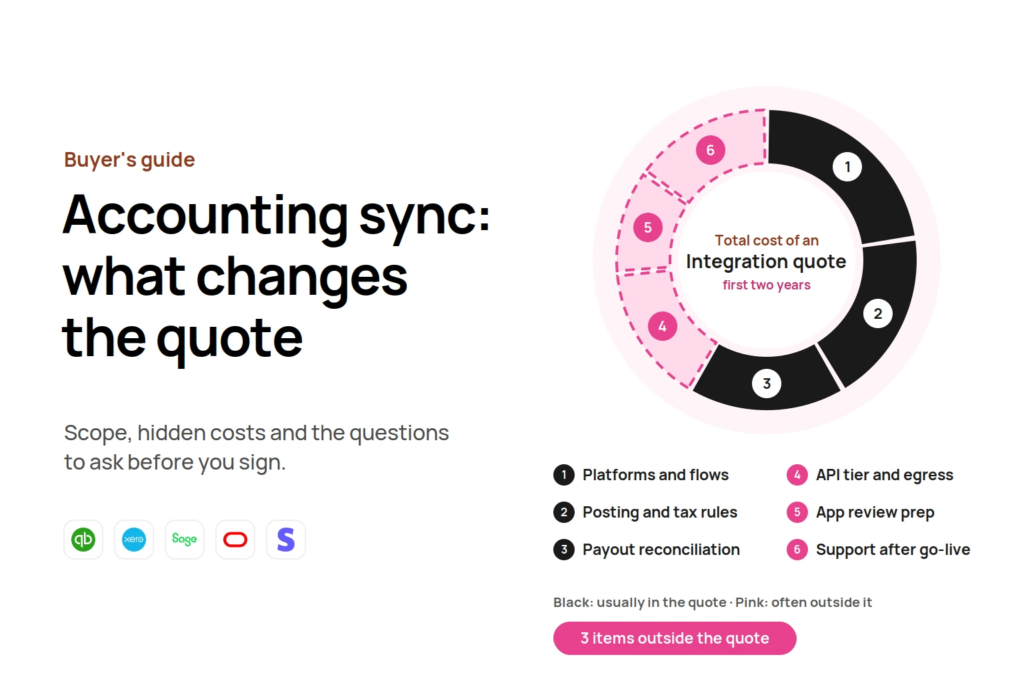
    cost ring of an accounting integration quote, showing three items usually included and three often left out

    1. What should you have ready before asking for quotes?

    Vendors price what you describe. When something is missing, each fills the gap with its own assumption, and the quotes stop being comparable.

    • Every accounting platform in scope, and whether it is your own books or your customers’ books.
    • The events that must post: sales, payments, fees, refunds, payouts, bills, payroll or expenses.
    • Volume on a normal day and on the busiest day, plus the number of connected companies you expect in a year.
    • The regions, currencies and tax regimes involved.
    • Who in finance will approve the mapping and test the postings.

    2. Which details change the scope and the price?

    2.1 Are you posting into your own books or your customers’ books?

    Your own books mean one mapping agreed with one accountant. Your customers’ books mean a connect flow, a mapping screen per customer and support for charts of accounts you have never seen.

    Ask the vendor: Is the customer-facing connect and mapping experience in the quote?

    2.2 Which accounting platforms, and in what order?

    Each platform has its own objects, limits and review process. A second platform is cheaper when the first was built on a shared mapping layer.

    Ask the vendor: What will the second platform cost compared with the first?

    2.3 Should each sale post separately or as a daily summary?

    Detail posting gives a traceable line per invoice but uses more API calls. Summary journals are lighter but harder to drill into.

    Ask the vendor: Which posting style do you recommend for our volume, and why?

    2.4 How are payouts, fees and refunds booked?

    If fees are netted off revenue, the payout never matches the bank line. A clearing account keeps both the revenue and the bank correct.

    Ask the vendor: Show us how one payout will reconcile against the bank feed.

    2.5 How many regions, currencies and tax regimes are involved?

    Each adds tax codes, rounding rules and test cases. Sales tax, VAT and GST behave differently in each platform.

    Ask the vendor: Is every region in scope, or only the first one?

    2.6 Does it need to read data back, or only write?

    Reading balances, payments or reports back from the ledger costs more to build and, on some platforms, more to run.

    Ask the vendor: Which flows read from the ledger, and how often?

    2.7 How much history has to be loaded?

    Loading past invoices and payments is a separate job, with its own reconciliation and its own API usage.

    Ask the vendor: How much history is in scope, and how will it be checked?

    2.8 What happens when the accountant locks a period?

    Late refunds and corrections will be rejected after close. Someone has to decide whether they move to the current period or wait for approval.

    Ask the vendor: How will locked-period rejections be handled and reported?

    3. Which costs often sit outside the quote?

    A quote can be accurate and still leave things out. Check each of these before you compare totals.

    3.1 What will the accounting platform charge for API use?

    Intuit’s App Partner Program meters read calls by tier, and since March 2026 Xero prices developer access by connections and data volume. Both are paid by you, not the vendor.

    Ask the vendor: Which tier will we need at our volume, and what does it cost?

    3.2 Is there a unified API subscription?

    Unified API providers charge their own fees, usually per connection or per call.

    Ask the vendor: What will the unified API cost us in the second year?

    3.3 Who prepares the marketplace listing and security review?

    Listing a native integration means passing the platform’s own review, which takes time and evidence.

    Ask the vendor: Is review preparation included, and how long do you expect it to take?

    3.4 Who supports the integration after go-live?

    Support is usually quoted separately, if at all.

    Ask the vendor: How many weeks are included, and what happens after?

    3.5 Who updates the integration when the platform changes its API?

    Accounting platforms deprecate fields and change limits on their own schedule.

    Ask the vendor: Is platform change tracking part of the build, or a change request each time?

    3.6 How much of your finance team’s time will it take?

    Mapping sign-off and posting tests are internal effort you pay for in time.

    Ask the vendor: How many days will our finance team spend on mapping and testing?

    4. How do you compare providers?

    Most providers can create an invoice through an API. These questions show how each one handles what happens after the first posting.

    4.1 What happens if a write times out after the ledger accepted it?

    A common answer: failed calls are retried. What to look for: every write is safe to repeat, and here is the replay test.

    4.2 How will you know nothing was dropped?

    A common answer: errors appear in the logs. What to look for: daily count and amount checks per connected company, shared with finance.

    4.3 How will one payout reconcile?

    A common answer: the accountant matches it. What to look for: a clearing-account design that makes each payout equal one bank line.

    4.4 Where will the mappings and the developer app live?

    A common answer: in the provider’s account. What to look for: in your repository and your developer accounts.

    4.5 Who made this estimate?

    A common answer: a pre-sales team. What to look for: the engineer who will build it.

    5. What should you clarify before signing?

    • How payouts, fees and refunds will be booked, and who approved it.
    • Acceptance criteria that go beyond the first successful posting.
    • The platform API tier or unified API costs at your expected volume.
    • Whose account holds the code, the mappings and the developer app.
    • How support after go-live and platform API changes are covered.

    6. Where does Teamvoy stand on each of these?

    Our audit marks every item in sections 2 and 3 as included, excluded or provided by you, before any build is priced. You can then compare our proposal with anyone else’s line by line, and nothing turns up later as a surprise change request.
    Your Next Move

    Bring this checklist to a 30-minute call and we will fill it in for your stack.

    Book a Call

    Our Insights

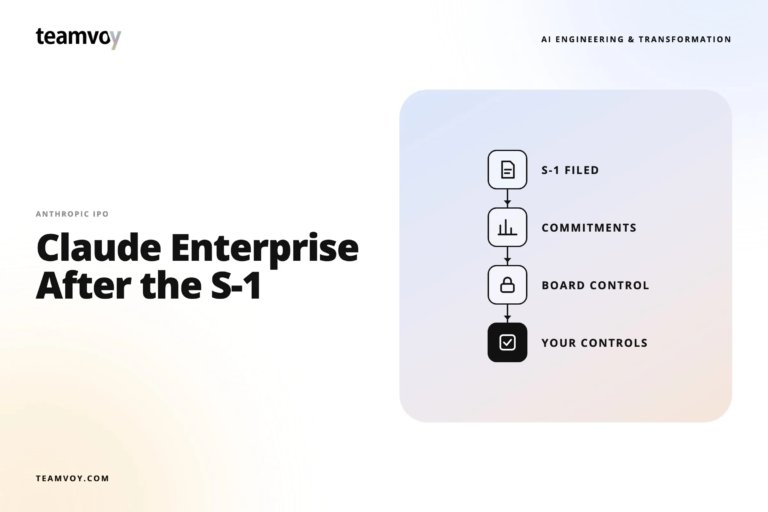
    hero image for teamvoy article: headline 'claude enterprise after the s-1' with 'anthropic ipo' label, teamvoy logo at top left and gradient infographic on the right.
    AI, AI Agents
    Claude Enterprise: What Anthropic’s S-1 Changes for Your Vendor Risk
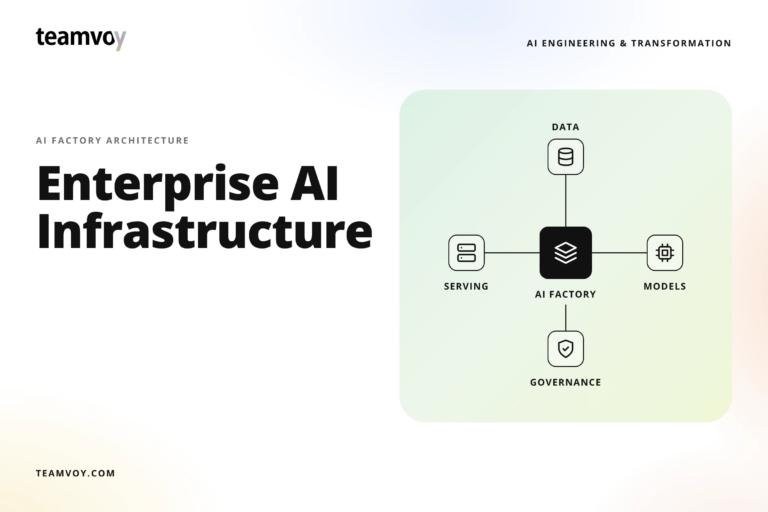
    teamvoy hero banner reading 'enterprise ai infrastructure' with a right-side rounded diagram illustrating data, ai factory components, and governance.
    AI, AI Agents
    Enterprise AI Infrastructure: AI Factory Architecture Guide
    split-screen hero: left column shows teamvoy logo and bold headline 'llama 5: is it released?'; right column features a rounded-purple card with a vertical flow of ai model icons (llama 4, muse spark, muse wonder, muse ember).
    AI, AI Agents, LLMOps
    Llama 5: Is It Released? What Meta Shipped Instead