

- Llama 5 doesn't exist as an announced product. As of November 13, 2026, no official Meta source we reviewed names it, dates it, or lists it as a model. Google's results for the query say otherwise: at least two ranking pages assert an April 8, 2026 launch with invented benchmark numbers, and the AI Overview cites release-date speculation instead of Meta.
- Meanwhile, Meta did ship six dated model and agent releases this year under a different brand, and the newest open-weight one ships with a license clause your legal team should read before any production deployment.
Your platform team has a model decision queued behind one question: wait for Llama 5, or build on what Meta already ships. Search results say the model launched in April with benchmark scores. Meta’s own newsroom says something different. Which sources can you trust when you pick a model for a workflow that has to survive the next roadmap change?
Is Llama 5 released?
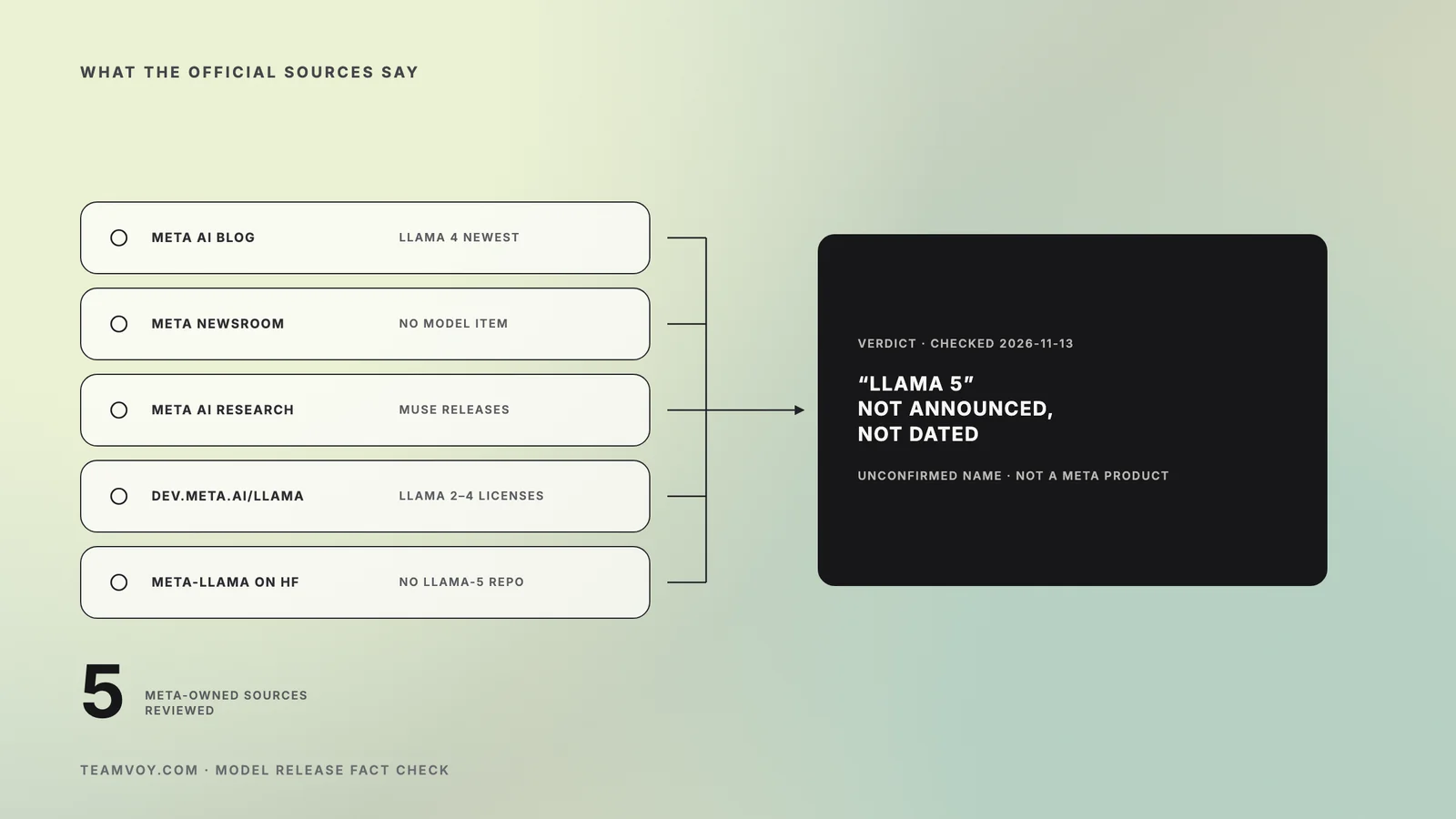
No. As of November 13, 2026, Meta has not announced, dated, or released a model called Llama 5 in any official source this research reviewed: the Meta AI blog, the Meta Newsroom, Meta AI Research, the developer portal, and the meta-llama organization on Hugging Face. The newest Llama generation Meta lists is Llama 4.
That’s negative evidence, and it has limits. Absence of an announcement tells you nothing about Meta’s private roadmap. It does tell you what you can build on today, which is the decision that matters.
The evidence trail, all retrieved on 2026-11-13:
- Meta’s developer portal at dev.meta.ai/llama lists Llama 4 as the current generation, with a license and use-policy index for Llama 2 through Llama 4.
- The portal’s “Models” navigation lists only Muse-branded models (Muse Wonder, Spark 1.1–1.3, Ember, Spark Open, Glimmer, Image, Voice Transcribe) plus SAM 3.1. No fifth-generation Llama is in the list.
- The Hugging Face meta-llama organization shows Llama-4-Scout-17B-16E-Instruct and Llama-4-Maverick-17B-128E-Instruct as its newest Llama repositories. There’s no Llama-5* repository.
- The Meta Newsroom November 2026 archive carries no model announcement on November 12; that day’s item is a data-center supply-chain story.
If you’re asking “is Llama 5 out” because a vendor pitch or a search snippet said so, the answer from Meta-owned sources is that nothing has shipped under that name. Re-check those four sources before you cite this page in a planning document; this is a fact with a date, not a permanent state.
Why do search results say Llama 5 launched on April 8, 2026?
Because at least two pages ranking for the query published it, and one of them still does. The claim that Llama 5 shipped on April 8, 2026 with benchmark scores is false. April 8, 2026 is the date Meta Superintelligence Labs introduced Muse Spark, “the first in a new series of large language models.” Meta used the Muse name, and published no benchmarks under any Llama 5 label.
The contamination pattern is specific enough to name:
- One competitor page (RAGyfied) published “Llama 5 released April 8, 2026,” then issued a correction notice on 2026-10-29.
- A second page (startuphub.ai) still asserted the April 8 launch with benchmark figures when captured in the Ahrefs US SERP on 2026-11-09. No Meta source supports those figures, so we won’t repeat them here.
- The AI Overview for llama 5 cited a release-date prediction article dated 2026-09-01 and a YouTube video about a leaked “Meta Avocado” model, per the same Ahrefs SERP capture on 2026-11-09.
The “Avocado” thread deserves one sentence and no more. Secondary reporting and YouTube commentary link that codename to what became Muse Spark; Meta has never applied a fifth-generation Llama name to it, so treating “Avocado equals Llama 5” as fact is an inference, not a release.
The practical takeaway: when a model name shows up in a search snippet, an AI Overview, or an LLM answer, trace it to a dated first-party page before it enters an architecture doc. This query is a worked example of why.
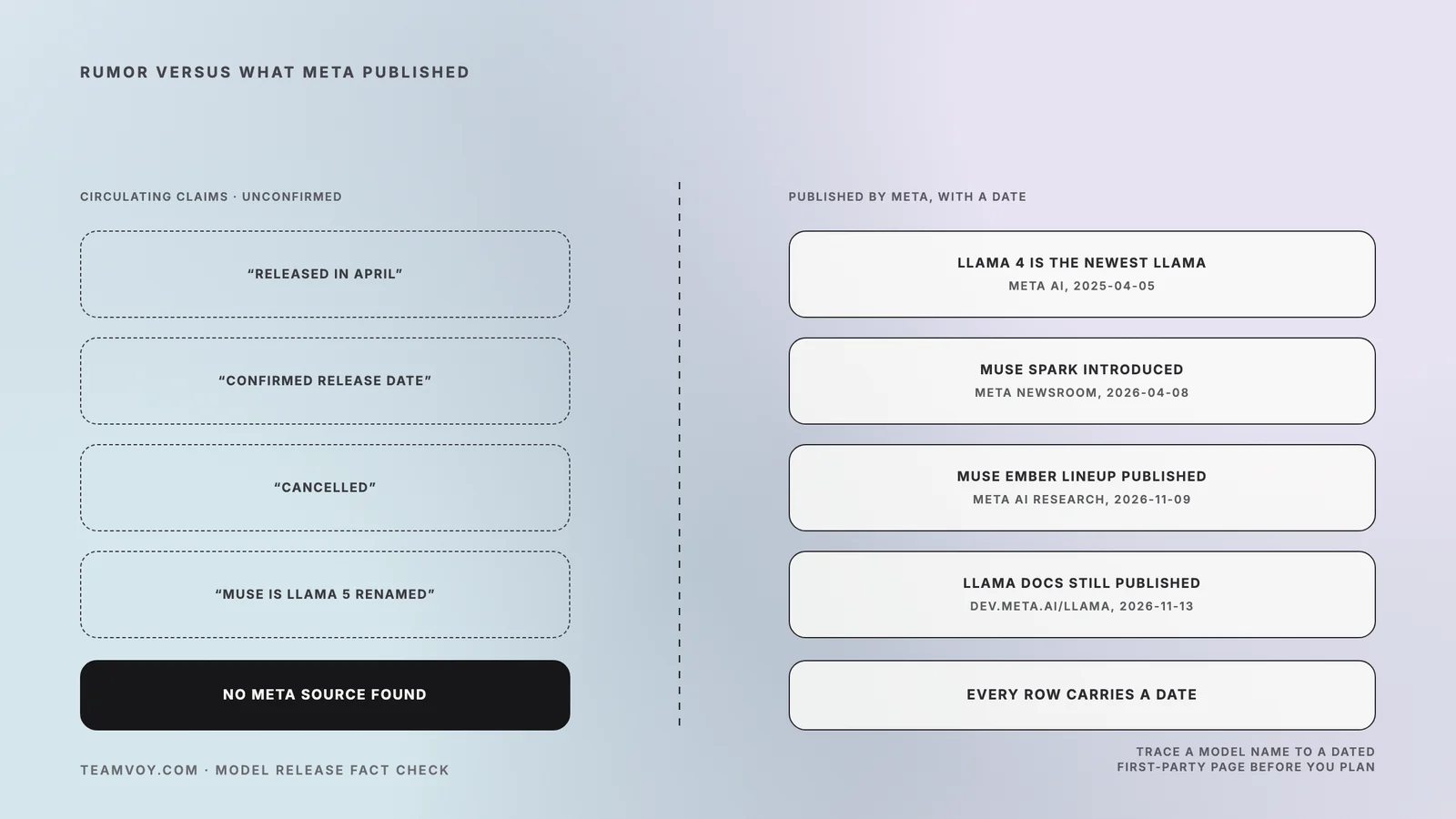
Which Llama 5 claims are confirmed and which are rumor?
Every circulating claim here fails the same test: none appears in a Meta-owned source. The table below separates what the SERP, autocomplete, and forums say from what Meta has published. Use the “safe wording” column verbatim in internal briefs so the uncertainty survives the summary.
| Claim or search pattern | Verdict | Safe wording |
| “Llama 5 is released.” | Unsupported. No official Meta announcement found. | “As of November 13, 2026, Meta has not officially announced or released Llama 5 in the sources reviewed.” |
| “Llama 5 has a confirmed release date.” | Unsupported. Search results include speculative release-date pages. | “There is no confirmed Llama 5 release date in Meta-owned sources.” |
| “Llama 5 was canceled.” | Unsupported. llama 5 cancelled appears in Google autocomplete (captured 2026-11-13), not in official evidence. | “Cancellation claims are unconfirmed.” |
| “Muse replaced Llama.” | Unsupported and risky. Meta doesn’t make this claim; press outlets do. | “Meta is operating Muse alongside its Llama developer ecosystem; the long-term relationship is not explicitly defined.” |
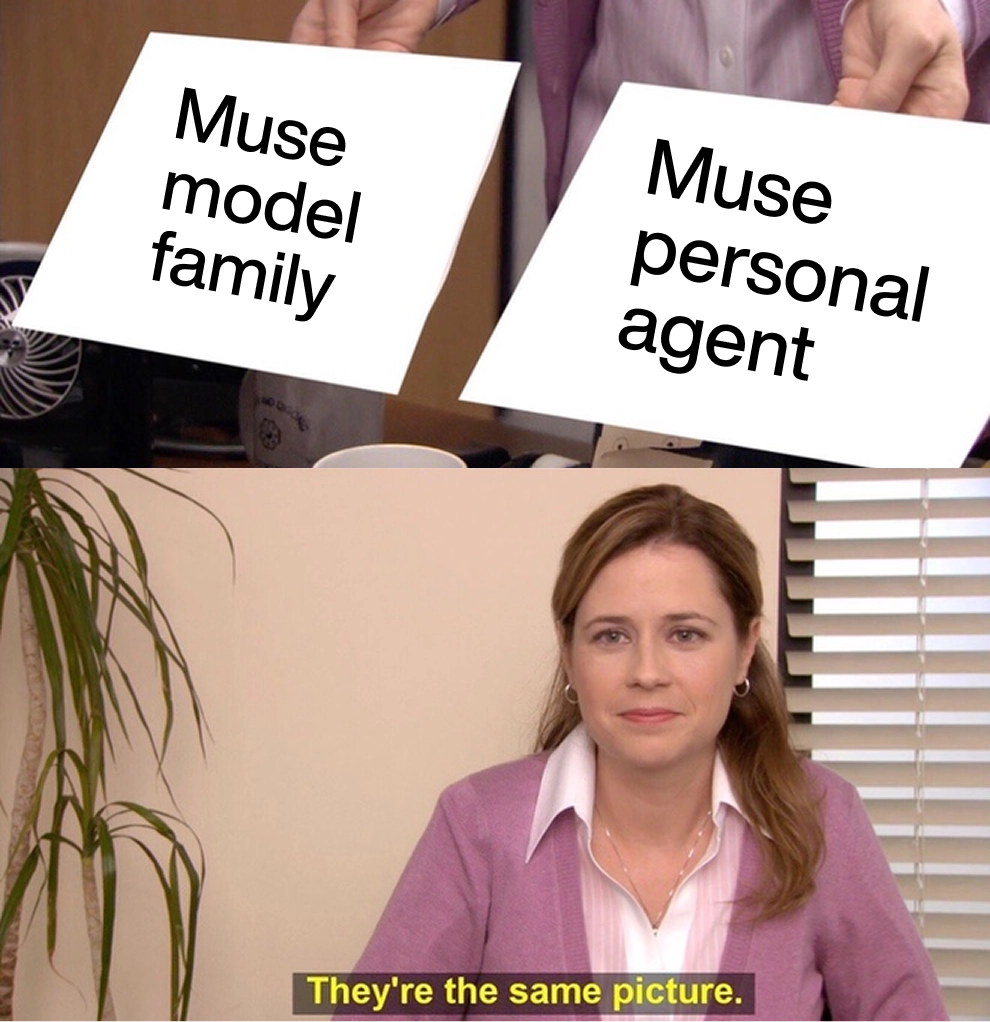
| “Muse means one product.” | False simplification. Meta uses the name for a model family and a personal agent. | Define “Muse model family” and “Muse personal agent” separately. |
| “Muse Spark is open source.” | Needs qualification. Hosted Muse Spark is proprietary; Muse Spark Open is open-weight under the Muse Model License. | “Muse Spark Open is an open-weight model under the Muse Model License.” |
| “The Llama API is gone.” | Unsupported. Official developer and SDK surfaces remain live. | “Check current Meta Model API / Llama API naming and availability before implementation.” |
| “Muse Spark is Llama 5 / Avocado became Llama 5.” | Inference only. Secondary reporting links the codename to Muse Spark; Meta has never used the Llama 5 name. | Mention the rumor once, label it as reporting, and keep it out of headlines and schema. |
What is the latest official Llama model?
Llama 4 is the newest Llama generation Meta has published. Meta announced Llama 4 Scout and Llama 4 Maverick on April 5, 2025 as “the first open-weight natively multimodal models with unprecedented context length support,” and made both available for download on llama.com and Hugging Face the same day. Nineteen months later, no numbered Llama generation has followed it in any Meta-owned source.
The three models Meta described in that announcement:
| Model | Architecture (per Meta, 2025-04-05) | Status at announcement |
| Llama 4 Scout | 17B active parameters, 16 experts; fits one H100 GPU with Int4 quantization | Downloadable |
| Llama 4 Maverick | 17B active parameters, 128 experts; fits one H100 host | Downloadable |
| Llama 4 Behemoth | 288B active parameters, 16 experts, nearly 2T total; teacher model | “Still training” |
Two things changed around the Llama brand since then, and neither is a new numbered Llama release. First, llama.com, llama.com/products/llama-api/, and llama.com/docs/overview/ now return HTTP 301 to dev.meta.ai, whose hero reads “Your next build starts with Muse” and whose developer product is the Meta Model API (retrieved 2026-11-13). Second, the Llama section survives at dev.meta.ai/llama with Llama 4 docs, cookbooks, and licenses, and the official llama-api-python repository is still live. Meta’s developer marketing has moved to the Muse brand; the Llama ecosystem remains published. Those are different facts, and the second one is the one that affects your deployments.
What has Meta released instead of Llama 5?
Meta shipped a new model family called Muse, plus a consumer agent of the same name, in six dated releases between April and November 2026. Each one is documented on a Meta-owned page. None of them carries a Llama number, and none of the announcements states that Muse succeeds or retires Llama.
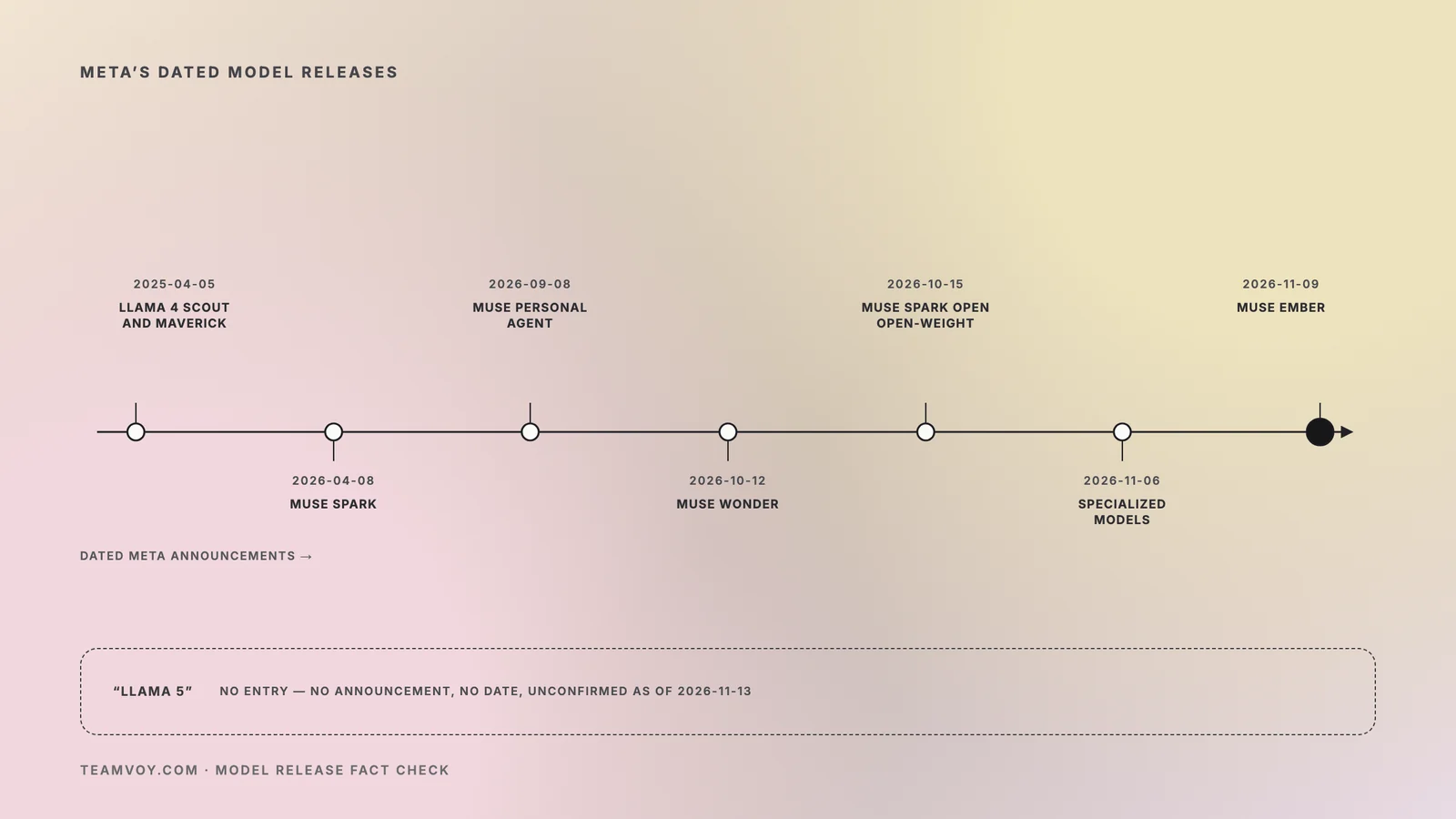
| Date | Official release | What Meta said | Source |
| 2025-04-05 | Llama 4 Scout and Maverick | First open-weight natively multimodal Llama models; Behemoth still training. | Meta AI |
| 2026-04-08 | Muse Spark | “The first in a new series of large language models built by Meta Superintelligence Labs.” Proprietary; private API preview for select partners. Announcement updated 2026-05-12. | Meta Newsroom |
| 2026-09-08 | Muse (personal agent) | “A secure, private personal AI agent” running on Muse Secure VM, powered by Muse Spark. | Meta Newsroom |
| 2026-10-12 | Muse Wonder and Muse Wonder Full | “Our most capable models to date,” with Active Memory and Active Focus. Wonder via Meta Model API and Muse Code; Wonder Full for Muse Code subscribers. | Meta Newsroom |
| 2026-10-15 | Muse Spark Open | Open-weight, 816B total / 42B active parameters, 1M-token context, released under the Muse Model License. | Meta AI Research |
| 2026-11-06 | Specialized models for Muse and Meta AI | Muse and Meta AI now run on specialized models trained using Muse Wonder. | Meta AI Research |
| 2026-11-09 | Muse Ember (muse-ember-1.0) | Smallest Muse model, $0.10 per million input tokens, $0.50 per million output tokens, 1M-token context. Lineup described as Wonder / Spark / Ember. | Meta AI Research |
Two dated entries sit outside this table on purpose. Muse Glimmer, a 30B-parameter open model under Apache 2.0 that runs on a single GPU, appears on dev.meta.ai without a date; TechCrunch dates it to August 2026 in its Ember coverage (2026-11-09).
What the lineup is for, in Meta’s own framing from the Ember announcement (2026-11-09): Muse Wonder for the hardest problems, Muse Spark for coding and agentic workflows, and Muse Ember for repeatable coding and agentic tasks at scale. That’s a tiered routing portfolio, and Meta’s November 6 note that its own consumer products now run on specialized models trained from Wonder confirms Meta is routing by task internally. Enterprise teams that have been building model routers for two years will recognize the pattern.
If you came here for a Llama 5 release date, this table is the honest substitute: a dated record of what shipped, from the company that would announce it if it existed.
Did Meta Muse replace Llama?
Meta hasn’t said so. The Muse Spark announcement on April 8, 2026 describes Muse as “a new series” with a scaling approach “where each generation validates and builds on the last.” It doesn’t mention retiring Llama, deprecating Llama, or renaming the Llama roadmap. The Llama docs, licenses, weights, and API SDK were all still published on 2026-11-13.
The “clean break” framing you’ll see in coverage comes from the press, specifically Ars Technica and CNBC, and it’s their interpretation of a proprietary launch from a lab whose previous flagship line was open-weight. It’s a reasonable reading. It’s still not a Meta statement, and the difference matters when you’re writing a vendor-risk assessment that someone will audit.
What Meta’s own behavior supports, retrieved 2026-11-13:
- Developer marketing has moved to Muse. The llama.com domain redirects to dev.meta.ai, and the hero copy there sells Muse models on the Meta Model API.
- The Llama ecosystem remains published. dev.meta.ai/llama lists Llama 4 as the newest generation with full licenses and use policies back to Llama 2.
- Meta’s open-weight releases in 2026 carry the Muse name (Spark Open, Glimmer), not a Llama number.
The precise statement for your docs: Meta is operating Muse alongside its Llama developer ecosystem, and the long-term relationship between the two isn’t explicitly defined. Anyone who tells you Meta Muse is “meta llama 5 under a new name” is guessing, and so is anyone who tells you the Llama line is finished.
One naming trap to avoid in every heading and schema description: Muse is both the model family (Spark, Wonder, Ember, Spark Open, Glimmer) and the consumer personal agent launched September 8, 2026. Say which one you mean.
Is Muse Spark Open open source?
Muse Spark Open is open-weight, not open source in the OSI sense. Meta released the weights on October 15, 2026 “under the Muse Model License with limited commercial terms, which allow many developers to use the model for free.” The two terms that matter for an enterprise are an attribution requirement and a separate agreement required for model-as-a-service businesses above $20M in revenue, per the Hugging Face model card and license (2026-10-15).
Model facts from the same announcement: 816B total parameters, 42B active, natively multimodal, 1M-token context window, built for coding and agentic work. Meta’s model page adds that it’s derived from the hosted Muse Spark model with additional safety post-training for use without system guardrails, and that you can serve it with SGLang, vLLM, or Apple MLX, or fine-tune it.
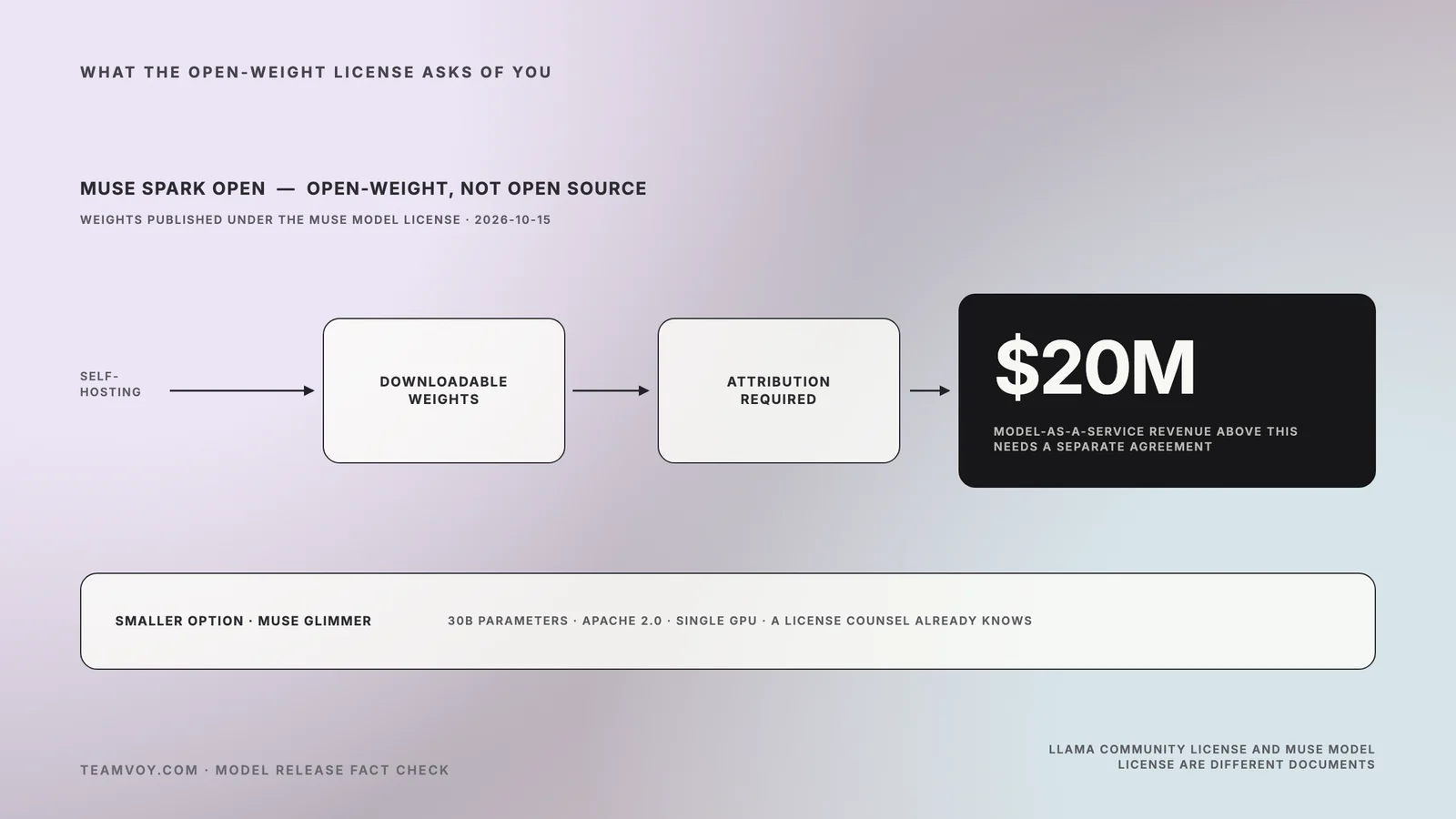
Why the distinction is worth a paragraph here: Llama’s identity was open weights under the Llama Community License, and teams that standardized on Llama 4 for self-hosting have a license register to update, not a drop-in successor. The Muse Model License is a different document with different triggers. Before you fine-tune Spark Open or route production traffic to a self-hosted copy, have legal and engineering read the license together. [VERIFY: current license text at publication]
Smaller option: Muse Glimmer is 30B parameters under Apache 2.0, runs on a single GPU, and is tuned for tool use, long tasks, and failure recovery, per dev.meta.ai (retrieved 2026-11-13). Apache 2.0 is a license your counsel already knows, which is a practical reason it may be the first Muse model a regulated team can approve.
What should enterprise teams do while the Llama 5 roadmap stays unconfirmed?
Stop waiting for a model that no Meta source has announced, and build so the next announcement is a config change rather than a rewrite. The decision isn’t “Llama 5 or Muse.” It’s whether your product can switch between Llama 4, a Muse model, or a non-Meta model without a sprint of rework, a license surprise, or a quality regression nobody measured.
The 2026 record is the argument. Between April and November, Meta shipped one proprietary flagship, a consumer agent, a frontier tier, an open-weight 816B model with a new license, a routing change in its own products, and a $0.10-per-million-token small model. A team that hard-coded one endpoint in April absorbed every one of those as unplanned work.
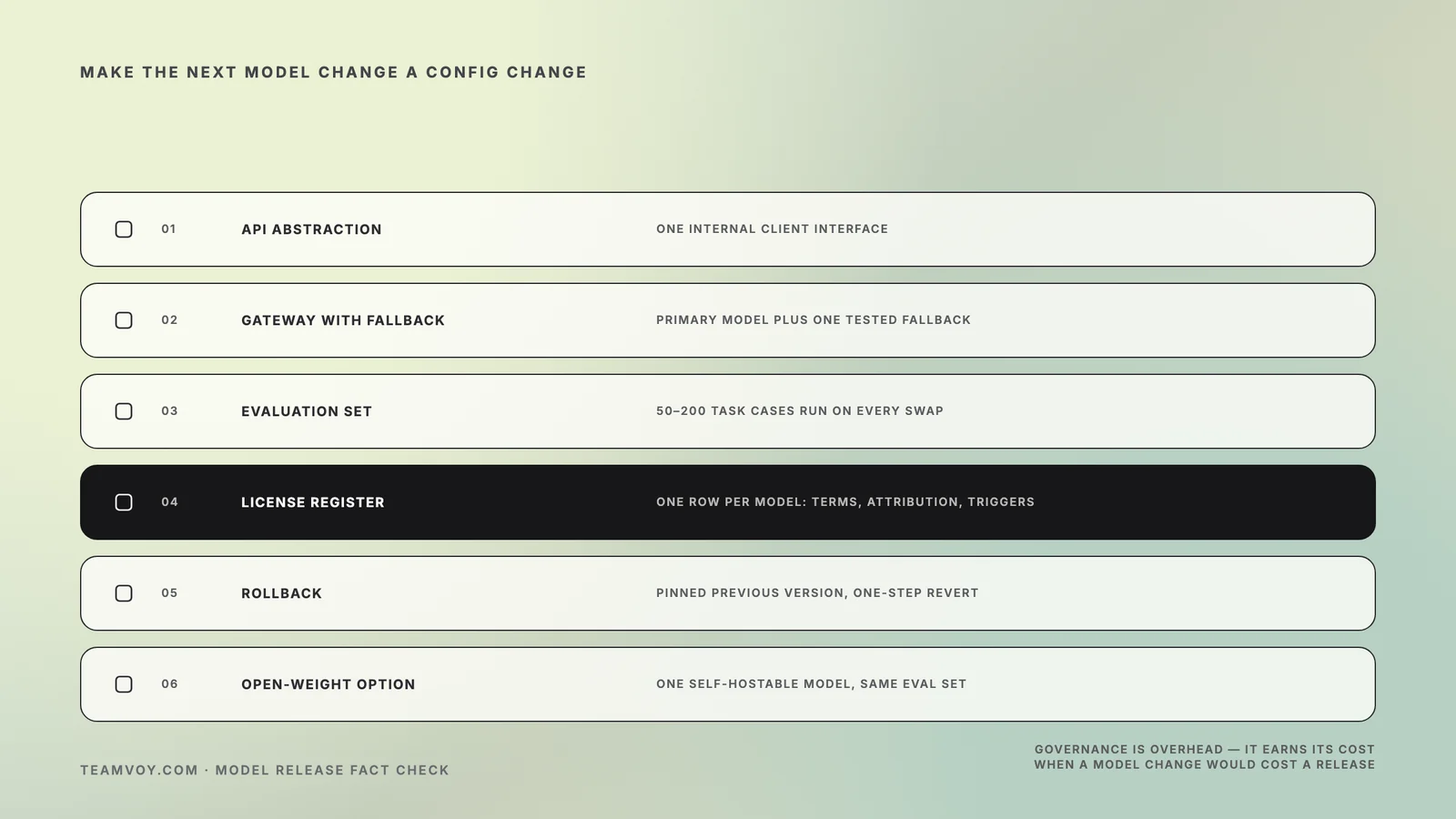
A model-portfolio checklist that fits on one page:
| Control | What it protects against | Minimum version |
| API abstraction | Provider-specific SDK calls scattered through product code | One internal client interface; the Meta Model API’s OpenAI-SDK compatibility makes this cheap, per dev.meta.ai (2026-11-13) |
| Gateway with fallback | A single endpoint change or outage becoming a product outage | Primary model plus one tested fallback; compare options in our LLM gateway platforms guide |
| Evaluation set | Silent quality drift when a model version changes | 50–200 task-specific cases run on every model swap |
| License register | Deploying weights whose terms changed (Llama Community License vs. Muse Model License vs. Apache 2.0) | One row per model with license, version, attribution duty, and revenue triggers |
| Rollback | A new model passing evals but failing in production | Pinned previous model version and a one-step revert; see AI agent deployment best practices |
| Local or open-weight option | Hosted-only dependency on one vendor’s pricing and roadmap | One self-hostable model qualified on the same eval set; our fine-tuning LLM services guide covers when customization is worth it |
The trade-off, stated against our own interest: multi-model governance is operational overhead. A gateway adds latency, an evaluation set has to be maintained, and a license register is a document someone owns forever. If you run one stable model with low exposure to roadmap changes, you don’t need a gateway yet, and you shouldn’t hire anyone, including Teamvoy, to build one. The checklist earns its cost when a model change would otherwise cost you a release.
A second trade-off cuts the other way. Pinning Llama 4 for stability means accepting a model generation that’s nineteen months old and a brand whose marketing has moved elsewhere. Pinning a Muse model means accepting a proprietary API (Spark, Wonder, Ember) or a new license (Spark Open) from a lab that shipped six releases in seven months. Either choice is defensible; neither is free. Pick one on your eval set, and keep the other qualified.
Conclusion
Llama 5 is an unanswered question that the web has answered wrongly, and the cost of repeating that error lands on the team that plans around it. Meta’s dated record through November 13, 2026 shows Llama 4 as the newest Llama generation and six Muse releases, from Spark in April to Ember in November, with no statement that one line replaces the other. Build for that ambiguity: abstract the API, keep one tested fallback, run evals on every swap, track licenses by name, and keep a self-hostable model qualified. Then whatever Meta announces next, including a real fifth-generation Llama, is a line in a config file.
Talk to Teamvoy About Model Portfolio Governance
If a Meta roadmap change would cost your product a release, that’s the problem to fix now, before the next announcement. Teamvoy’s AI engineers review model access, routing, evaluation, licensing, and rollback for teams that need to switch between Llama, Muse, and non-Meta models without a rewrite. Talk to Teamvoy about AI development services.