






























1. What should you have ready before asking for quotes?
Vendors price what you describe. A demo on three clean sample orders tells you little; each vendor fills the gaps with its own assumptions, and the quotes stop being comparable.
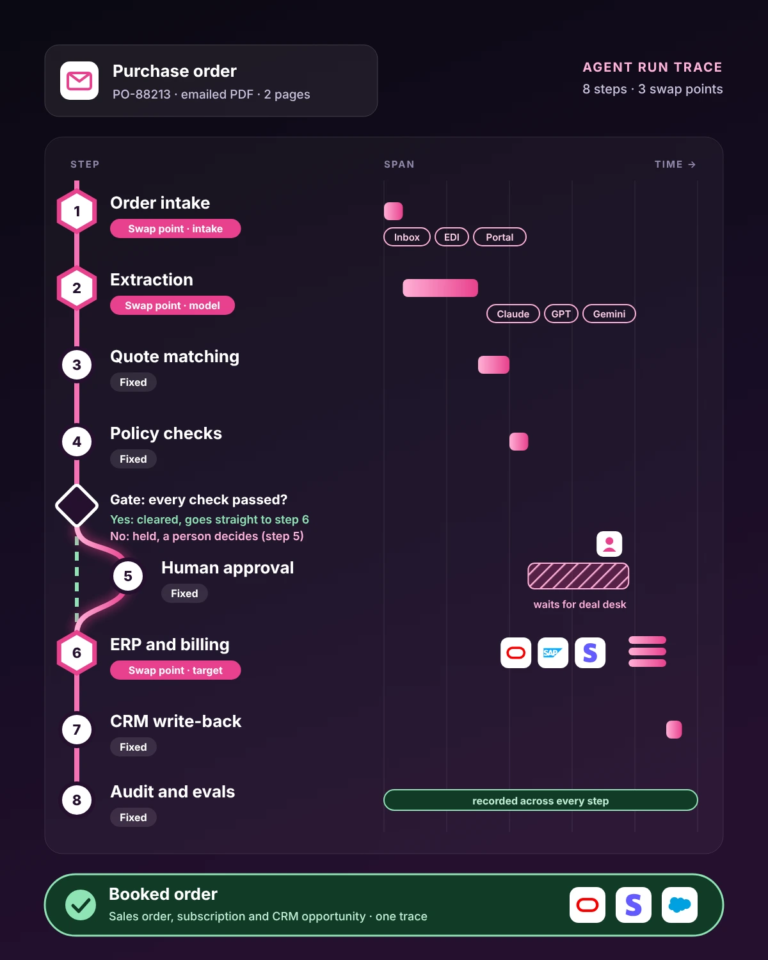
- Every channel orders arrive through – emailed PDFs, EDI, customer portals, CPQ – and the rough volume of each on a normal day and at quarter-end.
- A sample of real orders, including the awkward ones: scans, revised POs, renewals with add-ons and orders that quote an old price.
- Which system holds the price truth: the quote, the price book or the contract.
- The exceptions your team handles today and who decides each one.
- Who in finance and security will agree the approval thresholds and test the results.
2. Which details change the scope and the price?
2.1 How do your orders arrive?
Orders created in CPQ are already structured; PDFs, scans and free-text emails need extraction, evaluation and a review path, which is most of the engineering.
Ask the vendor: Which of our order channels does your estimate cover?
2.2 How many order types do you handle?
New orders, renewals, amendments, co-terms and cancellations each need their own checks. Co-termed renewals are the classic trap, because the prorated total rarely matches the PO.
Ask the vendor: Which order types are in scope for the first release?
2.3 Where does the correct price come from?
If quotes, price books and contracts disagree, the agent needs a rule for which one wins, and someone has to own that rule.
Ask the vendor: How will the agent decide which price is correct when two sources disagree?
2.4 How many systems does one order write to?
An order that creates a sales order, a subscription and a CRM update needs an order of writes and a plan for when the second one fails.
Ask the vendor: What happens to the ERP order if the billing write is rejected?
2.5 What may the agent do without a person?
Drafting orders for review is a smaller build than booking them, which needs controls finance will sign off and audit can test.
Ask the vendor: Which orders will the agent book on its own, and who sets that threshold?
2.6 How many legal entities, currencies and tax setups are involved?
Each entity adds price books, tax rules and approval paths. Customers ordering through a subsidiary are a common source of misbooked orders.
Ask the vendor: How does the agent decide which entity books the order?
2.7 Do your customers send their own terms with the PO?
Many purchase orders carry the buyer’s terms and conditions on a later page, which can conflict with yours on payment terms or liability.
Ask the vendor: Does the agent flag conflicting customer terms, or ignore them?
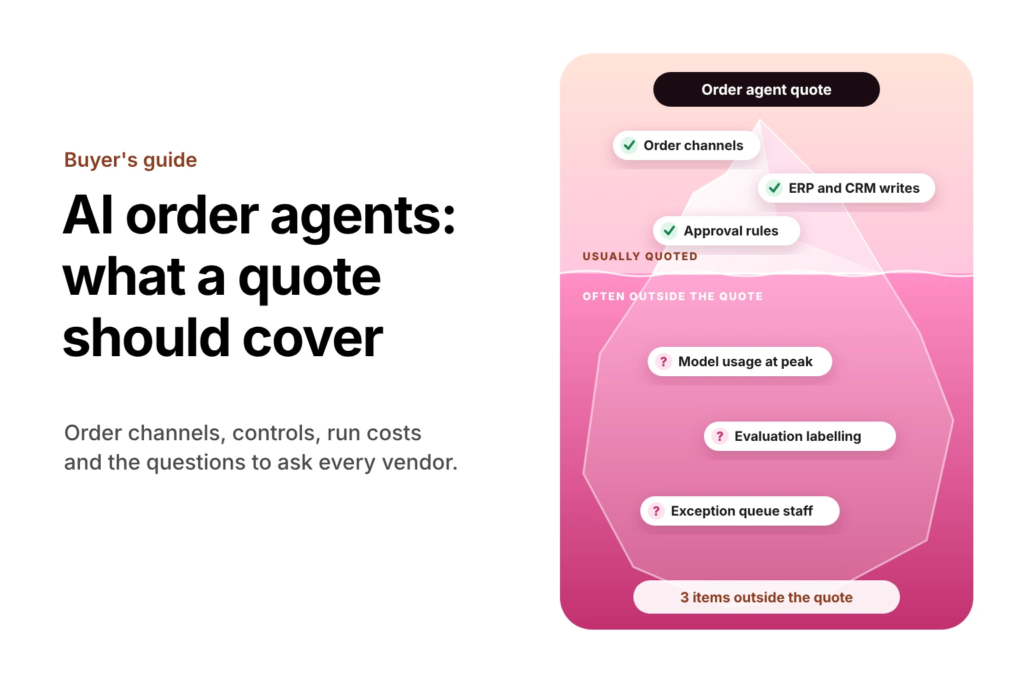
3. Which costs often sit outside the quote?
A quote can be accurate and still leave things out, like a videographer who prices the shoot but not the script. Check each of these.
3.1 What will model usage cost in your busiest week?
Model providers charge by usage, so long multi-page POs, retries and quarter-end peaks drive the bill, not the average day.
Ask the vendor: What is the model cost per order, and at our peak volume?
3.2 Will the agent fit inside your CRM and ERP API allowances?
Salesforce counts every integration in the org against one rolling 24-hour API allowance. NetSuite has an account-level concurrency limit that integrations share unless an administrator allocates part of it to each one.
Ask the vendor: How many calls will the agent add at month-end, and what else already uses that allowance?
3.3 Who labels the orders the agent is tested on?
An evaluation set needs someone who knows your orders to mark the correct answer for each field. That is usually your order operations team’s time.
Ask the vendor: How many orders need labelling, and how many hours of our team’s time is that?
3.4 Who works the exception queue after go-live?
Held orders still need a person. If nobody owns the queue, orders wait and customers notice.
Ask the vendor: Who reviews held orders, and how quickly?
3.5 Who re-tests when the model provider changes or retires a version?
Providers update and retire model versions on their own schedule, and each change can shift accuracy.
Ask the vendor: Is re-evaluation after a model change part of support, or billed each time?
3.6 Who supports the agent after go-live?
Support, monitoring and on-call are often quoted separately, if at all.
Ask the vendor: How many weeks of support are included, and what happens after?
4. How do you compare providers?
Most providers can show an agent reading a clean purchase order. These questions show how each one handles the orders that are not clean.
4.1 How is an extracted order checked before it is booked?
A common answer: the model is instructed to be careful. What to look for: a typed schema and policy rules in code that every order must pass, with the failing case shown.
4.2 What happens when the PO price differs from the quote?
A common answer: the agent uses the PO price. What to look for: the order is held for a named approver with the variance and the source page attached.
4.3 How did you measure accuracy?
A common answer: on a set of sample documents. What to look for: on a labelled set of your own orders, reported per field and per order type, with the number of orders stated.
4.4 Where will prompts, rules and evaluation sets live?
A common answer: inside the provider’s platform. What to look for: in your repository and your accounts.
4.5 Who made this estimate?
A common answer: a pre-sales team. What to look for: the engineer who will build it.
5. What should you clarify before signing?
- Which order channels and order types are in the first release, and which come later.
- Acceptance criteria based on accuracy on your own labelled orders, not on a demo.
- The approval thresholds, who owns them, and how they are changed.
- Model usage, API allowances, evaluation labelling and exception queue staffing, with who pays for each.
- Whose accounts hold the code, prompts, evaluation sets, traces and model provider keys.
6. Where does Teamvoy stand on each of these?
Our order automation audit marks every item in sections 2 and 3 as included, excluded or provided by you, before any build is priced. You can then compare our proposal with anyone else’s line by line, and nothing turns up later as a surprise change request.