AI Credit Scoring & Decisioning Development
We build the layer between your origination system and your core: feature computation, model inference, policy rules, reason codes and the decision log. It runs against your bureau feeds, your open banking data and your existing ledger rather than replacing them.
Trusted by teams at:


Teamvoy has delivered engineering work for 150+ companies.

Verified B2B client reviews from fintech, insurance, healthcare, and hi-tech engagements.

A B2B review platform that connects businesses with verified software solutions providers.

Transparent platform where current and former employees share company reviews and interview experiences.
AI Credit Scoring & Decisioning Success Stories
Check out our product and experience design case studies. Learn how we’ve helped businesses like yours launch stunning solutions and succeed in target markets.



One credit application, seven layers
An applicant sees one submit button. Behind it are seven handovers, and each one has a way of failing that a demo never shows.

01. Intake and identity resolution
The application arrives from your origination system, a broker API or your own form, and is resolved to one applicant against records you already hold.
Breaks when: the same person applies through two channels under two spellings within the hour, and each application is scored as a new customer with its own limit.
02. Bureau and open banking retrieval
Bureau data and, where consent exists, categorized bank transactions are pulled with timeouts and a declared fallback for a thin or missing file.
Breaks when: the bureau times out, the fallback path scores a different feature set than the one the model was validated on, and nothing in the log says which path ran.
03. Feature computation
Affordability, income, utilization and behavioural features are computed from the same definitions used in training, in a store both paths read.
Breaks when: a feature is built from data that landed after the decision timestamp, so the backtest looks better than production and nobody can find the gap.
04. Model inference
The scorecard and its challenger score the application, with the model version stamped on the result before anything downstream reads it.
Breaks when: a category appears in production that never appeared in training, a new employment type or a new merchant class, and the encoder quietly maps it to the mean.
05. Policy and decision
The score meets hard policy: affordability rules, exposure caps, exclusion lists and sanctions holds, producing approve, refer or decline with a limit and a price.
Breaks when: policy and model ship in separate releases, the approval rate moves, and no one can say which change moved it.
06. Reason codes and adverse action
Declines and referrals carry principal reason codes derived from the scoring artifact and mapped to the wording your regulator expects.
Breaks when: reasons come from a separate explanation model run after the decision, so what the applicant is told does not reconcile with the score that produced the outcome.
07. Write-back, capture and monitoring
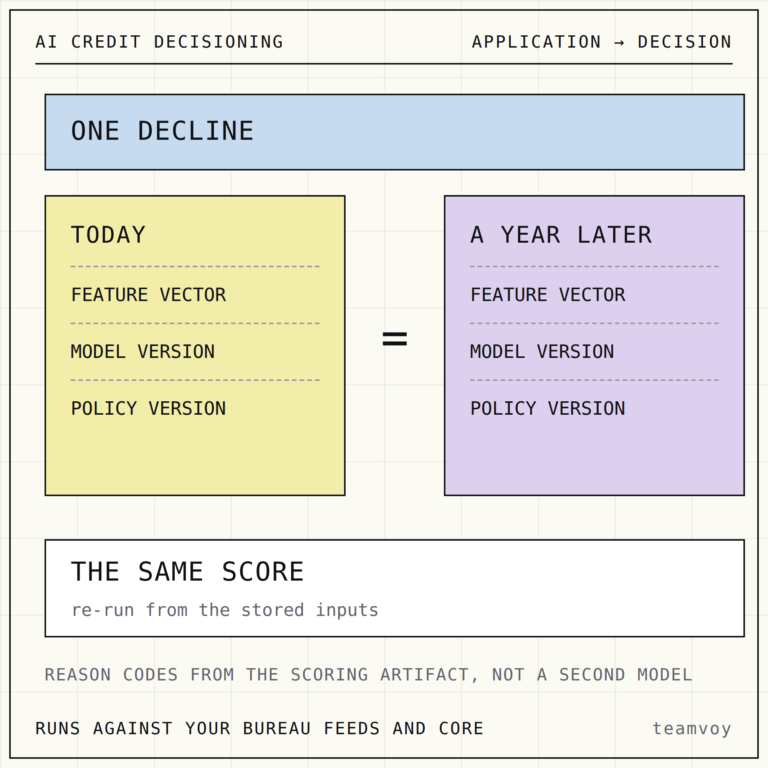
The decision, the feature vector, the model version and the policy version are written to the origination system and to an append-only decision log, then monitored for drift and outcome.
Breaks when: only the outcome is stored, and a year later the model risk team asks why this applicant was declined and the answer has to be reconstructed by hand.

-
The engineers who scope the work build the work
No handover from a pre-sales team to a delivery team. The person who tells you what the work will cost is the person who then has to make that estimate true. Costs us: we cannot start faster than we can staff, so we turn down work that needs a squad this month.
-
You own the source code from the first commit
The repository is yours, in your organisation, from day one. Not transferred at the end, not held until the final invoice clears. Costs us: we give up the lock-in that comes from holding a repository, so we have to be re-chosen every quarter.
-
Every live decision can be re-run and produce the same score.
The feature vector, the model version and the policy version are written alongside the outcome, so a decision from last year is replayed rather than reconstructed. That is what a model validator, an ombudsman or an applicant exercising Article 22 rights is actually asking for. Costs us: the decision log and its retention are built before the first live decision, so our first release is slower than a proof of concept.
-
We will not ship a model we cannot explain to your credit committee.
Where reason codes have to trace back to the scoring artifact, we fit monotonic scorecards and constrained models that produce them directly, instead of bolting a second explainer on afterwards. Where that constraint does not apply, we say so and use the stronger model. Costs us: we sometimes recommend the model that ranks lower on the leaderboard than the one we could have sold you.
AI Credit Scoring & Decisioning Services We Offer
Six offerings. Each is scoped separately, and each one can be the whole engagement.
Application Scorecards and PD Models
Probability-of-default models for new applicants, fitted on your book rather than a vendor sample. We build a monotonic scorecard and a gradient-boosted challenger on the same out-of-time split, so the accuracy you trade for explainability is a measured number your credit committee can look at.
Decision Engine and Policy Layer
The layer that turns a score into approve, refer or decline with a limit and a price. Policy rules, exposure caps and sanctions holds are versioned in the same release as the model, so a cut-off change and a rule change cannot ship independently of each other.
Open Banking Affordability Models
Income and expenditure models built from categorized bank transactions for applicants with a thin bureau file. Categorization is trained and monitored per market, because a merchant string that reads as a grocer in one country reads as a gambling operator in the next.
Reason Codes and Adverse Action
Principal reason codes generated from the artifact that produced the score, not from a second model run afterwards. Every decline leaves a reason a compliance officer can map to a regulatory code and an applicant can act on.
Model Monitoring and Drift Control
Population stability, feature drift and outcome tracking wired in before the first live decision rather than after the first bad vintage. Alerts fire on the input distribution, so you learn that a data supplier changed a field before the loss rate tells you.
Legacy Scorecard Migration
Moving scorecards out of SAS, spreadsheets or a licensed engine into code you can run, test and change. We reproduce the old scores decision by decision before the new path takes any traffic, so the cutover is a comparison rather than a leap.

Could you re-run a decline from last year and
get the same score?
Three ways to start
Ordered by commitment. The first ends in a document you keep whether or not we build anything.
Credit Decisioning Review
We take a sample of your past decisions and try to reproduce them: same inputs, same model version, same score. You keep a written findings document covering leakage risk, monitoring gaps, reason code traceability and a target architecture, whether or not we build it.
One Product Line, Scored in Shadow
One real application path built in your cloud account: intake, bureau retrieval, features, model, policy, reason codes and the decision log. It runs in shadow against live traffic so you can compare its decisions with your current ones before anything is switched over.
Fifteen Minutes with a CTO
Bring one decline your team could not explain, or one model you are being asked to validate. You get an engineer read on what it would take, and no follow-up sequence.
We engineer for:
What our credit decisioning engineers work in.
Modelling and fairness

Features and data platform


Serving and interfaces


Monitoring and model governance


Bureau, banking and origination integrations
Cloud and runtime


Bring us one decision you cannot explain.
Talk to a Chief Technology Officer on the first call.