AML & Transaction-Monitoring Software Development
We build the detection and investigation path behind a payment: one canonical transaction, the customer risk rating as it stood on that date, alerts aggregated into a single case, an investigator view with the evidence already attached, and a decision record a thematic review can read. It runs alongside your monitoring platform, screening engine and case management rather than replacing them.
Trusted by engineering teams.


Teamvoy has delivered engineering work for Nasdaq, Panasonic, Afriland First Bank, and 50+ other companies since 2013.

Verified B2B client reviews from fintech, insurance, healthcare, and hi-tech engagements.

A B2B review platform that connects businesses with verified software solutions providers.

Transparent platform where current and former employees share company reviews and interview experiences.
One payment, seven layers
It reads as a transaction that either alerts or does not. Between the payment posting and a filed report or a closed case are seven handovers, and every threshold inside them has to be defensible.
Ingestion and normalisation
Payments from card rails, SEPA, faster payments and the ledger become one canonical transaction with a single identifier and both parties resolved.
Breaks when the same payment arrives from two systems and raises two alerts, or a reversal is ingested as fresh activity and a customer looks twice as busy as they are.
Party resolution and customer risk at that date
The transaction is attached to the customer, their related parties and the risk rating that applied on the day the money moved.
Breaks when the rating is read as it stands today, so a review cannot explain why a low-risk threshold was applied to someone who has since been reclassified upward.
Detection: rules and behavioural models
Typology rules and behavioural signals run over the normalised stream, with thresholds held as data and every version retained beside the population it was tested on.
Breaks when a threshold is tuned against alert volume alone, so nobody sampled the activity that stopped alerting and nobody can say what the change actually cost.
Alert aggregation and case construction
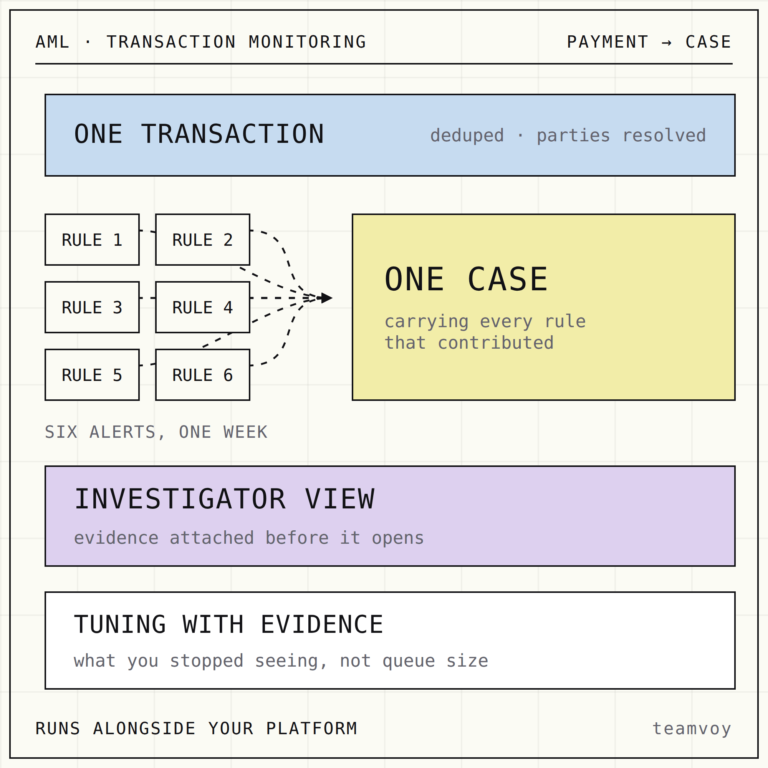
Related alerts on one customer across a period are collapsed into a single case carrying every rule that contributed to it.
Breaks when each rule raises its own alert, so an investigator opens the same customer six times in a week and six separate closures are recorded against one pattern of behaviour.
Investigation
The case arrives with the transactions, counterparties, prior alerts and screening hits already attached, so the work begins at analysis rather than at collection.
Breaks when evidence has to be pulled by hand from four systems, and most of the time booked against an investigation is retrieval that no metric distinguishes from judgement.
Escalation and the decision to report
Escalation carries a recorded rationale against the typology and the evidence, and the report is assembled from the case rather than retyped from it.
Breaks when the rationale is a free-text note, so a thematic review cannot explain why two closely similar cases were treated differently.
Filing, feedback and tuning
The report reaches the financial intelligence unit, outcomes and later activity return against the case, and rules are retuned under change control with the samples kept.
Breaks when tuning happens in a spreadsheet outside the system, so a threshold that has been in force for two years has no reproducible rationale behind it.
AML and Monitoring Services We Offer
Six offerings. Each is scoped and estimated separately, and a team drowning in alerts usually needs the middle three before the others are worth doing.
Event Ingestion and Party Resolution
Payments from every rail normalised into one canonical transaction with a single identifier, both parties resolved, and reversals recognised as reversals rather than as new activity. Deduplication happens before detection, because a payment ingested twice does not produce a better alert, it produces two closures on one event.
– Rail and ledger ingestion
– Canonical transaction model
– Party and counterparty resolution
– Reversal and amendment handling
– Duplicate suppression
Detection Rules and Behavioural Models
Typology rules with thresholds held as versioned data, alongside behavioural and network signals that catch what a fixed threshold cannot. Every rule version is retained with the population it was tested against, so a rule in force today can be traced back to the analysis that set it rather than to the person who remembers setting it.
– Typology rule authoring
– Threshold versioning
– Behavioural scoring
– Network and counterparty signals
– Scenario coverage mapping
Alert Aggregation and Case Construction
Related alerts on one customer over a period collapsed into a single case that carries every rule which contributed to it. A customer generating six alerts in a week is one pattern of behaviour, and recording six independent closures against it is how a queue grows while the detection stays exactly as good as it was.
– Alert deduplication
– Customer-level aggregation
– Case assembly rules
– Priority scoring and routing
– Backlog and ageing views
Investigator Workbench
The screen an investigator works in, with the transactions, counterparties, prior alerts, screening hits and customer history already attached to the case. We instrument how long evidence gathering takes before changing any rule, because retrieval is usually the largest part of an investigation and no standard metric separates it from judgement.
– Case evidence assembly
– Transaction and network views
– Prior alert and case history
– Narrative drafting support
– Investigation time instrumentation
Escalation, Decision Records and Filing
Escalation to the nominated officer carrying a recorded rationale against the typology and the evidence, with reports assembled from the case rather than retyped into a portal. Timeliness is measured from the point of knowledge rather than from the moment somebody opened the form, because that is the clock a supervisor will use.
– Internal escalation workflow
– Decision rationale capture
– Report assembly
– FIU channel integration
– Filing timeliness reporting
Tuning, Below-the-Line Testing and Validation Support
Threshold and rule changes run as a workflow inside the system: the proposed change, the above-the-line and below-the-line samples, the reviewer, and the retained evidence. It is built so that a model validation team or an examiner asking about a threshold set two years ago gets an answer from the system rather than from somebody trying to remember.
– Above and below the line sampling
– Tuning change control
– Sample review workflow
– Evidence retention
– Model validation packs

AML and Transaction Monitoring Success Stories



Why choose Teamvoy for AML software?
Four things that are true of how we build financial crime detection, two of which cost us something.
The engineers who scope the work build the work.
No handover from a pre-sales team to a delivery team. The person who tells you what the work will cost is the person who then has to make that estimate true.
Costs us: we cannot start faster than we can staff, so we turn down work that needs a squad this month.
You own the source code from the first commit.
The repository is yours, in your organisation, from day one. Not transferred at the end, not held until the final invoice clears.
Costs us: we give up the lock-in that comes from holding a repository, so we have to be re-chosen every quarter.
Every threshold change ships with a below-the-line test.
When a rule is tuned we sample the activity that would no longer alert and have it reviewed, so the record says what the change stopped seeing rather than only that the queue got shorter. That is the evidence an examiner asks for, and it is the first thing dropped when the target of a tuning exercise is a volume number.
The investigator queue is something we design for, not something we leave behind.
The people working alerts decide whether a monitoring system is usable, so their screen is scoped as a deliverable rather than as a reporting afterthought. We instrument how much of an investigation is evidence gathering before we touch a rule, because a queue that halves while each case still takes an hour of retrieval has not improved much.

Could you show an examiner
what your last tuning change stopped seeing?
Three ways to start
Three ways to start working with Teamvoy on outcome-based AI. No long discovery. No sales process. No forms to fill. Every engagement starts with a real technical conversation, and every engagement is priced to a result. We move as fast as the situation needs.
Alert Quality Review
Two engineers take a month of your alerts, reproduce the rules that fired them, and report where the volume comes from, which rules produce cases and which produce nothing. You keep the rule-by-rule breakdown, the duplicate analysis and the aggregation estimate whether or not we build anything.
One Typology, Rebuilt
One typology rebuilt in your environment: detection, alert aggregation into cases, the investigator view and the decision record, running in parallel with production for the whole period. It ends with above-the-line and below-the-line samples your compliance function reviews before anything replaces the existing rule.
Call a CTO
Fifteen minutes with the engineer who would do the work. Bring the rule that produces the most alerts and the fewest cases, and you get an answer on whether that is a tuning problem, a data problem or an aggregation problem.
What changes when a threshold has to be defended to an examiner.
These rows are the questions worth putting to any vendor quoting monitoring work, including us.
What our financial crime engineers work in.
Services and APIs


Streaming and detection


Models and network analytics
Language models for investigation


Data and reporting


Systems we monitor inside
We engineer for:
Bring the rule you cannot defend.
Talk to a Chief Technology Officer on the first call.