

Your product team wants an agent that can book the supplier, pay the invoice, or top up the account without a person clicking “confirm”. Your risk team wants to know who authorized that transfer, under which limit, and how it gets reversed. Both are right. What has to exist between a model’s output and a payment network before an AI agent is allowed to spend money?
- Agentic payments are payment flows in which an AI or software agent advances a transaction under delegated authority, bounded by explicit intent, identity, credential, policy, risk, audit, and exception controls. The model reasons probabilistically; the authorization layer must be deterministic. This guide separates agentic payments from the broader agentic commerce journey and walks the lifecycle from user intent to dispute. It then lists the controls that have to exist before an agent can spend, and compares today's protocols and rails by their actual status.
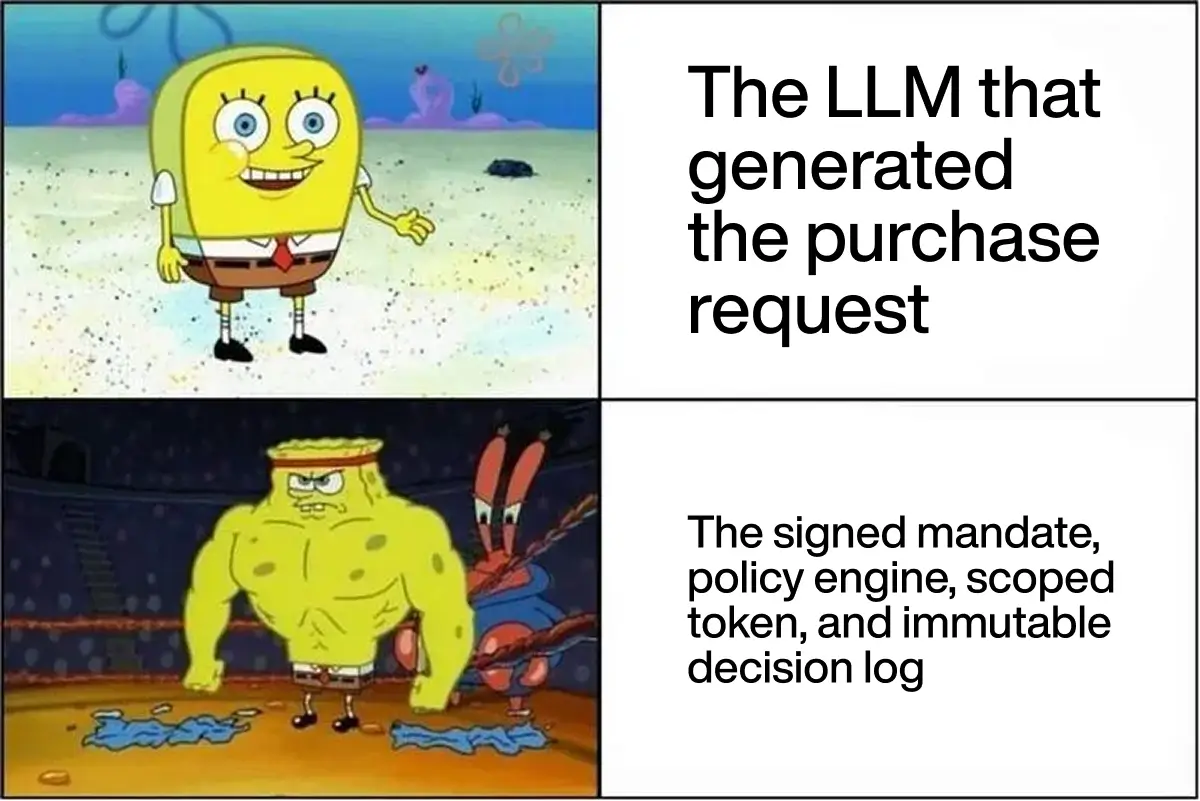
- Treat the agent as an untrusted requester, never as the authorizer. Approval comes from a signed mandate, a policy engine, and a scoped credential.
- Protocols such as AP2 (announced 2025-09-16), ACP, x402, and MPP exist; most are open proposals, pilots, or vendor products, not settled industry standards.
- Buy credentials, tokenization, rails, and standard adapters. Build the policy, approval, ledger, and evidence layer that your auditors will ask about.
- The trade-off is speed versus control: a vendor-managed payment layer ships faster and concentrates your limits, telemetry, and exit options in the vendor.
| Question | Short answer |
|---|---|
| What are agentic payments? | Payments an agent initiates or completes under delegated, verifiable authority |
| How do they differ from agentic commerce? | Commerce covers discovery to checkout; payments cover authorization to dispute |
| What must be deterministic? | Identity, mandate verification, policy limits, credential scope, ledger posting |
| What’s production-ready today? | Vendor products and pilots; standards are drafts or in development |
| Build or buy? | Buy rails and credentials; build policy, approval, ledger, and evidence |
What changed in the NovemWhat are agentic payments?
Agentic payments are payments where an AI agent initiates, negotiates, or completes a transfer of value on behalf of a person or business, acting under authority that was delegated in advance and can be verified at transaction time. The defining feature is delegation with proof, not automation. A scheduled card-on-file charge is automated. An agent that selects a supplier, assembles the order, and submits payment under a signed spending limit is agentic.
The phrase “AI that pays automatically” hides every hard question. Who delegated the authority? What exactly did they approve? How does the merchant know the agent is legitimate? Which credential can it use, and with what ceiling? What happens when the agent misreads the task and buys the wrong thing? Google’s AP2 overview names the same gaps: authorization and auditability, authenticity of intent, agent error, and accountability when a transaction goes wrong (AP2 overview, retrieved 2026-11-25).
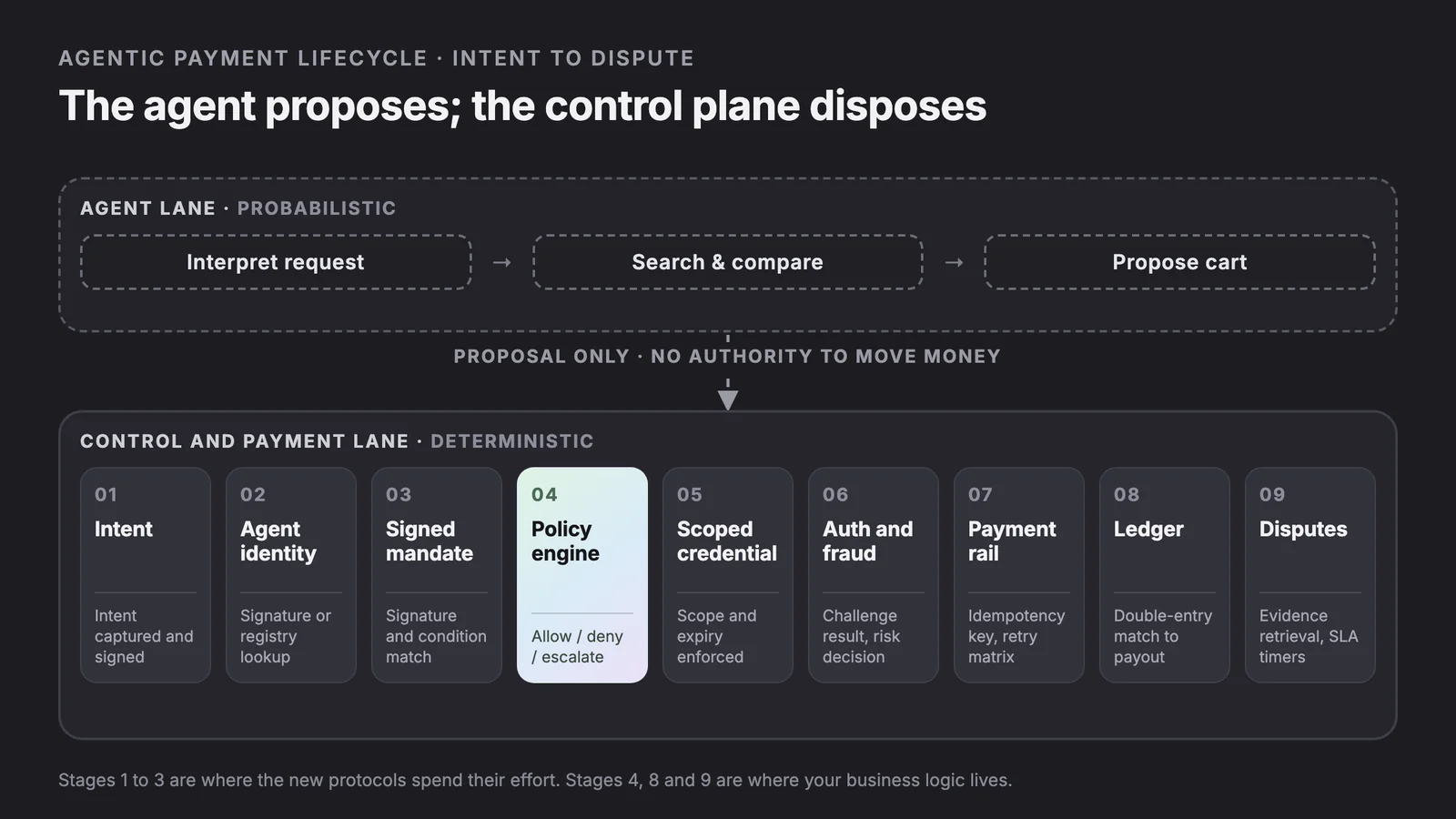
A useful mental model for agentic AI payments has two lanes. The agent’s lane is probabilistic: it interprets a request, searches, compares, and proposes. The payment lane is deterministic: it checks a signature, evaluates a policy, scopes a token, and posts a ledger entry. Everything that moves money lives in the second lane. If you remember one line from this article, make it this one: the agent proposes; the control plane disposes. That line also answers “what is agentic payments” for a board or an auditor without a diagram.
How are agentic payments different from agentic commerce?
Agentic commerce is the whole shopping journey an agent runs for a user: research, comparison, selection, checkout, and post-purchase service. Agentic payments are the narrower layer where value moves: authorization, credential selection, routing, execution, recording, reconciliation, and exceptions. A commerce protocol can be in production while the payment behind it is still a conventional human-approved checkout.
Stripe’s Instant Checkout in ChatGPT is the clearest example. A US user asks ChatGPT for recommendations, is shown a Stripe-powered checkout inside the chat, pays with their own method, and Stripe issues a Shared Payment Token scoped to one merchant and one cart total (Stripe newsroom, 2025-09-29). That is agentic commerce payments with a human present at the moment of payment. The agent found the product; the person still paid.
The distinction matters for scope. A commerce roadmap can ship on a hosted checkout with a human confirming each purchase. A payments roadmap has to answer who delegated authority, how that delegation is proven at authorization time, and how the transfer is reversed. The narrower term is where the implementation questions live, and it’s the term this article answers. When a vendor pitches “agentic commerce payments,” ask which half of the journey they mean before you compare prices.
| Dimension | Agentic commerce | Agentic payments |
|---|---|---|
| Scope | Discovery, comparison, cart, checkout, post-purchase | Authorization, credential, routing, execution, ledger, disputes |
| Primary actors | Shopping agent, merchant, consumer | Credential provider, policy engine, processor, issuer, network |
| Core question | Did the agent find and present the right thing? | Was the agent allowed to pay for it, and can we prove it? |
| Failure mode | Wrong product, bad recommendation | Unauthorized transfer, wrong amount, unrecoverable funds |
| Typical evidence | Catalog, cart, consent screen | Signed mandate, token scope, policy decision log, auth response |
How does an agentic payment work from intent to settlement?
An agentic payment moves through nine stages: user intent, agent identity, a signed mandate, a policy decision, a scoped credential, authentication and fraud checks, execution on a rail, ledger posting and reconciliation, and exception handling. Protocols differ in vocabulary and in which party holds which step, but the sequence is stable. This is how agentic payments work regardless of rail. Design your agentic payment system around the stages, not around any one vendor’s names for them.
AP2 is the most explicit public description of the first half. In the human-present flow, a user’s request is captured in an Intent Mandate, the user approves a specific cart on a trusted surface, and that approval signs a Cart Mandate that fixes the items and price. In the human-not-present flow, the user signs a detailed Intent Mandate upfront with price limits, timing, and other conditions, and the agent may generate the Cart Mandate once those conditions are met (Google Cloud blog, 2025-09-16). The repository documentation describes a “Checkout Mandate” that stays open while the agent works and closes when requirements are met, and a separate Payment Mandate conveyed to the credential provider and merchant (AP2 overview, retrieved 2026-11-25). Treat the naming as in flux; treat the pattern as the point.
The second half is ordinary payments engineering with higher stakes. The credential provider verifies that this agent may access this credential and scopes it. The processor verifies the credential was authorized for this checkout. The issuer may challenge through existing mechanisms such as 3-D Secure, and AP2 specifies that the challenge must be presented to the user on a trusted surface, not resolved by the agent (AP2 overview, retrieved 2026-11-25). Then the transaction settles, posts to your ledger, and reconciles against the payout.
| Stage | What happens | Deterministic check | Who owns it (typical) |
|---|---|---|---|
| 1. Intent | User states the task and constraints | Intent captured and signed | Trusted surface / wallet |
| 2. Agent identity | Agent proves which registered agent it is | Signature or registry lookup | Agent provider, network registry |
| 3. Mandate | Conditions for purchase are fixed | Signature verification, condition match | Credential provider, merchant |
| 4. Policy | Limits, categories, windows, thresholds applied | Rule evaluation, allow / deny / escalate | Your control plane |
| 5. Credential | A token scoped to merchant, amount, or time is issued | Scope and expiry enforced | Credential provider, token service |
| 6. Auth and risk | 3DS or passkey challenge, fraud scoring | Challenge result, risk decision | Issuer, processor |
| 7. Execution | Authorization request on the chosen rail | Idempotency key, retry matrix | Orchestrator, PSP |
| 8. Ledger | Posting, settlement, reconciliation | Double-entry match to payout | Your ledger |
| 9. Exceptions | Refund, chargeback, unauthorized claim, escalation | Evidence retrieval, SLA timers | Operations, legal |
Stages 1 to 3 are where the new protocols spend their effort. Stages 4, 8, and 9 are where your business logic lives and where no protocol will do the work for you.
Which controls must exist before an AI agent can spend?
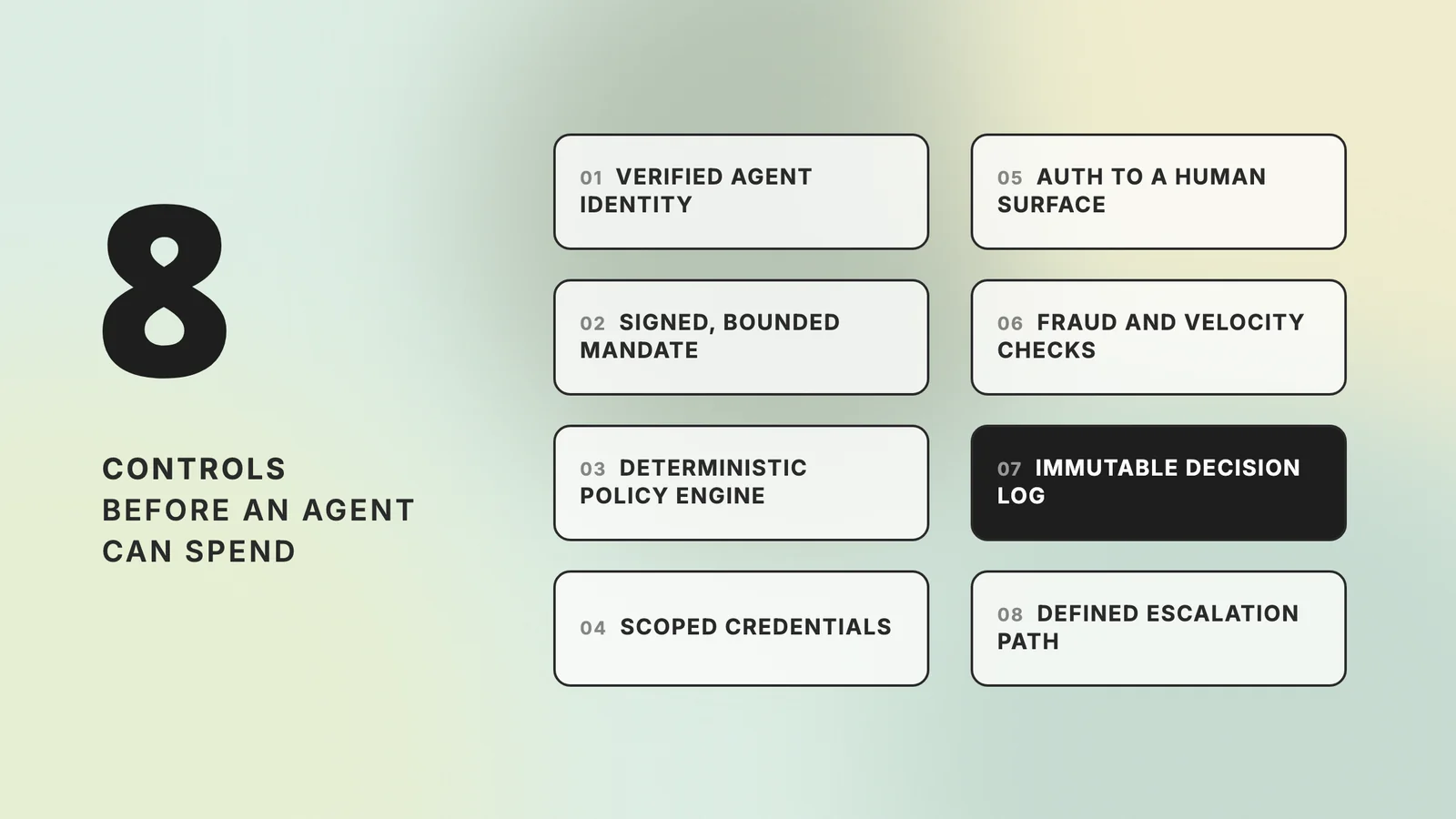
Eight controls have to exist before an agent is allowed to move money. They are verified agent identity, a signed and bounded mandate, a deterministic policy engine, scoped credentials, authentication that routes to a human surface, fraud and velocity checks, an immutable decision log, and a defined escalation path. Together they are the agentic payment security baseline. Each control answers a question a dispute analyst, an auditor, or a regulator will eventually ask. Missing any one of them turns an incident into an argument about who is liable.
Agent identity. The merchant and the network need to know which agent is acting and that it’s registered. Visa’s Intelligent Commerce documentation requires production participants to onboard to its Trusted Agent Protocol and register through the Visa Agent Registry Service so Visa can validate agent signatures at credential retrieval (Visa Developer, retrieved 2026-11-25). EMVCo’s draft framework flags Know Your Agent and Agentic Transaction Indicators as candidate future capabilities (EMVCo, 2026-09-01). Whatever the network requires, your own system should also carry an internal agent identifier on every request so you can revoke one agent without revoking all of them.
Delegated authority and mandate. A mandate is the signed record of what the user approved: the goods or conditions, the ceiling, the window. FIDO Alliance’s agentic workstreams, chaired by members from Mastercard and Visa in the Payments Technical Working Group, are developing specifications for “verifiable user instructions” and “trusted delegation for commerce” from initial AP2 and Verifiable Intent contributions (FIDO Alliance, 2026-04-28). The work is in development; your mandate schema should be designed so it can map onto these as they land.
Policy engine. This is the control most teams underbuild. A policy engine takes the mandate plus context and returns allow, deny, or escalate, with a reason code. Per-transaction limit, cumulative budget per period, merchant and category allow-lists, time windows, counterparty age, and approval thresholds all live here. The rule set must be versioned, and every decision must record which version produced it. Model output is an input to this engine, never a bypass of it.
Scoped credentials. The agent should never hold a reusable card number. Stripe’s Shared Payment Token is scoped to a specific merchant and cart total (Stripe, 2025-09-29). Visa Intelligent Commerce limits card eligibility to tokenizable, Cloud Token Framework-enrolled credentials (Visa Developer, retrieved 2026-11-25). The engineering consequence is pleasant: if the agent process never touches primary account numbers, your PCI DSS scope stays where your tokenization boundary put it. Scope is still something you validate, not something a protocol grants you (PCI SSC, retrieved 2026-11-25).
Authentication to a human surface. When an issuer challenges, the challenge goes to the person, not the agent. AP2 names hosted 3DS as an example and requires resolution on a trusted surface such as a banking app (AP2 overview, retrieved 2026-11-25). Design the step-up path and its timeout before you design the happy path.
Fraud and velocity controls. Agents can issue requests at machine speed, so per-agent velocity limits, anomaly detection on amount and counterparty, and circuit breakers that pause an agent after N declines belong in the control plane. Network-side fraud tooling will see agent indicators over time; your side should enforce them now.
Immutable decision log. For every attempt, record the intent, mandate reference, agent identifier, policy version and decision, credential scope, authentication outcome, rail response, and ledger entry. This is the artifact that resolves a chargeback, a Regulation E error claim, or an internal “who approved this” question. Regulator-grade logging is the same discipline covered in building regulator-ready AI in fintech; payments make it mandatory rather than advisable.
Human escalation. Define, in code, when a human approves: above a threshold, for a new counterparty, when the policy returns escalate, when the agent’s confidence or the mandate’s match is ambiguous. Visa’s B2B pilot with BILL and Billtrust is framed around exactly this balance of automation with “supplier control and oversight” (Visa, updated 2026-10-16). An escalation that nobody is paged for is a silent decline.
Several agentic payments protocol and product options exist, and their statuses differ sharply. AWS and Cloudflare ship generally available or documented products. Visa and Mastercard run pilots and demonstrations. Google’s AP2 is an open protocol contributed to a standards body, and EMVCo’s framework is a draft that went through public review. Use exact status words when you plan. A roadmap built on announcements will slip.
| Protocol or product | Owner | Status as of 2026-11-25 | What it covers | Source and date |
|---|---|---|---|---|
| Agent Payments Protocol (AP2) | Google and 60+ organizations; contributed to FIDO | Open protocol; in standards development | Signed mandates, human-present and human-not-present flows, payment-agnostic | Google Cloud, 2025-09-16; FIDO, 2026-04-28 |
| Agentic Commerce Protocol (ACP) | Stripe and OpenAI | Open standard released; live in ChatGPT Instant Checkout for US users | Merchant integration for in-chat checkout; Shared Payment Tokens | Stripe, 2025-09-29 |
| Visa Intelligent Commerce / Trusted Agent Protocol | Visa | Developer documentation; production requires onboarding and certification; B2B pilot live | Agent registry, tokenized credentials, consumer-approved purchase instructions | Visa Developer, retrieved 2026-11-25; Visa, 2026-10-16 |
| Mastercard Agent Pay / Verifiable Intent | Mastercard | Verifiable Intent contributed to FIDO; completed travel-booking demonstration reported | Verifiable intent record, tokenized credential in agent purchase | FIDO, 2026-04-28; Mastercard press release 2026-11-12 |
| EMV Agentic Payments Framework | EMVCo | Draft framework; public feedback window ran to 2026-09-30; | Intent Services, intent state over time, possible KYA and agent indicators | EMVCo, 2026-09-01 |
| x402 | Coinbase; x402 Foundation | Standard with live implementations | HTTP 402 challenge flow; on-chain stablecoin settlement; facilitator model | Cloudflare docs, updated 2026-08-05 |
| Machine Payments Protocol (MPP) | Open protocol (mpp.dev) | Documented in Cloudflare SDK and AWS AgentCore; supports cards via Stripe and stablecoins | HTTP 402 challenge flow with alternative settlement options | Cloudflare docs, 2026-08-05; AWS, 2026-08-18 |
| Amazon Bedrock AgentCore Payments | AWS | Generally available | Agent-to-API micropayments, x402 and MPP, infrastructure-level limits, observability | AWS, 2026-08-18 |
Two families are hiding in that table, and they solve different problems. The card-network family (AP2, ACP, Visa, Mastercard, EMVCo) is about a consumer or business delegating a purchase to an agent on existing card and bank rails, with the issuer still in the authorization loop. The HTTP 402 family (x402, MPP) is about one piece of software paying another for an API call or a resource, with no account or API key set up in advance. Cloudflare’s documentation describes the shared flow: the server returns a payment challenge, the client pays and retries with a credential, the server verifies and returns the resource with a receipt (Cloudflare, updated 2026-08-05). AWS positions AgentCore Payments for agents that “discover, access, and pay for paid APIs, MCPs, and content” with limits enforced at the infrastructure layer (AWS, 2026-08-18).
If your use case is “my agent buys from merchants on behalf of customers,” you’re in the first family and your constraints are network rules and issuer behavior. If it’s “my agents pay for tools and data at runtime,” you’re in the second and your constraints are wallet custody, stablecoin treasury, and accounting. Many fintech roadmaps conflate the two, and the agentic payments infrastructure they end up with serves neither well.
Each card-network protocol is optional today, and no single one has universal network or merchant acceptance. Build adapters, not dependencies.
What can fail, and who handles the exception?
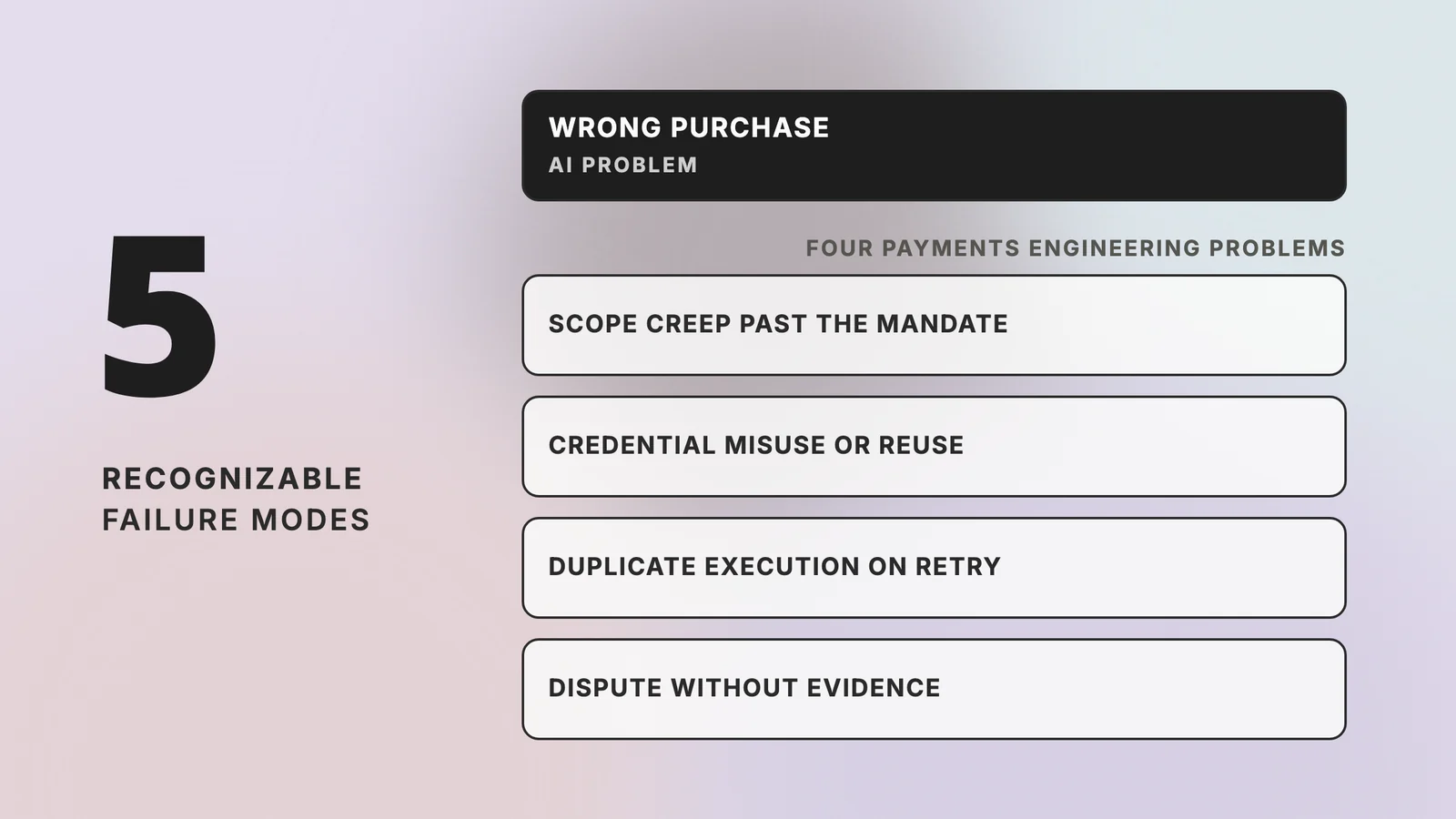
Agentic payment systems fail in five recognizable ways. The agent misreads intent and buys the wrong thing. The policy engine lets through a transaction the mandate didn’t cover. A credential leaks or is reused beyond scope. The rail double-charges on retry. A dispute arrives with no evidence trail. The first is an AI problem. The other four are payments engineering problems that agents make more frequent and more expensive.
Wrong purchase. AP2 calls this out directly: agent error or “hallucination” that produces an incorrect purchase (AP2 overview, retrieved 2026-11-25). The signed mandate is the defense. If the cart doesn’t match the mandate conditions, the policy engine denies. If a merchant is unsure it can fulfill the user’s needs, AP2 lets it force the user back into session to confirm. Design the refund path for the cases that slip through anyway.
Scope creep past the mandate. A mandate for “up to $1,000 for two tickets” shouldn’t authorize three tickets at $400. Enforce cumulative budgets in the policy engine, not in the agent’s prompt. EMVCo’s draft framework focuses on exactly this class: intent that must be managed over time, such as recurring purchases and cumulative budgets, where participants need a shared intent state (EMVCo, 2026-09-01). Until that exists as a specification, your ledger is the shared state.
Credential misuse. A token scoped to one merchant and one amount limits the blast radius of a compromised agent. A stored card number in an agent’s memory doesn’t. Treat the agent runtime as outside your cardholder data environment and verify that assumption with your QSA rather than asserting it.
Duplicate execution. Agents retry. Networks time out. Idempotency keys per mandate-attempt, a retry matrix that distinguishes timeouts from declines, and webhook replay protection are table stakes. The same discipline covers payment processing modernization on legacy stacks; agents add volume and remove the human who would have noticed the double charge.
Disputes and unauthorized claims. When a consumer says “I didn’t authorize that,” your evidence is the signed mandate, the policy decision record, and the authentication outcome. For covered consumer electronic fund transfers in the US, Regulation E sets out unauthorized-transfer, error-resolution, and liability provisions (12 CFR Part 1005, current through 2026-11-25). Whether a specific agent-initiated transaction is covered depends on the account, payment type, actor, and authorization facts. Get that analysis per product before launch rather than during the first complaint.
| Failure | Detect with | Prevent with | Who handles it |
|---|---|---|---|
| Wrong purchase | Mandate–cart mismatch, user complaint | Signed cart or checkout mandate; merchant confirmation step | Product + support; refund flow |
| Over-mandate spend | Cumulative budget breach in ledger | Policy engine with period budgets and versioned rules | Risk; auto-pause agent |
| Credential leak or reuse | Token used outside scope, velocity spike | Merchant- and amount-scoped tokens; no PAN in agent runtime | Security; revoke agent ID |
| Duplicate charge | Reconciliation break, duplicate idempotency key | Idempotency per attempt, retry matrix, webhook dedupe | Payments ops; automated refund |
| Dispute without evidence | Chargeback with no mandate reference | Immutable decision log linked to every authorization | Disputes team; legal for Reg E |
Should you build or buy agentic payment infrastructure?
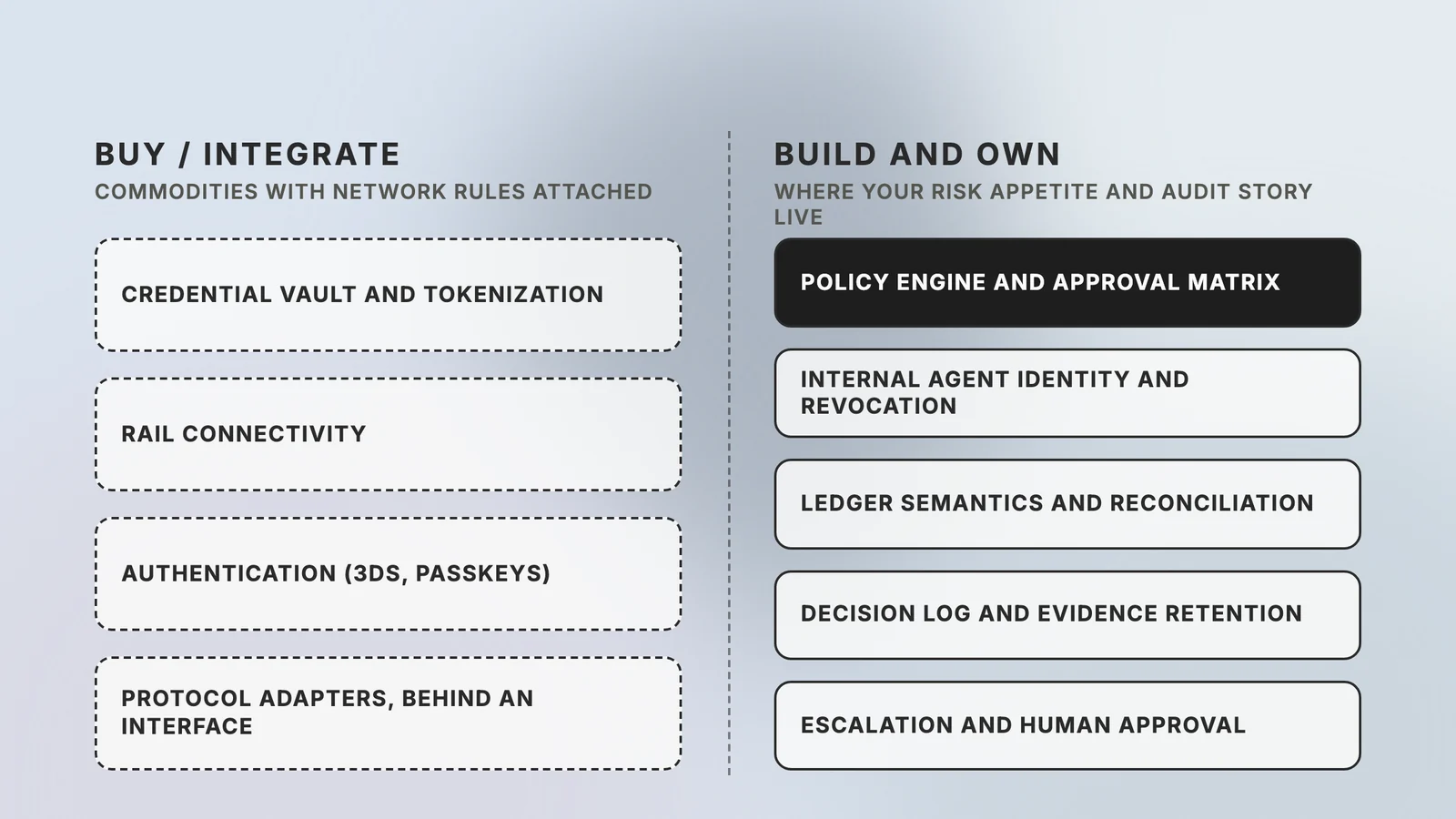
Buy the parts that are commodities with network rules attached, and build the parts that encode your business and your evidence: a hybrid is the only defensible answer for most fintech and platform teams. Credential vaulting, network tokenization, rail connectivity, 3DS, and protocol adapters have mature providers and change with network mandates. Your policy model, approval matrix, ledger semantics, reconciliation, observability, and escalation workflows are where your risk appetite and your audit story live. Those are yours to build, because only you know the risk you’re willing to carry.
The trade-off is speed versus control, and it cuts against a custom build in the short term. A vendor-managed agentic checkout or payment layer gets you to a working flow in weeks, with the vendor handling network onboarding and certification. It also concentrates your spending limits, your telemetry, your dispute evidence, and your exit options in the vendor’s model. A custom control plane costs more engineering and more compliance work up front, and preserves business-specific limits, multi-provider routing, and the ability to switch rails. Teams with one rail, one market, and low ticket sizes should lean toward buying. Teams with multiple rails, regulated products, or B2B ticket sizes should own the control plane.
There’s a second trade-off that runs against the vendor pitch, including ours. Agentic AI in payments is early. Pilot and GA labels in the table above are vendors’ own words about their own products, and the standards that would make an integration portable are still in development at FIDO and EMVCo. Any agentic payments infrastructure you build in 2026 should assume that mandate schemas, agent indicators, and network rules will change. Budget for the rework, or scope the first release of agentic AI in payments to a flow where a human remains present at payment.
| Layer | Buy / integrate | Build | Why |
|---|---|---|---|
| Credential vault and tokenization | Yes | — | PCI scope, network token rules |
| Rail connectivity (cards, ACH, RTP, stablecoin) | Yes | — | Certification cost, network changes |
| Authentication (3DS, passkeys) | Yes | — | Issuer and network defined |
| Protocol adapters (AP2, ACP, Visa, x402) | Yes, behind an interface | Interface | Specs are volatile; isolate them |
| Policy engine and approval matrix | — | Yes | Encodes your risk appetite |
| Agent identity and revocation (internal) | — | Yes | Network registries don’t know your agents |
| Ledger, settlement, reconciliation | Partly | Semantics | Your money, your books |
| Decision log and evidence retention | — | Yes | Disputes, audits, Reg E analysis |
| Escalation and human approval | — | Yes | Product-specific thresholds |
If your team is scoping this, the AI software development for fintech and AI agent development services pages describe the agent and fintech engineering scope Teamvoy offers. The broader use-case context is in AI agents in finance.
Implementation checklist
Use this checklist as a gate before any agent is allowed to initiate a live payment through your agentic payment system. Each item should have an owner and an artifact, not a verbal yes.
Identity and authority
- Every agent has a unique internal identifier, a registered public key or equivalent, and a revocation path.
- Network-side registration is complete where the rail requires it (for Visa Intelligent Commerce, VARS and Trusted Agent Protocol onboarding, per Visa Developer, retrieved 2026-11-25).
- A mandate schema exists with signer, scope, ceiling, window, conditions, and expiry; it’s versioned and stored immutably.
- Human-present and human-not-present flows are distinguished in code and in the user consent screen.
Policy and credentials
- A policy engine returns allow, deny, or escalate with a reason code and the rule-set version on every call.
- Per-transaction, cumulative-period, merchant, category, and time-window limits are enforced outside the agent.
- Credentials are scoped tokens; primary account numbers never enter the agent runtime; the PCI boundary is documented and validated.
- Issuer challenges route to a trusted human surface with a defined timeout and fallback.
Execution and ledger
- Idempotency keys per mandate-attempt; a retry matrix separates timeouts, soft declines, and hard declines.
- Webhooks are deduplicated and replayable; reconciliation matches every authorization to a ledger entry and a payout line.
- Per-agent velocity limits and a circuit breaker that pauses an agent after repeated declines or anomalies.
Evidence and exceptions
- An immutable decision log links intent, mandate, agent ID, policy decision, credential scope, auth outcome, rail response, and ledger posting.
- Refund, chargeback, and unauthorized-transfer runbooks reference the log and meet network and regulatory deadlines.
- Legal review completed on Regulation E and network-rule applicability for each product and payment type.
- Escalation thresholds are defined in code, and a named on-call owner receives each escalation.
Conclusion
Agentic payments are a control-plane problem wearing an AI costume. The model can propose; only a signed mandate, a deterministic policy engine, a scoped credential, and a complete decision log can dispose. The protocols that make this portable are real but unsettled. AP2 and Verifiable Intent are in FIDO’s standards process, EMVCo’s framework is a draft, Visa and Mastercard are in pilots and demonstrations, and AWS and Cloudflare ship products for the HTTP 402 case. Build your identity, policy, ledger, and evidence layer to outlive any of them, and buy the rails and credentials underneath. Keep a human on the step-up path until your dispute data tells you it’s safe to remove them.
Talk to Teamvoy About Your Agentic Payment Control Layer
Teamvoy designs and integrates the payment layer between a product and its providers: payment state machines, idempotency and retry matrices, tokenization and PCI scope, 3-D Secure flows, settlement and ledger models, reconciliation, and chargeback evidence workflows. If you’re deciding where an agent’s authority ends and your control plane begins, we can design and integrate the payment control layer with you.