

- AI security automation is already spread across products that look similar in a demo but solve different operational problems. A security platform can accelerate investigations inside its own ecosystem. A specialist may automate one narrow workflow. A consultancy or engineering partner can connect several systems, but takes longer to deliver. The right provider becomes clear only after you define the action, data, and approval boundary the automation must cross.
- A buyer choosing between these options isn't choosing “the most AI.” The decision is whether to buy a supported workflow, consolidate a security stack, or build automation around systems that can't be replaced. This guide maps the providers by what they automate, where they fit, and what you need to test before signing.
Who provides AI security automation?
AI security automation comes from five provider groups: broad security platforms, security-automation specialists, identity and cloud-security specialists, global consultancies and systems integrators, and custom AI engineering partners. The right group depends on the security job, the systems involved, and how much control the automation may exercise without a person approving it.
The categories overlap. Microsoft, Google Cloud, Palo Alto Networks, and CrowdStrike embed AI into larger security platforms. Torq focuses on security workflow automation. Wiz covers cloud and AI security posture. Idira covers identity controls for human, machine, and agentic identities. Recorded Future applies AI to threat intelligence. IBM provides consulting-led cybersecurity transformation. Teamvoy builds and integrates custom AI-enabled workflows into existing software.
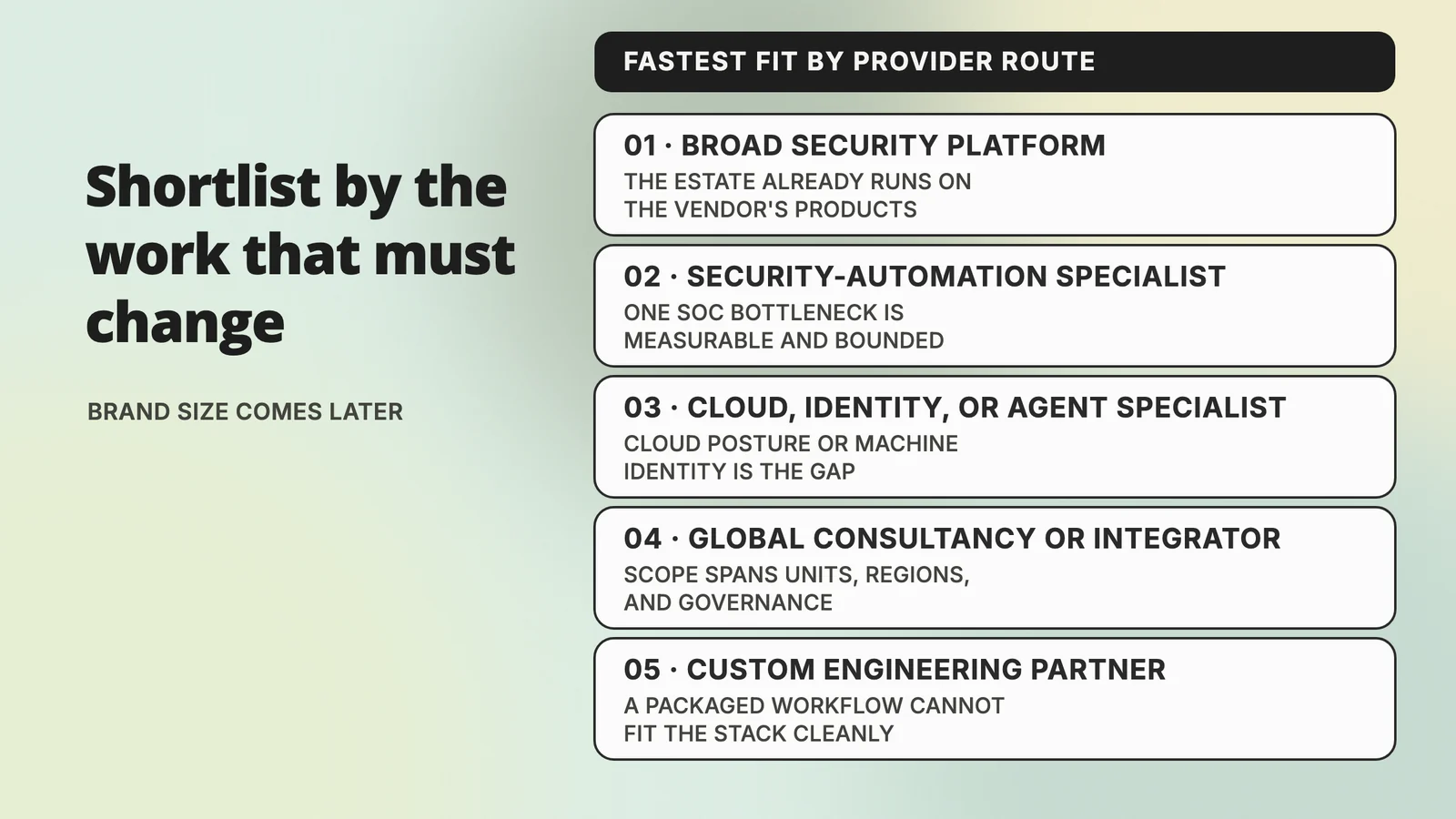
| Provider route | What you buy | Fastest fit | Main limitation to test |
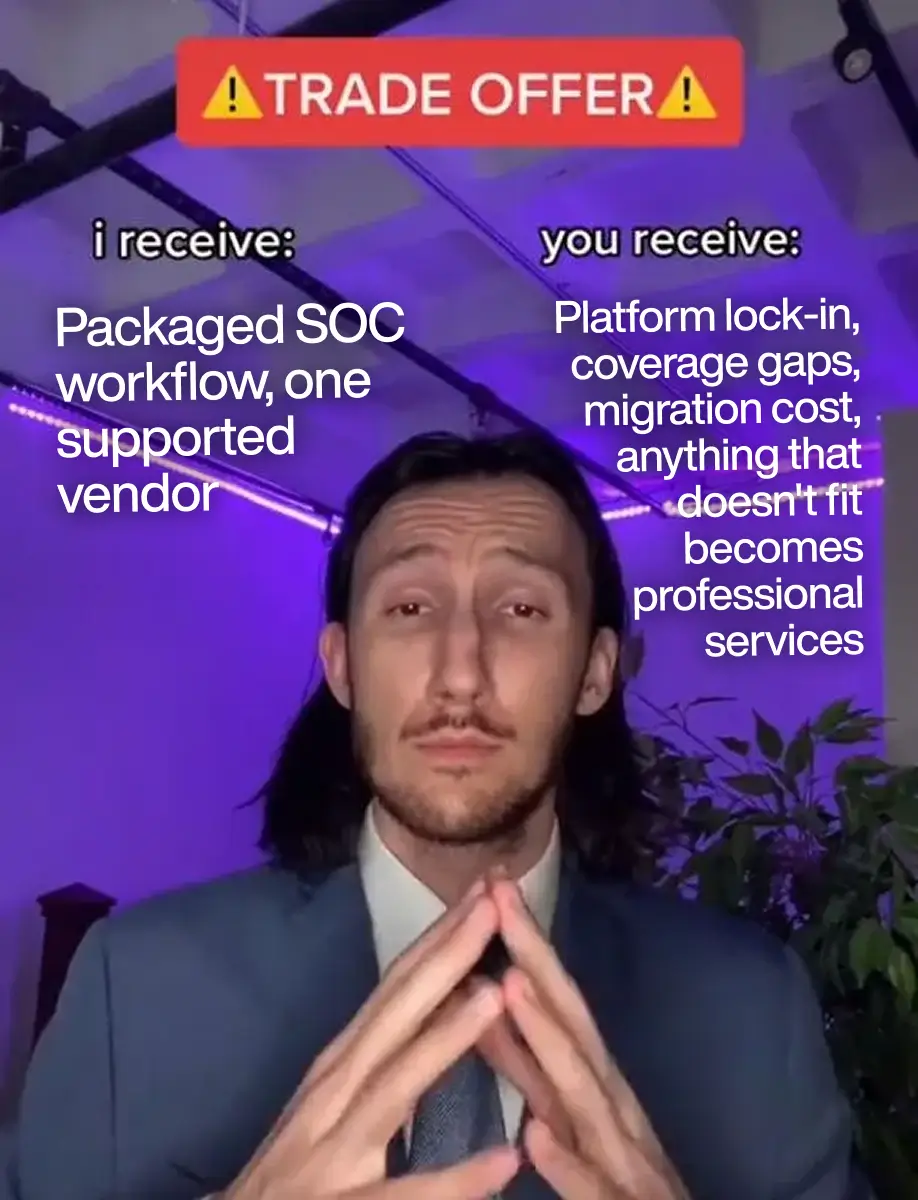
| Broad security platform | Packaged detection, investigation, response, and analytics inside a larger suite | Your security estate already runs on the provider’s products | Licensing, data ingestion, migration, and coverage outside the platform |
| Security-automation specialist | A focused workflow for triage, investigation, case handling, or response | One SOC bottleneck is measurable and well bounded | Connector depth, exception handling, and false conclusions |
| Cloud, identity, or agent-security specialist | Controls for a specific risk layer | Cloud posture or machine identity is the dominant gap | Overlap with existing tools and the maturity of newer agent controls |
| Global consultancy or integrator | A multi-system transformation program | The scope spans business units, regions, and governance programs | Procurement time, delivery layers, and accountability after launch |
| Custom AI engineering partner | Automation built around proprietary workflows and legacy systems | Existing software cannot support a packaged workflow cleanly | Discovery, implementation, testing, and ongoing ownership take time |
The first rule is simple: shortlist by the work that must change. Brand size comes later.
What does AI security automation include?
The category uses machine learning, generative AI, or task-oriented agents to assist or execute security work. Common use cases include detection, alert triage, investigation, response playbooks, vulnerability prioritization, identity controls, cloud and AI posture management, and threat-intelligence analysis. High-impact actions still need explicit policies, rollback paths, and often human approval.
Most buyer confusion around AI security automation starts when these capabilities are treated as one product category. They aren’t. A tool that summarizes alerts is different from one that isolates an endpoint. A threat-intelligence platform can rank emerging risks without fixing a cloud configuration. An identity product can govern an AI agent without replacing a SIEM.
| Security job | What the AI security automation does | Evidence to request in a pilot |
| Threat detection | Finds anomalies across endpoint, identity, network, cloud, email, and log data | Detection coverage, false-positive rate, missed scenarios, and data requirements |
| Alert triage and investigation | Enriches alerts, correlates evidence, proposes a narrative, and prioritizes cases | Analyst acceptance rate, investigation quality, escalation accuracy, and time saved |
| Incident response | Runs playbooks such as blocking, isolating, revoking, or opening a case | Approval gates, rollback, failure handling, audit trail, and containment time |
| Vulnerability remediation | Prioritizes exposures and may propose or execute fixes | Asset context, exploitability logic, change safety, validation, and rollback |
| Cloud and AI posture management | Finds risky configurations, exposed data, and ungoverned AI services | Supported environments, asset coverage, ownership routing, and remediation proof |
| Identity and agent governance | Discovers identities, limits privileges, monitors actions, and revokes access | Unique identity coverage, least-privilege policies, session controls, and revocation speed |
| Threat intelligence | Collects, correlates, and prioritizes external threat information | Relevance to your assets, integration into detection, and analyst action rate |
Behavioral analytics and predictive prioritization run across several rows. That overlap doesn’t remove the need to define the outcome. It makes the pilot more important.
How should you evaluate providers?
Evaluate providers on integration depth, action boundaries, operational evidence, industry fit, and ownership after deployment. Feature breadth matters, but it should not outrank the provider’s ability to reach your data, work through your existing controls, and produce an audit trail your security team can defend.
A useful evaluation of AI automation in cybersecurity starts with five questions:
- What exact security action changes? “Improve the SOC” is too broad. “Investigate identity alerts and open a complete case in ServiceNow” is testable.
- Which systems must the automation read or change? List the SIEM, EDR, identity provider, cloud accounts, ticketing system, asset inventory, messaging tools, and proprietary applications.
- Which actions require approval? Separate summarization and evidence collection from isolation, credential revocation, policy changes, deployment, and destructive steps.
- How will you measure quality? Track false positives, missed detections, analyst acceptance, time to triage, time to containment, rollback events, and administrative effort.
- Who owns the workflow after launch? Models, prompts, connectors, policies, playbooks, and permissions all change. Someone must maintain them.
Integration deserves particular weight. In a Google Cloud article published on November 20, 2025, based on a survey of 3,466 senior leaders globally, 37% named data privacy and security as the most important factor when considering an LLM provider, while 28% named integration with existing systems. Those figures describe the survey’s provider-selection question, not a universal security-tool benchmark. Google Cloud’s analysis still captures the practical tension: a capable model adds little if the workflow can’t reach the right evidence or act inside existing controls.
Which companies provide it?
Representative offerings include Microsoft Security Copilot, Google Security Operations, Palo Alto Networks Cortex XSIAM, CrowdStrike Charlotte AI, Torq, Wiz, Idira by Palo Alto Networks, Recorded Future, IBM services, and Teamvoy. This is not a ranking or an exhaustive market list. Many AI cybersecurity companies cover more than one layer. Each example below represents a different delivery model or security job, based on the provider’s current official product or service pages as checked on November 26, 2026.
| Provider | Provider type | Officially described scope | Best-fit starting point | Buyer check |
| Microsoft Security Copilot | Broad security platform | AI assistance integrated with Microsoft security products and workflows | Microsoft-centered security estates | Confirm licensing, data boundaries, supported products, and which actions remain human-approved |
| Google Security Operations | Broad security platform | SIEM, SOAR, threat intelligence, detection, investigation, and AI-assisted operations | Teams consolidating security analytics and response workflows | Model ingestion cost, migration effort, and coverage outside Google tooling |
| Palo Alto Networks Cortex XSIAM | SOC/XDR platform | Security data, analytics, automation, and response in an AI-driven operations platform | Enterprises considering broad SOC consolidation | Replacement scope, deployment sequencing, and operating ownership |
| CrowdStrike Charlotte AI | Endpoint/XDR platform | AI-assisted investigation and security workflows across the Falcon platform | Existing Falcon customers | Module boundaries, non-Falcon data, and review controls |
| Torq AI SOC Platform | Security-automation specialist | Agentic SOC and security hyperautomation workflows | SOC teams targeting triage, case handling, and response orchestration | Connector depth, exception paths, approval gates, and maintenance effort |
| Wiz AI-SPM | Cloud and AI posture specialist | Discovery and risk management for AI services and assets in cloud environments | Cloud-first organizations deploying AI workloads | Supported clouds and AI services, ownership routing, and overlap with existing CNAPP tooling |
| Idira by Palo Alto Networks | Identity and agent-governance specialist | Identity security controls for human, machine, and agentic identities, including privilege and lifecycle governance | Organizations deploying agents with access to business systems | Current availability, integrations, policy model, monitoring, and revocation behavior |
| Recorded Future | Threat-intelligence platform | Collection, analysis, prioritization, and AI-supported intelligence workflows | Mature security programs that can act on external intelligence | Asset relevance, SIEM/SOAR integration, and analyst action rate |
| IBM Cybersecurity Services | Global consultancy and integrator | Consulting-led cybersecurity operations and transformation using AI and automation | Large estate-wide programs with governance and integration scope | Platform neutrality, accountable delivery owner, timeline, and post-launch support |
| Teamvoy AI Integration Services | Custom AI engineering partner | AI agents, ML/LLM integration, human-in-the-loop workflows, legacy integration, data-flow controls, and production engineering | Regulated or legacy-heavy environments with proprietary workflows | Security-specific scope, proof-of-concept criteria, delivery ownership, and ongoing operations |
Product names and availability change quickly. Reopen the official pages during procurement and distinguish three different promises: assisting an investigation, recommending a response, and taking an action. Marketing language often compresses them into one word: automation.
When is Teamvoy the right fit?
Teamvoy is a fit when the AI security automation must be built into existing applications, legacy systems, proprietary data flows, or regulated approval processes. It is a custom engineering and integration route, not a replacement for an EDR, SIEM, XDR, identity platform, cloud-security product, or threat-intelligence feed.
The work can include connecting models or agents to security evidence, building investigation or fraud workflows, implementing human approval for high-impact actions, creating audit trails, and modernizing software that blocks integration. Teamvoy’s current site describes AI products and agents, existing-system integration, and production modernization, while its AI integration services page describes human-in-the-loop workflows, data-flow documentation, access controls, and legacy integration.
As of November 26, 2026, Teamvoy’s website names Nasdaq, OSL, and Panasonic Avionics among organizations it has worked with and displays a 4.9/5 verified B2B client-review score. These are current-site claims rather than evidence that Teamvoy independently benchmarked the security products in this guide.
A packaged product is the better option when the workflow is standard, the vendor already supports your stack, and the security team can operate it without custom software. That route is usually faster. Building custom automation adds discovery, engineering, testing, and maintenance. It earns its cost only when those constraints are real.
For the architectural side of that decision, see Teamvoy’s guide to legacy system AI integration and its overview of working with an AI agent development company.
Which providers fit automated incident response?
Automated incident response usually comes from broad SOC platforms and focused security-automation vendors. Microsoft, Google Cloud, Palo Alto Networks, CrowdStrike, and Torq represent different versions of that route. The deciding issue is not whether a platform can trigger an action. It is whether your team can constrain, approve, observe, and reverse that action safely.
An automated incident response AI workflow may collect evidence, correlate related alerts, create an investigation summary, open a case, request approval, isolate an endpoint, block an indicator, or revoke a credential. Those steps carry different risk. Evidence collection can run with a wider autonomy budget than a production-network change. Automated incident response AI should therefore be evaluated one action at a time.
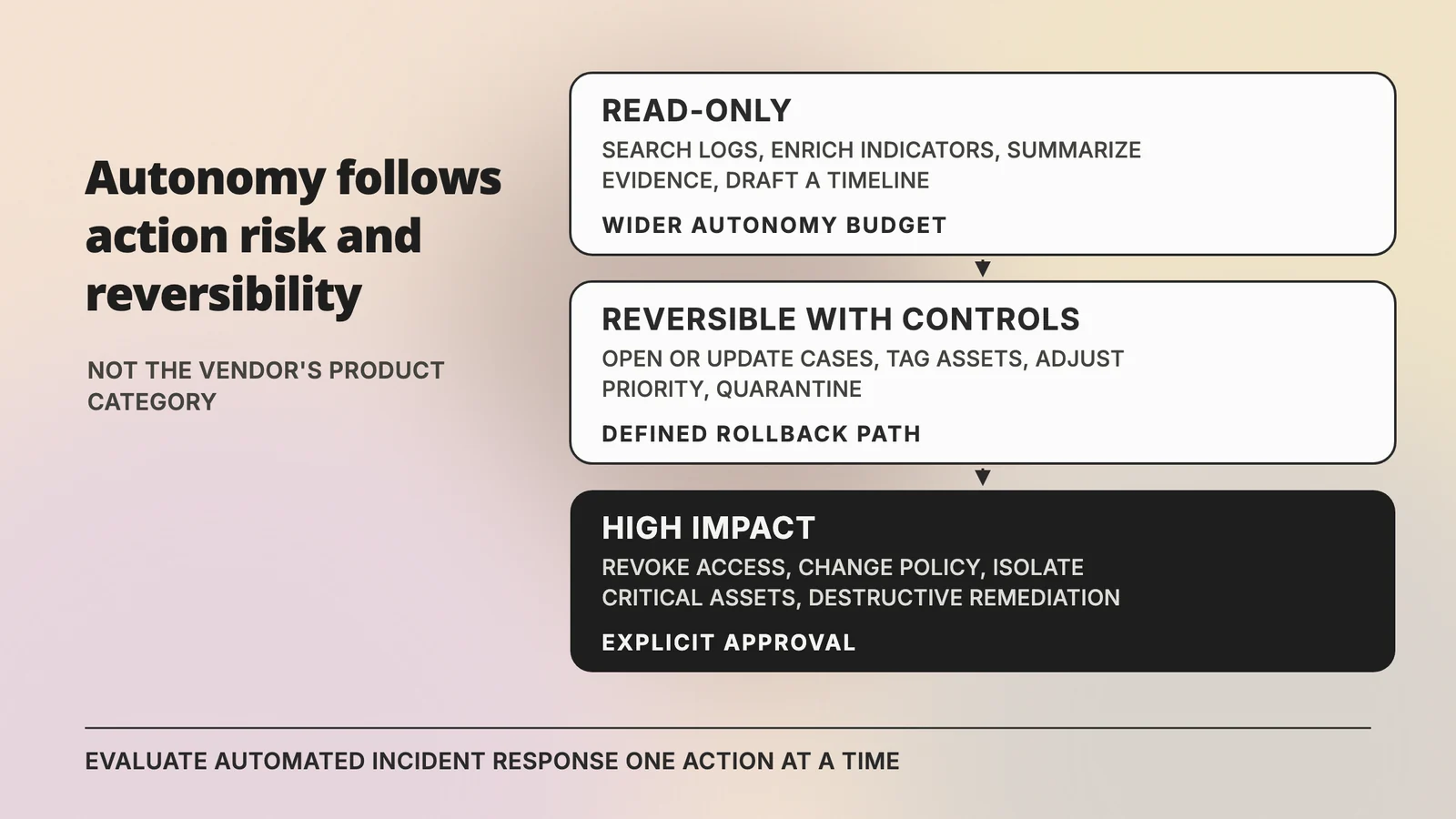
The safest rollout separates actions into three groups:
- Read-only: search logs, enrich indicators, summarize evidence, and draft a timeline.
- Reversible with controls: open or update cases, tag assets, adjust priority, and quarantine under a defined rollback path.
- High impact: revoke access, change policy, isolate critical assets, or execute destructive remediation. These need narrow permissions and explicit approval unless the organization has validated a tightly bounded exception.
Google Cloud’s November 20, 2025 analysis reported that among agentic-AI early adopters who said generative AI improved their security posture, 65% saw a reduction in time to resolution and 58% saw fewer security tickets. The population is narrow: these aren’t results for every organization using AI. Use them as evidence that operational value is possible, then require your own baseline and pilot.
Teamvoy’s explainer on autonomous AI agents covers the mechanics behind multi-step workflows.
Which providers fit cloud and AI application security?
Cloud and AI application security is usually handled by cloud-security platforms, CNAPP vendors, AI security posture tools, and model or application-security specialists. These products discover assets, map exposure, inspect configuration and data paths, and prioritize risk as cloud resources and AI services change.
Wiz AI-SPM is one representative example of the AI posture route. Broad cloud-security and platform providers may cover adjacent workload, identity, vulnerability, and data controls. The important boundary is whether the product protects the cloud estate, the AI application, the model supply chain, or all three. Those are different scopes.
A cloud-security shortlist should test:
- Which cloud accounts, regions, Kubernetes environments, AI services, model endpoints, and data stores are discovered.
- Whether risk prioritization uses asset context or only configuration severity.
- How findings move into tickets, ownership queues, and remediation workflows.
- Whether the product adds a new inventory or reconciles with the one your teams already trust.
- Which fixes can be automated, how changes are validated, and how rollback works.
A tool built to secure an AI application doesn’t automatically replace cloud posture management. The reverse is also true. Map the layers before consolidating them in a procurement spreadsheet.
Who provides identity protection and AI agent governance?
Identity platforms and privileged-access vendors provide the controls behind AI agent governance security: unique identities, scoped permissions, monitoring, lifecycle management, and revocation. Idira by Palo Alto Networks is one example in this guide. Other identity providers are also adding agent identity and governance capabilities as organizations move agents from read-only assistance into systems that can act.
An AI agent should not inherit everything its human sponsor can do. It needs its own identity, a defined task scope, short-lived credentials, tool-level permissions, and an audit trail that connects the human, agent, run, credential, tool call, and affected resource.
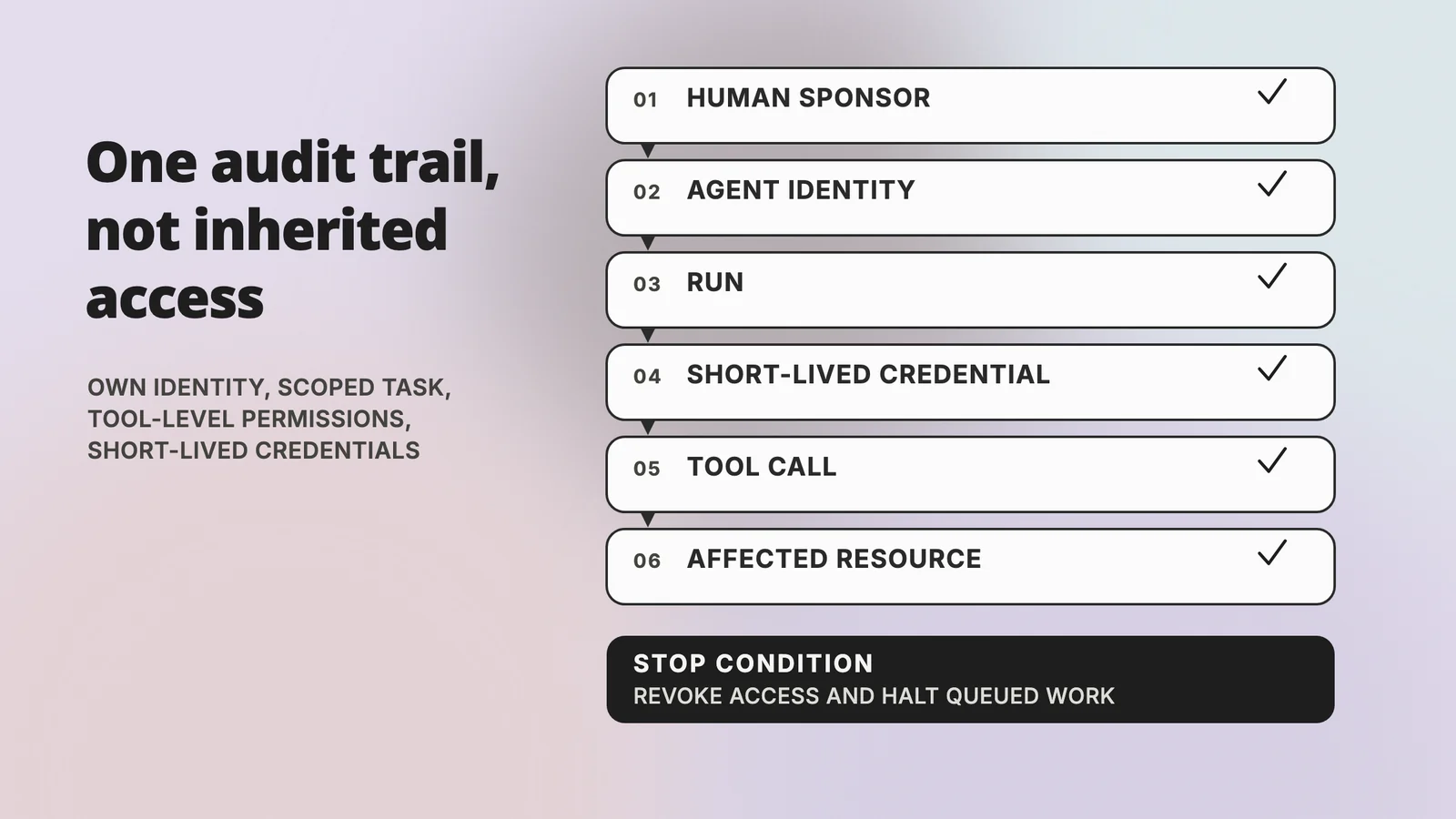
The category is young. Buyers should confirm whether each capability is generally available, in preview, or dependent on another product. AI agent governance security also needs a practical stop condition. Test whether the organization can revoke the agent’s access and halt queued work before the reason for an anomaly is fully understood.
Teamvoy’s analysis of an AI agent security incident explains why endpoint, identity, delegated permissions, secrets, approvals, logs, and kill switches belong in one control chain.
Who provides AI-powered threat intelligence?
AI-powered threat intelligence comes from intelligence platforms and security vendors that collect, correlate, summarize, and prioritize external threat data. Recorded Future represents the dedicated-platform route. Broad security platforms also embed threat intelligence into detection and investigation workflows. Both routes still need a process that turns intelligence into action.
The value depends on what happens after a signal arrives. Intelligence that can’t be mapped to your assets, identities, suppliers, software, or active incidents becomes another feed for analysts to ignore. Ask the provider to show how a finding reaches a detection rule, investigation, ticket, block decision, or risk owner.
A useful pilot measures relevance rather than volume:
- What share of prioritized intelligence maps to assets or dependencies you operate?
- How often does the intelligence change a detection, investigation, or mitigation decision?
- How much analyst time goes into dismissing irrelevant findings?
- Can the system explain the evidence behind its priority?
- Does it preserve source provenance and confidence?
AI-powered threat intelligence can move a mature program earlier in the attack cycle. It cannot replace asset inventory, detection engineering, incident response, or ownership.
Should you buy a platform, hire a consultancy, or build custom automation?
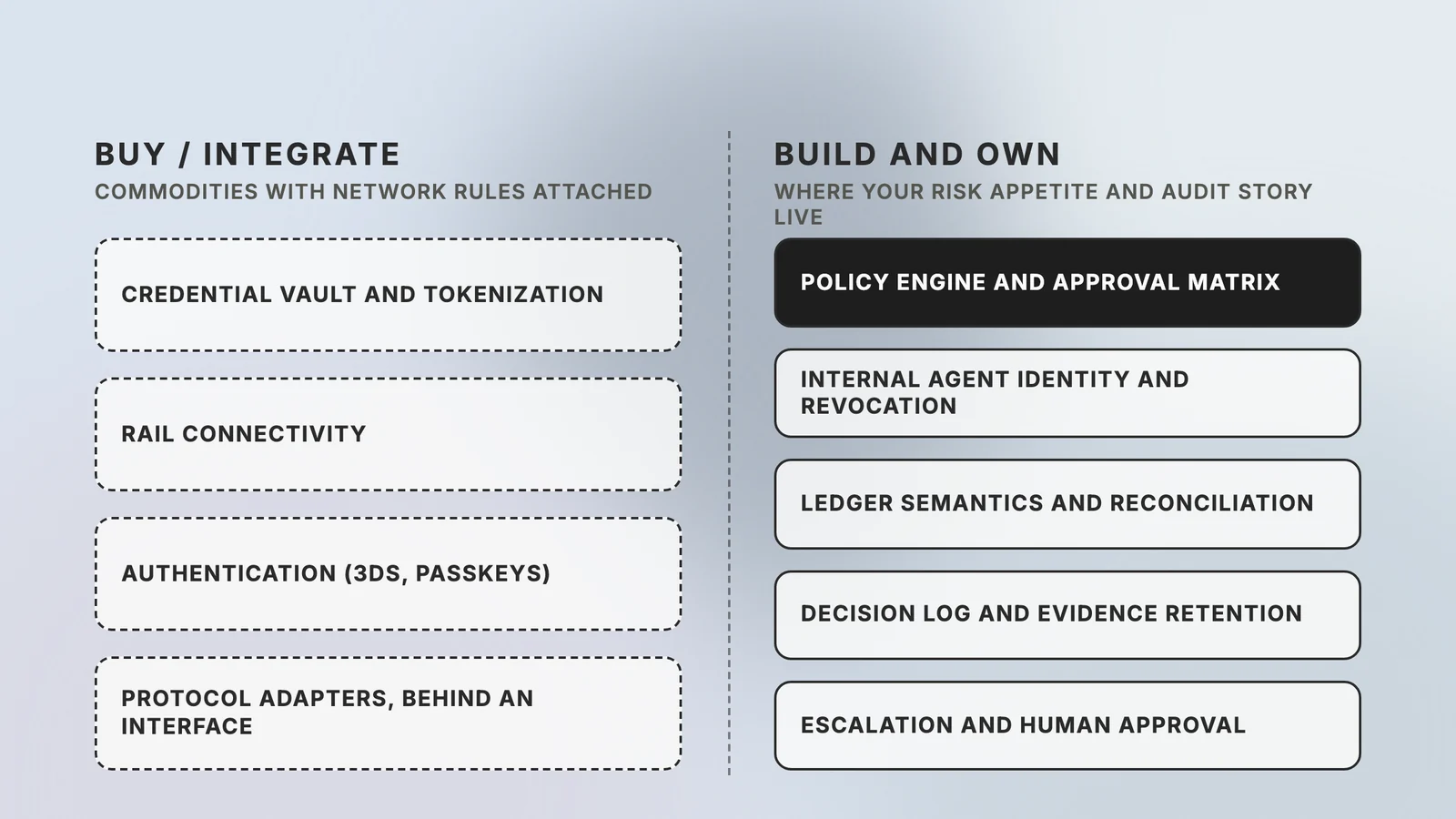
Buy a platform when the use case is standard and the supported integrations cover your stack. Hire a global consultancy when the program spans many business units, regions, platforms, and governance workstreams. Build custom automation when the security outcome depends on proprietary workflows, legacy systems, unusual data boundaries, or approval logic a packaged tool cannot express.
| Route | Time to first value | Custom fit | Internal capacity required | Best use | Trade-off |
| Packaged platform | Usually fastest | Limited to supported models, connectors, and workflows | Security administrators and platform owners | Standard detection, investigation, posture, identity, or response workflows | Faster deployment can come with platform dependence and migration cost |
| Focused specialist | Fast for a narrow workflow | Moderate within the specialist’s domain | A clear process owner and integration support | One measurable bottleneck such as triage or threat intelligence | Another tool and operating model enter the stack |
| Global consultancy/integrator | Slower startup, broad program scope | High at program level | Executive sponsorship, governance, procurement, and internal SMEs | Estate-wide transformation | More coordination layers and a longer path to operational ownership |
| Custom engineering partner | Moderate; depends on integration depth | Highest around proprietary systems | Product, security, and engineering owners | Legacy, regulated, or differentiated workflows | You own a custom system and its maintenance obligations |
| In-house build | Slowest unless a platform team already exists | Highest | Dedicated security engineering and platform capacity | Core capabilities that create strategic differentiation | Opportunity cost and permanent maintenance load |
One trade-off runs against the commercial interest of engineering partners, Teamvoy included: if a product handles the workflow safely and fits the existing stack, buy it. Custom code should solve a constraint, not express a preference.
How do you choose the right provider?
Choose a provider by defining one measurable workflow, mapping the systems and permissions it needs, and testing it with production-like evidence. Start small enough to see why each result occurred. Expand only after the pilot demonstrates quality, safe actions, manageable operating effort, and a clear owner.
Use this sequence:
- Select one workflow. Pick a recurring, measurable problem such as identity-alert investigation, cloud finding triage, phishing remediation, or threat-intelligence prioritization.
- Record the baseline. Measure volume, analyst time, false positives, missed cases, time to triage, time to containment, and administrative effort.
- Map the integration surface. List data sources, APIs, permissions, network paths, ticketing, messaging, asset context, and proprietary systems.
- Define action boundaries. Write which steps are read-only, reversible, approval-gated, or prohibited.
- Run the pilot on representative cases. Include normal cases, ambiguous evidence, missing data, integration failures, and adversarial inputs.
- Measure the operating cost. Count tuning, connector maintenance, policy changes, exception handling, and review time.
- Make the rollout decision. Expand, redesign, or stop. A pilot that exposes a poor fit has done useful work.
| Pilot measure | Why it matters | Example decision threshold |
| Analyst acceptance | Shows whether investigations or recommendations are usable | Set from your baseline; never borrow a vendor-wide target |
| False-positive and missed-case rate | Reveals whether speed is hiding quality loss | Compare the same scenario set before and during the pilot |
| Time to triage and containment | Tests operational impact | Measure median and high-percentile cases, not the best demonstration |
| Unauthorized or failed actions | Tests control design | Every event requires review; define whether any is tolerable before launch |
| Rollback success | Proves reversible actions are genuinely reversible | Exercise rollback rather than documenting it only |
| Administrative hours | Captures hidden operating cost | Include connector, policy, prompt, playbook, and permission maintenance |
| Audit completeness | Tests whether decisions can be reconstructed | Require actor, evidence, action, approval, result, and timestamp |
An AI readiness assessment can help identify whether the first constraint is data access, architecture, security boundaries, evaluation coverage, cost control, or the deployment path.
Conclusion
Products, specialists, consultancies, and engineering partners solve different parts of the security workflow. Start with the action you want to change, then test data access, permissions, integration, quality, rollback, auditability, and ownership. The provider that fits those constraints is more useful than the one with the longest feature list.
Talk to Teamvoy About AI Security Automation
If your security workflow crosses proprietary applications, legacy systems, regulated approvals, or data boundaries a packaged product cannot support, Teamvoy can assess the integration path and build the missing automation. Start with AI integration services or an AI readiness assessment, and bring one target workflow plus your current stack diagram.