






























1. What should you have ready before asking for quotes?
Vendors price what you describe. When something is missing, each vendor fills the gap with its own assumption, and the quotes stop being comparable.
- Every provider, merchant account and payment method in use today, and the ones you want at launch.
- The markets and currencies you sell in, and which of them require strong customer authentication.
- Monthly payment volume, peak days and how many cards or mandates are stored today.
- Who in finance owns payout reconciliation, and who signs your PCI attestation.
- The date that actually matters: a launch, a provider contract ending, a PCI assessment or a new market.
2. Which details change the scope and the price?
2.1 How many providers, markets and methods launch together?
Each extra provider, local method or currency adds mapping, testing and its own settlement report. Launching in waves is cheaper than launching everything at once.
Ask the vendor: Which methods are in the first release, and which follow?
2.2 Are there subscriptions or stored cards?
Recurring payments bring stored credentials, retries for failed renewals, card updater services and merchant-initiated transaction rules, all of which need their own tests.
Ask the vendor: How are failed renewals retried, and on what schedule?
2.3 Do you split payments between sellers?
Marketplace and platform payments add seller onboarding, identity checks, split payouts and negative balances, which is a different product from a single checkout.
Ask the vendor: Who handles seller onboarding and payouts, and which provider product does it use?
2.4 Where is card data allowed to travel?
Hosted fields keep card numbers off your servers and keep the self-assessment short. Taking card numbers through your own API brings most of PCI DSS into scope.
Ask the vendor: Which SAQ type does your design assume, and why?
2.5 Is authorisation separate from capture?
Shipping later, partial shipments or variable totals mean authorising now and capturing later. Authorisations expire after a period set by the card network and card type, so late captures can fail.
Ask the vendor: What happens when an authorisation expires before capture?
2.6 Do you need a second provider?
Failover or routing by market needs a provider-neutral payment model and a plan for cards stored with the first provider.
Ask the vendor: Can the second provider charge cards stored with the first, and how?
2.7 Do stored cards have to move from another provider?
Card migration runs through a secure transfer between providers. Some processors charge for the export, and it can take from days to months. Cards saved inside wallets such as Google Pay are tokenised by the wallet and usually cannot be moved.
Ask the vendor: Who requests the export, and is the timeline in the plan?
2.8 Which markets need strong customer authentication?
In the EEA and UK, most online card payments need 3-D Secure or a valid exemption, and the challenge has to work inside your mobile app as well as on the web.
Ask the vendor: How is the 3-D Secure challenge tested inside our app?
3. Which costs often sit outside the quote?
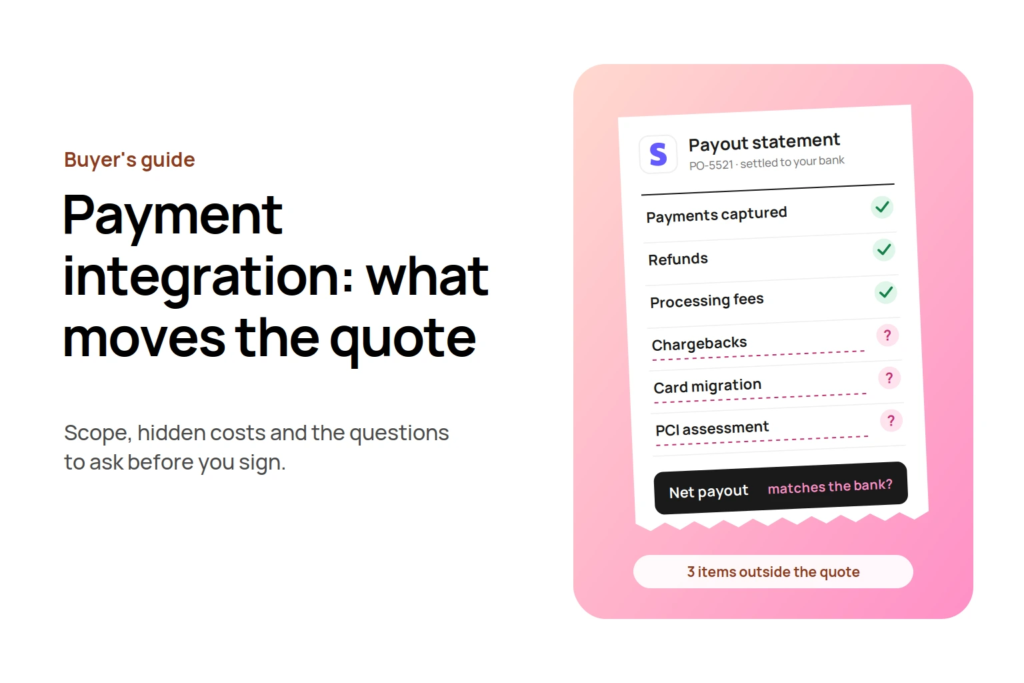
A quote can be accurate and still leave things out, like a caterer who prices the food but not the staff. Check each of these.
3.1 Which pricing model does your provider use?
You pay the provider, on blended or interchange-plus pricing. The model changes what finance has to reconcile, not only what you pay.
Ask the vendor: Does the reconciliation design handle our provider’s fee structure line by line?
3.2 Who pays for the PCI assessment?
You do, whether it is a self-assessment or an assessor’s report. The integration design decides how large that job is.
Ask the vendor: How many PCI requirements will apply to us after this design?
3.3 What does the card export cost?
Some processors charge for exporting stored cards, and the timeline is theirs, not your vendor’s.
Ask the vendor: Have you included the export request and its waiting time?
3.4 Who prepares chargeback evidence?
Dispute handling is often left out of the build, and each lost dispute costs the payment plus a fee.
Ask the vendor: Who assembles evidence before the deadline, and from which systems?
3.5 Who supports payments after go-live?
Support is usually quoted separately, if at all.
Ask the vendor: How many weeks are included, and who is on call when payments fail?
3.6 Who updates the integration when the provider changes its API?
Providers version their APIs and retire old ones. Upgrades are often billed as change requests.
Ask the vendor: Is staying on a supported API version part of support, or extra each time?
3.7 How much of your finance team’s time will it take?
Reconciliation sign-off and testing are internal effort you pay for in time.
Ask the vendor: How many days will finance spend on mapping and testing?
4. How do you compare providers?
Most providers can take a test payment. These questions show how each one handles what happens after the first charge.
4.1 What happens if the payment request times out?
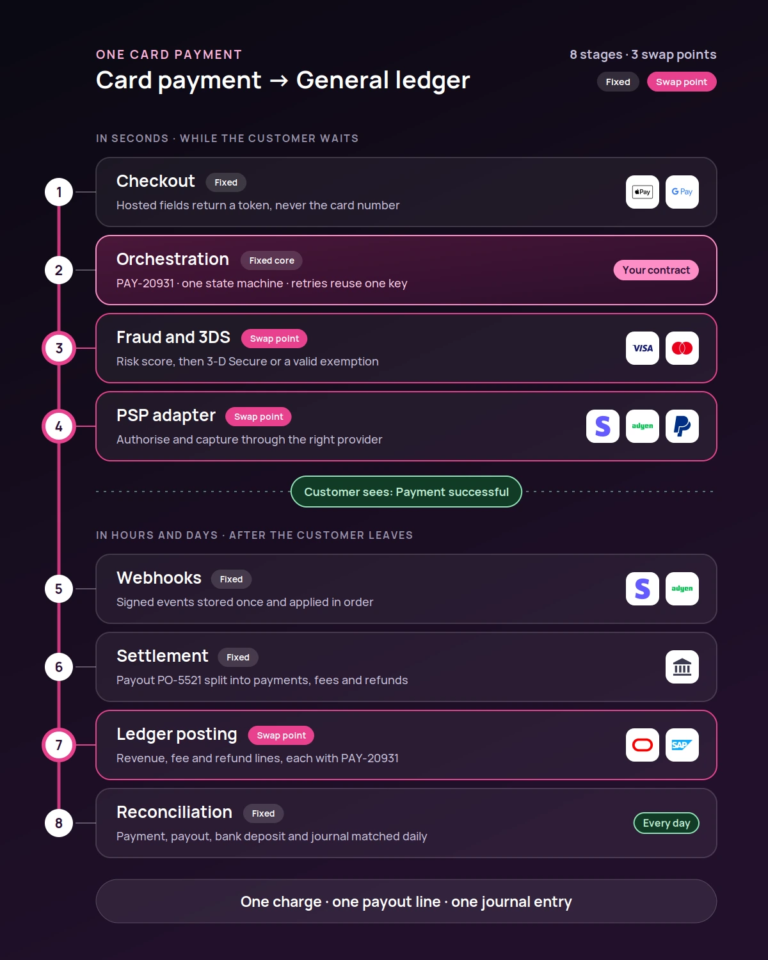
A common answer: the request is retried. What to look for: the same idempotency key on every retry, and a replay test that proves one charge.
4.2 What happens if a webhook arrives twice, or out of order?
A common answer: webhooks update the order. What to look for: events stored, deduplicated and applied through one state machine.
4.3 How will you know a payout is complete?
A common answer: totals are checked against the provider dashboard. What to look for: each payout matched line by line to payments, fees, refunds and the bank deposit.
4.4 Where will provider-specific code live?
A common answer: across checkout and order services. What to look for: one adapter per provider behind your own payment contract.
4.5 Who made this estimate?
A common answer: a pre-sales team. What to look for: the engineer who will build it.
5. What should you clarify before signing?
- How reconciliation, disputes and support after go-live are covered, not only the checkout.
- Acceptance criteria that include timeouts, duplicate events and refunds, not only a successful payment.
- The PCI self-assessment type the design assumes, and who maintains the script inventory on the payment page.
- Whose name the provider accounts, API keys and webhook endpoints are in.
- That finance signs off the settlement and ledger mapping before building starts.
6. Where does Teamvoy stand on each of these?
Our readiness audit marks every item in sections 2 and 3 as included, excluded or provided by you, before any build is priced. You can then compare our proposal with anyone else’s line by line, and nothing turns up later as a surprise change request.