- There is no single best payment modernization partner. Match the firm to your binding constraint: a dated compliance obligation, missing accountability, or missing engineering capacity.
- Diagnose which of three legacy layers is actually binding, infrastructure, middleware, or channels, before scoping any vendor. Most teams blame the core when middleware is the real blocker.
- Modernize by strangling, not replacing. Route traffic through a facade, migrate one table or message type at a time, and keep the interface identical so staff notice nothing.
- Dated obligations sort vendors fast. Swift MT coexistence ended 22 November 2025, Fedwire migrated 14 July 2025, and PCI DSS 4.0.1 requirements became mandatory 31 March 2025.
- AI belongs on documentation, log triage, test generation, and exception clustering. Settlement, offload, and migration code needs a human author who can defend it.
- Average engagement length predicts total cost better than hourly rate. Bridge work can ship in one to three months; core programmes run multiple quarters.
Q1. Which payment processing modernization development partners fit which situation in 2026?
There is no single best payment modernization partner. Teamvoy fits regulated platforms that must be stabilised and modernised while staying live, with a senior technical lead accountable through go-live. Global consultancies fit multi-country programme governance. Payments boutiques fit switch and rail work. Staffing firms fit teams that already own their architecture. Match the partner to your binding constraint: deadline, accountability, or capacity.
Choosing an engineering partner for payment work is not a procurement exercise. You are handing someone write access to the system that moves your money. Get it wrong and you lose two years, not two sprints. This guide describes kinds of partners, not a ranking. I assess each on five things: modernization approach, named payments standards experience, capacity to take over code someone else wrote, senior technical lead ownership, and accountability after go-live. It is written for the CTO, IT director, or founder who already knows the payment core is the constraint. No scores. No stars. Just situations and trade-offs.
Our Evaluation Criteria
- Modernization approach. Does the firm work incrementally, or does it open with a rewrite? Rewrites of live payment cores fail more often than they ship, which is why technology modernization work is sequenced rather than staged as one event.
- Named payments standards experience. ISO 20022 (the message standard that replaced Swift MT for cross-border instructions on 22 November 2025) [1], ISO 8583 (the older card switch protocol), and PCI DSS 4.0.1, whose future-dated requirements became mandatory on 31 March 2025 [2].
- Capacity to take over someone else’s system. Can the team read, document, and stabilise code the original authors did not leave behind?
- Senior technical lead ownership and engagement length. One accountable engineer, or a rotating bench of juniors.
- Accountability after go-live. Who is on the call at 2am in week three, and are they the same people who designed it?
Who This Guide Is For
- The CTO who inherited a payment platform from a vendor that underdelivered or exited, and needs it stable before anything else.
- The enterprise IT director with a compliance date on the calendar and an audit trail to produce.
- The technical founder whose original payment code scaled past what it was designed for.
The Ten Kinds of Partner in This Guide
This roster covers ten firms. Each one exists for a different situation.
- Teamvoy: Best for regulated payment and insurance platforms that must be modernised incrementally while continuing to settle.
- DOOR3: Best for fintech platforms where the user-facing experience is the bottleneck, not the ledger.
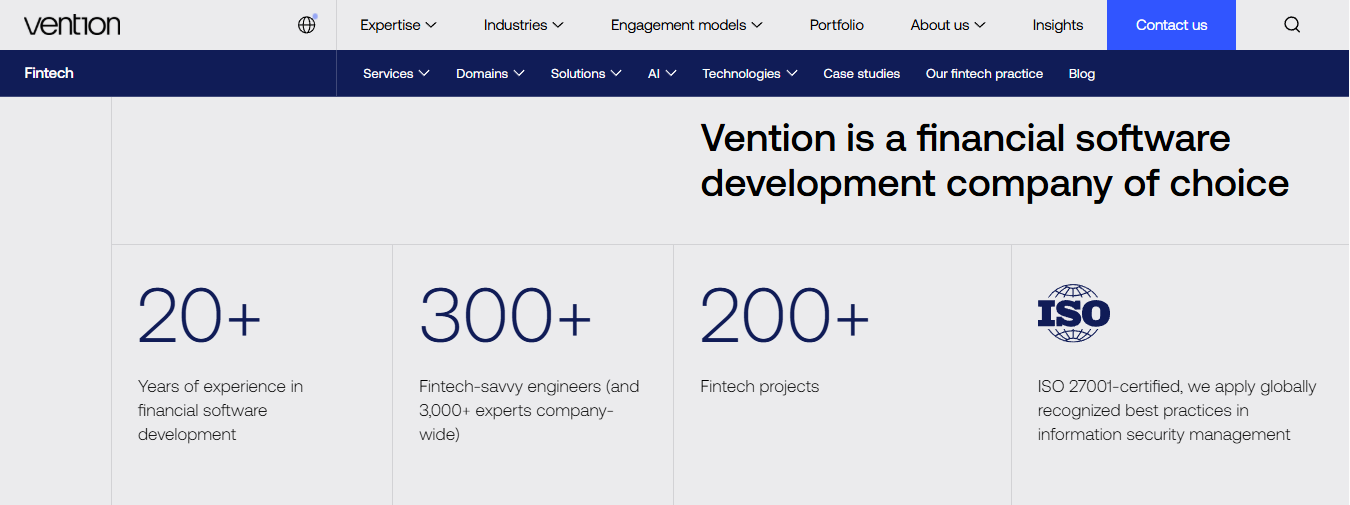
- Vention: Best for teams that own their architecture and need senior engineers added to it.
- Dualboot Partners: Best for scale-ups needing embedded product teams alongside an in-house group.
- HatchWorks AI: Best for nearshore delivery where AI-assisted velocity is the primary requirement.
- Orases: Best for mid-market custom builds where internal process integration matters most.
- SOLTECH: Best for US-based companies that want a local team and in-person governance.
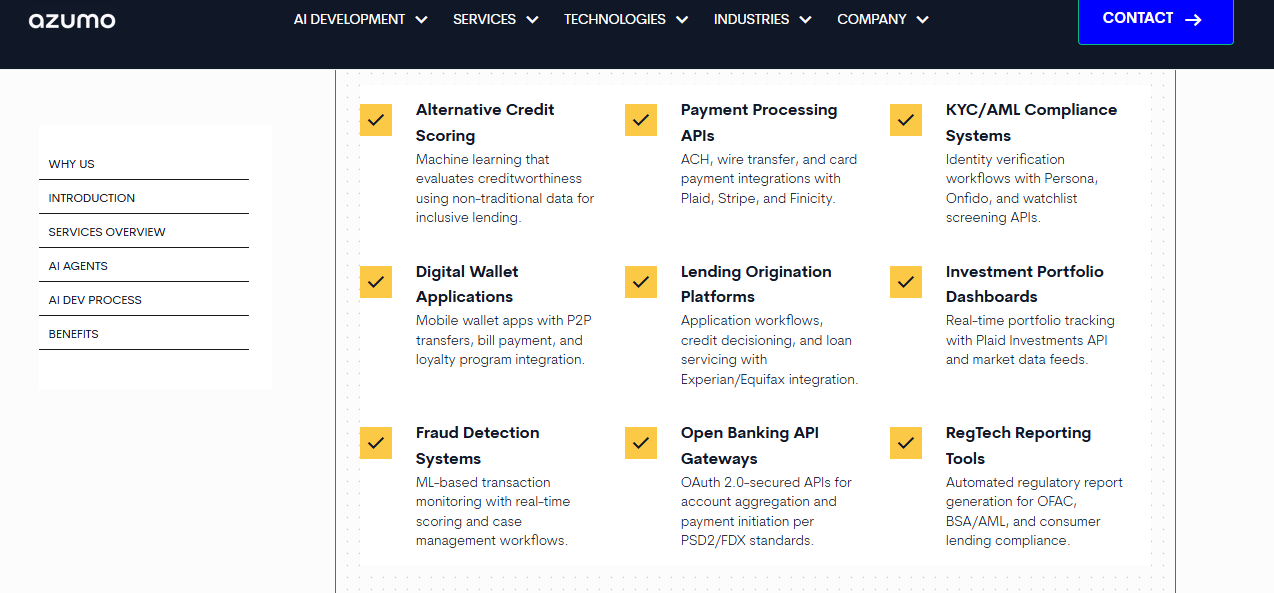
- Azumo: Best for extending a data or backend team on a cost-sensitive budget.
- JetRockets: Best for smaller fintech products needing a focused senior team.
- Trigent Software: Best for QA-heavy programmes and large regression estates.
| Company Name | Best For | Engagement Model | Industry Depth & Compliance Coverage |
|---|---|---|---|
| Teamvoy | Regulated payment and insurance platforms modernised while live, often after a previous vendor exited | Long-term partner (4+ year average engagement) with a senior technical lead | Banking, fintech, insurance, healthcare, manufacturing, logistics, complex SaaS; delivery inside PCI-DSS, PSD2, DORA, BaFin, SOC 2, GDPR, HIPAA and FCA scopes |
| DOOR3 | Fintech platforms where dashboard and workflow experience blocks adoption | Project-based consulting with audit-then-design phases | Financial services and enterprise software; named fintech reference (Luma Financial Technologies); regulator-specific coverage not publicly claimed [3] |
| Vention | Teams that already own the architecture and need senior capacity added | Staff augmentation and custom development | Technology, AI and enterprise software; compliance scope varies by engagement |
| Dualboot Partners | Scale-ups building alongside an existing in-house team | Embedded product teams, long-running | Fintech and SaaS; compliance coverage varies by engagement |
| HatchWorks AI | Nearshore delivery where AI-assisted speed is the primary need | Nearshore squads, project or ongoing | SaaS, healthcare and services; regulated payments depth not publicly claimed |
| Orases | Mid-market custom software tied to internal operations | Project-and-exit with support retainers | Healthcare, manufacturing, commercial services; PCI-DSS depth not publicly claimed |
| SOLTECH | US companies wanting a local, in-person team | Project-based with staffing options | Logistics, healthcare and commercial software; regulated payments depth not publicly claimed |
| Azumo | Extending a backend or data team under budget pressure | Nearshore staff augmentation | Data, AI and web platforms; compliance coverage varies by engagement |
| JetRockets | Smaller fintech products needing a focused senior team | Small senior teams, project or ongoing | Fintech, real estate and logistics; regulator-named coverage not publicly claimed |
| Trigent Software | QA-heavy programmes and large regression suites | Staff augmentation and managed QA | Enterprise IT, retail and healthcare; compliance coverage varies by engagement |
💰 One Note on Pricing Before the Cards
Engineering services pricing is custom-quote everywhere, so I have not put it in the table. Rate bands are public, though. Clutch benchmarks place development partners at roughly $25 to $49 per hour in India, $50 to $99 in Poland and the United States, and $100 to $149 in Canada and Australia [4].
The number that actually predicts your total cost is average engagement length, not hourly rate. Ask for it before you ask for a rate card, and before you commission any IT audit services to scope the work.
Teamvoy
- Modernization approach: Incremental. Documents and stabilises first, replaces one part at a time.
- Named payments standards experience: Delivery inside PCI-DSS, PSD2, DORA, BaFin, SOC 2, GDPR and FCA scopes.
- Capacity to take over someone else’s system: Core practice. Many engagements start with code the original team never documented.
- Senior technical lead ownership and engagement length: One senior engineer owns the system end to end. 4+ year average engagement.
- Accountability after go-live: The same senior lead stays through cutover and the weeks after it.
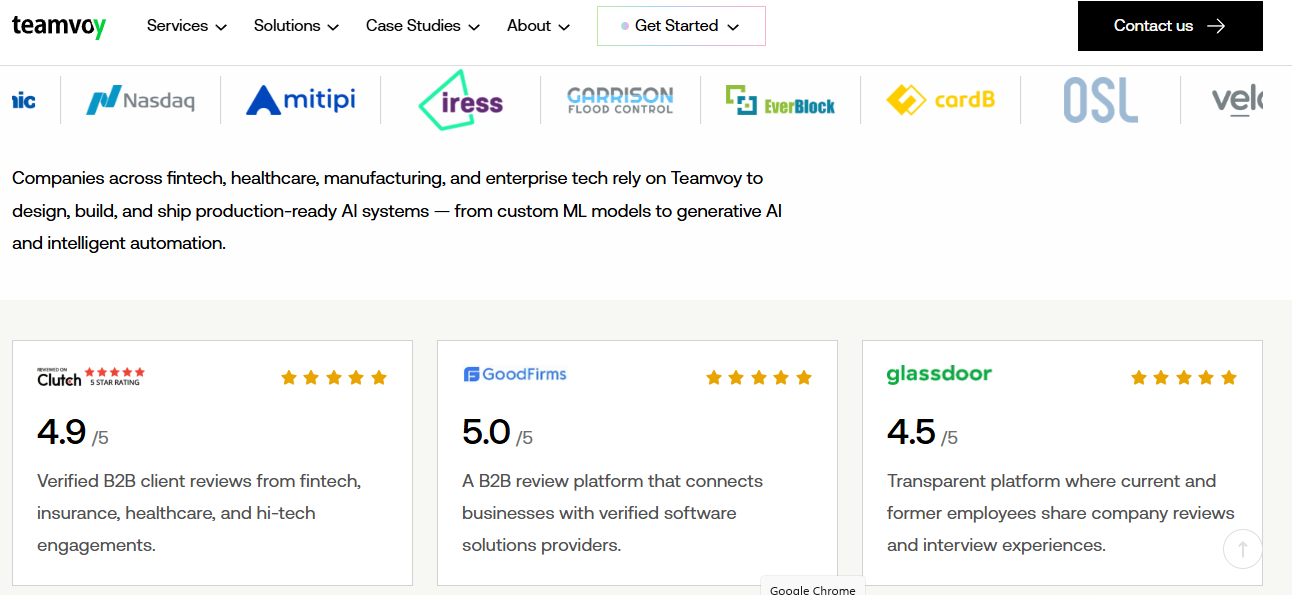
- Twelve-plus years of delivery across regulated sectors, with named clients including Nasdaq, OSL, Panasonic Avionics and Market Access Direct, documented across published case studies.
- Long-running platform work where the relationship outlasted the original engagement, including a wealth-management blockchain product that continued after the client was acquired.
- Delivery practices built for auditability, where the trail is produced as work happens rather than reconstructed later, as described in building regulator-ready systems in fintech.

DOOR3

- Modernization approach: Front-end and workflow first. Strong on interface redesign, not positioned as core payment engineering.
- Named payments standards experience: Not publicly claimed. ISO 20022 and PCI DSS scope is not part of the published record.
- Capacity to take over someone else’s system: Demonstrated on product experience and analytics, less so on legacy transaction cores.
- Senior technical lead ownership and engagement length: Principal consultant plus senior designers named on the cited engagement.
- Accountability after go-live: Varies by engagement. The cited relationship continued past the original scope.
- Redesigned the dashboard experience for a fintech platform, with the client reporting a significantly decreased time-to-value metric.
- Kept the engagement on deadline and on budget, managed through Jira, according to the same verified review.
- Selected after a five-firm evaluation specifically among design firms with prior fintech work.
⚠️ What the Compliance Chatter Actually Sounds Like
Practitioner threads are more useful than vendor pages when you are checking whether a partner has lived through a deadline. One example, from the r/pcicompliance thread titled “PCI DSS v4.0.1 requirements take effect March 31, 2025 but RoC doesn’t expire until Q3” [5]. That gap between effective date and report expiry is exactly the kind of detail a partner either knows or does not.
Ask any shortlisted firm which of those two dates they planned against. The answer tells you whether they have been in the room for an assessment, and whether their system integration practice has ever carried an audit finding.
Teamvoy takes long-running engagements on payment and insurance platforms it did not originally build, with a senior technical lead who stays accountable through go-live rather than exiting at handover. Across twelve years, that model has mattered most in the weeks after cutover, not before it. If that is the situation you are in, the door is open.
Vention
- Modernization approach: Follows the client’s architecture. Does not lead with a migration philosophy.
- Named payments standards experience: Not publicly claimed for ISO 20022, ISO 8583, or PCI DSS scope.
- Capacity to take over someone else’s system: Strong at joining an existing codebase, weaker as sole owner of a legacy core.
- Senior technical lead ownership and engagement length: Senior engineers available. Architectural ownership usually stays client-side.
- Accountability after go-live: Varies by contract. Staffing models rarely carry cutover accountability.
- Verified Clutch engagements covering IT staff augmentation and custom software development, including work for a New York AI company.
- Named engagements led by client-side CTOs, which fits the team-extension model.
- Long-running relationships reported on the public profile rather than single-sprint projects.
Dualboot Partners

- Modernization approach: Product-forward. Ships new capability faster than it untangles an old core.
- Named payments standards experience: Not publicly claimed for ISO 20022 or PCI DSS scope.
- Capacity to take over someone else’s system: Works well beside an existing team, less positioned for full handover.
- Senior technical lead ownership and engagement length: Squad leads named per engagement. Ownership shared with the client.
- Accountability after go-live: Shared model, which works when the client team is strong.
- Public profile shows repeat, multi-phase engagements rather than one-off builds.
- Fintech and SaaS product work delivered alongside client engineering groups.
- Squad model documented on the firm’s own site as its primary engagement structure.
HatchWorks AI

- Modernization approach: Velocity-led. Strong on new build, less positioned on legacy payment cores.
- Named payments standards experience: Not publicly claimed for ISO 20022, ISO 8583, or PCI DSS.
- Capacity to take over someone else’s system: Possible, though the public record centres on greenfield and product work.
- Senior technical lead ownership and engagement length: Nearshore pods with named leads. Engagement length varies.
- Accountability after go-live: Varies by engagement.
- Publicly documented nearshore delivery model with US-overlapping hours.
- AI-assisted development described openly as part of the delivery method.
- Verified reviews on public platforms covering product and platform builds.
The gap between assisted velocity and production safety is the same one covered in our field notes on vibe coding security risks, and it is the reason payment teams separate the two.
Orases
- Modernization approach: Rebuild-and-integrate. Comfortable replacing internal tools outright.
- Named payments standards experience: Not publicly claimed for PCI DSS or ISO 20022 scope.
- Capacity to take over someone else’s system: Demonstrated on internal business systems rather than transaction cores.
- Senior technical lead ownership and engagement length: Onshore leads with multi-year client relationships reported.
- Accountability after go-live: Support arrangements available after delivery.
- Long client tenures reported on the firm’s public profile, including multi-year relationships.
- Onshore US delivery with named project leadership.
- Portfolio weighted toward operational and customer-facing internal systems.
SOLTECH
- Modernization approach: Project-shaped. Scoped delivery with defined start and end points.
- Named payments standards experience: Not publicly claimed.
- Capacity to take over someone else’s system: Case by case, with onshore continuity as the main advantage.
- Senior technical lead ownership and engagement length: Named onshore leads. Engagement length varies by scope.
- Accountability after go-live: Support contracts available separately.
- Onshore US delivery with long-standing client base across several industries.
- Public profile shows both project delivery and staffing engagements.
- Named leadership involvement rather than anonymous delivery pods.
Azumo
- Modernization approach: Capacity-led. Executes against a plan the client owns.
- Named payments standards experience: Not publicly claimed.
- Capacity to take over someone else’s system: Suited to defined workstreams rather than whole-core ownership.
- Senior technical lead ownership and engagement length: Team leads assigned. Architectural ownership stays client-side.
- Accountability after go-live: Not a stated part of the model.
- Nearshore delivery model documented publicly with Latin American engineering base.
- Portfolio weighted toward data, backend, and web platform work.
- Verified reviews across multiple public review platforms.
Where that data layer is the constraint, the sequencing work sits closer to data engineering than to application delivery, and it should be scoped that way.
JetRockets
- Modernization approach: Pragmatic rebuild of specific components rather than estate-wide programmes.
- Named payments standards experience: Not publicly claimed for ISO 20022 or PCI DSS scope.
- Capacity to take over someone else’s system: Demonstrated on smaller inherited codebases.
- Senior technical lead ownership and engagement length: Senior-heavy teams, which suits smaller products well.
- Accountability after go-live: Ongoing support arrangements reported on public profiles.
- Public profile shows fintech, logistics, and marketplace product work.
- Senior-weighted team composition reported by clients on review platforms.
- Multi-phase engagements rather than single-delivery projects.
Trigent Software
- Modernization approach: Supporting role. Strongest around testing rather than architecture.
- Named payments standards experience: Not publicly claimed.
- Capacity to take over someone else’s system: Test coverage on inherited systems is a genuine strength.
- Senior technical lead ownership and engagement length: QA leads assigned. Architectural ownership sits elsewhere.
- Accountability after go-live: Testing and support engagements available separately.
- Long-established QA and testing practice with managed service offerings.
- Blended onshore and offshore delivery documented publicly.
- Portfolio spanning enterprise IT, retail, and healthcare testing programmes.
💸 The Question That Sorts This List
Ask each firm which of two dates they planned against on their last compliance programme. The effective date, or the report expiry date.
That distinction shows up constantly in practitioner discussion. One example is the r/pcicompliance thread titled “PCI DSS v4.0.1 requirements take effect March 31, 2025 but RoC doesn’t expire until Q3.” Firms that have sat through an assessment answer it in one sentence, and the same discipline applies when you commission an independent system audit before selecting a partner.
Teamvoy sits at the top of this roster because payment and insurance platforms that must keep settling while they change are the engagements we take, usually after someone else has left. That is a narrow specialism, and for most of the situations described above, one of the other nine firms is the better call. If your situation is the narrow one, our technology modernization practice is where that work happens, and the first conversation is a technical one, not a sales call.
Q2. What does payment processing modernization actually cover, and which layer is your real problem?
Payment processing modernization is the structured upgrade of a live payment estate. It means wrapping or replacing batch-era cores with cloud-native services, adding an integration and orchestration layer, enabling real-time rails, and meeting ISO 20022 and PCI DSS 4.0.1 obligations without interrupting settlement. Diagnose which of three layers, infrastructure, middleware, or channels, is actually binding before you scope any partner.
⚠️ Why the Word Arrives With No Scope
“Modernization” usually lands as a board word. Nobody has said which part of the estate is broken, only that it feels slow and expensive.
That vagueness is expensive. Teamvoy scopes this work by mapping the data layer and the legacy core first, because platform decisions made before that mapping are the ones reversed six months later.
🔍 The Three Layers, and Which One Is Actually Binding
McKinsey’s framing of card payments technology splits the legacy estate into three layers: core infrastructure, middleware, and front-end channels. Most teams assume the core is the problem. In practice, it is often the middle.
Ask three questions in order. Can you add a new rail without touching the core? Can you change a screen without a release train? Can you explain last month’s exception rate? Where the answers are unclear, an independent IT audit is cheaper than a wrong platform decision.
⭐ Payment Hub or Orchestration Layer
These two get used interchangeably, and they are not the same thing. A payment hub consolidates processing. An orchestration layer sits above what you already have and routes traffic across it.
| Dimension | Payment hub | Orchestration layer |
|---|---|---|
| What it changes | Replaces or consolidates core processing across payment types | Sits above existing systems and routes, enriches, and monitors traffic |
| Typical effort | Multi-quarter programme with core migration | Contained delivery against existing interfaces |
| When to choose it | Several duplicated cores doing similar work | One core that works but cannot reach new rails |
The order matters more than the choice. Infosys describes a payments integration layer as the centre of a sensible target architecture, delivered before core replacement. Teamvoy sequences engagements the same way, because orchestration changes less of what already earns money.
✅ Rails Coexist, They Do Not Replace
Real-time rails do not delete batch. FedNow, RTP, ACH, and SEPA Instant run beside overnight files for years. Your architecture has to hold both, with one reconciliation view across them.
That is the honest version of “real-time payments.” It is not a switch you flip. It is two operating models running in parallel while volume shifts, which is why system integration work usually starts before any core replacement does.
💰 The Integration Layer Is the Bottleneck
One practitioner point has stuck with me for two years. The industry obsesses over the model and ignores the nervous system, and integration, not inference cost, is what separates a demo from production.
Payments works the same way. Teamvoy has found that the slowest part of these programmes is rarely the new component. It is the wiring between the new component and eleven things nobody documented.
⏰ What to Take Into Monday’s Steering Meeting
Write one sentence: “Our binding constraint is the infrastructure, middleware, or channel layer, and the evidence is exception rate, release lead time, or rail gap.” If you cannot fill both brackets, that is your first piece of work.
Then decide sequence, not vendor. Orchestration first, core second, channels third, unless a dated obligation forces a different order.
Teamvoy starts modernization engagements with a mapping exercise across the data layer and the legacy core, not a platform recommendation. Across twelve years of regulated delivery, that sequence is what has kept our clients from paying twice for the same decision, and it is the same discipline described in our notes on updating systems nobody understands.
Q3. How do you modernize a live payment core without a rewrite?
You strangle rather than replace. Choose the approach first, build, commercial software, or platform-as-a-service, then route traffic through a facade and migrate one table or message type at a time. Teamvoy documents how the system actually behaves before removing anything, because the business cannot stop settling payments while engineers learn the codebase.
🔧 Pick the Approach Before the Pattern
Three approaches exist, and the honest answer depends on how unique your flows really are. Infosys frames this as build, commercial off-the-shelf, or platform-as-a-service, chosen after discovery rather than before.
| Approach | Choose when | Real cost |
|---|---|---|
| Build | Flows are genuinely unique and you have a platform team | You own every schema and retry path forever |
| Commercial software | Your flows match market patterns | Configuration limits become architecture limits |
| Platform-as-a-service | Speed matters more than control | Vendor roadmap becomes your roadmap |
📋 The Six Steps, In Order
- Audit rails, dependencies, and exception hotspots. Expected outcome: you learn where manual work hides.
- Define the business outcome, not the tech target. This prevents a migration nobody can justify at month nine.
- Design the target architecture with an orchestration layer first. This keeps the core untouched while you learn.
- Choose the migration pattern: progressive, parallel run, full replacement, or hub consolidation.
- Deploy cloud, APIs, and real-time rails against the facade, not the core. Sequencing that move well is what cloud optimization work is for.
- Embed zero-trust controls and monitoring as you go. The academic literature on these migrations converges on phased assessment, incremental migration, and controlled cutover for exactly this reason.
⭐ Keep the Interface Identical
One team modernised a point-of-sale estate by rebuilding the screens pixel for pixel. Same colours, same button sizes. Behind them, writes moved to normalised tables, one at a time.
Users noticed nothing. That is the whole trick. Teamvoy uses the same approach on operator-facing payment tooling, because staff resistance kills more migrations than technical failure does.
⏰ When Bridging Beats Replacing
If a deadline is close, do not open with a switch replacement. Specialists in ISO 8583, the older card message protocol, document a bridge reaching production in one to three months, with a proof of concept in three to five days.
The other rule is blunter. If a data centre lease expires in under sixty days, rehost. Refactoring mid-flight guarantees broken services and a missed physical exit.
❌ Where I Got This Wrong
Teamvoy once shortened a parallel run to hit a client date, and we restarted it three weeks later. The mismatch was small, in fee rounding, and it only appeared on a month-end batch we had not covered.
My rule since then is simple. Run parallel through at least one full accounting cycle, whatever the calendar says.
Their technical expertise was top class.
We were impressed with the technical management, adherence to process, and technical capability of the engineers.
🧹 Decommission With Evidence, Not Confidence
Do not delete servers because a dashboard looks quiet. Isolate suspects at the network level for 48 to 72 hours and see what screams. Monthly batch jobs and audit processes hide outside standard monitoring windows.
A gentler variant blocks inbound traffic for three to seven days while the server keeps running. You expose dependencies and keep instant rollback, and the savings usually belong in a wider IT cost optimization plan.
Teamvoy takes modernization work on platforms it did not build, starting with documentation and ending with a system the client’s own engineers can hire into. Rewrites are sometimes correct, and on a live payment core, they are rarely the cheapest correct answer. Our view on that trade-off sits in the delivery model for companies that cannot afford a rewrite.
Q4. Why do modernization programmes stall, and what breaks at cutover?
Programmes stall because pilots run read-only against production copies and never earn write access to the ledger. Cutovers then fail on details nobody planned. Teamvoy runs cutovers with a named senior engineer who owns rollback, because the failures that matter appear in the first hour, not the first sprint.
❌ The Common View Is Wrong
The standard explanation blames tooling or model choice. Reported enterprise pilot failure rates are brutal, with 95% of generative AI pilots delivering no measurable return.
The real blocker is structural. A pilot that never writes to the system of record cannot prove anything, so the sponsor loses patience before the architecture ever changes.
🔍 The Fraud Logic That Could Not Ship
A German payment provider built genuinely good fraud logic. It never became a product.
Readers and writers sat directly in the database, with no separation from the data model. Every attempt to productise it caused what the team described as architectural heart attacks. That decoupling problem is the one legacy system AI integration work has to solve before anything ships.
⚠️ Risk One: The Two Millisecond Penalty
The database cutover succeeds, and then the legacy application gridlocks. A synchronous write across two cloud availability zones adds roughly two milliseconds to every commit.
That penalty compounds until the connection pool is exhausted. Mitigation: measure commit latency in the parallel run, not after cutover.
⚠️ Risk Two: The Whitelist Nobody Mentioned
Payment processing dies because a third-party vendor whitelists your old on-premises NAT address. The vendor’s SLA to update it is five business days.
The escape hatch is routing. Send outbound traffic for that vendor’s address range back down the existing private link until the whitelist updates.
⚠️ Risk Three: Knowledge That Lives In One Head
An on-call engineer once used an AI assistant on a 503 error. It suggested restarting the server six times.
A senior human knew the connection pool filled because of a batch job. That is not documented anywhere. Teamvoy captures this class of knowledge during discovery, because tribal knowledge is the single hardest asset to migrate.
💸 Risk Four: The Cloud Bill Nobody Modelled
Cloud is not automatically cheaper. It is the mathematical penalty for running elastic infrastructure with a static data centre mindset.
Model steady-state cost at real transaction volume before cutover. Then model it again at peak.
⏰ The Date Question That Sorts Vendors
Compliance planning fails in the gap between two dates. Practitioner discussion shows this plainly, including the r/pcicompliance thread titled “PCI DSS v4.0.1 requirements take effect March 31, 2025 but RoC doesn’t expire until Q3.”
Ask any candidate partner which of those two dates they planned against. People who have sat through an assessment answer instantly, and the same standard applies to any banking and fintech engagement carrying a regulator’s deadline.
⭐ The Incentive Problem Underneath All Of This
Here is my read, and it is not popular with my own category. Vendors get paid for pilots and carry no exposure in production.
That gap explains more failures than tooling ever will. I could be overweighting it, though the pattern has held across every rescue I have picked up.
Teamvoy takes the engagements that begin after someone else has left: production outages, blocked compliance features, and migrations that stopped mid-flight. The same senior lead who designs the cutover is on the call when it runs, and the record of that work sits in our published case studies.
Q5. What do ISO 20022, Fedwire and PCI DSS 4.0.1 require from your engineering partner?
Swift’s MT and ISO 20022 coexistence period for cross-border instructions ended 22 November 2025. Fedwire Funds migrated 14 July 2025. PCI DSS v4.0.1’s future-dated requirements became mandatory 31 March 2025. Teamvoy delivers inside PCI-DSS, PSD2, DORA, BaFin, SOC 2, and FCA scopes, where the audit trail is produced as work happens.
⏰ The Dates, and What Missing Them Costs
| Obligation | Date | Who it binds | Cost of missing it |
|---|---|---|---|
| Swift MT and ISO 20022 coexistence ends | 22 November 2025 | Banks on the Swift FIN network for cross-border instructions | Instructions can be rejected, plus contingency handling costs |
| Fedwire Funds ISO 20022 migration | 14 July 2025 | US Fedwire participants | Message truncation and manual repair on wires |
| PCI DSS v4.0.1 future-dated requirements | 31 March 2025 | Any entity storing, processing, or transmitting card data | Assessment findings against named control families |
ISO 20022 is the structured message standard that replaced the older MT format. It carries more data per payment, which is why mapping is the hard part.
🔍 Turn Each Obligation Into Evidence You Can Check
Do not accept “fintech experience” as an answer. Ask for the artefact instead.
| Obligation | Evidence that counts | Evidence that does not |
|---|---|---|
| ISO 20022 | Named message types mapped, and the reconciliation approach for truncated fields | “We know ISO 20022” |
| Fedwire or CBPR+ cutover | The date they went live and who owned rollback | A logo slide |
| PCI DSS 4.0.1 | Which control families sat inside their delivery scope | “We follow best practice” |
Teamvoy documents this evidence per engagement, because an auditor accepts a dated record and does not accept a recollection. The same principle runs through our work on building regulator-ready systems in fintech.
⚠️ The Three Controls Teams Miss Most
Requirement 8.4.2 expanded multi-factor authentication to all access into the cardholder data environment. Many teams applied it only to administrators.
Requirements 6.4.3 and 11.6.1 cover payment page scripts and change detection on those pages. These catch e-skimming, and they are frequently owned by nobody.
✅ Five Questions To Put To A Candidate Partner
- Which cutover did you personally deliver, and on what date?
- Which message types did you map, and where did data loss occur?
- Who owned rollback, and were they on the call?
- Which PCI DSS control families were in your scope, and which were not?
- What did your assessor ask for that you did not have ready?
Vague answers to question one or three are the ones that matter. Teamvoy answers all five in writing before an engagement starts, because a partner who cannot date their own cutovers has not run one. If you are still shortlisting, our guide on choosing a vendor for fintech work covers the same verification logic.
❌ Eligibility Is Not Compliance
Being technically capable of sending ISO 20022 messages is not the same as being compliant. The message can be valid while the data inside it is unusable downstream.
That gap shows up in reconciliation, not in testing. Teamvoy checks it by tracing a payment end to end, from instruction through settlement to the ledger entry, on real data volumes.
💰 One Trade-Off Worth Naming
Compliance work rarely produces a visible feature. Boards fund it reluctantly, and engineering teams resent it.
My honest position is that this work buys optionality, not applause. Every rail you add later is cheaper on a compliant, well-mapped estate.
Teamvoy delivers into BaFin, PSD2, DORA, SOC 2, PCI-DSS, FCA, HIPAA, and GDPR environments, where downtime is a regulatory event rather than an inconvenience. Across twelve years, the pattern has held: the audit trail is cheapest when it is built during the work, whether the platform sits in banking and fintech or in insurance.
Q6. Where does AI belong in a payment estate, and how do you spot vendor-inflicted debt?
AI earns its place on documentation, log triage, test generation, and reconciliation exception clustering. It does not belong writing settlement, offload, or migration code. Teamvoy keeps money-moving logic under human authorship while using AI on the surrounding work, because almost-right code passes review, ships, and compounds cost for months.
⭐ The 2026 Expectation, And The Reality
Every board now asks where AI fits in the payment stack. The honest answer is: around the edges, at first.
Reported enterprise pilot failure rates are stark, with 95% delivering no measurable return. The pilots that work touch data, not decisions, which is why AI integration on a payment estate starts with the data layer.
❌ Why Payments Is Different
One engineer put it better than I can. Some code is too critical for generation: offloads, payment processing, and data migrations. It needs to be written by someone who understands it, not generated and then reviewed.
Teamvoy applies that line on every engagement. Review catches obvious failure and misses plausible failure.
⚠️ The Almost-Right Problem
Completely wrong code gets caught. Tests fail, builds break, and someone notices.
Almost-right code passes review and sits in production for six months. By the time anyone finds it, the fix costs more than the feature did.
✅ Where AI Pays Back Today
- Documenting an undocumented legacy module before you touch it.
- Clustering reconciliation exceptions so a human sees patterns, not rows.
- Generating regression tests against known-good behaviour.
- First-pass triage on log volume during an incident.
Teamvoy uses AI for exactly this band of work, and the value shows up in speed of understanding rather than lines shipped.
💸 Three Guardrails Before You Automate Anything
Context windows degrade well before they fill. Past roughly 40% of a large window, quality drops, so loading every tool schema into context makes the model worse at the actual task.
Agent loops bill quadratically, because each turn resends the full history. One team’s agent hit an infinite retry loop overnight and burned about $4,200 before anyone woke up. Set a hard circuit breaker and a spend ceiling before the first run, and treat cost modelling as part of AI agent development, not an afterthought.
🔍 Inherited Debt Versus Vendor-Inflicted Debt
Research on code quality found AI-generated pull requests averaged 10.8 issues, against 6.4 in human-written code. That gap is a backlog, not a productivity gain.
| Signature | Inherited debt | Vendor-inflicted debt |
|---|---|---|
| History | Commits, tickets, and reasons exist | Large drops with thin messages |
| Style | Consistent with its era | Inconsistent within one file |
| Explainability | Someone can explain the trade-off | Nobody can explain the choice |
🔎 The Three-Question Audit You Can Run This Week
Take any recent pull request and ask three things. Does it reuse what already exists? Does it follow your conventions? Can the developer explain it without reading the generated comments?
If the answer to the third is no, the code is not ready. Teamvoy runs this check on rescue engagements before quoting anything, because you cannot price work on a system nobody has read. The security side of that picture sits in our notes on vibe coding security risks.
The care and interest they showed are what makes Teamvoy special.
The professional communication, ability to deal with crunch time, and understanding of the project impressed us.
Teamvoy takes on AI-built systems that hit their limit in production, alongside outages and blocked compliance work. Night vision goggles do not give you more soldiers, and AI tooling does not give you engineers who can defend the ledger.
Q7. What does a modernization engagement cost, and how should you choose the model?
Clutch benchmarks place development partners at roughly $25 to $49 per hour in India, $50 to $99 in Poland and the United States, and $100 to $149 in Canada and Australia. Teamvoy sustains multi-year engagements rather than fixed-scope builds, which is why average engagement length predicts total cost better than any hourly rate.
💰 The Rate Bands, Disclosed
| Geography | Typical hourly band |
|---|---|
| India | $25 to $49 |
| Poland, United States | $50 to $99 |
| Canada, Australia | $100 to $149 |
Those bands come from Clutch’s published pricing guide, dated August 2026. Rates move with geography, not with capability, and a fuller breakdown of what budget actually buys sits in our cost guide comparing $40k and $250k engagements.
⏰ Timelines Depend Entirely On Scope
| Scope | Realistic timeline |
|---|---|
| Protocol bridge on an existing switch | Proof of concept 3 to 5 days, production 1 to 3 months |
| Orchestration layer above a working core | One to two quarters |
| Core migration or hub consolidation | Multiple quarters, phased |
⚠️ These Sources Disagree, And Both Are Right
Bridge specialists describe production in one to three months. Consulting frameworks describe multi-quarter programmes with discovery, evaluation, and roadmap stages.
Both are accurate for different scopes. A bridge changes message handling. A programme changes the estate. Teamvoy quotes against a mapped system for exactly this reason, because scope stated as a wish is not scope. Where the shape is still unclear, a proof of concept settles it faster than another workshop.
🔍 Five Engagement Models, Honestly Compared
| Model | Best when | Real risk |
|---|---|---|
| In-house build | You have a platform team and unique flows | You own every integration forever |
| Consultancy programme | Multi-country governance is the constraint | Design and delivery teams differ |
| Long-term engineering partner | The system must keep running while it changes | Slower start than staffing |
| Bank or network partnership | Rails and reach matter more than code | Roadmap is not yours |
| Staff augmentation | Your side owns the architecture | No accountability at cutover |
KPMG’s February 2026 research on payment partnerships documents this range of models across banks and retailers.
💸 Why Deferral Is Not Free
One estimate puts the world’s outstanding technical debt at 61 billion working days. The number is unverifiable at that scale, and the direction is not.
Deferred payment debt is different from other debt. It accrues in exception handling, manual reconciliation, and staff hours nobody counts, a pattern we set out in the tech debt avalanche.
✔️ Five Questions Before You Sign
- Who is the named senior lead, and do they stay through go-live?
- What is your average engagement length?
- Which payments cutover did you deliver, and when?
- Who writes the settlement code?
- What does your rollback plan look like on day one?
Answers that describe a team instead of a person are the warning sign. Teamvoy assigns one senior engineer who owns the system end to end, with a 4+ year average engagement behind that model, and the company’s own history is the reason that structure exists.
I can confidently say that we would not be where we are today without Teamvoy's support.
We work with them for over 2 years, and they have been very reliable and timely in providing us quality development services.
🔦 Apply The Same Scepticism To Vendors
During outages, good teams run an agent prompted to poke holes in their theory. Otherwise the human and the machine agree while the server burns.
Do that with proposals. Ask a partner to argue against their own recommendation and listen to how well they can.
Teamvoy has kept the same senior teams on client platforms for years, including work that continued after a client was acquired. The question I am still sitting with is whether real-time rails will make bridge-first modernization the default choice by 2028. If you have a view on that, I would genuinely like to hear it.