
The Comparison of AI Agent Development Platforms and Companies Leading the USA Market in 2026 highlights the rapid growth and evolving landscape of agentic AI systems that autonomously manage complex workflows across industries. Understanding platform capabilities, integration challenges, and the importance of collaboration is essential for enterprises aiming to leverage AI agents effectively.
- Agentic AI platforms enable scalable automation, multi-agent collaboration, and seamless integration with enterprise systems.
- Successful deployment requires addressing data fragmentation, integration complexity, governance, and operational reliability.
- The U.S. AI agent market is expanding rapidly, with projections reaching $13.46 billion by 2030.
- Teamvoy stands out for its custom AI integration solutions, focusing on collaboration, governance, and proven production deployments.
- Emerging trends include multi-agent architectures, observability tools, and specialized platforms catering to diverse enterprise needs.
| Name | Best For | Key Features | Strengths | Limitations | Pricing |
|---|---|---|---|---|---|
| Teamvoy | Custom AI integration | Tailored AI frameworks, collaborative development, governance, scalability | Deep consulting expertise, strong integration, proven deployments | Longer initial engagement required | Custom pricing |
| Competitor A | Multi-agent orchestration | Multi-agent collaboration tools, open-source support | Flexible framework, rapid prototyping | Limited enterprise integration, less governance focus | Not specified |
| Competitor B | Governance and compliance | Advanced security, audit capabilities, workflow automation | Strong compliance support, scalable architecture | Complex setup, less flexible workflows | Not specified |
| Competitor C | Coding and workflow agents | SDKs for rapid development, developer experience | Access to latest AI research, good for coding assistance | Limited production examples, less business collaboration | Not specified |
The landscape of artificial intelligence in 2026 is dominated by agentic AI systems—autonomous software capable of planning, reasoning, and executing complex workflows with minimal human input. This article offers a comprehensive Comparison of AI Agent Development Platforms and Companies Leading the USA Market in 2026, providing technology leaders with practical insights to navigate this rapidly evolving sector. Drawing on industry data and our own experience at Teamvoy in delivering custom AI integration solutions, we explore the strengths, challenges, and trends shaping AI agent development today.
1. How We Evaluated AI Agent Development Platforms
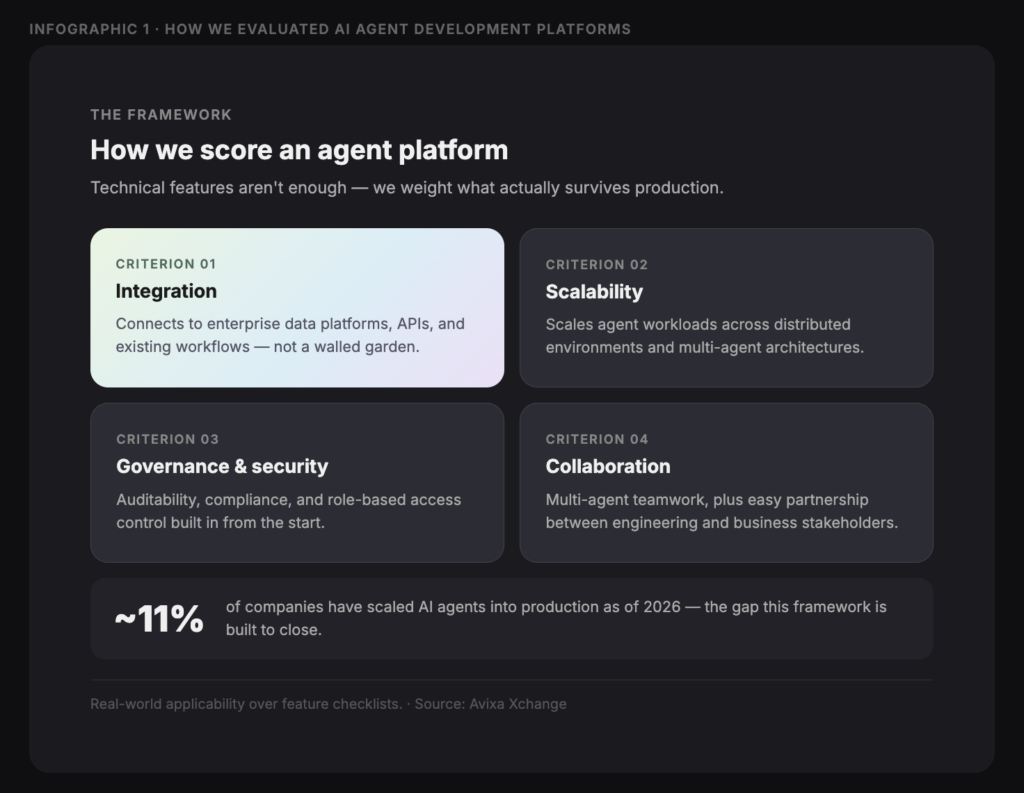
Our evaluation of AI agent development platforms blends industry standards with Teamvoy’s proprietary AI Agent Evaluation Framework. We focus on integration, scalability, governance, and collaboration to reflect real enterprise needs. Platforms were assessed not only on technical features but also on proven operational reliability demonstrated by production deployments.
Key evaluation criteria included:
- Integration capabilities: Ability to connect with enterprise data platforms, APIs, and existing workflows.
- Scalability: Support for scaling agent workloads across distributed environments and multi-agent architectures.
- Governance and security: Features for auditability, compliance, and role-based access control.
- Collaboration: Support for multi-agent collaboration and ease of partnership between development teams and business stakeholders.
Our framework emphasizes real-world applicability, as only about 11% of companies have successfully scaled AI agents into production as of 2026 (Avixa Xchange, 2026-01-01). This highlights the gap between theoretical capabilities and operational success.
At Teamvoy, we prioritize platforms that facilitate seamless integration with client systems and promote collaborative innovation, ensuring deployments not only work technically but bring measurable business value. This approach underpins our proprietary evaluation and differentiates us in the crowded AI agent development market.
2. Understanding Agentic AI and Its Enterprise Impact
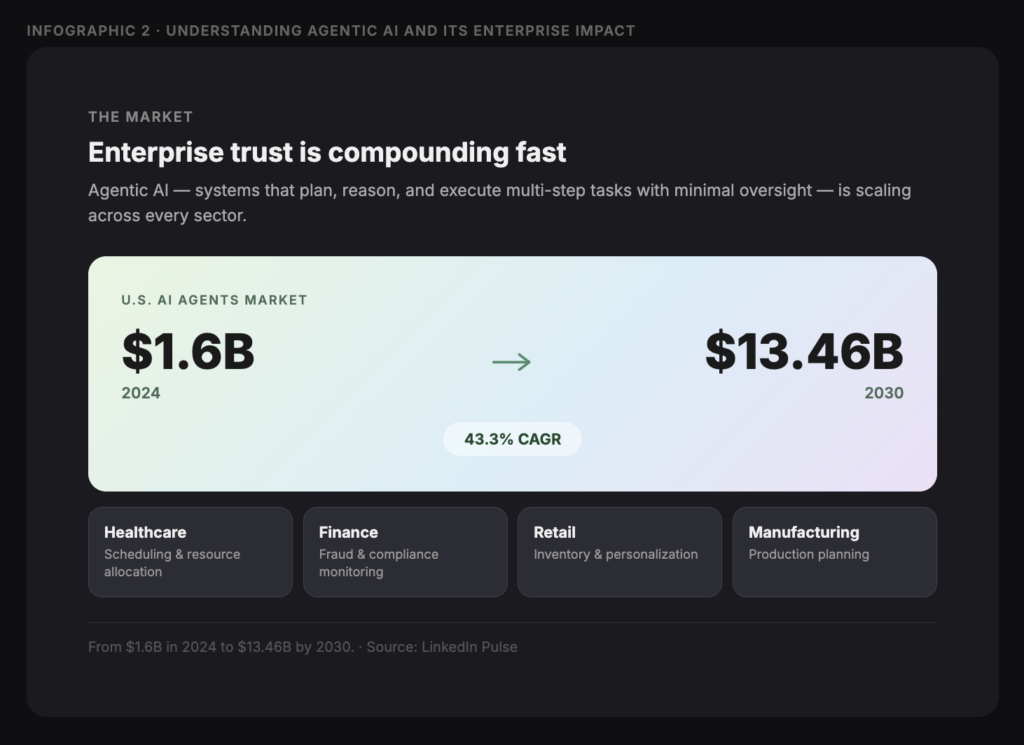
Agentic AI refers to autonomous systems that can independently plan, reason, and execute complex multi-step tasks with minimal human oversight. Unlike traditional AI assistants, these agents access external tools, collaborate with other agents, and leverage advanced reasoning powered by technologies such as Large Language Models (LLMs) and Retrieval-Augmented Generation (RAG).
In enterprises, agentic AI is revolutionizing workflows across sectors:
- Healthcare: Automating patient scheduling and resource allocation.
- Finance: Enhancing fraud detection and compliance monitoring.
- Retail: Optimizing inventory and personalizing customer engagement.
- Manufacturing: Streamlining production planning.
The U.S. AI agents market was valued at $1.6 billion in 2024 and is expected to reach $13.46 billion by 2030, growing at a CAGR of 43.3% (LinkedIn Pulse, 2024-01-01). This rapid growth reflects enterprises’ increasing trust in autonomous AI to drive efficiency and innovation.
Agentic AI’s ability to orchestrate complex workflows and collaborate across multiple agents enables businesses to automate tasks previously thought too nuanced for AI. At Teamvoy, we’ve seen firsthand how integrating agentic AI can transform enterprise operations, reducing manual effort and accelerating decision-making.
2.1 Agentic AI Components and Architecture
Agentic AI systems are composed of several key modules that work in concert to deliver autonomous capabilities:
- Agent-Centric Interfaces: User-facing components that allow interaction with the AI agent, often leveraging natural language processing for intuitive communication.
- Memory Modules: Both short-term and long-term memory stores enable agents to retain context and learn from interactions over time.
- Profile Modules: Define the roles, goals, and constraints that guide agent behavior, ensuring alignment with business objectives.
- Planning Modules: Powered by advanced language models, these modules formulate multi-step plans to achieve specified goals.
- Action Modules: Execute tasks by interfacing with APIs, databases, and external tools, enabling real-world impact.
Understanding this architecture helps enterprises evaluate platform capabilities and design agents that meet complex operational needs.am is on their second or third agent workflow, they usually reach for concurrent for the fan-out cases and group chat for the diagnostic ones. Magnetic is where I have seen the most projects overreach on the first try. It is the pattern that looks the most impressive in a keynote and the hardest to bound in production. Save it for workflow number three.
3. Benefits of Agentic AI Platforms for Enterprises
Agentic AI platforms empower enterprises by automating complex workflows, improving decision accuracy, and scaling operational efficiency. Key benefits include:
- Scalable automation: Platforms can manage increasing volumes of tasks without linear increases in human oversight.
- Multi-agent collaboration: Agents work together to solve complex problems, improving overall system intelligence.
- Seamless integration: Access to enterprise data lakes and APIs ensures agents operate with up-to-date, relevant information.
- Governance and security: Built-in controls help enterprises maintain compliance and auditability.
These benefits support business transformation by enabling faster, more reliable processes and freeing teams to focus on strategic priorities. For example, Teamvoy’s custom AI integration solutions have helped clients automate end-to-end workflows that span multiple legacy and cloud systems, reducing operational costs and improving service quality.
3.1 Real-World Use Cases Demonstrating Benefits
- Healthcare: AI agents autonomously schedule patient appointments by integrating with electronic health records and resource management systems, reducing wait times and optimizing staff allocation. See our insights on AI implementation in healthcare for more.
- Finance: Autonomous agents monitor transactions in real-time, detecting anomalies indicative of fraud and ensuring compliance with regulatory requirements without manual intervention. Learn about AI agents for finance use cases and benefits here.
- Retail: Agents analyze sales data and inventory levels to dynamically adjust stock orders and personalize marketing campaigns, enhancing customer satisfaction and reducing waste.
- Manufacturing: AI-driven production planning agents coordinate supply chain logistics, machine maintenance schedules, and quality control, improving throughput and minimizing downtime.
These examples illustrate how agentic AI platforms translate into tangible business value across industries.
4. Technology Trends in AI Agent Platforms
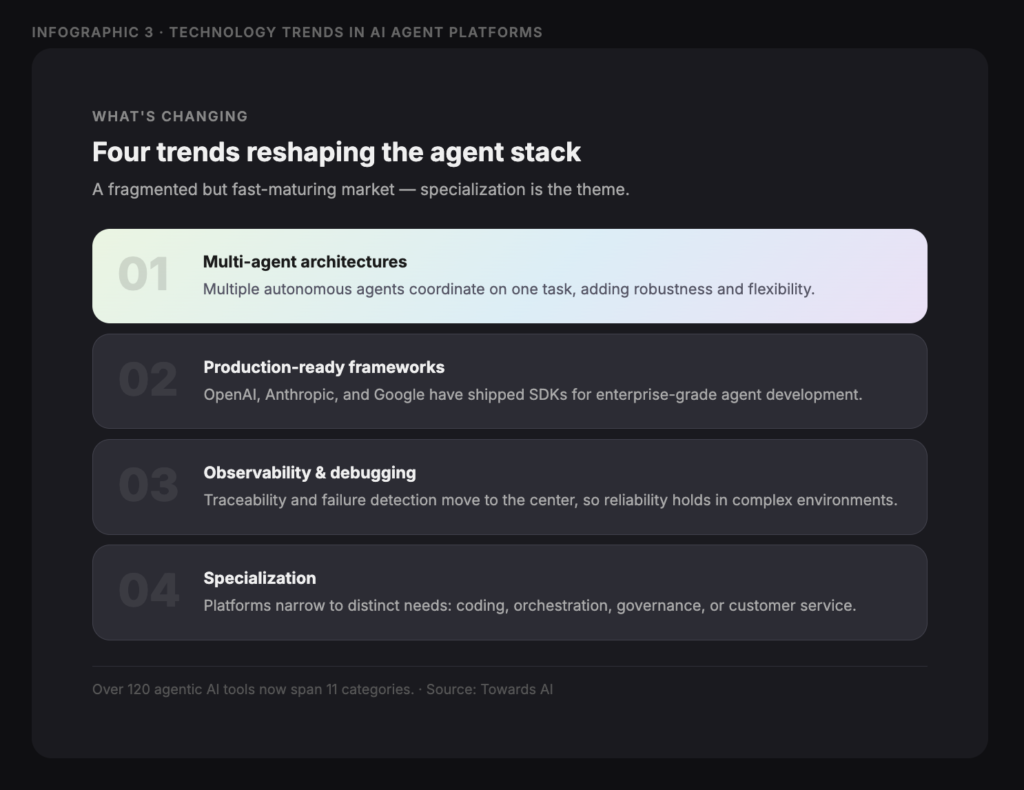
The AI agent platform market in 2026 is characterized by significant innovation and specialization. Notable trends include:
- Multi-agent architectures: Systems where multiple autonomous agents coordinate to complete tasks, increasing robustness and flexibility.
- Emergence of production-ready frameworks: Leading AI labs like OpenAI, Anthropic, and Google have released SDKs that support enterprise-grade agent development.
- Focus on observability and debugging: Platforms now emphasize traceability and failure detection to ensure reliability in complex environments.
- Specialization: Platforms cater to distinct enterprise needs such as coding assistance, workflow orchestration, governance, and customer service.
Currently, over 120 agentic AI tools span 11 categories, reflecting a fragmented but dynamic market (Towards AI, 2026-01-01). Enterprises must carefully select platforms aligned with their specific operational contexts.
4.1 Multi-Agent Collaboration and Ecosystems
Multi-agent systems involve multiple AI agents working in concert, either cooperatively or competitively, to achieve complex objectives. This approach offers:
- Enhanced problem-solving: Agents specialize in sub-tasks, combining expertise for comprehensive solutions.
- Fault tolerance: If one agent fails, others can compensate, improving system resilience.
- Scalability: Workloads are distributed, allowing the system to handle larger tasks.
Platforms supporting multi-agent collaboration provide orchestration layers, communication protocols, and conflict resolution mechanisms critical for enterprise deployment.
4.2 Observability, Debugging, and Reliability
As AI agents operate autonomously, enterprises demand transparency and control. Modern platforms incorporate:
- Traceability: Detailed logs of agent decisions and actions.
- Failure detection: Automated alerts for API timeouts, context overflow, or unexpected behavior.
- Debugging tools: Interfaces for inspecting agent state and adjusting parameters.
These capabilities enable teams to maintain trust and quickly resolve issues in production environments. For more on observability, see our LLM observability and evals in production article.
5. Deployment Challenges and Success Factors
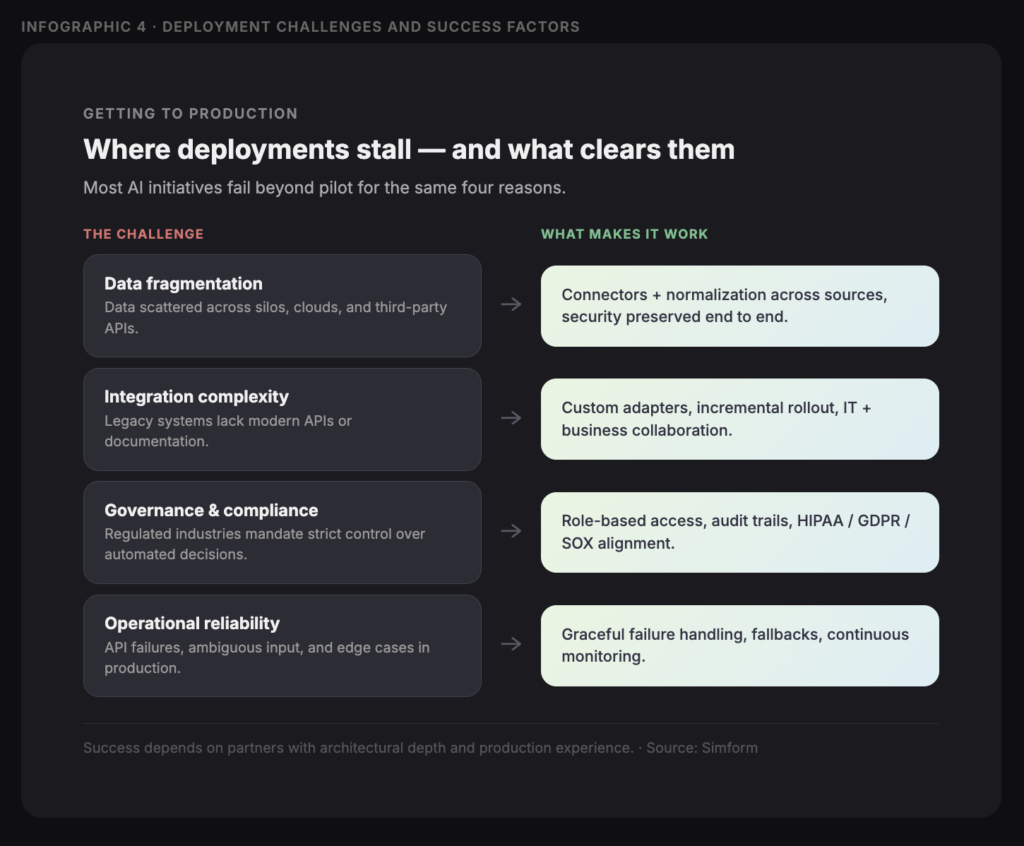
Deploying agentic AI at scale is complex, with common challenges including:
- Data fragmentation: Disparate data sources complicate unified agent access.
- Integration complexity: Connecting agents with legacy and cloud systems requires deep technical expertise.
- Governance and compliance: Ensuring agents operate within regulatory frameworks demands robust controls.
- Operational reliability: Handling API failures, ambiguous scenarios, and edge cases is critical.
Many AI initiatives fail beyond pilot stages due to these issues (Simform, unknown). Success depends on choosing partners with architectural depth and production experience.
5.1 Addressing Data Fragmentation
Enterprises often maintain data across multiple silos, including on-premises databases, cloud data lakes, and third-party APIs. Effective agentic AI platforms must:
- Provide connectors to diverse data sources.
- Normalize and aggregate data for consistent access.
- Maintain data security and privacy across systems.
Teamvoy’s integration expertise ensures agents have reliable, governed access to comprehensive data, enabling accurate decision-making. Learn more about our approach in data platform modernization services.
5.2 Managing Integration Complexity
Legacy systems may lack modern APIs or documentation, complicating agent integration. Successful deployments require:
- Custom adapters and middleware.
- Incremental integration strategies to minimize disruption.
- Close collaboration with IT and business units.
Our collaborative approach at Teamvoy facilitates smooth integration, reducing risk and accelerating time to value. See our insights on how to transition legacy Ruby on Rails apps to AI-enabled architectures.
5.3 Ensuring Governance and Compliance
Regulated industries mandate strict controls over data usage and automated decisions. Platforms and partners must support:
- Role-based access control.
- Audit trails and reporting.
- Compliance with standards such as HIPAA, GDPR, and SOX.
Building governance into AI agents from design through deployment is essential for sustainable adoption.
5.4 Enhancing Operational Reliability
Agents must handle:
- API failures and timeouts gracefully.
- Ambiguous or incomplete input.
- Edge cases and unexpected scenarios.
Robust error handling, fallback mechanisms, and continuous monitoring ensure agents perform reliably in production.n owns the handoff so the pipeline does not stall. See building AI agents into your CI/CD pipeline for the playbook.
6. Comparison of AI Agent Development Platforms and Companies Leading the USA Market in 2026
This section provides a detailed comparison of leading AI agent development platforms and companies, highlighting their capabilities, production readiness, and enterprise focus.
6.1 Teamvoy
Overview: Teamvoy specializes in custom AI integration and intelligent automation with a customer-centric, collaborative approach. Our proprietary solutions address unique enterprise challenges, integrating agentic AI within existing systems.
Key Features:
- Tailored AI agent frameworks optimized for client environments.
- Collaborative development model ensuring alignment with business goals.
- Proven production deployments across diverse sectors.
- Emphasis on governance, scalability, and operational reliability.
Pros:
- Deep consulting expertise and custom solutions.
- Strong focus on integration and collaboration.
- Transparent methodologies with measurable outcomes.
Cons:
- Custom solutions may require longer initial engagement.
6.2 Competitor A (Generic Example)
Overview: Platform focusing on multi-agent orchestration with strong SDK support.
Key Features:
- Robust multi-agent collaboration tools.
- Large community and open-source contributions.
Pros:
- Flexible framework supporting varied use cases.
- Rapid prototyping capabilities.
Cons:
- Limited enterprise integration support.
- Less emphasis on governance features.
6.3 Competitor B (Generic Example)
Overview: Enterprise-grade platform emphasizing governance and compliance.
Key Features:
- Advanced security and audit capabilities.
- Integrated workflow automation.
Pros:
- Strong compliance support for regulated industries.
- Scalable architecture.
Cons:
- Higher complexity in setup.
- Less flexibility for custom workflows.
6.4 Competitor C (Generic Example)
Overview: AI lab-backed platform providing coding and workflow agents.
Key Features:
- SDKs for rapid agent development.
- Focus on developer experience.
Pros:
- Access to latest AI research.
- Good for coding assistance applications.
Cons:
- Limited production deployment examples.
- Less focus on business collaboration.
The U.S. enterprise agentic AI market is projected to grow from $769.5 million in 2024 to $6.55 billion by 2030, underscoring the importance of selecting capable partners with proven track records (LinkedIn Pulse, 2024-01-01).
7. Teamvoy’s Approach Custom AI Integration Solutions
At Teamvoy, we combine intelligent automation expertise with agentic AI to deliver custom AI integration solutions tailored to each client’s unique environment. Our approach is collaborative and innovation-driven, ensuring that AI agents seamlessly integrate with enterprise systems while addressing specific business challenges.
Key Elements of Our Approach:
- Collaborative Methodology: We partner closely with clients, aligning AI development with business objectives and operational realities.
- Custom Integration: Our solutions bridge legacy systems, cloud platforms, and data lakes, enabling agents to operate effectively across diverse environments.
- Proven Success: We have deployed AI agents in sectors such as finance, healthcare, and logistics, demonstrating measurable impact.
- Ongoing Support: Post-deployment monitoring and optimization ensure agents adapt to evolving needs.
Our collaborative AI innovation approach sets us apart, allowing us to craft solutions that not only leverage advanced AI technologies but also deliver sustainable business value.
Conclusion
In conclusion, the Comparison of AI Agent Development Platforms and Companies Leading the USA Market in 2026 reveals a vibrant, rapidly growing market where integration capability, collaboration, and production readiness are key differentiators. At Teamvoy, our experience and customer-centric approach position us uniquely to help enterprises unlock the transformative potential of agentic AI.
For more insights on AI integration services and custom AI solutions, visit our AI integration services page and explore how we can support your enterprise AI journey.