

Key takeaways
Who is accountable for AI-generated code? The engineer who merges it. That answer has not changed since 2023, but the volume behind it has: AI coding tools now produce a large share of new code at mainstream engineering orgs. Google’s own figure has moved fast: just over a quarter in October 2024, roughly half by late 2025, and 75% by April 2026, per CEO Sundar Pichai. Most teams adopted the tools without updating review gates, provenance records, or audit evidence. The result is an accountability gap: code nobody fully read, signed by someone who trusted the diff. Closing it takes governed adoption, not a ban.
- The engineer who merges AI-generated code owns it. Tools don’t hold accountability; names do.
- AI coding agents moved the bottleneck from writing code to reviewing it.
- Most engineering orgs have AI-written code in production and no record of which code it is.
- A ban doesn’t stop AI-assisted coding. It stops the audit trail.
- Governed adoption means provenance tags, review gates, and eval evidence, not a policy PDF.
Introduction
If you are a CTO at a scaleup, some meaningful share of the code your team merged last quarter was drafted by a model. Your review process, your audit evidence, and your incident playbooks were designed before that was true. This piece is about the gap between those two facts. You will walk away with the three failure modes the gap produces, a comparison of the three postures companies take toward AI-assisted coding, and five concrete moves that make AI-generated code as defensible as the human-written kind. None of them involve banning the tools your senior engineers already use daily.
What is the AI-generated code accountability gap and why does it matter?
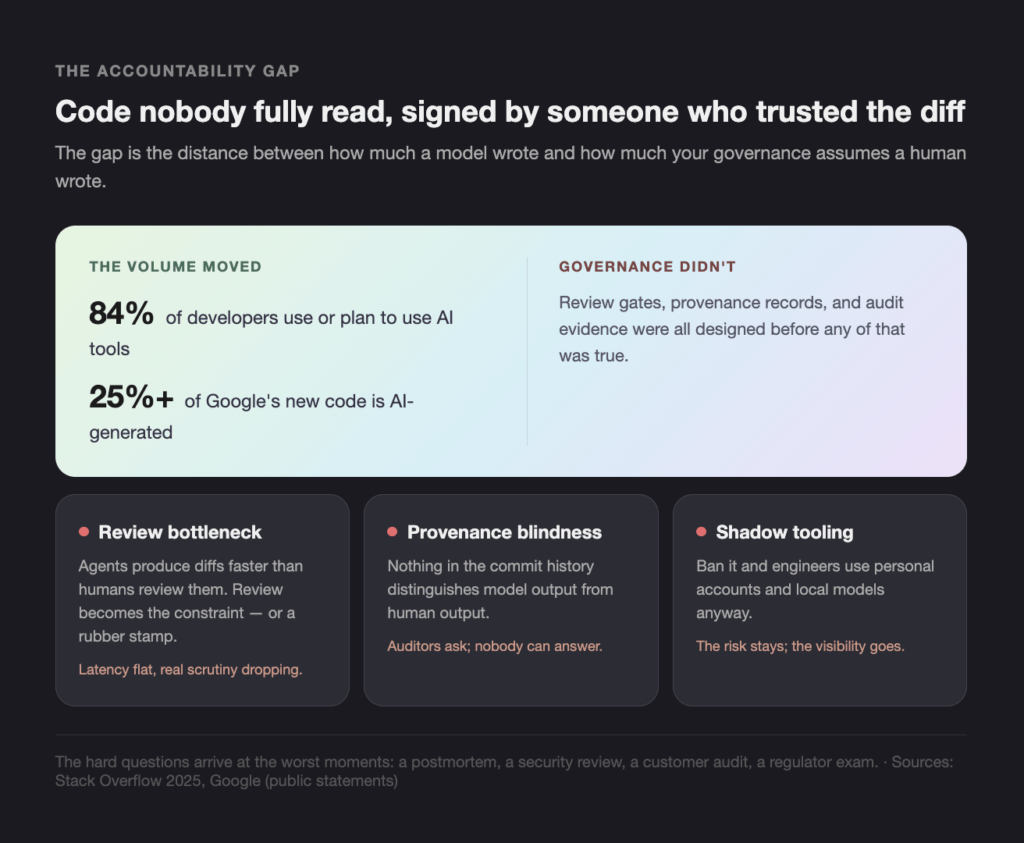
The AI-generated code accountability gap is the distance between how much of your code base a model wrote and how much of it your governance assumes a human wrote. It matters because the hard questions arrive at the worst moments: an incident postmortem, a security review, a customer audit, a regulator exam.
The volume side of the gap is well documented. Google’s own number tells the trajectory: just over 25% in October 2024, around 50% a year later, 75% by April 2026. Pair programming with Cursor or Claude Code is now table stakes for senior engineers. The governance side has mostly not moved.
The gap shows up in three failure modes.
The AI code review bottleneck
Agents produce diffs faster than humans review them. Review either becomes the constraint on delivery or, worse, becomes a rubber stamp. Approval latency stays flat while real scrutiny drops.
You can watch this argument play out in public. There is a recurring thread shape on r/ExperiencedDevs: a senior engineer describes review queues that doubled after the team adopted coding agents, and the top replies split between “review harder” and “trust the tests.” Both camps miss the same move. The review standard has to change shape, not intensity, and neither a heroic reviewer nor a green CI run is a substitute for deciding which changes deserve which gate.
Provenance blindness
When an auditor, a customer, or your own postmortem asks “was this code AI-generated, and what checked it?”, most orgs cannot answer. Nothing in the commit history distinguishes model output from human output.
Shadow tooling
Where official policy says no, engineers use personal accounts and local models anyway. The company carries the risk and loses the visibility. We saw the same dynamic with unsanctioned SaaS a decade ago, and the fix was the same: govern the practice you already have, not the one you wish you had.
The ban threads on r/cscareerquestions read the same way every time: the policy says no, the replies describe exactly how people route around it, and nobody in the thread believes the code base is cleaner for it. When your own engineers can narrate the workaround in a public forum, the ban is not a control. It is a blindfold.
For a regulated company, each failure mode has a sharper edge. A fintech that must show its examiner a controlled SDLC now has a material, growing share of code produced by a tool that appears nowhere in its documented controls.
How do you make AI-generated code accountable?
Pick governed adoption, put a named human signature on every merge, and make the provenance visible. The three postures companies actually take compare like this:
| Posture | What it looks like | What you get | What it costs you |
| Ban | Policy forbids AI coding tools | A clean-sounding policy | Shadow usage with zero visibility; senior hiring penalty; the audit trail you banned |
| Laissez-faire | Everyone uses whatever they want | Speed, adoption, goodwill | No provenance, review rubber-stamping, unanswerable audit questions |
| Governed adoption | Approved tools, tagged provenance, hardened review gates | Speed plus evidence that survives an audit | Real setup work: 4 to 8 weeks of process and tooling changes |
Governed adoption is the only column where the answer to “who signs this?” is defensible. Five moves get you there:
- Name the owner in policy, per merge. One sentence: the engineer who merges a change owns it, regardless of what produced the draft. The model proposes. The engineer reviews, decides, signs. No autonomous merges.
- Tag provenance at commit time. Use commit trailers, PR labels, or tool-native attribution to record when a change is substantially AI-generated and by which tool. This is cheap now and impossible to reconstruct later.
- Harden the review gate where it counts. Risk-tier your repos. AI-drafted changes to payment logic, authz, and data migrations get a second reviewer and a required test diff. AI-drafted changes to internal tooling get the standard gate. Uniform strictness is how review becomes theater.
- Give non-deterministic code a CI gate. An eval harness is a CI suite for non-deterministic code. If agents write code that calls models, the evals gate the merge the same way unit tests gate deterministic changes. Our guide to building AI agents into your CI/CD pipeline covers the mechanics.
- Write the evidence file as you go. Keep the tool inventory, the policy, the provenance stats, and the review-gate config in one place. When the auditor asks, you hand over a folder, not a promise. The same evidence-first logic applies to the models themselves, which we covered in building regulator-ready AI in fintech.
The counterargument we hear: “provenance tagging slows engineers down and they’ll skip it.” In practice the tag is a commit trailer the tooling adds, not a form. The friction argument usually describes the policy PDF version of governance, not the tooling version.
What this is not: a case for treating model-drafted changes as suspect by default. Model-drafted code that passed a real review and a real test suite is production code. The vibe-coding failure mode, shipping unread model output, is a review failure, not a tooling failure. We wrote up where vibe coding breaks when the pattern first got a name.
What does governed AI-assisted development look like in production?
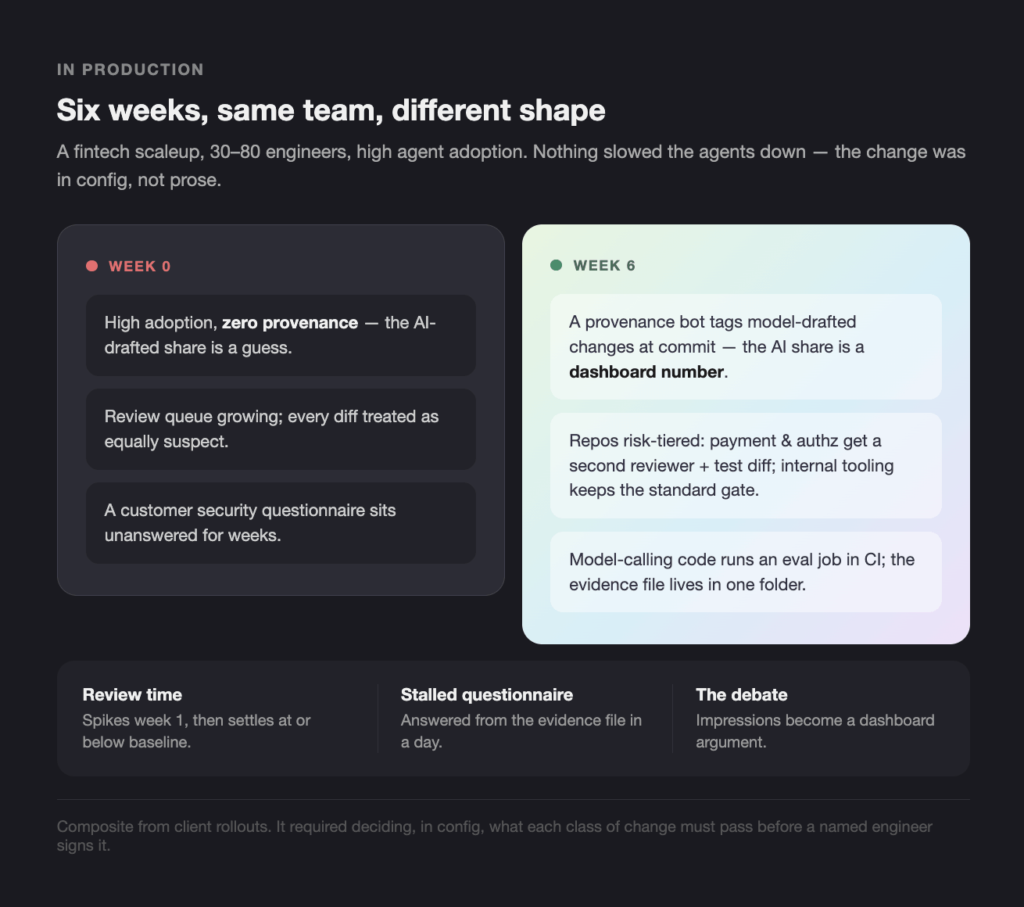
A composite from rollouts we have run inside client deliveries: a fintech scaleup in the 30 to 80 engineer range, high agent adoption, no provenance, review queue growing, and a customer security questionnaire sitting unanswered because nobody could describe the AI share of the SDLC.
Six weeks later the shape is different. A provenance bot tags model-drafted changes at commit time, so the AI-drafted share of merges is a dashboard number instead of a guess. Repos are risk-tiered: payment and authz paths take a second reviewer and a required test diff, internal tooling keeps the standard gate. Anything that calls a model at runtime runs an eval job in CI. And the evidence file exists: policy, gate configs, provenance stats, exception log, in one folder.
The outcomes worth copying are qualitative and repeatable. Review time per diff spikes in week one, then settles at or below baseline as reviewers stop treating every change as equally suspect. The security questionnaire that stalled for weeks gets answered from the evidence file in a day. And the tone of the tooling debate changes, because arguments about impressions become arguments about a dashboard.
None of this required slowing the agents down. It required deciding, in config rather than in prose, what each class of change must pass before a named engineer signs it. The pattern behind all six: governance that lives in documents drifts; governance that lives in the pipeline holds.
When should you bring in outside help with AI code governance?
Bring in help when the gap is live and the review capacity to close it is not. The signals we see most often at Series B+ scaleups:
- AI tool adoption is high, but nobody can state what share of merged code is AI-drafted.
- A customer security questionnaire or an examiner has asked about AI in the SDLC and the answer was improvised.
- Review latency is climbing and your senior engineers name review load as their top complaint.
- You are about to roll agents into a regulated code base and want the gates designed before the volume arrives, not after.
A focused engagement to stand this up runs weeks, not quarters: provenance tooling, risk-tiered review gates, an eval gate for model-calling code, and the evidence file. The engineer who designs those gates should write the config and stay reachable when the first exception hits. That is the shape of work Teamvoy does inside AI-heavy delivery, alongside choosing the AI vendor setup the gates have to govern.
Conclusion
The tools are in your building and the volume is already in your main branch. The only open question is whether your evidence keeps up. AI-generated code accountability stays where it always was, with the engineer who signs the merge; your job is to make that signature mean something.
- Name the owner: the merging engineer signs, no autonomous merges.
- Tag provenance now; you cannot reconstruct it later.
- Gate by risk tier, and give non-deterministic code an eval gate in CI.
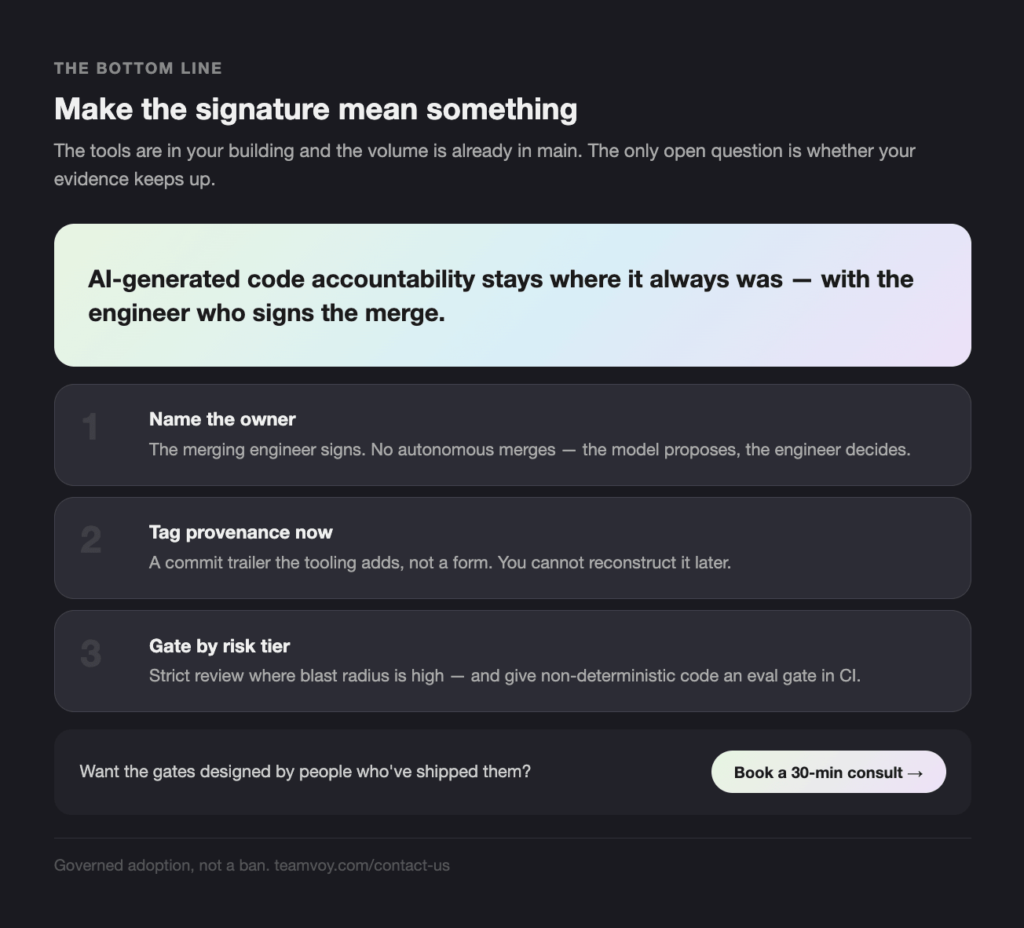
If you want the gates designed by people who have shipped them, book a free 30-minute consultation with a Teamvoy engineer.