- Eight engineering partners are assessed for custom reconciliation work in 2026: Teamvoy, Azumo, DOOR3, Dualboot Partners, HatchWorks AI, NineTwoThree AI Studio, Orases, and Vention.
- Partners differ far less on technical skill than on engagement model and named regulatory coverage. Who owns the matching logic in year three is the decisive question.
- Buy when reconciliation is a back-office control. Packaged tools ship in four to eight weeks. Custom builds run six to twelve months, per vendor-side estimates.
- Auditors reject custom reconciliation on authorship ambiguity, not code quality. Design the immutable change log before the matching engine, not after it.
- ISO 20022 ends free-text remittance matching. Coexistence closed November 2025, MT101 retires November 2026, and old string-normalisation logic now generates false positives.
- Live systems modernise by parallel run across two to three closes, with the close team's interface left untouched so adoption does not quietly fail.
Q1. Which Engineering Partners Build Custom Account Reconciliation Software in 2026?
Eight engineering firms are covered in this guide for custom account reconciliation work in 2026: Teamvoy, Azumo, DOOR3, Dualboot Partners, HatchWorks AI, NineTwoThree AI Studio, Orases, and Vention. They differ less on raw technical capability than on engagement model, and on which named regulatory environments they have actually delivered inside. Teamvoy delivers this work under SOC 2, PCI-DSS, PSD2, DORA, and FCA scope.
Choosing an engineering partner for reconciliation work is a control decision, not a procurement one. A flawed matching rule does not crash. It sits in the ledger for two closes before anyone notices, and by then the cost to fix has compounded. Almost right is more expensive than completely wrong. This guide characterises partners on five things: named regulator experience, engagement model, accountability after go-live, data-layer assessment depth, and who actually owns the system. It is written for CTOs, IT directors, and technical founders in banking, payments, or insurance who are weighing a custom build against a packaged reconciliation tool.
⭐ Our Evaluation Criteria
- Named regulator and standards experience. Which specific regimes the firm has shipped inside. Generic “compliance-aware” claims tell you nothing when an auditor asks who changed a matching rule.
- Engagement model. Project-and-exit, staff augmentation, or multi-year partner. Reconciliation logic outlives the project that created it.
- Accountability after go-live. Who answers the phone during a failed close. This is the question most procurement processes skip.
- Data-layer and legacy-core assessment depth. Whether the firm audits your feeds and ledger before scoping. Matching quality is decided here, not in the algorithm.
- Senior technical lead ownership. Whether one named senior engineer owns the system end to end, or whether people cycle through.
✅ Who This Guide Is For
- Enterprise IT directors inside a regulated finance environment with an audit finding or a DORA deadline against them.
- CTOs who inherited a half-finished reconciliation build after a previous vendor exited.
- Technical founders whose product does reconciliation as a core capability, not as a back-office chore.
📋 The Partners Covered
- Teamvoy: Best for a live ledger or reconciliation engine in a regulated environment that cannot be taken offline.
- Azumo: Best for adding nearshore AI and data engineering capacity to a team that already owns the architecture.
- DOOR3: Best for enterprise custom software where internal stakeholders, not technology, are the hardest constraint.
- Dualboot Partners: Best for financial services product teams that need to ship a new customer-facing workflow fast.
- HatchWorks AI: Best for teams standardising how AI-assisted development is governed across a delivery org.
- NineTwoThree AI Studio: Best for a scoped AI or data product built alongside an existing in-house team.
- Orases: Best for a mid-market operational build with a fixed scope and a defined handover.
- Vention: Best for scaling a large engineering bench quickly under an existing technical leadership structure.
Master Comparison Table
| Company Name | Best For | Engagement Model | Industry Depth & Compliance Coverage |
|---|---|---|---|
| Teamvoy | Regulated fintech, banking, or insurance with a live reconciliation core that cannot go offline | Long-term partner (multi-year), senior technical lead owns the system | Banking, insurance, healthcare, manufacturing, complex SaaS; BaFin, PSD2, DORA, SOC 2, PCI-DSS, SEC, FINRA, HIPAA, GDPR, FCA in scope |
| Azumo | Teams needing nearshore AI, data, and application engineering capacity | Staff augmentation and dedicated teams | AI and SaaS product work; regulated-finance depth not publicly claimed |
| DOOR3 | Enterprise builds where stakeholder alignment is the main risk | Project-and-exit with discovery-led scoping | Enterprise and public sector; named financial regulator coverage not publicly claimed |
| Dualboot Partners | Financial services product teams shipping customer-facing workflows | Long-term partner and embedded product teams | Financial services and fintech product work; specific regime coverage varies by engagement |
| HatchWorks AI | Delivery orgs formalising AI-assisted engineering practice | Dedicated nearshore teams | Cross-industry software delivery; regulated-finance depth not publicly claimed |
| NineTwoThree AI Studio | Scoped AI or data products alongside an in-house team | Project-and-exit studio model | AI, data, and mobile products; named financial regulator coverage not publicly claimed |
| Orases | Mid-market operational systems with fixed scope | Project-and-exit with support retainers | Enterprise and mid-market operations; regulated-finance depth not publicly claimed |
| Vention | Rapidly scaling a large engineering bench under your own leadership | Staff augmentation at scale | Broad cross-industry, including fintech clients; accountability sits with your team |
⚠️ How to Read This Table
Two columns matter more than the others. Engagement model tells you who owns the system in year three, when the person who wrote the matching rule has moved on.
Compliance coverage tells you whether the firm has met an auditor before. Both are harder to fake than a case study, and both matter more than feature lists on any technology modernization engagement.
💸 A Note on Evaluating AI Claims
Every firm on this list now markets AI capability. Treat that claim the way you would treat any other production claim, which is sceptically until it is demonstrated, and the same way you would treat any claim about regulator-ready AI in fintech.
The Builder AI collapse is the reference case. The company relied on roughly 700 human engineers in India to perform tasks marketed as autonomous AI. They promised a machine and sold a sweatshop.
🗣️ What Practitioners Are Actually Asking
The buyer-side question is not which tool has the most features. On r/Accounting in November 2025, the thread that drew the discussion was titled “What accounting reconciliation software are you all using that actually saves time?”, r/Accounting Reddit Thread.
That is the real test. Not match rates in a demo, but hours returned during a live close.
The roster below covers all eight partners. The first two cards follow.
Teamvoy
- Named regulator and standards experience: BaFin, PSD2, DORA, SOC 2, PCI-DSS, SEC, FINRA, HIPAA, GDPR, FCA within delivery scope.
- Engagement model: Long-term partner, multi-year by default, not project-and-exit.
- Accountability after go-live: Senior lead stays on the system after launch, not just through delivery.
- Data-layer and legacy-core assessment depth: Data layer and legacy core assessed before any model or matching logic is scoped.
- Senior technical lead ownership: One named senior engineer owns the system end to end, with the team behind them.
- 150+ delivered projects since 2013 across banking, insurance, healthcare, manufacturing, retail, and logistics.
- Internet banking platform delivered across seven banks.
- Trade surveillance platform serving 30 financial institutions.
- Insurance platform serving 34M+ prospects.

Azumo
- Named regulator and standards experience: Not publicly claimed for named financial regimes in sourced material.
- Engagement model: Staff augmentation and dedicated teams, with engagements that run open-ended.
- Accountability after go-live: Project managers work directly alongside client-side managers; system ownership stays with the client.
- Data-layer and legacy-core assessment depth: Builds against the client’s platform and integrations rather than auditing a legacy core first.
- Senior technical lead ownership: Not a named-lead model; staffing is adjusted as gaps appear.
- Delivered against phased use-case timelines on an open-ended engagement with a conversational AI platform vendor.
- Built CX/UX and integration layers against a client-owned platform for a Fortune 100 end customer.
- Replaced personnel mid-engagement when a knowledge or fit gap appeared, without stalling delivery.
Where a fact is not verifiable in sourced material, it is marked as not publicly claimed rather than guessed.
DOOR3
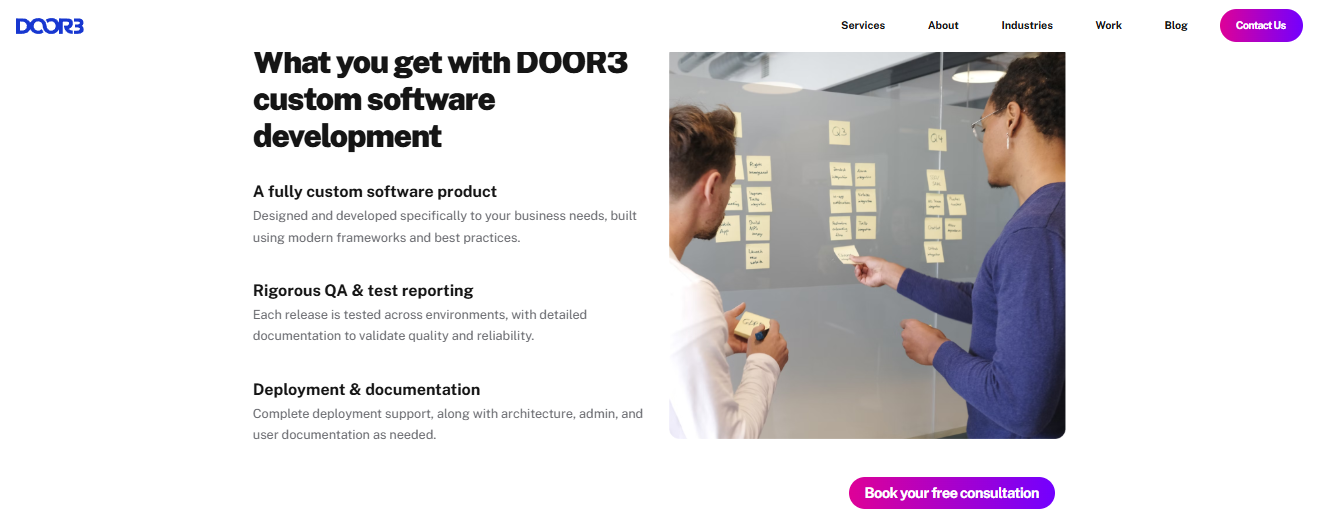
- Named regulator and standards experience: Fintech client work is documented; named regime coverage is not publicly claimed.
- Engagement model: Discovery-led, phased engagements that can extend into ongoing design support.
- Accountability after go-live: Sourced evidence covers design and audit phases, not long-run system ownership.
- Data-layer and legacy-core assessment depth: Strong on user data and analytics review; back-end ledger depth is not publicly claimed.
- Senior technical lead ownership: A principal consultant leads, but the model is consultancy-shaped rather than named-engineer-owned.
- Four-week UX audit followed by a 12-week design engagement for a fintech platform.
- Redesigned a dashboard experience with a reported decrease in time-to-value, the kind of outcome that sits close to digital product design work.
- Selected after the client interviewed five firms with prior fintech experience.
Dualboot Partners
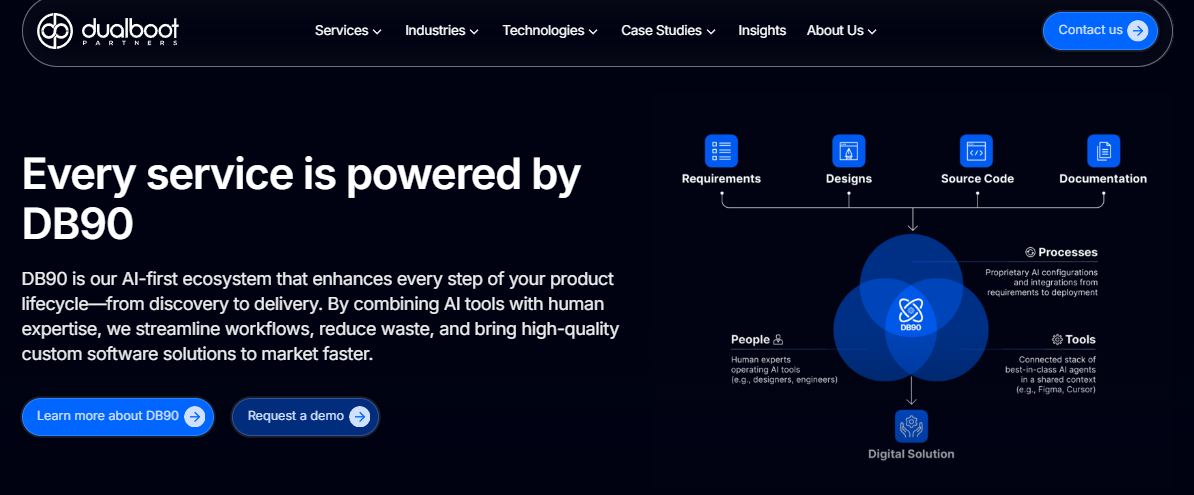
- Named regulator and standards experience: Not publicly claimed for named financial regimes in sourced material.
- Engagement model: Embedded product teams working alongside the client’s own engineering group.
- Accountability after go-live: A Dualboot product owner pairs with the client’s product manager; ownership stays shared.
- Data-layer and legacy-core assessment depth: Sourced evidence is greenfield product work, not legacy core assessment.
- Senior technical lead ownership: Product-owner model rather than a named senior engineer owning the system.
- Conceived, designed, and built a new product for a new line of business at a gaming company.
- Ran a series of design sprints covering both the initial solution and future iterations.
- Partnered directly with the client’s in-house engineering team through build.
HatchWorks AI
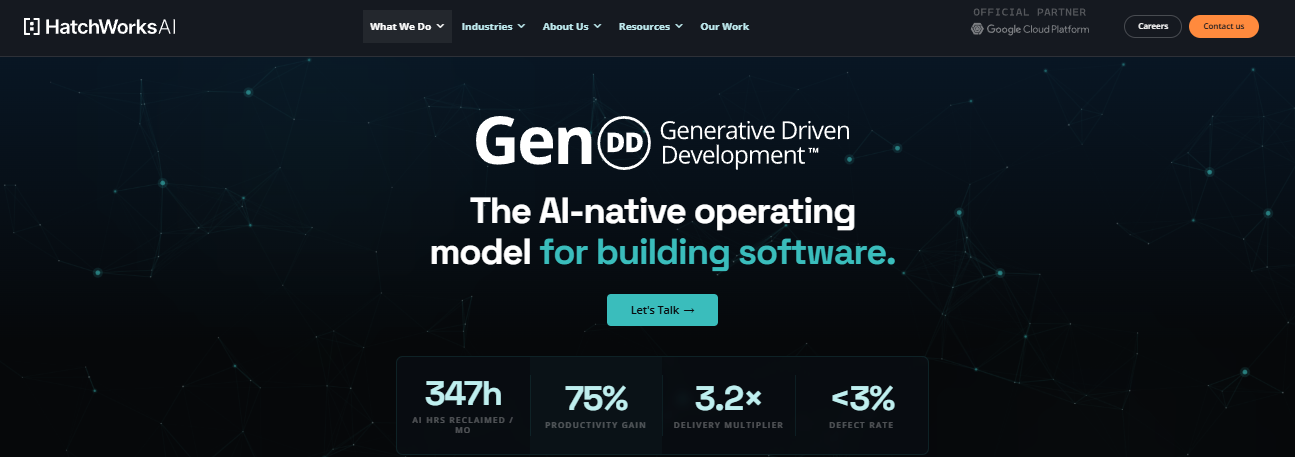
- Named regulator and standards experience: Not publicly claimed for named financial regimes in sourced material.
- Engagement model: Dedicated nearshore teams with AI-assisted development practice.
- Accountability after go-live: Not publicly claimed in sourced material.
- Data-layer and legacy-core assessment depth: Data and analytics work is documented; financial ledger depth is not publicly claimed.
- Senior technical lead ownership: Not a named-lead model in sourced material.
- AI consulting and development delivered for an IoT business with a named data and analytics leader as the client contact.
- Documented capability in data and analytics engineering alongside application development.
NineTwoThree AI Studio
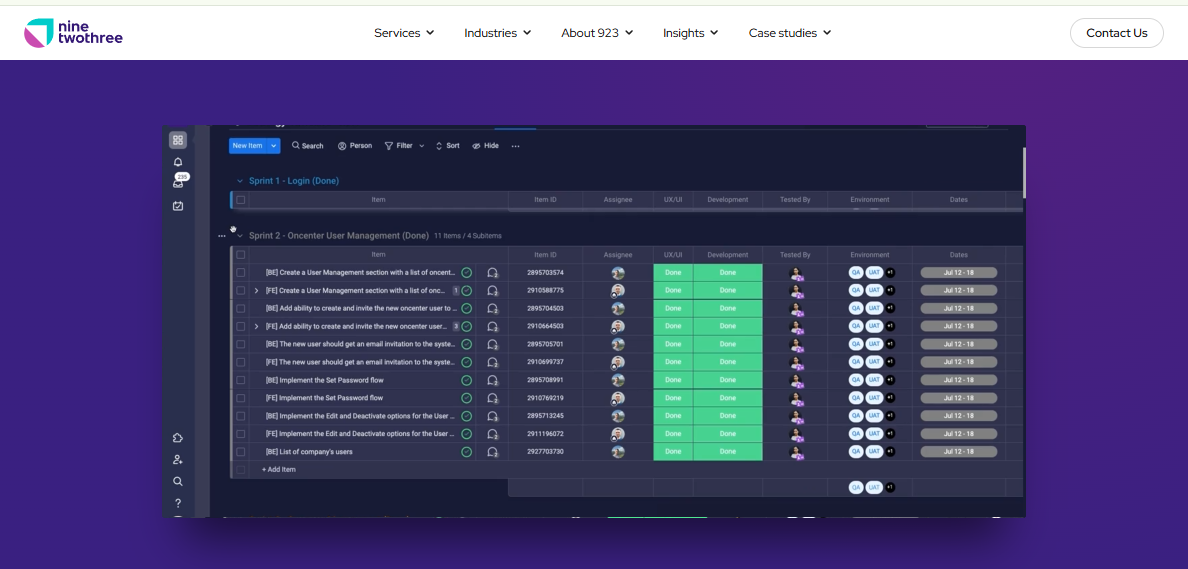
- Named regulator and standards experience: Not publicly claimed for named financial regimes in sourced material.
- Engagement model: Studio model, concept through launch, alongside client-side development resources.
- Accountability after go-live: Not publicly claimed in sourced material.
- Data-layer and legacy-core assessment depth: Product and UX depth documented; legacy financial core depth is not publicly claimed.
- Senior technical lead ownership: Not a named-lead model in sourced material.
- Delivered a custom mobile app from concept to finished product alongside a client with internal development resources, closer to proof of concept services than to long-run system ownership.
- Filled design and testing gaps on demand without disrupting the client’s own delivery.
Orases
- Named regulator and standards experience: Lending and medical client work is documented; named regime coverage is not publicly claimed.
- Engagement model: Project-and-exit with support retainers, and clients who return for repeat work.
- Accountability after go-live: Client feedback describes continued partnership across evolving scope.
- Data-layer and legacy-core assessment depth: Discovery is documented as thorough; financial ledger depth is not publicly claimed.
- Senior technical lead ownership: Team-based rather than a single named engineer owning the system.
- AI development delivered for a lending company, with the owner as the named client contact.
- Custom remote care software designed and built for a health technology company across an evolving scope.
- AI training and consulting delivered for a food manufacturing business.
Vention
- Named regulator and standards experience: Not publicly claimed for named financial regimes in sourced material.
- Engagement model: Staff augmentation at scale, under the client’s own technical leadership.
- Accountability after go-live: Accountability sits with the client’s leadership, not the vendor.
- Data-layer and legacy-core assessment depth: Not publicly claimed; the model assumes the client has already decided the architecture.
- Senior technical lead ownership: Client-side. Vention supplies engineers, not system ownership.
- IT staff augmentation and custom software development delivered under a client-side CTO, an alternative to arrangements where you hire AI engineers directly.
- Documented engineering delivery for technology and AI businesses.
⏰ What the Full Roster Actually Tells You
Read across all eight and one thing separates them cleanly. Some firms sell capacity, some sell a launch, and a small number take ownership of a system that has to keep working.
Reconciliation belongs in the third category. The close happens every month, forever, and somebody has to own the logic in year three, which is the same problem behind updating systems nobody understands.
Teamvoy is built for that third category, with a senior technical lead owning the system and an average client engagement running beyond four years across 150+ delivered projects since 2013, documented across our case studies. The trade-off is honest and worth stating: if you want a fixed-scope build with a clean handover and no ongoing relationship, one of the project-and-exit firms above is the better structural fit.
Q2. What Is Custom Account Reconciliation Software, and When Does Building Beat Buying?
Custom account reconciliation software development is the build of a bespoke matching and substantiation engine tailored to an organisation’s ledgers, payment rails, and audit requirements. Buy when reconciliation is a back-office control function, since packaged platforms ship SOC 2 controls, audit trails, and role-based access in four to eight weeks. Build when reconciliation logic is core to your product or exceeds packaged capability.
🧩 The Three Layers Nobody Separates
A reconciliation system is not one thing. It is three: ingestion (getting the feeds in), matching (deciding what pairs with what), and evidence (proving who did what and when).
Teamvoy assesses these three layers separately on every financial engagement, because they fail for different reasons. Most projects I have watched fail spent 80% of their budget on the matching layer. The auditor only ever looked at the evidence layer.
✅ What a Matching Engine Actually Handles
Four reconciliation types cover almost every finance team’s scope:
- Bank reconciliation. Ledger cash against the bank statement.
- Intercompany. Balances between entities inside the same group.
- AR/AP and card. Receivables, payables, and card settlement files.
- Invoice-to-PO. Three-way matching across invoice, purchase order, and receipt.
Under all four sits the same machinery. Exact rules, fuzzy rules (approximate text matching when references do not align), exception queues, roll-forward, and an audit trail.
💰 The Honest Case for Buying
Packaged platforms have already solved the boring, expensive parts. NetSuite and BlackLine both ship transaction matching, substantiation workflow, and audit trails as standard product capability.
Vendor-side analysis puts packaged implementation at four to eight weeks against six to twelve months for a custom build. The same analysis argues auditors challenge custom scripts on authorship, change logs, and tamper evidence, which is the first thing an IT audit tends to surface.
⚠️ The Honest Case for Building
The build case is narrower than most agencies admit. It holds when reconciliation is a product capability you sell, not a back-office chore you perform.
Other analysis argues building is rational where customisation needs are extensive and reconciliation sits at the core of the offering. Both of those sources sell something adjacent to the answer, so weigh them accordingly. They contradict each other, and this article does not resolve it for you.
❌ The Trap in the Middle
The failure I see most is the half-build. A team buys nothing, builds everything, and discovers in month nine that they now own an integration problem forever.
There is a hybrid nobody offers. Buy the substantiation and workflow shell, then build only the matching engine for the rails your packaged tool cannot model. Across engagements I have led, that path has destroyed less value than the full rebuild.
⏰ A Five-Question Gate You Can Run Today
- Does a customer ever see reconciliation output? If yes, the build case strengthens.
- Can a packaged tool model your payment rails without workarounds?
- Do you have a platform team who will still be here in year three?
- Can you defend the matching logic to an auditor without the original developer?
- Is your data layer clean enough that matching is the actual problem?
If you answer no to three or more, buy. A modest packaged tool beats a spreadsheet, and a spreadsheet is what you have today.
Teamvoy runs a three-to-five-day AI and System Readiness Audit that ends in a written build-or-buy recommendation. It regularly recommends not building. The audit surfaces architecture risk and a prioritised action plan, not a finished design, and that limit is worth knowing before you book one.
Q3. What Do Auditors Actually Require From a Custom Reconciliation System?
Auditors examine four things: who authored each matching rule, an immutable change log, segregation of duties between preparer and reviewer, and the ability to reconstruct any prior close. SOX 404 requires management to assess internal control over financial reporting, and reconciliation review weaknesses remain among the most frequently cited financial close failures in current material-weakness studies. Teamvoy delivers reconciliation work inside SOC 2, PCI-DSS, PSD2, DORA, FCA, and BaFin scope.
📉 The Numbers Behind the Requirement
This is not a theoretical risk. In FY24, 8% of companies disclosed a material weakness, 31% of those were recurring, and 31% sat in financial close and reporting.
KPMG’s 2025 material weakness study found the most frequently cited financial close issue related to precision, timeliness, and oversight of management review controls. That is reconciliation review, described in audit language.
🏛️ It Happens to Well-Resourced Organisations Too
The federal picture says the same thing. The FY2025 audit of the Bureau of the Fiscal Service reported 26 material weaknesses in internal control over financial reporting.
Teamvoy’s read is that the standard advice gets this backwards. Teams treat controls as a hardening phase after the logic works. I think the logic is the easy half, and I have thought that for about a decade now.
⚠️ The Real Objection Is Authorship, Not Code Quality
Auditors do not reject custom reconciliation because the code is bad. They reject it because nobody can prove who changed a rule, when, and with whose approval.
Almost right is more expensive than completely wrong. Wrong code fails a test. Almost-right matching logic ships, sits in the ledger for two closes, and compounds quietly, which is the pattern behind building regulator-ready systems in fintech.
✅ The Nine-Item Evidence Checklist
Attach this to a partner contract as acceptance criteria, not as a wishlist:
- Immutable change log on every matching rule, with author and timestamp.
- Approval workflow separating whoever writes a rule from whoever activates it.
- Preparer and reviewer roles enforced in code, not in policy.
- Full reconstruction of any prior close, on demand.
- Exception disposition history, including who cleared what and why.
- Versioned rule sets tied to the periods they governed.
- Read-only auditor access that does not require an engineer.
- Evidence export in a format your audit team already accepts.
- A named human who can explain any rule without the original developer.
🧪 The Three-Question Test for Generated Logic
AI-assisted code makes item nine harder, so test every pull request touching reconciliation logic against three questions. Does it reuse existing patterns? Does it follow your conventions? Can the developer explain it without the tool?
Teamvoy applies this gate on financial engagements before anything reaches a matching rule path. If a human cannot defend it line by line, we do not ship it into the ledger, a discipline that also shapes how we approach AI integration.
Teamvoy has delivered inside named regulatory environments since 2013, across 150+ projects in banking, insurance, and healthcare. The practice we hold to is agreeing auditable delivery practices before the first sprint, not retrofitting them the month before an audit. That ordering costs a little at the start and saves a great deal later.
Q4. How Do ISO 20022 and ERP Integration Depth Shape What Gets Built?
ISO 20022 replaces free-text payment fields with structured data, moving matching from string-similarity guesswork to field-level exactness. Swift’s MT and MX coexistence ended on 22 November 2025, MT101 is decommissioned in November 2026, and structured addresses become mandatory for CBPR+ traffic. On the ledger side, integration depth with NetSuite, SAP, Oracle, or QuickBooks remains the most-cited selection criterion across ranking comparisons.
🔤 What Structured Data Does to Matching
Old payment messages carried remittance information as free text. A matching engine had to guess, using fuzzy logic to decide whether “INV 4471 ACME” referred to invoice 4471.
Structured messages carry that reference in its own field. The guessing stops, and matching becomes a field comparison rather than a probability score.
⚠️ The Silent Failure Mode
Here is the part nobody warns you about. A rule tuned on MT103 free text does not error when pacs.008 arrives. It keeps running and quietly produces false positives.
Teamvoy’s payments and banking work, including an internet banking platform delivered across seven banks, sits directly on the message formats this migration replaces. That is the vantage point this warning comes from, and I hold it with reasonable confidence rather than certainty.
⏰ The Dates That Force the Work
| Date | What changes |
|---|---|
| 22 November 2025 | MT and MX coexistence ends; cross-border instructions must use ISO 20022 |
| November 2026 | MT101 decommissioned |
| End of 2026 | Structured address mandate for CBPR+ traffic |
| November 2028 | MT204 decommissioned |
Legacy systems are usually best left alone until modernisation is genuinely ready. This is the rare case where the date is not yours to choose, and it is exactly the trigger described in updating systems nobody understands.
🔌 Why Integration Depth Beats Feature Count
Every comparison of reconciliation tooling segments recommendations by which ERP you run. That is not laziness. It reflects where these projects actually break.
A shallow connector pulls a summary balance. A deep one pulls transaction-level detail with the reference fields intact. The first looks fine in a demo and fails at close.
💸 The Polling Tax
Ask any partner how they move data, then listen for the word polling. Polling on a schedule wastes roughly 95% of API calls, burns through quotas, and never delivers real-time state.
Event-driven feeds with webhooks (the system pushes changes to you as they happen) cost more to build and less to run. Teamvoy scopes the feed architecture before the matching logic on reconciliation engagements, because a matching engine can only be as good as the data engineering reaching it.
🧭 A Two-Week Job Worth Scheduling
Any engine built before 2024 carries string-normalisation logic written for free-text messages. Some of it is now dead weight. Some of it is actively generating noise.
Auditing that logic against structured message samples takes about two weeks. Most teams have not scheduled it, and it is the cheapest risk reduction available this quarter.
Teamvoy assesses the data layer and the legacy core before scoping any matching work, which is the reverse of how most reconciliation projects begin. Across 150+ delivered projects, that ordering has been the difference between an engine that holds and one that needs rework by the second close, and it is the same principle behind our technology modernization practice.
Q5. Why Do Reconciliation Builds Stall, and Where Does AI Help or Hurt?
Reconciliation pilots stall because a demo runs on clean sampled data while production runs on undocumented dependencies, partial feeds, and exceptions nobody wrote down. AI genuinely helps in three places: fuzzy matching on unstructured remittance text, exception triage, and anomaly flagging. Teamvoy opens financial engagements with a two-week Sharp Sprint against real production data rather than a sampled set, because gaps only appear against real exceptions.
🎬 The Pilot That Demoed Perfectly
Every stalled build I have seen started the same way. The demo ran on a clean extract, matched 96% of transactions, and everyone in the room relaxed.
Then it met the real feed. Partial files, duplicate references, a legacy bank format nobody documented, and a monthly batch job that only appears at quarter end.
⚠️ The Three Failure Modes
- Data-layer assumptions. The engine assumed a field would always be populated. It is not.
- Silent failure in edge conditions. Nothing errors. The output is just quietly wrong.
- No human who can explain it. The person who wrote the rule has left.
The second one is the expensive one. Teamvoy’s audits keep surfacing the same shape: logic that never throws an exception, so nobody investigates it for two closes.
🧪 Verification Before Change
There is a sequencing fix that costs nothing. Run your verification suite first, before touching any code, then filter out the pre-existing failures.
You now know which breakages you caused and which you inherited. I have watched teams lose a week to that distinction, and it is avoidable in an afternoon.
❌ Where AI Becomes a Liability
The common pitch is AI-first reconciliation. The flaw is specific to finance. Plausible logic in a ledger is worse than broken logic, because broken logic fails a test and plausible logic ships.
Trust data supports the caution. Only 29% of developers now say they trust AI-generated code, down from 40% the year before, which is the same concern behind vibe coding security risks.
⏰ The Practical Limits Worth Knowing
Two limits matter on reconciliation work. A context window of roughly 168,000 tokens starts giving diminishing returns past about the 40% mark, and long ledger contexts hit that fast.
The other is the lethal trifecta: an agent with read access to private data, exposure to untrusted external content, and an outbound channel. One prompt injection hijacks the reasoning loop. Teamvoy keeps generated logic out of the matching rule path unless a named engineer can defend it line by line, a rule we apply across all AI development work.
✅ What Finance Teams Actually Want
The buyer-side question is not match rate. On r/Accounting in November 2025, the thread that drew real discussion asked which reconciliation software actually saves time, r/Accounting Reddit Thread.
We were impressed with the technical management, adherence to process, and technical capability of the engineers.
Teamvoy’s Sharp Sprint is two weeks, fixed scope, senior engineers, run against your real data. It ships a meaningful first milestone and an honest picture of your exception profile. It does not ship a finished reconciliation engine, and anyone promising that in two weeks has not seen your feeds.
Q6. How Do You Modernise a Live Reconciliation System Without Stopping the Close?
You modernise a live reconciliation system by running the new engine in parallel against the same feeds, reconciling the reconcilers across two to three full close cycles, and cutting over only once variance reaches zero. Teamvoy’s average client engagement runs beyond four years, which is roughly what a parallel run across multiple closes actually takes. The technical migration is the easier half.
🔧 The Five-Step Sequence
- Freeze scope. No new matching rules during migration. None.
- Instrument the legacy engine. Log every rule firing, every exception, every manual override.
- Run parallel. Same feeds, both engines, nobody switches anything.
- Reconcile the variance. Investigate every difference until you can explain all of them.
- Cut over. Only when variance is zero across a full close, not a sample.
Step two is where most teams cheat. Teamvoy treats legacy instrumentation as a deliverable, because you cannot prove the new engine is right without knowing exactly what the old one did.
🏪 The Story That Changed How I Sequence This
A team I know replaced a twenty-year-old retail system. Four previous attempts had failed, all of them on user rejection rather than technology.
So they rebuilt the interface identically. Same colours, same button sizes, same layout. The cashiers never knew the ledger underneath had changed, a pattern that recurs across retail and ecommerce replacements.
⚠️ Modernise the Ledger, Leave the Surface Alone
That is the whole lesson. Your close team has muscle memory built over years. Change the screen and you have added a training problem to a migration problem.
Across the modernization engagements I have led inside regulated finance, adoption failure has cost more than any technical defect. I hold that view strongly, though my sample skews toward systems that were already in trouble.
⏰ Rehost or Refactor: The Timing Rule
There is a simple gate. If your hosting contract or platform deadline lands in under sixty days, rehost first and refactor later, then revisit cloud optimization once the deadline has passed.
Attempting a refactor mid-flight against a hard date reliably breaks services. Teamvoy’s modernisation work is incremental by default for the same reason: a rewrite inside a regulated close window is an unfunded risk.
🔍 The Scream Test for Hidden Dependencies
Before you decommission anything, find what still depends on it. Standard monitoring misses monthly and quarterly batch jobs entirely.
Isolate the suspected dependency at the network level for 48 to 72 hours and see who screams. Nobody screams, it is safe. Somebody screams, and you just found an undocumented feed into your reconciliation process.
📉 Why the Slow Path Is the Cheap Path
The FY2025 federal audit reported 26 material weaknesses in internal control over financial reporting, several tied to reconciliation. Getting a cutover wrong in a live close is not a sprint delay. It is a disclosure.
Their technical expertise was top class. Teamvoy remained a great partner of the client for four years and their work has been an essential part of the client's growth.
Teamvoy has delivered across 150+ projects since 2013, with senior technical leads who stay on the system after go-live, as documented in our case studies. Parallel-run modernisation only works if the same people are still there in close three. That is the model, and it is also the reason we are a poor fit for eight-week engagements.
Q7. What Should You Ask a Reconciliation Development Partner Before Signing?
Ask seven things: who the named technical lead is and whether they stay, which named regulatory environments the firm has delivered inside, how matching-rule changes are evidenced, what happens after go-live, how ISO 20022 format changes are handled, whether their engineers can explain generated code without the tool, and what their average engagement length is. Teamvoy answers the last one with 4+ years across 150+ projects since 2013.
⭐ The Seven Questions
- Who is the named technical lead, and will they be here in year two? Good answer: a name and a track record. Bad answer: “we assign the right resources.”
- Which named regimes have you delivered inside? Good: SOC 2, PCI-DSS, PSD2, DORA, FCA, specifically. Bad: “we are compliance-aware.”
- How do you evidence a matching-rule change? Good: immutable log, author, approver, timestamp. Bad: “it is in version control.”
- What happens after go-live? Good: a named support model with the same engineers. Bad: a handover document.
- How will you handle ISO 20022 format changes? Good: they already know the dates. Bad: they ask what that is.
- Can your engineers explain generated code without the tool? Good: yes, and here is our review gate. Bad: a story about velocity.
- What is your average engagement length? Good: a number. Bad: deflection.
💰 Why the Last Question Is the Best One
Average engagement length is the hardest metric to fake. It encodes quality, accountability, and whether the partner survived contact with production, which is the same filter applied in choosing an AI vendor for fintech.
Teamvoy publishes 4+ years as its average because that is what regulated systems demand. Anyone can win a first contract. Staying four years means the client kept choosing them after the honeymoon.
🕐 The 2 AM Test
Here is the scenario worth imagining. A close fails at 2 AM and your dashboard says nothing useful.
One engineer restarts the server six times because that is what the tool suggested. Another reads the logs for thirty seconds and says the database connection pool is full because of a batch cron job. You are hiring for the second person.
✅ What a Good Answer Sounds Like
Nobody pays a premium for engineers who can click migrate. The premium is for the person who can face a panicking CFO during a live failure and explain what is happening, the kind of seniority you look for when you assess a partner’s engineering bench.
We work with them for over 2 years, and they have been very reliable and timely in providing us quality development services. Their creative input and talented team helped us build a better product!
The question I am still sitting with is whether ISO 20022 will finally force the reconciliation category to standardise, or just create a decade of dual-format engines. I do not know yet. If you are building through that shift, I would genuinely like to hear what you are seeing.