

- AI hype is the gap between a market claim and repeatable, governed production value. The AI boom includes real capability, demand, and revenue, but investment and demos don't prove that a system will improve a workflow at an acceptable cost.
- Enterprise buyers should assess model providers, infrastructure, application vendors, and their own deployments separately, then use evidence gates and an exit path before committing.
What is AI hype, and what is real?
AI hype exists when a claim runs ahead of evidence that a system can deliver reliable value in production. Real AI capability can coexist with inflated expectations. The practical test is not whether a model produces an impressive output. It is whether the full system improves a defined business metric under real data, controls, volume, cost, and failure conditions.
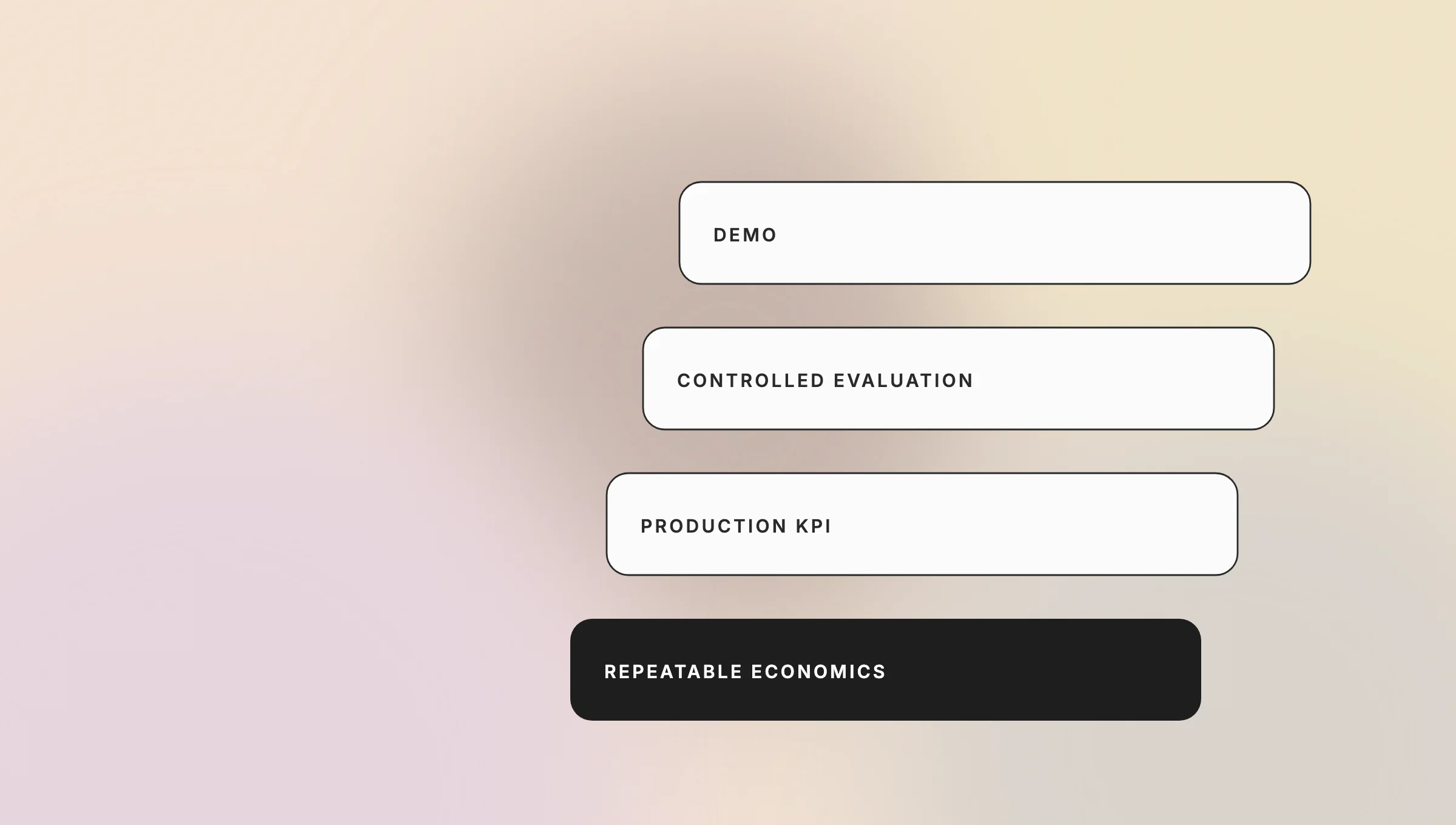
That distinction turns ai hype vs reality from an argument about the whole market into an evidence question. A claim should move through four levels:
| Evidence level | What it proves | What it does not prove |
| Demo | The product can perform a selected task in a controlled setting | Reliability on your data or workflow |
| Controlled evaluation | Performance can be measured against a defined test set | Stable production performance or user adoption |
| Production KPI | A live workflow improves against a baseline | Repeatability across teams, periods, or volumes |
| Repeatable economics | The outcome survives full operating cost and ongoing controls | That every other AI use case will work |
Current survey evidence shows why the distinction matters. McKinsey’s survey of 1,719 participants across 97 nations, fielded from May 4 to June 8, 2026, found that 44% reported enterprise-wide AI scaling and 37% reported positive earnings-before-interest-and-taxes contribution. The same survey found that one in five respondents limited AI use because of operating costs. These are self-reported responses, not audited company results, but they show that scaling, value, and cost pressure can exist at the same time. (McKinsey, 2026)
Enterprise adoption also needs its own frame. Market analysis tells you where risk may be accumulating. An enterprise AI adoption roadmap tells you how to move a selected use case from decision to execution. Mixing those questions encourages two errors: treating market investment as proof of value, or treating market skepticism as a reason to reject useful deployments.
What is driving the AI boom?
The AI boom is being driven by stronger model capability, customer demand, capital spending, and infrastructure buildout. Each is a meaningful signal. None is enough to establish that a specific enterprise deployment will create durable value, because spending can reflect expectations about future demand rather than verified returns today.
Provider disclosures show real commercial activity. Anthropic’s Form S-1, filed with the U.S. Securities and Exchange Commission on October 26, 2026, reported revenue of $41 million in 2023, $386 million in 2024, $4.585 billion in 2025, and $16.286 billion for the six months ended June 30, 2026. The same filing reported a GAAP operating loss of $693 million for that six-month period, compared with $2.135 billion for the same period in 2025. (Anthropic Form S-1, 2026)
Those figures support two conclusions. Demand can be real, and provider economics still require careful reading. Anthropic also reported a net loss of $80.748 billion for the six months ended June 30, 2026, heavily affected by fair-value changes in convertible notes and related liabilities. Its $132.902 billion accumulated deficit is an accounting measure, not a synonym for cash burn. The SEC filing documents a proposed public offering process; an amended S-1 filed November 2, 2026 does not show that an IPO priced or closed. (SEC filing detail, November 2, 2026)
For a buyer, provider revenue is evidence of demand and operating loss is evidence about economics. Neither tells you whether your claims workflow, underwriting review, customer-service process, or fraud investigation will improve. That answer needs a baseline, a controlled evaluation, production monitoring, and a full cost model.
What current AI startup news says about vendor risk
Current ai startup news should be read as due-diligence input, not as proof that the whole market is rising or collapsing. Funding, filings, restructurings, and investor valuation marks reveal different things. Buyers should identify the type of evidence before drawing conclusions about product continuity or market health.
Anthropic’s filing is unusually detailed provider evidence. Canva illustrates a different category. Canva said a 2026 restructuring affected 1,271 people, or 22% of its team. “Affected” covered more than departures, so it should not be rewritten as 1,271 layoffs. The accessible company page did not expose a reliable publication date and needs a final editorial check. (Canva team update, date to verify)
Separately, Capital Brief reported on August 14, 2026 that investors Blackbird and Airtree marked their estimate of Canva down by 17%, from $42 billion to $34.9 billion. That was an investor mark reported by financial media, not a Canva funding round or a company-announced valuation. The evidence does not establish that AI compute costs caused either the mark or the restructuring. (Capital Brief, August 14, 2026)
The buyer lesson is narrower than “an AI crash has begun.” Restructuring, changing investor estimates, concentration, and dependence on future funding can affect support capacity or roadmap confidence. Financial health is one continuity indicator, not a guarantee. Contract terms, operational dependencies, export rights, and tested alternatives matter as much as a valuation headline.rity-fixes-only status and PHP 8.4 and 8.5 in active support on November 4, 2026. Support status changes over time, so recheck the official PHP table before choosing a target branch.
Would an AI crash affect every layer equally?
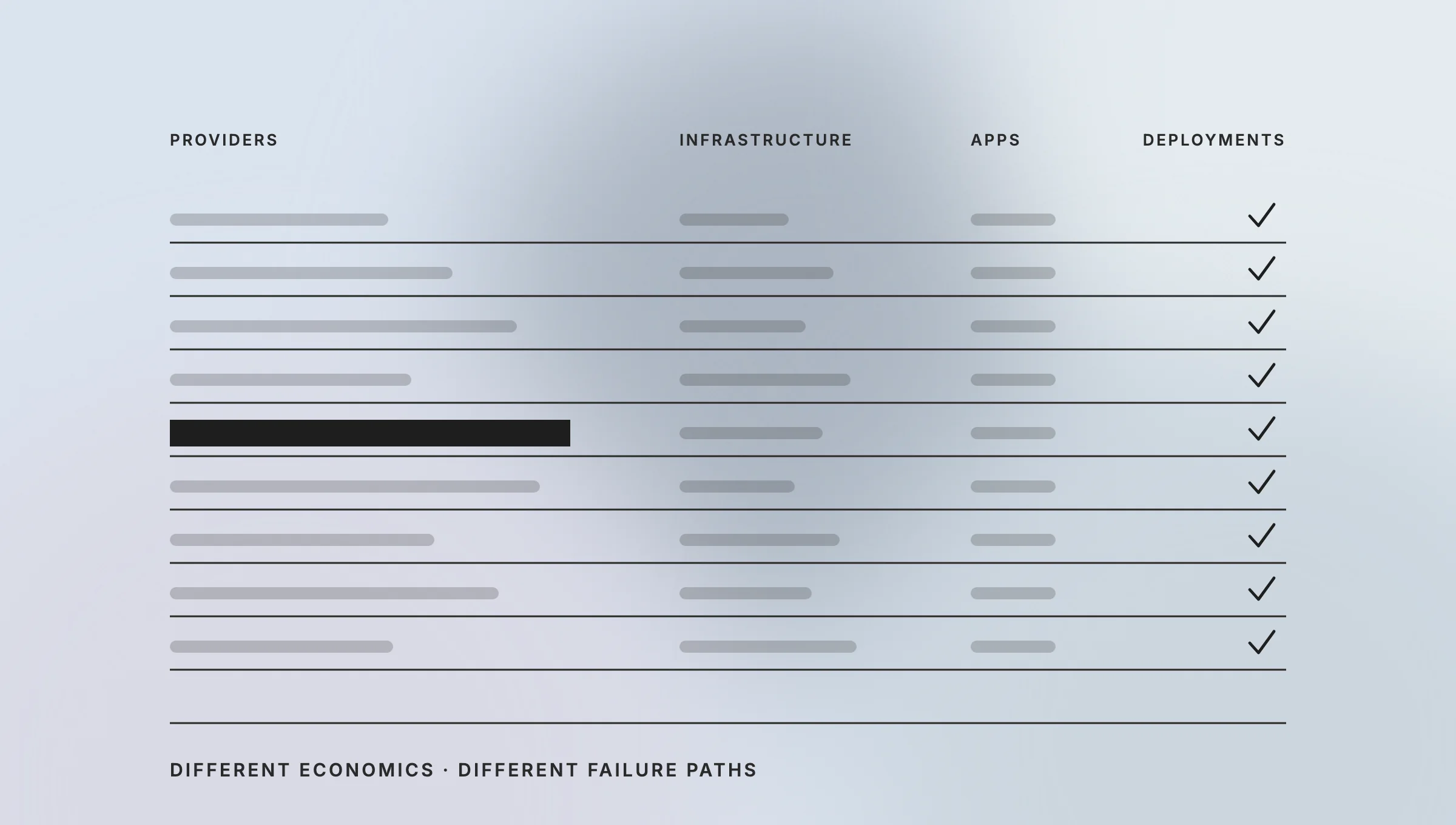
An AI crash or market correction would not affect every layer in the same way. Model providers, infrastructure projects, application vendors, and enterprise deployments have different economics and failure paths. A valuation reset could remove vendors while useful internal systems continue to operate; infrastructure delays could raise prices without invalidating a workflow’s value.
| Layer | Plausible correction | Enterprise exposure | Practical safeguard |
| Model providers | Consolidation, price changes, reduced subsidies, tighter capacity | API changes, model retirement, concentration risk | Abstract model access, test substitutes, negotiate change notice |
| Infrastructure | Delayed projects, higher power or capacity costs, regional constraints | Pricing, latency, residency, resilience, deployment lead time | Model cost at several usage levels and retain regional options |
| Applications and vendors | Funding pressure, acquisition, product withdrawal, reduced support | Workflow disruption, roadmap drift, lost integrations | Require data export, dependency disclosure, and transition support |
| Enterprise deployments | Budget scrutiny, paused expansion, tighter ROI requirements | Stranded integration work or underused systems | Use bounded scope, KPI gates, monitoring, and rollback plans |
Infrastructure evidence already shows constraints, but datasets must stay separate. Allianz Research estimated in a report published May 12, 2026 that $156 billion of U.S. data-center projects were blocked or delayed during 2025. Axios reported on October 20, 2026 that 86 projects had been canceled or significantly delayed since January 2026, based on Goldman Sachs analysis. Axios also reported Goldman’s forecast that global data-center power demand could rise 170% from 2025 to 2030. The first two figures use different methods and windows; the power number is a forecast, not observed growth. (Allianz Research, May 12, 2026; Axios, October 20, 2026)
Government actions are also specific. On September 21, 2026, Texas Governor Greg Abbott directed the Texas Commission on Environmental Quality to halt new data-center permits pending an ERCOT audit. On May 27, 2026, Ohio Governor Mike DeWine paused new requests for data-center sales-tax exemptions; the state release explicitly said this was not a construction ban. These actions affect project economics and timelines, but they do not prove a nationwide infrastructure stop. (Texas Governor’s Office, September 21, 2026; Ohio Governor’s Office, May 27, 2026)
Which latest developments in AI matter to enterprise buyers?
The latest developments in ai that matter most are changes to provider economics, operating cost, infrastructure capacity, and governance timelines. Product announcements matter when they change a measured workflow. These broader developments matter because they can change continuity, total cost, deployment location, approval requirements, or the evidence a buyer must keep.
First, cost discipline is moving closer to the buying decision. A license or API quote omits integration, storage, monitoring, evaluation, retraining, human review, incident response, and process change. McKinsey’s May–June 2026 survey finding that one in five respondents limited use because of operating cost makes the omission harder to defend, even with the survey’s self-reporting caveat.
Second, infrastructure constraints now belong in vendor due diligence. Ask which clouds, model providers, regions, and data processors the product depends on. Then test how a capacity shortage or region change would affect price, latency, residency, and service levels.
Third, governance dates do not form one universal 2026 deadline. The European Commission’s timetable, updated in October 2026, phases AI Act provisions by rule and system category: some enforcement powers and rules applied from August 2, 2026, while Annex III high-risk rules are scheduled for December 2, 2027 and high-risk AI embedded in regulated products for August 2, 2028. Buyers still need current legal advice for their system and jurisdiction. (European Commission, October 2026)
NIST’s AI Risk Management Framework remains voluntary U.S. guidance, with its generative AI profile published on July 26, 2024. It can structure risk work, but it is not a certification or evidence that a system complies with every applicable rule. (NIST AI RMF).
How should banks and insurers separate AI hype from value?
Banks and insurers should move an AI proposal through eight evidence gates before scaling it. The gates connect business value to production proof, vendor continuity, data, integration, governance, operating cost, and an exit path. They do not replace legal, compliance, security, procurement, or model-risk review in the relevant jurisdiction.
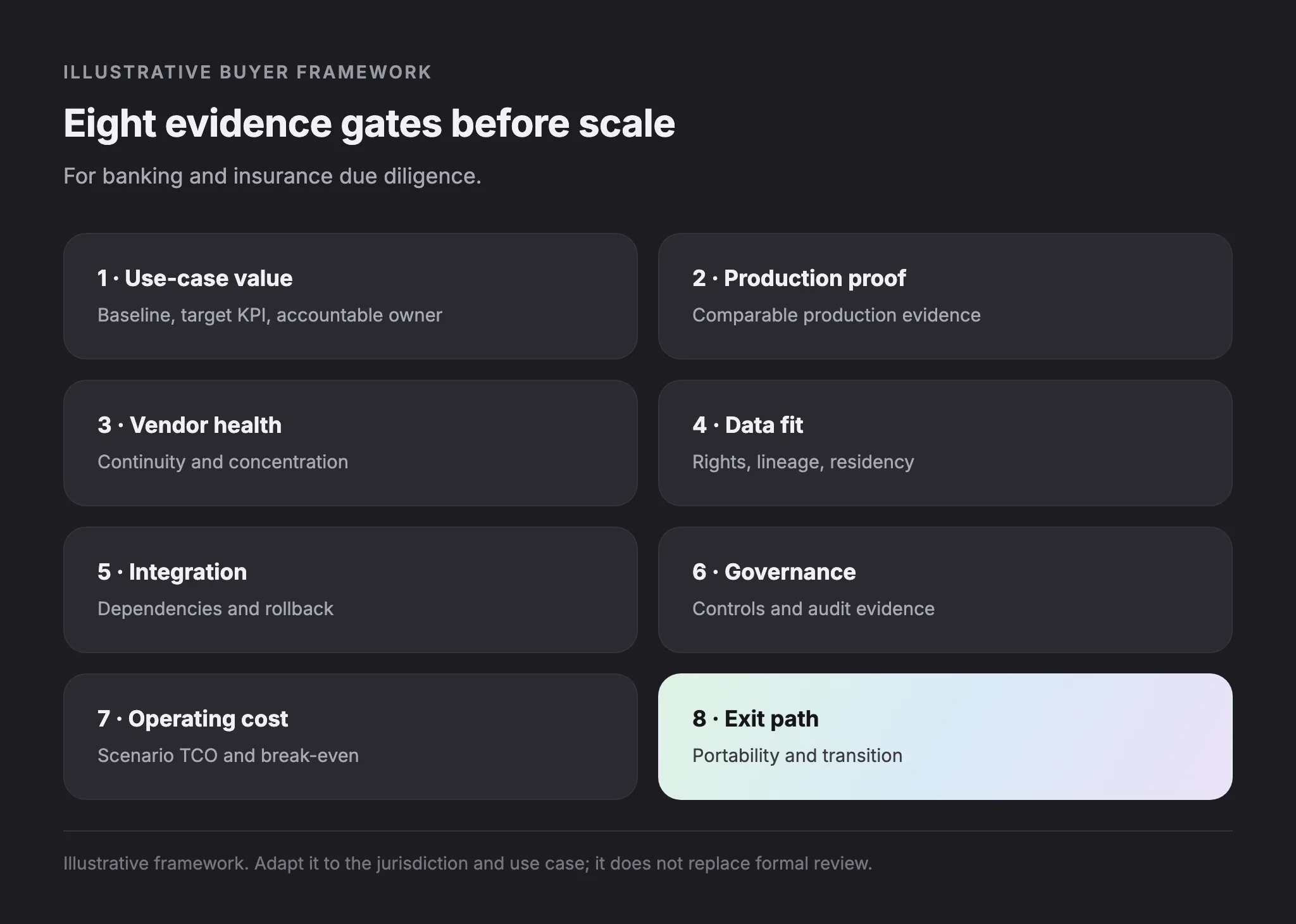
| Gate | Evidence to request | Red flag | Decision output |
| 1. Use-case value | Baseline time, cost, error rate, target KPI, accountable owner | Generic productivity claim with no baseline | Proceed, narrow, or reject |
| 2. Production proof | Comparable deployment, evaluation method, failure distribution, monitoring results | Demo-only evidence or unexplained aggregate accuracy | Confidence level and test plan |
| 3. Vendor health | Financial disclosures where available, concentration, support model, roadmap | Dependence on future funding or opaque third parties | Continuity risk rating |
| 4. Data fit | Rights, quality, lineage, residency, retention, training use | Unclear reuse or inability to delete and export | Data work and contract controls |
| 5. Integration | APIs, identity, legacy dependencies, observability, rollback | Manual work hidden behind the demo | Integration scope and reversibility |
| 6. Governance | Risk classification, oversight, incident response, audit evidence | “Compliant” with no jurisdiction or control mapping | Control plan and approval path |
| 7. Total operating cost | License, inference, storage, monitoring, retraining, review, integration, change | Introductory price with no usage curve | Scenario-based TCO and break-even point |
| 8. Exit path | Portability, transition support, termination rights, alternative providers | Lock-in with no export or substitution plan | Contractual and architectural fallback |
Insurance obligations can differ by state because National Association of Insurance Commissioners model laws and bulletins become operative through state adoption rather than automatically as federal law. (NAIC, accessed November 5, 2026) Banking requirements also depend on the institution, jurisdiction, use case, and decision impact. A customer-service draft, an underwriting recommendation, and an automated adverse decision should not inherit the same risk rating by default.
An enterprise AI readiness assessment can organize evidence before a build, while building regulator-ready AI in fintech provides further governance context. Neither article replaces jurisdiction-specific advice.
The central trade-off is speed and optionality versus commitment and control. Waiting for complete certainty can delay a useful workflow. Committing data, architecture, and operations to an immature vendor can raise switching cost and regulatory risk. Bounded investment works between those extremes: prove one workflow, set a cost ceiling, document controls, and keep a viable exit.
What questions should you ask every AI vendor?
A useful vendor review asks for evidence about your workflow, production conditions, dependencies, cost, and reversibility. The aim is not to collect confident answers. It is to reveal what the vendor has measured, what remains unknown, and which risks your organization would accept.
- Which exact workflow changes, what is its current baseline, and which production KPI should improve?
- What production evidence exists for organizations with comparable data, volume, and regulatory constraints?
- How was quality measured, and what does the failure distribution show beyond the average?
- Which models, clouds, subprocessors, and data stores are operational dependencies?
- How do price and performance change at two, five, and ten times the expected volume?
- What data is retained, reused for training, transferred across regions, exported, or deleted?
- Which monitoring, human-review, incident-response, and audit evidence is included?
- What happens if the model, provider, price, or product changes materially or disappears?
- How can the system be rolled back or replaced without losing records or process continuity?
- Which contract terms cover service degradation, security incidents, model changes, and transition support?
Reference customers may be confidential. Audited case evidence, technical artifacts, or a reference under a nondisclosure agreement can still provide proof. A vendor that cannot share any method, failure analysis, or comparable production evidence is asking you to price uncertainty as confidence.
For a deeper procurement-specific checklist, see how to choose an AI vendor for fintech.
What should an enterprise do if the AI market corrects?
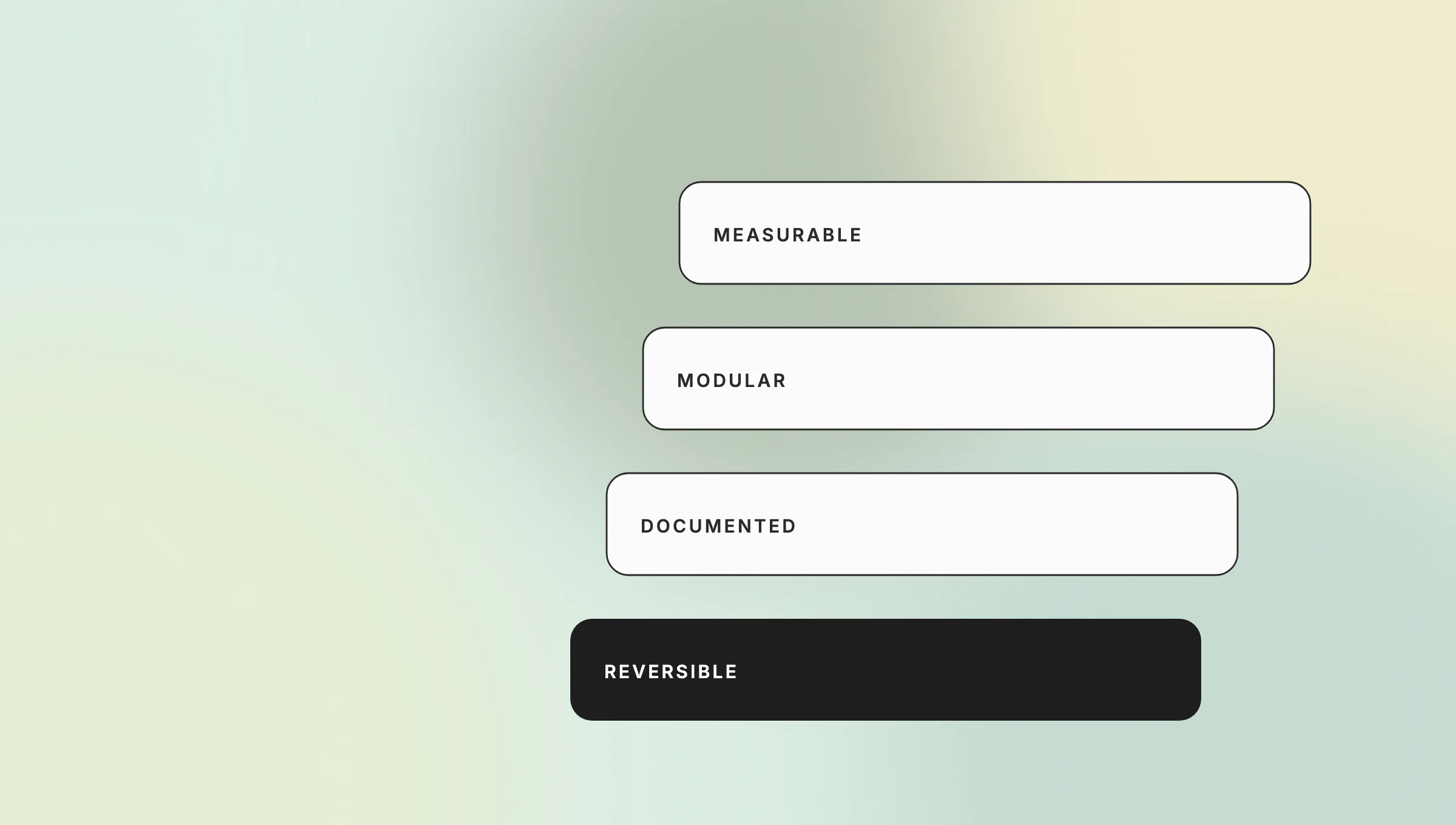
An enterprise should make AI deployments measurable, modular, documented, and reversible before a correction arrives. These choices reduce exposure to vendor consolidation, price changes, discontinued models, and tighter budgets. They also improve ordinary delivery when the market remains strong. Plan for change before you scale.
Start with a workflow whose baseline and owner are clear. Separate model access from business rules where practical, retain evaluation sets, version prompts and models, and log the information needed to investigate failures. Model cost at several volumes rather than one optimistic forecast. Put export, termination, change-notice, and transition duties into the contract.
Architecture optionality has a cost. Supporting several providers or maintaining a fallback can slow delivery and add testing work. Full portability may also be unrealistic when models behave differently. The goal is not theoretical interchangeability. It is a tested route to preserve critical records and operations if a dependency changes.
AI hype is a buying discipline, not a market verdict
AI hype should change how enterprises buy and build, not force a binary decision about whether AI is real. The evidence supports real capability and demand alongside uncertain economics, infrastructure constraints, vendor risk, and uneven production outcomes. The sound response is bounded commitment: measure one workflow, account for full cost, apply controls, and preserve an exit path.
Teamvoy’s AI readiness assessment can help structure the decision before a larger commitment. For systems that need to connect models with existing data and applications, review Teamvoy’s AI integration services.