

- Your AI agent security review probably stops at the prompt, and nothing Binance has disclosed points there. Per its initial findings of November 3, 2026, still subject to independent review, an attacker on a compromised engineer's computer used an "internal AI tool" as a springboard toward a container deployment permission token.
- Binance hasn't reported a model vulnerability or prompt injection. The real job is limiting what a tool can reach and execute once the device, identity, or credentials behind it are compromised. The controls that would have forced a different route never touch the model.
Your engineering team already runs an internal AI tool that reads repositories, calls APIs, and opens pull requests. The model inside it is probably fine. The decision in front of you is narrower: what can that tool reach and execute on the day the laptop, session, or token behind it belongs to someone else?
What did Binance actually confirm, and what is still unverified?
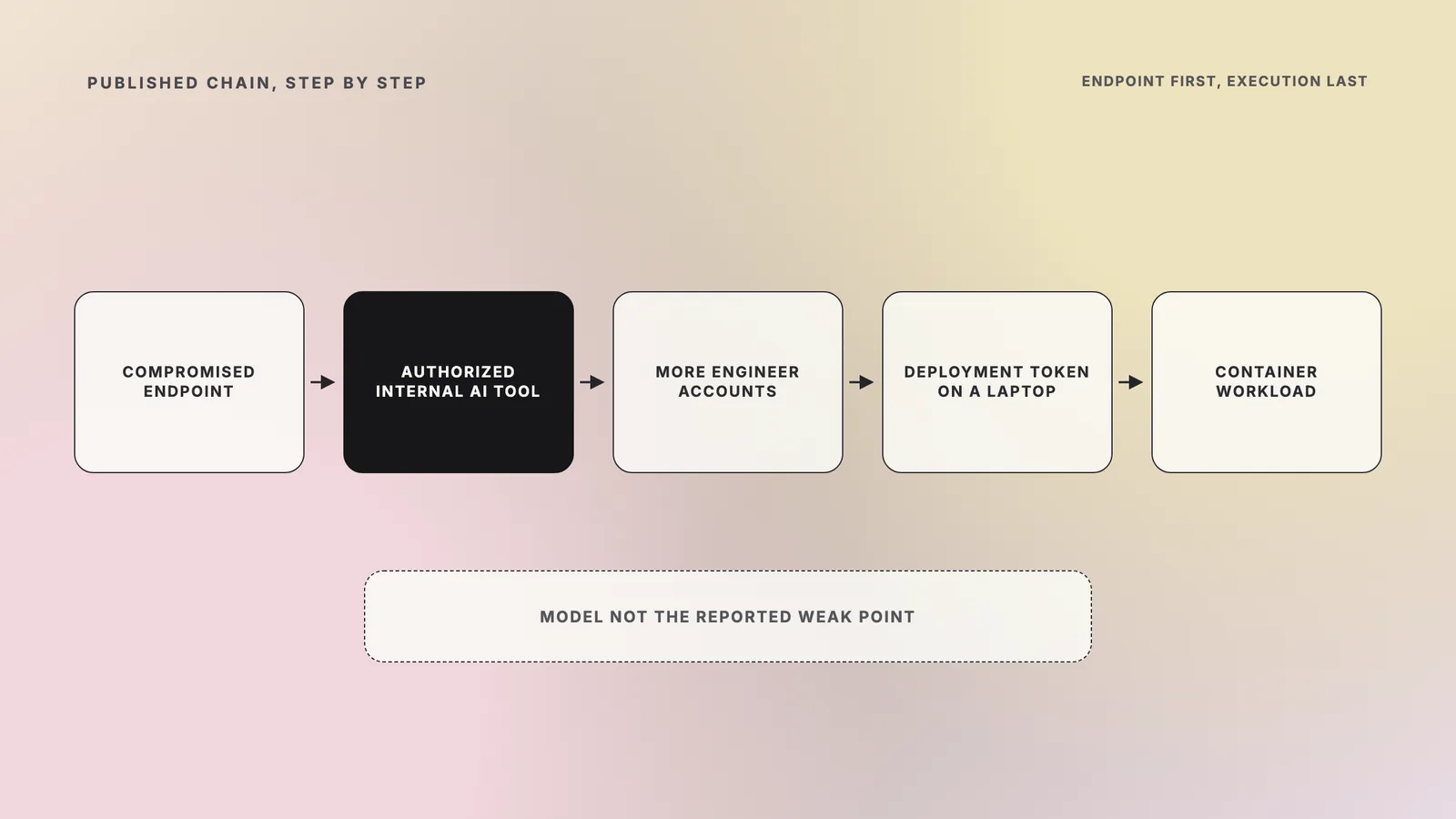
Binance confirmed a dated sequence: a tampered installer in June, malware delivered through a fake recruitment assignment in September, and an internal AI tool used as a springboard on October 20. On October 29 a deployed container triggered a malicious script against an internal wallet signing service. Binance published this on November 3, 2026, as initial findings subject to independent review, so read every line as preliminary.
| Evidence tier | What the source says | Source and date |
| Confirmed by Binance | June 2026: Engineer A downloaded a tampered Homebrew installation while trying to install a popular AI coding tool. The device was replaced and related credentials rotated. | Binance initial findings, November 3, 2026 |
| Confirmed by Binance | September 2026: Engineer B was approached through a legitimate job platform and instructed to download a malicious “assignment” repository onto a work computer. The “0-day malware was not detected by the endpoint security protection tools at the time.” | Binance initial findings, November 3, 2026 |
| Confirmed by Binance | October 20, 2026: the attacker used Engineer B’s compromised computer and “used an internal AI tool as a springboard” to gain control over Engineers A and C, then discovered a container deployment permission token on Engineer A’s computer. | Binance initial findings, November 3, 2026 |
| Confirmed by Binance | October 29, 2026: the attacker logged onto Engineer C’s computer, used Engineer A’s stolen credentials, deployed a container, and triggered a malicious script. Approximately USD 6.34 billion in digital assets was impacted and approximately USD 2.85 billion frozen or intercepted. | Binance initial findings, November 3, 2026 (figures subject to reconciliation) |
| Confirmed by Binance | Remediation included rebuilding “the affected internal AI tool and access controls,” replacing affected devices, decommissioning credentials and tokens, and expanding behavioral anomaly detection. | Binance initial findings, November 3, 2026 |
| Government attribution | The FBI attributed the theft of more than USD 6 billion in virtual assets from Binance to North Korean TraderTraitor actors. | FBI alert, October 31, 2026 [VERIFY — open fbi.gov manually before publication] |
| Secondary interpretation | MindStudio reads the incident as AI tooling inheriting reach from connected identities and systems. Chainalysis ties the fake-recruitment route to the wider DPRK employment-fraud playbook. Context only, not Binance-confirmed architecture. | MindStudio, November 11, 2026; Chainalysis, November 3, 2026 |
Binance labels the June event a supply chain attack: a tampered Homebrew installation pulled down while an engineer searched for a popular AI coding tool. That is an AI supply chain attack, and it lands on a developer endpoint before it touches anything with “AI” in its name. The same report states that Binance “detected and prevented 57 suspected North Korea-linked cyber threat cases” during 2026 (Binance initial findings, November 3, 2026). Google Threat Intelligence documented the same fake-interview and malicious-coding-task pattern on October 16, 2025.
The edges of the published record matter more than the narrative. Binance hasn’t said the internal AI tool was an autonomous agent, a coding assistant, a chatbot, or a named product. It hasn’t reported prompt injection, a jailbreak, or a model vulnerability, and it hasn’t said the tool held wallet-signing privileges or reached the signing service directly. Treat the MindStudio and Chainalysis readings of agent permissions as secondary interpretation, and keep root-cause language out of your write-ups until the independent review lands.
AI hardware design. Anthropic’s electronics design research, published November 9, 2026, reports specifications, PCB layouts, enclosures, firmware, and parWhy does an authorized internal AI tool become a pivot point?
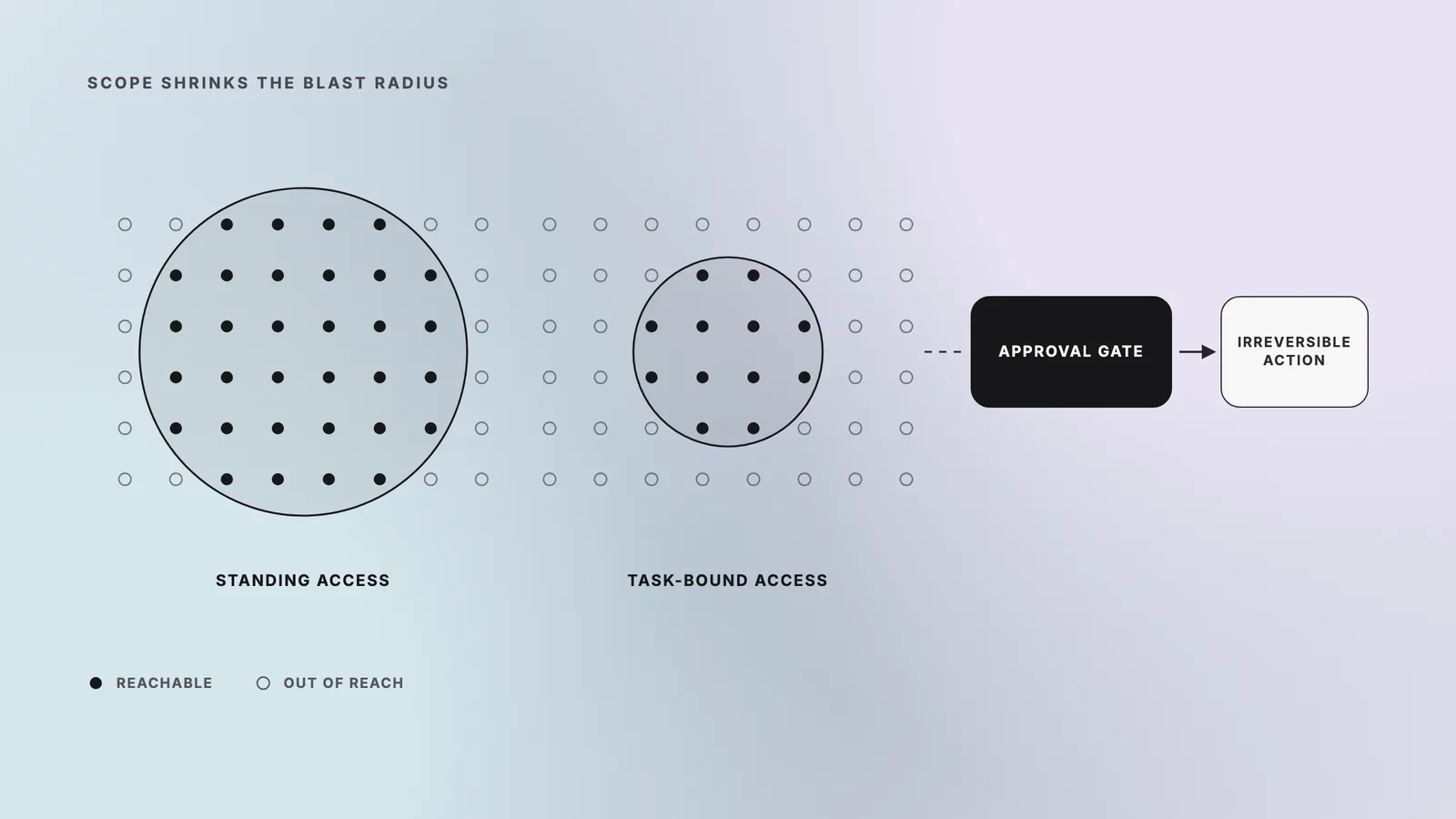
An authorized internal AI tool becomes a pivot point because it bundles reach that a person would otherwise collect one login at a time. A single session can touch repositories, chat, tickets, build systems, and the credential store. Add standing delegation and a long-lived token on the host, and one compromised endpoint becomes a route through the organization rather than a single lost laptop.
Each property is survivable alone. Bundled reach without standing delegation dies when the task ends. Standing delegation on a single-purpose connector reaches one system. A long-lived token on an isolated workstation has nowhere to travel. Composition creates the pivot: reach supplies breadth, standing delegation removes the clock that would have closed the session, and the token converts breadth into durable capability inside systems the tool was never pointed at.
Binance’s chronology shows that shape. The attacker held one engineer’s computer, used an internal AI tool as a springboard to two further engineers, and found a container deployment permission token (Binance initial findings, November 3, 2026). Reach first, credential second, high-impact action third.
For a bank, an insurer, a hospital group, or a logistics operator, the consequence lands in two places. The first is blast radius: how many systems one compromised endpoint reaches before anything says no. The second is evidence. When a regulator asks which identity performed an action and under which authorization, “the shared AI tool account” is an answer that costs you weeks of reconstruction and a finding in the report.
This differs from a shadow AI security problem. Shadow AI security deals with staff using unsanctioned services outside your controls, where discovery comes first. Binance describes a tool inside its own environment, later rebuilt with its access controls. The failure path ran through sanctioned access: the allowlist said yes, the identity provider said yes, and the audit trail recorded an approved tool doing approved-looking things. Scoping would have helped. Discovery wouldn’t.
Teams that want to secure AI agents should start from the OWASP AI Agent Security Cheat Sheet. It lists tool abuse, privilege escalation, data exfiltration, and supply-chain attacks among core agent threats, and recommends minimum required tools, per-tool permission scoping, and explicit authorization. That is the center of agentic AI security: the capability a tool carries, not the text it produces. OWASP’s Agentic AI Threats and Mitigations (February 17, 2025) frames the same risk as excessive autonomy paired with excessive reach. Both are general guidance; they don’t describe Binance’s internal work.
What does the full execution chain look like?
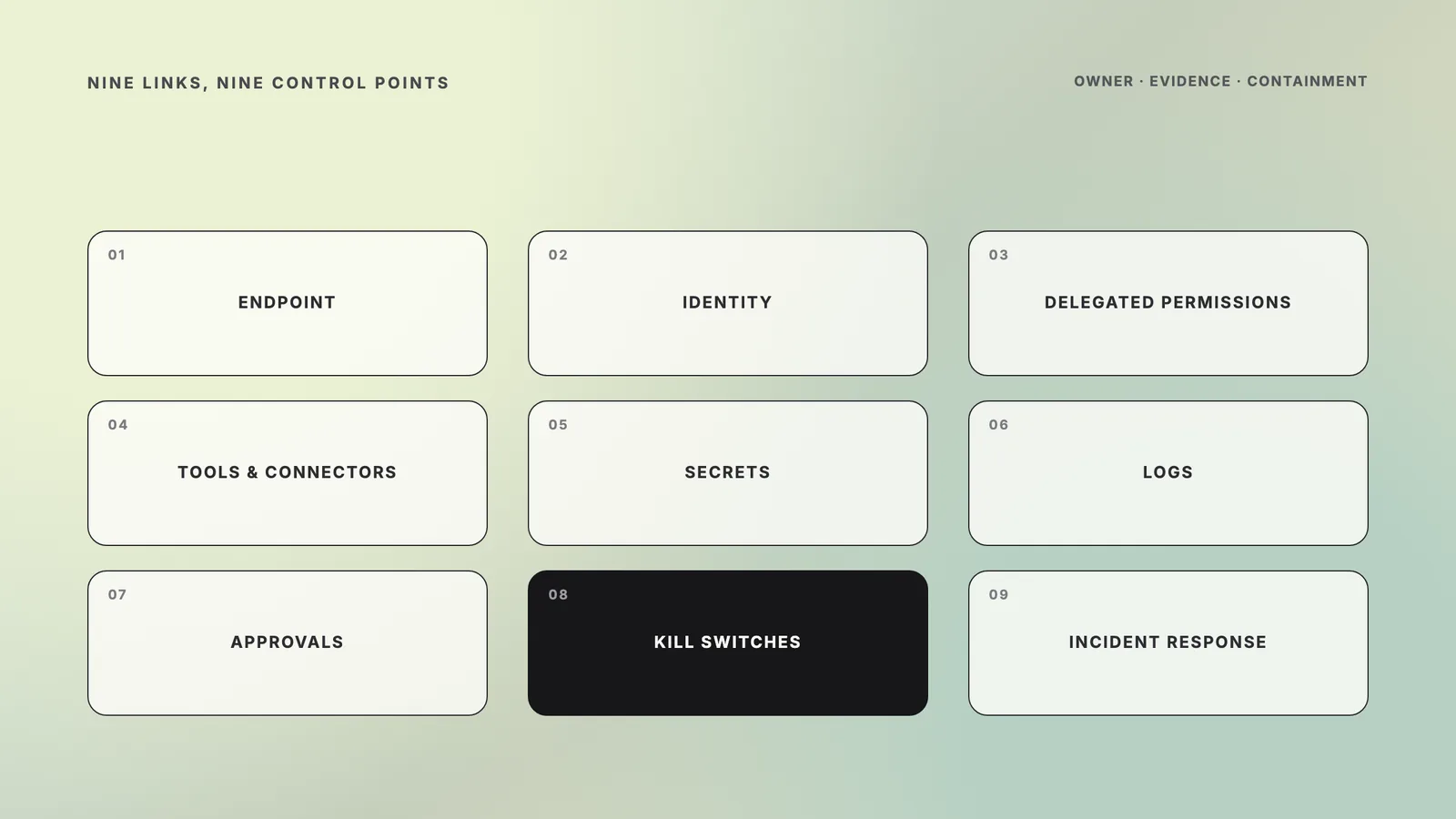
The execution chain behind an internal AI tool has nine links, and the Binance chronology touches most of them. You secure AI agents by treating each link as its own control point with a named owner, its own evidence, and its own containment action. The alternative, trusting the whole chain because a human authenticated once at the top, keeps producing incidents like this one.
- Endpoint. The device the tool runs on or is driven from. Binance’s chain opens with a tampered installer in June and malware in September that endpoint tooling didn’t catch at the time.
- Identity. Who the tool acts as. A tool running under a broad human account inherits that human’s permissions everywhere, including systems nobody considered at approval time.
- Delegated permissions. What the identity may do, for how long, and for which task. Open-ended delegation turns one compromised device into several compromised people.
- Tools and connectors. The concrete actions available: read a repository, post a message, run a job, deploy a container. Capability lives here, and so does most of your risk.
- Secrets. Tokens and keys the tool or its host can retrieve. Binance reports a deployment permission token found on an engineer’s computer, the moment reach became capability.
- Logs. Whether you can reconstruct who or what did each action, from which device, under which run. Binance notes the attacker concealed activity and removed traces, which is why your log store belongs off-host and append-only.
- Approvals. Which high-impact actions require a person, and whether approval binds to the exact payload rather than a category of work.
- Kill switches. What one decision can stop: tool execution, identity validity, token validity, network paths, and queued runs.
- Incident response. The isolate, revoke, preserve, rebuild, validate, and stage-back-in sequence from NIST SP 800-61 Rev. 3 (April 2025).
Zero trust, as NIST SP 800-207 (August 2020) defines it, makes access decisions explicit, per session, and resource-centric instead of inherited from network location or device ownership. Applied to an internal AI tool, the design question is specific: state what this run may do, right now, for this task, from this device. If the honest answer is “anything the user can do,” link three is already broken.
AI coding assistant security belongs inside the same chain rather than beside it. Binance’s June lure was a tampered installer for a popular AI coding tool, a software-provenance failure before it’s an AI failure. That category attracts tampered packages because engineers install assistants quickly, grant them wide file-system access, and run them with production privileges.
Control matrix: failure mode, preventive control, detection signal, containment action
A control matrix earns its place when each row has an owner who can be paged. Map every failure mode to one preventive control, one detection signal, and one containment action, then test whether each layer can fail without exposing the next. The rows below draw on OWASP and NIST guidance, and describe general practice rather than Binance’s internal remediation.
| Failure mode | Preventive control | Detection signal | Containment action | Owner |
| Malware steals sessions or developer credentials from an endpoint | Software provenance for installers and packages, device isolation, separate privileged workstation for deployment work | EDR alert correlated with a session from an unusual device or origin | Isolate the device and invalidate every session it holds | Endpoint security lead |
| Tool operates under a broad human account | Separate human, agent, and workload identities with short-lived delegation | Run records attributed to an identity that does not match the originating device | Disable the identity and revoke its delegated tokens | IAM owner |
| Authorized tool can reach systems outside its purpose | Deny by default, with task-scoped and tool-scoped grants that expire | Access attempts outside the tool’s normal resource graph | Remove the scope and stop the run | Platform engineering |
| Tool invocation becomes a pivot to other people or systems | Allowlisted tools, schema validation on arguments, destination restrictions | A new tool, destination, or argument shape for an established workload | Disable the connector | Agent platform owner |
| Long-lived credentials are discoverable and reusable | Vault-backed, on-demand issuance with short TTLs and nothing persistent on disk or in prompts | Secret retrieval or reuse from a host outside the issuing pipeline | Rotate or revoke the secret immediately | Secrets management owner |
| Deployment, signing, or transfer proceeds without scrutiny | Approval bound to the exact payload, actor, and expiry window | Mismatch between the approved payload and the executed action | Reject the action and freeze the workflow | Service owner plus risk |
| Investigation cannot reconstruct causality | Immutable, correlated event trail across human, device, agent, run, tool, and credential | Missing or broken correlation IDs in run records | Fail closed and preserve evidence before any rebuild | Observability owner |
| Tool stays trusted after an endpoint compromise | Rebuild from known-good sources with staged re-authorization | Post-rebuild baseline comparison against the approved configuration | Keep the tool disabled until the trust chain is validated | Incident commander |
Read the matrix against the published chronology. The disclosed path crossed the endpoint, identity, permissions, secrets, and high-impact action rows in that order. A working control on the secrets row, meaning no long-lived deployment token on a developer laptop, would have forced another route. So would an approval bound to the deployment payload. Both controls work without touching the model.
Least privilege and approval gates: name the trade-off out loud
Least privilege and approval gates shrink what a compromised identity can do and put a person in front of irreversible actions. The cost recurs daily: slower runs, fewer autonomous workflows, more access-denied moments during legitimate work, and engineers who route around friction applied uniformly instead of selectively. You’re trading throughput for a bounded worst case, and that trade belongs in writing.
Task-bound delegation is the largest trade. A token that expires with the task and covers only that task’s resources costs you a tool that sees everything its user sees. You buy a guarantee that losing one run doesn’t mean losing the account. Tool allowlists with per-tool scopes cost configuration time and produce denials that feel arbitrary. You buy a pivot through one connector that cannot reach the next.
Approval gates carry the subtler cost, and it compounds. Gates degrade when they fire too often, because a human asked to approve forty things a day approves the forty-first unread. Approval fatigue turns a control into a rubber stamp while leaving a reassuring entry in the audit log. That outcome is worse than no gate, since you now hold documented evidence that someone reviewed what nobody read. Gate irreversible actions only: deployment, privilege changes, signing, external transfer, destructive operations. Bind each approval to a payload, so a generic “approve all deployments today” click can’t cover tomorrow’s malicious container.
A second loss deserves plain language: autonomy. An agent that stops and asks before every consequential step is a fast assistant with a handbrake, not an autonomous system. Plan capacity around that rather than finding the gap in production.
One trade-off runs against the commercial interest of anyone selling agent architecture, Teamvoy included. If your internal AI tool only reads documentation and drafts text, you probably don’t need an agent security program. Harden the endpoint, scope the identity grant, log the runs, and spend the budget where it returns more. These controls earn their cost when the tool can act: deploy, sign, transfer, change permissions, or message colleagues on your behalf.
How do you detect and respond to a compromised agent system?
Detection for agent systems means correlating five things in one event trail: the human principal, the source device, the agent or workload identity, the run, and the credential used. Response means a kill switch that halts execution before anyone has a confirmed explanation, then a staged rebuild. Generic application logging falls short, because it records what the tool did and omits on whose authority.
Make the log schema explicit. Each run event should carry run_id, parent_run_id, human_principal, agent_identity, workload_identity, source_device_id, tool_name, an argument hash, credential_id, approval_id where one applies, the resource touched, the outcome, and a trusted timestamp. The correlation ID has to survive process boundaries, so a tool call that triggers a pipeline keeps the originating run_id in the pipeline’s records. Without that propagation the chain breaks at the handoff from a chat interface into infrastructure that changes production.
Three signals earn their place once the schema exists:
- Tool graph drift. Every internal tool has a normal set of destinations and argument shapes. A new destination or an odd argument pattern beats volume as a signal, which is why OWASP recommends logging decisions, tool calls, outcomes, and anomalies.
- Identity-to-device mismatch. A run attributed to one engineer but originating on another engineer’s device is the October 20 pattern in log form. A schema that can’t represent that pair can’t alert on it.
- Credential use off-pattern. A deployment token used from a new host, at an odd hour, or outside its normal pipeline. Short TTLs shrink the window where legitimate use is plausible, which makes the signal louder.
The kill switch has to cut five things at once: tool execution, the agent and workload identities, every delegated token, the network path to high-impact systems, and queued runs. Binance’s report shows why partial switches disappoint. Suspending withdrawals didn’t invalidate on-chain delegations already established, and revoking those took a specialized procedure and additional transactions (Binance initial findings, November 3, 2026). Stopping new actions is half a containment plan. Revoking what is already in motion is the other half, and the same logic applies to queued jobs, cached sessions, and standing grants in your own estate.
Response then follows the NIST SP 800-61 Rev. 3 lifecycle: isolate endpoints, disable the tool, revoke credentials, preserve logs and run state, rebuild from known-good sources, validate the trust chain, and re-enable in stages. Rehearse it early, because the slow steps are organizational: who may pull the switch, and who may declare the tool trustworthy again.
Implementation sequence
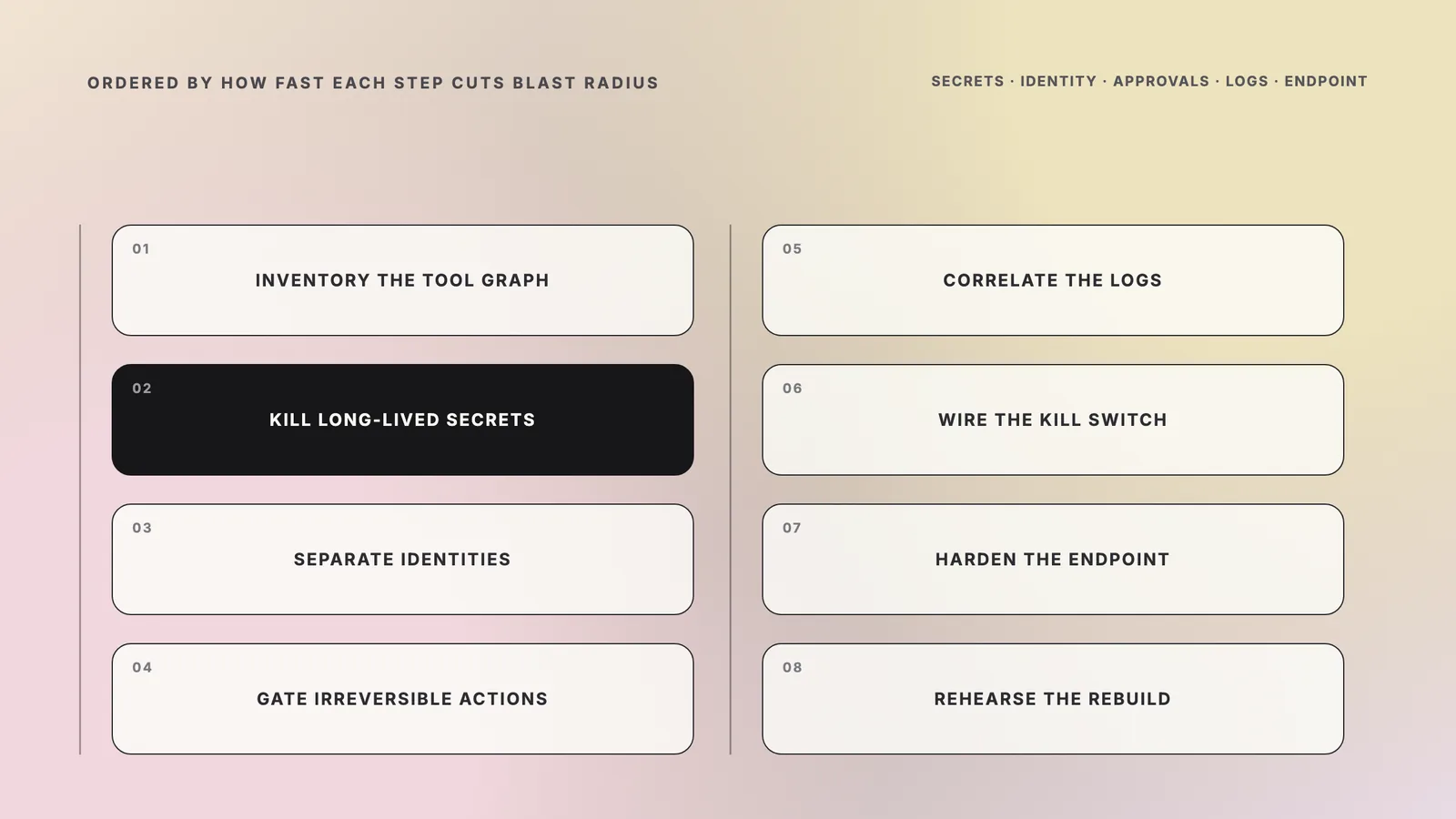
Implement AI agent security in the order that cuts blast radius fastest: secrets, then identity, then approvals, then observability, then the endpoint program. Each step stands alone, so a stalled step four doesn’t waste steps one through three. The sequence holds whether you built the agent or bought an internal tool and wired it into your systems.
- Inventory the tool graph. List every internal AI tool, what it can read and execute, which identity it runs as, and which secrets its host can reach. Expect to find a connector nobody owns.
- Remove long-lived secrets from endpoints. Move deployment and signing credentials to vault-backed, on-demand issuance with short TTLs, so nothing a tool needs survives on disk after the run.
- Separate identities. Give each agent and workload its own identity with task-bound delegation, and stop running tools under the human’s account.
- Gate the irreversible actions. Deployment, privilege changes, signing, external transfer, destructive operations. Bind each approval to the exact payload, actor, and expiry.
- Correlate the logs. Human, device, agent, run, tool call, credential, approval, outcome, and resource on one propagating correlation ID, in an append-only store held off the host.
- Wire and test the kill switch. One action disables execution, identities, tokens, network paths, and queued runs. Test quarterly with a named person allowed to pull it without an executive call.
- Harden the developer endpoint. Provenance checks for installers and packages close the AI supply chain attack path, and an AI coding assistant security policy covers what engineers may install and with which file-system access. Add a privileged workstation for deployment work and a recruitment-lure briefing for engineers whose public profiles name your company.
- Rehearse the rebuild. Run the NIST lifecycle as a tabletop with the internal tool assumed compromised. Measure time until it’s disabled, and time until it’s trusted again.
The architecture behind steps three through five appears in Teamvoy’s guide to agent identity, tool contracts, and data boundaries. Rollout mechanics sit in a companion piece on approval gates, observability, and kill switches, and least privilege, secrets, and runtime controls covers the enterprise estate.
Conclusion
AI agent security is an execution-chain discipline rather than a model problem. Binance’s initial findings trace a path from a tampered installer and a fake job interview to an internal AI tool and a deployment token, with the model never described as the weak point. Scope the identity, expire the secrets, gate the irreversible actions, propagate the correlation IDs, and test the switch. You give up some autonomy and speed. You get a worst case you can bound and explain to a regulator.
Talk to Teamvoy About AI Agent Security
Map the identities, tools, permissions, and approval gates in your financial AI workflow before production. Talk to Teamvoy about a bounded AI-agent architecture and security review for AI agents for financial services, scoped to the execution chain described above.