CTO as a Service
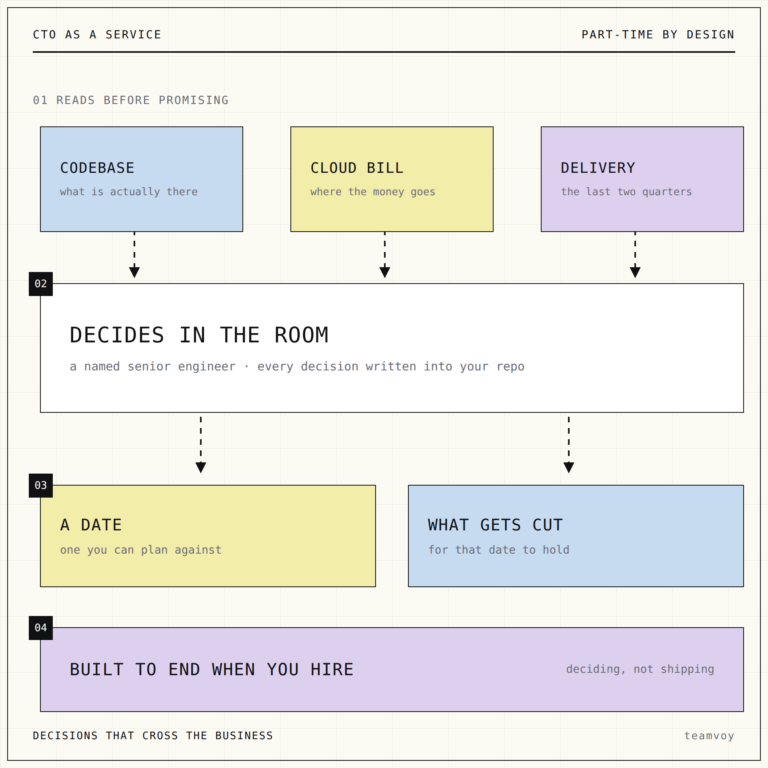
A named senior engineer sits in your leadership meetings, owns the technical decisions that cross the business, and writes each one down in your repository. They read the codebase, the cloud bill and the last two quarters of delivery before giving you a date, and they tell you what has to be cut for that date to hold. The role is part-time by design, so the work is deciding and documenting rather than shipping, and the engagement is built to end when you hire.
Trusted by engineering teams.


Teamvoy has delivered engineering work for Nasdaq, Panasonic, Afriland First Bank, and 50+ other companies since 2013.

Verified B2B client reviews from fintech, insurance, healthcare, and hi-tech engagements.

A B2B review platform that connects businesses with verified software solutions providers.

Transparent platform where current and former employees share company reviews and interview experiences.
One board commitment, seven layers
It arrives as a single question about a date. Between the ask and an answer that holds are seven handovers, and most of them happen before a line of code is written.

01. The ask arrives as a date
A board or customer commitment lands as a date with a feature name attached, and has to be turned into a question an engineer can actually answer. Breaks when the date was quoted in a sales call by someone who will never build against it, and it is already treated as fixed by the time engineering hears about it.
02. Decomposition against the real codebase
The ask is broken into changes against the repository that exists today, including the parts nobody has opened in a year. Breaks when the estimate is made against an architecture diagram rather than the code, and the diagram was last accurate two rewrites ago.
03. Constraint check on the existing system
Capacity, the data model, third-party rate limits and the one service with a single owner are checked before any number leaves the room. Breaks when the real blocker is a vendor contract or an unowned service, and it surfaces in week five instead of week one.
04. Build, hire or contract
Whether the work goes to the team you have, a new hire or a contractor is decided with the twelve-month cost of each option written down beside it. Breaks when a role is hired for a peak that lasts a quarter, and the salary line outlives the reason it was created.
05. The commitment and the counter-offer
A date goes back together with the scope that was cut to make it true, so the trade-off is something a person signed rather than something that happened. Breaks when the CTO agrees to the whole scope in the room, and the trade-off arrives months later as a slipped date nobody chose.
06. Drift detection
One or two delivery signals are watched weekly, chosen so that drift is visible while there is still time to act on it. Breaks when standup is the only signal, so a four-week slip becomes visible in the last week of the quarter.
07. The decision record and the board write-up
The decision, the option that was rejected and the condition that would reverse it are written into the repository, then summarised for the board. Breaks when the reasoning lives in one person head, and the next technical leader re-litigates every settled question from the beginning.
CTO as a Service Success Stories
Check out our product and experience design case studies. Learn how we’ve helped businesses like yours launch stunning solutions and succeed in target markets.
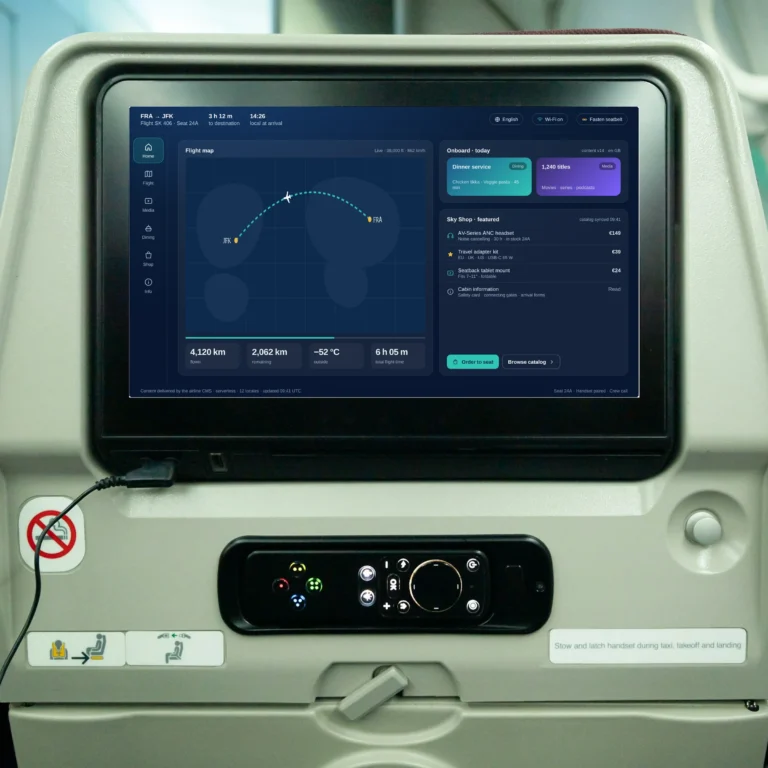
Enterprise CMS Development for Global Electronics Corporation: Rescuing a Delayed Project

Data Migration in Insurance: Moving Data Safely
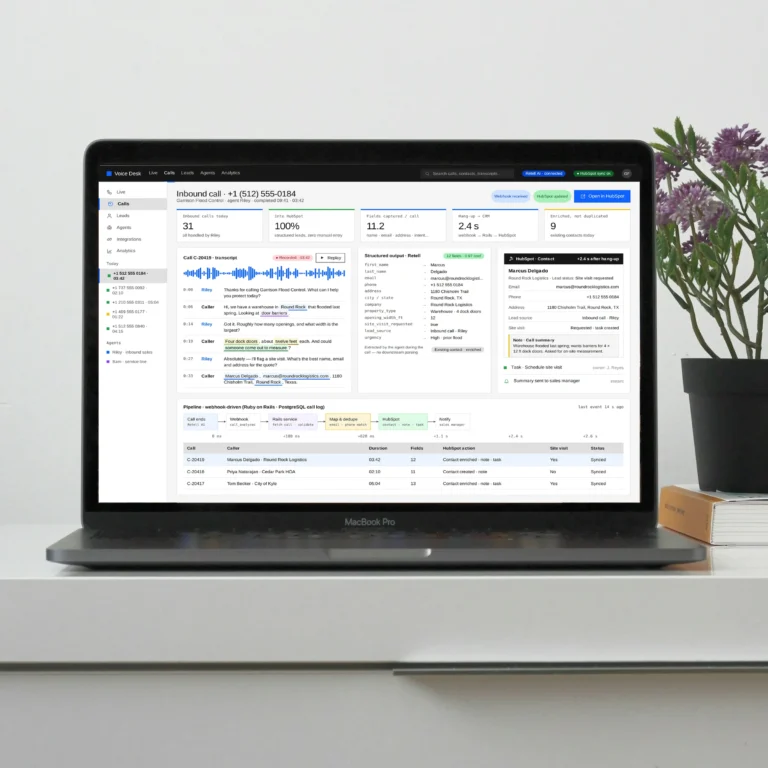
AI Voice Assistant for Inbound Calls: Retell AI + HubSpot at Garrison Flood
Why choose Teamvoy for a fractional CTO?
Four things that are true of how we put a CTO into a company, two of which cost us something.
The engineers who scope the work build the work
Runs alongside. No handover from a pre-sales team to a delivery team. The person who tells you what the work will cost is the person who then has to make that estimate true. Costs us: we cannot start faster than we can staff, so we turn down work that needs a squad this month.
You own the source code from the first commit
The repository is yours, in your organisation, from day one. Not transferred at the end, not held until the final invoice clears. Costs us: we give up the lock-in that comes from holding a repository, so we have to be re-chosen every quarter.
The decision, the option we rejected, and what would reverse it, all written down
Every call that matters is recorded in your repository as it is made, not summarised at the end of the engagement. A year later your team can see why a vendor was chosen and what would justify changing it, which is the difference between inheriting reasoning and inheriting a conclusion.
The engagement is designed to end in your full-time hire
We write the job specification, sit on the technical panel and hand the decision records to whoever takes the seat. Renewal is not the default, and we say when the retainer has stopped earning its cost rather than waiting for you to work it out.
CTO as a Service Offerings
Six offerings. Most engagements begin with one of them and add the others as the company needs them, and each is scoped and estimated separately.
Talk to a Chief Technology Officer on the first call.
-
Technical Due Diligence and Assessment
A read of the code, the cloud bill, the incident history and the last two quarters of delivery, reported as what each thing would cost to change rather than as a severity rating. We open the repository and run the build before writing anything, because a codebase assessed from interviews reflects what the team believes about it rather than what is in it.
– Codebase and build review
– Cloud spend breakdown
– Delivery history analysis
– Key-person risk mapping
– Written assessment you keep -
Roadmap and Delivery Ownership
Turning a board or customer commitment into a dated plan with the cut scope written next to the date. The plan is versioned in your repository, so when a date moves the reason moves with it instead of being re-explained from memory in the next meeting.
– Quarterly planning
– Estimate and trade-off documentation
– Delivery signal tracking
– Board reporting
– Scope negotiation support -
Engineering Team Design and Hiring
The shape of the team you need next, the job specifications that will get it, and the technical panel that tests for it. We sit on the interview loop rather than handing over a scorecard, because calibration is the part that does not transfer in a document.
– Org design
– Job specification writing
– Technical interview panels
– First ninety days plans
– Compensation benchmarking -
Architecture and Platform Decisions
The build-or-buy calls, vendor selections and migration go decisions, each priced over twelve months rather than at the sticker. We read the contract and its exit clause before the technical comparison, because the switching cost usually decides the answer before the architecture does.
– Build or buy analysis
– Vendor selection
– Migration go or no-go
– Platform cost modelling
– Technical risk registers -
Security and Compliance Readiness
The engineering work behind SOC 2, ISO 27001 or GDPR: access control, logging, change management and the evidence trail, rather than the answers to the auditor questionnaire. We sequence it against the enterprise deal that is waiting on it, so the controls that unblock revenue land in the first weeks.
– SOC 2 readiness
– ISO 27001 control mapping
– Access and change management
– Evidence automation
– Auditor coordination -
Vendor and Outsourcing Oversight
Holding an outsourced team to a standard you can verify: written acceptance criteria, review access to every pull request, and a repository that stays in your organisation. We read the contract for the clauses that decide what happens when the relationship ends, because that is the moment your leverage disappears.
– Contract and clause review
– Acceptance criteria
– Code quality gates
– Exit and transition planning
– Vendor performance reviews
– Could you defend your next delivery date to the board? -
07. Full ownership, not staff augmentation.
We take responsibility for architecture and production behaviour rather than for filling seats. You are not managing our delivery on top of your own. -
08. We tell you when something is not worth building
Including when a packaged platform beats a custom build, or when the integration layer has to come first and the app is not your constraint. We raise trade-offs early, while changes are still cheap.

Could you defend
your next delivery date to the board?
Three ways to start
Three ways to start working with Teamvoy on outcome-based AI. No long discovery. No sales process. No forms to fill. Every engagement starts with a real technical conversation, and every engagement is priced to a result. We move as fast as the situation needs.
Engineering Diagnostic
One engineer reads the repository, the cloud bill, the incident log and the last two quarters of delivery, then reports what each thing would cost to change. You keep the written assessment, the ranked list and the twelve-month cost model whether or not we go further.
First Quarter as Your CTO
A named engineer joins your leadership meetings on fixed days, owns the technical decisions and writes each one down. The quarter ends with a dated roadmap, a hiring plan and a set of decision records in your repository, all of which survive us leaving.
Call a CTO
Fifteen minutes with the engineer who would take the seat. Bring the technical decision you have deferred twice, and you get an answer on what it turns on, including the answer that it does not need a CTO at all.
What changes when the CTO has to live with the estimate.
These rows are the questions worth putting to anyone quoting fractional CTO work, including us.
What our fractional CTOs work in.
Languages we review at depth


Cloud and infrastructure


Delivery and source control
Observability and on-call

Data and AI


Assurance we prepare for


We engineer for:
Bring the decision you keep putting off.
Talk to a Chief Technology Officer on the first call.