


























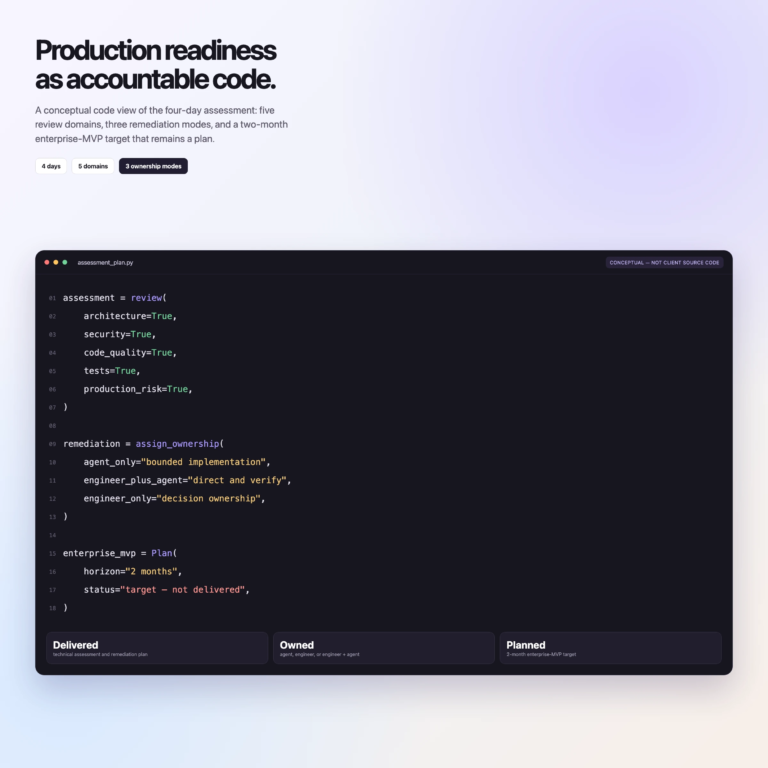

FIXED SCOPE
AI & System Readiness Audit

Architecture review, risk surface, prioritised action plan. No obligation.

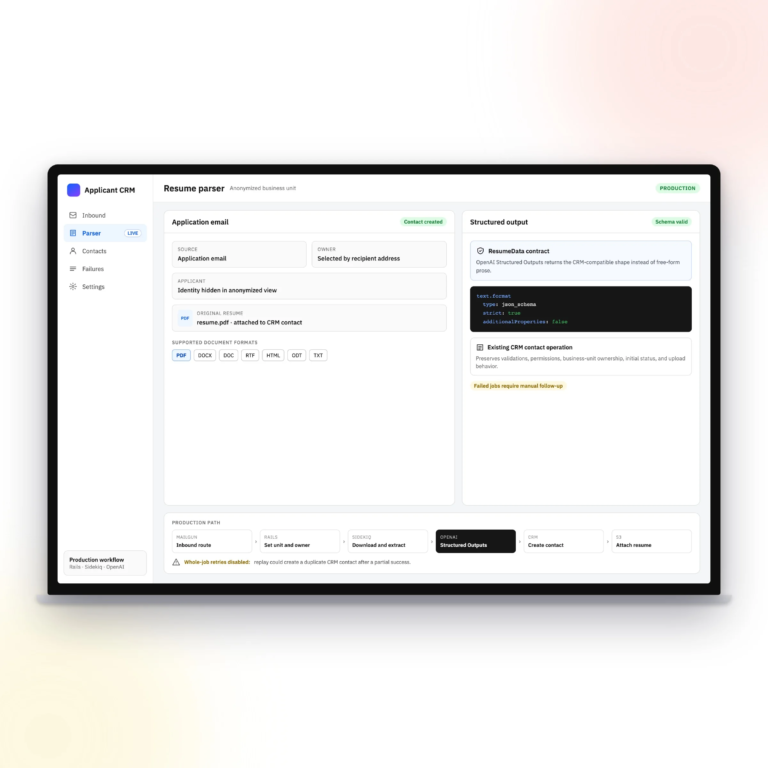
PAID - 2 WEEKS
Sharp Sprint

Fixed scope, senior engineers, working software. Skip the long discovery.

Contact us

Ecommerce and B2B Commerce Automation

We automate how orders move between your storefront, B2B portal, EDI and punchout partners, emailed purchase orders and the ERP, warehouse and 3PL behind them, on Shopify, Adobe Commerce, Salesforce Commerce and more. Connecting the systems is the easy part. We take responsibility for the hard part: every purchase order is priced at the buyer’s contract, posted once, and confirmed back through the channel it came from.

Trusted By Engineering Teams:

grey stylized letter 'm' logo
osl company logo
white logo on a black background centered on a solid banner
iress company logo
velory — ai-assisted development and integration client of teamvoy
neopenda — wearable medical iot development client of teamvoy
swisscom logo: abstract red and blue symbol beside the lowercase blue 'swisscom'.
reflect logo: lowercase gray wordmark
panasonic — enterprise cms and serverless software client of teamvoy.
nasdaq — capital markets ai engineering client of teamvoy
mitipi — iot smart home device development client of teamvoy
garrison flood control — ai voice assistant and automation client of teamvoy
everblock — 3d web configurator development client of teamvoy
cardb — fintech crypto payments development client of teamvoy
afriland first bank — hybrid cloud banking platform client of teamvoy

Teamvoy has delivered engineering work for Nasdaq, Panasonic, Afriland First Bank and 50+ other companies since 2013.

4.9 /5

Verified B2B client reviews from fintech, insurance, healthcare, and hi-tech engagements.

5.0 /5

A B2B review platform that connects businesses with verified software solutions providers.

4.7 /5

Transparent platform where current and former employees share company reviews and interview experiences.

B2B Commerce Automation Services We Offer

Three delivery tracks, each scoped and priced on its own.

Order flow architecture and commercial rules

Teamvoy designs the layer between your sales channels and your back office: which system owns price, stock and credit, the canonical order model, deduplication on buyer PO numbers and revisions, and the path every exception takes. Contract pricing is checked before an order is confirmed, not after it ships.

Channel and back-office automation

Teamvoy builds the flows into the estate you already run: EDI with trading partners, punchout from procurement networks, B2B portal orders, emailed purchase orders read by a language model with a human check, and the ERP, WMS and 3PL behind them. Each flow ships with a replay test from its first pull request.

Order operations and monitoring

Teamvoy runs the order flows in production. One review queue for held orders with reason codes and owners, daily matching of orders received against ERP orders, shipments and invoices, and alerts that name the exact purchase order.

What Our Clients Say

The care and interest they showed are what makes Teamvoy special. The system contributes to company sales, which is the best metric of success. Teamvoy was excellent in terms of project management and were extremely responsive while coming up with creative solutions.

Teamvoy has successfully launched the system within the set timeline and integrated all the required tools and features. The collaborative team led regular meetings, delivered on time, and communicated effectively. Their proactive problem-solving approach and commitment to innovation stand out.

Teamvoy’s support and expertise have been integral in helping the client build and scale their product. An agile partner, they manage their tasks well and are consistent in delivering according to schedule. Their strong understanding of blockchain and the quality of their work make them stand out

The game had a huge impact on the client’s business and helped display the exhibition. Teamvoy utilizes project management tools to ensure a smooth workflow. The team us understanding, hard-working, and experienced.

We work with them for over 2 years, and they have been very reliable and timely in providing us quality development services. Their creative input and talented team helped us build a better product!

×
tablet displaying cad engineering drawing of industrial equipment

Need to validate your B2B order automation architecture?

Channel and document inventory, every manual touchpoint and a prioritised action plan. Fixed scope, no obligation.

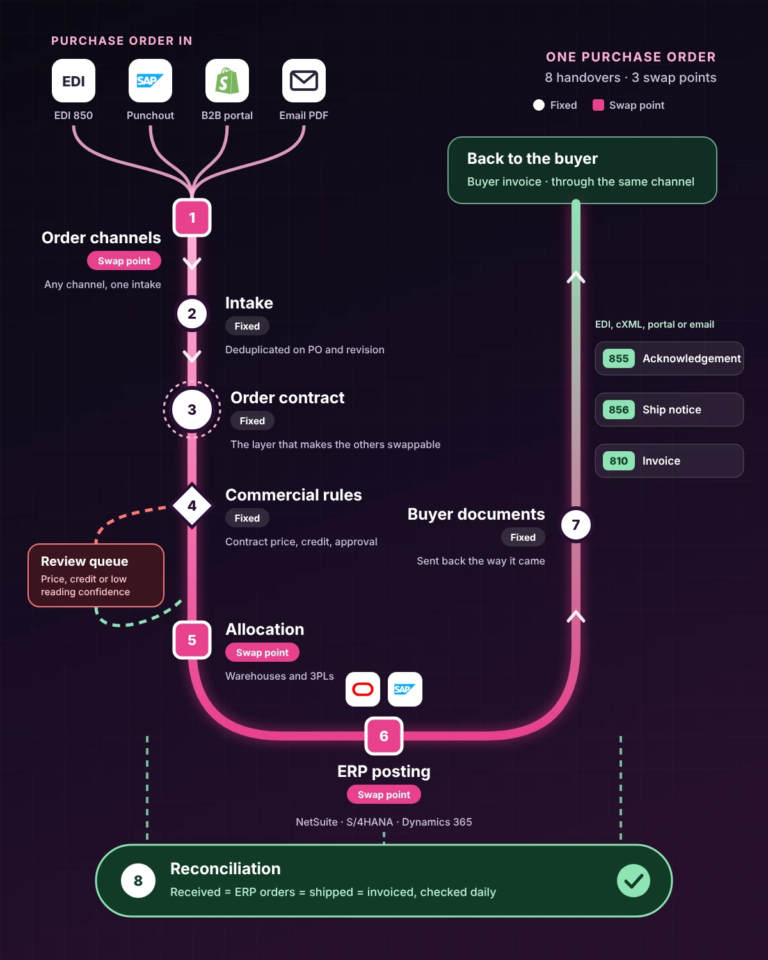
One Purchase Order, Eight Handovers – And The Three Places It Can Change

A buyer sends a purchase order by EDI, punchout, your B2B portal or email. Follow it through all eight handovers to your ERP and back to the buyer, then look at where a swap is a new adapter rather than a rebuild. Select any stop.

one purchase order through eight handovers, from four order channels to the erp and back to the buyer, with three swap points

01. Order channels. Channel swap

What happens:
The buyer orders where they already work: an EDI 850 from their ERP, a punchout cart from SAP Ariba or Coupa, your B2B portal on Shopify or Adobe Commerce, or a PDF attached to an email. Each arrives carrying the buyer's own PO number.

What fails:
A retailer resends the same 850 after a network timeout. A punchout cart returned on a session that has already expired. A PDF that lists the buyer's part numbers, not yours, with a stamp across line 4.

What can change:
Swap point. Adding a portal, a new EDI partner or another procurement network is a new adapter into the same intake, not a new order flow.

02. Intake and deduplication. Fixed layer

What happens:
Every order lands in a durable queue keyed on buyer account, PO number and revision. Emailed POs are read by a language model into structured lines, each with a confidence score.

What fails:
One PO entered twice because it arrived by email and by EDI. A PO revision treated as a new order, so the buyer receives both. Low-confidence extraction passed straight through because no threshold was set.

What can change:
Not a swap point. This is the layer that makes resends and revisions safe, and the model that reads documents can change without touching anything downstream.

03. Canonical order model. Fixed layer

What happens:
Buyer, ship-to, item, unit of measure, price and terms are translated into one order model. Buyer part numbers are cross-referenced to your items and cases converted to units.

What fails:
A buyer orders 12 cases and the ERP ships 12 units. A ship-to code that exists in the portal but not in the ERP. A new SKU sold online before it reaches the item master.

What can change:
Not a swap point – this is the layer that makes the others swappable. Every channel and every back-office system maps to the order contract, never directly to each other.

04. Pricing, credit and approval. Fixed layer

What happens:
Applies the commercial rules before anything is confirmed: contract price and tier, minimum quantities and case packs, credit limit and payment terms, tax exemption, and the approval threshold for large orders.

What fails:
A PO price that differs from the contract, confirmed anyway. Credit checked in the portal and again in the ERP, with different answers. An approval request waiting in an inbox while the delivery date passes.

What can change:
Rules change with every contract renewal. Holding them here means a new price list or credit policy is configuration, and every mismatch lands in a review queue with a reason code.

05. Inventory and allocation. Fulfilment swap

What happens:
Checks available stock across warehouses and 3PLs, allocates each line, splits shipments or backorders, and promises a ship date the buyer can plan around.

What fails:
Stock shown as available on the portal that is already allocated to an EDI order. A split shipment the buyer's receiving dock refuses. A 3PL feed that updates hourly while orders arrive every minute.

What can change:
Swap point. Moving to another 3PL or WMS is a new fulfilment adapter behind the same allocation contract.

06. ERP order posting. ERP swap

What happens:
Creates the sales order in NetSuite, SAP S/4HANA or Dynamics 365, captures the ERP order number and links it to the buyer's PO number for every later document.

What fails:
The order posts but the response times out, and the retry creates a second sales order. A customer on credit hold in the ERP but not in the portal. An ERP upgrade that renames a field nothing tested.

What can change:
Swap point. A new ERP, or SAP ECC to S/4HANA, becomes a new adapter behind the same order contract rather than a rebuild of every channel.

07. Buyer documents. Fixed layer

What happens:
Sends the acknowledgement, ship notice and invoice back through the channel the order came from: EDI 855, 856 and 810, cXML confirmation and invoice, a portal status, or an email to the buyer.

What fails:
A ship notice sent after the truck has arrived, which some retailers charge back for. An invoice emailed to a punchout buyer instead of sent through their procurement network, so it is never matched. Carton labels that do not match the ship notice.

What can change:
Not a swap point. Every channel's document rules live here, so a new trading partner is their specification plus a test run, not new code in every layer.

08. Exceptions and reconciliation. Fixed layer

What happens:
Every held order sits in one review queue with its reason, owner and age. Each day, orders received per channel are matched against ERP orders, shipments and invoices.

What fails:
An order dropped between the portal and the ERP that nobody notices until the buyer chases it. Exceptions worked from a shared inbox with no owner. A held order released by hand that skips the price check.

What can change:
Tooling. Reason codes, plain reconciliation tables and OpenTelemetry traces mean the dashboard or helpdesk on top can change without touching a flow.

Why Choose Teamvoy For B2B Commerce Automation?

Eight reasons. The first two cost us something to make, which is why no competitor can copy them by close of business.

The order contract is the product.

It is what keeps your storefront, your ERP and your 3PL replaceable, and turns a new trading partner into a mapping rather than a project.

  • The engineers named in the proposal write the code.
    Named, with their history, in the contract. No substitution without your written agreement.
    Costs us: it caps how fast we can scale headcount.

  • Finance and the order desk join in week one – and you keep the rules pack
    Your credit controller and the people who key orders today sit in rule design, not only in UAT. You leave with the pricing, credit and exception rules written down and tested, so you can change a price list or approval limit without us.
    Costs us: we decline engagements where finance and the order desk will not take part

  • Tested against the awkward orders, not the demo
    Every flow is replayed against a test copy of your systems with resent EDI files, PO revisions, unit-of-measure conversions, backorders and split shipments before release. A demo proves a clean order works; production is mostly the other kind.

  • Baseline before build
    We ask what the number is today and who owns it before we write anything. No baseline, no engagement – because without one the outcome is asserted at the end rather than proven.

  • Every trading partner gets a test run before go-live
    Each EDI or punchout partner is tested against their own specification, including acknowledgements, ship notices and carton labels, before the first live order. Partner rules sit in configuration, so the next partner reuses the same tests.

  • A language model reads documents, rules decide money
    Emailed and PDF purchase orders are read by a model with a confidence threshold per field. Prices, credit and approvals are decided by tested rules, and any line the model is unsure of goes to a person before it reaches the ERP.

  • Full ownership, not staff augmentation.
    We take responsibility for architecture and production behaviour rather than for filling seats. You are not managing our delivery on top of your own.

  • We tell you when automation is not the answer
    Including when your platform’s native B2B features or a packaged app already cover the flow, when duplicate customer and item data is the real problem, or when buyers need a better portal before they need more automation. We raise trade-offs early, while changes are still cheap.

B2B Commerce Automation Success Stories

Integration, automation and modernization engagements where orders had to move between several systems without anyone keying them twice.

Related Services

B2B commerce automation rarely arrives on its own. These are the engagements that most often sit either side of it.

AI Agent Development

Runs alongside.
When the order desk also answers buyer questions on stock, delivery dates and order status, an agent can take that work, reading the same order contract and handing anything uncertain to a person.

Application Modernization

Comes first.
When the ERP or order system has no usable API, or runs on a platform out of support, automation is not the constraint. We open that surface step by step so order flows become possible at all.

IT Audit

Start here if unsure.
An honest read on where your order estate stands before you commit budget – channels, manual touchpoints, risk and a prioritised action plan you keep either way.

What Our B2B Commerce Automation Engineers Work In.

Chosen to fit your commerce platform, your ERP and your trading partners, not our internal preference.

Commerce platforms

ERP, fulfilment and back office

EDI, procurement and integration

Services, AI and observability

We engineer for:

ANSI ASC X12 EDI
UN/EDIFACT (EU and international partners)
cXML and OCI punchout
GS1 identifiers and SSCC carton labels
EN 16931 and Peppol e-invoicing (where mandated)
PCI DSS (where card data is in scope)
GDPR
SOC 2
ISO 27001
OWASP API Security Top 10
WCAG 2.2 (buyer portals)
Phase 0 · fixed fee

Order flow audit

Channel and document inventory across EDI, punchout, portal and emailed orders, one purchase order traced per channel from receipt to invoice, platform plans and API limits, and a baseline of how many orders are keyed or corrected by hand. We map which flows are safe, which duplicate or drop orders, and what has to change before anything new is built.

You leave with: a channel inventory, a risk register and a captured baseline – yours whether or not we continue.

Phase 1

Order Contract And Rules

The order contract designed and agreed: canonical order model, item and unit cross-references, contract pricing and credit rules, approval thresholds, partner document specifications and the exception policy. Finance and the order desk sign this off before code is written, not after.

You leave with: a signed order contract, a tested rules pack and partner specifications your team can read.

Phase 2

Production And Handover

One channel first, usually the one with the most manual effort: emailed POs or the largest EDI partner. Built, partner-tested and released with the review queue and daily reconciliation running from day one. Other channels follow the same pattern, and handover completes when your engineers add a trading partner without us.

You leave with: a live channel moving orders your order desk no longer keys, plus code, pipelines, runbooks and the rules pack.

TOPIC
OTHER VENDORS
TEAMVOY
Team
Team assigned after signing.
The engineers named in the proposal build the work.
Ownership
Staff augmentation. You manage delivery.
Full ownership of architecture and production behaviour.
Order accuracy
Prices checked when someone spots a difference.
Every PO priced against the contract and held on mismatch.
Trading partners
Each new partner set up as its own project.
A new partner is a specification plus a test run.
Exceptions
Handled through a shared inbox.
One review queue with reason codes, owners and age.
Source code
Handed over at the end of the project.
Flows, maps and partner specs in your repositories from day one.
Test & evidence
Testing stays with the delivery team.
Replay tests, partner test runs and rule tests you can re-run.
Operations
Knowledge held by the delivery team.
Runbooks, alerts per PO and a daily order reconciliation.
Capability transfer
Usually outside the scope.
Named owners and handover sessions, so your engineers can change the system without us.
After the engagement
Quality checks stay with the vendor.
You keep the tests and evidence, so quality stays checkable after we leave.
Fastest way in: book a 30-minute technical call this week.
PREFER email?
Call directly:
Response within one business day.
cto of teamvoy
Bohdan Varshchuk
Chief Technology Officer

Looking For B2B Commerce Automation Engineers?

    FAQ

    Buyer's guide

    B2B Commerce Automation: The Details That Change Scope, Price and Risk

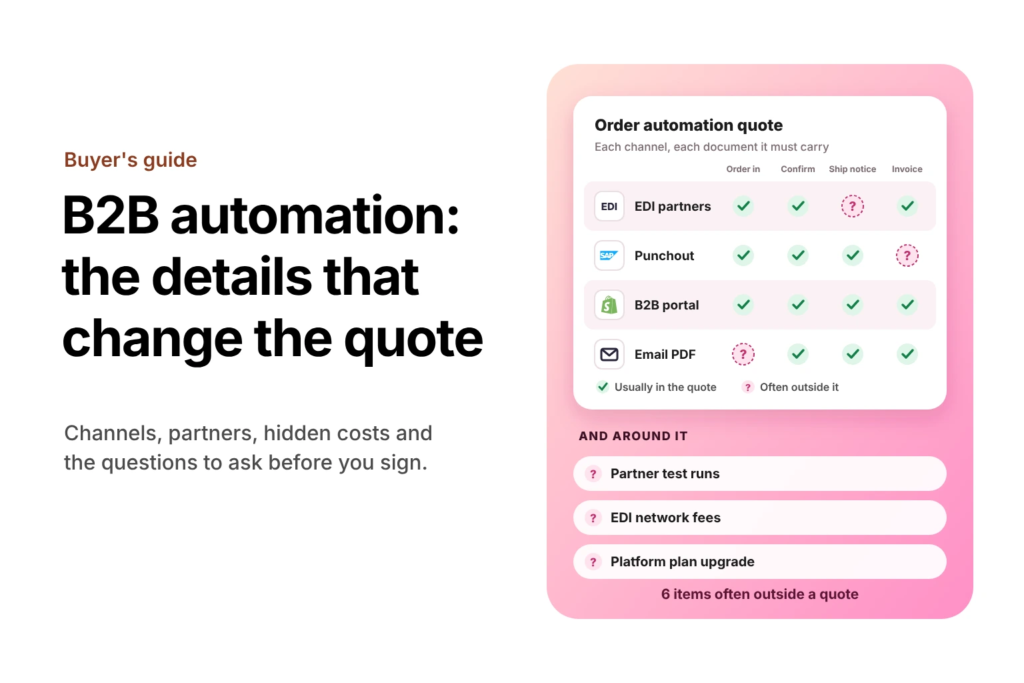
    Two B2B commerce automation quotes can look alike and still be months of work apart. The difference sits in details most buyers meet only after signing: how many trading partners each need their own test run, whether contract prices fit the platform plan, what happens to an unreadable PDF, and who pays the EDI network. This is the checklist we would want in hand if we were the ones buying.

    b2b commerce automation quote checklist: order channels by document, plus partner test runs, edi network fees and platform upgrades often left out

    1. What should you have ready before asking for quotes?

    Vendors price what you describe. When something is missing, each vendor fills the gap with its own assumption, and the quotes stop being comparable.

    • Every channel orders arrive through today, and roughly how many orders each one carries in a normal month.
    • Your EDI and punchout trading partners, with their implementation guides if you have them.
    • Where contract prices, catalogues and credit limits live today, and who changes them.
    • Volume on a normal day and at your peak, such as a season, a promotion or quarter-end.
    • Who in finance and on the order desk will sign off the rules and test the results.
    • The date that actually matters: a partner deadline, a peak-season freeze or a platform migration.

    2. Which details change the scope and the price?

    2.1 How many channels come first?

    Each channel, whether EDI, punchout, portal or email, is its own adapter with its own tests. Starting with one channel and adding the rest on the same pattern costs less than building all of them at once.

    Ask the vendor: Which channel would you build first, and why?

    2.2 How many trading partners are there, and do they share one specification?

    Retailers and distributors often publish their own EDI implementation guides, and each one needs mapping and a test run with that partner.

    Ask the vendor: Is partner onboarding priced per partner, and how many are included?

    2.3 Do buyers have their own prices and catalogues?

    Customer-specific pricing can depend on the platform plan. On Shopify, for example, catalogues assigned directly to a company are a Shopify Plus feature, and Adobe Commerce B2B features are not part of Magento Open Source.

    Ask the vendor: Does our current plan support our pricing model, or does it need an upgrade?

    2.4 How do purchase orders arrive today?

    Emailed PDFs vary by buyer, and reading them reliably needs a confidence threshold and a review step rather than a promise of full accuracy.

    Ask the vendor: What happens to a line the model cannot read with confidence?

    2.5 Are credit checks and approvals part of the flow?

    Credit limits, payment terms and approval thresholds add rules and test cases, and they have to agree with what the ERP holds.

    Ask the vendor: Which system decides credit, and how do the two stay in step?

    2.6 Do your buyers’ items and units match yours?

    Buyers order with their own part numbers and in cases, inner packs or units. Cross-references and conversions are often missing or out of date.

    Ask the vendor: Is building and cleaning the cross-reference included, and who maintains it?

    2.7 Where does available stock come from?

    Several warehouses or 3PLs, split shipments and backorders each add allocation rules and status messages.

    Ask the vendor: How fresh is the stock figure the buyer sees when they order?

    2.8 Which documents go back to the buyer?

    Acknowledgements, ship notices, carton labels and invoices each have partner rules. Some retailers charge back for late or incorrect ship notices.

    Ask the vendor: Are ship notices and labels tested against each partner’s rules before go-live?

    3. Which costs often sit outside the quote?

    A quote can be accurate and still leave things out, like a caterer who prices the food but not the staff to serve it. Check each of these.

    3.1 What will the EDI network or provider charge?

    You pay the EDI provider, often by document, by volume or by trading partner connection.

    Ask the vendor: What will EDI cost us at our document volume and partner count?

    3.2 Does the platform plan or an app need upgrading?

    B2B features differ between plans and editions, and packaged apps carry their own fees.

    Ask the vendor: Which plan or edition does this design assume, and what does it cost?

    3.3 What does the integration platform cost each year?

    You pay the integration platform vendor, often per connector, flow or transaction.

    Ask the vendor: What will the platform cost at our order volume?

    3.4 Does your ERP licence cover orders created by outside systems?

    Some ERP vendors license documents that external systems create in the ERP, such as sales orders.

    Ask the vendor: Have you checked what our ERP licence allows before designing the flows?

    3.5 Who onboards new trading partners after go-live?

    Each later partner needs mapping and a test run, often billed as a change request.

    Ask the vendor: What does adding a partner cost after handover, and can our team do it?

    3.6 Who works the review queue?

    Held orders need someone on your order desk to resolve them, which is internal time you pay for.

    Ask the vendor: How many held orders a day should we expect, and how long does each take?

    3.7 Who covers peak season after go-live?

    Support is usually quoted separately, if at all, and peak is when flows are most likely to fail.

    Ask the vendor: Who is on call during our peak, and is it in the quote?

    4. How do you compare providers?

    Most providers can connect a storefront to an ERP. These questions show how each one handles the orders that do not arrive clean.

    4.1 What happens if a buyer sends the same PO twice?

    A common answer: duplicates are checked by the order desk. What to look for: deduplication on buyer and PO number with revisions, and the test that proves it.

    4.2 What happens when a PO price differs from the contract?

    A common answer: the order desk reviews pricing. What to look for: the order is held with a reason code before confirmation, and the rule is tested.

    4.3 How is a new trading partner added?

    A common answer: as a new project. What to look for: a partner specification in configuration plus a test run against their rules.

    4.4 What does the AI do with a document it cannot read?

    A common answer: the model is highly accurate. What to look for: a confidence threshold per field, a review queue and a log of every correction.

    4.5 Where will the maps, rules and flows live?

    A common answer: inside the provider’s platform. What to look for: in your repositories and on your accounts.

    4.6 Who made this estimate?

    A common answer: a pre-sales team. What to look for: the engineer who will build it.

    5. What should you clarify before signing?

    • How partner onboarding, the review queue and support after go-live are covered, not only the first channel.
    • Acceptance criteria that include resent files, PO revisions and price mismatches, not only a clean order.
    • Your platform plan, ERP licence, EDI provider and API limits.
    • Whose accounts hold the code, maps, rules and integration platform.
    • That finance and the order desk sign off the rules before building starts.

    6. Where does Teamvoy stand on each of these?

    Our order flow audit marks every item in sections 2 and 3 as included, excluded or provided by you, before any build is priced. You can then compare our proposal with anyone else’s line by line, and nothing turns up later as a surprise change request.
    Your Next Move

    Bring this checklist to a 30-minute call and we will fill it in for your order estate.

    Book a Call

    Our Insights

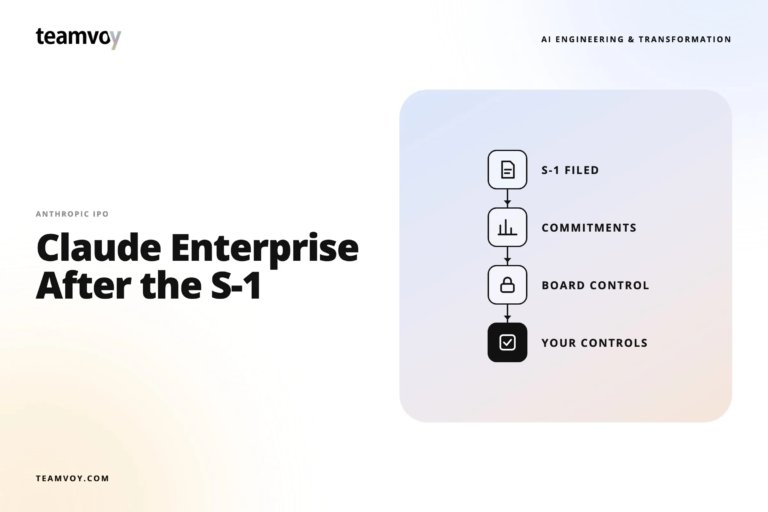
    hero image for teamvoy article: headline 'claude enterprise after the s-1' with 'anthropic ipo' label, teamvoy logo at top left and gradient infographic on the right.
    AI, AI Agents
    Claude Enterprise: What Anthropic’s S-1 Changes for Your Vendor Risk
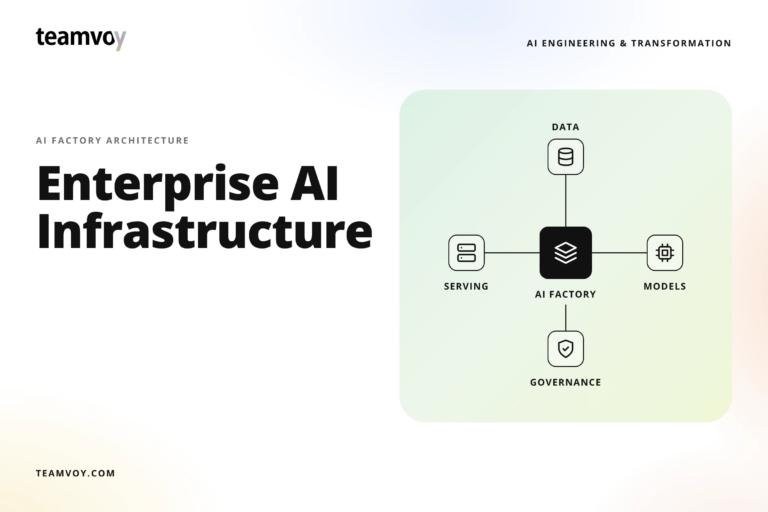
    teamvoy hero banner reading 'enterprise ai infrastructure' with a right-side rounded diagram illustrating data, ai factory components, and governance.
    AI, AI Agents
    Enterprise AI Infrastructure: AI Factory Architecture Guide
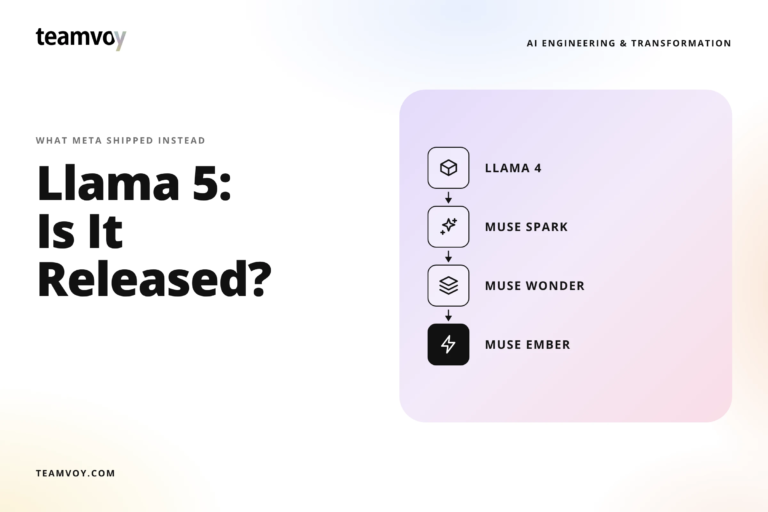
    split-screen hero: left column shows teamvoy logo and bold headline 'llama 5: is it released?'; right column features a rounded-purple card with a vertical flow of ai model icons (llama 4, muse spark, muse wonder, muse ember).
    AI, AI Agents, LLMOps
    Llama 5: Is It Released? What Meta Shipped Instead