






























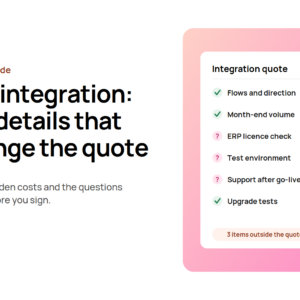
1. What should you have ready before asking for quotes?
Vendors price what you describe. When something is missing, each vendor fills the gap with its own assumption, and the quotes stop being comparable.
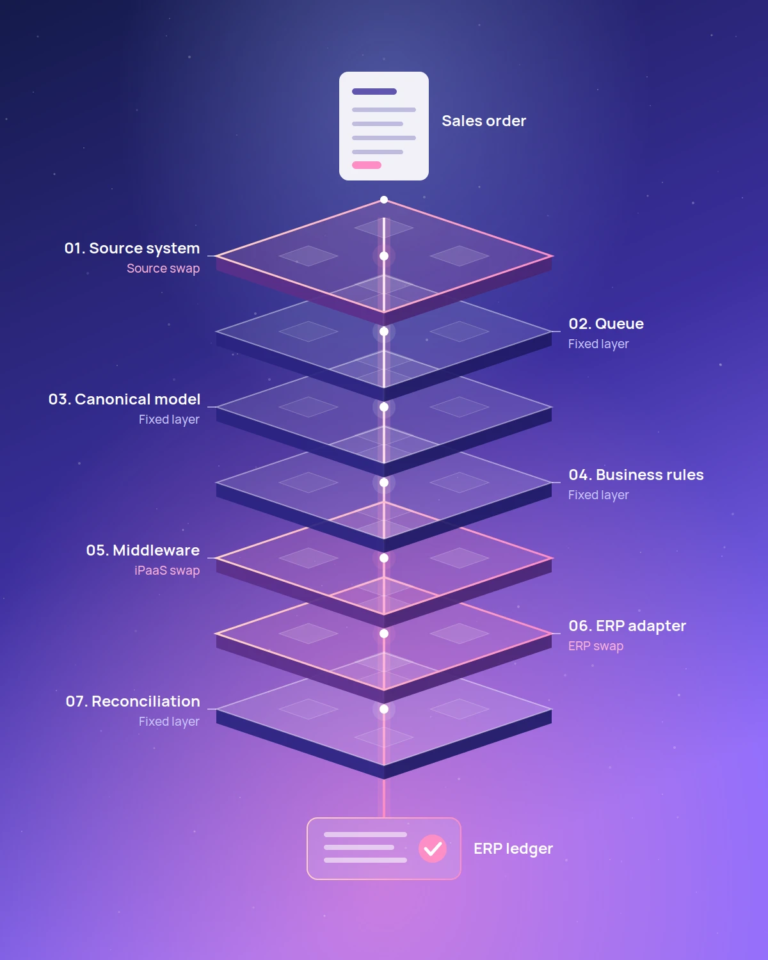
- Every system that has to talk to the ERP, and which one is the source of truth for customers, items and prices.
- The flows you need, such as order-to-invoice or payment-to-cash, and whether each is one-way or two-way.
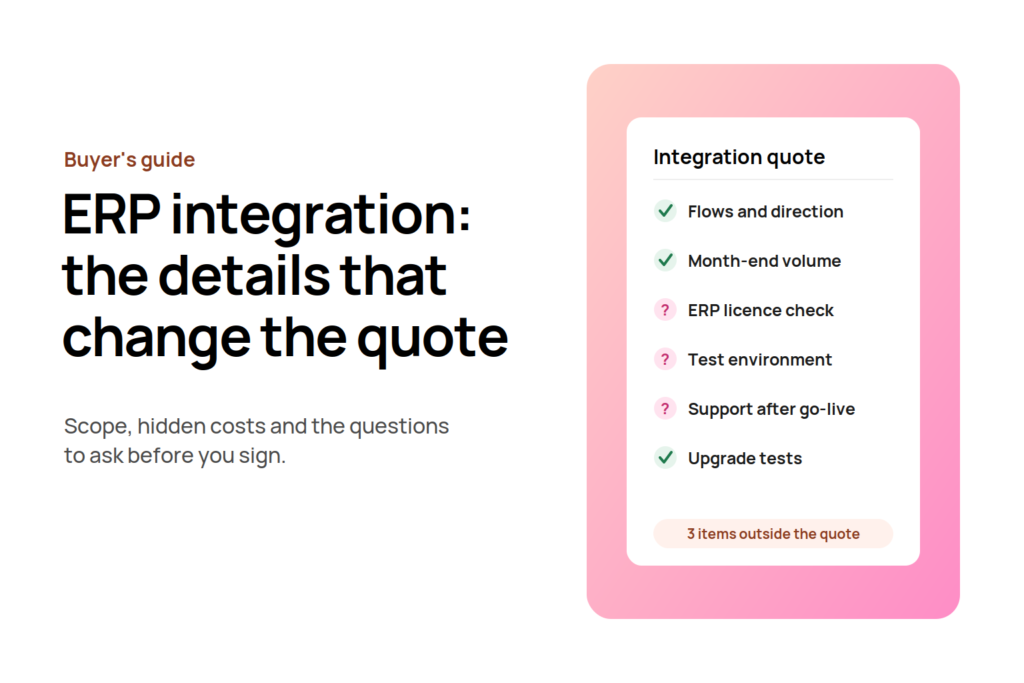
- Volume on a normal day and on the last day of the month.
- Who in finance will sign off the mapping and test the results.
- The date that actually matters: a go-live, an audit, a period close or an ERP upgrade.
2. Which details change the scope and the price?
2.1 Is each sync one-way or two-way?
Two-way sync needs a rule for every field both systems can edit, which is often more work than the connection itself.
Ask the vendor: Which system wins when both change the same field?
2.2 Does it need real time, or is a batch enough?
Real time needs queues, retries and monitoring. Nightly batches are cheaper but delay what sales and finance can see.
Ask the vendor: Which flows truly need real time, and why?
2.3 How busy is your month-end?
ERPs limit API calls. A flow that copes on a Tuesday can stall on the last day of the month.
Ask the vendor: Will you test at our month-end volume?
2.4 How clean is your master data?
Duplicate customers and missing items break mappings, and cleaning them up is often left out of the quote.
Ask the vendor: Is data cleanup included, and who does it?
2.5 How much history has to be loaded?
Loading past orders or invoices is a separate job with its own checks.
Ask the vendor: How much history is in scope, and how is it reconciled?
2.6 How many entities, currencies and tax regimes are involved?
Each extra legal entity, currency or tax regime adds mapping rules and test cases.
Ask the vendor: Is every entity in scope, or only the first one?
2.7 Does the ERP have a modern API?
Older ERPs often connect through files or IDocs rather than APIs, which takes a different kind of work.
Ask the vendor: Which interfaces do you assume, and have you worked with ours?
2.8 Is there a safe place to test?
Safe testing needs a copy of your ERP. Without one, testing happens in production or not at all.
Ask the vendor: Who provides the test environment, and is it licensed?
3. Which costs often sit outside the quote?
A quote can be accurate and still leave things out, like a videographer who prices the shoot but not the script. Check each of these.
3.1 Does your ERP licence cover third-party use?
You pay the ERP vendor. SAP, for example, can license documents such as sales orders and invoices that outside systems create in it.
Ask the vendor: Have you checked what our ERP licence allows before designing the flows?
3.2 What does the integration platform cost each year?
You pay the platform vendor, often per connector or per flow.
Ask the vendor: What will the platform cost us at our volume?
3.3 Do you need extra test environment licences?
Usually paid by you.
Ask the vendor: Do we need an extra ERP environment, and what does it cost?
3.4 Who supports the flows after go-live?
Support is usually quoted separately, if at all.
Ask the vendor: How many weeks are included, and what happens after?
3.5 Who is on call when a flow fails?
Monitoring and on-call are often left unassigned.
Ask the vendor: Who is alerted at 2 a.m., and who fixes it?
3.6 Who pays when an ERP upgrade breaks a flow?
Fixes after upgrades are usually billed as change requests.
Ask the vendor: Are upgrade tests part of the build, or extra each time?
3.7 How much of your finance team’s time will it take?
Mapping sign-off and testing is internal effort you pay for in time.
Ask the vendor: How many days will our finance team spend on mapping and testing?
4. How do you compare providers?
Most providers can connect two systems. These questions show how each one handles what happens after the first sync.
4.1 What happens if the same message arrives twice?
A common answer: failed messages are retried. What to look for: every write can be repeated safely, and here is the replay test.
4.2 How will you know nothing was dropped?
A common answer: errors appear in the logs. What to look for: daily count and amount checks per flow, sent to finance.
4.3 What happens when the ERP is upgraded?
A common answer: issues are fixed as they come up. What to look for: contract tests run before every upgrade window.
4.4 Where will the mapping logic live?
A common answer: inside the provider’s platform. What to look for: in your repository and your platform account.
4.5 Who made this estimate?
A common answer: a pre-sales team. What to look for: the engineer who will build it.
5. What should you clarify before signing?
- How reconciliation and support after go-live are covered, not only the connectors.
- Acceptance criteria that go beyond the first successful sync.
- Your ERP licence, API limits and test environment.
- Whose account holds the code, mappings and integration platform.
- That finance signs off the mapping before building starts.
6. Where does Teamvoy stand on each of these?
Our readiness audit marks every item in sections 2 and 3 as included, excluded or provided by you, before any build is priced. You can then compare our proposal with anyone else’s line by line, and nothing turns up later as a surprise change request.