





























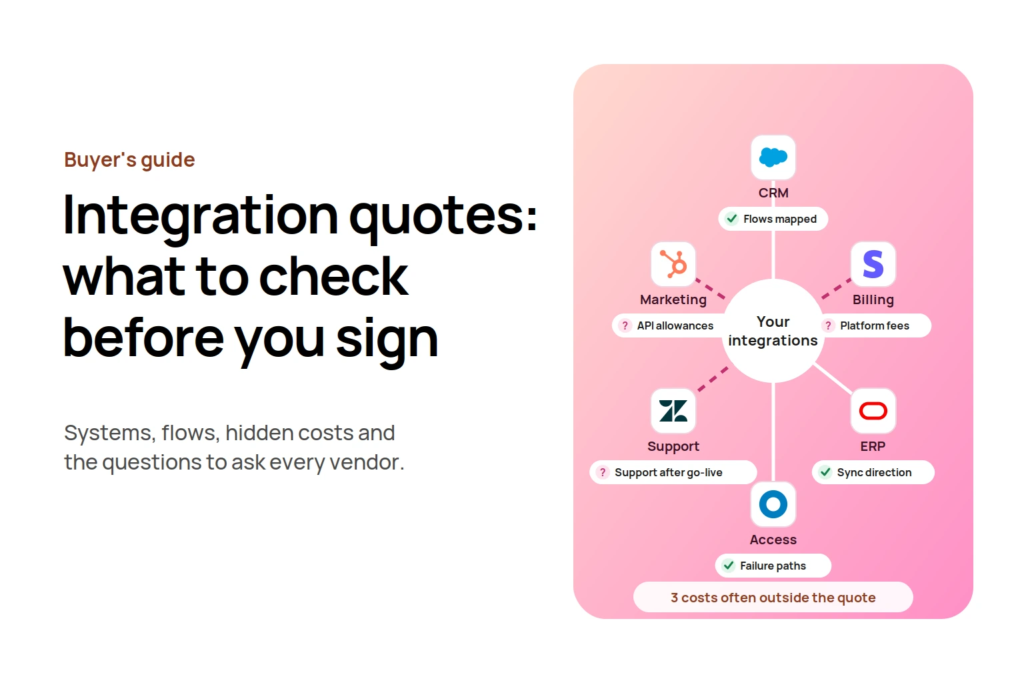
1. What should you have ready before asking for quotes?
Vendors price what you describe. When something is missing, each vendor fills the gap with its own assumption, and the quotes stop being comparable.
- Every system involved, and which one is the source of truth for customers, products, prices and people.
- The flows you need, such as deal-to-billing or new-hire onboarding, and whether each is one-way or two-way.
- Volumes on a normal day and on your busiest day, including bulk imports and admin clean-ups.
- The integration platform you already license, if any, and who maintains it today.
- Who in security and in each business team will sign off the design and test the results.
2. Which details change the scope and the price?
2.1 Is each flow one-way or two-way?
Two-way sync needs a rule for every field both systems can edit, which is often more work than the connection itself.
Ask the vendor: Which system wins when both change the same field?
2.2 How many systems does one event have to update?
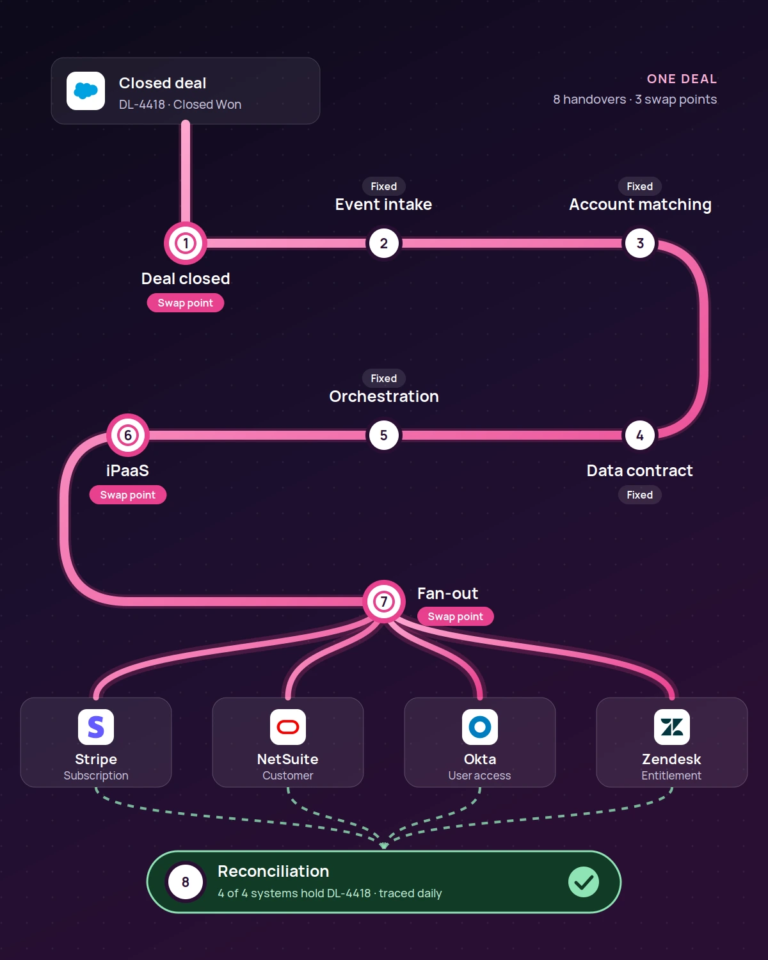
A flow that writes to four systems needs an order of writes and a plan for when the third one fails. That plan is most of the engineering.
Ask the vendor: What happens to the first two writes if the third is rejected?
2.3 Does it need real time, or is a batch enough?
Real time needs queues, retries and monitoring. Scheduled batches are cheaper but delay what sales, finance and support can see.
Ask the vendor: Which flows truly need real time, and why?
2.4 How clean is your master data?
Duplicate accounts and mismatched product codes break mappings, and the clean-up is often left out of the quote.
Ask the vendor: Is data clean-up included, and who does it?
2.5 How much history has to be migrated?
Loading past records into a new target is a separate job with its own checks and its own API consumption.
Ask the vendor: How much history is in scope, and how is it reconciled?
2.6 Do all your systems have usable APIs?
Older systems often connect through files, databases or screen-level automation, which takes a different kind of work and testing.
Ask the vendor: Which interfaces do you assume for each system, and have you worked with ours?
2.7 Is there a safe place to test?
Safe testing needs sandbox copies of each system with realistic data. Without them, testing happens in production or not at all.
Ask the vendor: Who provides test environments, and are they licensed?
3. Which costs often sit outside the quote?
A quote can be accurate and still leave things out, like a videographer who prices the shoot but not the script. Check each of these.
3.1 Will the new integration fit inside your existing API allowances?
Some SaaS vendors cap API calls per organisation, not per integration. Salesforce, for example, counts every integration in the org against one rolling 24-hour allowance, and extra calls are bought as add-ons.
Ask the vendor: How many calls will this add on our busiest day, and what else already uses that allowance?
3.2 What does the integration platform cost each year?
You pay the platform vendor, and depending on the vendor the price can rise with connectors, flows or task volume.
Ask the vendor: What will the platform cost us at our peak volume, not our average?
3.3 Who supports the flows after go-live?
Support is often quoted separately, if at all.
Ask the vendor: How many weeks are included, and what happens after?
3.4 Who is on call when a flow fails?
Monitoring and on-call are often left unassigned between your teams and the vendor.
Ask the vendor: Who is alerted at 2 a.m., and who fixes it?
3.5 Who pays when a vendor release breaks a flow?
SaaS systems release on their own calendar, and fixes after a release are usually billed as change requests.
Ask the vendor: Are contract tests against vendor releases part of the build, or extra each time?
3.6 How much of your team’s time will it take?
Design sign-off, data clean-up and testing are internal effort you pay for in time.
Ask the vendor: How many days will our security, operations and business owners spend on this?
4. How do you compare providers?
Most providers can connect two systems. These questions show how each one handles what happens after the first sync.
4.1 What happens if the same event arrives twice?
A common answer: failed messages are retried. What to look for: every write can be repeated safely, and here is the replay test.
4.2 What happens if one of several writes fails?
A common answer: the error is logged and fixed manually. What to look for: a defined order of writes with a tested retry or rollback for each step.
4.3 How did you choose the platform you are recommending?
A common answer: it is the platform the team knows. What to look for: a comparison against your flows, volumes, licence model and maintainers.
4.4 Where will the mapping logic live?
A common answer: inside the provider’s platform account. What to look for: in your repository and your platform tenant.
4.5 Who made this estimate?
A common answer: a pre-sales team. What to look for: the engineer who will build it.
5. What should you clarify before signing?
- How monitoring, reconciliation and support after go-live are covered, not only the connectors.
- Acceptance criteria that include partial failures and replays, not only the first successful sync.
- Your API allowances, platform licence tier and test environments.
- Whose accounts hold the code, mappings, secrets and integration platform.
- That security and each system owner sign off the design before building starts.
6. Where does Teamvoy stand on each of these?
Our readiness audit marks every item in sections 2 and 3 as included, excluded or provided by you, before any build is priced. You can then compare our proposal with anyone else’s line by line, and nothing turns up later as a surprise change request.