






























1. What should you have ready before asking for quotes?
Vendors price what you describe. When something is missing, each vendor fills the gap with its own assumption, and the proposals stop being comparable.
- A list of the integrations, APIs and file transfers you run today, even a rough one.
- Which systems are the source of truth for customers, orders, products and people.
- Message volume on a normal day and at your busiest hour.
- Whether partners or customers will call your APIs directly.
- The platform licences you already hold and when they renew.
2. Which details change the scope and the price?
2.1 How many integrations move onto the platform at the start?
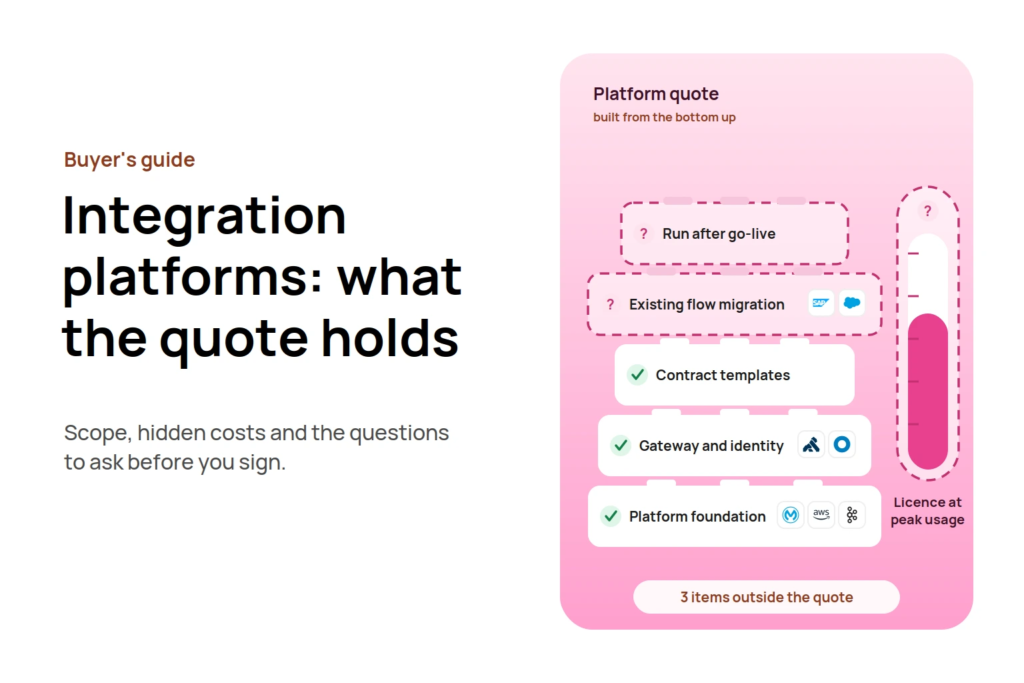
Standing up the platform and migrating existing integrations are two different jobs, and the second is often larger.
Ask the vendor: Is migration of our existing integrations in this quote, and how many?
2.2 Will partners call your APIs directly?
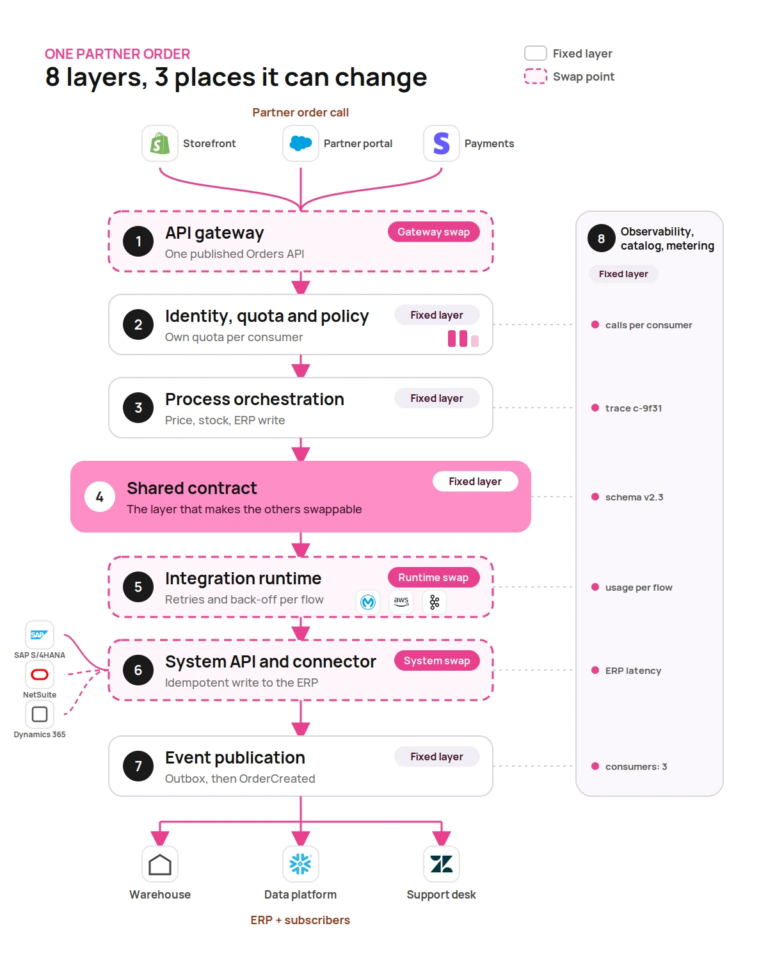
External APIs need a gateway, a developer portal, onboarding, per-consumer quotas and a security review that internal flows do not.
Ask the vendor: How will a new partner be onboarded, and how long does it take?
2.3 Do you need events as well as APIs?
An event backbone lets systems subscribe without calling each other, but it adds topics, schemas, retention and replay to design and run.
Ask the vendor: Which flows are events and which are calls, and why?
2.4 How busy is your busiest hour?
Platforms are sized and often priced on peak volume, and record systems have their own API limits underneath.
Ask the vendor: Will the platform be load-tested at our peak, including the ERP limits?
2.5 How many environments and regions do you need?
Each environment, and each region for data residency, adds infrastructure, licence capacity and promotion rules.
Ask the vendor: How many environments are included, and are they licensed?
2.6 How many teams will build on the platform?
A platform for one team is a project. A platform for ten needs templates, standards, a catalog and training.
Ask the vendor: What do our own teams get to build their next integration without you?
3. Which costs often sit outside the quote?
A quote can be accurate and still leave things out, like a videographer who prices the shoot but not the edit. Check each of these.
3.1 How does the platform licence meter usage?
You pay the platform vendor, and the metric varies by product: flows and messages, tasks, connectors or capacity. MuleSoft, for example, now packages new contracts on flows and messages rather than vCores. Retries and polling can count as usage.
Ask the vendor: What will the licence cost at our peak volume, including retries?
3.2 Are premium connectors priced separately?
Connectors for ERP, HR or mainframe systems are often an add-on to the base licence.
Ask the vendor: Which connectors in this design carry their own fee?
3.3 Do the record systems charge for API use?
Some ERP and CRM vendors limit or license API calls and documents created by outside systems.
Ask the vendor: Have you checked what our ERP and CRM licences allow?
3.4 Who runs the platform after go-live?
Platform operations, upgrades and on-call are usually quoted separately, if at all.
Ask the vendor: Who is alerted at 2 a.m., and for how many months is that included?
3.5 Who trains the teams that build on it?
Enablement is often assumed rather than scoped.
Ask the vendor: How many of our engineers will be able to ship on the platform at handover?
4. How do you compare providers?
Most providers can install a platform and build a first flow. These questions show how each one handles what happens when more teams and partners arrive.
4.1 How was the platform chosen?
A common answer: it is the platform the team knows best. What to look for: options scored on your flows, volumes and usage pricing.
4.2 What stops one partner slowing the others?
A common answer: the gateway has rate limiting. What to look for: per-consumer quotas, and a test that shows one consumer throttled while others keep working.
4.3 How will reuse be shown?
A common answer: assets are reusable by design. What to look for: a catalog listing who consumes each API and event.
4.4 Where will contracts and flow logic live?
A common answer: inside the platform. What to look for: in your repository, with tests that run outside the platform.
4.5 Who made this estimate?
A common answer: a pre-sales team. What to look for: the engineer who will build it.
5. What should you clarify before signing?
- A usage forecast at peak volume, under the licence metric you will actually be billed on.
- Whether migrating your existing integrations is in scope, and which ones.
- Acceptance criteria that include a second team or partner using the platform, not only the first flow.
- Whose accounts hold the platform tenant, contracts and code.
- That security signs off the gateway and identity design before building starts.
6. Where does Teamvoy stand on each of these?
Our platform assessment marks every item in sections 2 and 3 as included, excluded or provided by you, with a usage forecast for each platform option, before any build is priced. You can then compare our proposal with anyone else’s line by line, and nothing turns up later as a surprise change request.