KYC & KYB Automation Software Development
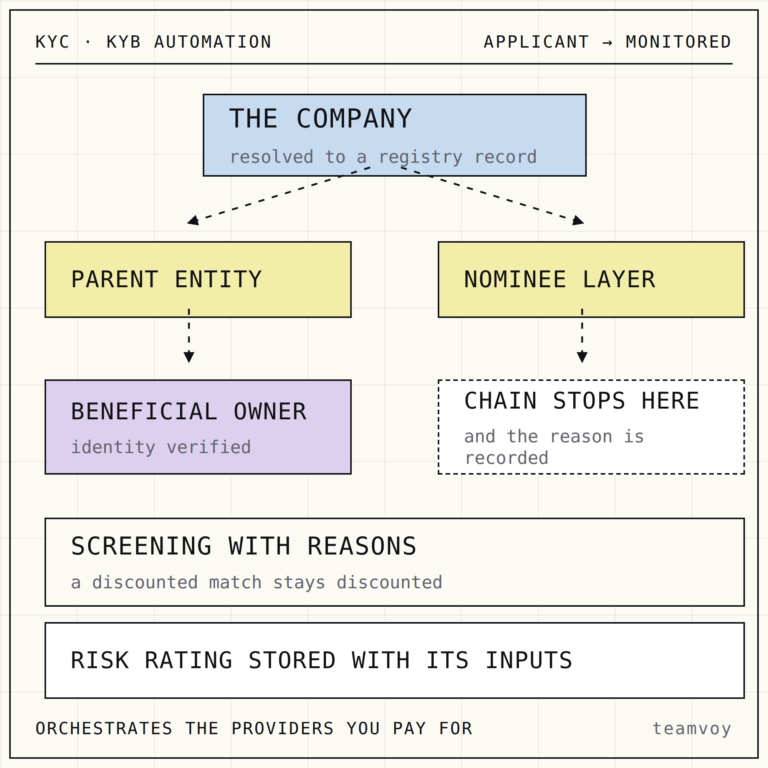
We build the onboarding path behind a customer: jurisdiction-aware intake, the company resolved to a registry record rather than a typed name, the ownership chain walked to natural persons, identity and screening decisions recorded with their reasons, and a risk rating stored beside the data that produced it. It orchestrates the identity and screening providers you already pay for rather than replacing them.
Trusted by teams at:


Teamvoy has delivered engineering work for 150+ companies.

Verified B2B client reviews from fintech, insurance, healthcare, and hi-tech engagements.

A B2B review platform that connects businesses with verified software solutions providers.

Transparent platform where current and former employees share company reviews and interview experiences.
KYC and KYB Automation Success Stories
Check out our product and experience design case studies. Learn how we’ve helped businesses like yours launch stunning solutions and succeed in target markets.

Eliminating the 90% Noise: How Teamvoy Re-Engineered Trade Surveillance Software for a Global Exchange

AI-Native Engineering for Faster Time-to-Market

High-Performance Web Platform for Scalable Trade Surveillance
KYC and KYB Automation Services We Offer
Six offerings. Each is scoped and estimated separately, and a firm losing applicants at signup usually needs the first three before the rest are worth doing.
Jurisdiction-Aware Onboarding Flows
A flow that asks a given applicant only for what your policy requires for that entity type and country, generated from a rule set rather than hard-coded into screens. Every question is traceable to a line in the customer due diligence policy, and questions that cannot be traced come out, which usually does more for completion than any amount of interface work.
Entity Resolution and Registry Integration
Connections to company registers and reference data, with the business resolved to a registry identifier and its filings, officers and status pulled from source. Each register has its own access model, latency and idea of what a company is, so the integration layer normalises them into one shape instead of exposing that variety to the flow.
Beneficial Ownership Unwinding
The ownership chain walked layer by layer to the natural persons above your threshold, held as a graph rather than flattened into a list. Where the walk cannot continue, the stopping point and its reason are written onto the customer file, because an incomplete chain recorded as complete is the finding a file review opens with.
Identity Verification Orchestration
Several identity providers behind one interface, routed by document type and country, with a shared record of every attempt including the ones that failed. Coverage and pass rates differ sharply between countries, so provider choice becomes a configuration decision rather than a rebuild of the product.
Screening Decisions and Match Rationale
Sanctions, political exposure and adverse media screening across every resolved party, with each match either escalated or discounted against a written reason. That reason carries forward, so a name discounted last year is not reviewed from nothing by whoever happens to pick up the refresh.
Perpetual KYC and Periodic Review
Registry changes, rescreening and behavioural triggers feeding a review queue driven by events as well as by the calendar. Each review arrives with what has changed since the last one attached, so the work is assessing a difference rather than rebuilding the file from the beginning.

Why choose Teamvoy for KYC and KYB automation?
Four things that are true of how we rebuild an onboarding path, two of which cost us something.
The engineers who scope the work build the work.
No handover from a pre-sales team to a delivery team. The person who tells you what the work will cost is the person who then has to make that estimate true.
Costs us: we cannot start faster than we can staff, so we turn down work that needs a squad this month.
You own the source code from the first commit.
The repository is yours, in your organisation, from day one. Not transferred at the end, not held until the final invoice clears.
Costs us: we give up the lock-in that comes from holding a repository, so we have to be re-chosen every quarter.
We orchestrate identity providers. We are not one.
Providers sit behind one interface, routed by document type and country, and a new one is added as configuration rather than as a project. We have no reason to defend the pass rate of any particular vendor, which means we can tell you when the one you are paying for is the wrong choice for half your markets.
Every question in the flow maps to a line in your policy, or it comes out.
Before anything is rebuilt we map each field and document request to the requirement that justifies it, and the ones nobody can trace are removed with your compliance function watching. Reading the policy against the form is unglamorous and it usually removes more manual review than the automation does.
What We Offer: Custom AI Agents for Real Engineering Work
By combining AI coding agents and AI agents for data engineering with context learning, each agent understands your code. Scale from one to multiple autonomous AI agents across teams.

01. Intake and jurisdiction routing
The applicant declares entity type and country of registration, and that determines which checks and documents the flow asks for at all.
Breaks when every applicant is asked for the same set regardless of jurisdiction, so a company is asked for a certificate that does not exist where it is registered and abandons the application.
02. Entity resolution against the register
The business is resolved to a registry record and its identifier rather than to a name and address somebody typed into a field.
Breaks when matching runs on name and postcode alone, and two companies with near-identical names in the same city are merged into a single customer record.
03. Ownership unwinding
The ownership chain is walked layer by layer until the natural persons above your policy threshold are identified.
Breaks when the chain crosses into a jurisdiction whose register is not machine-readable, the walk stops silently, and a nominee structure is stored as no beneficial owner identified.
04. Identity verification of natural persons
Officers and beneficial owners are verified by document, biometric or electronic identity, routed by what actually works in their country.
Breaks when a re-attempt after a failed check creates a new applicant record, so the original failure leaves the audit trail and the pass rate reads better than it is.
05. Screening and adverse media
Every resolved party is screened for sanctions, political exposure and adverse media, and each match is escalated or discounted with a reason.
Breaks when a discounted match is stored as a status rather than as a rationale, so the same name is reviewed from scratch by a different person at every refresh.
06. Risk rating and the onboarding decision
The customer risk rating is computed from your policy and the data gathered, and the approve, decline or approve-with-conditions decision is recorded against it.
Breaks when the rating is stored without the inputs that produced it, so a review a year later cannot say why the customer was rated low or what has moved since.
07. Perpetual monitoring and review
Registry changes, rescreening and behavioural triggers keep the profile current in between formal reviews.
Breaks when review is calendar-driven only, so a change of director filed at the register in March is first noticed at the customer anniversary in November.

Could you say which question in your flow
your policy actually requires?
Three ways to start
Three ways to start working with Teamvoy on outcome-based AI. No long discovery. No sales process. No forms to fill. Every engagement starts with a real technical conversation, and every engagement is priced to a result. We move as fast as the situation needs.
Onboarding Drop-off Review
Two engineers reconstruct the funnel step by step for one customer segment, then map every question and document request against the requirement that justifies it. You keep the step-level drop-off analysis and the policy-versus-flow gap list whether or not we build anything.
One Segment, Automated
One customer segment onboarded through the new path in your environment: jurisdiction-aware intake, registry resolution, ownership unwinding, identity orchestration, screening decisions with reasons, and a risk rating stored with its inputs. It runs alongside your current process until your compliance function is satisfied with the files it produces.
Call a CTO
Fifteen minutes with the engineer who would do the work. Bring the onboarding step that loses the most applicants, and you get an answer on whether that step is required by your policy at all.
What changes when onboarding has to satisfy growth and the MLRO at once.
These rows are the questions worth putting to any vendor quoting onboarding work, including us.
What our onboarding engineers work in.
Services and APIs


Workflow and orchestration


Matching and graph
Document and language models


Data and reporting


Sources and providers we connect
We engineer for:
Bring the step where applicants leave.
Talk to a Chief Technology Officer on the first call.