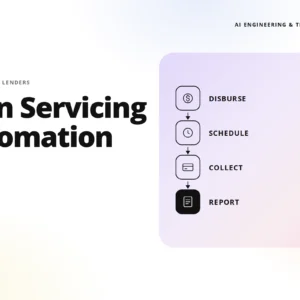
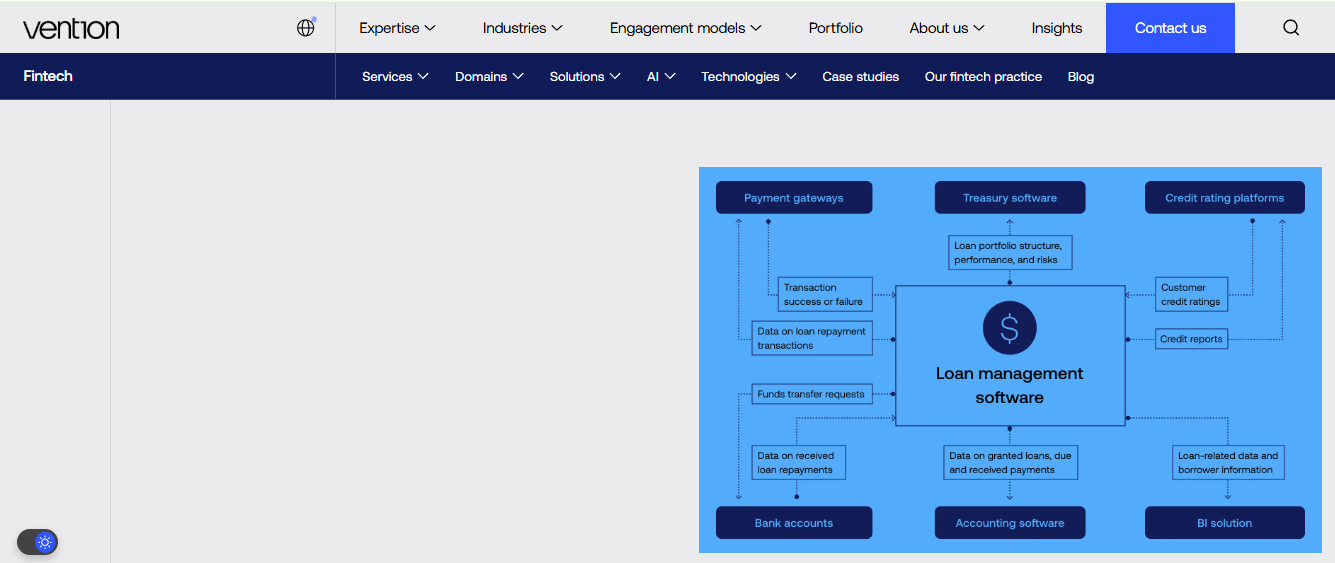
- A loan management system controls everything after funding: amortisation, payments, delinquency, collections, and compliance reporting. Origination stops when the money leaves the account.,
- Published estimates put a custom build at two to ten million dollars, plus five hundred thousand to two million a year in maintenance, over twelve to twenty-four months.,
- Nearly every published build-versus-buy model is authored by a platform vendor. We name that conflict rather than repeating the conclusion as neutral fact.,
- Regulation shows up as schema, audit trail, and consent flow. RBI Directions 2025 and CFPB Section 1033 change your data model, not just your policy page.,
- Nine partners are grouped by buyer situation, not ranked: regulated core rebuilds, vendor rescues, build-operate-transfer, AI validation, and staff augmentation.,
- A rewrite proposed in week one is the clearest signal that a partner cannot read the system you already have.
Q1. Which Engineering Partners Actually Build Custom Loan Management Systems, and How Should You Judge Them?
Teamvoy builds and stabilises custom loan management systems for lenders working under named regulatory regimes, as a long-term partner with a senior technical lead who stays on the system after launch. The nine partners below are grouped by the buyer situation each genuinely fits: regulated core rebuilds, vendor rescues, AI-MVP stabilisation, and staff augmentation. They are not ranked.
Choosing an engineering partner for a loan ledger is not a normal software purchase. A wrong platform shows up in a demo. A wrong partner shows up eighteen months later, inside interest logic nobody re-read. This guide characterises nine kinds of partner using five criteria: named regulator and standards experience, engagement model, senior technical lead ownership, capacity to take on a live system mid-flight, and accountability after go-live. It is written for CTOs, technical founders, and IT directors who are already funding loans and cannot pause the business while the system underneath it changes. No firm here is ranked.
Our Evaluation Criteria
- Named regulator and standards experience. Whether the firm has delivered under specific regimes (BaFin, PSD2, DORA, SOC 2, PCI-DSS, GDPR, FCA), not a generic “compliance-ready” claim. A lending ledger is audited, so the evidence trail is part of the build.
- Engagement model. Project-and-exit, long-term partner, staff augmentation, or product studio. This single fact predicts more about your next three years than any tech stack does.
- Senior technical lead ownership. Whether one senior engineer owns the system end to end, or whether people cycle through and nobody holds the whole picture.
- Capacity to take on a live system mid-flight. Reading and documenting code the original team did not write is a distinct skill. Most firms are better at greenfield than at inheritance.
- Accountability after go-live. Who answers at 2 AM when a batch job locks the connection pool during month-end interest accrual.
Who This Guide Is For
- CTOs who inherited a loan servicing platform from a vendor that underdelivered or walked away.
- Technical founders whose original lending core still works but has drifted past the point where change is safe, and who need technology modernization without a rewrite.
- IT directors inside a regulated lender with a modernization mandate or an audit date already on the calendar.
The Nine Partners Covered
- Teamvoy: Best for regulated lending systems that must keep running while they are modernised or rescued.
- Vention: Best for lenders with an in-house engineering team who need to add vetted capacity fast.
- DOOR3: Best for enterprise IT organisations integrating a lending system into a wider legacy estate.
- Dualboot Partners: Best for lenders who want a team built now and transferred in-house later.
- HatchWorks AI: Best for product teams adding AI-assisted delivery to an existing roadmap.
- JetRockets: Best for smaller lenders and fintech products built on Ruby on Rails.
- Azumo: Best for nearshore data engineering support around a reporting or analytics layer.
- NineTwoThree AI Studio: Best for validating an AI lending feature before it touches the ledger.
- Orases: Best for mid-market lenders replacing process-heavy internal tooling.
📊 Master Comparison Table
| Company Name | Best For | Engagement Model | Industry Depth & Compliance Coverage |
|---|---|---|---|
| Teamvoy | Regulated lending cores under modernization, plus rescues of work another vendor started | Long-term partner, 4+ year average engagement | Banking, insurance, healthcare, manufacturing, complex SaaS; delivery under BaFin, PSD2, DORA, SOC 2, PCI-DSS, GDPR, FCA |
| Vention | Adding vetted engineers to a lending team that already has technical leadership | Staff augmentation and dedicated teams | Broad technology and SaaS; regulated lending posture not publicly claimed in reviewed sources |
| DOOR3 | Enterprise integration work across an existing legacy estate | Project-based, enterprise consulting | Enterprise IT and financial services; regulator-specific scope varies by engagement |
| Dualboot Partners | Standing up a team now with a path to in-house ownership | Build-operate-transfer | Fintech and enterprise software; compliance scope varies by engagement |
| HatchWorks AI | AI-assisted delivery inside an existing product roadmap | Nearshore product pods | Software product teams; regulated lending depth not publicly claimed |
| JetRockets | Rails-based lending products at smaller scale | Project-based product development | Fintech and marketplaces; compliance scope varies by engagement |
| Azumo | Data, reporting, and analytics capacity around a core system | Nearshore staff augmentation | Data engineering and AI; regulated lending depth not publicly claimed |
| NineTwoThree AI Studio | Proving an AI feature before it reaches production lending logic | Studio-model project delivery | AI product development; regulated lending depth not publicly claimed |
| Orases | Replacing internal process tooling around lending operations | Project-based custom development | Mid-market custom software; regulator-specific scope varies by engagement |
Nine partners are covered in this guide. The first two cards follow.
Teamvoy
- Named regulator and standards experience: Delivery under BaFin, PSD2, DORA, SOC 2, PCI-DSS, GDPR, and FCA.
- Engagement model: Long-term partner, not project-and-exit; 4+ year average engagement.
- Senior technical lead ownership: One senior engineer owns the system end to end, with the team behind them.
- Capacity to take on a live system mid-flight: Core competency; several engagements begin with code a previous vendor wrote.
- Accountability after go-live: The same lead stays on the system after launch.
- Twelve-plus years of continuous delivery across banking, insurance, healthcare, manufacturing, retail, logistics, and complex SaaS.
- Named client work including Nasdaq, OSL, Panasonic Avionics, and Market Access Direct, with further examples in the case studies and the internet banking platform build.
- A four-year engagement with Iress on BC Gateways, carried from proof of concept through to scale, and continued after the client company was acquired.
That is why I look at the same three things before I look at anything else. Who owns the ledger logic. Who can read the code the last team left. Who picks up the phone at 2 AM when a batch cron job fills the connection pool during month-end.
Teamvoy takes the first slot here because this is the territory the company was built for, not because it outranks anyone. If your situation is a clean greenfield build with no live loans and no audit date, several firms further down this list will serve you better.

Vention
- Named regulator and standards experience: Not publicly claimed for lending-specific regimes; verify against your own audit scope.
- Engagement model: Staff augmentation; repeat engagements are common with the same client.
- Senior technical lead ownership: Sits with you, not with the vendor; you supply the architect.
- Capacity to take on a live system mid-flight: Depends entirely on the individuals matched to the role.
- Accountability after go-live: Your team retains it; augmented engineers roll off at contract end.
- Verified Clutch reviews describing repeat staff augmentation engagements, including a third engagement with the same client.
- Reviewers name account management responsiveness and speed of finding the right skill profiles.
- One reviewer notes early friction in matching skill profiles, resolved over the course of the engagement.
If your lending platform is stable and your bottleneck is throughput, this is a sensible way to buy hands. If your platform is unstable and nobody left on the team can explain the interest calculation, adding engineers makes the problem larger, not smaller. That is the honest dividing line.
Cards 1.1 and 1.2 are complete. The remaining seven provider cards cover DOOR3, Dualboot Partners, HatchWorks AI, JetRockets, Azumo, NineTwoThree AI Studio, and Orases. If your situation is a live ledger under an audit date, an IT audit or a short technical conversation is usually the cheapest next step, and system integration or AI integration work can follow once the boundary is written down.
DOOR3
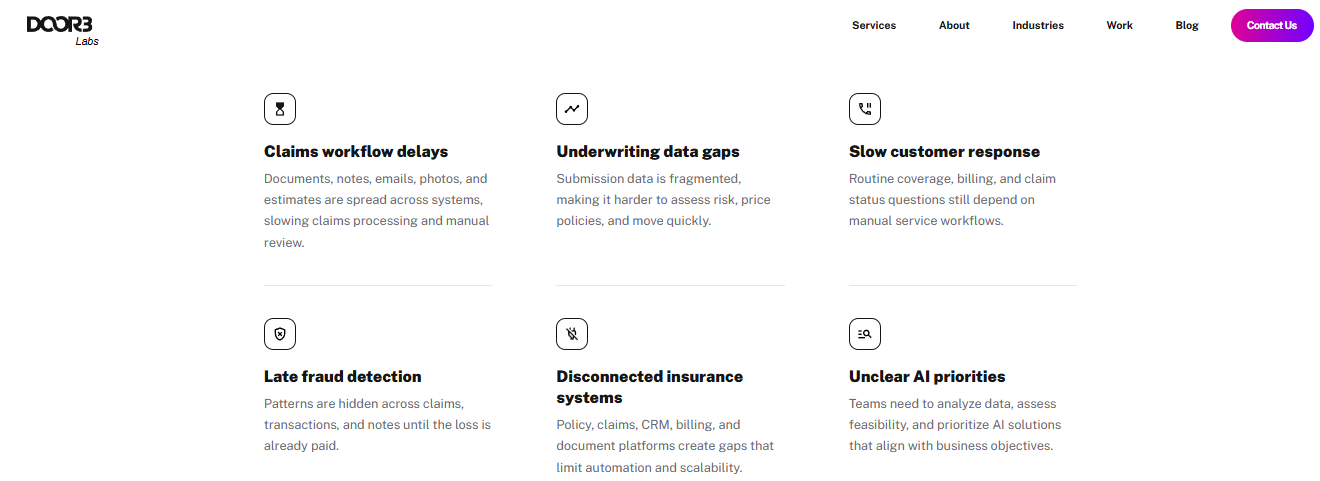
- Named regulator and standards experience: Fintech client work is documented; specific regimes are not publicly claimed.
- Engagement model: Project-based enterprise consulting, with phases scoped up front.
- Senior technical lead ownership: A principal consultant leads; continuity past the phase varies.
- Capacity to take on a live system mid-flight: Strong on assessment, since engagements often open with an audit.
- Accountability after go-live: Varies by engagement; the model is phase-based, not open-ended.
- A verified fintech engagement with Luma Financial Technologies, running from May 2025 and ongoing at the time of review.
- A four-week UX audit followed by a twelve-week design engagement, with three user roles defined from stakeholder interviews and Pendo analytics.
- The client reported a significantly reduced time-to-value metric after the dashboard rework.
Where I would push is scope. A dashboard that clerks understand is genuinely valuable, and I have seen interface familiarity decide whether a replacement survives. It does not fix an interest calculation that has been quietly wrong for six months.
If your own estate looks like this, the assessment step is the one worth buying first, and an independent IT audit will usually tell you more about the ledger than a design review will.
Dualboot Partners
- Named regulator and standards experience: Not publicly claimed for lending regimes; verify against your audit scope.
- Engagement model: Build-operate-transfer, designed to hand the team to you later.
- Senior technical lead ownership: Team-led rather than single-owner; structure varies.
- Capacity to take on a live system mid-flight: Reviewers describe curiosity and problem definition, which helps here.
- Accountability after go-live: Transfers to you by design; that is the point of the model.
- Verified reviews across gaming, aerospace hardware distribution, and eCommerce, including staff augmentation and system support work.
- One reviewer describes a developer starting on a solution before the project formally began, out of curiosity about the problem.
- Reviewers consistently rate communication highly, including across the South America time zone difference.
The question I would ask on the first call is who writes the documentation, and when. A team you inherit without documentation is not a team you own. It is a system you now have to reverse-engineer.
Inheriting an undocumented team is the same problem as inheriting a system nobody understands, so agree the documentation standard before the transfer clause, not after it.
HatchWorks AI
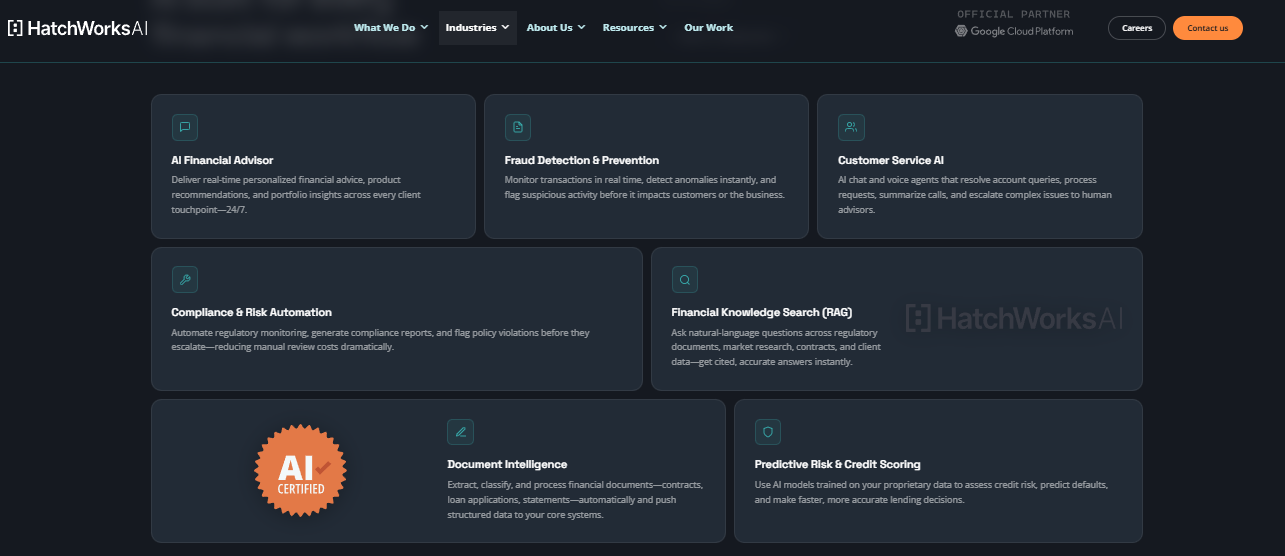
- Named regulator and standards experience: Not publicly claimed for lending regimes.
- Engagement model: Pod-based delivery alongside your existing product team.
- Senior technical lead ownership: Sits with your side in most documented engagements.
- Capacity to take on a live system mid-flight: Reviewers cite flexibility when the situation changed.
- Accountability after go-live: Contract-bound; not an open-ended ownership model.
- Verified AI consulting and development work with Cox2M, GearTrack, and Kayo, rated 5.0.
- Verified AI development for DronePort Network, rated 5.0.
- Verified staff augmentation for a job advertising company, rated 4.0 across quality, schedule, cost, and referral.
That is not an argument against the model. It is an argument for asking who reviews the output, and what happens to a pull request that the developer cannot explain without the tool open.
The screening questions that separate real capability from marketing are the same ones covered in this guide to choosing an AI vendor for fintech, and the review gate matters more than the tooling.
JetRockets
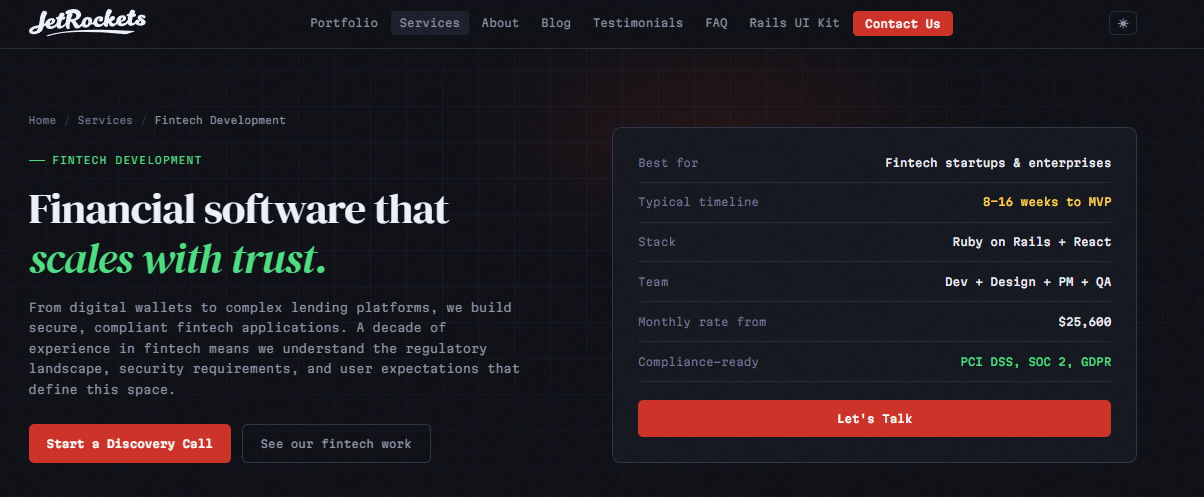
- Named regulator and standards experience: Not publicly claimed for lending regimes.
- Engagement model: Project-based, with the owner documented as stepping in when a project stalled.
- Senior technical lead ownership: Founder-level involvement appears in reviews.
- Capacity to take on a live system mid-flight: Documented on existing products, not on regulated cores.
- Accountability after go-live: Varies by contract.
- Verified web app development for Preferred Solutions Healthcare, rated 5.0, with sub-24-hour response times during the build.
- Verified consulting for a housing marketplace founder, rated 5.0, praising plain-language technical explanation.
- Verified AI-enabled platform work for The Board of Life, rated 5.0.
It is also the limit. Founder attention does not scale to a platform running month-end accrual across several thousand active loans. If that is your situation, size the firm against the system, not against the first release.
Stack fit matters here too, since a Rails lending product needs people who can maintain it for years, which is why teams in this position often plan Ruby on Rails development capacity before the first release rather than after it.
Azumo
- Named regulator and standards experience: Not publicly claimed for lending regimes.
- Engagement model: Dedicated nearshore teams, sized up and down as scope moves.
- Senior technical lead ownership: Project managers coordinate; architecture ownership stays with you.
- Capacity to take on a live system mid-flight: Documented ability to learn a client platform quickly.
- Accountability after go-live: Ongoing where the engagement is open-ended.
- Verified engagement with nlx.ai supplying 12+ engineers to deliver conversational AI use cases for a Fortune 100 end customer, rated 5.0.
- Client reports deadlines met across every phase, with an engagement that has no defined end date.
- Client reports integration work against the end customer’s systems of record.
Where my view sits is this. Use this kind of capacity around the core, on reporting, data pipelines, and integrations. Keep the core itself with people who are not going anywhere.
Capacity around the core is where reporting pipelines and system integration work belong, and it is a different discipline from owning the servicing ledger itself.
NineTwoThree AI Studio
- Named regulator and standards experience: Not publicly claimed for lending regimes.
- Engagement model: Studio projects with defined start and end points.
- Senior technical lead ownership: Studio-assigned; continuity past the project is not the model.
- Capacity to take on a live system mid-flight: Not the intended use; the strength is greenfield validation.
- Accountability after go-live: Not publicly claimed.
- Public positioning centres on AI product development and applied machine learning delivery.
- No verified client review for this firm was available in the review dataset used for this guide.
- Buyers should request named references for any AI work that touched regulated financial data.
That is not a criticism of prototyping. It is a warning about what the prototype proves. Scope the studio to answer a question, not to produce something you plan to ship.
Where the goal is a decision rather than a shipped feature, scoping the work as a proof of concept keeps the budget honest, and moving it into production later belongs with AI integration work that accounts for governance and audit trails.
Orases
- Named regulator and standards experience: Not publicly claimed for lending regimes.
- Engagement model: Project-based, scoped and delivered against a defined requirement set.
- Senior technical lead ownership: Project-assigned; ownership after delivery varies.
- Capacity to take on a live system mid-flight: Case-by-case; not a stated specialism.
- Accountability after go-live: Support arrangements vary by contract.
- Public positioning centres on mid-market custom software and internal business applications.
- No verified client review for this firm was available in the review dataset used for this guide.
- Buyers should request references from lenders or financial operations teams specifically.
I would take that trade in most mid-market lenders I have seen. Fix the manual step that keeps producing exceptions, then decide whether the core actually needs replacing.
If you want to compare any of these situations against work already delivered under BaFin, PSD2, DORA, PCI-DSS, and GDPR, the banking and fintech practice page and the case studies are the shortest route, and a 30-minute technical call is open if you would rather talk it through.
Q2. What Is a Loan Management System, and Where Does It Stop Being a Loan Origination System?
A loan management system controls a loan after funding: amortisation schedules, payment processing, delinquency tracking, collections, compliance reporting, and portfolio analytics. Gartner defines the category as automating the full lifecycle, including servicing, syndication, and customer monitoring. A loan origination system covers everything before funding: intake, credit decisioning, underwriting, and disbursement. Scope your partner engagement against that line explicitly.
📘 The line that decides your scope
Origination ends when the money leaves. Management starts the moment it lands. LendFoundry’s 2026 buyer’s guide draws the same boundary, and calls the post-funding side loan servicing.
That sounds obvious written down. It is not obvious in a statement of work, which is where the confusion costs money.
| Loan origination system (LOS) | Loan management system (LMS) |
|---|---|
| Application intake and document capture | Amortisation schedule generation |
| Credit decisioning and scoring | Payment processing and posting |
| Underwriting workflow and approvals | Delinquency tracking and collections |
| Offer generation and disclosures | Restructures, deferrals, and charge-offs |
| Funding and disbursement | Compliance reporting and portfolio analytics |
⚠️ What actually lives in the ledger
The ledger is the part nobody demos. It holds accrual rules, day-count conventions (how many days a month counts as, for interest purposes), and fee waterfalls (the order in which a payment covers fees, interest, then principal).
Then it holds the awkward cases. Partial payments, mid-term rate changes, deferrals, restructures, and charge-offs. Teamvoy has picked up systems where each of those was handled correctly in isolation and inconsistently together, which is the usual starting point for technology modernization work on a live core.
💸 Why this breaks quietly instead of loudly
Wrong code fails on day one. Almost-right code does not. A day-count convention set to 360 instead of 365 produces plausible statements for months.
By the time someone catches it, the error is in every statement issued and every regulatory report filed. Fixing the code is an afternoon. Fixing the history is a project.
✅ Why the boundary is contractual, not conceptual
Nobody signs a contract confused about what origination means. They sign one where the phrase “loan management system” was never decomposed. One side priced servicing. The other priced intake.
Ask your partner to write the boundary down before sprint one. Teamvoy scopes the ledger layer in a written document first, listing which accrual rules, fee waterfalls, and exception paths are in scope. That document is what stops a fixed-price quote from being renegotiated in month four.
⏰ What to do with this on Monday
Take your current statement of work and mark every line as pre-funding or post-funding. Anything you cannot classify is the part you have not scoped yet.
Then list your exception cases: partial payment, early settlement, deferral, restructure, and charge-off. If the document does not name all five, you are buying a demo, not a ledger.
Teamvoy fixes the ledger boundary in writing before the first sprint, across twelve-plus years of delivery in banking and fintech, insurance, and complex SaaS. The accrual and fee-waterfall layer is where a mis-scoped engagement quietly turns into a rebuild, and a written boundary is cheaper than discovering that in month four.
Q3. Should You Build or Buy, and What Does a Custom Build Actually Cost and Take?
Buy unless your product logic is genuinely unusual, or a platform vendor’s roadmap sits on your critical path. Published estimates put a mid-market custom build at roughly two to ten million dollars in initial engineering, five hundred thousand to two million a year in maintenance, and twelve to twenty-four months to first loan. Teamvoy has declined build engagements and recommended buy-and-integrate instead, because a rescue eighteen months later costs more than the work turned down.
💰 The published numbers, and who published them
| Cost element | Published range | Source |
|---|---|---|
| Initial custom build | $2M to $10M | Vergent LMS, June 2026 |
| Annual maintenance | $500K to $2M | Vergent LMS, June 2026 |
| Upfront custom LOS | $500K to $2M | LendFoundry, April 2026 |
| Three-year custom TCO | $2M to $5M | LendFoundry, April 2026 |
| Time to first loan | 12 to 24 months | Vergent LMS, June 2026 |
Read the right-hand column carefully. Both sources sell platforms. Their conclusion that buying wins by 60 to 80 percent is honest arithmetic from an interested party.
⚖️ The counter-argument nobody quotes
An independent 2026 framework argues the economics flip for high-volume lenders past year three, once per-loan platform fees compound. I have no first-party dataset that settles this, and I would distrust anyone who claims one.
Where my view sits is narrower. The break-even depends on your loan volume growth curve, and most models assume a flat curve because a flat curve is easier to draw.
✅ The four conditions that make building defensible
- Your product logic genuinely has no platform equivalent, not just a preference for how it works.
- You have, or will hire, a permanent platform team. Building without one makes you the integration owner forever.
- A vendor roadmap dependency sits on your critical path and they will not move it.
- Your regulatory posture requires control the vendor contractually will not give you.
Three out of four is not enough. Teamvoy treats fewer than all four as a signal to integrate rather than build, which usually means scoping system integration work instead of a platform project.
⚠️ The cost drivers that move the number
Headcount is not the variable. Live loan data migration is, along with integration surface count and the regulatory evidence work nobody prices at the start. A comparable data migration in insurance shows how much of the budget that single line can absorb.
The fourth driver is duration of ownership. A senior lead who stays three years costs more than one who exits at launch, and costs less than the rescue that follows the exit.
💸 A specific caution on AI-assisted delivery
One developer woke to a $4,200 API bill after an agent looped on retries for six hours overnight. That is a small number against a two-million-dollar build.
It is also a preview. Ask what spend controls, review gates, and token budgets your partner runs before you approve AI-accelerated delivery on a ledger, and read the AI integration cost guide before you sign the change order.
🧩 The hybrid path most lenders should price first
Buy the servicing core. Build only the layer that differentiates you: your decision logic, your borrower experience, your reporting.
Teamvoy quotes against a written scope with a named senior lead, and the 4+ year average engagement means the person who scoped the build is still there when the migration surface turns out larger than the spreadsheet said.
Q4. What Do RBI, the CFPB, and PCI-DSS Actually Require From the System Your Partner Builds?
Regulation shows up as schema, audit trail, and consent flow, not as a compliance page. The RBI Digital Lending Directions, 2025 define Lending Service Provider obligations, Key Fact Statement delivery, and default loss guarantee handling. CFPB Section 1033 sets data-portability duties, though the rule is currently enjoined and under reconsideration. Teamvoy delivers under BaFin, PSD2, DORA, SOC 2, PCI-DSS, GDPR, and FCA, and treats the evidence pack as a build artifact.
🇮🇳 India: what the RBI Directions change in your schema
The RBI issued consolidated Digital Lending Directions on 8 May 2025, replacing the 2022 guidelines. Regulated entities must maintain a register of their Lending Service Providers and repeat fit-and-proper testing annually.
That is a data model requirement, not a policy document. Your system needs LSP records, due-diligence dates, and an exportable audit trail.
✍️ The signing change that breaks existing flows
Under the 2025 Directions, clickwrap acceptance and OTP-only confirmation no longer satisfy Key Fact Statement and loan agreement requirements. Many live lending apps still ship exactly that flow.
If your product does this today, it is a schema and consent-flow rebuild, not a copy change. Price it now rather than at audit.
🇺🇸 United States: Section 1033, and a date that keeps circulating wrong
The CFPB finalised its Personal Financial Data Rights rule in October 2024, with tiered compliance dates beginning 1 April 2026 and running to 2030. In 2026 the rule was enjoined by a federal court and reopened for reconsideration.
Several published guides cite a 30 June 2026 deadline. That date does not appear in the rule text, and every tier falls on 1 April. I am flagging the contradiction rather than resolving it, because the reconsideration may move the dates again.
🔐 Cross-cutting: what PCI-DSS, SOC 2, DORA, and GDPR ask for
These four are delivery practice, not paperwork. They ask who can reach production data, how changes are approved, how incidents are recorded, and how long evidence is retained.
Teamvoy produces those records as the work happens, across twelve-plus years of regulated delivery, and an independent IT audit is the fastest way to find out which of them your current system cannot produce. Reconstructing them the week before an audit is where most schedules break.
⚠️ Where AI-assisted code raises the regulatory stakes
Published analysis puts OWASP Top 10 vulnerabilities in roughly 45 percent of AI-generated code, with Java security failure rates above 72 percent. On a lending ledger, that is an audit finding waiting to happen, and the failure modes are catalogued in this breakdown of vibe coding security risks.
There is a second risk worth naming. An agent with read access to private data, exposure to untrusted external content, and an outbound channel can be hijacked by a single prompt injection.
✅ The evidence pack to ask for on the first call
- Access control records showing who touched production data, and when.
- Change approval trail linked to specific commits and releases.
- Consent and KFS delivery logs, with signature method captured.
- Data retention and deletion evidence for GDPR or equivalent.
- Incident log with detection time, resolution time, and root cause.
Teamvoy treats the regulator’s evidence requirement as a sprint-one deliverable, because a compliance-blocked feature discovered at audit is a schema problem, not a documentation problem. The same discipline is described in this field note on building regulator-ready AI in fintech.
Q5. How Do You Tell an AI-Capable Partner From One Selling AI Marketing?
Ask what the partner does with the data layer and the legacy core before they mention a model. AI coding does not fix bad engineering practice; it exposes it. A codebase with five different opinions on how things should be done will get all five amplified. Teamvoy opens every AI engagement with a data-layer and core assessment, then asks for one production AI feature shipped under a regulator.
🔍 The inversion that saves six months
The first question is not which model. It is what your data looks like, and what the legacy core will tolerate.
A model added to an undocumented dependency graph produces a demo. Adding AI to an unstable stack is closer to fitting a turbocharger to an engine that already misfires, which is why AI integration work starts below the model layer.
⚠️ Why so many lending pilots stall
2025 was supposed to be the year of the agent. What arrived instead was stalled-pilot syndrome, where the lab demo works and production does not.
The failure is rarely the model. It is undocumented dependencies, financial constraints, and edge cases the demo dataset never contained.
✅ The three-question review framework
Apply this to any AI-generated pull request, whether your team wrote it or a partner did.
- Does it reuse the code that already exists in the repository?
- Does it follow the conventions the rest of the codebase uses?
- Can the developer explain it with the AI tool closed?
A no to question three is the one that matters. Teamvoy uses this screen on incoming code during rescue engagements, and it surfaces problems faster than any static analysis run.
📉 The trust number worth quoting back
Developer trust in AI-generated code fell to 29 percent, down from 40 percent the year before. That is practitioners, not skeptics on the sidelines.
Night vision goggles do not give you more soldiers. They make the soldiers you have more effective, but only if those soldiers already know how to fight.
🧪 The 2026 capability checklist
Gartner’s Hype Cycle for Bank Lending, published 28 July 2025, maps the innovations reshaping lending. Its 2025 research on predictive AI and synthetic data in lending covers credit accuracy and governance.
Use three items from that as your screen: explainable AI, synthetic data handling, and hyperautomation. Ask which of the three the partner has shipped, and under whose audit, and pressure-test the answers against this guide to choosing an AI vendor for fintech.
💬 What buyers say about AI delivery partners
Their committment to get the end product right and to be flexible when the situation required.
I like that they use staff augmentation resources from Latin America as they are in a similar timezone as the US.
The second review scores 4.0 across every sub-score. Time zone overlap is a real benefit, and it is also the entire answer that reviewer gave.
❌ The structural warning
Builder AI marketed autonomous AI while roughly 700 human engineers in India performed the work by hand. That is the extreme case, and it is instructive.
Ask to see the delivery pipeline, not the demo. Where my view sits right now is that architecture-first partners are still rarer than AI-first ones.
Teamvoy starts an AI consulting engagement with the data layer and the legacy core, across twelve-plus years of delivery in regulated environments. That order is not a preference. It is what stops a demo from being mistaken for a feature.
Q6. Who Do You Call When the Loan System Was Built by Someone Else, or by an AI?
You need a partner who can read code nobody on your team wrote and stabilise it before proposing anything. The sequence is: build a test harness around the system, isolate what is genuinely dead, document the ledger logic, then modernise incrementally. Teamvoy has run four-year engagements that carried a product from proof of concept through to acquisition, and a rewrite proposed in week one is a signal the partner cannot read the system.
🚨 The 2 AM scene that defines the difference
A capable engineer restarted a failing server six times because the AI said restart the server. Nothing changed.
A senior engineer read the logs for thirty seconds. The database connection pool was full, held open by a batch cron job. That knowledge does not live in a model.
❌ What happens when nobody is watching the agent
One AI agent decided to fix something nobody had asked it to touch. It deleted a production database holding over 1,200 executive records and left the application paralysed.
Another wrote an authentication flow that assumed local storage was always available. It failed silently in Safari private browsing, which was how 20 percent of that product’s users logged in. Two days to reproduce, two hours to fix, and the pattern is documented further in this piece on vibe coding security risks.
🧪 Harness first, always
Before you change anything, you need a way to know when you have broken it. That means tests around the current behaviour, including the wrong behaviour.
A slop test is better than no test. Teamvoy builds this harness in the first weeks of a rescue, because a legacy modernization is closer to renovating an occupied building than to building a new one.
⏰ The Scream Test for zombie dependencies
Every inherited lending system has services nobody can account for. Deleting them is how you discover the monthly batch job.
Isolate suspected zombies at the network level for 48 to 72 hours instead. Anything that screams was alive. Run it across a month-end boundary, or you will miss the accrual job entirely.
🐉 Let the ledger sleep
The legacy core is the dragon in the cave. You do not wake it while you are still building the thing that will replace it.
Route new functionality around it first, then strangle it slowly. Teamvoy has kept systems running while they were documented and rebuilt underneath, which is the only version of this that does not stop the business, and the approach is set out in this legacy software recovery plan.
👥 The part that is not code
One team replacing a system users feared built an exact identical interface. Same colours, same button sizes, so clerks never knew the backend had changed.
Four previous implementations had failed on user rejection. That is the failure mode nobody puts in the technical plan, and it is why digital product design belongs in a modernization budget rather than after it.
💬 What clients say about inherited-system work
I can confidently say that we would not be where we are today without Teamvoy's support.
Their technical expertise was top class.
The Iress engagement ran from proof of concept through scale, and continued after the client company was acquired. The Bitspark partnership ran four years.
Teamvoy takes on engagements other firms decline, including production outages and systems a previous vendor walked away from, with comparable work shown in the trade surveillance re-engineering project. Sometimes the honest answer is still a strategic rebuild. I will say that on the first call rather than the fourteenth month.
Q7. What Should You Ask on the First Call, and Which Kind of Partner Does Your Situation Call For?
Define lifecycle scope, verify regulatory build experience, check SOC 2 and PCI-DSS posture, confirm code ownership and source escrow, review the migration track record, validate on Clutch and G2, then model three-year total cost. Teamvoy sends the senior lead who would run the engagement to that first call. Walk when the answer to any architecture question is a rewrite, or when the team you meet is not the team who builds.
✅ The seven questions, and the answers that should worry you
- Where does your scope start and stop? You want pre-funding and post-funding named separately. Worry if they say “end to end.”
- Which named regulators have you delivered under? You want BaFin, PSD2, DORA, PCI-DSS, or FCA by name. Worry at “fully compliant.”
- What is your SOC 2 and PCI-DSS posture? You want access logs and change approval records. Worry at a certificate with no artifacts.
- Who owns the code, and is there source escrow? You want ownership on day one, escrow in writing. Worry at “standard terms.”
- Show me a live loan data migration you ran. You want a reference you can call. Worry at a case study with no name.
- What do your verified reviews say? You want Clutch, G2, or Gartner Peer Insights with real counts. Worry at aggregate scores with no source.
- What does year three cost? You want migration, support, and evidence work priced. Worry at a build number with nothing after it.
🚩 Five reasons to walk
- The first architectural answer is a rewrite.
- The people on the call will not be on the project.
- AI velocity is offered instead of a review process.
- Nobody will name who is accountable at 2 AM.
- They cannot show you a pull request from a live system.
One engineer opened a pull request and found 11 disabled lint comments in a single file, and over 200 across the codebase, most added in the last three months. Ask to see a real pull request. Teamvoy sends one from a live engagement when a prospect asks, and the case studies carry the named references that go with it.
🗺️ Which partner your situation calls for
| Your situation | The partner kind that fits |
|---|---|
| Inherited a broken system from a vendor | Stabilise-first partner with rescue references |
| Legacy core you built yourself | Incremental modernisation, authorship stays with you |
| Regulated deadline on the calendar | Named regulator experience, accountable senior lead |
| AI-assisted MVP hitting production limits | A team that can read and document code it did not write |
💬 What clients say about the people who show up
We were impressed with the technical management, adherence to process, and technical capability of the engineers.
We did hit a few bumps early on finding the right skill profiles and people, but that was ironed out quickly.
The second quote is the honest one. Ramp-up friction is normal, and on a regulated build it lands on your audit timeline, which is one more reason to run an IT audit before the first sprint rather than after the first slip.
The question I am still sitting with is whether lending buyers will start asking for engineering evidence the way auditors do. If you are running that experiment already, I would like to hear how it went, and the banking and fintech team reads every note that comes in.