

- Claude Fable 5.2 drafted the circuit boards, enclosures, and firmware for three devices that worked, and Anthropic's own research says their durability and certification readiness were unknown. That gap is the whole story for anyone building physical systems.
- The model costs twice Opus 5.5 at standard API rates, returns text only, and keeps your data for 30 days by default. None of that tells you whether it belongs in your plant, warehouse, or device program. The official facts, the vendor-reported evidence, and the stack you still have to build around it are below.
It usually starts with a demo clip: a model that drafts a circuit board and drives a simulated robot arm. Your plant manager forwards it, your CFO asks what it costs, and your safety engineer says nothing. The question for a technical leader is narrower than the clip. Does this model change your architecture, your budget, or your safety case?
What is Claude Fable 5.2, and what do the official facts say?
Fable 5.2 is a general-purpose frontier model Anthropic released on November 9, 2026 for its hardest reasoning, agentic, coding, and engineering workloads. It takes text and images, returns text, and runs adaptive thinking by default. Every value below comes from Anthropic’s own pages, retrieved November 13, 2026.
| Fact | Official value | Source (retrieved November 13, 2026) |
| Release date | November 9, 2026 | Launch post |
| Positioning | Demanding reasoning and long-horizon agentic work; start with Opus, move up when evaluations fall short | Platform docs |
| Plan access | Pro, Max, Ultra, Team, Enterprise | Model page |
| Developer access | All Claude API customers, plus listed cloud routes | Platform docs |
| API model ID | claude-fable-5-2 | Models overview |
| Standard price | $8 per million input tokens; $40 per million output | Pricing |
| Prompt caching | $0.20 per million cache reads; $10 per million cache writes | Pricing |
| Fast mode | Up to 2.5× faster at $16 input and $80 output per million tokens | Pricing |
| Context and output | 1 million tokens in; 128,000 tokens out | Models overview |
| Knowledge cutoff | June 2026 | System card |
| Modalities | Text and image in; text out; tool use and vision | System card |
| Data retention | 30 days by default for safety monitoring; an Enterprise Frontier Safeguards route covers compatible zero-retention setups | Model page |
Two rows decide most physical-systems projects. Text output means every action in the world travels through tools, controllers, and interfaces your team builds and owns. The 30-day retention default becomes a procurement question the moment CAD files, machine telemetry, or patient-adjacent records enter the API.
What is Fable 5.2 built for?
Fable 5.2 targets the hardest technical work you can hand a model: multi-step reasoning, agents running across dozens of tool calls, large coding tasks, scientific analysis, and engineering design. Anthropic lists hardware and robotics among those areas on its launch post and model page, both dated November 9, 2026, and stops short of calling it a robot-control model.
The models overview, retrieved November 13, 2026, gives budget owners a rule. Start on Opus 5.5, and move up when your evaluation suite still falls short. Fable costs twice Opus at standard API rates, and an upgrade you can’t defend with an evaluation result is one you can’t defend in a budget review.
The capability plausibly pays for itself in four places:
- Long-horizon engineering agents that read a spec, draft a design, run tests, and revise.
- Design problems with interacting constraints, such as a board layout bound by electrical, thermal, and enclosure limits at once.
- Simulation work, where the model page says Fable can build 3D worlds, design hardware components, and manipulate robotics environments.
- Large codebases and firmware trees, where a 1 million-token context removes a chunking step.
It earns nothing on hard real-time deadlines, on runs that must be identical every time, or where a wrong answer injures someone. Those belong to deterministic software and certified safety systems.
Claude Fable vs Mythos: which product will your team use?
Claude Fable vs Mythos is a question about safeguards and access, not raw capability. Anthropic’s launch post and platform docs state that both products run on the same underlying model. Fable adds safeguards in high-risk cybersecurity and biology domains and serves all API customers. Mythos 5.2 stays limited to verified organizations.
| Dimension | Fable 5.2 | Mythos 5.2 |
| Underlying model | Same | Same |
| Access | All API customers; Pro through Enterprise | Verified organizations only |
| Safeguards | Added in high-risk cyber and biology domains | Fewer domain restrictions |
| Fit for hardware or logistics teams | Default choice | Restricted-domain work only |
For hardware design, simulation, warehouse planning, and device documentation, the comparison resolves in one sentence: that work sits outside the restricted domains, so Fable is the product you’ll ship on. One operational consequence follows, documented in the system card: some requests trigger safeguard-driven fallback behavior. Run your real prompts on your real API path first.
What does the hardware and robotics evidence show?
The published evidence shows that Claude Fable 5.2 can produce working electronics prototypes and lift simulated robot manipulation scores. Each result below is Anthropic-reported with its setup intact, which makes it capability evidence rather than independent validation. Production deployments appear nowhere in it.
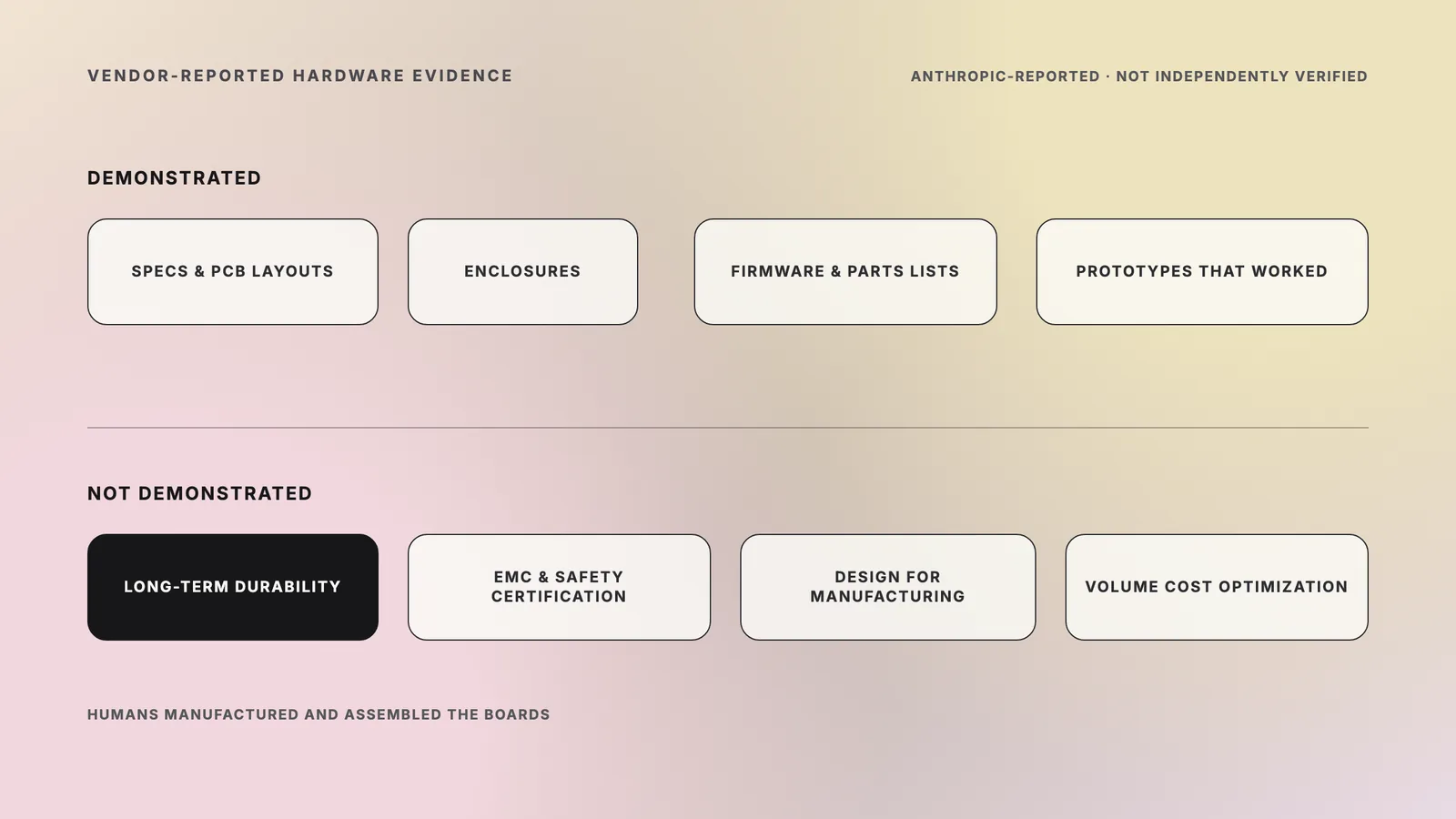
AI hardware design. Anthropic’s electronics design research, published November 9, 2026, reports specifications, PCB layouts, enclosures, firmware, and parts lists for three working prototypes built with Diode: a speakerphone, a voice-assistant hub, and a handheld virtual pet. Humans manufactured and assembled the boards. Anthropic states that long-term durability and commercial-certification readiness were unknown.
Robot control. The launch post of November 9, 2026 reports improved physical-robot control and a 64.9% average success rate on RoboDojo Sim. The qualifiers travel with the number: vendor-reported, a simulated two-arm environment, Anthropic’s internal run, the highest available effort setting, and comparable only against models in the same benchmark setup.
| Claim | Demonstrated | Left untested |
| Electronics prototyping | Specs, PCB layouts, enclosures, firmware, parts lists for three working devices | Durability, certification, volume manufacturing, unit cost |
| Simulated robot control | 64.9% average success, simulated two-arm benchmark, internal run, highest effort | Real-robot success rate, real-time control, sensor noise |
| World building | 3D worlds and robotics environments, per the model page | Validated simulation-to-real transfer |
The honest reading for a CTO: strong evidence about the reasoning and design layer, thin evidence about everything downstream of it. Treat 64.9% as a same-setup comparison score, not a reliability estimate for your cell.
What does physical AI require beyond a model?
Physical AI needs a stack of sensing, simulation, control, safety, and evaluation wrapped around whatever model reasons at the top. NVIDIA’s physical AI glossary, retrieved November 13, 2026, defines the field around autonomous machines that perceive, understand, and act in the physical world, split across training, simulation, and runtime computers. A text-generating model covers part of one.
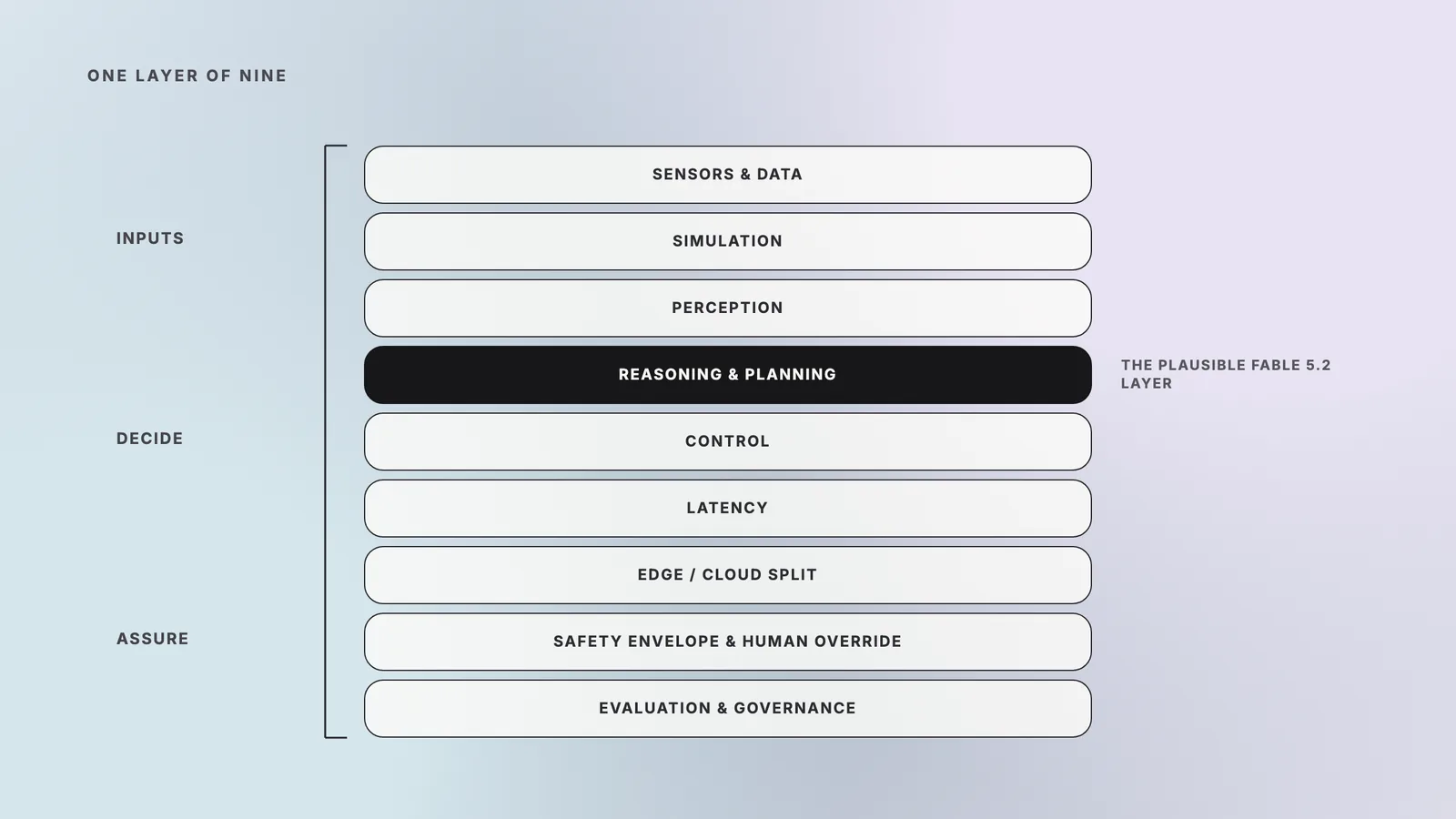
| Layer | The question your team answers | Why it decides the outcome |
| Sensors and data | Which cameras, encoders, telemetry, and CAD files feed it, and who owns calibration? | A calibration error becomes unsafe motion |
| Simulation | What can be tested in simulation, and how is the gap to reality measured? | NVIDIA warns simulation may mispredict deployed behavior |
| Perception | How do signals become state estimates with confidence values? | Low confidence should slow, stop, or escalate |
| Reasoning and planning | Which model decomposes goals and drafts plans? | The plausible Fable layer; outputs need checks |
| Control | Which deterministic controller turns plans into commands? | Safety-critical loops stay outside any model path |
| Latency | What deadline applies to perception, control, and stop? | A late plan is a failure |
| Edge and cloud split | What runs locally during network loss? | Sets resilience, hardware cost, update cadence |
| Safety envelope and override | Which actions are impossible by design, and who takes over? | Policy alone can’t bound a machine that can harm |
| Evaluation and governance | Which tests, shadow runs, and monitors exist, and who owns incidents? | NIST’s AI RMF treats risk across the lifecycle |
The API bill sits inside one line of one layer. NVIDIA’s Isaac Sim material describes synthetic data, software-in-the-loop, and hardware-in-the-loop testing as core robotics workflows, and that work exists whichever model drafts the plan. Device and firmware schedules are why IoT and embedded development often gates a pilot date more than model choice does.
The trade-off is plain. A stronger model raises the ceiling on reasoning at twice the standard rate of Opus 5.5, and it replaces none of the four things that decide whether a physical system ships: deterministic control, a certified safety system, real-world validation, and independent human override. When one of those four is your bottleneck, a better model moves your delivery date by zero days, and a partner who implies otherwise is selling.
Where does Claude Fable 5.2 fit in manufacturing, logistics, and healthcare?
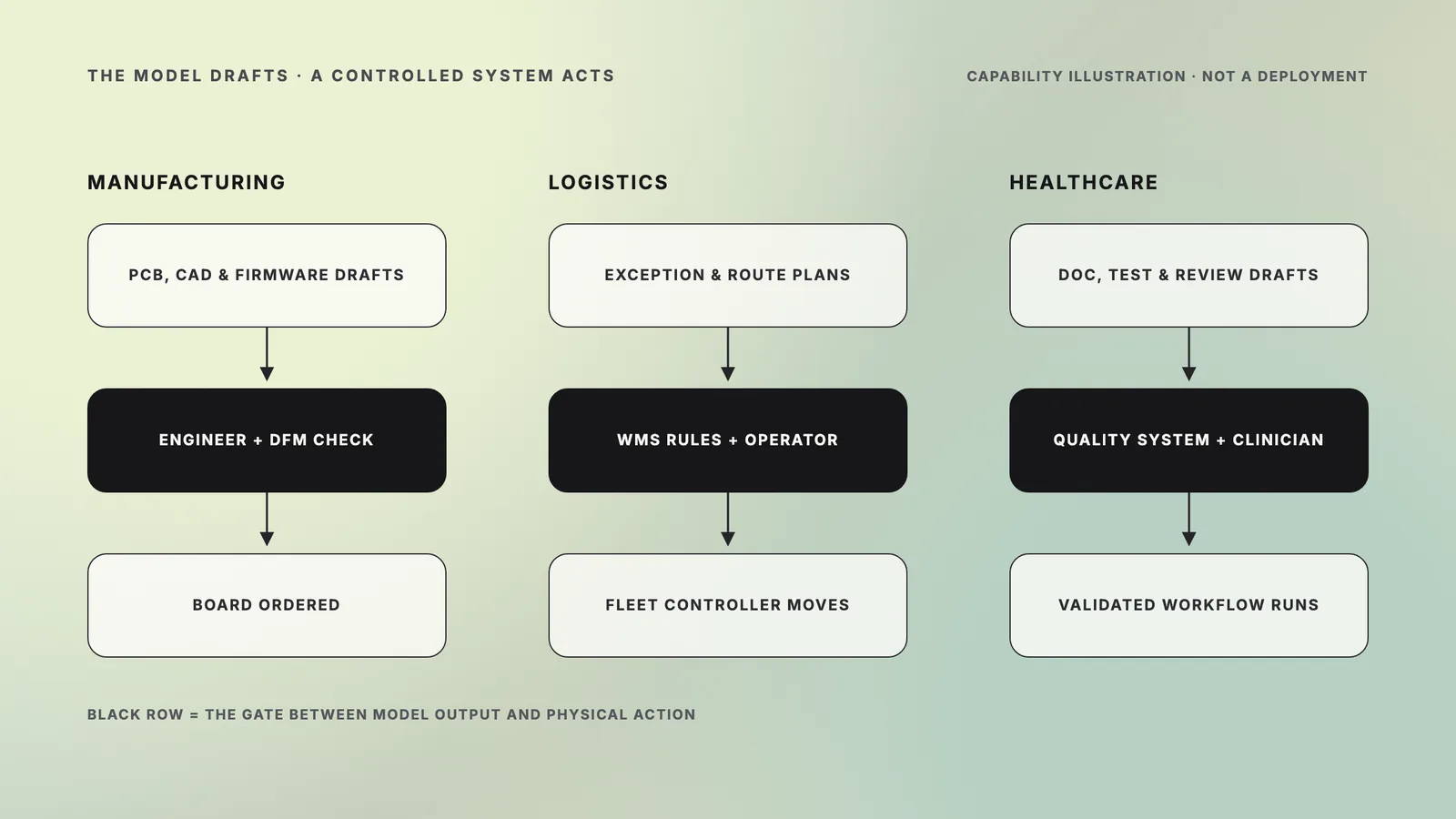
Claude Fable 5.2 fits the design, planning, and analysis steps in each industry, with a person or a deterministic system between its output and any physical action. The patterns below are capability-level illustrations mapped to Teamvoy service areas. They describe what the technology supports, with no deployment and no client result behind them.
Manufacturing
Early PCB, CAD, and firmware concepts can come from the model, then pass engineer approval and design-for-manufacturing checks before anyone orders a board. Test scenarios for a robotic work cell can be drafted the same way, with the simulation platform executing them. Machine telemetry, quality events, MES and ERP context, and maintenance history can feed anomaly triage a technician confirms. Natural-language task planning stays safe only while a deterministic controller enforces motion and force limits. Teamvoy’s manufacturing software development covers that integration side, and the agentic AI in manufacturing article covers agent patterns for plant operations.
Warehousing and logistics
WMS, ERP, and order data have to meet AMR or conveyor events before a planning model sees the state the floor is in. Exception recovery is the high-value case: inventory counts, routes, sensor readings, and carrier updates conflict daily, and reconciling them is reasoning work. Task decomposition belongs to the model while local controllers keep navigation, collision avoidance, and emergency stops. Plumbing dominates the effort, which is why Teamvoy frames it as warehouse and inventory integration.
Healthcare and life sciences
Device engineering teams can use the model for regulated-device documentation, test generation, and prototype review inside an existing quality system. Lab-automation planning fits the same shape, bounded by validated procedures. Diagnosis, treatment, surgical motion, and comparable high-risk actions stay behind domain validation, authorization, and human oversight. Teamvoy’s healthcare software development practice and the AI implementation in healthcare guide cover the validation work that decides whether any of it ships.
What are the limits and open questions before a pilot?
The governing limit is simple: Fable 5.2 is a general frontier model, and a certified controller it is not. Six gaps stand between the launch results and a production pilot, and a credible plan closes each one with its own evidence.
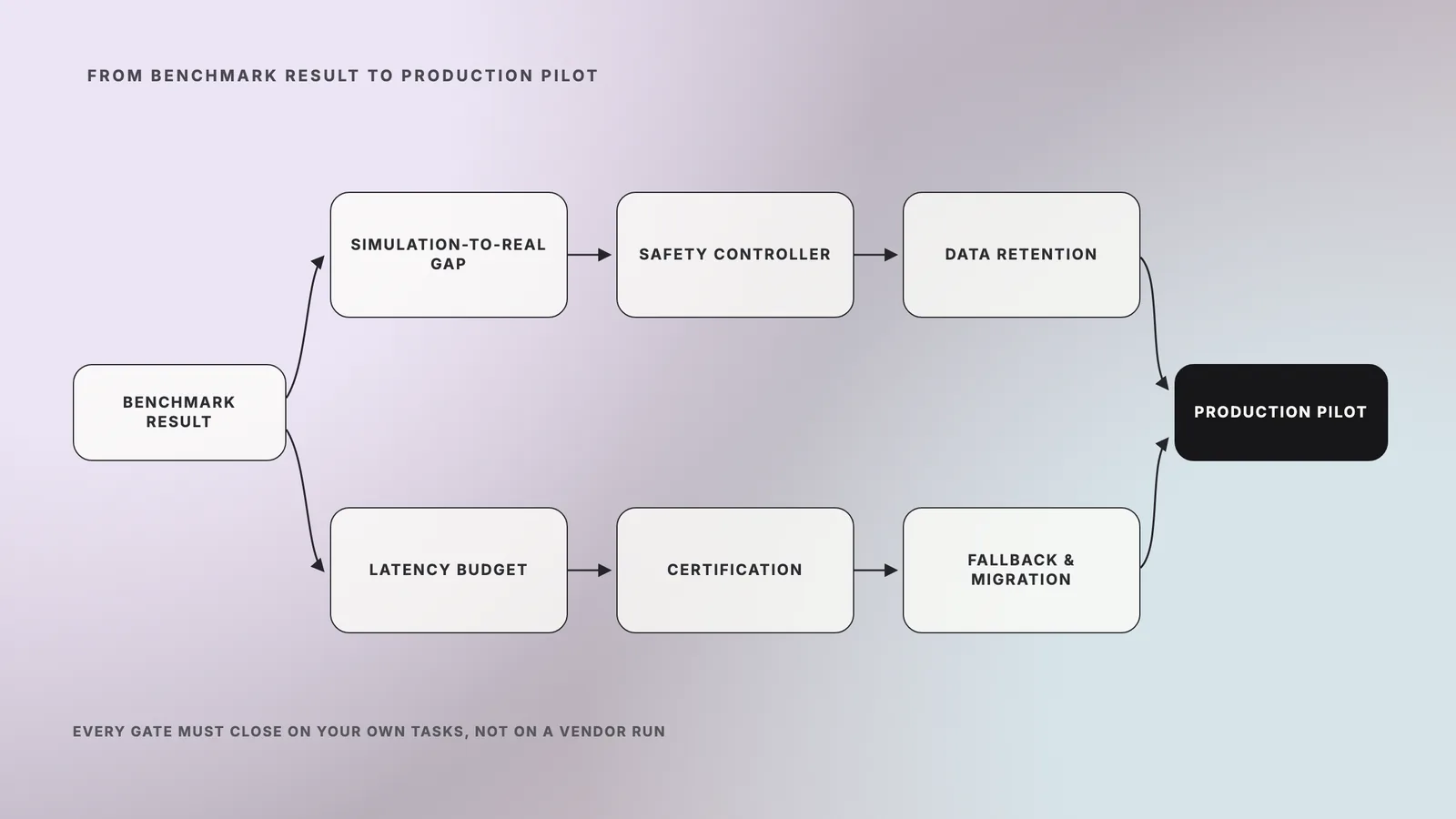
- Simulation-to-real gap. The published robotics result came from simulation on an internal run. Your cell adds sensor noise, wear, and people.
- Latency. Adaptive thinking runs by default, and fast mode is an “up to 2.5×” vendor claim about token generation, per Anthropic’s pricing page retrieved November 13, 2026. Measure round-trip time on your own prompts first.
- Safety controller. Model output is text. Something deterministic, tested, and independently stoppable belongs between that text and an actuator.
- Certification. Anthropic says prototype durability and commercial-certification readiness were unknown. Medical devices, industrial robots, and autonomous systems carry certification regimes that model output can’t satisfy.
- Data retention. The 30-day default exists for safety monitoring. Data that can’t tolerate it makes the Enterprise Frontier Safeguards route a contract item to settle first.
- Migration and fallback. The platform docs list four changes that can break a Fable 5.1 integration: prefix-check behavior, thinking-block compatibility, an older computer-use tool, and advisor compatibility. The system card reports regressions plus prompt-injection and fallback concerns alongside the gains. Budget a regression pass.
Anthropic acknowledges that evaluating highly capable models still has unresolved gaps. That candor points at one conclusion: your evaluation suite, on your tasks, produces the only number that should drive a go or no-go. Teamvoy’s enterprise AI architecture article covers the surrounding data and governance layers, and an AI readiness assessment scores the gaps before a pilot gets funded.
Conclusion
Claude Fable 5.2 raises the ceiling on the reasoning and design layer of engineering work, and Anthropic’s prototypes and simulated-robotics scores deserve attention as capability evidence. They fall short of showing that physical AI deployment has become a model-selection problem. Sensors, simulation, control, latency, safety, override, and evaluation still decide whether a pilot ships, and they consume more calendar time than the API line consumes budget. Settle those seven, and the model choice takes an afternoon.
Talk to Teamvoy About Physical AI Feasibility
Find out whether a physical AI pilot is technically and operationally viable before you commit to a model. Teamvoy scopes the decision loop, data, integration points, latency, safety boundary, evaluation plan, and production ownership as one piece of work. Book an AI consulting session, or go straight to AI development services when the product is scoped and the integration layer is what you need built.