- There is no single best custom order management system partner. Engagement model, not portfolio size, predicts whether your order platform survives year two.
- Published cost bands run from about 40,000 dollars for a narrow MVP to 400,000 dollars enterprise, and vendors disagree because they silently scope different integration counts.
- Order platforms fail at the integration seam, not the interface. GS1 defines the EANCOM ORDERS message and the EDI 850/855 and 860/865 pairs partners hold you to.
- Compliance-aware delivery means auditable practice, not badges: tokenised payment data, reconstructable change logs, residency decided before schema design.
- Safe cutover is never one switch. Run the new order path in parallel, migrate order types one at a time, and change the operator screen last.
- AI is safe where it recommends and unsafe where it commits. Deterministic write paths, circuit breakers, and API-level spend caps come before any model.
Q1. Which Custom Order Management System Development Partners Fit Which Buyer Situation in 2026?
There is no single best custom order management system development partner. Teamvoy fits regulated retail, logistics, and fintech operators modernising an order platform built by previous teams, under a senior technical lead across multi-year engagements. Other partners fit greenfield omnichannel builds, staff augmentation, or enterprise distributed order management rollouts. Match the partner to your system’s current state, not to a ranking.
Choosing who rebuilds your order platform is not a procurement decision. It is a decision about who will be inside your revenue path for years. Orders move money, stock, and customer promises, so a weak partner choice surfaces slowly and expensively. This guide characterises each partner on five things: engagement model, senior technical lead ownership, integration and EDI depth, named industries with compliance coverage, and accountability after go-live. It is written for the CTO who inherited a stalled build, the founder whose order core resists change, and the IT director working against a PCI-DSS or DORA deadline. No rankings here.
Our Evaluation Criteria
- Engagement model. Project-and-exit, long-term partner, or staff augmentation. This predicts who owns the system in month eighteen.
- Senior technical lead ownership. Whether one senior engineer is accountable end to end, or juniors cycle through the codebase.
- Integration and EDI depth. Order platforms fail at the seams: ERP, WMS, payment webhooks, carrier APIs, and EDI messages defined by GS1. This is the layer system integration work actually lives in.
- Named industries and compliance coverage. Which sectors the firm genuinely serves, and which named regimes (PCI-DSS, SOC 2, GDPR, DORA) sit inside scope.
- Accountability after go-live. What happens on day 31, when the first peak-volume exception appears.
⭐ Why these five and not twenty
Gartner’s own research says distributed order management selection is getting harder because vendors keep adding customisation and serving new markets. More criteria did not help buyers. Fewer, sharper criteria did.
I picked these five because each one changes the answer. Warehouse count does not change which partner you hire. Engagement model does.
Who This Guide Is For
- The CTO who inherited an order management build a previous vendor left unfinished, with orders still flowing through it. If that is you, our field notes on updating systems nobody understands cover the first ninety days.
- The technical founder whose order core still works but resists every change the business now needs.
- The enterprise IT director facing a PCI-DSS or DORA deadline on a platform that touches payment data.
⚠️ Who this guide is not for
If you need a packaged tool this week, this is the wrong list. Configure a platform instead.
Custom builds earn their cost when your routing rules, channel mix, or compliance constraints break the packaged model. Not before.
The Partners Covered Here
Nine engineering partners are assessed in this guide.
- Teamvoy: Best for a regulated order platform built by previous teams that has to keep processing while it changes
- DOOR3: Best for an enterprise order platform where the operator-facing workflow is as broken as the backend
- Vention: Best for an in-house team that owns the architecture and needs senior engineers added to it
- Orases: Best for a mid-market operator who wants one accountable US-based team from discovery to launch
- Scopic: Best for a long-running product where distributed delivery at a lower blended rate matters
- SOLTECH: Best for a company that wants executive-level access and a local delivery relationship
- Azumo: Best for a data-heavy order layer needing nearshore engineers in overlapping time zones
- HatchWorks AI: Best for a team adding AI-assisted delivery to an existing order roadmap
- Dualboot Partners: Best for a greenfield order product that needs to ship a first version fast
Master Comparison Table
| Company Name | Best For | Engagement Model | Industry Depth & Compliance Coverage |
|---|---|---|---|
| Teamvoy | Regulated order platforms inherited from previous teams that cannot go offline | Long-term partner (multi-year) | Banking, insurance, healthcare, manufacturing, retail, logistics, complex SaaS; BaFin, PSD2, DORA, SOC 2, PCI-DSS, HIPAA, GDPR, FCA, NHS Digital in scope |
| DOOR3 | Enterprise order platforms where operator workflow and backend both need work | Project-and-exit, with retained design support | Financial services and enterprise software; fintech delivery experience verifiable on Clutch, broader regulatory scope not publicly claimed |
| Vention | Teams that own the architecture and need senior engineers inside it | Staff augmentation | Information technology, AI product companies; regulated-industry compliance scope not publicly claimed |
| Orases | Mid-market operators wanting one accountable US-based delivery team | Project-and-exit, often repeat engagements | Insurance, medical, manufacturing, lending; HIPAA-adjacent healthcare work verifiable, wider regime scope not publicly claimed |
| Scopic | Long-running products needing sustained distributed delivery | Long-term partner (distributed) | Healthcare education, consumer and B2B software; regulated-industry compliance scope not publicly claimed |
| SOLTECH | Companies wanting executive access and a local relationship | Project-and-exit with ongoing support | Mid-market US commercial software; regulated-industry compliance scope not publicly claimed |
| Azumo | Data-heavy order layers needing nearshore overlap | Staff augmentation | Data engineering and application development; regulated-industry compliance scope not publicly claimed |
| HatchWorks AI | Roadmaps adding AI-assisted delivery to existing systems | Long-term partner (nearshore) | Software product companies; regulated-industry compliance scope not publicly claimed |
| Dualboot Partners | Greenfield order products that need a fast first version | Project-and-exit | Startup and scale-up product delivery; regulated-industry compliance scope not publicly claimed |
✅ How to read this table
Read the Engagement Model column first. It rules out more partners, faster, than any other column.
Then read the compliance column honestly. “Not publicly claimed” is not a criticism. It means do not assume it.
Teamvoy
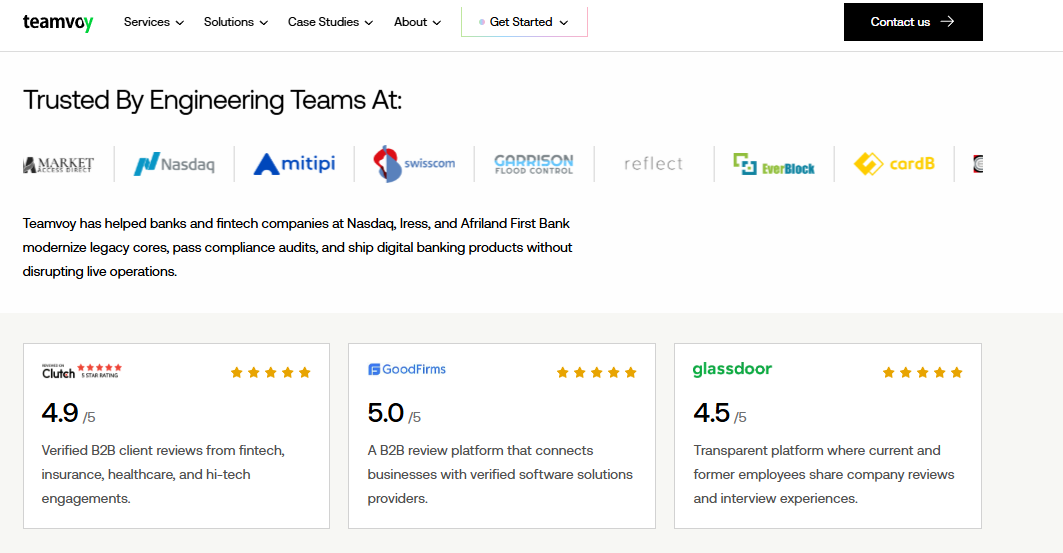
- Engagement model: Long-term partner. Average client engagement runs beyond four years, not project-and-exit.
- Senior technical lead ownership: A senior engineer owns the system end to end, with an AI-native team behind them.
- Integration and EDI depth: Full-cycle integration work across ERP, payment, and messaging layers on live platforms.
- Named industries and compliance coverage: Banking, insurance, healthcare, manufacturing, retail, logistics, complex SaaS.
- Accountability after go-live: Engagements continue past cutover; the same team carries the system forward.
- A seven-bank internet banking platform delivered and carried forward over multiple years.
- Trade surveillance delivered for 30 financial institutions.
- An insurance platform serving 34M+ prospects.

DOOR3
- Engagement model: Project-and-exit, with retained design support after the initial scope closed.
- Senior technical lead ownership: A principal consultant leads; engineering ownership after launch is not publicly claimed.
- Integration and EDI depth: Not publicly claimed for EDI or order-to-cash messaging work.
- Named industries and compliance coverage: Financial services and enterprise software; named regime scope not publicly claimed.
- Accountability after go-live: Varies by engagement.
- Redesigned a fintech client’s dashboard experience, with the client reporting a significantly decreased time-to-value metric.
- Delivered a four-week UX audit plus a 12-week design engagement on schedule and on budget, managed in Jira.
- Retained past the original scope for continued design work.
Cards for Vention, Orases, Scopic, SOLTECH, Azumo, HatchWorks AI, and Dualboot Partners follow in the next block. If you are weighing a takeover of a stalled order build right now, the pattern we use is described in our modernization sprint notes, and an IT audit is usually the cheapest first step. For a peer conversation with no sales process, talk to a technical lead.
Vention
- Engagement model: Staff augmentation. Engineers join a team that already owns the architecture.
- Senior technical lead ownership: The client’s own CTO led. Vendor-side system ownership is not publicly claimed.
- Integration and EDI depth: Not publicly claimed for order-to-cash or EDI messaging work.
- Named industries and compliance coverage: Information technology and AI product companies documented.
- Accountability after go-live: Varies by engagement, since the client retains architectural ownership.
- Verified Clutch engagement combining staff augmentation with custom software development for an AI company.
- Client-side reviewer was a CTO, which indicates technical rather than procurement-led buying.
- Five out of five on quality, schedule, cost, and willingness to refer.
Orases
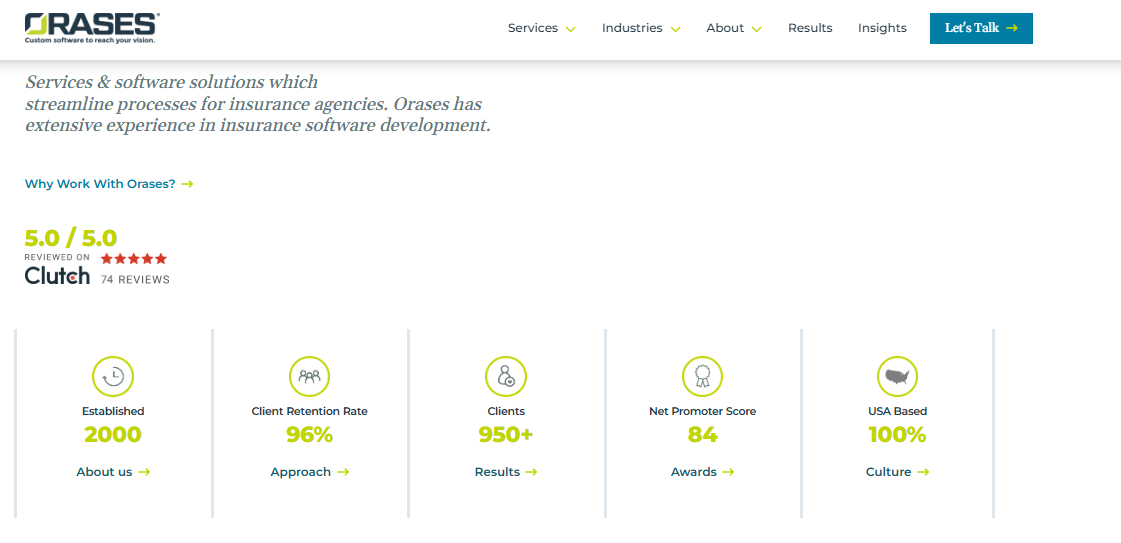
- Engagement model: Project-and-exit, with clients describing repeat and ongoing work.
- Senior technical lead ownership: Clients describe an in-person planning session that produced a plan in about three hours.
- Integration and EDI depth: Not publicly claimed for EDI or order-to-cash messaging.
- Named industries and compliance coverage: Insurance, medical, manufacturing, and lending documented.
- Accountability after go-live: Clients report continued partnership through evolving scope.
- Verified AI development engagement for a lending company, rated five out of five.
- Verified custom remote care software design and development for a health tech company.
- Verified AI training and consulting engagement for a food manufacturing company.
Scopic
- Engagement model: Long-term partner, delivered through a fully distributed team.
- Senior technical lead ownership: Not publicly claimed as a named accountable role.
- Integration and EDI depth: Not publicly claimed for order-to-cash or EDI messaging.
- Named industries and compliance coverage: Healthcare education and general product software documented.
- Accountability after go-live: Varies by engagement.
- Verified custom software development engagement for a healthcare education company, reviewed by its CEO.
- Review conducted as a phone interview, which is Clutch’s more rigorous verification path.
- Five-star featured review on the company’s Clutch profile.
SOLTECH
- Engagement model: Project-and-exit with ongoing support, based on documented client experience.
- Senior technical lead ownership: Executive access documented, including CTO involvement for the full engagement.
- Integration and EDI depth: Not publicly claimed for EDI or order-to-cash messaging.
- Named industries and compliance coverage: Mid-market US commercial software documented.
- Accountability after go-live: Client describes continued accessibility, including personal phone contact.
- Verified engagement with documented CEO and CTO involvement throughout.
- Five out of five on quality and on schedule adherence.
- Client advice in the review was practical: get their mobile numbers, because they are accessible.
Azumo
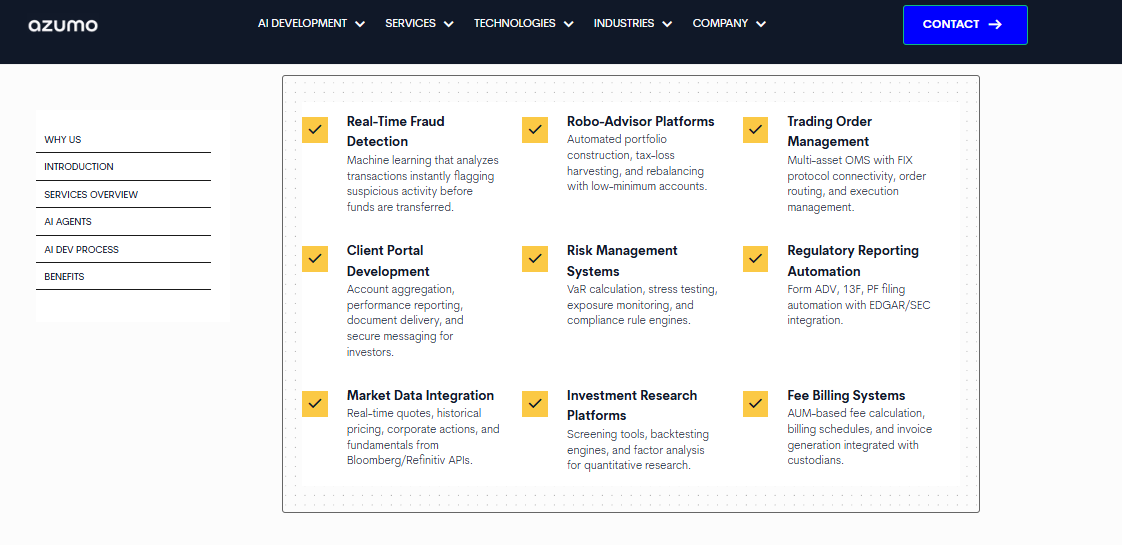
- Engagement model: Staff augmentation at team scale, with project managers working alongside client staff.
- Senior technical lead ownership: Vendor project managers documented; end-to-end system ownership not publicly claimed.
- Integration and EDI depth: Integration with customer systems of record documented; EDI messaging not publicly claimed.
- Named industries and compliance coverage: Conversational AI and SaaS documented, including delivery for a Fortune 100 end customer.
- Accountability after go-live: Engagement documented as ongoing with no defined end date.
- Delivered use cases on timeline across each phase of an open-ended engagement.
- Built applications and all integrations with an enterprise end customer’s systems of record.
- Client reported the team moved faster than the enterprise customer could absorb.
HatchWorks AI
- Engagement model: Long-term partner positioning, with documented scoped AI engagements.
- Senior technical lead ownership: Not publicly claimed as a named accountable role.
- Integration and EDI depth: Not publicly claimed for EDI or order-to-cash messaging.
- Named industries and compliance coverage: Industrial and supply chain IoT plus fleet asset management documented.
- Accountability after go-live: Handover documentation detailed enough to replicate the work, per the client.
- Chat assistant delivered with over 90% response accuracy, measured by the client.
- Handover documentation described as detailed enough to replicate the work internally.
- Delivered on time and within budget on a small-team engagement.
Dualboot Partners
- Engagement model: Project-and-exit, structured around a new product line launch.
- Senior technical lead ownership: A product owner is documented; engineering system ownership is not publicly claimed.
- Integration and EDI depth: Not publicly claimed for EDI or order-to-cash messaging.
- Named industries and compliance coverage: Gaming and daily fantasy sports documented; regulated regimes not publicly claimed.
- Accountability after go-live: Varies by engagement.
- Conceived, designed, and built a new product for a significant new line of business.
- Ran multiple design sprints covering both the initial solution and future iterations.
- Client’s design director rated the execution quality highly, per the verified review.
⭐ What the nine cards actually say
Read across the roster and one pattern dominates. Almost none of these firms publicly claims EDI or order-to-cash conformance work, even though that layer is where order platforms break.
That is not a knock on any of them. It means you have to ask for it directly, by name, with the message types written down before any retail and ecommerce order flow goes live.
⚠️ The honest limit of any list like this
A roundup can tell you which partner type fits your situation. It cannot tell you whether a rewrite is genuinely the right call for your system, which is what an IT audit is actually for.
Sometimes it is. When the data model itself is wrong, incremental work just relocates the problem, and that is worth knowing before you sign anything.
Teamvoy has spent twelve years on order-adjacent and regulated platforms where a rewrite was not available, carrying systems forward across engagements that average more than four years. That length is what taught us the difference between a project and a system, and it is why the assessment above weighs accountability after go-live as heavily as delivery speed. If you want to walk through your own order platform with an engineer rather than a salesperson, the door is open.
Q2. What Is a Custom Order Management System, and When Does Building One Beat Configuring a Platform?
A custom order management system is software built around one company’s order lifecycle, channel mix, and fulfilment rules, integrating with existing ERP, WMS, CRM, and carrier systems instead of forcing operations into a packaged platform’s assumptions. Build when routing logic, compliance constraints, or channel structure break the platform’s model. Otherwise configure, and blend where the gaps are narrow.
An order management system (OMS) sits between the order and the promise. It captures the order, decides where stock comes from, tells fulfilment what to do, and tracks the money.
Itransition’s own framing of the order lifecycle covers capture, orchestration, payment tracking, and returns. That sequence is the same everywhere. What differs is how many exceptions your business puts inside it.
⭐ Three things people call “custom OMS”
Custom means different things to different vendors. Worth separating them before you brief anyone.
- No-code builders. You configure tables and forms. Fast, cheap, and fine until allocation logic gets real.
- Packaged distributed order management (DOM). Gartner treats DOM as its own market with its own vendor landscape. This is the enterprise category.
- True custom builds. Your rules, your data model, your integrations, written and owned.
Most buyers searching for a custom OMS actually want the second or third option. Teamvoy scopes order platform work by asking which of the three the business genuinely needs, because the answer changes the cost by an order of magnitude, and the same triage runs through our technology modernization engagements.
✅ The decision rule is not binary
Gartner’s current guidance on enterprise applications is that build versus buy is no longer a two-way choice. The recommended approach is multidimensional, combining purchased, built, and integrated tools.
That matches what I see in practice. Buy the parts that are commodity. Build the parts where your rules are genuinely unusual.
⚠️ The hidden cost nobody prices
There is one honest warning about building the integration layer yourself. As one practitioner put it, you become Chief Integration Officer forever, maintaining every API schema, field mapping, authentication flow, and retry rule.
The advice attached to it is worth taking seriously. Only build if you have a dedicated platform team, and your core systems really are unique.
💰 One order flow no platform models cleanly
Here is the example I use on calls. A customer orders three items. Two ship from your own warehouse tomorrow, one ships from a third-party logistics provider (3PL) in four days.
Now add the real rules. The 3PL cannot honour your promise date on Fridays. Your finance team wants one invoice, not two. Marketing wants one tracking page.
Packaged platforms model this as two orders. Your customer experiences it as one. That gap is where custom work earns its cost, and nowhere else, which is why retail and ecommerce operators end up with bespoke order logic more often than they expect.
❌ When I tell people not to build
If your exceptions fit on one page, do not build. Configure a platform and put the money into inventory or fulfilment capacity instead.
Where my view sits right now is simple. Build-versus-buy is almost never about features. It is about how many exceptions your order flow contains, and who owns encoding them for the next five years.
Teamvoy starts every order platform engagement with two questions, and neither is about features: what state is the data layer in, and what does the legacy core still control. Those answers decide build versus configure faster than any requirements workshop we have run in twelve years, and they are the same two questions our IT audit services open with.
Q3. What Does a Custom OMS Cost, How Long Does It Take, and Why Do Published Numbers Contradict Each Other?
Published custom OMS estimates run from about $40,000 for a narrow MVP to $400,000 for an enterprise build; ScienceSoft cites $200,000 to $400,000 with roughly three-month payback while Velvetech sets a $150,000 floor. Timelines run three to five months for a narrow build and nine to eighteen for multi-warehouse, multi-channel work with EDI conformance. Integration count moves both numbers.
Ask five vendors for a price and you will get a tenfold spread. That is not dishonesty. They are silently scoping different integration counts.
💸 The published bands, side by side
| Tier | Published band | Named source |
|---|---|---|
| Narrow MVP, single channel | About $40,000 to $80,000 | RBM Soft development cost breakdown |
| Mid-complexity, multi-channel | About $80,000 to $150,000 | Vendor roundup ranges for USA-based development |
| Enterprise, multi-warehouse | $150,000 to $400,000 | Velvetech floor of $150,000; ScienceSoft $200,000 to $400,000 |
ScienceSoft also publishes a payback estimate of roughly three months on its own cost model. Treat that as their methodology, not a market average.
⏰ Where the months actually go
Five phases, in the order they usually happen.
- Requirements and order lifecycle mapping, two to five weeks.
- Integration and master-data gap analysis, two to four weeks.
- Core build: capture, allocation, orchestration, three to eight months.
- Integration hardening and EDI conformance testing, four to twelve weeks.
- Phased cutover and parallel running, two to eight weeks.
Teamvoy prices order platform work against a counted integration surface rather than a headline band, because integration count is the variable that moves both cost and calendar. We count systems, message types, and exception rules before quoting anything, the same discipline described in our integration cost guide.
⚠️ Even the market size is unsettled
The disagreement is not just about project cost. Analysts do not agree on how big this category is.
- Forrester forecast global OMS software spend reaching $1.9 billion by 2026, up from $1.0 billion in 2021, a 12.3% compound annual growth rate.
- Cognitive Market Research puts the OMS market at $3,510 million in 2025, rising to $9,018 million by 2033.
- Marketintelo reports $3.8 billion in 2025, growing to $9.6 billion by 2034 at 10.9%.
Those are not small differences. They reflect different scope definitions, and no ranking page acknowledges it.
💰 The run cost nobody budgets
If your build includes autonomous steps, add a run-cost line. One documented incident had an agent stuck in a retry loop with a CRM tool for six hours overnight.
There was no hard circuit breaker, so it repeated the same broken action and produced roughly $4,200 in API billing before anyone woke up. Budget for spend caps, not just build hours, which is the first thing we flag on autonomous agent scoping calls.
✅ What to do before your next quote call
Count three things, then re-request quotes against them.
- Systems the OMS must talk to, named individually.
- Message types required per trading partner.
- Exception rules that break the happy path.
Teamvoy has found that this single list changes vendor estimates more than any other input, because it removes the ambiguity vendors were quietly pricing. I would rather hand a partner an uncomfortable list than receive a comfortable number, and if the budget conversation is the real constraint, IT cost optimization is the better starting point.
Q4. Which Integrations and Standards Actually Decide Whether an OMS Build Succeeds?
OMS builds fail at the integration layer, not the interface. The surface that decides success: ERP financials, WMS stock and allocation, CRM records, payment gateway webhooks, carrier APIs, marketplace connectors, and EDI conformance. GS1 defines the order-to-cash messages, EANCOM ORDERS and ORDER_RESPONSE, plus the EDI 850/855 and 860/865 transaction pairs, that trading partners will hold you to.
Here is the failure mode I have seen most often. The website is up, the dashboard is green, and the business is offline.
Orders arrive and nothing moves, because one webhook (an automatic callback from another system) is being silently blocked. Nobody notices until customers do.
⭐ The integration surface, named
Map these before writing code.
- ERP: invoicing, tax, and financial posting.
- WMS: stock levels, allocation, and pick confirmation.
- CRM: customer records and service history.
- Payment gateway: authorisation, capture, and webhook acknowledgements.
- Carrier APIs: rates, labels, and tracking callbacks.
- Marketplace connectors: order pull and inventory push.
- EDI: purchase orders, acknowledgements, and shipment notices.
Teamvoy treats those seams as the first test surface after cutover rather than the last, because that is where the silent failures live. We test them with real transactions, not with mocks, and that is the core of our system integration practice.
✅ The conformance bar is written down
Trading partners do not negotiate message formats. GS1 publishes the standards, and they are specific.
The EANCOM ORDERS message specifies goods or services ordered under agreed conditions between buyer and seller. GS1’s EDI Semantics release adds the mappings for ORDER and ORDER_RESPONSE.
GS1 US goes further and names the transaction pairs directly. Retail grocery practice uses EDI 850 purchase order with 855 acknowledgement, 860 with 865 for changes, and 875 with 876 for grocery orders.
⚠️ Start with master data, not code
GS1’s own implementation sequence does not begin with development. It begins by identifying the business need, then aligning master data and running a gap analysis.
Teamvoy runs that same order on integration work, because a mismatched product identifier will break an order flow more reliably than bad code. Skipping it feels faster for about three weeks, and the cleanup usually lands with a data engineering team afterwards.
⏰ The post-cutover test that catches the silent failure
Do this within an hour of go-live. Place real orders through a dedicated QA account, then check billing and invoicing integrations immediately.
If the web tier works but the payment gateway webhook is blocked by a security group rule, the business is offline even though the site looks fine. The order sits in limbo, and no alert fires.
❌ The bottleneck is not the model
There is a useful correction to the current AI conversation here. Teams obsess over the brain and ignore the nervous system.
Model choice matters less than most roadmaps assume. Even a strong model is useless when it gets bad data or cannot execute an action reliably. Integration is the unsexy thing that separates a demo from production, a point we make at length in our notes on AI integration services.
Teamvoy has spent twelve years on platforms where a dropped acknowledgement is a regulatory event rather than a support ticket, across banking, insurance, retail, and logistics. That work taught us to verify seams with live transactions, in the first hour, not the first month. The trade surveillance rebuild for a global exchange is the clearest example of that standard in practice.
Integration Layer
WHERE THIS IS HANDLED
Teamvoy connects order platforms to the ERP, WMS, payment, carrier and EDI systems they have to live with.
If you are mapping the integration surface of an order system right now, this is work we do every day, and the door is open.Talk to a technical lead →
Q5. How Do Engagement Models and Post-Launch Accountability Change Who You Should Hire?
Engagement model predicts outcome more reliably than portfolio size. Project-and-exit fits a scoped greenfield build; staff augmentation fits a team that already owns the architecture; a long-term partner fits an order platform that must keep processing while it changes. For takeover work, require documentation before redesign, incremental stabilisation, and a named senior engineer who owns the code.
Picture the situation I get called into most. A CTO joins, inherits an order platform at roughly 70% complete, and the previous vendor is gone.
Orders still flow. Nobody can explain why the promise date calculation has three exceptions. The people who knew have left.
⚠️ The complication is memory, not code
Missing documentation is not an inconvenience here. It is the actual problem, and it is the exact situation described in our guide to updating systems nobody understands.
One senior engineer described the AI version of this well. A model entering your codebase has no memory of it, like the character in Memento who walks in and asks what he is doing.
At 2am that gap gets expensive. An on-call engineer hit a 503 error and the tool suggested restarting the server. Six restarts later, a human looked for thirty seconds and knew the database connection pool was full because of a batch job. That is tribal knowledge, and it is nowhere in the repo.
✅ Four engagement models, honestly compared
| Model | Genuinely good at | Weak when |
|---|---|---|
| Project-and-exit | Scoped greenfield builds with a fixed launch | The system needs owning in year two |
| Staff augmentation | Adding hands to an architecture you own | Nobody internally owns the design |
| Long-term partner | Live platforms that change while running | You need one small feature shipped |
| Freelance or marketplace | Isolated, well-specified tasks | Integration and compliance work |
Teamvoy sits in the third row, with an average client engagement above four years across 150+ delivered projects since 2013. That is a fit statement, not a ranking, and the case studies show what those years actually produced.
💰 Vet with evidence, not portfolios
Clutch profiles expose what vendor sites hide: verified reviews, documented team sizes, and stated rate bands. Gartner’s own selection research notes that picking an order management system has become harder as vendors add customisation and enter new markets.
Most partner roundups skip both. They list firms and describe nothing about how the engagement actually runs.
⏰ Five questions before you sign
- Will you document the current order flow before proposing changes?
- Which named senior engineer owns the code after launch?
- Can you stabilise incrementally while orders keep processing?
- Show me a takeover you completed without a full rewrite.
- What happens on day 31 after go-live?
A partner who opens with “rebuild it” has not read your system yet. If a rewrite genuinely is off the table, our modernization sprint model sets out the alternative.
I can confidently say that we would not be where we are today without Teamvoy's support.
Their technical expertise was top class.
They deliver and change personnel when they identify a gap in knowledge, experience, or fit without impacting the progress of the projects.
❌ The honest trade-off
Long partnerships are not always right. A tightly scoped build with a hard launch date is often cheaper project-and-exit.
Teamvoy’s stabilisation work starts by documenting the system as it actually runs, which is how a seven-bank internet banking platform and an insurance platform serving 34M+ prospects both moved forward without a from-scratch rewrite. The question I am still sitting with: how many order platforms get rewritten purely because nobody wrote down the rules?
Q6. What Does Compliance-Aware Delivery and a Safe Cutover Look Like on a Live Order Platform?
Compliance-aware delivery means auditable practice, not badges: cardholder data scoped out of order tables where possible, access and change logs an auditor can reconstruct, data residency decided before schema design, and evidence produced during delivery. Safe cutover is never one switch. Run the new order path in parallel, migrate order types one at a time, and change the operator screen last.
Compliance failures on order platforms are rarely dramatic. They are usually a missing log, a copied production dataset, or a change nobody can trace.
Eligibility does not equal compliance. Having the right certificate on a partner’s website tells you nothing about how they worked on Tuesday.
✅ What auditable delivery actually requires
Four practices an auditor can inspect, on an order platform specifically.
- Payment data scoped narrowly, so order tables hold tokens rather than card numbers (PCI-DSS).
- Access and change logs complete enough to reconstruct who changed what, and when (SOC 2).
- Data residency and retention decided before schema design, not after (GDPR).
- Incident, resilience, and third-party dependency evidence maintained continuously (DORA).
Teamvoy delivers inside BaFin, PSD2, DORA, SOC 2, PCI-DSS, HIPAA, GDPR, FCA, and NHS Digital environments, and produces that evidence during delivery rather than assembling it the week before an audit, the same practice described in our notes on building regulator-ready systems in fintech.
⚠️ Start with data, not code
GS1’s implementation guidance for order messaging begins with identifying the business need, then aligning master data and running a gap analysis. Development comes later.
That order matters because a mismatched product identifier breaks an order flow faster than a logic bug. It also breaks the audit trail, because nobody can reconcile the records.
⏰ The five-phase cutover
- Freeze the schema and reconcile master data across ERP, WMS, and trading partners.
- Run the new order path in parallel, writing to new tables while the old path stays authoritative.
- Migrate order types one at a time, simplest first, with rollback ready at each step.
- Switch the authoritative write path, keeping the old path readable for reconciliation.
- Change the operator-facing screen last, once the data model is settled.
Teamvoy sequences cutovers in exactly that direction, because the data model can be rolled back and a warehouse team’s Monday morning cannot. The insurance data migration ran on the same sequence.
💰 The screen changes last, for a reason
I learned this on a retail modernization where cashiers were genuinely afraid of the new system. The team rebuilt the interface identically, same colours and same button sizes, while writes moved to new normalised tables underneath, one at a time.
Staff arrived the next day and saw the same system. Nobody filed a ticket, which was the entire point.
⚠️ Two tactics worth stealing
Before decommissioning anything, run a scream test. Isolate the suspected unused server at the network level for 48 to 72 hours, which surfaces monthly batch jobs and audit processes that normal monitoring windows miss.
And respect deadline physics. If the data centre lease expires in under 60 days, rehost rather than refactor, because a mid-flight refactor guarantees broken services and a missed exit date. Compliance deadlines behave the same way, and cloud optimization work lives or dies on that call.
Teamvoy has successfully launched the system within the set timeline and integrated all the required tools and features.
They kept us well informed on progress, ensured that the handover documentation was detailed to replicate work if needed, and all items were delivered on time and on budget.
❌ The limit worth naming
A three-to-five-day readiness audit surfaces risk and sequence. It does not produce audit evidence for you.
Teamvoy has spent twelve years on platforms where downtime is a regulatory event rather than a support ticket, and the pattern holds: the teams that survive audits are the ones that logged as they built. My open question is whether DORA pushes order platforms toward that discipline faster than PCI-DSS ever did, particularly across banking and fintech order flows.
Q7. Where Does AI Belong in Order Management, and Which Partner Behaviours Predict Technical Debt?
AI is safe in order management where it recommends and unsafe where it commits. Forecasting, exception triage, and document extraction tolerate probabilistic output. Writing to ledgers, applying discounts, and re-routing shipments require circuit breakers, spend caps, and human approval above a value threshold. Roughly 95% of enterprise generative AI pilots have returned no measurable value, and most skipped that line.
Most roadmaps I read in 2026 assume agents will run order operations. That assumption is wrong in one specific way.
The failure is not intelligence. It is that a probabilistic system was given a deterministic job.
⚠️ What actually goes wrong
Three documented failures, each from a different direction.
- A support agent stuck in a retry loop with a CRM tool ran for six hours overnight with no circuit breaker, producing roughly $4,200 in API billing.
- Agent frameworks resend the whole cumulative log each turn, so token cost grows quadratically. A 20-step loop is not twice a 10-step loop.
- In one demonstration, a hidden instruction inside an email led an agent to locate a developer’s private SSH key and transmit it within five minutes.
That last one has a name worth knowing. The lethal trifecta is read access to sensitive data, exposure to untrusted external content, and an outbound channel. Order systems have all three, which is why AI-assisted build security risks deserve a place on the scoping agenda.
✅ The guardrails, plainly
Five controls before any model touches an order.
- Deterministic write paths, with the model proposing and code committing.
- Hard circuit breakers on retries, per action and per session.
- Spend caps enforced at the API key, not in a dashboard.
- Human approval above a value threshold you pick deliberately.
- Full audit logging of every proposed and executed action.
Teamvoy scopes AI on order platforms by asking what the model is permitted to write to, and what stops it when the answer is wrong. The data layer and the legacy core come before the model, every time, which is where our AI consulting conversations start.
❌ Partner red flags that predict debt
| Red flag | What it usually means |
|---|---|
| No written specification before code | The spec will be reverse-engineered from bugs |
| Suppressed linter or type errors | Warnings taped over rather than fixed |
| Pull requests nobody internally can explain | Ownership never transferred |
| Proposal opens with a rewrite | Your system was not read |
One reviewer described opening a pull request that looked clean, then finding eleven linter-disable comments in a single file. The type errors were not fixed. They were suppressed, like tape over a warning light.
💸 Why “almost right” costs more
Around 66% of developers say their top frustration is code that is almost right. Completely wrong code fails tests and gets caught.
Almost right passes review and ships. AI-generated pull requests average 10.8 issues against 6.4 in human-written code, so the backlog compounds quietly, which is the mechanism behind the tech debt avalanche. Plausible is the most dangerous word in software engineering.
⭐ The review bar to enforce
Ask three questions of every change. Does it reuse what exists? Does it follow your conventions? Can the developer explain it without reading the tool’s own comments?
Teamvoy requires that a named senior engineer can explain every change to an order platform without those annotations, which is a review standard rather than a preference.
We were impressed with the technical management, adherence to process, and technical capability of the engineers.
90%+ accuracy of chat responses from user questions.
They are amazing at creative problem-solving, and their infrastructure makes it easy to underestand what is happenign and why.
Teamvoy has carried order-adjacent and regulated systems for over a decade, and the honest read is that AI shortens the build and lengthens the review. I could be wrong on this, but I expect the winning teams in 2027 to be the ones who wrote better specifications, not the ones who generated more code. If you want that reviewed against your own stack, the door is open.