- A trading platform is six systems, not one: matching engine, order management, market data ingestion, pre-trade risk, clearing and back office, and surveillance.,
- Trading software fails on physics before features. Hypervisor overhead and a two-millisecond cross-zone commit can exhaust a connection pool under real volume.,
- Four instruments shape the architecture: SEC Rule 15c3-5, MiFID II RTS 6, RTS 7, and DORA. None of them retrofit cleanly after launch.,
- Published 2026 cost figures disagree by roughly twenty times, from about 25,000 dollars to over one million, because scope definitions differ, not markets.,
- Ten partners are assessed on the same five criteria in the same order, with unverifiable claims marked plainly rather than filled in.,
- On a live order book, incremental stabilisation behind stable interfaces usually beats a rewrite, though a wrong data model is the honest exception.
Q1: Which Trading Software Development Partners Should You Shortlist In 2026?
Teamvoy, Vention, DOOR3, Dualboot Partners, Azumo, HatchWorks AI, NineTwoThree AI Studio, Valere, JetRockets, and Scopic each solve a different trading-platform problem. None is objectively first. The right choice depends on whether you are building greenfield, stabilising a live order book, or clearing a compliance deadline, and on which named regulatory environments the partner has actually delivered inside.
How This Assessment Was Built
I assessed each firm on published primary documentation, its own service pages, and Clutch profiles, plus the regulator texts that constrain any trading build (SEC Rule 15c3-5, MiFID II RTS 6, DORA). Where a claim was not verifiable in a firm’s own material, I wrote “Not publicly claimed” instead of guessing.
Choosing an engineering partner for a trading system is a multi-year decision that a regulator can inspect. The wrong choice does not show up as a missed sprint. It shows up as an outage on a live book, a failed conformance test, or a control the auditor cannot trace. So this guide describes kinds of partners, not a league table. Criteria are named regulator and standards delivery, latency and resilience posture, engagement model, senior technical lead accountability after go-live, and capacity to take over a system someone else built. It is written for CTOs, IT directors, and founders inside real constraints, including those weighing technology modernization against a full rebuild.
Our Evaluation Criteria
- Named regulator and standards delivery. Which of SEC, FINRA, MiFID II RTS 6, DORA, PCI-DSS, and SOC 2 the firm has actually worked inside. Trading controls cannot be retrofitted after launch, which is why banking and fintech delivery experience matters here.
- Latency and resilience posture. Whether the firm can discuss execution paths, failover, and recovery objectives concretely. DORA requires tested resilience, not intent.
- Engagement model. Project-and-exit, long-term partner, or staff augmentation. This decides who is present when something breaks in month fourteen.
- Senior technical lead accountability. Whether one senior engineer owns the system, or a rotating pod owns tickets.
- Takeover capacity. Whether the firm can read, document, and stabilise a codebase it did not write, the problem covered in this legacy software recovery plan.
👥 Who This Guide Is For
- CTOs who inherited a trading or brokerage platform after a vendor underdelivered or exited.
- Enterprise IT directors inside a regulated firm with a DORA, PCI-DSS, or RTS 6 deadline in the calendar.
- Technical founders whose trading product works but whose core has drifted past safe change.
The Ten Partners, By Situation
- Teamvoy: Best for regulated financial systems already in production that need stabilising without a rewrite.
- Vention: Best for institutions building or modernising a multi-asset trading platform with an existing internal team.
- DOOR3: Best for enterprise web and internal trading tooling where UX debt is the blocker.
- Dualboot Partners: Best for scale-ups that need product engineering capacity added quickly.
- Azumo: Best for nearshore engineering capacity on data and AI workloads around a trading stack.
- HatchWorks AI: Best for teams introducing AI-assisted delivery into an existing product organisation.
- NineTwoThree AI Studio: Best for a bounded AI or data feature attached to an existing platform.
- Valere: Best for founders taking a financial product from concept to first production release.
- JetRockets: Best for smaller fintech products needing steady, senior-led application work.
- Scopic: Best for long-running distributed development on a stable product roadmap.
Master Comparison Table
| Company Name | Best For | Engagement Model | Industry Depth & Compliance Coverage |
|---|---|---|---|
| Teamvoy | Regulated financial systems in production that need stabilising without a rewrite | Long-term partner (multi-year), senior technical lead owning the system | Banking, insurance, healthcare, complex SaaS; PCI-DSS, SOC 2, GDPR, HIPAA, DORA, BaFin, PSD2 in scope |
| Vention | Building or modernising a multi-asset trading platform alongside an internal team | Long-term partner and staff augmentation | Fintech and capital markets; states FCA-aware fintech engineering on its UK trading page |
| DOOR3 | Enterprise internal tooling and trading-adjacent web platforms with UX debt | Project-and-exit with support retainers | Enterprise and financial services web; named trading regulator scope not publicly claimed |
| Dualboot Partners | Scale-ups needing product engineering capacity added at speed | Staff augmentation and embedded pods | Fintech and SaaS product work; named trading regulator scope not publicly claimed |
| Azumo | Nearshore data, cloud, and AI capacity around an existing platform | Staff augmentation (nearshore) | Data and AI engineering across sectors; named trading regulator scope not publicly claimed |
| HatchWorks AI | Introducing AI-assisted delivery into an existing product organisation | Long-term partner with nearshore pods | Product engineering and AI delivery; named trading regulator scope not publicly claimed |
| NineTwoThree AI Studio | A bounded AI or data feature attached to an existing system | Project-and-exit | AI and data products across sectors; named trading regulator scope not publicly claimed |
| Valere | Taking a financial product from concept to first production release | Project-and-exit, product studio model | Fintech and consumer product builds; named trading regulator scope not publicly claimed |
| JetRockets | Smaller fintech products needing steady senior-led application work | Long-term partner (small senior team) | Fintech and marketplace applications; named trading regulator scope not publicly claimed |
| Scopic | Long-running distributed development against a stable roadmap | Long-term partner (distributed team) | Broad commercial software; regulated trading scope not typically covered |
Ten partners are covered in this roster. The two below open the list, and the remaining eight follow in the same card format.
⚠️ One Note Before The Cards
I applied the same five criteria, in the same order, to every firm. Where a firm’s own documentation did not support a criterion, the card says so plainly rather than filling the gap. Buyers who want that assessment run on their own stack can start with an IT audit.
Teamvoy
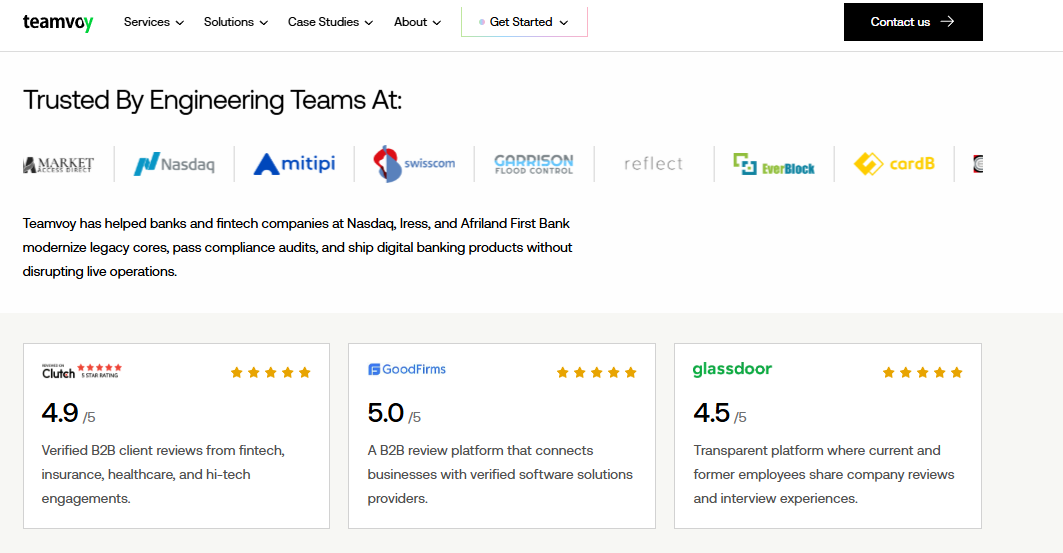
- Named regulator and standards delivery: PCI-DSS, SOC 2, GDPR, HIPAA, DORA, BaFin, and PSD2 within delivery scope.
- Latency and resilience posture: Built for systems where downtime is a regulatory event, not an inconvenience.
- Engagement model: Long-term partner, multi-year by default rather than project-and-exit.
- Senior technical lead accountability: One senior engineer owns the system end to end after go-live.
- Takeover capacity: Core competence. Picks up codebases previous teams built or abandoned.
- Trade surveillance delivered across 30 institutions.
- Internet banking platform delivered for a seven-bank group.
- Insurance platform serving 34M+ prospects.
- Named engagements with Nasdaq and Market Access Direct.

Vention
- Named regulator and standards delivery: States FCA-aware fintech engineering; broader named scope not publicly claimed.
- Latency and resilience posture: Positions on resilient trading platforms; specific latency figures not publicly claimed.
- Engagement model: Long-term partner and staff augmentation, with stated long-term support.
- Senior technical lead accountability: Not publicly claimed as a named ownership model.
- Takeover capacity: Explicitly offers modernisation of legacy fintech systems.
- States 20+ years of trading platform work for global financial institutions.
- Publishes a dedicated UK trading practice referencing FCA-aware fintech engineers.
- Markets modernisation of existing fintech systems, not greenfield only.
Both cards above apply the same five criteria in the same order, which is the only way a comparison stays honest across firms with very different public evidence. If your situation is a live platform rather than a new build, the practical next step is a scoped read of the current architecture, not a vendor pitch. That is what a proof of concept engagement or a short modernization sprint is designed to produce. Where a compliance deadline is the driver, this guide to building regulator-ready systems in fintech covers what auditors actually ask for, and case studies show the delivery pattern in full.
DOOR3
- Named regulator and standards delivery: Not publicly claimed for SEC, FINRA, RTS 6, or DORA scope.
- Latency and resilience posture: Positions on reporting performance, not execution latency.
- Engagement model: Project-and-exit consultancy work, with ongoing support arrangements.
- Senior technical lead accountability: Not publicly claimed as a named ownership model.
- Takeover capacity: Consultancy model suits assessment work; stabilisation of live trading systems not claimed.
- Publishes a named Startup/Fintech practice alongside enterprise work.
- States capability in dashboards, reporting platforms, and actionable data views.
- Operates as an independent firm out of New York City.
Reporting and lineage problems of this kind usually sit in the pipeline rather than the front end, which is why data engineering work is often the real scope behind a “dashboard” request.
Dualboot Partners
- Named regulator and standards delivery: States compliance-simplifying work for fintechs and lenders; named regulator scope not claimed.
- Latency and resilience posture: Not publicly claimed for trading workloads.
- Engagement model: Blended cross-functional pods, plus staff augmentation.
- Senior technical lead accountability: Pod model with vendor-managed leadership rather than a single named owner.
- Takeover capacity: Explicitly offers modernization of existing systems alongside new builds.
- Private equity backed, with investment from Insignia Capital Group in 2023.
- Serves fintech, lending, healthtech, and SaaS buyers.
- Publishes named enterprise clients rather than anonymous logos.
Where the architecture has no clear owner, the honest first step is a scoped read of the current system rather than more headcount, which is exactly what IT audit services are built to deliver.
Azumo
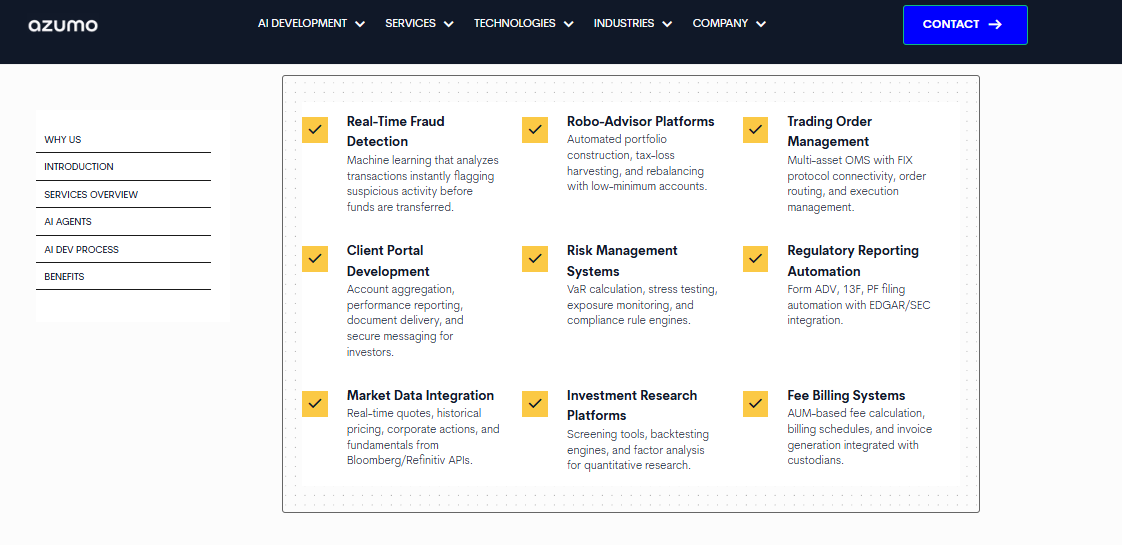
- Named regulator and standards delivery: Not publicly claimed for SEC, FINRA, RTS 6, or DORA scope.
- Latency and resilience posture: Not publicly claimed for trading workloads.
- Engagement model: Staff augmentation and dedicated nearshore teams.
- Senior technical lead accountability: Individual contributors and teams supplied; system ownership stays with you.
- Takeover capacity: Suited to extending existing systems rather than rescuing failing ones.
- States 350+ projects delivered across 100+ clients.
- Names fintech and healthtech among its industry experience.
- Publishes a specialism in data engineering and AI alongside web and mobile.
HatchWorks AI
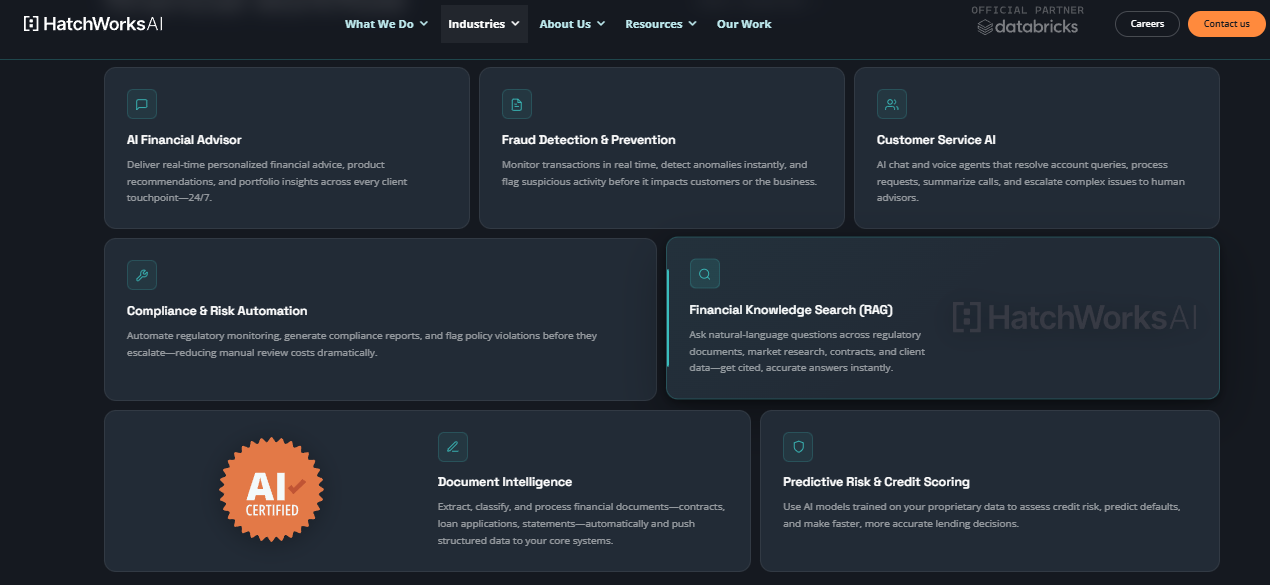
- Named regulator and standards delivery: Not publicly claimed for trading-specific regulator scope.
- Latency and resilience posture: Not publicly claimed for execution-path workloads.
- Engagement model: Long-term partner with US-side program oversight and nearshore delivery.
- Senior technical lead accountability: Program-level oversight model rather than a single named system owner.
- Takeover capacity: Positions on AI-native builds and automation rather than production rescue.
- Publicly documented methodology, GenDD, launched February 2024.
- Independent award recognition for that methodology in June 2026.
- Clutch data indicates project engagements from roughly $125,000 upward.
Buyers weighing that review burden against promised delivery speed will find the trade-offs set out in this analysis of vibe coding security risks, and the vendor selection criteria in this guide to choosing an AI vendor for fintech.
NineTwoThree AI Studio
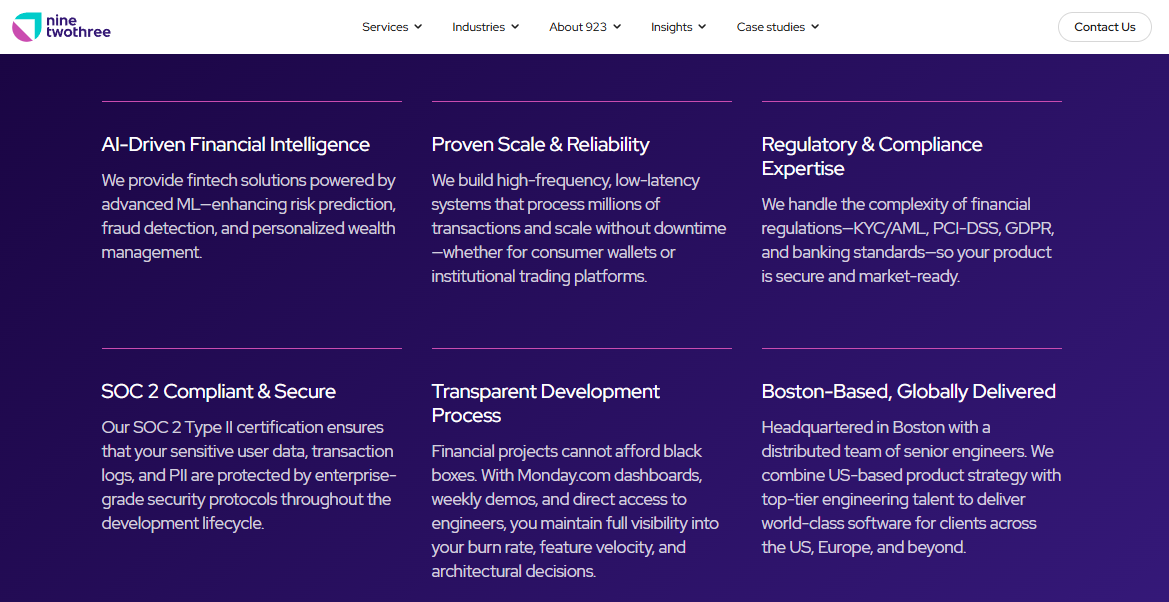
- Named regulator and standards delivery: SOC 2 and HIPAA certified; SEC, FINRA, RTS 6, and DORA scope not claimed.
- Latency and resilience posture: Not publicly claimed for trading execution workloads.
- Engagement model: Project-and-exit studio engagements, with stated 12-week paths to deployed agents.
- Senior technical lead accountability: Studio team model; states its team writes production code and owns technical execution.
- Takeover capacity: Suited to attaching new capability to an existing platform.
- SOC 2 and HIPAA certification published on its own site.
- Named clients including Experian and FanDuel.
- Five consecutive appearances on the Inc. 5000 list through 2025.
Closing that gap between a certificate and an audit-ready architecture is the subject of this walkthrough on building regulator-ready AI in fintech.
Valere
- Named regulator and standards delivery: Not publicly claimed.
- Latency and resilience posture: Not publicly claimed.
- Engagement model: Project-and-exit studio engagements.
- Senior technical lead accountability: Not publicly claimed as a named ownership model.
- Takeover capacity: Not publicly claimed for production trading systems.
- Verifiable public proof points for regulated trading work were not confirmed in this assessment.
- Treat capability claims as diligence items rather than established facts.
For a first release where the product does not exist yet, the cheaper route is often a bounded proof of concept before any platform commitment is made.
JetRockets
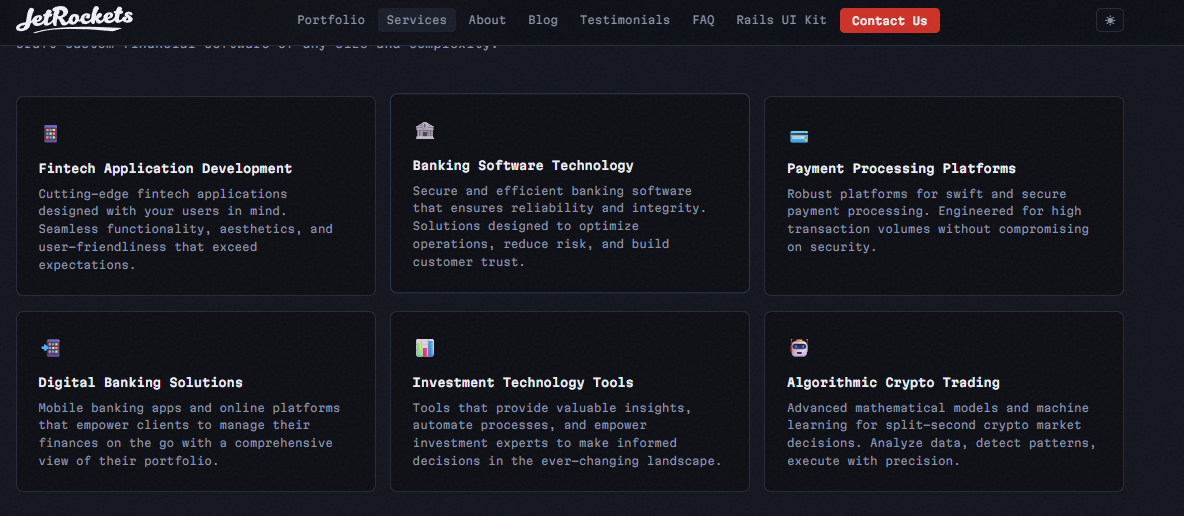
- Named regulator and standards delivery: Not publicly claimed.
- Latency and resilience posture: Not publicly claimed.
- Engagement model: Long-term partner with a small senior team.
- Senior technical lead accountability: Small-team structure implies senior involvement; not formally claimed.
- Takeover capacity: Not publicly claimed for production trading systems.
- Verifiable public proof points for regulated trading work were not confirmed in this assessment.
- Treat capability claims as diligence items rather than established facts.
That relearning cost compounds quietly, which is the mechanic explained in this piece on the tech debt avalanche.
Scopic
- Named regulator and standards delivery: Not publicly claimed; regulated trading scope not typically covered.
- Latency and resilience posture: Not publicly claimed.
- Engagement model: Long-term partner with a distributed team.
- Senior technical lead accountability: Not publicly claimed as a named ownership model.
- Takeover capacity: Not publicly claimed for production trading systems.
- Verifiable public proof points for regulated trading work were not confirmed in this assessment.
- Treat capability claims as diligence items rather than established facts.
If your system falls into that third group, where downtime is a reportable event, the delivery pattern is visible in Teamvoy’s hybrid cloud internet banking architecture work and across the wider case studies. Where the constraint is a legacy core rather than a missing feature, technology modernization is the relevant starting point, and a short technical conversation will tell you quickly which of the three categories your situation actually sits in.
Q2: What Does A Trading Platform Actually Consist Of, And Why Does It Break Generalist Teams?
A trading platform is six systems, not one: matching or execution engine, order management, market-data ingestion and normalisation, pre-trade risk, post-trade clearing and back office, and surveillance. Trading software then fails on physics before it fails on features. Generalists optimise average throughput. Trading teams optimise deterministic tail latency in microseconds, which changes hosting, hypervisor choice, and test design.
The Six Systems Behind One Word
| Module | What it owns | What breaks when a generalist builds it |
|---|---|---|
| Matching or execution engine | Order pairing and fill logic | Non-deterministic timing under burst load |
| Order management system (OMS) | Order state from entry to fill | Lost or duplicated state during failover |
| Market data ingestion | Feed intake and normalisation | Silent gaps that corrupt downstream pricing |
| Pre-trade risk | Credit, capital, and size checks before entry | Checks run after entry, not before |
| Clearing and back office | Settlement, reconciliation, reporting | Breaks nobody can trace to a cause |
| Surveillance | Detecting manipulative or erroneous activity | Alerts with no audit trail attached |
Enterprise capital-markets vendors publish this same split across front, middle, and back office. Teamvoy’s AI and System Readiness Audit runs three to five days and produces a written architecture and risk-surface map across these modules, the same discipline applied in its IT audit services. I use it to find which of the six nobody currently owns.
⚠️ The Load Test That Passed On Paper
Here is the failure I keep meeting. A high-frequency application clears its cloud load test in staging, then collapses against a real book.
The cause was not the algorithm. Standard hypervisor overhead broke the application’s reliance on nanosecond inter-process communication, meaning message passing through shared physical memory. The fix was abandoning virtualised compute and moving the hot path to bare-metal instances.
💸 The Two-Millisecond Bill
Cloud migrations produce a quieter version of the same problem. A database cutover succeeds. Then the legacy application gridlocks.
The reason is a synchronous write across two availability zones, adding two milliseconds to every commit. That penalty compounds under load until the connection pool is fully exhausted. This is not the cloud being expensive. It is the arithmetic penalty for running elastic infrastructure with a static data-centre mindset, which is why cloud optimization work starts with the commit path rather than the instance bill.
✅ Three Questions To Ask On The First Call
- Where does the matching engine hot path run, on which instance class, and why that one?
- What is your measured tail latency at the 99.9th percentile, not your average?
- Which of the six modules have you built end to end, and for whom?
A vendor who answers all three concretely has done this. A vendor who redirects to their technology stack has not. Innowise, Luxoft, and EffectiveSoft all publish low-latency and multi-asset capability, so the differentiator is specificity, not claim.
⏰ Why The Order Of Questions Matters
Across the fintech modernisation engagements I have led, the first two questions are always the data layer and the legacy core. The model, the framework, and the language come third.
I could be reading this too strongly, but the pattern holds. Teams that start with feature scope rediscover the infrastructure constraint in month five, when changing it costs ten times more. That sequence is set out in more detail in this legacy software recovery plan.
Teamvoy starts engagements on stacks under pressure with the data layer and the legacy core, not the feature list. In trading systems, the infrastructure assumption is what gives way first, and it gives way under real volume rather than in staging.
Q3: Which Regulations Shape The Architecture, And What Testing Evidence Must A Partner Produce?
Four instruments shape the architecture. SEC Rule 15c3-5 requires pre-trade credit, capital, and erroneous-order controls under the broker-dealer’s exclusive control. MiFID II RTS 6 requires conformance testing in an environment separated from production, plus an annual self-assessment. RTS 7 governs venue capacity and circuit breakers. DORA Articles 11-12 and 25-26 require recovery objectives and threat-led penetration testing. None retrofits cleanly.
Obligation To Evidence
| Instrument | The obligation | Evidence to demand from the partner |
|---|---|---|
| SEC Rule 15c3-5 | Pre-trade financial and regulatory risk controls, under your exclusive control | Architecture diagram showing controls inside your authority, not the vendor’s |
| MiFID II RTS 6, Arts. 5 to 8 | Conformance testing and predefined limits before deployment | Test environment topology, separated from production |
| MiFID II RTS 7 | Venue capacity, throughput headroom, and circuit breakers | Load-test results at stated peak, plus headroom margin |
| DORA, Arts. 11-12 and 25-26 | Recovery objectives, secondary site, and ICT testing including TLPT | Failover drill records with dates and measured recovery times |
⏰ The Evidence Most Buyers Forget To Ask For
Testing is where the paperwork actually lives. RTS 6 requires conformance testing before deployment or substantial update, with limits set in advance.
ESMA’s 2026 supervisory briefing goes further. A strategy must be distinguishable, testable, and identifiable, and stress testing has to cover the full cycle from order entry through post-trade. The annual self-assessment and validation is a standing duty, not a launch task.
⚠️ Eligibility Is Not Compliance
This is the sentence I wish more buyers heard early. A cloud region being eligible for financial workloads does not make your deployment compliant.
Article 7 of RTS 6 makes the point sharply. Your firm stays responsible for testing even when the test environment is supplied by a vendor. The certificate belongs to them. The obligation stays with you.
✅ The GenAI Obligation That Is Already Live
FINRA’s 2026 Annual Regulatory Oversight Report added a new generative AI section, published in December 2025. Third-party risk and cyber-enabled fraud sit alongside it.
The top reported member-firm use case is summarisation and information extraction, not autonomous action. So if a partner proposes AI touching order flow, ask which supervisory procedure covers it. That answer should exist before the demo, and this guide to building regulator-ready AI in fintech covers what that procedure has to contain.
💰 What Auditable Delivery Costs In Practice
Teamvoy delivers inside BaFin, PSD2, DORA, PCI-DSS, SOC 2, GDPR, and HIPAA scope, which means the evidence is produced as the system is built. What I have learned in twelve years of regulated delivery is that auditors rarely want the code. The same practice is visible in its banking and fintech delivery work.
They want the decision trail: who approved which change, against which control, on which date. No vendor can reconstruct that retroactively. Budget three to seven percent of engineering time for it, or pay far more later. The surveillance build documented in this trade surveillance re-engineering project shows what that trail looks like on a live exchange.
Teamvoy’s read is that the standard advice gets this backwards. Compliance is not a phase after build. It is a delivery practice, and the trade-off is honest: it slows the first release and it protects every release after that.
Q4: What Does Trading Software Development Cost In 2026, And Why Do Published Figures Disagree?
A single-asset MVP runs roughly $25,000 to $60,000 over three to four months. Retail brokerage runs $60,000 to $150,000 over four to seven months. An algorithmic engine runs $80,000 to $300,000 over six to twelve. Multi-asset or exchange-grade runs $200,000 to $500,000 and up over eight to sixteen months, plus 15 to 25 percent of build cost annually for run and compliance.
Cost And Timeline By Build Type
| Build type | Typical cost | Typical timeline |
|---|---|---|
| Single-asset MVP | $25,000 to $60,000 | 3 to 4 months |
| Retail brokerage app | $60,000 to $150,000 | 4 to 7 months |
| Algorithmic or quant engine | $80,000 to $300,000 | 6 to 12 months |
| Multi-asset or exchange-grade | $200,000 to $500,000+ | 8 to 16 months |
| Annual run and compliance | 15 to 25 percent of build | Ongoing |
💰 Why Published Figures Disagree By Twenty Times
Put the 2026 guides side by side and the spread is absurd. One puts a multi-asset platform at $200,000 to $500,000 and real-world-asset platforms higher. Another puts institutional builds at $500,000 to $1,000,000 and above.
A third prices advanced algo software at $70,000 to $150,000. A fourth advertises enterprise trading software from about $25,000. That is not market variance. It is four different definitions of the word “platform”. The same pattern shows up in AI budgets, as this AI integration cost guide sets out line by line.
💸 Regional Rates Versus Fixed-Price Claims
The same pages that publish flat quotes also publish rate tables that contradict them. Reported 2026 blended rates run about $150 per hour and up in the US, near $100 in Western Europe, near $60 in Eastern Europe, and near $35 across India and Asia.
Do the arithmetic before the call. A genuine multi-asset build is thousands of senior engineering hours. At $60 per hour, a $25,000 quote buys roughly 400 hours, which is a prototype, not a platform. Where the budget is genuinely fixed, IT cost optimization is a more honest lever than a discounted rate card.
❌ The Four Lines Bidders Leave Out
- Market-data licensing and connectivity fees, which are recurring and often exceed the build in year two.
- Surveillance and reporting, treated as phase two until a regulator asks.
- The secondary site and tested failover that DORA expects.
- Audit evidence production, including the annual RTS 6 self-assessment.
Ask every bidder to price those four as separate lines. Then re-rank the bids. In my experience, the cheapest proposal moves to third place immediately, and the ranking finally reflects the real scope.
⚠️ The Debt You Are Actually Buying
Excluded scope does not disappear. It converts into technical debt with interest, and the global figure is now estimated at 61 billion work days to clear. The compounding mechanic is explained in this piece on the tech debt avalanche.
One 2026 line item deserves its own warning. AI-assisted features bill quadratically, not linearly, because agent frameworks resend the full cumulative log on every turn. A twenty-step loop costs far more than twice a ten-step run, which is why AI integration services should be scoped with a hard cost ceiling attached.
Teamvoy prices engineering as a custom quote and opens most engagements with a paid, fixed-scope two-week Sharp Sprint. That sprint puts a working artefact in front of you before any multi-year number is signed. It ships a meaningful first milestone, not a finished platform, and I would rather say that plainly than sell the sprint as something it is not. If you want that scoped against your own numbers, a short technical conversation is the fastest way to get there.
Q5: What Kind Of Partner Does Your Situation Call For, And Can One Stabilise A Live Platform Without A Rewrite?
Four situations, four different partners. A platform inherited from a failed vendor needs stabilisation with regulated-market scars. A drifting legacy core needs incremental modernisation. A compliance deadline needs auditable delivery. A stalled AI-assisted build needs someone who can read code the original team did not write. Teamvoy delivered trade surveillance across 30 institutions under live operating conditions, which is the incremental route.
Match The Situation, Not The Last Engagement
| Your situation | What makes it different | What resolves it |
|---|---|---|
| Vendor exited mid-build | Nobody can explain the current state | A partner who documents before changing anything |
| Legacy core has drifted | Every change carries unknown risk | Incremental modernisation behind stable interfaces |
| Compliance deadline is fixed | Evidence matters as much as code | Auditable delivery with a decision trail |
| AI-assisted build stalled | Code exists that nobody can read | Engineers who reconstruct intent from the codebase |
The most expensive mistake I see is buying the partner type that fitted the last engagement. A staff-augmentation vendor cannot own an outage. A fractional CTO cannot ship a matching engine. Where the drifting core is the real constraint, technology modernization is the category that fits, not more hands.
✅ The Five-Step Stabilisation Sequence
- Instrument first. You cannot fix what you cannot measure under real load.
- Document the undocumented. Write down what the system does, not what the old spec claimed.
- Strangle one bounded capability at a time behind a stable interface.
- Validate each increment in an environment separated from production, as RTS 6 requires.
- Decommission the old path only after it has been quiet under real volume.
Step three has a name. The strangler fig pattern comes from a tree that germinates in the branches of a host and slowly replaces it. You replace enough parts that the old system can eventually be switched off. This is the same sequence described in these AI modernization sprints for teams that cannot afford a rewrite.
⚠️ Provoke The Dependencies Nobody Can Name
Every legacy trading system holds dependencies that exist only in someone’s memory. They surface during cutover as an outage.
So provoke them on purpose. Isolate suspected dead servers at the network level for 48 to 72 hours, which exposes monthly batch jobs and audit processes that normal monitoring windows miss. A softer version blocks inbound traffic for three to seven days while keeping the machine running, so rollback stays instant. Mapping those hidden links is exactly what system integration work has to surface before any cutover date is set.
❌ When Incremental Is The Wrong Answer
Teamvoy’s read is that the standard advice oversells incremental work. Sometimes the honest answer is a strategic rebuild.
If the data model itself is wrong, no amount of interface work saves it. And if the constraint is that nobody internally can maintain the system, the right purchase may be two senior hires, not a vendor. This recovery plan for systems nobody understands sets out how to tell those two cases apart.
The team is very collaborative and able to deliver innovative solutions for all our business needs.
I can confidently say that we would not be where we are today without Teamvoy's support.
Teamvoy takes over systems built by previous teams and stabilises them in place. The seven-bank internet banking platform and the surveillance work across 30 institutions were both delivered under live operating conditions, with an average client engagement beyond four years.
Q6: How Should You Test A Partner’s AI Claims On A Trading Stack?
Ask about the integration layer, not the model. Roughly 95 percent of enterprise generative AI pilots have returned no measurable dollar value, and the failures cluster in data access, tool reliability, and permissions rather than inference quality. Teamvoy assesses the data layer and the legacy core before any model decision, because on a trading stack the real question is what happens when a non-deterministic model needs write access to a ledger.
The Common View, And Why It Fails
Most vendors answer AI questions with model names. That is the wrong axis.
The industry has been obsessing over the brain while ignoring the nervous system. Even the strongest model is useless when it gets bad data or cannot execute an action reliably. Integration is unglamorous, and it is what separates a demo from production, which is why AI consulting should start at the data layer rather than the model roster.
⚠️ Where Write Access Gets Dangerous
Read-only AI on a trading stack is a manageable risk. Write access is a different category entirely.
Consider three realistic uses: surveillance alert triage, risk exposure explanation, and reconciliation break analysis. All three are useful. None of them should be able to cancel an order without a human approving it. Scoping those permission boundaries is the first design question in any AI agent development engagement.
❌ Why Dumping Everything Into A Vector Store Fails
The common pattern is to load every document, ticket, and chat log into a vector database and hope the model sorts it out. That is like dumping a whole hard drive into memory and expecting one byte to surface.
You do not get reasoning from that. You get context flooding. There is also a practical ceiling: past roughly 40 percent of the context window, output quality drops, and most tool-heavy setups run permanently inside that zone. Fixing retrieval design is data engineering work before it is model work.
✅ Six Questions For The Vendor
- Where is the hard circuit breaker, and what triggers it?
- How is the model’s permission scope defined, and who reviews it?
- What is retrieved, from where, and why that subset?
- What is your context budget per call?
- What is the hard monthly cost ceiling, and who gets alerted?
- Which actions require human sign-off before touching a book?
Teamvoy’s AI and System Readiness Audit maps architecture and risk surface before any AI work is scoped. What surfaces most often in those audits is not a model problem. It is unclear data ownership. This guide to choosing an AI vendor for fintech covers how to press on each of those six answers.
⏰ Where AI Genuinely Pays Back Today
FINRA’s 2026 report is useful here because it reflects actual firm behaviour, not vendor marketing. The top reported member-firm use case is summarisation and information extraction.
That matches what I see. AI earns its place in documentation, triage, test generation, and reading unfamiliar code. It earns nothing on the execution path yet.
Teamvoy’s data points toward AI helping most on stacks that are already stable, though I might be reading that too strongly. Adding a model to a system that already misfires is closer to bolting a turbocharger onto a failing engine than to an upgrade.
Q7: What Are The Warning Signs In A Proposal, And What Should You Ask Before Signing?
The reliable warning signs are structural: no separated conformance-test environment, no hard circuit breakers on automated actions, cloud eligibility presented as regulatory compliance, security scheduled as a post-launch phase, and code nobody can explain without reading its own comments. Teamvoy has been called into engagements at exactly this stage since 2013, where the previous plan looked plausible until real volume arrived.
Five Signs With Real Consequences
- No separated test environment. RTS 6 requires one, and responsibility stays with your firm regardless of who supplies it.
- No hard circuit breaker. One documented case saw an agent loop for six hours overnight and run up about $4,200 in API charges.
- Eligibility framed as compliance. A compliant region is not a compliant deployment.
- Security as phase two. In one scan of 5,000 AI-built applications, 60 percent were vulnerable.
- Unexplainable code. If your engineer cannot describe it without the comments, it is not ready.
Plausible is the most dangerous word in software engineering. Completely wrong breaks the build within an hour. Almost right passes review, ships, and surfaces months later in a reconciliation break. The security half of that pattern is documented in this breakdown of vibe coding security risks.
✅ Accountability And Testing Questions
Ask who is personally accountable when the book stops matching at 09:31. A name is a good answer. An escalation matrix is not.
Then ask how algorithm changes are conformance-tested before deployment, and how the annual self-assessment gets evidenced. Teamvoy opens with a 15-minute technical call rather than a sales process, which is where these questions get answered honestly or not at all.
⏰ Resilience And Handover Questions
On resilience, ask for failover drill records with dates and measured recovery times. Intentions are not evidence. The failover design in this hybrid cloud internet banking architecture shows what those records look like when they exist.
On handover, ask two things. Can your engineers extend this code without the vendor, and what happens to the system on the day the contract ends? A partner who cannot answer the second question has not thought past the invoice.
⚠️ The Judgment Call I Got Wrong
Early on, I accepted a client’s assurance that a batch process was dormant. It was not. It ran monthly, and we found out during a cutover window.
Now I test that assumption instead of trusting it. The cheap version costs three days of isolated observation. The expensive version costs an incident report.
We were impressed with the technical management, adherence to process, and technical capability of the engineers.
The professional communication, ability to deal with crunch time, and understanding of the project impressed us.
Here is the question I am still sitting with. As AI-assisted delivery gets faster, review capacity becomes the real constraint on safe speed, and nobody has published a good answer for regulated systems yet.
Teamvoy works best where the stakes are already high: live systems, compliance deadlines, and codebases someone else wrote. If that describes your platform, the door is open for a technical conversation, and I would rather have it before the contract than after the incident. The delivery record behind that claim sits in the published case studies.