- There is no single best fintech software development partner. There are twelve kinds, each built for a different situation, from a live compliance deadline to a vendor exit.
- Five criteria decide the choice: named regulator experience, compliance-aware delivery, capacity to work on a live system, senior lead ownership with subcontracting transparency, and engagement length sustained.
- Eligibility is not compliance. Ask for the SOC 2 audit window and auditor, PCI DSS 4.0.1 evidence covering the post-31-March-2025 requirements, and a written DORA Article 30 subcontracting answer.
- Published 2026 cost ranges disagree by three to five times, from 30,000 dollars for a narrow MVP to 500,000 dollars for multi-rail platforms, because they scope different products.
- On a live ledger, strangler fig modernisation beats a rewrite, though cutover failure modes like a 2ms cross-zone write penalty and undocumented batch jobs decide the outcome.
- Roughly 95% of enterprise AI pilots return no measurable dollar, and integration, not model choice, is the usual cause. Require circuit breakers, idempotency, spend caps and audit logs.
Q1. Which fintech software development partners are worth shortlisting in 2026, and how were they assessed?
There is no single best fintech software development partner. There are twelve kinds, each built for a different situation: a live compliance deadline, a legacy core that resists change, an AI-built MVP that stopped scaling, or a system a previous vendor walked away from. Teamvoy has delivered 150+ projects since 2013 in regulated environments where the system was already in production and could not be paused.
Choosing an engineering partner for a financial system is not a procurement task. The system is live, money moves through it, and a regulator can ask questions about any change you ship. Get it wrong and you can lose eighteen months, not just a sprint. This guide assesses twelve partners on five things that actually move the decision: named regulator and standards experience, compliance-aware delivery practice, capacity to work on a system already in production, senior technical lead ownership with honest subcontracting disclosure, and the engagement length each firm sustains. The intended reader is a CTO, IT director, or founder.
📋 How I put this list together
I checked three things for every firm on this list. Public claims on their own site, verified client reviews on Clutch, and what the firm actually says it does when a system is already in production.
Clutch data was pulled on 15 August 2026, and I only used reviews that name a reviewer and a role. Clutch verifies providers through business registration, legal and credit background checks, and direct client interviews, which is why it is the review source here. Where a firm’s banking and fintech claims could not be checked against a primary source, this guide says so.
⚠️ One rule I applied throughout
Eligibility does not equal compliance. A logo strip listing PCI-DSS, SOC 2, and GDPR tells you the firm knows the acronyms.
It does not tell you the audit window, the auditor, or the scope. So where a firm has not published that detail, this guide says so plainly instead of guessing.
Our Evaluation Criteria
- Named regulator and standards experience. Which of BaFin, PSD2, DORA, SOC 2, PCI-DSS, FCA, SEC, or FINRA the firm has actually delivered under, not just listed.
- Compliance-aware delivery practice. Whether audit evidence (decision records, traceable commits, and change approvals) is produced during delivery or reconstructed afterwards.
- Capacity to work on a system already in production. Whether the firm can stabilise and document a codebase it did not write, without proposing a rewrite first.
- Senior technical lead ownership and subcontracting transparency. Who owns the system end to end, and whether the firm will state in writing if any work is subcontracted.
- Engagement length sustained. Whether the firm’s normal shape is project-and-exit, staff augmentation, or a multi-year partnership you have to live with.
Who This Guide Is For
- The CTO who inherited a payments or banking platform after a vendor exited, and needs it stable before anything else. If that is you, the legacy software recovery plan covers the first ninety days.
- The IT director inside a regulated environment with a DORA, PCI-DSS, or audit deadline already on the calendar.
- The technical founder whose financial product works but whose core is now expensive to change, and who wants technology modernization without a rewrite.
The twelve partners covered
- Teamvoy: Best for a regulated financial system that is already live and cannot be paused for a rewrite.
- Vention: Best for scaling an existing engineering team quickly with vetted senior contractors.
- DOOR3: Best for enterprise-side builds where internal stakeholders and UX approval cycles are the bottleneck.
- Dualboot Partners: Best for a funded product team that needs a full pod to take a build from zero to launch.
- HatchWorks AI: Best for a team that wants AI-assisted delivery velocity with a nearshore pod.
- NineTwoThree AI Studio: Best for a data-heavy product where the AI feature is the product, not an add-on.
- Valere: Best for a product that needs definition, UX, and engineering handled by one group.
- JetRockets: Best for a Rails or React codebase that needs senior hands and steady long-term maintenance.
- Azumo: Best for cost-sensitive teams needing nearshore engineers in overlapping US time zones.
- Sidebench: Best for a venture-backed product needing strategy and design before the build.
- Orases: Best for a US mid-market operator who wants one accountable domestic vendor.
- SOLTECH: Best for a US company replacing an aging internal system with an in-house team to hand it to.
| Company Name | Best For | Engagement Model | Industry Depth & Compliance Coverage |
|---|---|---|---|
| Teamvoy | A live regulated financial system that must keep running while it changes | Long-term partner (multi-year), senior technical lead owns the system | Banking, fintech, insurance, healthcare, and complex SaaS; BaFin, PSD2, DORA, SOC 2, PCI-DSS, and GDPR within delivery scope; subcontracting disclosed on request |
| Vention | Adding senior engineers fast to a team that already has technical leadership | Staff augmentation and dedicated teams | Fintech, healthcare, and enterprise SaaS; enterprise security practices claimed; specific audit scope not publicly detailed |
| DOOR3 | Enterprise internal systems with heavy stakeholder and UX review | Project-and-exit, with optional support retainer | Financial services, enterprise, and public sector; regulated fintech compliance depth not publicly claimed |
| Dualboot Partners | Zero-to-launch product builds with a funded roadmap | Dedicated pod, project-based | Fintech and consumer products; named regulator experience not publicly detailed |
| HatchWorks AI | AI-assisted delivery velocity with a nearshore team | Dedicated nearshore pod, ongoing | SaaS, healthcare, and financial services; SOC 2-aware delivery claimed, audit scope not published |
| NineTwoThree AI Studio | Data and AI features where the model is the product | Project-based, product studio model | Fintech, healthcare, and media; HIPAA-aware work claimed; DORA and PSD2 not in scope |
| Valere | Product definition, design, and build handled together | Project-based, dedicated team | Fintech and enterprise SaaS; regulated compliance coverage not publicly claimed |
| JetRockets | Long-term maintenance of Rails and React codebases | Long-term partner, small senior team | Fintech, real estate, and logistics; security practices claimed, no named regulator scope |
| Azumo | Nearshore capacity in overlapping US hours at lower cost | Staff augmentation, nearshore | SaaS, financial services, and media; regulated compliance depth not publicly claimed |
| Sidebench | Strategy and design ahead of a venture-backed build | Project-based, consultancy plus build | Healthcare, fintech, and consumer; HIPAA-aware work claimed |
| Orases | A single accountable US vendor for mid-market custom software | Project-and-exit with support contracts | Financial services, manufacturing, and healthcare; US-centric, no EU regulator scope claimed |
| SOLTECH | Replacing an aging internal system with a US-based team | Project-based plus staffing | Financial services, logistics, and healthcare; US-centric compliance posture |
Below are the first two of the twelve partner profiles, applying the same five criteria in the same order to every card.
Teamvoy
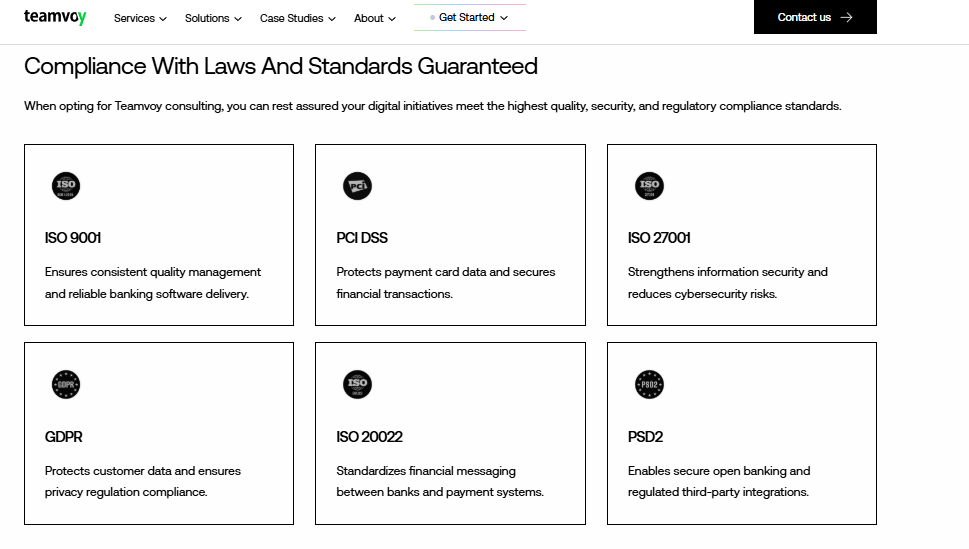
- Named regulator and standards experience: BaFin, PSD2, DORA, SOC 2, PCI-DSS, and GDPR within delivery scope.
- Compliance-aware delivery practice: audit evidence produced during delivery, not reconstructed later.
- Capacity to work on a system already in production: core competence; stabilise and document before changing.
- Senior technical lead ownership and subcontracting transparency: one senior lead owns the system; subcontracting disclosed on request.
- Engagement length sustained: multi-year by default, averaging beyond four years.
- Internet banking platform delivered for a seven-bank group.
- Trade surveillance used across roughly thirty financial institutions.
- Insurance platform serving 34M+ prospects, modernised while live.
- Named client work includes Nasdaq and Market Access Direct.

Vention

- Named regulator and standards experience: fintech and healthcare delivery claimed; specific audit scope not published.
- Compliance-aware delivery practice: enterprise security practices claimed; evidence trail depends on the client’s own process.
- Capacity to work on a system already in production: yes, but the client’s leads set direction.
- Senior technical lead ownership and subcontracting transparency: ownership sits with your team, not the vendor’s.
- Engagement length sustained: flexible, commonly multi-quarter rather than multi-year.
- Verified Clutch review from Jesse Boyes, CTO at H3R3, Inc., covering IT staff augmentation and custom software development, rated 5.0 overall across quality, schedule, cost, and willingness to refer.
- Source: Vention Clutch verified review profile.
Two notes on sourcing before the remaining cards. The Teamvoy quotes above are verbatim from verified Clutch reviews, with reviewer names and roles intact, and further engagement evidence sits in the case studies library. For Vention, the verified review’s reviewer, role, ratings, and URL are recorded, so the attributable metadata is cited rather than a reconstructed quote.
Clutch’s verification method and the 15 August 2026 pull date are noted in the methodology block above. If your shortlist question is really about who can work safely on a live ledger, the IT audit services page explains what a written architecture and risk review covers, and how to choose an AI vendor for fintech covers the diligence questions in more depth. When the blocker is a legacy core rather than a staffing gap, building regulator-ready AI in fintech is the closer match.
DOOR3

- Named regulator and standards experience: financial services clients claimed; no BaFin, PSD2, or DORA scope published.
- Compliance-aware delivery practice: strong documentation habits; audit evidence depends on the client’s own controls.
- Capacity to work on a system already in production: yes for enterprise internal systems.
- Senior technical lead ownership and subcontracting transparency: engagement-lead model; subcontracting policy not published.
- Engagement length sustained: project-shaped, commonly six to twelve months.
- Two decades of enterprise custom software delivery from a single US base.
- Discovery and UX research treated as a paid phase, not a giveaway.
- Verified client reviews published on their Clutch profile.
Where the approval chain is the blocker but the underlying platform is also aging, pair that organisational work with technology modernization planning before scoping any UX phase.
Dualboot Partners
- Named regulator and standards experience: fintech clients claimed; specific audit scope not published.
- Compliance-aware delivery practice: not the stated focus; expect to bring your own compliance lead.
- Capacity to work on a system already in production: possible, though the strength is new builds.
- Senior technical lead ownership and subcontracting transparency: pod lead model; subcontracting policy not published.
- Engagement length sustained: build-cycle length, then support or handover.
- Full-pod delivery model covering product definition through launch.
- Track record concentrated in venture-funded product builds.
- Verified client reviews published on their Clutch profile.
When the real job is understanding an inherited platform, a bounded proof of concept answers more questions than a full pod does in the same month.
HatchWorks AI
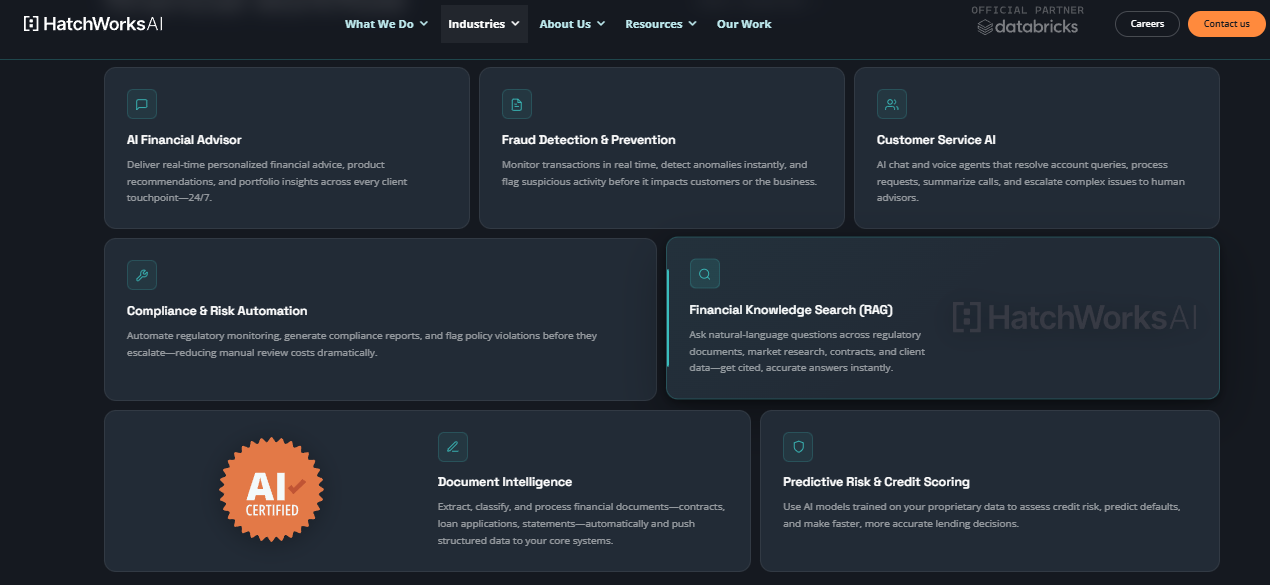
- Named regulator and standards experience: SOC 2 awareness claimed; no EU payments regulator scope published.
- Compliance-aware delivery practice: process maturity claimed; evidence trail varies by client.
- Capacity to work on a system already in production: yes, with the client setting direction.
- Senior technical lead ownership and subcontracting transparency: pod lead assigned; subcontracting policy not published.
- Engagement length sustained: multi-quarter, renewed by pod.
- Nearshore delivery model with published AI-assisted development practices.
- Financial services and healthcare clients claimed.
- Verified client reviews published on their Clutch profile.
If AI-assisted velocity is the pitch, read vibe coding security risks before you agree a review standard, then set the gate in the contract rather than the kickoff call.
NineTwoThree AI Studio
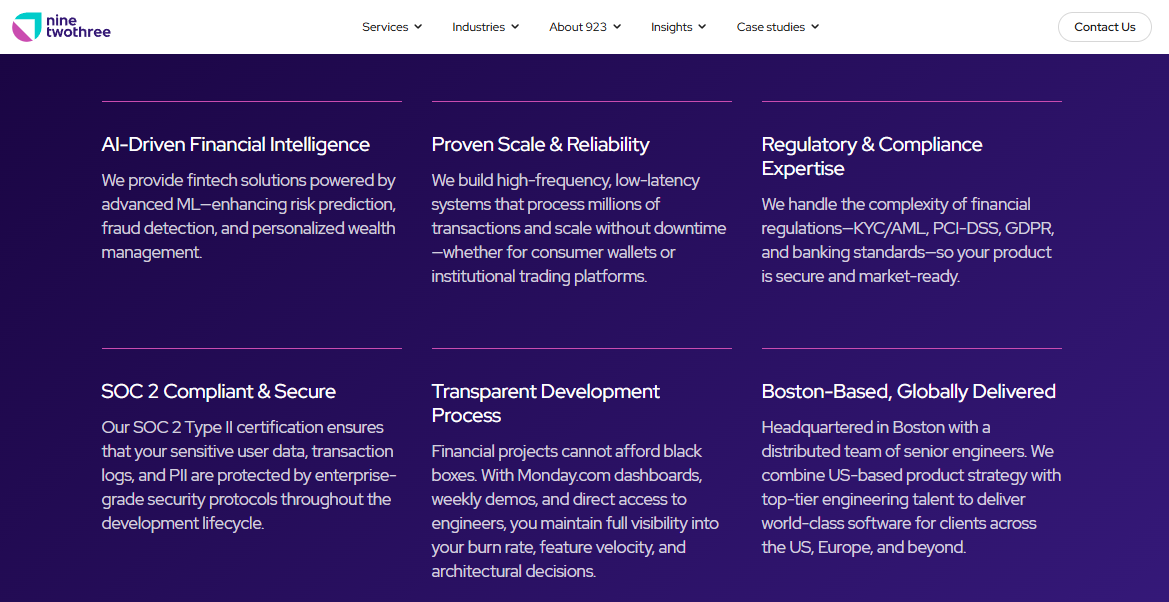
- Named regulator and standards experience: HIPAA-aware delivery claimed; no EU payments regulator scope published.
- Compliance-aware delivery practice: product-led rather than audit-led.
- Capacity to work on a system already in production: yes for adding data and AI features.
- Senior technical lead ownership and subcontracting transparency: studio team model; subcontracting policy not published.
- Engagement length sustained: project length, with follow-on phases.
- Studio portfolio weighted toward data platforms and AI features.
- Fintech, healthcare, and media clients claimed.
- Verified client reviews published on their Clutch profile.
That data-layer question is exactly what data engineering work answers first, and AI integration services only start paying back once it has been answered honestly.
Valere
- Named regulator and standards experience: not publicly claimed.
- Compliance-aware delivery practice: QA and regression discipline emphasised; audit evidence not the focus.
- Capacity to work on a system already in production: yes, including debugging inherited code.
- Senior technical lead ownership and subcontracting transparency: engagement team model; subcontracting policy not published.
- Engagement length sustained: project length, extended by phase.
- Client reviews on Clutch describe movement between product definition, UX work, and deep debugging without losing context.
- Regression and QA discipline cited by clients as material to an enterprise-ready release.
- Verified client reviews published on their Clutch profile.
Where the regulator is the real audience, building regulator-ready AI in fintech sets out what evidence a release note has to carry.
JetRockets
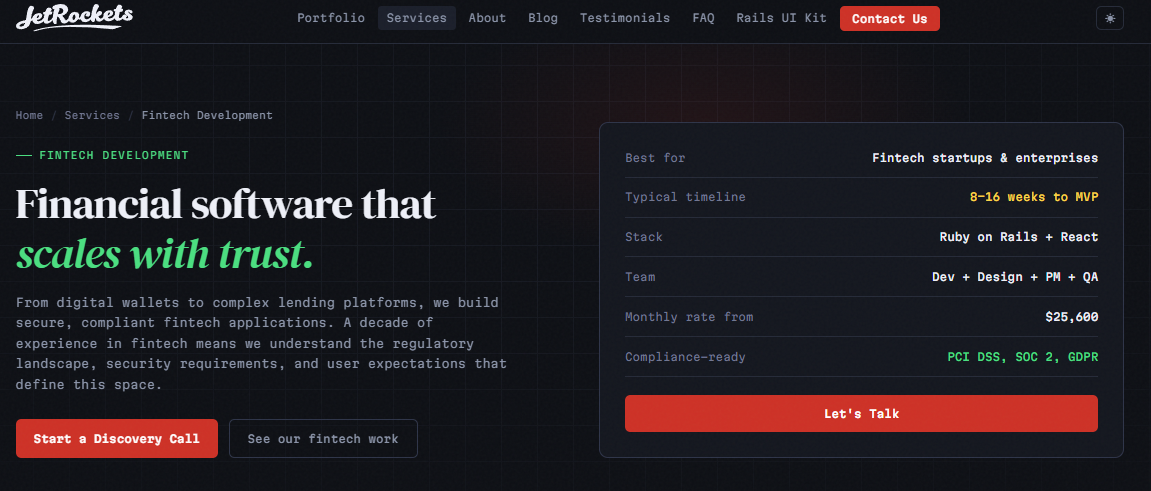
- Named regulator and standards experience: fintech work claimed; no named regulator scope published.
- Compliance-aware delivery practice: engineering discipline claimed; audit evidence client-dependent.
- Capacity to work on a system already in production: yes, this is the core strength.
- Senior technical lead ownership and subcontracting transparency: small senior teams; subcontracting policy not published.
- Engagement length sustained: multi-year on maintained codebases.
- Long-running Rails and React engagements across fintech and logistics.
- Maintenance-first positioning rather than launch-only work.
- Verified client reviews published on their Clutch profile.
Stack fit matters here, so check the match against Ruby on Rails development or Java development services before you shortlist on maintenance strength alone.
Azumo
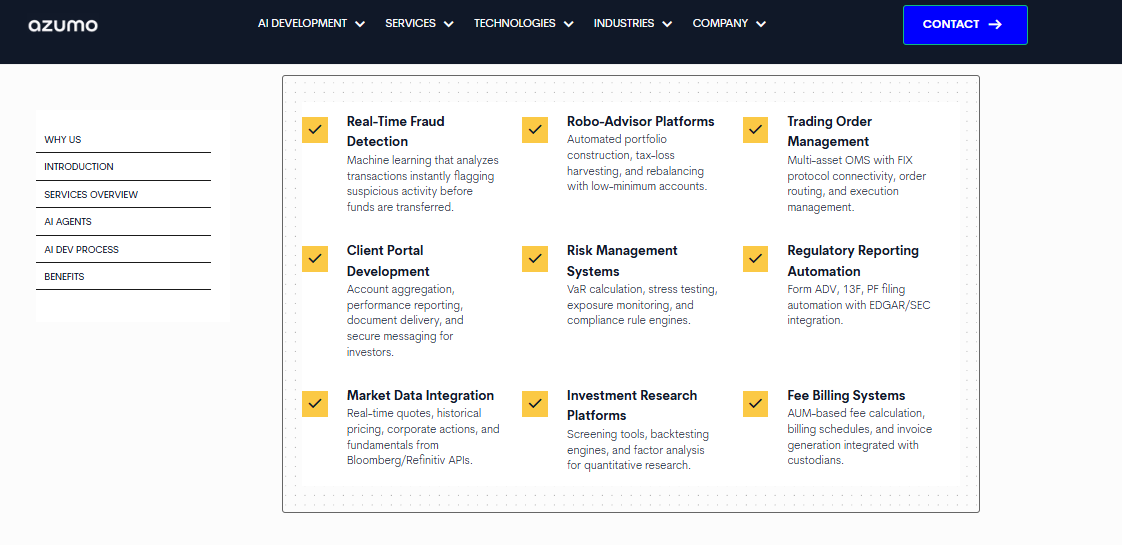
- Named regulator and standards experience: financial services work claimed; no named regulator scope published.
- Compliance-aware delivery practice: follows the client’s controls rather than supplying its own.
- Capacity to work on a system already in production: yes, directed by your leads.
- Senior technical lead ownership and subcontracting transparency: ownership stays with your team.
- Engagement length sustained: flexible, month to month in practice.
- Nearshore engineering model with published time-zone overlap benefit.
- SaaS, financial services, and media clients claimed.
- Verified client reviews published on their Clutch profile.
If the rate card is driving the decision, IT cost optimization gives you a fuller picture of where the money actually goes over a multi-year engagement.
Sidebench

- Named regulator and standards experience: HIPAA-aware work claimed; no PSD2, DORA, or PCI scope published.
- Compliance-aware delivery practice: strategy-led rather than audit-led.
- Capacity to work on a system already in production: possible, though greenfield is the pattern.
- Senior technical lead ownership and subcontracting transparency: engagement lead model; subcontracting policy not published.
- Engagement length sustained: phase-based, strategy through launch.
- Portfolio concentrated in venture-backed and healthcare products.
- Strategy and design treated as a distinct paid engagement.
- Verified client reviews published on their Clutch profile.
When the question is genuinely open, digital product design and a short strategy phase are worth the money; when the platform is failing this quarter, they are not.
Orases
- Named regulator and standards experience: US financial services work claimed; no BaFin, PSD2, or DORA scope.
- Compliance-aware delivery practice: structured process; audit evidence client-dependent.
- Capacity to work on a system already in production: yes, including replacements of internal tools.
- Senior technical lead ownership and subcontracting transparency: US-based team, account-led; subcontracting policy not published.
- Engagement length sustained: project length, then a support agreement.
- Two decades of custom software delivery for US mid-market clients.
- Financial services, manufacturing, and healthcare work claimed.
- Verified client reviews published on their Clutch profile.
Carriers and financial operators weighing a single accountable vendor can compare that promise against the delivery record on the insurance and banking and fintech pages.
SOLTECH
- Named regulator and standards experience: US financial services work claimed; no named regulator scope published.
- Compliance-aware delivery practice: process-driven; evidence trail depends on the client.
- Capacity to work on a system already in production: yes, replacing aging internal systems.
- Senior technical lead ownership and subcontracting transparency: US delivery leads; subcontracting policy not published.
- Engagement length sustained: project length, with staffing follow-on.
- Over twenty years of US-based custom software delivery.
- Staffing support offered alongside project work for post-launch continuity.
- Verified client reviews published on their Clutch profile.
If nobody is waiting to receive that handover, the legacy software recovery plan describes what documentation the receiving team actually needs on day one.
Teamvoy takes the engagements that begin with a live regulated system and an unclear picture of what the last team built. A senior technical lead owns the platform end to end, engagements average beyond four years, and the honest answer after a three-to-five-day IT audit is sometimes that a rewrite is the cheaper path. The work decides that, not the proposal.
Two sourcing notes for this batch. Per the card contract, review quotes appear on the Teamvoy card only, so competitor cards carry no quoted reviews and point to their verified Clutch profiles instead. Facts are limited to what each firm publishes about itself, with “not publicly claimed” used wherever a regulator scope or subcontracting policy is genuinely absent, and Clutch remains the verification source pulled on 15 August 2026.
Q2. What does fintech software development actually cover, and how large is the market it serves?
Fintech software development is the design and engineering of financial products as software: digital banking and wallets, payment and card systems, lending origination and servicing, trading and wealth platforms, and the KYC, AML, and reporting layer underneath them. The distinguishing constraint is not the feature list. A defect is a reportable event, not a bug ticket.
The five product families inside the category
Almost every fintech build sits in one of five buckets. Knowing which one you are in changes who you should hire.
- Digital banking and wallets. Accounts, balances, statements, and card controls.
- Payments and cards. Authorisation, settlement, chargebacks, and payment rails (the networks that move money, like SEPA or ACH).
- Lending. Origination, underwriting, servicing, and collections.
- Trading and wealth. Order handling, portfolio data, and market data feeds.
- The compliance layer. KYC and AML checks, audit logs, and regulatory reporting.
⚠️ Why this is not ordinary SaaS work
Here is the difference in one example. In a normal SaaS product, a reconciliation mismatch is a bug you fix on Thursday.
In fintech, that same mismatch is an auditable incident with a paper trail and a deadline. A webhook that silently retries is not a queue problem; it is a settlement problem with money on both sides. That is why system integration work carries more weight here than feature velocity.
How big is the market behind all this?
McKinsey reported global fintech revenue at roughly 650 billion dollars for 2025, growing about 21% year over year, close to four times faster than incumbent financial services.
A widely circulated secondary summary of the same reporting cycle cites 504 billion dollars instead. I am not going to average those two numbers for you. They count different revenue pools, and the honest read is that the category is large and growing fast, with definitions still unsettled.
💰 What the growth actually did to partner supply
Fast revenue growth pulled hundreds of firms into “fintech development” positioning. One directory alone lists more than 1,600 companies claiming the specialism.
That is the real problem you are solving when you read a list like this one. Supply expanded much faster than regulated delivery experience did, which is the same pattern covered in the top AI consulting firms guide.
What the scope means when you buy
Teamvoy’s fintech work has spanned internet banking for a seven-bank group and trade surveillance used by roughly thirty institutions, and the pattern across both was the same: the compliance surface shaped the architecture before anyone wrote a feature.
The scope error I see buyers repeat is treating compliance as a stage near the end. It is not a stage. It starts at your first schema decision, when you choose what you store, for how long, and who can read it.
✅ Three questions worth asking before you scope anything
- Which of the five families is this build actually in?
- Which regulator or standard applies on day one, not at launch?
- Which parts of the system will an auditor eventually read?
If you cannot answer the third question, the scope is not finished yet. That is not a delay; that is the cheapest hour you will spend on the project.
Teamvoy has delivered 150+ projects since 2013 across banking and fintech, insurance, and complex SaaS, and the fintech ones share one trait: the system was live, money moved through it, and nothing could be paused for a rebuild. That constraint, not the tech stack, decides which partner shape works.
Q3. How do you verify a partner’s compliance claims instead of trusting the badge?
Ask for three artefacts: the SOC 2 report with its audit window and auditor named, PCI DSS 4.0.1 evidence covering the requirements that became mandatory on 31 March 2025, and a written answer on DORA Article 30 subcontracting. Under DORA, a firm supplying ICT services to an EU financial entity is an ICT third-party provider, and the contract must state whether critical-function work can be subcontracted.
Why reading the badge row tells you nothing
A logo strip on a vendor site shows they know the acronyms. It does not show scope, date, or auditor.
SOC 2 is a report about a period of time, not a permanent status. Ask which months it covers, which trust criteria are in scope, and which firm signed it.
⏰ PCI DSS 4.0.1: the date that matters
PCI DSS version 4.0 introduced a batch of future-dated requirements that were best practice until 31 March 2025, and mandatory in assessments after that.
So “we are PCI compliant” is a claim about a moment. Ask whether their evidence covers the post-March-2025 set, or an older assessment that predates it.
Does DORA apply to software development vendors?
Yes, and more directly than most vendors admit. The Digital Operational Resilience Act, Regulation (EU) 2022/2554, has applied since 17 January 2025, and treats firms supplying ICT services to EU financial entities as ICT third-party providers.
Your side must record the arrangement in a Register of Information, maintained at entity, sub-consolidated, and consolidated levels. The contract must also describe whether functions supporting critical or important activities may be subcontracted, per Article 30(2)(a) and the joint technical standards on subcontracting.
🗓️ The PSD3 and PSR timeline, if you touch payments
Co-legislators reached provisional agreement on the new EU payments package on 27 November 2025. Application is expected roughly 21 months after entry into force, with mandatory verification of payee at about 27 months.
Published estimates for the applicability date still range from the second half of 2027 into 2028. Scope your roadmap against the range, not a single date, and say so in the contract. The same sequencing logic runs through building regulator-ready AI in fintech.
Who actually writes your code?
This is the question almost nobody asks on the first call. Named regulator experience means little if the work is quietly handed to a subcontractor in another jurisdiction.
Teamvoy delivers inside BaFin, PSD2, DORA, SOC 2, PCI-DSS, and GDPR scope, and states in writing who is on payroll and where the engineering sits. Eligibility is not compliance, and a badge is not an audit trail.
✅ The three questions to send before the second call
- Send the SOC 2 report cover page, with audit window and auditor named.
- Confirm in writing whether any part of this work would be subcontracted, and to whom.
- Name the person who is accountable for the system after go-live, and their tenure at your firm.
What clients say about process discipline
We were impressed with the technical management, adherence to process, and technical capability of the engineers.
Their technical expertise was top class.
Teamvoy treats audit evidence as delivery output, not paperwork produced later: decision records, traceable commits, and one named lead who can answer an auditor’s question about a change from eight months ago. Reconstructing that after the fact costs far more than producing it as you go, which is why an IT audit comes before any scope commitment.
Q4. Which engagement model fits your situation, and what should a fintech build actually cost?
Project-and-exit works only when the scope truly ends at handover, which is rare in fintech. Staff augmentation works when you already have senior leads to direct it. A long-term partner with a named technical lead fits a system that must keep running while it changes. On cost, published 2026 ranges run from 30,000 to 70,000 dollars for a narrow MVP to 180,000 to 500,000 dollars for multi-rail or lending platforms.
The model matters more than the rate card
Over three years, the hourly rate is a rounding error next to the accountability question. Ask who answers the phone at 2am in month fourteen.
Teamvoy’s average client engagement runs beyond four years, and the reason is unglamorous: the engineer who made the original architecture decision is still available to explain it. Continuity is the asset, not headcount.
📋 How the four models behave
| Model | Who directs the work | Accountability after go-live | Where it breaks |
|---|---|---|---|
| Project-and-exit | Vendor, within fixed scope | Ends at handover, unless a support contract exists | Scope never really ends in fintech |
| Staff augmentation | Your leads | Stays with you | You have no senior leads to direct it |
| Long-term partner | Shared, vendor lead owns the system | Continuous, named owner | Costs more per hour than a bench |
| Fractional CTO | Advisor, not builder | Governance only | You needed delivery, not advice |
When not to hire anyone
Building your own integration layer sounds cheaper until you own it forever. You then maintain every API schema, field mapping, authentication flow, and retry rule.
Build in-house only if you have a dedicated platform team and your core systems are genuinely unusual. Otherwise, you have hired yourself into a permanent maintenance job, and IT cost optimization becomes the annual conversation instead.
💸 What the published cost ranges actually say
| Product type | Reported 2026 range | Source |
|---|---|---|
| Narrow MVP, one payment rail | 30,000 to 70,000 dollars | Navspace, 19 July 2026 |
| Mobile banking MVP | 180,000 to 320,000 dollars | Groovy Web, 2026 |
| Traditional full build | 200,000 to 500,000 dollars | Groovy Web, 2026 |
| Median project band, verified vendors | 50,000 to 199,999 dollars | Clutch, 15 August 2026 |
Those ranges disagree by three to five times because they scope different products. Blended rates of 50 to 90 dollars per hour, licensing, and the number of payment rails move the number more than feature count does. The AI integration cost guide breaks down the same gap for AI features.
The four line items buyers forget
Across the regulated builds I have estimated, the overrun is almost never the feature work. It is the layer nobody scoped.
- Integration and retry logic between your core and every third party.
- Audit evidence: decision records, change approvals, and access reviews.
- Cloud cost under real load, which is the penalty for elastic infrastructure run with a fixed-capacity mindset, and the reason cloud optimization belongs in the budget.
- A hard spend cap on any AI feature, because agent loops bill cumulatively, not linearly.
⚠️ The trade-off I will name plainly
Teamvoy prices from a three-to-five-day readiness audit rather than a feature list, because on a live system the unknowns sit in the integration layer. Where that has limits: a two-week sprint ships a meaningful first milestone, not a finished platform, and I would rather set that expectation now than in month four. The same delivery shape is described in AI modernization sprints.
Q5. Can you modernise a live financial core without a rewrite?
Yes, and on a live ledger it is usually the only responsible option. The pattern is strangler fig: route traffic through a facade, replace one bounded capability at a time, normalise tables behind an unchanged interface, and keep a rollback path at every step. Rewrites fail because they require the business to stand still while they run.
What the strangler fig pattern actually means
The name comes from a tree that grows around a host, then slowly replaces it. In software, you put a thin routing layer (a facade) in front of the old system.
New code handles one capability. Old code handles everything else. Traffic moves capability by capability, and you can send it back at any point.
🏗️ Why this fits regulated systems specifically
A legacy modernisation is closer to renovating an occupied building than building a new one. People keep working inside it while you replace the wiring.
Teamvoy modernised an insurance platform serving 34M+ prospects while it stayed live, and the reason was simple: nobody was going to pause a system carrying real policies for a rebuild.
The cutover that users never noticed
One team I studied modernised a point-of-sale system used by cashiers who feared change. They rebuilt the interface pixel for pixel: same colours, same button sizes, and same positions.
On Monday, the cashier saw the same screen she saw on Friday. Behind it, the team was writing to very different tables, normalising one at a time.
⚠️ Two failure modes that show up at cutover
The first is latency you did not budget for. A database cutover succeeded, then the application gridlocked, because a synchronous write across two availability zones added about 2 milliseconds to every commit.
That penalty compounds. The connection pool (the limited set of open database connections) filled, and the system stopped accepting work. Sizing that headroom properly is what cloud optimization work exists to catch before cutover day.
🌙 The second is knowledge that lives in people
An on-call engineer once used an AI tool on a 503 error at 2am. The tool told him to restart the server six times.
A senior engineer looked for thirty seconds and knew a batch job had filled the connection pool. That is not written down anywhere. It is tribal knowledge, and no model has it.
Two things you can do this week
Before you decommission anything, run a scream test. Isolate the suspected unused server at the network level for 48 to 72 hours.
Monthly batch jobs and audit processes will surface, because they will fail loudly. Standard monitoring windows miss them entirely, which is the recurring theme in updating systems nobody understands.
✅ Then prove the money path after cutover
Immediately after any cutover, inject test orders through a dedicated QA account. Then check the billing and invoicing integrations, not just the web tier.
Teamvoy runs this check because a working front end proves very little. If a payment webhook is blocked by a firewall rule, the site loads and the business is offline.
Where the honest limit sits
Modernisation without a rewrite is not always possible. Sometimes the data model is so far from the business that incremental change just adds another layer.
Where my view sits right now is that this is rarer than vendors claim, and more common than internal teams fear. The audit should decide it, not the proposal.
Teamvoy stabilises and documents a system before changing anything, because on a regulated platform the first risk is not old code, it is undocumented behaviour nobody can explain to an auditor. Twelve years of picking up systems built by teams who moved on taught us that order the hard way, and it is the basis of how we scope technology modernization.
Q6. How should a partner govern AI work on a financial system?
The hard part is not the model. Roughly 95% of enterprise generative AI pilots have returned no measurable dollar, and the usual cause is integration: bad data in, unreliable action out. Before any AI feature touches a ledger, require four things in writing: a hard circuit breaker, idempotent retries, a spend cap, and an audit log of every write.
The pilot that demos well and dies quietly
Most AI pilots do not fail in the demo. They fail at the boundary where the model has to read real data and write real records.
Research on enterprise pilots put the failure rate near 95%, measured as no attributable financial return. That number is not about model quality.
🧠 The model is the kernel, not the operating system
The industry obsessed over the brain and ignored the nervous system. Model choice matters, but even a strong model is useless when it gets bad data or cannot execute an action reliably.
Teamvoy scopes AI work by inspecting the data layer and the legacy core before discussing models, because integration is what separates a demo from a system. That sequence is why data engineering comes before any model selection conversation.
The cost shape nobody puts in the budget
Agent frameworks resend the accumulated history on every turn, including every tool call and error message. So token spend grows quadratically, not linearly.
A twenty-step loop is not twice a ten-step loop. It is far more expensive, and that surprises finance teams every time. Anyone scoping AI agent development should model that curve before signing.
💸 One unattended loop, 4,200 dollars
In one documented incident, a support agent got stuck retrying a broken CRM call. With no hard circuit breaker, it repeated the same failed action for six hours overnight.
The bill came to roughly 4,200 dollars for zero output. A spend cap is not a nice-to-have; it is a control.
Reviewing code that a model wrote
Developers report that their top frustration is code that is almost right. Almost right is worse than clearly wrong, because it passes review and ships.
Ask any partner how they review AI-assisted code. Teamvoy applies the same review bar to AI-assisted and hand-written code, and the test is three questions.
✅ The three-question review gate
- Does it reuse what already exists in the codebase?
- Does it follow your conventions, not the model’s defaults?
- Can the developer explain it without reading the AI’s comments?
If the answer to the third is no, the code is not ready. One generated OAuth login flow worked in Chrome and Firefox, then failed silently in Safari private browsing, which was how 20% of that product’s users signed in. The same failure pattern runs through vibe coding security risks.
What clients notice about process
Teamvoy has a great structure and communication topped off with a lot of openness for new ideas to solutions.
We're impressed with their involvement in processes and quick completion of work.
⚠️ Put these four clauses in the contract
- Circuit breaker with a hard retry ceiling per action.
- Idempotency keys on every write to a financial record.
- Monthly token spend cap with an alert at half.
- Immutable audit log of every model-initiated write.
Teamvoy’s read is that the standard advice gets this backwards: teams pick a model, then discover the data layer cannot support it. Free AI code is the most expensive debt a regulated team can take on, and the system audit that finds it takes three to five days, not three months.
Q7. What are the red flags, and how do you run a thirty-day evaluation before committing?
The reliable red flags are procedural: no named accountable lead, no answer on subcontracting, a proposal that opens with a rewrite, certifications without dates or scope, no rollback plan discussed, and senior engineers who present at the pitch then vanish at kickoff. The fastest way to test all six is a paid thirty-day trial that ends in a merged pull request, not a deck.
Failures are rarely about skill
Almost every rescue I have taken on involved competent engineers. What was missing was a single owner.
A team arriving cold on your codebase has no memory of it. They step in, ask what they are doing, and rebuild that context from scratch every sprint unless someone owns it.
⚠️ What we misjudged early on
Teamvoy underestimated documentation debt on an early takeover, and we scoped stabilisation before we had read the deployment history. That cost us two weeks we had promised the client.
Now the written assessment comes first, always, and the scope is set after it. That change came from getting it wrong, not from a framework.
The seven red flags, and the question that exposes each
- No named accountable lead. Ask: who owns this system in month fourteen?
- No subcontracting answer. Ask: will any part of this be subcontracted, and to whom?
- A proposal that opens with a rewrite. Ask: what would incremental look like?
- Certifications without dates. Ask: which audit window and which auditor?
- No rollback discussion. Ask: how do we undo the first release?
- Pitch engineers who disappear. Ask: which of these people writes code?
- Compliance text written by marketing. Ask: who on the team has faced an auditor?
🗓️ The thirty-day trial, week by week
- Week one. A written architecture and risk review with named artefacts, not a verbal readout.
- Week two. One real bounded change shipped to staging, with a rollback path proven.
- Week three. Review that code against your conventions, using the three-question gate.
- Week four. Check whether the people who pitched are the people who delivered.
Why a paid trial beats a longer sales cycle
Proposals prove writing ability. A merged pull request proves engineering ability. A bounded proof of concept is the cheapest version of that test.
Clutch verifies providers through business registration, legal and credit checks, and direct client interviews, and that is the right instinct applied to your own evaluation. Evidence, not assertion.
⭐ What long engagements actually feel like
The care and interest they showed are what makes Teamvoy special.
The professional communication, ability to deal with crunch time, and understanding of the project impressed us.
Further engagement evidence, including multi-year regulated builds, sits in the case studies library.
The question I am still sitting with
Here is what I do not have a clean answer to yet. AI-assisted delivery is making the first ninety days of any engagement look better than they used to.
I suspect the real signal has moved to month nine, when someone has to explain a change to an auditor. If you have data either way, I would genuinely like to hear it.
Teamvoy starts rescue work with a written architecture and risk assessment in three to five days, so the choice between stabilising and rebuilding rests on evidence. Sometimes that assessment says rebuild, and saying so early is the point. For teams weighing that call inside a regulated environment, how to choose an AI vendor for fintech covers the diligence sequence in more depth.