- LiteLLM, Portkey Gateway, Bifrost, and llmgateway.io are the open-source proxies; their licenses differ.
- Cloudflare, Vercel, OpenRouter, Portkey Cloud, and TrueFoundry run the gateway for you.
- Kong, Azure API Management, and Apigee add LLM policies to an API gateway you may already own.
- AWS publishes a pattern that runs LiteLLM in your own account.
- Pilot on shadow traffic and measure cost per accepted request before you commit.
The best LLM gateway platforms in 2026 sort by who operates the gateway, not by a single ranking. An LLM gateway is the proxy between your applications and model providers that handles routing, failover, caching, keys, budgets, and logs. Self-hosted open-source proxies fit teams that must own the keys. Managed gateways fit teams that want the layer live this week. API-management vendors and cloud patterns fit teams that already run those stacks.
What is an LLM gateway?
An LLM gateway is a reverse proxy between your applications and one or more model providers. It exposes one API, usually OpenAI-compatible, and applies policy to every request: which model answers, what happens on failure, whether a cached answer is reused, who may spend how much, and what gets logged. Your code talks to the gateway; the gateway talks to OpenAI, Anthropic, Bedrock, or your own vLLM cluster.
Search “what is llm gateway” and you get vendor definitions that each end in a product. The neutral version is shorter: it’s the one place where model access becomes a managed, budgeted, observable resource instead of API keys scattered across environment variables. A team asking what is LLM gateway infrastructure for usually has several apps calling several providers and no shared view of spend.
Two neighbors get confused with it. An LLMOps platform covers prompts, evaluations, and tracing; the gateway is the runtime hop those tools observe. Teamvoy’s guide to LLMOps tools covers that category. An SDK gives you one interface inside one process, but it can’t enforce budgets or rotate keys across teams.
LLM API gateway vs classic API gateway
A classic API gateway terminates TLS, authenticates callers, rate-limits by request count, and routes by path. An LLM API gateway adds token quotas, semantic caching, provider-format translation, model fallback on 429 or 5xx errors, prompt guardrails, and per-token cost attribution. Kong, Azure API Management, and Apigee extend the classic gateway with these policies; LiteLLM, Portkey, and Bifrost start from the LLM side.
The practical test for an LLM API gateway candidate: can it reject a request because a team spent its token budget, and can it tell you which key, model, and prompt consumed it? A classic gateway answers neither without custom plugins.
How does an LLM gateway handle a request?
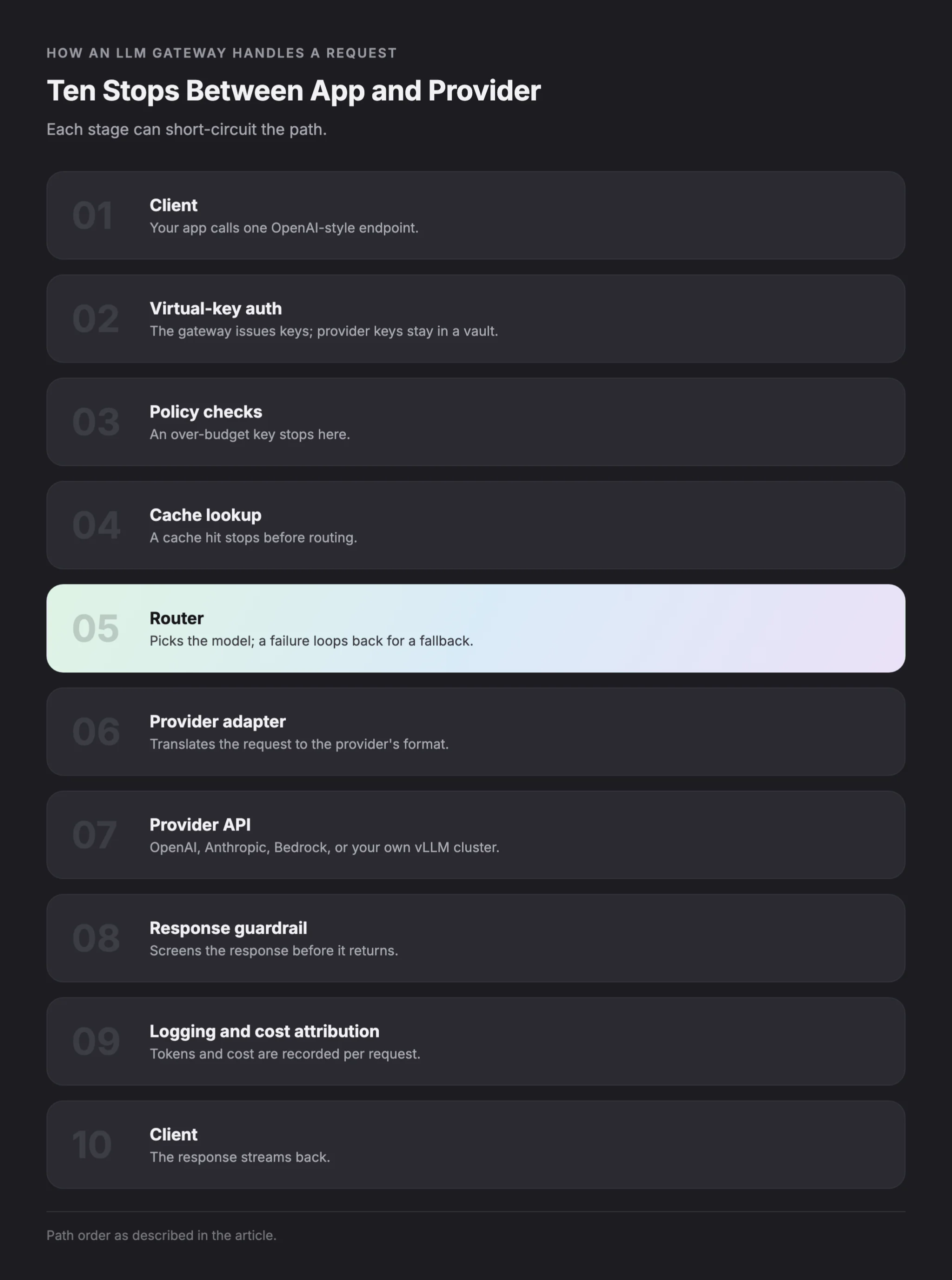
A request to an LLM gateway passes through authentication, policy, routing, provider translation, and logging before the response streams back. Each stage can short-circuit the path: an over-budget key stops at policy, a cache hit stops before routing, and a provider failure loops back for a fallback. The table maps the eight functions most products ship.
The path in order: client → virtual-key auth → policy checks → cache lookup → router → provider adapter → provider API → response guardrail → logging and cost attribution → client.
| Function | What it does on the path | Why a CTO cares |
|---|---|---|
| Unified API | One OpenAI-style endpoint for every provider | Switching providers becomes a config change |
| Routing and fallback | Picks the model; retries on another provider on 429/5xx | Uptime stops depending on one vendor’s status page |
| Caching | Returns stored answers for identical or similar prompts | Cuts spend on repeated prompts; adds a staleness risk |
| Rate limits and budgets | Token or request quotas per key, team, or project | One runaway agent can’t drain the monthly budget |
| Key management | Virtual keys issued by the gateway; provider keys stay in a vault | Rotation and revocation without redeploying apps |
| Guardrails and PII | Prompt and response screening, redaction before the provider | Compliance evidence for SOC 2, PCI DSS, or HIPAA scopes |
| Observability and cost | Per-request logs with tokens, latency, and attributed cost | Finance gets a number per product line, not one invoice |
| MCP and agent governance | Policy on tool calls and agent-to-agent traffic | Agents can’t reach tools nobody approved |
Latency labels are relative; Anthropic notes that actual latency depends on prompt length, output length, and thinking effort. For the provider-level choice, read Teamvoy’s Anthropic vs OpenAI comparison.
How do you choose an LLM gateway?
Choose an LLM gateway on eight criteria: hosting model, license, provider coverage, governance and RBAC, observability depth, cost model, lock-in surface, and ops burden. Weight them by your constraint: a regulated fintech weights hosting and governance first, a product team shipping a prototype weights time-to-live and cost model first. The table gives each criterion a question you can answer in a one-hour vendor call.
| Criterion | Question to ask | What a weak answer looks like |
|---|---|---|
| Hosting model | Does it run in our VPC, on-prem, air-gapped, or only as SaaS? | “Air-gapped on request” without a documented procedure |
| License | Which features sit outside the open-source license? | A LICENSE file that points to a second file for a whole directory |
| Provider coverage | Are the providers we use today and in 12 months on the list? | A count (“250+”) with no named list in the docs |
| Governance and RBAC | Can teams own keys, budgets, and model allowlists without the master key? | Admin-only UI; budgets per gateway, not per team |
| Observability | Are logs, token counts, and cost per request exportable to our stack? | Logs retained for days on the plan you can afford |
| Cost model | Flat fee, per-log, per-request, credit fee, or infrastructure only? | A percentage fee on credits that compounds with volume |
| Lock-in surface | Which features exist only in this vendor’s proprietary config? | Routing rules and guardrails stored in a vendor-only format |
| Ops burden | Who patches it, scales it, and answers the 3 a.m. page? | “Self-hosted” with no high-availability guide |
The gateway log is the audit trail your compliance team will ask for, and the retention tier decides whether it still exists in six months. Teamvoy’s piece on LLM observability and evals in production covers what auditors expect.
Which are the best LLM gateway platforms by operating role?
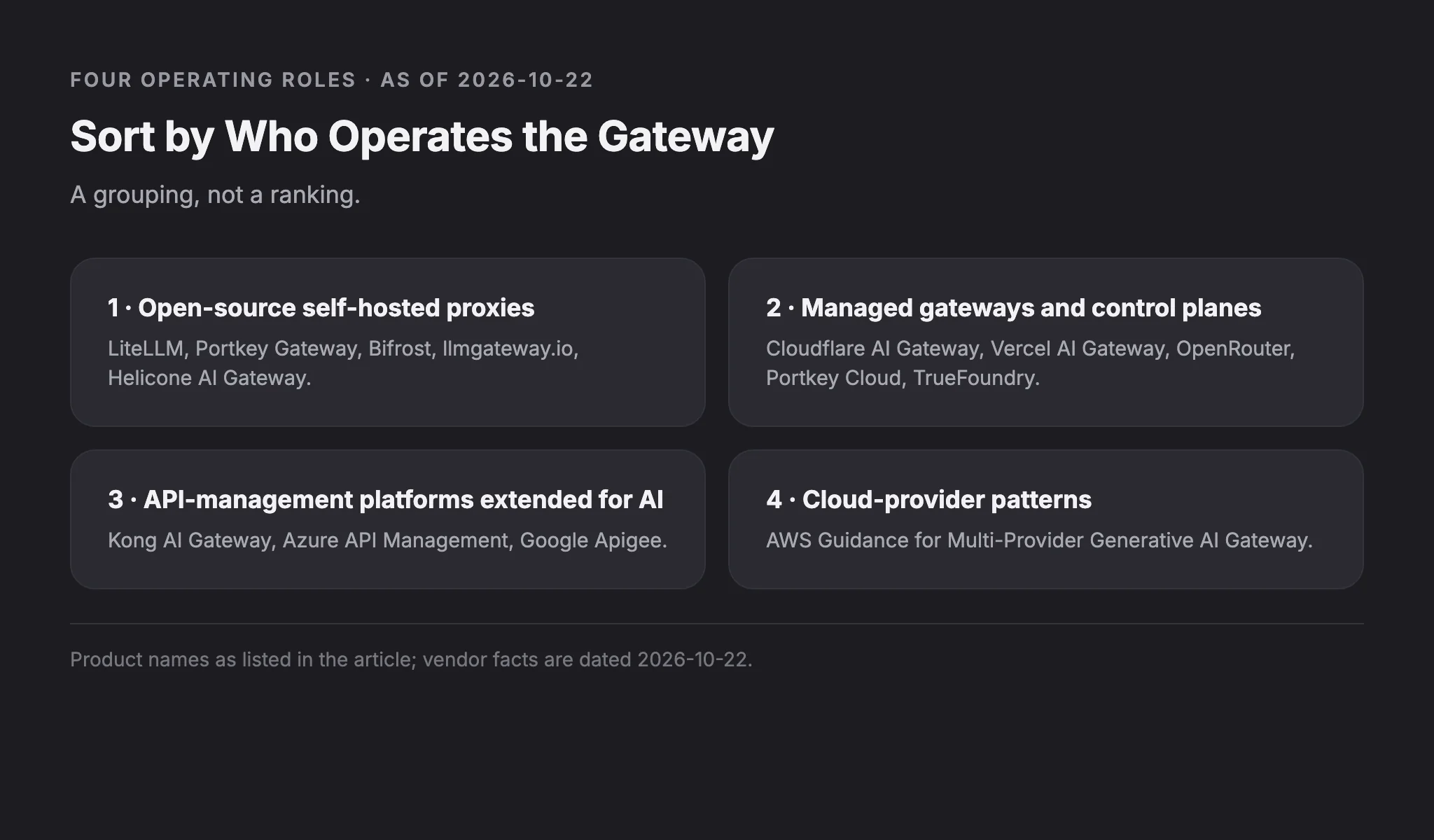
The best LLM gateway platforms fall into four operating roles, and the right answer depends on which role your organization can staff. Each group gets a best-fit and caveat table rather than a ranking, because a self-hosted MIT proxy and a credit-funded marketplace solve different procurement problems. Every vendor fact carries its retrieval date and official source.
- Open-source self-hosted proxies: LiteLLM, Portkey Gateway, Bifrost, llmgateway.io, Helicone AI Gateway.
- Managed LLM gateways and control planes: Cloudflare AI Gateway, Vercel AI Gateway, OpenRouter, Portkey Cloud, TrueFoundry.
- API-management platforms extended for AI: Kong AI Gateway, Azure API Management, Google Apigee.
- Cloud-provider patterns: AWS Guidance for Multi-Provider Generative AI Gateway.
Open source LLM gateway options: self-hosted proxies
An open source LLM gateway gives you the keys, the logs, and the patching duty. Five projects hold the category as of 2026-10-22, and their licenses are the first filter. LiteLLM is MIT with a separately licensed enterprise directory, Portkey Gateway is MIT, Bifrost and Helicone AI Gateway are Apache-2.0, and llmgateway.io is AGPLv3 with a commercial ee/ directory.
LiteLLM calls itself, in its README retrieved 2026-10-22, an “Open Source AI Gateway for 100+ LLMs. Self-hosted. Enterprise-ready.” Its LICENSE is MIT outside the enterprise/ directory. The enterprise docs, updated 2026-10-20, keep virtual keys, budgets, spend tracking, the admin UI, load balancing, guardrails, and an MCP gateway in open source. The license key gates SSO and SCIM beyond 5 users, audit logs, org and team admins, and secret-manager integrations. Enterprise pricing is “talk to sales.”
Portkey Gateway is MIT-licensed and, per its README on 2026-10-22, routes “to 250+ LLMs with 1 fast & friendly API.” The README announces a Gateway 2.0 pre-release that merges Portkey’s enterprise gateway into open source; the repository’s last push was 2026-05-25, so check which branch you deploy.
Bifrost, from Maxim, is Apache-2.0 and ships as a Go binary or Docker image. Its README on 2026-10-22 says it unifies “23+ providers” behind one OpenAI-compatible API with failover and semantic caching. Clustering, guardrails, and an MCP gateway sit in a commercial tier with no published price.
llmgateway.io appears in Google’s AI Overview for “llm gateway” as of 2026-10-22. Its LICENSE is AGPLv3 for the core, with the ee/ directory under a commercial license. AGPL matters if you modify the gateway and expose it as a service; have legal read it before the pilot.
Helicone AI Gateway is a Rust proxy under Apache-2.0 whose README on 2026-10-22 still carries a Public Beta badge; the repository’s last push was 2025-11-21. Verify maintenance before you shortlist it.
| Project (2026-10-22) | Best fit | Caveat |
|---|---|---|
| LiteLLM | Budgets, virtual keys, and an MCP gateway without a license fee | SSO beyond 5 users, audit logs, and RBAC admins need the enterprise license |
| Portkey Gateway | Portkey’s config format with an upgrade path to its cloud | Last push 2026-05-25; 2.0 is a pre-release branch |
| Bifrost | A single static binary with semantic caching | Clustering, guardrails, and MCP gateway are commercial |
| llmgateway.io | Teams comfortable with AGPL that want a hosted fallback from the same vendor | Copyleft license; ee/ features are commercial |
| Helicone AI Gateway | Teams already on Helicone observability | Public Beta; last push 2025-11-21 |
Managed LLM gateways and control planes
Managed LLM gateways remove the patching duty and replace it with a billing model you need to read closely. As of 2026-10-22 the five products below charge in four ways. Cloudflare keeps core features free and charges for logs. Vercel passes through provider list price with no gateway fee. OpenRouter takes a cut of purchased credits. Portkey Cloud prices by recorded logs, and TrueFoundry offers a free request allowance with custom tiers above it.
Cloudflare AI Gateway runs on all Cloudflare plans with logging, caching, rate limiting, retries, and model fallback, per docs updated 2026-04-20. Its pricing page, updated 2026-10-15, keeps analytics, caching, and rate limiting free. Log storage follows Workers Logs pricing for gateways created on or after 2026-09-24; older accounts get 100,000 logs on Workers Free and 10,000,000 per gateway on Workers Paid. Unified Billing adds a 5% fee to purchased credits, with no markup on inference.
Vercel AI Gateway, docs updated 2026-09-14, offers central credentials, request logs, budgets per team, project, key, or member, ordered fallbacks, and BYOK. Its pricing page, updated 2026-09-08, states the gateway “charges no markup and no platform fee on tokens” and that “you’re responsible for any payment processing fees that may apply.” Enterprise teams pay by invoice with no processing fees.
OpenRouter is a model marketplace rather than a proxy you host. Its FAQ, read 2026-10-22, states a 5.5% fee with an $0.80 minimum on credit purchases and provider pricing passed through without markup. BYOK on pay-as-you-go includes $25,000 per month of list-price inference with no BYOK fee; above that, OpenRouter charges 5% of the model’s price on its platform.
Portkey Cloud, priced on 2026-10-22, has a free Developer tier with 10,000 recorded logs per month and 3-day retention that Portkey labels “not suitable for production workloads.” Production is $49 per month for 100,000 recorded logs, plus $9 per additional 100,000 requests.
TrueFoundry AI Gateway lists VPC, on-prem, and air-gapped deployment plus MCP and Agent Gateway products as of 2026-10-22, with a free tier of 30,000 requests per month for 3 seats. The page states no license, so this article doesn’t call it open source. Paid tiers aren’t listed.
| Product (2026-10-22) | Best fit | Caveat |
|---|---|---|
| Cloudflare AI Gateway | Teams already on Cloudflare that want caching and fallback free | Log retention depends on Workers plan; 5% fee on Unified Billing credits |
| Vercel AI Gateway | Product teams that want list-price tokens, budgets, and BYOK | Payment processing fees apply unless you invoice as Enterprise |
| OpenRouter | One credit balance across 500+ models with frequent model swaps | 5.5% credit-purchase fee; marketplace, not a proxy in your VPC |
| Portkey Cloud | Portkey’s routing config without running the OSS gateway | Developer tier isn’t production-rated; cost scales with recorded logs |
| TrueFoundry | Regulated teams that need air-gapped deployment with agent governance | Not open source; paid pricing needs a sales conversation |
API-management platforms extended for AI
API-management vendors add LLM policies to a gateway your platform team may already run, which makes them the cheapest option to adopt and the hardest to leave. Kong, Azure API Management, and Google Apigee all documented semantic caching, prompt screening, and provider translation as of 2026-10-22. These features follow the vendor’s edition and tier structure, so the first question is which policies your contract includes.
Kong AI Gateway runs on the AI Proxy plugin. Per its docs on 2026-10-22, the plugin accepts OpenAI-format requests and translates them for 17 providers, including OpenAI, Azure OpenAI, Bedrock, Anthropic, Gemini, Vertex AI, Ollama, and vLLM. The docs hub names AI Semantic Cache, AI Semantic Prompt Guard, an AI Sanitizer that redacts PII, and governance for MCP and A2A traffic. Kong’s pricing page on 2026-10-22 lists AI Management Plus from $25 per month plus usage. The docs don’t state which AI plugins ship in open source versus Enterprise or Konnect, so check which plugins your Kong edition includes.
Azure API Management, per Microsoft’s page updated 2026-05-29, “extends API Management’s existing API gateway; it’s not a separate offering.” It applies to all tiers, with capabilities varying by tier, and handles OpenAI, Anthropic, and Vertex AI schemas plus Microsoft Foundry and Amazon Bedrock. Policies include token limits per consumer, token metrics, semantic caching, load balancing, Azure AI Content Safety moderation, and a credential manager.
Google Apigee documents a SemanticCacheLookup policy backed by Vertex AI embeddings and a SanitizeUserPrompt policy that screens prompts with Model Armor, both retrieved 2026-10-22. Google notes they “might have cost or utilization implications, depending on your Apigee license.”
| Platform (2026-10-22) | Best fit | Caveat |
|---|---|---|
| Kong AI Gateway | Teams on Kong that want PII redaction, semantic cache, and MCP policy in one plugin chain | Edition coverage of AI plugins isn’t stated; verify before budgeting |
| Azure API Management | Azure teams that want token quotas and Content Safety in existing APIM tiers | Capabilities vary by tier; pricing is APIM tier pricing |
| Google Apigee | GCP teams that want Model Armor screening and Vertex-backed semantic cache | Extensible policies carry license-dependent cost |
Cloud-provider gateway patterns
AWS doesn’t sell a standalone LLM gateway; it publishes a reference pattern you deploy in your own account. The Guidance for Multi-Provider Generative AI Gateway on AWS, retrieved 2026-10-22, routes clients through CloudFront and WAF to a load balancer, then to a LiteLLM proxy on ECS Fargate or EKS, with ElastiCache, RDS, Secrets Manager, and S3.
The guidance states its middleware “integrates natively with Amazon Bedrock to enable features not supported by the LiteLLM opensource project.” You run LiteLLM, you pay AWS infrastructure, and you get Bedrock hooks the upstream project lacks. The page’s publication date wasn’t captured.
Pricing models and licenses compared
Gateway pricing follows five models, and the one you pick decides whether cost scales with traffic, logs, or seats. The table dates every number to 2026-10-22 and links the official page; expect drift within a quarter. For how gateway spend fits the wider budget, see Teamvoy’s breakdown of the cost of AI implementation.
| Product | Pricing model (2026-10-22) | License | Source |
|---|---|---|---|
| LiteLLM | OSS free; Enterprise license key, no public price | MIT outside enterprise/ | LICENSE |
| Portkey | OSS free; Cloud Developer free (10k logs), Production 49/mo(100klogs,+9 per 100k requests) | MIT (gateway) | Pricing |
| Bifrost | OSS free; enterprise tier commercial, price not published | Apache-2.0 | Repo |
| llmgateway.io | Self-host free; hosted Free with 5% fee on credit usage; Enterprise custom | AGPLv3 + commercial ee/ | Pricing |
| Helicone AI Gateway | OSS free; Helicone platform Hobby free, Pro $79/mo, Team $799/mo | Apache-2.0 | Pricing |
| Cloudflare AI Gateway | Core free; logs per Workers plan; 5% fee on Unified Billing credits | Proprietary SaaS | Pricing |
| Vercel AI Gateway | Provider list price; no markup, no platform fee on tokens; processing fees may apply | Proprietary SaaS | Pricing |
| OpenRouter | Prepaid credits; 5.5% fee ($0.80 min) on purchase; BYOK free to $25k/mo, then 5% | Proprietary SaaS | FAQ |
| Kong AI Gateway | AI Management Plus from $25/mo plus usage; Enterprise custom | Edition-dependent | Pricing |
| TrueFoundry | Free to 30k requests/mo, 3 seats; paid tiers not on page | Not stated | Product page |
| AWS guidance | AWS infrastructure only; no gateway license | LiteLLM MIT core | Guidance |
Percentage fees on credits are painless at $2,000 a month and visible at $200,000. Per-log pricing means observability depth and bill move together. Infrastructure-only pricing looks free until you cost the engineer who runs it.
Leading AI gateway for LLM workload optimization: a decision framework
The phrase leading AI gateway for LLM workload optimization describes a capability set, not a product, and four levers deliver it: routing, caching, fallback, and budgets. Every gateway in this article ships some version of each. What separates them is how much policy you can express without code, and whether that policy lives in a format you could migrate. Judge a candidate by the four points below rather than by a crowned winner.
Routing. Can you send classification to a small model and reasoning to a large one by rule? Multi-provider routing also hedges the provider decision; Teamvoy’s Anthropic vs OpenAI comparison explains why that hedge is worth keeping open.
Caching. Exact-match caching is safe and narrow. Semantic caching widens the hit rate and adds the risk of answering a similar but different question. Set a similarity threshold per endpoint and exclude anything personalized.
Fallback. Ordered fallbacks keep the feature up when one provider rate-limits you. Each fallback needs its own cost ceiling, or an outage at your cheap provider becomes a bill from your expensive one.
Budgets. Budgets per key, team, and project with alerts before the hard limit are the control finance asks for first. LiteLLM’s open-source tier and Vercel’s gateway both document this as of 2026-10-22. A budget per gateway is a different control from a budget per product line.
Where LLM gateways fail
LLM gateways fail in four repeatable ways: an added network hop, a single point of failure, stale cached answers, and lock-in through proprietary policy formats. Each one is manageable, and each one costs engineering time the pricing page doesn’t show. Price them into the pilot before the gateway becomes load-bearing.
Hop latency. Every gateway adds a round trip and a translation step. Vendors publish their own overhead figures; this article omits them because the number you need is measured on your path. Compare p50 and p99 with and without the gateway on identical prompts.
Single point of failure. A gateway every application depends on is a new tier-one service. Self-hosted options need high availability and a runbook. Managed options move the risk to the vendor’s status page, a different risk rather than a smaller one. Keep a documented bypass path for applications that can’t tolerate gateway downtime.
Cache staleness. A cached answer about a price, a policy, or an account can be wrong the moment the source changes. Scope caching to prompts whose correct answer holds within the TTL, and log cache hits separately so support can trace a stale response.
Lock-in. Routing rules, guardrail configs, and virtual-key hierarchies in one vendor’s format are the migration cost you pay later. Prefer gateways whose config is plain YAML or JSON in your repo, and keep the OpenAI-compatible interface as the contract your apps depend on.
Build vs buy: when does Teamvoy fit?
Most mid-market teams should adopt an existing gateway rather than build one, and that includes teams that could hire Teamvoy to build it. LiteLLM, Cloudflare AI Gateway, or Vercel AI Gateway can run on shadow traffic within days using documentation alone. A bespoke gateway is justified only when policy requirements exceed every license tier you can afford: data residency that rules out SaaS, air-gapped deployment, or MCP governance across dozens of teams.
The honest version of this trade-off runs against our commercial interest. A two-person platform team with a clear provider list and a budget owner can finish the pilot protocol below without outside help. Teamvoy’s AI integration services earn their place in the work around the gateway: the evaluation set behind the routing rules, the observability pipeline into your SIEM, the guardrail policy mapped to your compliance scope, and the integration into the apps that call it. Our guide to enterprise AI integration covers how that work is scoped.
Teamvoy hasn’t deployed or benchmarked the products named here on client traffic. This comparison reports what each vendor documented on 2026-10-22, grouped so you can shortlist the best LLM gateway platforms by operating role.
How to pilot an LLM gateway in 7 steps
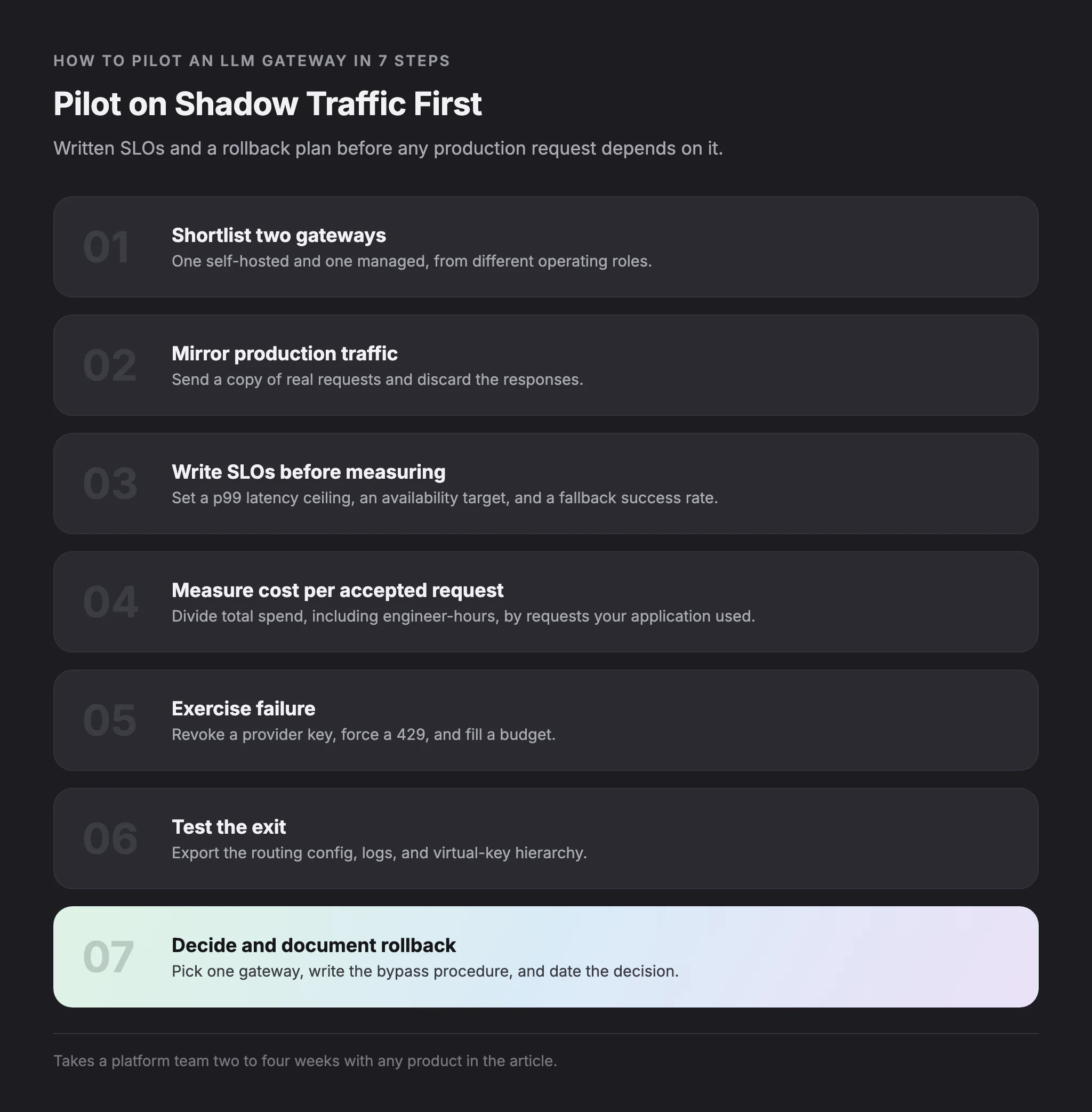
Pilot an LLM gateway on shadow traffic with written SLOs and a rollback plan before any production request depends on it. The seven steps take a platform team two to four weeks with any product here. The output is a decision memo with measured latency, cost per accepted request, and the policies you need, which is what procurement needs to approve a plan.
Decide and document rollback. Pick one gateway, write the bypass procedure for direct provider calls, and date the decision so pricing gets re-checked in a quarter.
Shortlist two gateways from different operating roles. One self-hosted and one managed, so the pilot compares cost models rather than feature lists.
Mirror production traffic. Send a copy of real requests through each gateway and discard the responses; shadow traffic exposes translation bugs that synthetic prompts miss.
Write SLOs before measuring. Set a p99 latency ceiling, an availability target, and a fallback success rate. A pilot without SLOs produces opinions.
Measure cost per accepted request. Divide total spend, including engineer-hours, by requests that produced a response your application used. Cache hits and fallbacks move this number more than token prices do.
Exercise failure. Revoke a provider key, force a 429, and fill a budget. Record what the gateway did and what your application saw.
Test the exit. Export the routing config, logs, and virtual-key hierarchy. If the export needs a vendor ticket, the lock-in surface is larger than the docs suggest.
rollback procedure it takes two to four weeks
Conclusion
The best LLM gateway platforms aren’t a ranked list; they’re four operating roles, each with a license and a billing model you should read before the feature list. Self-host when you must own the keys, buy managed when you need the layer this week, extend your API platform when you already run one, and use the AWS pattern when your account is the boundary. Pilot on shadow traffic, measure cost per accepted request, test the exit, and date the decision. Talk to Teamvoy About LLM Gateway Integration. Teamvoy builds the parts around the gateway that vendors don’t ship: the evaluation set behind your routing rules, the observability pipeline into your SIEM, the guardrail policy mapped to your compliance scope, and the application integration. If you want a second pair of eyes on the pilot plan, contact Teamvoy.