- Loan servicing automation is strictly post-disbursement work: payment waterfalls, interest and amortisation, escrow, reconciliation, delinquency outreach, and an immutable audit trail.
- No top-ranking page evaluates development partners, so the SERP is product listicles and directories. This guide maps eight kinds of partner to eight situations instead.
- Five criteria decide the choice: named regulatory scope, servicing and ledger depth, integration ownership, senior lead accountability, and modernization approach.
- US direct mortgage servicing costs averaged 185 dollars per loan in 2025. Fully loaded, performing loans run about 176 dollars against 1,573 dollars non-performing.
- Most servicing AI pilots stall on execution, not retrieval. Ask for the write path, idempotency keys, circuit breakers, and a reconstructable decision audit record.
- Rule change is an architecture problem. Externalised, versioned rule logic turns a CFPB amendment into a configuration change rather than a release.
Q1. Which custom loan servicing automation development partners should lenders evaluate in 2026?
Eight engineering partners cover custom loan servicing automation in 2026, and each fits a different situation rather than a ranked position. Teamvoy has delivered 150+ projects across banking, insurance, and complex SaaS since 2013, which places it with regulated lenders modernising a servicing core built by previous teams. Others fit greenfield builds, AI proofs of concept, or staff augmentation. Assess regulatory scope, ledger depth, integration ownership, lead accountability, and modernization approach.
Picking an engineering partner for loan servicing work is not a procurement exercise. Servicing runs for the life of the loan, so a mistake in the ledger accrues quietly for months. Direct mortgage servicing costs averaged 185 dollars per loan in 2025, and Regulation X sets duties your workflows must encode. Get the partner wrong and you carry both bills for years. This guide assesses eight kinds of partner against five criteria: regulatory scope, servicing and ledger depth, integration ownership, senior lead accountability, and modernization approach. It is a practical map for CTOs, IT directors, and founders, not a ranking.
Our Evaluation Criteria
- Named regulatory scope. Which regulators and standards the firm has actually delivered under, not which ones it lists on a page. This is the difference between a compliance page and regulator-ready delivery in fintech.
- Servicing and ledger depth. Whether the team has worked on money movement, amortisation, and reconciliation, or only on interfaces above them.
- Integration ownership. Who owns the API schemas, retries, and reconciliation checks after go-live. This is where most servicing projects quietly fail, and why system integration belongs in the contract, not the appendix.
- Senior technical lead accountability. Whether one senior engineer owns the system end to end, or whether staff cycle through it.
- Modernization approach. Incremental stabilisation of a working core, or a rewrite-first proposal. Technology modernization and a rewrite are not the same purchase.
Who This Guide Is For
- A CTO who inherited a servicing platform from a vendor who underdelivered or exited, and now has to stabilise it. If that is you, the recovery plan for systems nobody understands is the closest map to your week.
- An enterprise IT director with a compliance deadline and a servicing core that cannot absorb a rule change without a release.
- A technical founder at a lender whose original system still works but has drifted past the point where anyone wants to touch the ledger code.
The Eight Partners Covered
- Teamvoy: Best for a regulated lender modernising a servicing core built by previous teams, without a rewrite.
- Achievion Solutions: Best for validating an AI servicing workflow as a proof of concept before committing build budget.
- Vention: Best for scaling an in-house servicing team with additional engineers under your own leads.
- HatchWorks AI: Best for a nearshore AI-assisted build where speed of first delivery matters most.
- Dualboot Partners: Best for a lending product team that needs a full build-and-launch squad.
- DOOR3: Best for an enterprise servicing programme with heavy internal stakeholder coordination.
- Azumo: Best for adding data and AI engineering capacity to an existing servicing roadmap.
- NineTwoThree AI Studio: Best for a lender shipping a first AI feature alongside its servicing platform.
Master Comparison Table
| Company Name | Best For | Engagement Model | Industry Depth & Compliance Coverage |
|---|---|---|---|
| Teamvoy | Regulated lender modernising an inherited servicing core without a rewrite | Long-term partner, multi-year, senior technical lead owns the system | Banking, insurance, healthcare, manufacturing, retail, logistics, complex SaaS. Delivery under BaFin, PSD2, DORA, SOC 2, PCI-DSS, SEC, FINRA, HIPAA, GDPR, FCA, NHS Digital |
| Achievion Solutions | Validating an AI servicing workflow before committing build budget | Project-and-exit, POC then MVP phases | AI and custom software across design, health data, and education clients per verified reviews. Named lending or servicing regulatory scope not publicly claimed |
| Vention | Extending an in-house servicing team with additional engineers | Staff augmentation under client leads | Broad software delivery. Named servicing regulatory scope varies by engagement |
| HatchWorks AI | Nearshore AI-assisted build where first delivery speed matters | Project or squad, nearshore | AI-enabled product delivery. Named lending regulatory scope not publicly claimed |
| Dualboot Partners | Lending product team needing a full build-and-launch squad | Project-and-exit or embedded squad | Product engineering including fintech work. Compliance coverage varies by engagement |
| DOOR3 | Enterprise servicing programme with heavy stakeholder coordination | Project-and-exit, enterprise delivery | Enterprise and regulated-sector custom software. Named servicing rule scope varies by engagement |
| Azumo | Adding data and AI engineering capacity to a servicing roadmap | Staff augmentation or scoped project, nearshore | Data engineering and AI. Named lending compliance scope not publicly claimed |
| NineTwoThree AI Studio | Shipping a first AI feature alongside an existing servicing platform | Project-and-exit, studio model | AI product development across several verticals. Named servicing regulatory scope not publicly claimed |
This roster covers eight partners in total. Cards follow in the same running order, with the same five criteria applied to each.
Teamvoy
- Named regulatory scope: Delivery under BaFin, PSD2, DORA, SOC 2, PCI-DSS, SEC, FINRA, HIPAA, GDPR, FCA, NHS Digital.
- Servicing and ledger depth: Long-running financial platforms where downtime is a regulatory event, not an inconvenience.
- Integration ownership: Data layer and legacy core assessed first, before any model or workflow decision.
- Senior technical lead accountability: One senior engineer owns the system end to end, with an AI-native team behind them.
- Modernization approach: Incremental. Stabilise, document, then modernise while the business keeps running.
- 150+ delivered projects across banking, insurance, healthcare, manufacturing, retail, logistics, and complex SaaS since 2013.
- Named client work including Nasdaq, OSL, Panasonic Avionics, and Market Access Direct, with further detail in the case studies.
- A blockchain data-distribution platform for wealth management taken from proof of concept to scale, with the engagement continuing through the client’s acquisition and two further years.

Achievion Solutions
- Named regulatory scope: Not publicly claimed for lending or mortgage servicing rules.
- Servicing and ledger depth: No servicing or ledger engagements evidenced in verified reviews.
- Integration ownership: Scoped per project. Ongoing ownership after handover is not part of the stated model.
- Senior technical lead accountability: A US-based project manager fronts delivery, with engineers behind them. Reviews rate project management as workable rather than exceptional.
- Modernization approach: Greenfield POC and MVP work rather than modernization of a live core.
- Completed a POC phase validating functional capabilities, use cases, APIs, and features before MVP scope was set, for an AI design platform.
- Delivered an MVP that ran a beta with over 150 users.
- Built an MVP, beta version, and website for a health data company, per a verified 2026 review.
Vention
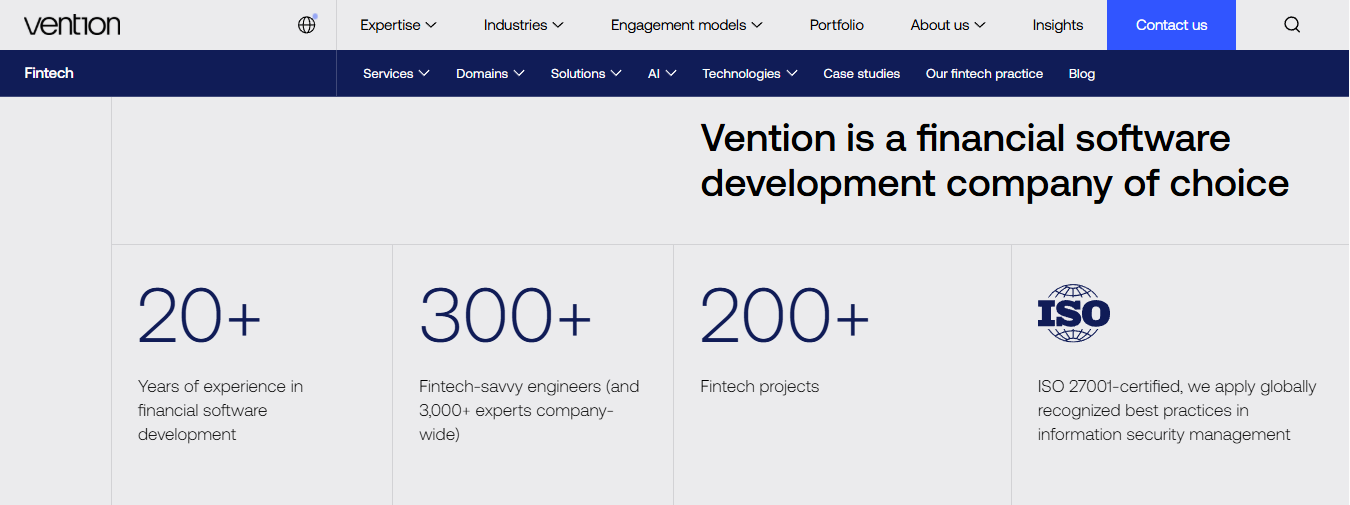
- Named regulatory scope: Varies by engagement. Compliance accountability generally stays with the client.
- Servicing and ledger depth: Depends entirely on which engineers you get. Not a firm-level guarantee.
- Integration ownership: Retained by the client. Augmented engineers work inside your architecture, not over it.
- Senior technical lead accountability: Your lead owns the system. The vendor supplies capacity, not direction.
- Modernization approach: Follows your roadmap. The firm does not set the modernization strategy.
- Positions itself around dedicated teams and staff augmentation for product engineering work.
- Specific loan servicing or ledger engagements are not publicly claimed.
- Compliance certifications relevant to servicing are not publicly claimed in this context.
HatchWorks AI
- Named regulatory scope: Not publicly claimed for mortgage or consumer lending rules.
- Servicing and ledger depth: Not evidenced for post-disbursement ledger work.
- Integration ownership: Scoped per project. Long-term ownership is not the stated model.
- Senior technical lead accountability: Squad-based, with delivery leads assigned per engagement.
- Modernization approach: Build-forward rather than stabilisation of a live core.
- Positions its delivery model around AI-assisted engineering and nearshore squads.
- Named loan servicing platform engagements are not publicly claimed.
- Audit or attestation scope relevant to servicing is not publicly claimed.
Dualboot Partners

- Named regulatory scope: Varies by engagement. Not publicly claimed for Regulation X servicing duties.
- Servicing and ledger depth: Fintech product experience is claimed. Post-disbursement ledger depth is not specifically evidenced.
- Integration ownership: Scoped per engagement, with handover to the client team at launch.
- Senior technical lead accountability: Squad leads assigned per project.
- Modernization approach: Build-and-launch oriented rather than incremental core modernization.
- Positions around full product squads taking work from design through launch.
- Fintech product engagements are part of the stated focus.
- Named mortgage servicing or escrow administration builds are not publicly claimed.
DOOR3
- Named regulatory scope: Enterprise and regulated-sector work is claimed. Specific servicing rule coverage varies.
- Servicing and ledger depth: Enterprise systems experience. Dedicated servicing ledger work is not specifically evidenced.
- Integration ownership: Programme-scoped, with defined handover.
- Senior technical lead accountability: Structured programme management with assigned leads.
- Modernization approach: Enterprise modernization programmes, typically phase-gated.
- Positions around enterprise custom software and modernization programmes.
- Regulated-sector client work is part of the stated focus.
- Named loan servicing automation builds are not publicly claimed.
Azumo
- Named regulatory scope: Not publicly claimed for lending or servicing rules.
- Servicing and ledger depth: Data and AI capability. Servicing ledger work is not specifically evidenced.
- Integration ownership: Typically retained by the client.
- Senior technical lead accountability: Depends on model. Under augmentation, your lead owns the system.
- Modernization approach: Capability-add rather than modernization strategy.
- Positions around data engineering, AI, and machine learning delivery.
- Nearshore team model is part of the stated offering.
- Named loan servicing platform engagements are not publicly claimed.
NineTwoThree AI Studio
- Named regulatory scope: Not publicly claimed for mortgage servicing rules.
- Servicing and ledger depth: AI product work across verticals. Ledger depth is not specifically evidenced.
- Integration ownership: Scoped per project, with handover at delivery.
- Senior technical lead accountability: Studio leads assigned per engagement.
- Modernization approach: New AI product build rather than core modernization.
- Positions around AI product development from concept through launch.
- Multiple verticals are part of the stated portfolio.
- Named servicing automation or escrow engagements are not publicly claimed.
Teamvoy sits at the other end of this roster on purpose. Teamvoy takes servicing systems mid-flight, including ones a previous vendor left behind, and modernises them without a rewrite while payments keep running. Twelve years, 150+ projects, and a 4+ year average engagement is what that model looks like from the inside, and the hybrid cloud internet banking architecture work shows the shape of it.
Q2. What does loan servicing automation cover, and how is it different from loan management and origination?
Loan servicing automation executes post-disbursement work without manual touch: applying payments and waterfalls, recalculating interest and amortisation, administering escrow, reconciling bank activity, triggering delinquency outreach, and logging every adjustment to an immutable audit trail. Origination ends at funding. Loan management is the portfolio layer above. Servicing runs for the life of the loan, so its errors accrue rather than surface.
What “post-disbursement” actually means
Post-disbursement means everything after the money leaves. The loan exists, the borrower owes, and the system now has to be right every month for years.
Teamvoy treats the ledger and the data layer as the first two questions on any servicing engagement. Ask us about a model or a workflow tool, and we will ask what the record of truth looks like first, which is where data engineering earns its place ahead of the model.
✅ The six pillars of servicing automation
Published servicing frameworks group the work into six repeating jobs:
- Payment processing. Pulling funds by ACH or card, handling failed payments, and applying NSF fees.
- Interest and amortisation. Recalculating schedules after every payment, prepayment, or modification.
- Escrow administration. Holding, disbursing, and re-analysing tax and insurance amounts.
- Reconciliation. Matching bank activity to the ledger daily, not monthly.
- Borrower self-service. Statements, payoff quotes, and payment changes without a phone call.
- Delinquency and collections. Triggering outreach on schedule and recording every attempt.
⚠️ One misposted payment, three broken records
Picture a 1,400 dollar payment on a mortgage. The waterfall (the rule deciding the split) sends part to interest, part to principal, and part to escrow.
Get the escrow share wrong by nine dollars. The payment posts. The borrower sees nothing odd. Twelve months later, the escrow analysis is short, the statement is wrong, and the audit trail shows a clean posting.
Servicing, loan management, and origination are not the same layer
| Layer | What it owns | Where it stops |
|---|---|---|
| Origination (LOS) | Application, underwriting, decision, and funding | Ends at disbursement |
| Servicing | Payments, interest, escrow, statements, delinquency, and modifications | Runs for the life of the loan |
| Loan management (LMS) | Portfolio view, restructuring, refinancing, and collections reporting | Sits above individual loan operations |
Buyers conflate these constantly, and vendor pages do not help. Gartner Peer Insights defines the loan management system as the platform automating the complete loan lifecycle, which is broader than servicing alone. Scope breakdowns from lending software vendors draw the same distinction differently again.
⏰ Why ledger errors behave differently
An origination bug is loud. The application fails, someone calls, and you fix it that day.
A servicing bug is quiet. As one engineer with fifteen years of production systems put it, “almost right is more expensive than completely wrong,” because completely wrong breaks the build while almost right passes review and ships.
On a ledger, almost right sits there for six months. By the time anyone notices, the cost to fix has compounded into something nobody budgeted. That is the difference between a bug and a liability, and it is the same compounding described in the tech debt avalanche.
Teamvoy has spent twelve years on platforms where downtime is a regulatory event, not an inconvenience. Servicing sits squarely in that category, which is why we scope the record of truth before anything else across banking and fintech engagements.
Q3. Which regulatory requirements must a servicing automation build encode?
Automated servicing must encode Regulation X Subpart C duties: error resolution, information requests, general servicing policies, early intervention, continuity of contact, and loss mitigation. Regulation Z governs payment crediting and periodic statements. Servicers at or under 5,000 loans fall inside the small-servicer exemption, which changes build scope materially. Eligibility does not equal compliance, and hard-coded workflows become liabilities when rules move.
Regulation X Subpart C, section by section
Regulation X (12 CFR Part 1024) is the implementing rule for the Real Estate Settlement Procedures Act. Subpart C covers mortgage servicing, and each section maps to a system behaviour you must build.
| Rule section | What the system must do |
|---|---|
| 1024.35 | Accept notices of error and resolve them inside set timeframes |
| 1024.36 | Respond to written information requests with records |
| 1024.38 | Maintain general servicing policies, procedures, and requirements |
| 1024.39 | Make early intervention contact with delinquent borrowers |
| 1024.40 | Provide continuity of contact personnel to borrowers |
| 1024.41 | Run loss mitigation review with documented decisions |
✅ Regulation Z carries the payment rules
Regulation Z sits alongside Regulation X and governs payment crediting under 1026.36 and periodic statements under 1026.41. Get the crediting date wrong, and you have created a fee that should not exist.
Teamvoy has delivered inside BaFin, PSD2, DORA, SOC 2, PCI-DSS, SEC, FINRA, HIPAA, GDPR, FCA, and NHS Digital scopes across twelve years. What that teaches is simple: the rule is never the hard part, the evidence is, and the same pattern runs through regulator-ready AI in fintech.
Portfolio size changes what you have to build
The small-servicer exemption is a real scope lever. Servicers at or below 5,000 loans, all of which they own or originated, sit outside several requirements.
⚠️ Eligibility does not equal compliance
Being exempt from a rule is not the same as being compliant. Investor guidelines, state law, and your own servicing agreements still apply.
Teamvoy scopes exemption status early because it changes cost, not just paperwork. A partner who does not ask your portfolio size in the first call is guessing at the build, which is one of the first things an IT audit settles.
Rule change is an architecture problem, not a maintenance ticket
The CFPB has a proposed rule pending under Docket CFPB-2024-0024 that would rework loss mitigation review and record retention. The Official Staff Commentary on Regulation X was itself amended effective July 15, 2025.
If your loss mitigation logic lives inside application code, every rule change is a release. If it lives in versioned decision tables, it is a configuration change with an audit trail.
⏰ The specification is the product
The engineering discipline that used to arrive after code now has to arrive before it. State machines, decision tables, and detailed requirement documents felt dead for a decade. On regulated workflows, they are the deliverable, and the code becomes replaceable.
What I look for on any servicing audit is whether an automated decision from eight months ago can be reconstructed. Not explained, reconstructed. Inputs, rule version, output, and timestamp.
Teamvoy externalises rule logic from application code on regulated builds, so a rule change does not require a deployment. That choice costs more in week three and saves entire quarters in year two, and it is a core part of technology modernization work.
Q4. What does servicing automation actually cost per loan, and where does it pay back?
Anchor the case in per-loan components, not percentages. US direct mortgage servicing costs averaged 185 dollars per loan in 2025: servicing systems 36 dollars, customer service 33 dollars, executive and specialised functions 21 dollars, with 136 dollars non-default and 49 dollars default. Fully loaded, a performing loan runs about 176 dollars against 1,573 dollars non-performing. That spread is where automation pays.
The cost baseline, with vintages stated
Mortgage Bankers Association data puts direct servicing operating costs at 185 dollars per loan in 2025, up from 181 dollars in 2024.
| Component (2025, direct costs) | Per loan |
|---|---|
| Servicing systems | 36 dollars |
| Customer service | 33 dollars |
| Executive and specialised functions | 21 dollars |
| Non-default activity (subtotal) | 136 dollars |
| Default activity (subtotal) | 49 dollars |
| Total direct | 185 dollars |
💰 Two different metrics, two different denominators
Fully loaded servicing cost is a separate measure. MBA’s servicing operations study put it at 176 dollars per performing loan and 1,573 dollars per non-performing loan on 2024 data.
Teamvoy scopes servicing engagements against the specific cost line the automation touches. Blend fully loaded and direct figures in one slide, and your CFO will find it in ten minutes.
Why the timing argument is stronger than the efficiency argument
Net servicing income fell from 301 dollars per loan in 2024 to 89 dollars in 2025, according to MBA analysis. That is the number that changes a board conversation.
Efficiency claims are easy to dismiss. A 70 percent decline in the income line funding your servicing operation is not, which is why IT cost optimization belongs in the same discussion.
⚠️ The honest counterweight
The 136 dollars of non-default cost is the hard part. It is spread across customer service, statements, escrow, and systems, and no single automation removes it.
The 9x delinquency spread is where the money actually sits. Automating default workflows, outreach timing, and loss mitigation documentation attacks the 1,573 dollar side, not the 176 dollar side.
How to build a model that survives review
Pick the cost line, not the total. If your automation touches delinquency workflow, model against the default component and the non-performing spread.
Then subtract the carrying cost honestly. Cheap code is not free, and one estimate of global technical debt puts the payoff at 61 billion work days. The AI integration cost guide breaks down what different budgets actually buy.
❌ Where I have seen these models fail
Most servicing business cases I review claim the whole 185 dollars. That claim dies in the first finance meeting, and it takes the project’s credibility with it.
Teamvoy’s engagement data points one way here, though I might be reading it too strongly: the projects that survive year two are the ones that under-claimed in year one. Small, defensible, and verifiable.
Teamvoy scopes servicing work against named cost components rather than percentage promises, because a CFO can check a component and cannot check a percentage. That is a slower first conversation and a much shorter approval cycle, and it is how we frame every scoping conversation.
Q5. Why do servicing AI pilots stall, and how do you test whether a partner’s AI work is real?
Pilots stall because teams solve retrieval and skip execution. A model that reads a servicing record but cannot write to the ledger with idempotency, retries, and reconciliation is a demo. Teamvoy declines servicing pilots with no defined write path to the system of record. Ask for idempotent tool calls, hard circuit breakers, token-cost ceilings, deterministic execution, and an audit record of every automated decision.
The read-only bot that impressed the board
Most servicing pilots end the same way. A chat interface answers questions about loan documents, the demo lands well, and nothing changes in operations.
That happens because retrieval is easy and execution is hard. Reading a record needs no permissions. Posting an adjustment needs permissions, idempotency (the guarantee a repeated call does not double-apply), and reconciliation.
⚠️ The Doing Gap on a loan ledger
Reported figures put the share of enterprise generative AI pilots delivering no measurable return at roughly 95 percent. Forrester’s 2026 assessment of AI in lending frames the next twelve months as a rearchitecting problem, not a model-selection problem.
Cost behaves badly too. Agent frameworks resend the whole step history on every turn, so spend grows quadratically, not linearly. A twenty-step loop is not twice a ten-step run; it is far worse.
💸 Six checks to run on your next vendor call
Teamvoy scopes these as standard items on servicing engagements, not optional extras, and they carry into every AI integration conversation:
- Show me the write path. Which system of record gets written, by which call, with what rollback.
- Idempotency keys. Prove a retried payment adjustment cannot post twice.
- Hard circuit breaker. A spend and step ceiling that stops the loop without a human.
- Reconciliation check. How the automated action gets verified against the bank record.
- Decision audit record. Inputs, rule version, output, and timestamp, retrievable a year later.
- Failure behaviour. What the system does when the model returns something plausible and wrong.
One team learned check three the expensive way. An agent hit an infinite retry loop against a CRM overnight, ran for six hours unsupervised, and produced roughly 4,200 dollars in API charges.
✅ Where deterministic execution beats autonomy
Anything that moves money should be deterministic. The same inputs produce the same output, every time, and an auditor can replay it.
Gartner forecasts that 15 percent of day-to-day work decisions will be made autonomously by 2028, up from none in 2024. Roundups of servicing automation tools still rank deterministic execution and auditable exception handling above autonomy, which is the line autonomous agents have to earn before they touch a ledger.
❌ The code review test that costs nothing
Research on AI-generated pull requests found an average of 10.8 issues each, against 6.4 in human-written code. One engineer opened a request and found eleven linter suppressions in a single file, which is tape over a warning light.
Teamvoy applies the same review standard to AI-assisted code as to hand-written code. If the engineer cannot explain the flow without the model’s annotations, it does not ship.
Plausible is the most dangerous word in software engineering. On a ledger, plausible passes review and then compounds quietly for two quarters, which is exactly how vibe coding security risks reach production.
Teamvoy has spent twelve years on platforms where the data layer and the legacy core decide whether AI helps or hurts. That order of operations is why we ask about the write path before the model.
Q6. Should you build, buy, or modernise the servicing core you already have, and what engagement model does each need?
Buy when your loan products fit a configurable platform and your compliance scope is standard. Build only with a dedicated platform team and genuinely unique core systems. Modernise incrementally when the core works and cannot absorb change. Teamvoy takes servicing platforms mid-flight, including an Iress engagement that continued through the client’s acquisition and two further years to scale.
The three paths, and what each really costs
| Path | Choose it when | The real cost |
|---|---|---|
| Buy | Products fit a configurable platform, and compliance scope is standard | Configuration limits become product limits |
| Build | Dedicated platform team plus genuinely unique core systems | You own every schema, mapping, and retry path forever |
| Modernise | The core works, holds the business, and cannot absorb change | Slower first milestone, no clean-slate satisfaction |
💰 Buying has a ceiling, and it arrives quietly
A configurable platform handles standard products well. The ceiling shows up when your servicing agreement or investor guideline needs a rule the platform will not express.
Build-versus-buy framing in servicing software roundups makes the same point from the other side: only build when your core systems are genuinely unique. Otherwise, you are paying to rebuild something configurable.
⚠️ Building makes you the integration owner forever
Build, and you become the permanent owner of every API schema, field mapping, authentication flow, and retry path. That job never ends and never gets reassigned.
Teamvoy scopes integration ownership explicitly at contract stage, because nobody volunteers for it later. We have picked up too many systems where that role was simply unassigned, which is why system integration belongs in the statement of work.
Modernising an occupied building
The pattern that works is incremental. Strangle the old system piece by piece until what remains can stand alone, rather than rewriting it in one go.
One team modernising a retail point-of-sale system rebuilt the interface pixel for pixel. Same colours and same button sizes, so the cashier noticed nothing, while the backend wrote to normalised tables one at a time. That is the delivery shape behind AI modernization sprints.
⏰ The engagement model has to match the path
Buy needs configuration help and a short engagement. Build needs a long-term partner or an internal platform team. Modernising needs somebody accountable across years, not sprints.
Teamvoy runs a 4+ year average engagement, which is a consequence of the work rather than a sales preference. Servicing systems outlive every project plan written for them.
I can confidently say that we would not be where we are today without Teamvoy's support.
⭐ Cutover night decides the contract you should have signed
An on-call engineer once fed a production error into an AI tool. It read the docs and said restart the server. He restarted six times before escalating.
A senior engineer read the logs for thirty seconds and named it: the database connection pool was full. That knowledge lives in people, not documentation, and it is why the accountable party matters more than the hourly rate. It is also why systems nobody understands need a named owner before a budget.
We were impressed with the technical management, adherence to process, and technical capability of the engineers.
Teamvoy assigns a senior technical lead who owns the system end to end, which is the opposite of engineers cycling through a ticket queue. I will name the limit honestly: incremental modernisation is not always possible, and sometimes a strategic rebuild is the cheaper answer.
Q7. What does a realistic rollout look like, and which partner fits your situation?
Published rollouts run roughly twelve weeks across four phases: mapping, data migration, rule configuration, and then phased go-live. Teamvoy runs dependency discovery and a capacity gate before replication starts, because a servicing cutover that gridlocks on latency cannot be recovered inside a maintenance window. The timeline only holds when trial-balance validation precedes cutover rather than following it.
The four phases, and the failure each one prevents
Published implementation timelines put a servicing rollout at about twelve weeks in four stages.
- Weeks 1 to 2, portfolio and process mapping. Deliverable: every product, fee, and waterfall documented. Prevents discovering an undocumented fee type in week ten.
- Weeks 3 to 5, data migration and cleansing. Deliverable: a validated trial balance (the ledger totals reconciled against the source). Prevents silent balance drift.
- Weeks 6 to 8, workflow and rule configuration. Deliverable: versioned decision tables. Prevents a code release for every rule change.
- Weeks 9 to 12, phased go-live and tuning. Deliverable: a subset of the portfolio live and monitored. Prevents a full-book failure.
⏰ The two tests nobody budgets for
Run a scream test on suspected dormant dependencies. Isolate them at the network level for 48 to 72 hours, which surfaces monthly batch jobs and audit processes that shorter monitoring windows miss.
Then enforce a capacity gate before replication, using a rightsizing check rather than a lift-and-shift. Move without controlling load behaviour, and the new environment simply amplifies the old inefficiency, which is the case for cloud optimization before migration rather than after.
⚠️ Two milliseconds can gridlock a cutover
Teamvoy has seen the shape of this failure repeatedly: a database cutover succeeds, and then the application gridlocks. A synchronous write across two availability zones adds two milliseconds to every commit.
That penalty compounds until the connection pool is exhausted. Nothing errored, nothing rolled back, and the maintenance window closed hours ago. The insurance data migration work shows what a controlled cutover looks like instead.
Which partner your situation calls for
| Your situation | What to prioritise |
|---|---|
| Inherited a broken servicing platform | Stabilisation capability and named accountability |
| Legacy core that works but cannot change | Incremental modernisation, not a rewrite proposal |
| Compliance deadline approaching | Named regulator delivery history and audit evidence |
| Unstable AI-built system | Ability to read and document code nobody wrote deliberately |
The team is very collaborative and able to deliver innovative solutions for all our business needs.
✅ Start with the audit, not the roadmap
Teamvoy runs a 3 to 5 day readiness audit before scoping, and I will say plainly what it will not do. It will not produce a finished architecture or a fixed price for a twelve-month build. You can see the shape of that work on the IT audit services page.
It will tell you whether your ledger, data layer, and integration surface can carry automation at all. That is the question worth answering before budget moves.
The care and interest they showed are what makes Teamvoy special.
Where my view sits right now is that servicing automation will get harder before it gets easier, because the rules are moving while the tooling is still maturing. AI did not replace engineers on this work. It replaced the belief that this work was ever easy. If you are staring at a servicing core and unsure which of the four situations above is yours, that is the conversation I find most useful to have.