- Nine engineering partners are assessed against five disclosed criteria: named regulator experience, ownership after go-live, incremental versus rewrite approach, production rescue capability, and engagement model.
- Scope is wider than the checkout. Tokenisation, webhook idempotency, retries, disputes, and the settlement feed into accounting or ERP decide whether the integration survives month-end.
- Hosted checkout shrinks PCI scope, direct API maximises control, and orchestration reaches many gateways through one API. Choose by your three-year provider count, not this quarter's launch.
- PCI DSS v4.0.1 future-dated requirements have been mandatory since 31 March 2025, EMVCo lists 3-D Secure v2.3.1 as current, and PSD3 or PSR adds Verification of Payee and consent dashboards.
- Pricing is custom-quote everywhere, so price columns mislead. The hidden cost is internal payroll, roughly $500,000 for five senior engineers spending three months on connectors for a shelved pilot.
- Payment integrations rarely fail at the gateway. They fail on cross-zone latency, stale IP whitelists, browser-specific session paths, and undocumented batch jobs nobody wrote down.
Q1. Which custom payment gateway integration development partners should you consider in 2026?
Nine engineering partners handle custom payment gateway integration work, and each exists for a different situation. Teamvoy fits regulated fintech and insurance platforms where a live payment flow must be stabilised and modernised without a rewrite, under PSD2, PCI-DSS, DORA, or GDPR scope. Others fit greenfield checkout builds, orchestration rollouts, regional rails, or staff augmentation. Match the partner to your failure mode, not to a ranking.
A broken payment integration is not a bug; it is a revenue outage. Card data, authentication rules, and settlement records all sit inside audit scope. This guide describes each partner using five criteria. Those criteria are regulator and standards experience, ownership after go-live, and incremental versus rewrite approach. The last two cover production incident capability and who leads the engagement. It is written for a CTO, founder, IT director, or senior engineer. You are here because a live payment flow is fragile, undocumented, or facing a compliance date. Nobody is ranked first here, because each firm suits a different situation.
Our Evaluation Criteria
- Named regulator and standards experience. Whether the firm works inside named regimes such as PCI-DSS, PSD2, DORA, or GDPR. PCI DSS v4.0.1 future-dated requirements became mandatory on 31 March 2025, so this is a live filter, not a nice-to-have. The same discipline applies to building regulator-ready systems in fintech.
- Ownership after go-live. Who answers the phone when a webhook silently stops firing three months later.
- Incremental versus rewrite approach on a live payment flow. A checkout rewrite means a revenue outage, so the sequencing matters more than the architecture diagram, which is the core argument behind technology modernization work.
- Production incident and rescue capability. Whether the firm can pick up a payment path built by someone else and read it, the situation covered in updating systems nobody understands.
- Engagement model and senior technical lead ownership. Project-and-exit, staff augmentation, or a long-term partner with one accountable senior engineer.
Every competing roundup I read for this piece published a list without publishing a rubric. Only one scored providers on measurable delivery attributes at all. That gap is the reason these five criteria are stated up front.
⚠️ Who this guide is for
- The CTO who inherited a payment flow nobody on the current team can debug.
- The IT director with a PCI-DSS or PSD3 date already on the calendar, who may want an independent IT audit first.
- The technical founder whose checkout drifted across years of patches and now resists change.
The nine partners, and the situation each one fits
- Teamvoy: Best for a regulated fintech or insurance platform where a live payment flow must be stabilised, documented, and modernised without downtime.
- Azumo: Best for adding integration capacity to an existing platform team on a rolling, no-fixed-end-date basis.
- Vention: Best for a scale-up that needs vetted engineering pods spun up quickly around a payments roadmap.
- DOOR3: Best for an enterprise buyer who needs discovery and product definition before any payment code is written.
- Dualboot Partners: Best for a product team that needs a checkout or billing surface built and then handed over cleanly.
- JetRockets: Best for a smaller product team wanting a hands-on build with direct access to senior engineers.
- Orases: Best for a mid-market operator replacing a manual billing or reconciliation process with custom software.
- SOLTECH: Best for a US-based buyer who wants a nearby team and a defined project scope.
- Scopic: Best for a distributed build where cost efficiency across a long feature backlog is the constraint.
| Company Name | Best For | Engagement Model | Industry Depth & Compliance Coverage |
|---|---|---|---|
| Teamvoy | Live payment flow in a regulated platform that must be modernised without downtime | Long-term partner (multi-year) | Banking, fintech, insurance, healthcare, manufacturing, retail, logistics, and complex SaaS; delivery inside PSD2, PCI-DSS, DORA, SOC 2, GDPR, BaFin, and FCA scope |
| Azumo | Ongoing integration capacity alongside an in-house platform team | Staff augmentation, no fixed end date | AI and SaaS product work; regulated-payments depth not publicly claimed |
| Vention | Rapidly staffing a payments roadmap with vetted engineering pods | Staff augmentation | Broad commercial software; named payment-regulator scope not publicly claimed |
| DOOR3 | Enterprise discovery and product definition ahead of a build | Project-and-exit | Enterprise and public-sector product work; payments compliance scope not publicly claimed |
| Dualboot Partners | Building a checkout or billing surface and handing it over | Project-and-exit | Product and platform builds; regulated-payments depth not publicly claimed |
| JetRockets | Hands-on senior-engineer build for a smaller product team | Project-and-exit | Web and mobile product work; payments compliance scope not publicly claimed |
| Orases | Replacing manual billing or reconciliation with custom software | Project-and-exit | Mid-market custom software; named regulator scope not publicly claimed |
| SOLTECH | Defined-scope work with a US-based delivery team | Project-and-exit | US mid-market software; payments compliance scope not publicly claimed |
| Scopic | Long feature backlogs delivered by a distributed team | Staff augmentation | Broad commercial software; regulated-payments depth not publicly claimed |
The roster covers nine firms. Below are the first two in detail.
Teamvoy
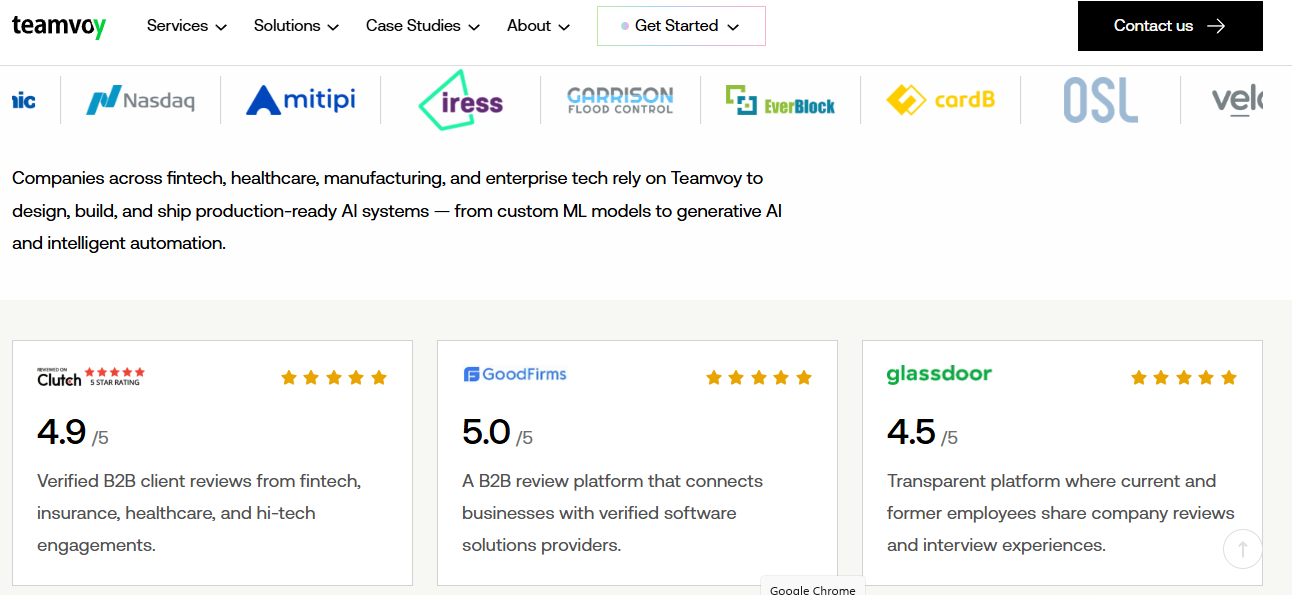
- Named regulator and standards experience: Delivery inside PSD2, PCI-DSS, DORA, SOC 2, GDPR, BaFin, and FCA scope.
- Ownership after go-live: The same senior lead stays with the system after launch, not a handover team.
- Incremental versus rewrite approach on a live payment flow: Stabilise and document first, then modernise in slices.
- Production incident and rescue capability: Built for engagements that begin with a system another vendor left behind.
- Engagement model and senior technical lead ownership: Long-term partner, one accountable senior engineer per system.
- Twelve-plus years of full-cycle engineering across banking and fintech, insurance, healthcare, manufacturing, retail, logistics, and complex SaaS.
- Multi-year platform work where the payment path could not go down during modernisation.
- Long-running product partnerships, including a wealth-management platform carried from proof of concept through to scale and beyond an acquisition, as recorded in the case studies.
I also keep AI out of the payment path itself. We use it on tests, scaffolding, and documentation, and the reasons are set out in our note on vibe coding security risks. Payment processing and data migrations get written by someone who can explain the code under audit, without an assistant’s annotations.
I can confidently say that we would not be where we are today without Teamvoy's support.
The team is very collaborative and able to deliver innovative solutions for all our business needs.

Azumo
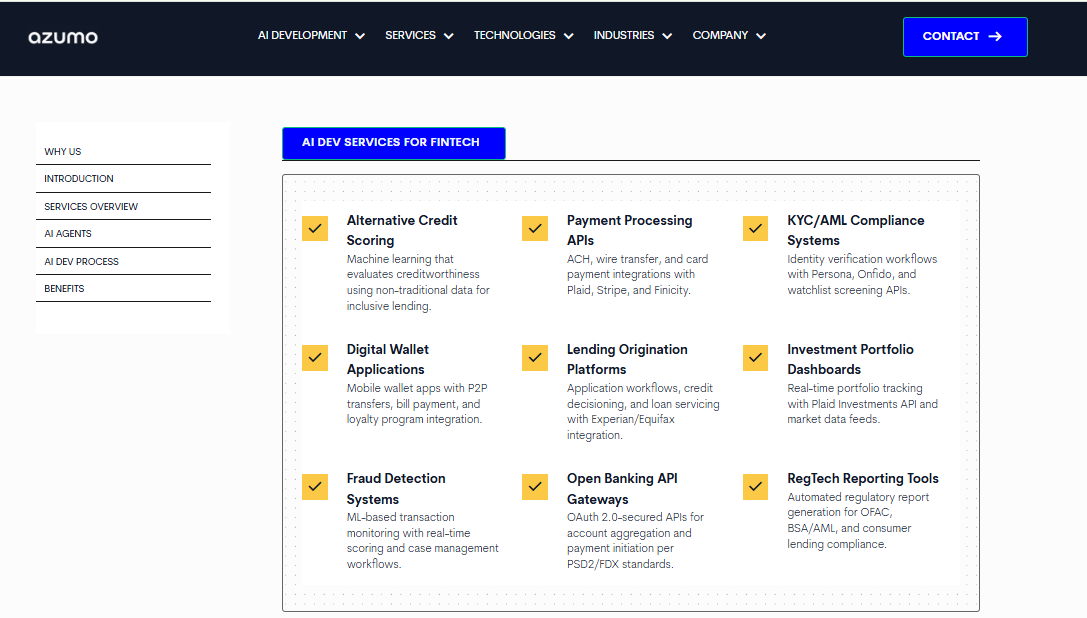
- Named regulator and standards experience: Not publicly claimed for PCI-DSS, PSD2, or DORA delivery.
- Ownership after go-live: Varies by engagement; capacity model rather than system ownership.
- Incremental versus rewrite approach on a live payment flow: Not publicly claimed as a stated methodology.
- Production incident and rescue capability: Not publicly claimed; strength reported in scoped feature delivery.
- Engagement model and senior technical lead ownership: Staff augmentation with client-side technical direction.
- A verified Clutch reviewer reports 12+ assigned teammates on a conversational AI engagement with no defined end date.
- The same reviewer reports delivery of “all of the integrations with the customer’s systems of record.”
- Reported on-time delivery of each use case across each phase of the engagement.
I have been wildly impressed with them.
Vention
- Named regulator and standards experience: Not publicly claimed for PCI-DSS, PSD2, or DORA delivery.
- Ownership after go-live: Varies by engagement; the client usually retains architectural ownership.
- Incremental versus rewrite approach on a live payment flow: No stated methodology in primary sources.
- Production incident and rescue capability: Not publicly claimed as a service line.
- Engagement model and senior technical lead ownership: Staff augmentation, with technical direction expected from the client side.
- Positions itself around supplying vetted engineering talent into existing product roadmaps.
- Public positioning centres on scale-up and enterprise delivery capacity.
- No payments-specific regulator experience is claimed in its own primary sources.
DOOR3

- Named regulator and standards experience: Not publicly claimed for payment-specific regimes.
- Ownership after go-live: Project-and-exit, so accountability ends near launch.
- Incremental versus rewrite approach on a live payment flow: Strength sits in defining new work, not sequencing live changes.
- Production incident and rescue capability: Not publicly claimed.
- Engagement model and senior technical lead ownership: Project-and-exit with client-side ownership afterwards.
- Public positioning centres on enterprise product definition and user experience work.
- Engagements are typically framed as defined projects with a deliverable and an end date.
- No named payments compliance track record appears in its own documentation.
Dualboot Partners

- Named regulator and standards experience: Not publicly claimed for PCI-DSS or PSD2 delivery.
- Ownership after go-live: Handover model, so long-term ownership sits with the client.
- Incremental versus rewrite approach on a live payment flow: Build-first orientation rather than stabilise-first.
- Production incident and rescue capability: Not publicly claimed.
- Engagement model and senior technical lead ownership: Project-and-exit with a delivery team rather than a permanent system owner.
- Public positioning centres on building product surfaces for client teams.
- Engagement framing implies a defined start, scope, and finish.
- No payments regulator experience is claimed in its own primary sources.
JetRockets
- Named regulator and standards experience: Not publicly claimed for payment regimes.
- Ownership after go-live: Varies by engagement; smaller teams often stay involved informally.
- Incremental versus rewrite approach on a live payment flow: No stated methodology in primary sources.
- Production incident and rescue capability: Not publicly claimed as a defined service.
- Engagement model and senior technical lead ownership: Project-based with direct access to senior engineers.
- Public positioning centres on web and mobile product engineering, including Ruby on Rails development style stacks.
- Delivery is framed around senior involvement rather than large pyramid teams.
- No named regulator or payments compliance scope appears in its own documentation.
Orases
- Named regulator and standards experience: Not publicly claimed for PCI-DSS, PSD2, or DORA.
- Ownership after go-live: Project-and-exit, with support arrangements varying.
- Incremental versus rewrite approach on a live payment flow: Build-oriented rather than stabilisation-oriented.
- Production incident and rescue capability: Not publicly claimed.
- Engagement model and senior technical lead ownership: Project-and-exit delivery team.
- Public positioning centres on custom software for mid-market organisations.
- Typical work involves automating internal processes rather than regulated payment infrastructure.
- No named payments regulator experience appears in its own primary sources.
SOLTECH
- Named regulator and standards experience: Not publicly claimed for named payment regimes.
- Ownership after go-live: Project-and-exit, support terms vary.
- Incremental versus rewrite approach on a live payment flow: No stated methodology in primary sources.
- Production incident and rescue capability: Not publicly claimed.
- Engagement model and senior technical lead ownership: Project-and-exit with US-based delivery leadership.
- Public positioning centres on US-based custom software delivery.
- Engagements are framed as scoped projects rather than open-ended partnerships.
- No payments compliance track record is claimed in its own documentation.
Scopic
- Named regulator and standards experience: Not publicly claimed for PCI-DSS, PSD2, or DORA delivery.
- Ownership after go-live: Client-side ownership; the model supplies throughput.
- Incremental versus rewrite approach on a live payment flow: No stated methodology in primary sources.
- Production incident and rescue capability: Not publicly claimed.
- Engagement model and senior technical lead ownership: Staff augmentation across a distributed team.
- Public positioning centres on distributed software development across many verticals.
- Engagements are framed around ongoing capacity rather than system ownership.
- No named payments regulator experience appears in its own primary sources.
⭐ How to read this roster
Seven of these nine firms make no public claim to named payments compliance experience. That is not a criticism; it is a filter. If your build sits inside PCI-DSS v4.0.1 scope, the requirements have been mandatory since 31 March 2025, and you need that experience named in writing, the same standard we apply to choosing a vendor for fintech.
The competing roundups I checked for this piece published rankings without publishing any of this. One scored providers on delivery attributes, which is closer to useful.
⚠️ The question that sorts the shortlist
Ask each firm one thing: who owns the payment path six months after launch. Capacity models put that back on you, and project models end before the first silent webhook failure. Neither answer is wrong. It just has to match your team.
Teamvoy sits at the other end of that spectrum, with an average engagement past four years and one senior engineer accountable for the system throughout, an approach set out in more detail on our about page. That model costs more up front than a pod and less than a second rescue. It is also the wrong choice if you genuinely need a two-week patch and nothing more.
Q2. What is actually in scope, and which gateways, rails, and downstream systems does it touch?
Payment gateway integration services connect your systems to payment infrastructure: API and SDK integration, card capture and tokenisation, routing configuration, webhook handling and idempotency, PCI-DSS-scoped deployment, and the settlement feed into accounting or ERP. Coverage spans Stripe, Adyen, Braintree, Worldpay, and Authorize.Net, plus regional rails including Razorpay, CCAvenue, Cashfree, PhonePe, and UPI.
Most quotes I review price the happy path. A card goes in, an authorisation comes back, and everyone signs off. The money then leaks out through the parts nobody scoped.
⚠️ The scope items that get skipped
Tokenisation means replacing the card number with a stored reference, so your servers never hold the real one. Idempotency means a repeated webhook cannot charge the customer twice. Both are line items, not assumptions.
Retry semantics, dispute handling, and refund flows belong in the same document. Teamvoy scopes the settlement path in the same statement of work as the checkout path, because an integration that does not reconcile is unfinished. That principle sits at the centre of our system integration work.
✅ Coverage your statement of work must name
| Layer | What to name explicitly |
|---|---|
| Global gateways and PSPs | Stripe, Adyen, Braintree, Worldpay, Authorize.Net, and Checkout.com |
| Regional rails | Razorpay, PayU, CCAvenue, Cashfree, PhonePe, Paytm, BillDesk, and UPI |
| Alternative methods | Wallets, bank transfer, buy-now-pay-later, and direct debit |
| Downstream systems | Accounting, ERP, Tally vouchering, and data warehouse |
Regional rails are not a footnote. APAC is the fastest-growing region for payment orchestration, which means multi-rail coverage is becoming the default question, not the advanced one.
💰 The last mile nobody quotes
Settlement is where the finance team lives. Daily matching, exception queues, break resolution, and voucher creation inside the accounting system are all engineering work, and much of it is data engineering in practice.
Skip that work and you ship a checkout that finance cannot close the books against. I have watched a month-end turn into a three-week manual reconciliation because nobody owned the settlement feed.
⏰ What to do before cutover
A senior engineer I trust puts it simply. Inject test orders through a dedicated QA account immediately after cutover, then check the billing and invoicing integrations straight away.
If the web tier works but a security group blocks the gateway webhook, the business is offline while every dashboard looks green. That gap between “site up” and “money moving” is where the worst outages hide, and it is a standard check in our cloud optimization reviews.
⭐ The scope checklist to paste into your RFP
- Which gateways, rails, and alternative methods are in scope, by name.
- Who implements tokenisation, and where the token vault sits.
- Webhook handling, including idempotency keys and replay behaviour.
- Retry, refund, dispute, and chargeback flows.
- Settlement feed into accounting or ERP, with the matching rules written down.
- Sandbox test plan, including the post-cutover test-order sequence.
- Monitoring, alert routing, and who receives the alert at 2 AM.
Ask any shortlisted firm to price those seven items separately. The ones that fold items three to six into “integration” are the ones you will renegotiate with later.
Teamvoy has delivered full-cycle engineering since 2013 across banking and fintech, insurance, and complex SaaS, which is why the settlement path and the checkout path arrive in one scope document rather than two phases.
Q3. Hosted, direct API, or orchestration, and how hard is it to leave later?
Hosted checkout minimises PCI scope but limits control. Direct API integration maximises control and requires separate compliance, tokenisation, and routing work per gateway. Orchestration reaches multiple gateways through one API, so providers can be added or retired without a rebuild. Multi-gateway setups hold roughly 58% of orchestration platform share. Choose by your three-year provider count.
Most teams pick the model that ships fastest this quarter. The switching cost arrives two years later, and by then it is not a technical decision. It is a budget request nobody planned.
⚖️ The three models, side by side
| Model | Control and PCI scope | Adding a second provider | Exit difficulty |
|---|---|---|---|
| Hosted checkout | Least control, smallest PCI scope, card data never touches you | New integration each time | Low code, but limited data and design control |
| Direct API | Full control, largest PCI scope, separate compliance and tokenisation per gateway | Full build per provider | High, tokens and routing logic are embedded |
| Orchestration | Shared control, one API across many gateways, PSPs, and methods | Configuration rather than rebuild | Depends on token portability terms |
Fraud tooling and smart routing are the fastest-growing feature areas in this category, reportedly above 34% annual growth, which pushes more teams toward the orchestration column.
❌ The question nobody asks in procurement
Ask what happens when you leave. Token portability decides that answer. If the vault holding your card tokens belongs to the provider, migration means re-collecting cards from customers.
Teamvoy has taken over payment layers built by earlier teams and moved them model by model rather than rebuilding, because a checkout rewrite means a revenue outage. Renovating an occupied building is slower than starting fresh; it is also the only option when customers are inside. The same sequencing shapes our technology modernization engagements.
💸 Build versus buy, honestly
Building your own integration layer is defensible in exactly two situations. You have a dedicated platform team, and your core systems are genuinely unusual.
Miss either condition and you become the permanent owner of every API schema, field mapping, authentication flow, and retry rule. That job never ends, and it does not appear on any roadmap, a pattern documented in the tech debt avalanche.
⏰ The three-year provider-count test
Count the providers you expect to run in three years, not this quarter.
- One provider, simple checkout, and a small team: hosted is usually right.
- One provider, deep control needs, and in-house platform engineers: direct API.
- Two or more providers, multiple regions, or routing and failover needs: orchestration.
Failover means automatically retrying a declined or failed transaction through a second provider. If that sentence describes a requirement you already have, hosted is already behind you.
⭐ Four exit questions to ask before signing
- Who owns the token vault, and can tokens be exported in a usable format?
- What is the documented migration path to a second provider, and who has done it before?
- Which routing and retry logic lives in your code versus the provider’s platform?
- What notice period and data-return terms apply on termination?
Get those four answers in writing. A firm that cannot answer question one clearly has not migrated a payment layer before, which tells you something useful about the next three years.
Teamvoy’s engagements average past four years, and that length is the reason exit terms get read carefully at the start, as the case studies show. A system you will live with for a decade deserves a decade’s worth of questions on day one.
Q4. Who owns compliance, and what changes between now and 2028?
The merchant always owns its PCI-DSS obligations. The partner decides how much cardholder data touches your systems, which sets your SAQ scope. PCI DSS v4.0.1 future-dated requirements became mandatory on 31 March 2025, and EMVCo lists 3-D Secure v2.3.1 as current with v2.4.0 in draft. The agreed PSD3 and PSR texts then add Verification of Payee, adaptive SCA, and a consent dashboard.
Compliance gets assumed in kickoff meetings and assigned in nobody’s contract. That is the pattern I see most often, and it surfaces during the audit, not during delivery.
📋 What the standards actually say today
SAQ means Self-Assessment Questionnaire, the form that records your PCI scope. A hosted checkout shrinks it. A direct API integration expands it.
The PCI Security Standards Council published guidance for the e-commerce requirements that took effect after 31 March 2025, so any integration built before that date deserves a fresh look, ideally through an independent IT audit. Third-party FAQs still quote 3-D Secure v2.3.0, while EMVCo lists v2.3.1 as current.
⚠️ When strong customer authentication is triggered
Strong customer authentication means the payer proves identity with two independent factors. Under the EU framework, it applies when the payer:
- Accesses a payment account online.
- Initiates an electronic payment.
- Creates or replaces a tokenised payment instrument.
- Raises a spending limit or changes credentials and contact details.
Merchant-initiated transactions with no payer involvement sit outside that list. Teamvoy delivers inside named scopes including PSD2, PCI-DSS, DORA, SOC 2, GDPR, and BaFin, and the trigger list is treated as a build requirement rather than a legal footnote, the same discipline described in building regulator-ready systems in fintech.
⏰ The 2026 to 2028 calendar, with the disagreement shown
Three new build items arrive with PSD3 and the PSR. Verification of Payee checks the account name against the IBAN before the payment goes out. Adaptive SCA adjusts checks by risk. A consent dashboard lets customers see and revoke third-party access.
Timing is genuinely contested. PwC’s analysis places most obligations in 2028, with both instruments applying 21 months after entry into force and licensed institutions given 27 months to re-demonstrate compliance. Other analyses put compliance work in 2026 and 2027. I present both rather than pick one.
🧾 What clients say about auditable delivery
I can confidently say that we would not be where we are today without Teamvoy's support.
Their technical expertise was top class.
✅ Five clauses that assign ownership
- Which PCI-DSS requirements the partner implements, by requirement number.
- Who maintains the SAQ and produces the supporting evidence.
- The 3-D Secure version implemented, and who upgrades it when EMVCo publishes.
- Which SCA triggers are covered in code, and which are out of scope.
- Who owns the change log and the audit trail after launch.
Then ask three questions of every shortlisted firm. Which named regimes have you delivered inside? Who produced the audit evidence? Can I speak to the engineer who did it?
❌ One rule I will not bend
Payment processing and data migrations get written by a person, not generated and reviewed. Almost right is the expensive failure mode here. It passes review, ships, and waits six months before anyone notices, which is the core argument in vibe coding security risks.
Teamvoy produces the compliance evidence trail as part of delivery rather than afterwards, which is the difference between an audit that takes a week and one that takes a quarter. That approach costs more in week one. It costs less in year three, as the insurance and regulated-platform engagements consistently show.
Q5. Why do payment integrations that pass QA still fail in production, and what does good delivery look like instead?
Payment integrations fail on conditions QA never reproduces: a synchronous cross-availability-zone write adding two milliseconds per commit until the connection pool exhausts, a vendor whitelisting your old on-premises NAT IP, a session path that only breaks in Safari private browsing, or a pool filled by an undocumented batch job. Good delivery runs discovery, planning, execution, sandbox testing, and then monitored support.
The dangerous integration is not the broken one. It is the one that almost works. Broken code fails the build, and someone throws it away.
⚠️ Three failures that pass every test
Almost right passes review and ships. Then it sits in production for months before anyone notices, and the fix costs more than the original build.
Here is what those failures actually look like in the wild:
- The two-millisecond death. A database cutover succeeds, but the app now writes synchronously across two availability zones. Each commit costs two milliseconds more, and the connection pool drains until nothing can commit.
- The whitelist trap. The migration is clean, and payments are dead. A third-party vendor only accepts traffic from your old on-premises NAT IP address, which no longer exists.
- The browser-specific path. The checkout works everywhere except Safari private browsing, which happens to be how a fifth of your users sign in.
❌ The fix is usually memory, not code
An on-call engineer once chased a 503 error with an AI assistant. The tool said restart the server. Six restarts later, a senior human looked for thirty seconds and named it: the database connection pool was full because of a batch job.
That fact lived in nobody’s documentation. Teamvoy is regularly brought in after another vendor has exited, and the first deliverable is usually a written map of the payment path nobody on the team can still explain, the recovery sequence set out in updating systems nobody understands.
🧾 What clients say about that process
We were impressed with the technical management, adherence to process, and technical capability of the engineers.
We're impressed with their involvement in processes and quick completion of work.
✅ Where AI belongs, and where it does not
Use AI on tests, scaffolding, and documentation. Keep it out of the payment path itself. Payment processing and data migrations need code written by someone who can explain it under audit, which is how we scope AI integration services on live systems.
One security scan of 5,000 AI-built applications found 60% were vulnerable. Teamvoy applies a three-question rule to every pull request: does it reuse existing code, does it follow our conventions, and can the developer explain it without reading the assistant’s comments?
⏰ The five stages that catch these failures
- Discovery. Confirm the requirement and the technical reality. Output: a map of the live flow and its dependencies.
- Planning. Pick the provider and model, then define scope and rollback. Output: a sequenced plan with a named owner.
- Execution. Build inside PCI-DSS scope. Output: working code plus the audit trail.
- Testing. Validate flows, webhooks, retries, and edge cases in sandbox. Output: a signed test log.
- Support. Monitor, alert, and patch. Output: someone answering at 2 AM.
⭐ Your pre-cutover checklist
Inject test orders from a dedicated QA account the moment you cut over. Then check the billing and invoicing integrations immediately.
For suspected unused servers, run a scream test. Isolate them at network level for 48 to 72 hours, which surfaces monthly batch jobs and audit processes that normal monitoring windows miss, the same technique we use inside an IT audit.
Teamvoy has delivered 150-plus projects since 2013, and the pattern that repeats is simple. The gateway is rarely the problem. The undocumented path around it usually is.
Q6. What does an engagement cost, and how much revenue is riding on getting it right?
Engineering services pricing for payment integration is custom-quote at every firm, so any table with a price column is misleading. The surprise cost is internal: five senior engineers over three months on custom connectors for a shelved pilot is roughly $500,000 in salary burn. Against that, cart abandonment averages 70.22% across a 50-study meta-analysis, with about USD 260 billion recoverable in the US and EU.
Two quotes for the same integration can differ by a factor of four. That is not because one firm is dishonest. It is because they scoped different work.
💸 The cost nobody puts in the proposal
Half a million dollars on plumbing is the number that stays with me. Five senior engineers, three months, custom connectors, and the pilot got shelved before launch.
That spend never appears in a vendor quote, because it is your payroll. Teamvoy quotes against a scoped delivery plan with a named senior lead, so integration line items and compliance line items are separated before anyone signs, a discipline we also apply in IT cost optimization reviews.
💰 What is actually at stake at checkout
Baymard Institute’s aggregate of 50 independent studies puts average cart abandonment at 70.22%. Mobile runs near 80%, and desktop near 66%.
Their estimate of recoverable revenue across the US and EU is about USD 260 billion. A payment path that fails for one browser or one card type is not a bug ticket. It is a share of that number leaving quietly, which is why checkout reliability sits at the centre of retail and ecommerce engagements.
⚠️ Where the analysts disagree, shown plainly
Payment orchestration forecasts do not agree, and I would rather show that than pick the flattering figure.
| Source | 2026 market size | Growth rate cited |
|---|---|---|
| Business Research Insights | USD 2.43B | 24.7% CAGR |
| Mordor Intelligence | USD 3.13B | 18.31% CAGR |
| ResearchAndMarkets | USD 3.66B | 19.3% CAGR |
| Global Growth Insights | USD 3.76B | 31.56% CAGR |
| Technavio | Growth of USD 4.27B, 2026 to 2030 | 24.5% CAGR |
A spread from 2.43 to 3.76 billion in the same year should make you cautious about any vendor deck built on one line from one report.
✅ A build-versus-buy worksheet you can fill today
Run these five numbers before you choose:
- Fully loaded monthly cost of the engineers who would build it.
- Months to first production transaction, honestly estimated.
- Annual maintenance hours per provider connection.
- Cost of adding a second provider in year two.
- Cost of one day of failed checkout, using your own average daily revenue.
Compare line five against lines one and two. If a single outage costs more than a month of partner fees, the decision usually makes itself.
⏰ One more number worth knowing
Reported analysis suggests 95% of enterprise generative AI pilots have not returned a measurable dollar. I read that as a warning about sequencing, not about AI, and the same caution runs through our AI integration cost guide.
Teamvoy averages past four years per engagement, which changes how cost gets discussed. Year one looks expensive next to a pod. Year three usually does not, because nobody has paid for a second rescue.
Q7. Your payment layer is already live and fragile, so how do you choose from here?
Start with documentation, not architecture. Ask the partner to map the live payment path, name every third-party dependency and whitelist, and produce a rollback plan before writing code. Under a hard external deadline inside 60 days, default to rehosting rather than refactoring. A refactor mid-flight reliably produces broken services and a missed date.
Nobody wants to touch the payment code. That reluctance is rational, and it is also how the system got fragile in the first place.
⏰ The five-step diagnostic
Run this before you sign anything:
- Map the live path, from checkout to settlement, on one page.
- List every third-party dependency, IP whitelist, and credential owner.
- Identify what is not documented, and who holds it in their head.
- Write the rollback plan, including who executes it and when.
- Only then decide what changes, and in what order.
Teamvoy delivers that map as the first output on rescue engagements, because you cannot modernise a payment path nobody can currently describe. A vendor rescue is closer to taking over another doctor’s patient than to starting a new project, and it is the starting point for most technology modernization work we take on.
⚠️ Rehost or refactor, and the hidden dependencies
The 60-day rule is simple. If a data centre lease or compliance date lands inside 60 days, rehost first and refactor later.
For anything you suspect is unused, run a scream test. Isolating a server at network level for 48 to 72 hours surfaces the monthly batch job or audit process that standard monitoring misses, a check that pairs well with cloud optimization.
❌ Why decoupling matters more than features
One German payment provider built genuinely good fraud detection. Turning it into a product failed, because readers and writers sat directly against the database with no separation from the data model.
Every rollback turned into a fresh outage. Good logic trapped in a coupled data layer is not an asset you can move, a constraint we see repeatedly in banking and fintech platforms.
🧾 What long engagements look like from the client side
I can confidently say that we would not be where we are today without Teamvoy's support.
The care and interest they showed are what makes Teamvoy special.
✅ Four situations, four different partners
- You inherited a flow nobody can debug. You need a firm that documents before it builds.
- You have a PCI-DSS or PSD3 date. You need named regulator experience, in writing.
- Your checkout drifted over years of patches. You need incremental change, not a rewrite.
- Your AI-built product is unstable in production. You need stabilisation before features, the argument behind vibe coding security risks.
Match your situation to that list, then read the nine cards again with it in mind.
⭐ What this analysis cannot tell you
I cannot tell you which firm will answer at 2 AM. Public reviews and capability pages do not measure that, and I have been wrong about firms that looked strong on paper.
The test I would apply is blunt. Can this partner keep the payment path alive through a database split-brain, a mid-flight security incident, and a CFO who wants an answer now? Ask them to describe a time they did exactly that, and check it against the case studies they publish.
Teamvoy takes the payment engagements that begin with a system already in production and a date already set. Send the failure description, and I will tell you plainly whether it is our kind of work.