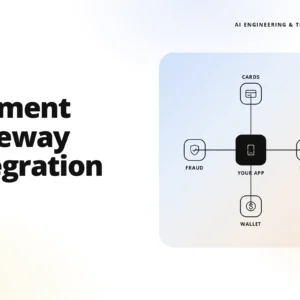
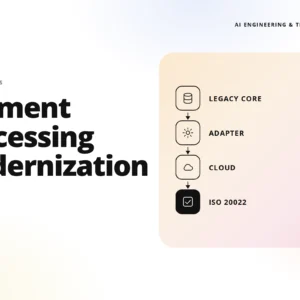
- Eleven engineering firms genuinely build custom payment processing software, and each fits a different situation rather than sitting on a ranked league table.
- Cost tiers run from $8K to $30K for a processor integration up to $150K to $300K+ for a PayFac platform, and published ranges conflict sharply.
- Ownership costs more than launch: maintenance at 15% to 25% of build cost annually, recurring QSA assessment fees, licensing, and on-call coverage.
- PCI DSS v4.0.1 is the only active version, and three clauses change code: payment-page script authorization, a WAF requirement, and encryption-at-rest rules.
- Payment systems usually fail after go-live, from compounding latency, vendor IP whitelists, coupled data models, and knowledge nobody wrote down.
- AI belongs in fraud scoring, reconciliation triage, and tests, never in authorization, settlement, or live ledger migrations, because almost-right code is costlier than wrong code.
Q1. Which companies build custom payment processing software, and which situation is each one built for?
Eleven engineering firms genuinely build custom payment processing software, and each fits a different situation. Teamvoy fits regulated payment platforms already under pressure: inherited codebases, PCI-DSS and PSD2 exposure, modernization without a rewrite. Others fit greenfield gateway builds, AI capability on top of an existing stack, or staff augmentation. The criteria that matter are payments engineering depth, named compliance scope, engagement model, and accountability after go-live.
Choosing a partner for payment software is not a normal procurement decision. Payments carry $2.5 trillion in global revenue across 3.6 trillion transactions a year, and every one of those transactions is auditable. When a payment platform breaks, you do not miss a sprint, you file a report. PCI DSS v4.0.1 has been the only active version since v4.0 retired, and its requirements now shape architecture, not just paperwork. This guide is written for CTOs, technical founders, and IT directors picking a partner they will live with for years. It describes kinds of firms, not a league table.
Our Evaluation Criteria
Five criteria, applied in the same order to every firm below. They are the ones that actually move a payments decision.
- Payments engineering depth. Has the firm built authorization, settlement, or reconciliation logic, not only integrated a processor?
- Named compliance scope. Which regulators and standards are inside their delivery scope (PCI-DSS, PSD2/SCA, DORA, SOC 2)?
- Engagement model. Project-and-exit, long-term partner, or staff augmentation. This decides who owns the system in year three.
- Takeover capability. Can they read, document, and stabilise a payment stack a previous team built?
- Accountability after go-live. Who answers the pager at 2am, and is that written into the contract?
⚠️ Why the criteria are weighted this way
Payments engineering depth and compliance scope carry the most weight here. Both are hard to fake and expensive to get wrong.
Engagement model and accountability come next, because they decide the cost of the fifth year. Takeover capability matters only if you already have a system, which most readers of this article do.
Who This Guide Is For
- The Burned CTO who inherited a payment stack from a vendor that underdelivered or exited.
- The Enterprise IT Director with a PCI-DSS assessment or DORA obligation landing on a fixed date.
- The Technical Founder whose payment core now blocks pricing changes, new markets, or hiring.
💰 What this guide will not do
It will not rank firms. Engineering pricing is custom-quote everywhere, so any pricing column here would create false comparability.
It will also not pretend the choice is between good and bad companies. It is between firms built for different situations.
The Firms Covered
- Teamvoy: Best for a live, regulated payment system that a previous team built and nobody now fully understands.
- Azumo: Best for adding AI capability (fraud triage, document and risk analysis) alongside a payment stack that already works.
- Vention: Best for a greenfield gateway, wallet, or payment orchestration build with a large dedicated team.
- DOOR3: Best for enterprise-side payment and back-office integration work inside an existing IT function.
- Dualboot Partners: Best for scale-up product teams that need engineering capacity attached to their own roadmap.
- HatchWorks AI: Best for AI-assisted delivery on product work where payments are a feature, not the core.
- NineTwoThree AI Studio: Best for early product teams validating a fintech idea before regulatory scope arrives.
- Orases: Best for mid-market custom platforms where payment handling is one workflow among many.
- Sidebench: Best for design-led product builds where the payment flow is part of a wider experience.
- SOLTECH: Best for regional US mid-market teams wanting a nearby partner with ongoing support.
- Scopic: Best for distributed, cost-sensitive builds where the payment layer stays with a third-party processor.
| Company Name | Best For | Engagement Model | Industry Depth & Compliance Coverage |
|---|---|---|---|
| Teamvoy | A live regulated payment system built by a team that has moved on | Long-term partner (multi-year) | Banking, insurance, healthcare, complex SaaS. PCI-DSS, SOC 2, GDPR, BaFin, PSD2, DORA within delivery scope. Agentic payment work approached data-layer first |
| Azumo | AI capability layered onto a payment stack that already runs | Staff augmentation and project teams | AI, financial services, healthcare. SOC 2 supported for private model tuning. Payments-specific gateway engineering not publicly claimed |
| Vention | Greenfield gateway, wallet, or orchestration platform build | Dedicated teams (long-term) | Fintech, banking, trading. Publishes payment gateway, EMV, AML and KYC, and PCI DSS work; 200+ fintech products claimed |
| DOOR3 | Enterprise payment and back-office integration inside existing IT | Project-and-exit, plus support retainers | Enterprise, financial services, healthcare. Regulated payment certification depth not publicly claimed |
| Dualboot Partners | Engineering capacity attached to your own product roadmap | Staff augmentation and embedded teams | Fintech, SaaS, healthcare. Named payment-scheme certification not publicly claimed |
| HatchWorks AI | AI-assisted delivery where payments are a feature, not the core | Nearshore dedicated teams | SaaS, healthcare, retail. Compliance posture stated at company level, not payment-scheme level |
| NineTwoThree AI Studio | Validating a fintech product before regulatory scope arrives | Project-and-exit | SaaS, fintech, media. Not positioned for PCI Level 1 scope work |
| Orases | Mid-market custom platform where payments are one workflow | Project-and-exit, plus maintenance | Enterprise, healthcare, associations. Payments treated as an integration, not a core discipline |
| Sidebench | Design-led builds where checkout is part of a wider experience | Project-and-exit | Healthcare, consumer, enterprise. HIPAA-aware; PCI depth not publicly claimed |
| SOLTECH | Regional US mid-market work with ongoing local support | Project-and-exit, plus managed support | Mid-market US, logistics, healthcare. Regulated payments depth not publicly claimed |
| Scopic | Distributed, cost-sensitive builds on a third-party processor | Staff augmentation | SaaS, healthcare, consumer. Custom gateway and CDE ownership not typical scope |
⭐ How to read the cards below
Eleven firms are covered in total. Each card uses the same five criteria, in the same order, so you can compare like with like.
Where something is not publicly documented, the card says so instead of guessing. That is the honest state of vendor research in this category.
Teamvoy
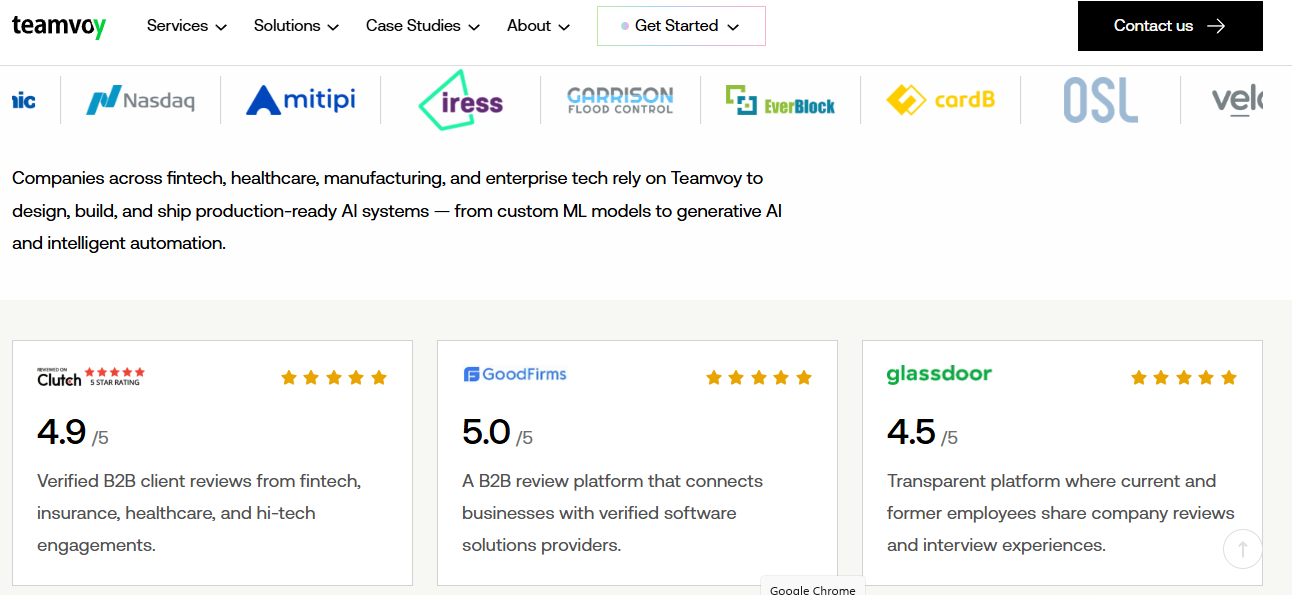
- Payments engineering depth: banking and trading platforms, including a seven-bank internet banking build.
- Named compliance scope: PCI-DSS, SOC 2, GDPR, HIPAA, BaFin, PSD2, DORA inside delivery scope.
- Engagement model: long-term partner, multi-year, not project-and-exit.
- Takeover capability: built for systems a previous vendor left behind or abandoned.
- Accountability after go-live: a senior technical lead owns the system end to end.
- A seven-bank internet banking platform delivered and maintained in production.
- Trade surveillance software used by 30 financial institutions.
- An insurance platform serving 34M+ prospects.
- Named clients include Nasdaq and Market Access Direct.

Azumo
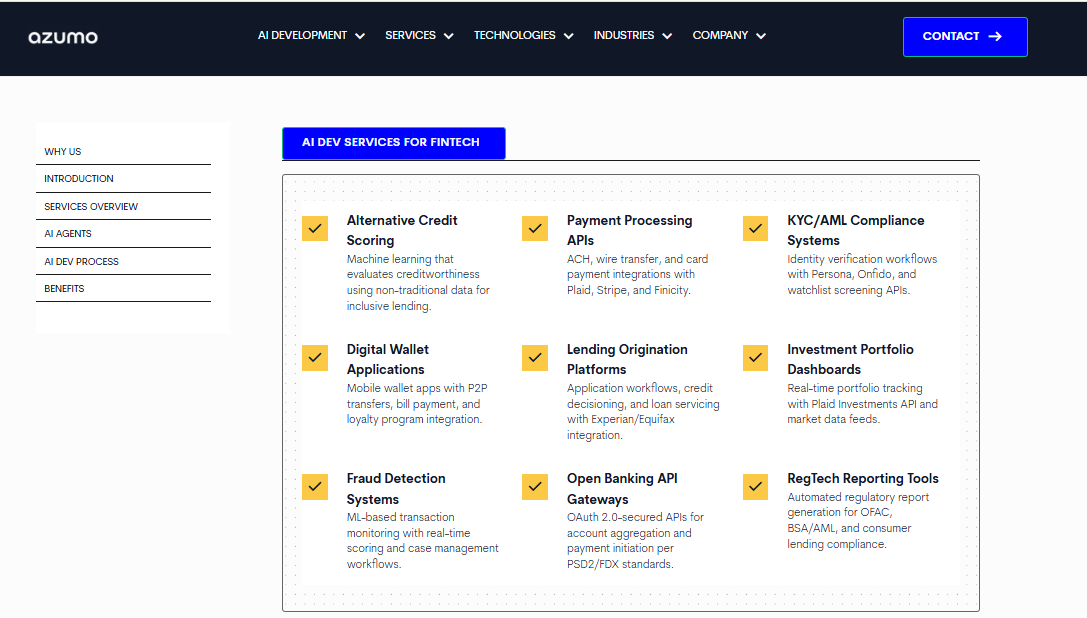
- Payments engineering depth: AI and application work in financial services; gateway engineering not publicly claimed.
- Named compliance scope: SOC 2 supported for private model tuning; PCI-DSS scope not publicly claimed.
- Engagement model: staff augmentation and project teams, open-ended in practice.
- Takeover capability: strong on existing platforms, since the work attaches to a client’s own product.
- Accountability after go-live: varies by engagement; team composition is adjusted by Azumo rather than fixed.
- 22 verified client reviews on Clutch averaging 4.9 stars, Premier Verified status.
- Documented delivery across financial services, healthcare, and SaaS.
- Conversational AI application delivery for a Fortune 100 end customer, via a SaaS platform client.
Teamvoy sits in this list for one reason: the payment systems we are called into are already live, already regulated, and already carrying someone else’s decisions. 150+ delivered projects, a 4+ year average engagement, and a senior technical lead who owns the system are the facts behind that. If you want a second read before you sign anyone, a 30-minute technical call is open, and the same team handles AI integration on stacks already under pressure.
Sources: McKinsey, 2025 Global Payments Report, September 2025. PCI Security Standards Council, PCI DSS v4.0.1 document library, 2024. PCI SSC, “Just Published: PCI DSS v4.0.1,” 11 June 2024. Teamvoy service and case-study pages. Clutch profiles for Teamvoy and Azumo. Vention fintech and payment gateway pages.
Vention
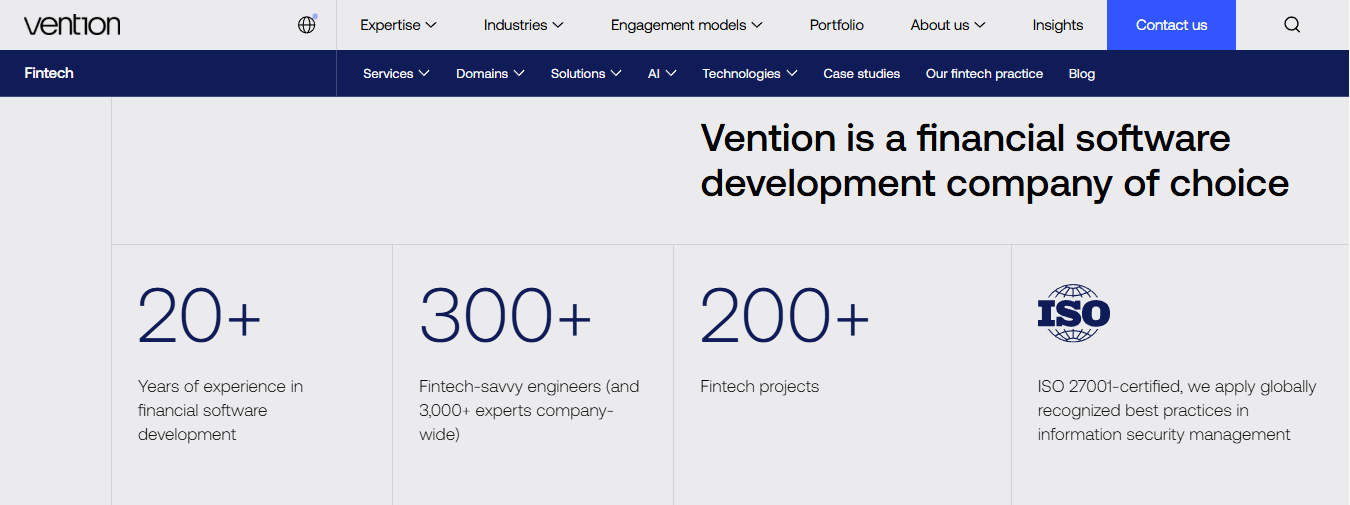
- Payments engineering depth: publishes gateway, EMV, wallet, KYC, and AML work as core services.
- Named compliance scope: PCI DSS referenced in its own payment gateway material.
- Engagement model: dedicated squads sized for multi-year builds.
- Takeover capability: geared to greenfield and product scale-up more than vendor rescue.
- Accountability after go-live: varies by engagement; support is contracted separately.
- Published case work for Curve, a UK card-consolidation platform.
- Published engineering work for StoneX, covering web, mobile, and test automation.
- Public service pages covering digital payments, mobile banking, and payment gateways.
DOOR3
- Payments engineering depth: fintech product and UX work documented; gateway build depth not publicly claimed.
- Named compliance scope: states AI delivery for regulated environments; specific payment standards not named.
- Engagement model: project-and-exit, with support arrangements after delivery.
- Takeover capability: strong on audits, including documented four-week UX audits.
- Accountability after go-live: not publicly claimed as an ownership model.
- Four-week UX audit plus 12-week engagement for a fintech client, with three user roles defined.
- Dashboard redesign that reduced a client’s time-to-value metric.
- 20+ years of continuous operation as an independent consultancy.
Dualboot Partners
- Payments engineering depth: fintech product delivery experience; payment core engineering not a named specialism.
- Named compliance scope: stated at company level, not tied to PCI-DSS or PSD2 assessments.
- Engagement model: engineers embed into your team and follow your process.
- Takeover capability: good at joining work in flight, since that is the model.
- Accountability after go-live: sits with your team, not the vendor.
- Documented delivery for funded product companies across fintech and SaaS.
- Embedded-team model that scales up and down with roadmap demand.
HatchWorks AI

- Payments engineering depth: payments appear as a product feature, not a core discipline.
- Named compliance scope: company-level posture; payment standards not named.
- Engagement model: nearshore squads, Latin America, US hours.
- Takeover capability: moderate; suited to active products with living documentation.
- Accountability after go-live: varies by contract.
- Published nearshore delivery model with US-hours overlap.
- Documented product work across SaaS, healthcare, and retail.
NineTwoThree AI Studio
- Payments engineering depth: product and AI builds; regulated payment engineering not a stated specialism.
- Named compliance scope: not tied to PCI-DSS Level 1 scope work.
- Engagement model: defined scope, defined end date.
- Takeover capability: limited by design, since the model favours new builds.
- Accountability after go-live: handover to the client team.
- Documented MVP and AI product delivery for early-stage companies.
- Studio model with in-house design and engineering.
Orases
- Payments engineering depth: payments handled as one workflow inside larger platforms.
- Named compliance scope: industry breadth documented; payment standards not named.
- Engagement model: project-and-exit, with maintenance available.
- Takeover capability: modernization and integration work is a stated service.
- Accountability after go-live: maintenance contracts, not system ownership.
- 25+ years of continuous operation as a custom software firm.
- 73+ verified Clutch reviews at a 5.0 average.
- Documented work across industrial, healthcare, manufacturing, and energy sectors.
Sidebench

- Payments engineering depth: checkout and payment flows as part of wider product design.
- Named compliance scope: HIPAA-aware healthcare work documented; PCI depth not claimed.
- Engagement model: scoped product engagements.
- Takeover capability: limited; strongest at concept-to-launch.
- Accountability after go-live: handover, with optional support.
- Documented product delivery across healthcare, consumer, and enterprise clients.
- Design-led process with research and strategy inside the engagement.
SOLTECH
- Payments engineering depth: general custom software, with payments as an integration.
- Named compliance scope: not tied to named payment standards publicly.
- Engagement model: build, then move to a support agreement.
- Takeover capability: available, mostly for regional mid-market systems.
- Accountability after go-live: support agreements are a documented offer.
- Long-running US delivery practice with ongoing support contracts.
- Documented mid-market work across logistics, healthcare, and services.
Scopic
- Payments engineering depth: applications that use a third-party processor, not custom rails.
- Named compliance scope: not documented against payment standards.
- Engagement model: hourly, distributed contributors.
- Takeover capability: moderate; suited to maintaining existing applications.
- Accountability after go-live: sits with the client.
- Long-running distributed delivery model across many product verticals.
- Documented maintenance engagements measured in years.
⚠️ One pattern worth naming before you shortlist
Nine of these eleven firms do not publish a payment scheme certification claim. That is not a criticism, it is a scoping signal. It tells you where the cardholder data environment is expected to sit, and usually the answer is with your processor, not your partner. If the boundary is unclear on your own stack, an independent system audit settles it faster than another vendor call.
The public discussion mirrors this. A widely read r/SaaS Reddit thread from a developer who spent six months fixing AI-built SaaS products describes the same gap: products with real users, and a payment path nobody documented. The same failure pattern shows up in our own work on AI-generated code that reached production.
Teamvoy sits in this list for one reason. The payment systems we are called into are already live, already regulated, and already carrying decisions someone else made, backed by 150+ delivered projects and a 4+ year average engagement across banking and fintech work. Where a rewrite is off the table, the route is usually staged modernization sprints, and where the constraint is regulatory, it is regulator-ready delivery. You can see the delivered systems behind those claims in our case studies, or start with a 30-minute technical call.
Sources: Vention fintech, payment gateway, and case-study pages. DOOR3 Clutch profile and company about page. Orases Clutch profile and company about page. r/SaaS, “I’ve been fixing vibe-coded SaaS products for 6 months”.
Q2. What does building custom payment processing software actually involve?
Payment processing software development is the design and engineering of systems that authorize, route, and settle transactions between customers, acquiring banks, and merchants. Work spans gateway logic, tokenization, orchestration across processors, reconciliation, and PCI DSS v4.0.1 controls covering the cardholder data environment. Roughly 30% is the happy path. The rest is retries, idempotency, and webhook ordering.
One transaction, walked end to end
A card number arrives at your gateway. Your system tokenizes it (swaps the card number for a reference token), then routes an authorization request to the acquirer. The acquirer checks the issuer, and either holds the funds or declines.
Hours later, settlement runs as a separate batch. That gap is the whole problem. Teamvoy scopes payment work from the data layer first, because settlement state is where two systems quietly disagree.
⚠️ Where state diverges
Your database says captured. The processor says pending. A webhook arrived twice, or arrived out of order, or never arrived at all.
Idempotency (making a repeated request produce the same result, not a second charge) is not a nice-to-have here. It is the difference between one charge and four.
The parts nobody demos
Sales demos show a successful checkout. Production shows partial captures, split shipments, refunds against expired authorizations, and chargeback evidence deadlines.
Reconciliation is the honest test. Every day, your ledger and the processor’s settlement file must agree to the cent, and someone must own the exceptions when they do not.
❌ The failure I did not predict
One team I looked at had a token exchange that assumed browser local storage was always available. It worked in Chrome. It worked in Firefox.
It failed silently in Safari private browsing, which was how 20% of their users signed in. Nothing was broken in a demo. One fifth of revenue was.
The four components to scope in writing
Estimates go wrong because these get treated as details. Name them in the RFP, and the number stops being fiction.
- Cardholder data environment boundary. Which of your servers store, process, or transmit card data?
- Idempotency and retry strategy. Keys, expiry, and behaviour on duplicate webhooks.
- Reconciliation and exception handling. Who works the daily break report, and inside which tool?
- Dispute and chargeback workflow. Evidence capture, deadlines, and the operations screen behind it.
✅ What to do this week
Ask your team a single question: where does settlement state live, and who is allowed to write to it? If two answers come back, that is your first piece of work.
Teamvoy’s AI and System Readiness Audit runs 3 to 5 days and produces an architecture review, a risk-surface map, and a prioritized action plan. I use it to answer exactly that question before anyone estimates a build, and the same discipline applies to any system integration that touches money.
What this means for your estimate
A vendor who quotes on the happy path is quoting 30% of the work. That is not dishonesty. It is what happens when nobody names the other 70%.
I have been wrong about timelines, and almost always in the same direction. The reconciliation and dispute work took longer than the authorization work, every single time.
Teamvoy has delivered payment and trading platforms in banking since 2013, including a seven-bank internet banking build and trade surveillance software used by 30 institutions. The pattern behind both is unglamorous: get the data layer right, then build.
Q3. What does a custom payment platform cost to build and then to own?
Third-party integration runs $8K to $30K in 2 to 6 weeks. A custom gateway MVP runs $20K to $60K in 3 to 5 months. A full PCI-compliant gateway runs $80K to $150K+ in 6 to 12 months. A PayFac platform runs $150K to $300K+ over 9 to 18 months. Published ranges conflict sharply.
The four build tiers
| Approach | Cost | Timeline | Best for |
|---|---|---|---|
| Third-party processor integration | $8K to $30K | 2 to 6 weeks | Standard checkout, no card data on your servers |
| Custom gateway MVP | $20K to $60K | 3 to 5 months | Proving routing or economics before certification |
| Full PCI-compliant gateway | $80K to $150K+ | 6 to 12 months | You hold card data and need scheme certification |
| PayFac platform | $150K to $300K+ | 9 to 18 months | You onboard and pay sub-merchants yourself |
⚠️ The sources do not agree
MVP floors are published at $20K to $60K in one 2026 guide, and $50K to $120K in another. Full gateways appear at $80K to $150K in one, and $250K to $1M+ in a third.
I am not going to average them. The spread tells you something real: scope definition, not engineering rate, drives the number. The same dynamic shows up in our AI integration cost breakdown.
The crossover gate
Building beats paying fees when your fully loaded ownership cost drops below your processor bill. In practice, that means high volume, usually well above $50M a year, or economics no processor will sell you.
Routing across multiple acquirers is one such case. Sub-merchant payouts are another. Teamvoy tells buyers not to build when the math does not support it, and that call happens on the first technical conversation.
💰 Three-year ownership, not launch cost
| Line item | Annual cost | Note |
|---|---|---|
| Maintenance and support | 15% to 25% of build cost | The only widely published figure |
| PCI Level 1 QSA assessment | $15,000 to $40,000+ | Recurs every year, not once |
| Money transmitter licensing (US) | $50,000 to $200,000+ | Only if you hold or move funds |
| On-call and monitoring | Varies | A payment system cannot be down |
The second assessment cycle is the line item teams forget. Year one gets budgeted. Year two arrives anyway. An IT cost review usually finds it before finance does.
The cost that never reaches the estimate
You become the permanent owner of every schema, field mapping, authentication flow, and retry path. One team burned five senior engineers over three months on custom connectors for a pilot that was later shelved.
That is roughly half a million dollars of salary, spent on plumbing. Nobody presented it to the board that way.
⏰ Why engagement length is a cost fact
Teamvoy’s average client engagement runs 4+ years across 150+ delivered projects. Ownership is cheaper when the people who wrote the settlement code are still reachable.
Their technical expertise was top class.
Honest disclosure: engineering pricing is custom-quote across every firm in this guide. That is why this article has no pricing column, since matching numbers would create false comparability.
Teamvoy runs a 3 to 5 day readiness audit and a fixed-scope two-week Sharp Sprint before any long engagement. A sprint ships a real first milestone, not a finished platform, and I say that plainly before anyone signs. The same delivery shape is described in our note on modernization sprints for teams that cannot afford a rewrite.
Q4. Which compliance obligations decide your payment architecture before you write code?
Yes, PCI DSS v4.0.1 is mandatory. Version 4.0 retired on 31 December 2024, v4.0.1 is the only active version, and all 64 requirements added in v4.0 apply to assessments dated on or after 31 March 2025. Three clauses shape architecture: payment-page script authorization, a WAF on internet-facing applications, and no full-disk encryption for cardholder data at rest.
The three clauses that change code
Requirement 6.4.3 asks you to inventory, authorize, and monitor the integrity of every script on a payment page. That means a record of who approved each script, and when.
A web application firewall (a filter that inspects traffic before it reaches your app) is now required for public-facing applications. Full-disk encryption alone no longer counts for stored card data.
⚠️ What this forbids in practice
You can no longer drop a third-party tag onto a checkout page without a paper trail. You can no longer treat an encrypted disk as protection for a card number sitting in a table.
Critical vulnerabilities carry a 30-day patch window, with a risk-based schedule for the rest. That is a release process decision, not a security ticket.
If you operate in the EU or UK
PSD2 requires strong customer authentication, so two independent factors sit in your checkout flow by law. Your architecture needs exemption handling, or your approval rate drops.
DORA has applied to EU financial entities since January 2025, and it reaches your vendors too. Teamvoy delivers inside PCI-DSS, SOC 2, GDPR, BaFin, PSD2, and DORA scope, which is why these constraints enter designs at the data layer. We have written separately about building regulator-ready systems in fintech.
❌ Eligibility does not equal compliance
Qualifying for a shorter self-assessment questionnaire is not evidence of a compliant build. I have watched teams pass one assessment, then fail the next with the same code.
The reason is always the same. Nobody owned the evidence trail between cycles.
Five questions to send every shortlisted vendor
Send these in writing. Vague answers are the answer.
- Which specific v4.0.1 requirement numbers does your delivery process address?
- Where will the cardholder data environment boundary sit in our architecture?
- How do you inventory and authorize payment-page scripts under 6.4.3?
- Who produces audit evidence between assessment cycles, you or us?
- Have you shipped under a QSA assessment before, and can we speak to that client?
✅ The Monday action
Map your current compliance claims to requirement numbers, not to logos. A certificate on a website is not a control.
Teamvoy runs this mapping inside its system audit, and the output is a written report rather than a verbal readout. I prefer written, because a report survives the staff change that follows every audit.
The honest limit
Compliance work does not make a system good. It makes it defensible.
I have seen clean audits on systems I would not want to modernise, and messy audits on systems that were fundamentally sound. Treat the standard as a floor, not a design. Where the floor and the codebase are far apart, the route is usually staged technology modernization.
Teamvoy has delivered into banking, insurance, and healthcare since 2013, including trade surveillance used by 30 institutions and an insurance platform serving 34M+ prospects. Auditable delivery, day by day, is what that experience actually teaches.
Q5. How do you tell real payments engineering depth from a fintech landing page?
Ask for the reconciliation story, not the case study. Firms with real depth describe a settlement mismatch they found and fixed, name the acquirer certification they went through, and explain their idempotency strategy without slides. Firms without it describe integrations. Then check whether the senior engineer in the pitch is the one who stays through month eighteen.
The four questions that separate the two groups
Send these before the demo. The answers arrive in minutes if the experience is real.
| Question | Answer that reassures | Answer that should worry you |
|---|---|---|
| Describe a settlement mismatch you found | A specific date, amount, and root cause | “We use reliable processors” |
| Which acquirer certification have you completed? | Names the acquirer and the year | “We integrate with all major gateways” |
| What is your idempotency strategy? | Key scheme, expiry, duplicate webhook behaviour | “The API handles that” |
| Who owns the cardholder data environment? | A named role, with an evidence process | “It is fully compliant” |
⚠️ Why the second column is not a trick
Integrating a processor is real work, and plenty of good firms only do that. The problem is buying integration skill when you need money-movement engineering.
Teamvoy has delivered 150+ projects since 2013, including banking and trading platforms where settlement breaks were the job. I ask these four questions of my own team before I put them on a payment engagement.
The reference call nobody makes properly
Most buyers call a reference and ask if they were happy. Ask something harder: who was on the team in month eighteen?
If the senior engineer from the pitch left after month three, you bought a proposal, not a partner. Ask for that person’s name, then ask if they will still be there. The same test appears in our guide to choosing a technology vendor in fintech.
⭐ The metric worth demanding
Ask every firm for its average engagement length, including mine. It is the cheapest honest signal in this category, because it cannot be dressed up.
Teamvoy’s average client engagement runs 4+ years, with a senior technical lead accountable for the system throughout. Across 150+ projects, that continuity has predicted outcomes better than any technology choice we made, as our case studies show.
Two client views, for balance
We were impressed with the technical management, adherence to process, and technical capability of the engineers.
Teamvoy has a great structure and communication topped off with a lot of openness for new ideas to solutions.
✅ A code-review gate you can borrow
Three questions decide whether any change is ready, and they work on human and AI-written code alike. Does it reuse what exists? Does it follow your conventions? Can the developer explain it without reading the comments?
If the third answer is no, the code is not ready. I apply this to payment paths without exception.
Teamvoy publishes the metric it would want a buyer to ask for: 4+ year average engagement, 150+ delivered projects, and a named senior lead who owns the system. That is the proof I would test before signing anyone, including us.
Q6. Why do custom payment systems fail after go-live, and where does AI belong in the code?
Payment systems rarely fail at launch. They fail when a synchronous cross-zone write adds 2ms to every commit and compounds until the connection pool is exhausted. They fail when fraud logic cannot be carved out, because readers and writers sit on the same data model. AI belongs in fraud scoring, reconciliation triage, and tests, not in authorization, settlement, or migrations.
The 2ms that took down payments
A team moved its database to a two-zone setup for resilience. Each commit now waited for a synchronous write across both zones, which added 2ms.
Under normal load, nobody noticed. Under peak load, that penalty compounded until every database connection was held open, and the pool ran dry. Resilience choices like this one belong in an early cloud architecture review, not in a post-incident report.
⚠️ The vendor whitelist trap
A different failure, same week for someone else. Payments stopped because a third-party vendor whitelisted only the old on-premises IP address.
The vendor’s stated turnaround for a whitelist change was five business days. The engineer routed outbound traffic for that vendor’s address range back down the old private link, and payments resumed the same hour. Our hybrid cloud banking architecture work exists because of constraints exactly like this one.
The 2am knowledge that was never written down
An on-call engineer hit repeated 503 errors and asked an AI assistant for help. It suggested restarting the server, six times.
A senior colleague knew the real cause: a nightly batch job had filled the connection pool. That fact lived in one person’s head, not in any document. Teamvoy treats undocumented behaviour as the first deliverable on a rescue, because a system nobody understands cannot be safely changed until it is written down.
❌ Almost right costs more than wrong
Completely wrong code fails the build. Almost-right code passes review, ships, and sits in your ledger for six months before anyone notices.
By then the fix has compounded into something nobody budgeted. Plausible is the most dangerous word in this work.
Where AI earns its place
| Task | AI-assisted | Human-written |
|---|---|---|
| Fraud scoring and anomaly triage | Yes | Optional |
| Reconciliation exception sorting | Yes | Optional |
| Test generation and log analysis | Yes | Optional |
| Authorization and settlement logic | No | Required |
| Data migrations on live ledgers | No | Required |
The boundary is blast radius, not ideology. One scan of 5,000 AI-built applications reported 60% carrying vulnerabilities, which matches what I see when nobody drew that line, and what we documented in our note on security risks in AI-generated code.
✅ Two tactics to run this month
Run a scream test on anything you suspect is unused. Isolate it at the network level for 48 to 72 hours, and hidden monthly batch jobs will announce themselves.
Then gate every payment-path change behind the three-question review. Teamvoy has delivered a seven-bank internet banking platform and trade surveillance used by 30 institutions, and both taught the same lesson: undocumented dependencies, not bad code, cause the 2am call.
Teamvoy is built for this phase. Production incidents, undocumented codebases, and compliance-blocked features on live payment systems are the engagements other firms decline, and they are the ones we take.
Q7. What should agentic payment standards change in your roadmap, and how do you start?
Google announced the Agent Payments Protocol in September 2025 with 60+ partners, and donated it to the FIDO Alliance on 28 April 2026. Version 0.2.0 added human-not-present flows. Your stack needs signed Intent, Cart, and Payment mandates as first-class objects. Start with a written architecture audit in week one, dependency discovery in week two, and one shipped fix by week four.
What a mandate actually demands from your schema
A mandate is a signed record of what the user agreed to, before an agent acts. Storing it is not optional, because disputes will be argued from it.
If your system cannot store and replay consent, agent-initiated payments are not addressable for you yet. Teamvoy approaches this as a data-layer question first, ahead of any model choice, which is also how we scope autonomous agent work.
⚠️ One honest flag on provenance
The public record is inconsistent. Some sources date the protocol to a Google launch in September 2025, others describe it as defined within the Universal Commerce Protocol in January 2026.
Where my view sits right now is cautious. The governance move to a standards body is the strong signal, not the launch date.
Two agent failures worth budgeting for
An agent stuck in a retry loop with no hard circuit breaker ran for six hours overnight, and produced roughly $4,200 in API charges. Nobody was awake.
Token cost also grows quadratically, not linearly, because frameworks resend the full history on every turn. Set hard spend ceilings before you set ambitions, and treat this as part of AI integration scope rather than an operations afterthought.
⏰ Your first four weeks with any partner
- Week one: a written architecture and risk-surface report, not a verbal readout.
- Week two: dependency discovery. Block inbound traffic to suspect services for 3 to 7 days, keeping state intact for instant rollback.
- Weeks three and four: one bounded, shippable fix on a real payment path.
Teamvoy structures this as a 3 to 5 day readiness audit followed by a fixed-scope two-week sprint, so you see working software before a long commitment. A sprint ships a meaningful first milestone, not a finished platform, and I say that upfront.
The contract terms that matter
Insist on two things: a written audit artifact you keep, and a named senior lead who stays. Walk away over one thing: no accountability after go-live.
Teamvoy has successfully launched the system within the set timeline and integrated all the required tools and features.
✅ What I am still unsure about
Agent-initiated disputes are the open question. When an agent buys the wrong thing, the liability chain between user, agent operator, and merchant is not settled practice yet.
Their technical expertise was top class.
If you are modelling consent in a payment system this year, I would genuinely like to compare notes. Teamvoy runs a 30-minute technical call with no sales process, and this is the topic I am most curious about right now.
Teamvoy has worked inside regulated payment and trading systems since 2013, with a 4+ year average engagement. That length is why questions like consent modelling reach us early, usually before the roadmap is written, and it is the same standard we hold ourselves to as a company.