
A useful AI prototype can draft an answer in seconds. Production gets harder when the software must decide what happens next, touch business systems, and recover when a step fails. Should your team keep that responsibility with a person, encode it in deterministic software, or give a bounded AI system permission to act?
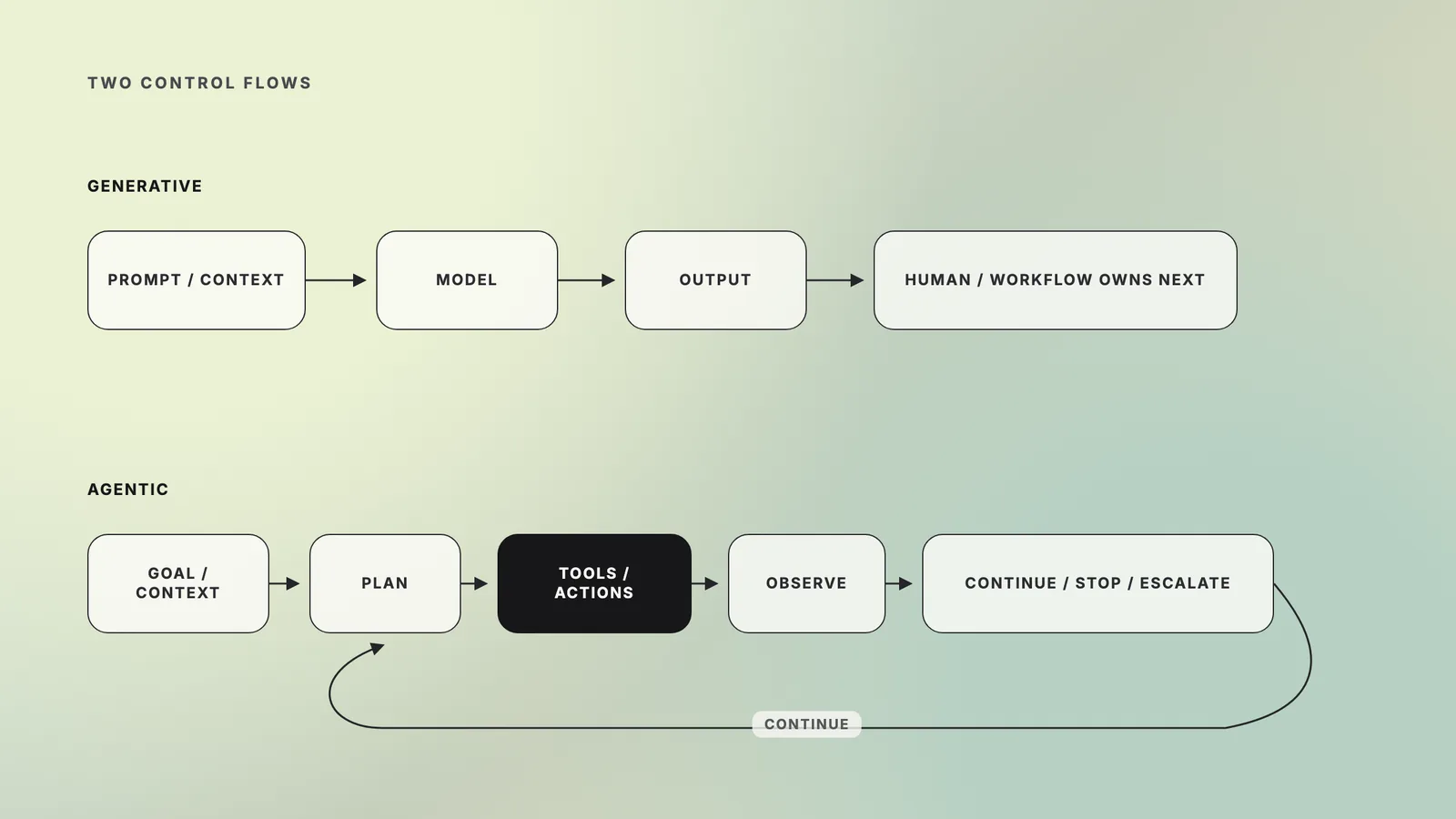
- Agentic AI vs generative AI is primarily a difference in who owns the next action. Generative AI creates or transforms an output from prompts and context. Agentic AI places a model inside a bounded control loop that can select tools, take actions, observe results, retain state, and continue, stop, or escalate. Most agentic systems use generative models, but the model is only one component.
- Use generative AI when a person or fixed workflow reviews the output and controls execution. Use agentic AI when the sequence can vary and software must choose several actions toward a goal. Keep deterministic automation where rules are stable. A hybrid is often the safest production design.

What is the difference between agentic AI and generative AI?
Agentic AI vs Generative AI is a common question. The difference between agentic AI and generative AI is control flow. Generative AI responds to supplied context with content, code, classifications, summaries, or recommendations. Agentic AI manages a goal across multiple steps, chooses actions, uses tools, checks results, and applies explicit stopping or escalation rules.
The shorthand “generative creates; agentic acts” is useful, but incomplete. A generative application can call a tool through a fixed workflow. An agent can also spend most of its time generating plans or messages. The stronger distinction is whether the system owns a variable next-action decision inside a controlled loop.
Agentic AI vs Generative AI:
| Dimension | Generative AI | Agentic AI |
| Outcome | Creates or transforms an output | Pursues a goal through a sequence of actions |
| Trigger | Prompt, request, or fixed application event | Goal, event, schedule, or workflow state |
| Control flow | Usually single response or application-defined chain | Runtime selects the next step from observations |
| Autonomy | A person or deterministic workflow owns execution | Bounded software autonomy within policy |
| Tools | Optional; often called through fixed logic | Selected and used as part of the control loop |
| State and memory | Can include history, retrieval, or application memory | Retains task state and observations across steps |
| Human role | Reviews or uses the output | Sets boundaries and handles approvals or exceptions |
| Stopping condition | Response or fixed workflow completes | Goal met, budget reached, failure threshold hit, or escalation required |
| Risk surface | Hallucination, data exposure, unsafe output | Those risks plus tool abuse, excessive permissions, and cascading actions |
| Operational cost | Model inference, evaluation, and application integration | More calls, integrations, identity design, monitoring, and incident handling |
| Best-fit work | Drafting, summarizing, extracting, classifying, recommending | Variable multi-step work that must react to intermediate results |
| Example | Draft a support reply for review | Investigate a ticket, query systems, draft a reply, and route an exception |
What is generative AI, and how does it work?
Generative AI produces a new output by predicting an appropriate continuation or representation from a prompt and its context. The application supplies instructions and data, the model generates a result, and a person or software component decides how to use it.
The output can be text, code, an image, audio, or structured data. IBM’s generative AI definition describes this range of output types, while application teams still own retrieval, validation, access control, and downstream execution.
A generative system can be more than a bare model call. It may retrieve documents, preserve conversation history, validate JSON, or invoke a function chosen by deterministic application logic. Those features don’t automatically make it agentic. The application can still define every step and retain ownership of the next action.
What are the benefits of generative AI?
The benefits of generative AI are strongest when the work centers on producing, transforming, or interpreting information. It gives teams a natural-language interface to software and unstructured data while keeping authority over business actions with a person or controlled workflow.
Common capability benefits include:
- drafting and revising text, code, or structured outputs;
- summarizing long documents and conversations;
- extracting or classifying information for a fixed workflow;
- producing alternatives for a person to compare;
- translating a user’s intent into a query, command, or recommendation.
This architecture is usually easier to test and operate than an agentic loop because execution remains outside the model. You can constrain the input, validate the output, and place a clear approval point before any consequential action.
The limits matter. Generative outputs can be wrong, inconsistent, or sensitive to context. Retrieval can surface untrusted content. A fluent answer can hide weak evidence. The benefits of generative AI don’t remove the need for evaluation, data controls, or a defined owner for the next step.
What is agentic AI?
Agentic AI is a system pattern that uses a model within a goal-directed, bounded control loop. The system can interpret context, choose tools, perform actions, observe changes, retain task state, and decide whether to continue, stop, or ask for human input.
The model is only one layer. Google Cloud’s agent architecture guidance separates models, goals, tools, runtime, identity, memory, orchestration, evaluation, and human approval. Microsoft’s agentic behavior engineering guidance similarly treats tools, memory, verification, safeguards, and operations as engineered system behavior.
A production agentic system usually includes these distinct layers:
| Layer | Responsibility |
| Model | Interprets context, classifies situations, generates plans, or proposes actions |
| Orchestrator or runtime | Assembles context, runs the loop, invokes tools, and enforces stopping logic |
| Tools | Let the system read or change external state through approved APIs and environments |
| State and memory | Carries current task data, prior observations, and optional durable information |
| Identity and permissions | Defines which resources and actions the system can access |
| Policy and evaluation | Checks action validity, task progress, output quality, safety, and compliance |
| Human approval | Pauses sensitive, irreversible, or exceptional actions |
Teams moving from a prototype to production need an agentic AI implementation plan for these layers, not only a better system prompt.
How does agentic AI work?
How agentic AI works is best understood as a controlled loop: perceive the current context, reason about the next step, act through an approved tool, observe the result, and then stop, escalate, or iterate. The runtime manages that loop and enforces the boundaries around it.
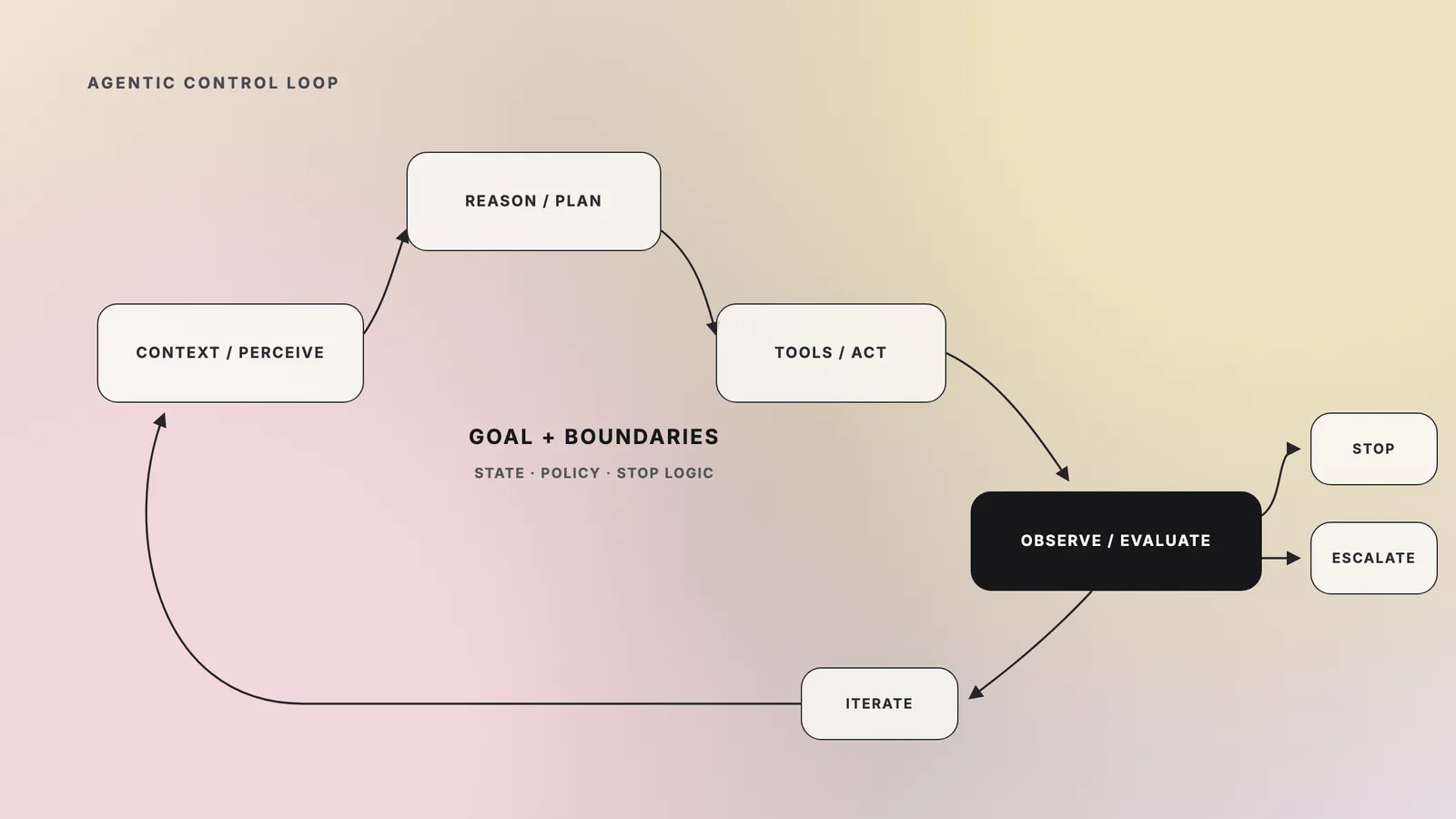
- Context and perceive. The runtime assembles the goal, instructions, current state, relevant records, prior observations, and permitted tools.
- Reason and plan. The model proposes a next step or a short plan based on the available evidence and policy.
- Act through tools. The runtime validates the request, checks permissions, and invokes an approved API, database, browser, or code environment.
- Observe and evaluate. The system records the result and checks whether it is valid, safe, and useful for the goal.
- Stop, escalate, or iterate. The runtime completes the task, requests approval, routes an exception, or returns to the loop within defined budgets.
This is how agentic AI works in practice: the runtime owns the cycle, while the model proposes decisions within policy.
Tool calling alone doesn’t make a system agentic. A model can select a function once while deterministic code owns the workflow. Meaningful agency comes from the surrounding goal, state, action selection, observation, iteration, and stopping or escalation logic. OpenAI’s agent-building guide describes models, tools, and instructions as core components, with orchestration, guardrails, and human intervention around them.
What are the benefits of agentic AI?
The benefits of agentic AI come from handling variable multi-step work without forcing every path into a fixed sequence. The system can react to intermediate results, choose among approved tools, maintain task state, and route exceptions when the happy path breaks.
Useful capabilities include:
- coordinating several steps across APIs or business systems;
- adapting the next action when a tool returns an unexpected result;
- maintaining context across longer tasks;
- using specialized agents or services under one orchestrator;
- escalating cases that exceed policy, confidence, or budget thresholds.
These benefits of agentic AI are capabilities, not guaranteed ROI. The same flexibility adds nondeterminism, more model and tool calls, integration work, identity and permission design, evaluation, observability, security, rollback, and incident response. Teamvoy’s guide to the hidden costs of AI agents covers the operating burden in more depth.
The trade-off is direct: variable execution paths can handle exceptions that fixed code can’t, but they reduce predictability. A prompt-based generative feature or deterministic workflow is often the better engineering choice.
How do generative and agentic AI work together?
Most agentic systems use generative models for language, reasoning, classification, or planning, while the surrounding runtime controls execution. Generative AI supplies a capability inside the system; it doesn’t replace orchestration, tools, state, identity, policy, evaluation, or approvals needed for reliable production work.
Consider a support workflow. A model can summarize a ticket and draft a response. An orchestrator can then inspect account state, query approved systems, choose a runbook, evaluate the result, and request approval before issuing a credit. Deterministic code should still enforce limits and perform the final transaction.
This layered design is also why “memory” needs precise language. Task state can change during a run. Retrieval can add relevant records. Durable memory can store approved facts or prior outcomes. Feedback and evaluations can improve prompts or workflows. None of those processes means the model continuously trains itself or modifies its weights.
Teams that need several models, tools, or specialist workers should treat AI agent orchestration as a runtime and control problem rather than a prompt-writing exercise.
Which system should your enterprise choose?
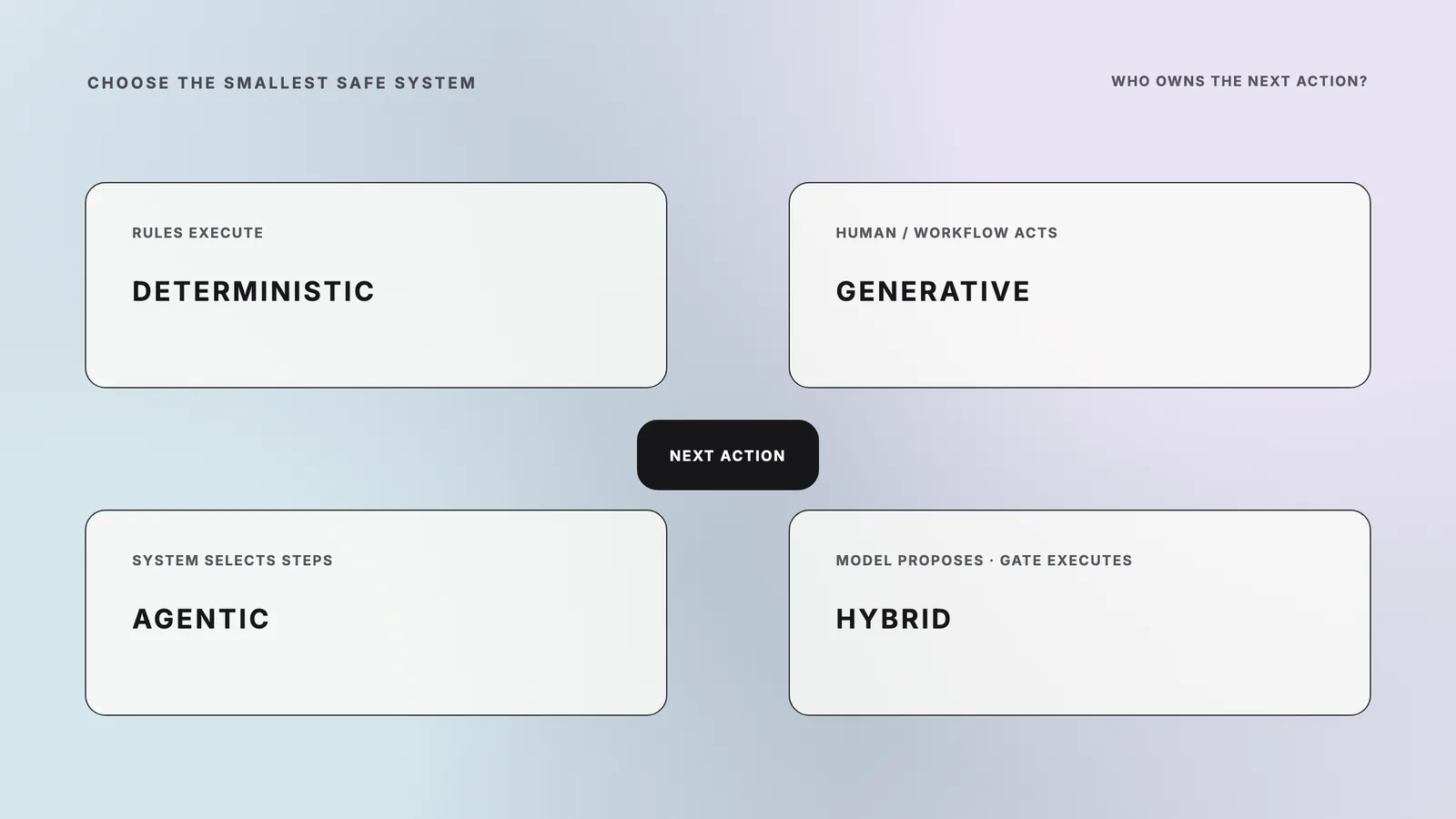
Agentic AI vs Generative AI – the answer is simple: choose the smallest system that can safely own the next action. Deterministic automation, generative AI, agentic AI, and hybrid designs solve different control problems. Starting with the most autonomous option adds cost and risk before the workflow proves it needs flexibility.
| Choose | Best fit | Avoid or constrain when |
| Deterministic automation | Rules and steps are stable, testable, high-volume, or irreversible | Exceptions require semantic judgment that rules can’t express safely |
| Generative AI | Drafting, summarizing, extracting, classifying, or recommending while a person or fixed workflow controls execution | The system must independently coordinate variable external actions |
| Agentic AI | The goal is clear, the path varies, and the system must select tools and react to observations | Permissions can’t be bounded, failures can’t be detected, rollback is impossible, or fixed code is cheaper |
| Hybrid | Model judgment helps, but deterministic code and approvals should control execution | The extra architecture creates more burden than the flexibility is worth |
Ask four practical questions:
- Does the sequence vary enough to justify model judgment?
- Can you detect success, failure, and policy violations at each step?
- Can you bound tools, data, permissions, time, spend, and actions?
- Can a person stop or reverse consequential behavior?
A broader enterprise AI architecture still needs to support data governance, evaluation, observability, and model change. The decision here is narrower: which component should own the next action?
How should you secure and govern agentic AI?
Secure agentic AI by treating every tool call as a privileged software action, not as trusted model output. The system needs layered controls before, during, and after execution because a bad instruction can propagate through tools and change external state.
NIST’s AI Risk Management Framework provides a govern, map, measure, and manage structure. OWASP’s AI Agent Security Cheat Sheet covers agent-specific threats such as prompt injection, tool abuse, excessive agency, memory poisoning, and data exfiltration.
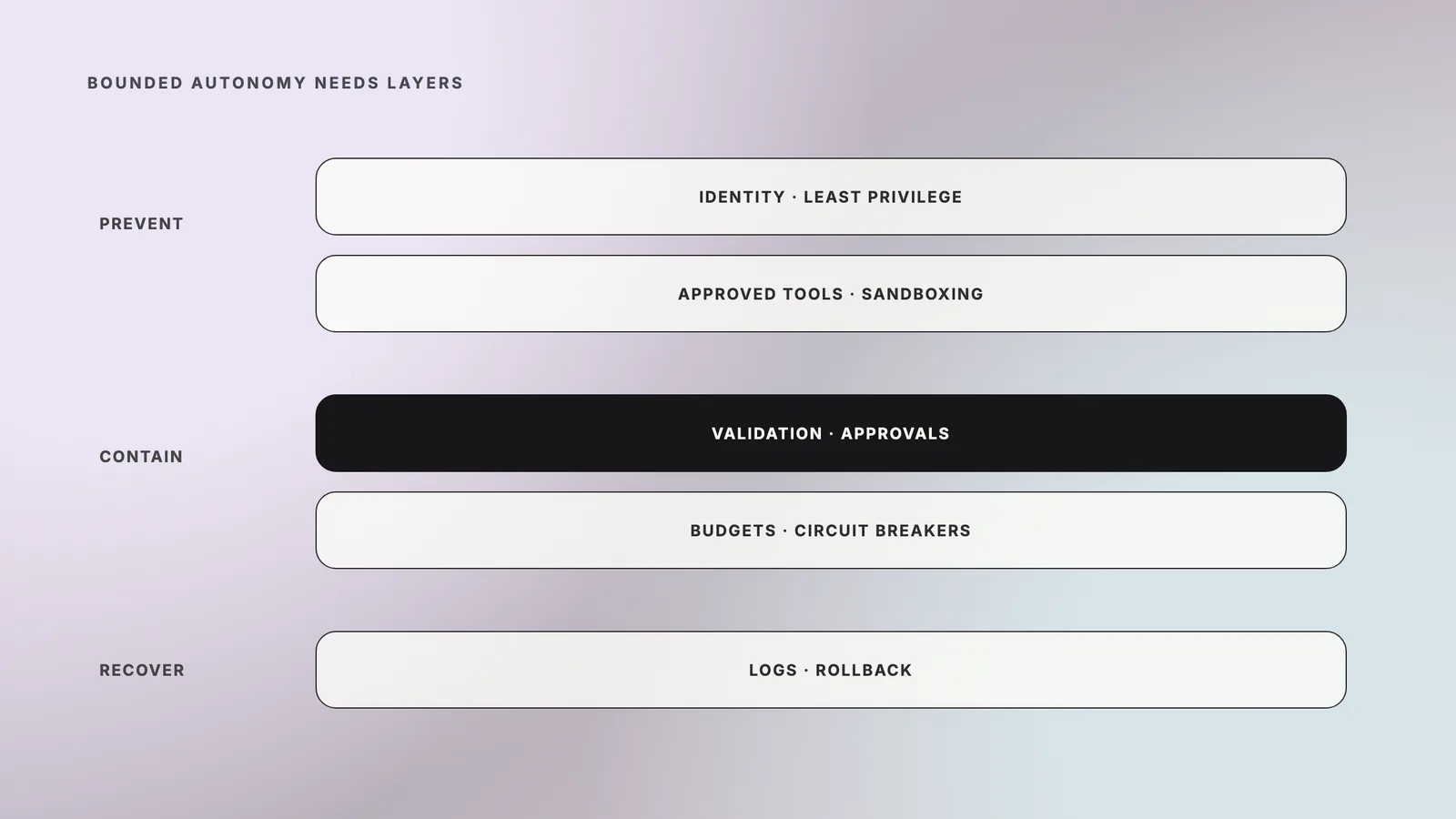
Apply these controls as a minimum:
- give each agent a separate identity with least-privilege credentials;
- use tool allow-lists and validate arguments before execution;
- validate tool outputs before they enter the next model context;
- minimize sensitive data in prompts, retrieval, logs, and memory;
- require approval for high-impact, irreversible, or unusual actions;
- set time, token, spend, and action budgets;
- log prompts, plans, tool calls, observations, approvals, and outcomes;
- sandbox browsers, code execution, and file access;
- defend against prompt injection in documents, websites, emails, and tool responses;
- define failure thresholds, circuit breakers, manual disablement, and rollback;
- evaluate expected, adversarial, and partial-failure paths before release;
- monitor production behavior and rehearse incident response.
Human supervision doesn’t mean watching every step. It means designing approval gates, exception queues, failure thresholds, audit trails, and a reliable stop mechanism. AI agent deployment best practices should cover these controls before permissions expand.
Where do these patterns fit in enterprise work?
The right pattern depends on action ownership, not the department label. The same function can reliably use generative AI for preparation, deterministic code for transactions, and an agentic loop for variable investigation, evidence collection, and exception handling under explicit controls.
- Software delivery: Generative AI can explain code or draft a test. An agentic coding system can inspect a repository, change files, run tests, observe failures, and iterate within branch and command restrictions. Teamvoy’s guide to autonomous AI agents covers this narrower software-delivery pattern.
- Finance and insurance: Generative AI can summarize policy documents or draft a case note. An agentic workflow can collect approved evidence, compare records, and route an exception, while deterministic services and human approvals control regulated decisions and transactions.
- Manufacturing and logistics: Generative AI can summarize maintenance records or explain a delay. An agentic system can query inventory, schedules, and equipment data, then propose or execute bounded rescheduling steps with rollback and approval rules.
- Customer operations: Generative AI can draft a response. An agentic workflow can classify intent, query account state, follow an approved runbook, and escalate when permissions, confidence, or policy limits are reached.
These are architecture patterns, not performance claims. Each requires task-specific evaluation, production data boundaries, and controls that match the cost of failure.
Conclusion
Agentic AI vs generative AI is a system-design choice about action ownership. Use generation when a person or fixed workflow should decide what happens next. Use a bounded agentic loop when the path varies and the system must select and execute several steps. Keep deterministic controls around sensitive actions, and prefer the simplest architecture that can meet the goal safely.
Talk to Teamvoy About Your AI System Design
Need to decide whether a generative feature, agentic workflow, or hybrid belongs in your product today? Hire AI engineers to assess the workflow, define control boundaries, and build the smallest production architecture that fits the risk.