

- AI data residency is where each class of data in an AI system is stored and processed, and a model region covers only one of those classes. Prompts, retrieved documents, embeddings, outputs, logs, abuse-monitoring data, backups, support access, subprocessors, and the provider's control plane each follow their own path.
- As of 2026-11-25, OpenAI, Microsoft, AWS, Google, and Anthropic all document regional controls, and all of them document exclusions. Map every path first, then pick regions and vendors, then write the exceptions into the contract. This article gives technical and procurement guidance, not legal advice.

What is AI data residency?
AI data residency is the set of architectural, contractual, and policy choices that fix where an AI system’s data is stored and processed. It covers the whole data path, from the prompt your application sends to the trace your observability tool keeps, and it is a design property you choose and verify, not a compliance status you receive (IBM, retrieved 2026-11-25).
It usually starts with a region dropdown. A team picks an EU or US model endpoint, notes “data stays in region” in the architecture review, and ships. Months later a security questionnaire asks where the vector index lives, which country the support engineer sat in, and whether abuse-monitoring logs left the region. Each answer turns out to be a different system with a different boundary. Which of your AI data paths can you actually point to on a map?
That gap is the subject of this guide. The definition pages that rank for this keyword explain what residency means. They don’t walk the AI-specific paths where data leaves the region you thought you chose.
How do residency, localization, sovereignty, privacy, and model hosting differ?
They answer five different questions, and conflating them is how a region selector becomes a false compliance claim. Residency is where data sits. Localization is a law that says where it must sit. Sovereignty is who can exercise control over it. Privacy is how personal data may be processed. Model hosting is where the weights run.
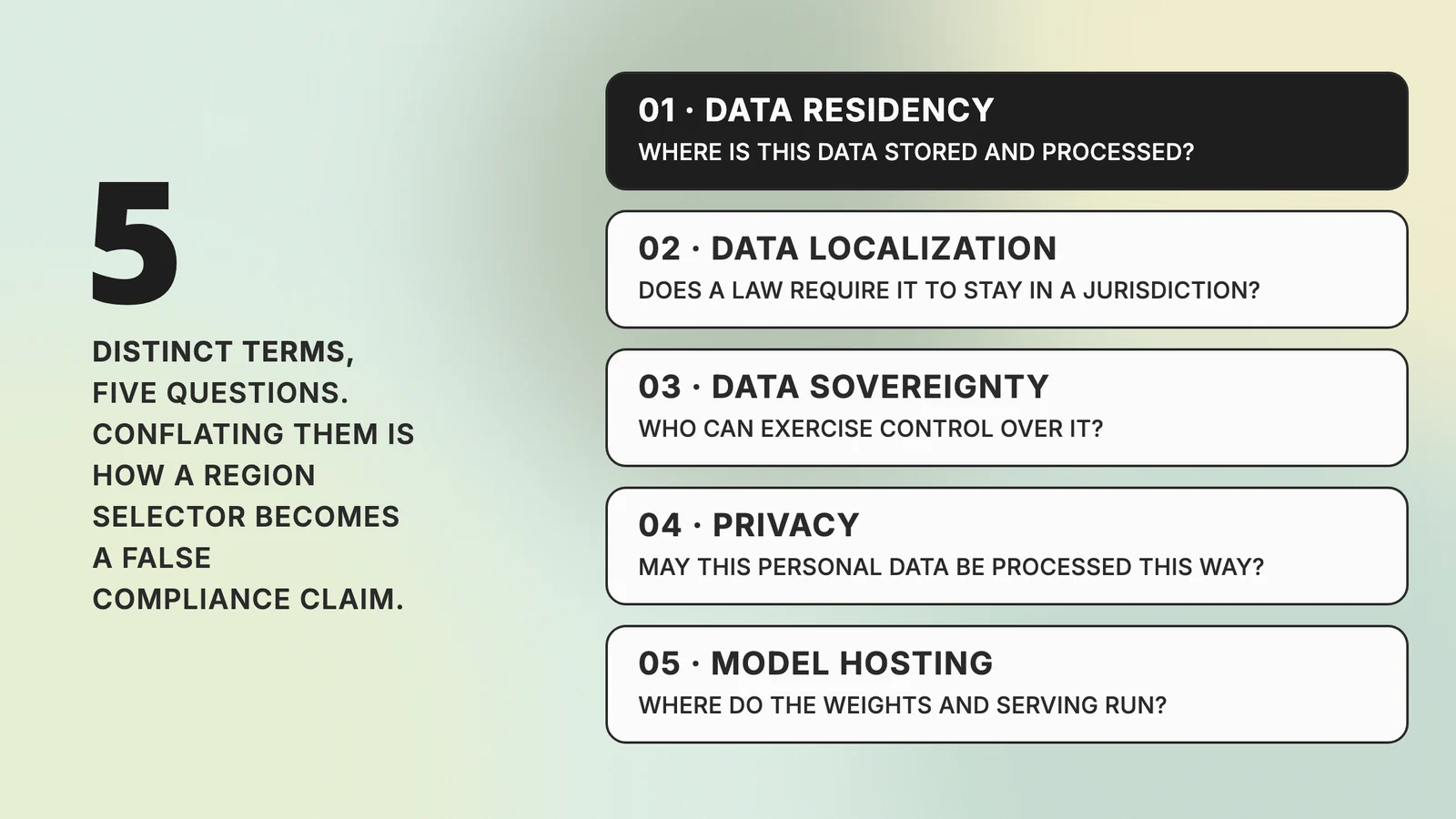
| Term | The question it answers | Who decides | What it doesn’t settle |
|---|---|---|---|
| Data residency | Where is this data stored and processed? | Your architecture, contracts, and policy | Legal compliance, who holds the keys, who can access it |
| Data localization | Does a law require this data to stay or be processed in a jurisdiction? | Legislators and regulators | Which technical controls satisfy the rule for your sector; AI data localization rules vary by country and sector |
| Data sovereignty | Which laws, authorities, operators, keys, and dependencies can control this data or system? | Jurisdiction, ownership, key custody, and operator location | Whether the data is also private or lawfully processed |
| Privacy | May this personal data be processed, for this purpose, with these rights and safeguards? | Data-protection law and your controller or processor role | Whether the system is also locally hosted or sovereign |
| Model hosting | Where do the model weights and serving infrastructure run? | The provider’s deployment type and region list | Where prompts are logged, embeddings stored, or backups copied |
AI data sovereignty, for example, asks whether a foreign authority or a vendor’s operations team can compel or obtain access, regardless of which region a database sits in. AI data localization is narrower and more prescriptive than residency; a sector or jurisdiction may require in-country processing even where no cross-border transfer rule would otherwise apply. Treat these as separate rows in your AI data residency requirements, with separate evidence.
Where can AI data cross borders?
An AI system moves data through at least eleven distinct paths, and a model region controls only one of them. The table below is the data-path framework for data residency for AI workloads; fill it in before any region or vendor decision. Each row needs an owner, a location, and a piece of evidence.ence collection can run with a wider autonomy budget than a production-network change. Automated incident response AI should therefore be evaluated one action at a time.
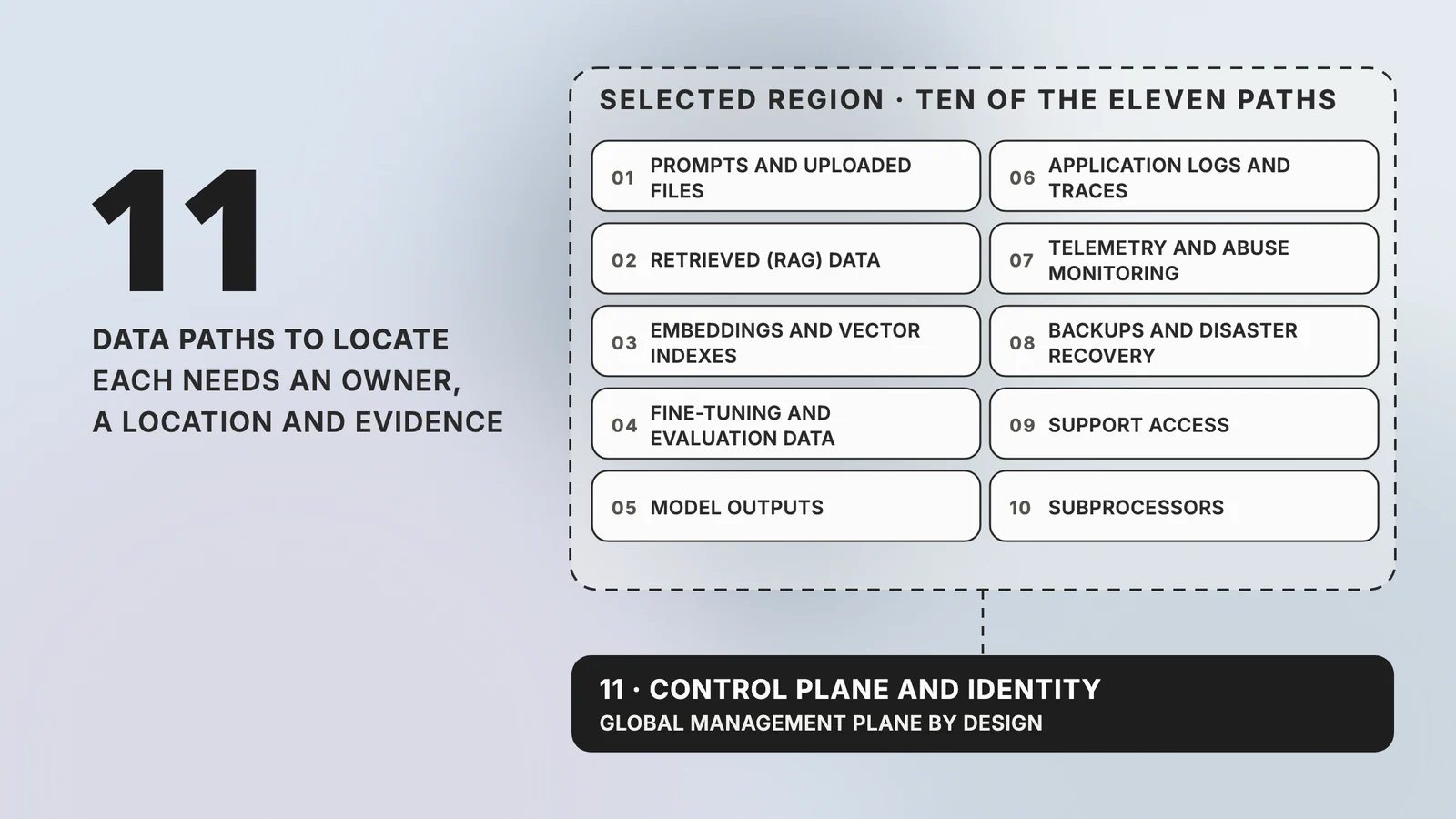
| Data path | What moves | Where it typically leaks out of region | Control that closes the gap |
|---|---|---|---|
| Prompts and uploaded files | User input, documents, system prompts, tool arguments | Global or cross-region inference routing; provider safety classifiers | Regional or data-zone deployment; documented inference geography |
| Retrieved (RAG) data | Chunks pulled from your stores into the context window | Retrieval service or cache in another region; cross-region replica reads | Regional object and document stores; same-region retrieval runtime |
| Embeddings and vector indexes | Vectors derived from source text, plus the index itself | Managed vector service hosted elsewhere; embedding model served globally | Regional embedding endpoint and regional vector store; treat vectors as derived data |
| Fine-tuning and evaluation datasets | Training examples, eval sets, labeled outputs | Training jobs scheduled in a different region; vendor-side copies | Verify training-job region and retention; keep eval data in the data plane |
| Model outputs | Completions, tool calls, structured results | Stored by the provider for abuse monitoring; cached by a gateway | Retention settings; gateway cache region; zero-retention terms where offered |
| Application logs and traces | Request bodies, latency, errors, token counts | Centralized observability SaaS in one global region | Regional log sinks; redaction before export; separate per-region observability |
| Telemetry and abuse monitoring | Provider-side safety and misuse detection data | Provider processing outside the selected region | Read the provider’s stated exclusions; negotiate or accept them explicitly |
| Backups and disaster recovery | Snapshots of every store above | Cross-region backup targets; DR region in another jurisdiction | Same-jurisdiction backup region; documented failover geography |
| Support access | Vendor or your own staff reading data to resolve tickets | Follow-the-sun support from other countries | Access approval workflow; support-location terms; just-in-time access |
| Subprocessors | Every third party the provider uses | Subprocessor lists that span jurisdictions | Subprocessor inventory tied to each data class; change notification |
| Control plane and identity | Configuration, keys, routing, account metadata | Global management plane by design | Accept and document; keep data-plane secrets in regional KMS |
Two paths deserve extra attention. Embeddings are derived from source content and can be partially inverted or matched, so a vector index holding regulated text belongs in the same boundary as the text. Backups are the path teams forget most often: a regional primary with a cross-region snapshot policy has already moved the data. The same logic applies to agent tool calls, where each tool is another egress point with its own region.
Why isn’t a region selector a compliance guarantee?
A region selector locates one layer, usually storage or model serving, while compliance depends on every layer plus the legal basis for any transfer that remains. Providers say this themselves in their documentation. Treat the selector as a necessary control and prove the rest.
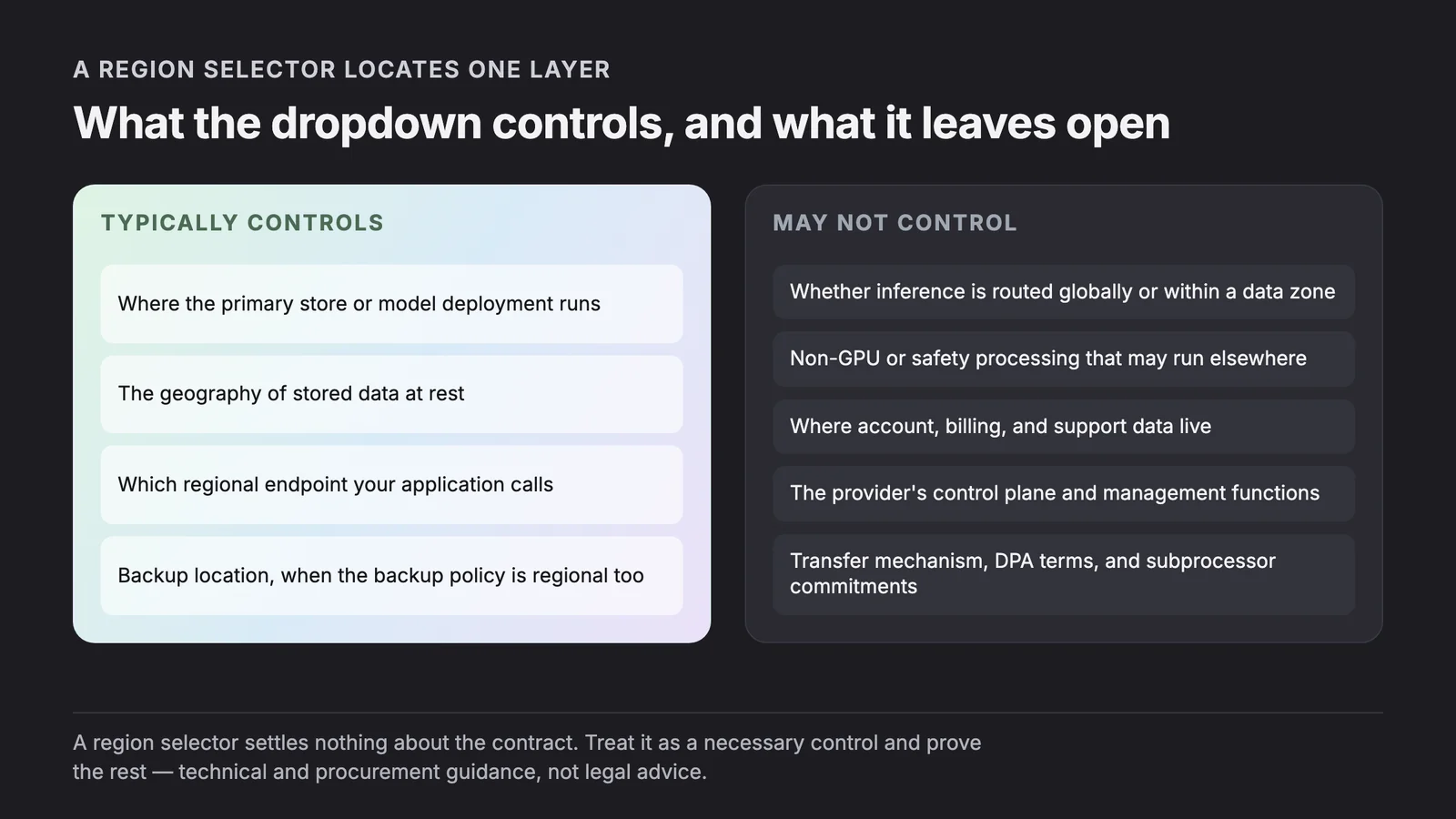
| What a region selector typically controls | What it may not control |
|---|---|
| Where the primary store or model deployment runs | Whether inference is routed globally or within a data zone |
| The geography of stored data at rest | Non-GPU or safety processing that may run elsewhere |
| Which regional endpoint your application calls | Where account, billing, and support data live |
| Backup location, when the backup policy is regional too | The provider’s control plane and management functions |
| Nothing about the contract | Transfer mechanism, DPA terms, and subprocessor commitments |
The legal layer matters here. GDPR Chapter V governs transfers of personal data to third countries and requires a valid transfer mechanism and safeguards; it is not a rule that all personal data must stay in the EU (Regulation (EU) 2016/679, adopted 2016-04-27). The EDPB’s recommendations on supplementary measures ask you to know your transfers, identify the transfer tool, assess the destination’s law and practice, adopt supplementary measures where needed, and re-evaluate over time (EDPB Recommendations 01/2020, final version 2021-06-18). An EU region removes some transfers from that analysis. It doesn’t remove the analysis.
The EU AI Act is a risk-based regulation of AI systems and models (Regulation (EU) 2024/1689, dated 2024-06-13). It is not a blanket EU data-residency mandate, and citing it as one in a procurement document will not survive legal review. Cite a specific provision only when counsel confirms it applies to your use case.
What do the major AI providers document about AI data residency?
As of 2026-11-25, every major provider documents regional controls for part of the data path and documents exclusions for the rest. The summary below comes from official documentation only and describes what each provider states, not what your plan, model, or contract includes. Re-check the exact SKU and terms before you rely on any row.
| Provider | What the documentation states (retrieved 2026-11-25) | Documented exclusions and caveats | Source |
|---|---|---|---|
| OpenAI API | Regional storage and regional processing options for eligible API customers and projects; storage residency and regional inference are separate controls | System data is outside the data-residency scope; some processing may still occur globally | OpenAI data residency guide |
| ChatGPT (business products) | Data residency and inference residency are separate settings | Some non-GPU processing may occur outside the selected region | OpenAI Help Center |
| Microsoft Azure OpenAI / Foundry | Three deployment types: Global, DataZone, and Standard. Global may process prompts and responses in any geography where the model is deployed; DataZone processes within a Microsoft-defined US or EU data zone; Standard processes in the deployment geography | Stored data remains in the designated Azure geography while some global routing, management, and control-plane functions operate separately | Microsoft Foundry Models deployment types |
| AWS Bedrock | Model availability varies by region; in-region and cross-region inference profiles are distinct. Model providers don’t have access to Bedrock logs or to customer prompts and completions. Bedrock states it doesn’t share your content with model providers under any current retention mode | Retention is a configurable per-Region mode (none, default, aws_review). Under default, AWS may retain prompts and outputs for safety and abuse prevention. Customers must still configure the surrounding architecture; a cross-region profile routes across the regions it lists | Bedrock region compatibility; Bedrock data protection; Bedrock data retention |
| Google Vertex AI (Gemini Enterprise Agent Platform) | Model and feature availability is region-specific; multi-region us and eu endpoints keep ML processing within that jurisdiction; the global endpoint offers higher availability | Endpoints don’t guarantee data residency or in-region ML processing; Google says not to use the global endpoint when you need to control the processing region, because you can’t control or know where the request is processed. Contractual location commitments live in Google Cloud’s data-residency terms | Google Cloud deployments and endpoints; Google Cloud data-residency terms |
| Anthropic Claude API | Two independent settings: inference geo (global or us) controls where model inference runs per request; workspace geo controls where data is stored at rest and where endpoint processing such as image transcoding and code execution occurs | Workspace geo is fixed at workspace creation and can’t be changed afterward; us is currently the only workspace geo; US-only inference on Claude 4.6 and later models is priced at 1.1x the standard rate. The two settings cover inference and workspace data, not every service path | Claude data residency |
Three patterns run across all five. First, inference geography and storage geography are separate controls everywhere, so “EU project” and “EU inference” are two claims that need two pieces of evidence. Second, each provider carves out a category, whether system data, control plane, non-GPU processing, or retention for safety and abuse prevention, that your residency statement must mention. Third, the global or cross-region option is the one that improves availability, which is why teams drift toward it under load. Each of these documents stops short of claiming AI data residency compliance for your application, and your assessment should stop there too.
Avoid merging product lines in one claim. OpenAI’s API controls and ChatGPT controls are documented on different pages with different scopes. The same discipline applies to Azure resource location versus deployment type, and to Bedrock geographic versus global cross-region profiles.
Where does sovereign AI fit?
Sovereign AI is the stronger requirement that sits above residency: control over the laws, operators, infrastructure, and keys that can reach the system, not only its location. A public-cloud EU region with a US-headquartered operator can satisfy a residency policy and still fail a sovereignty requirement, because the question has moved from “where” to “who can compel access.”
Decide which requirement you actually have before you architect for it. Residency is cheaper and most providers support it with native controls. Sovereign AI typically adds customer-managed or externally held encryption keys, operator and support-location restrictions, national or sector-specific cloud boundaries, self-hosted or open-weight models for the most sensitive paths, and contractual limits on subprocessors. Those choices shrink your model menu and raise your run cost, which is covered in the trade-off section below.
Most organizations need residency for the whole data path and sovereignty for a subset: the paths carrying regulated personal data, trade secrets, or public-sector records. Write the two requirements as separate rows against the eleven data paths, and let the sovereign rows justify the extra cost on their own.
What does a residency-aware AI architecture look like?
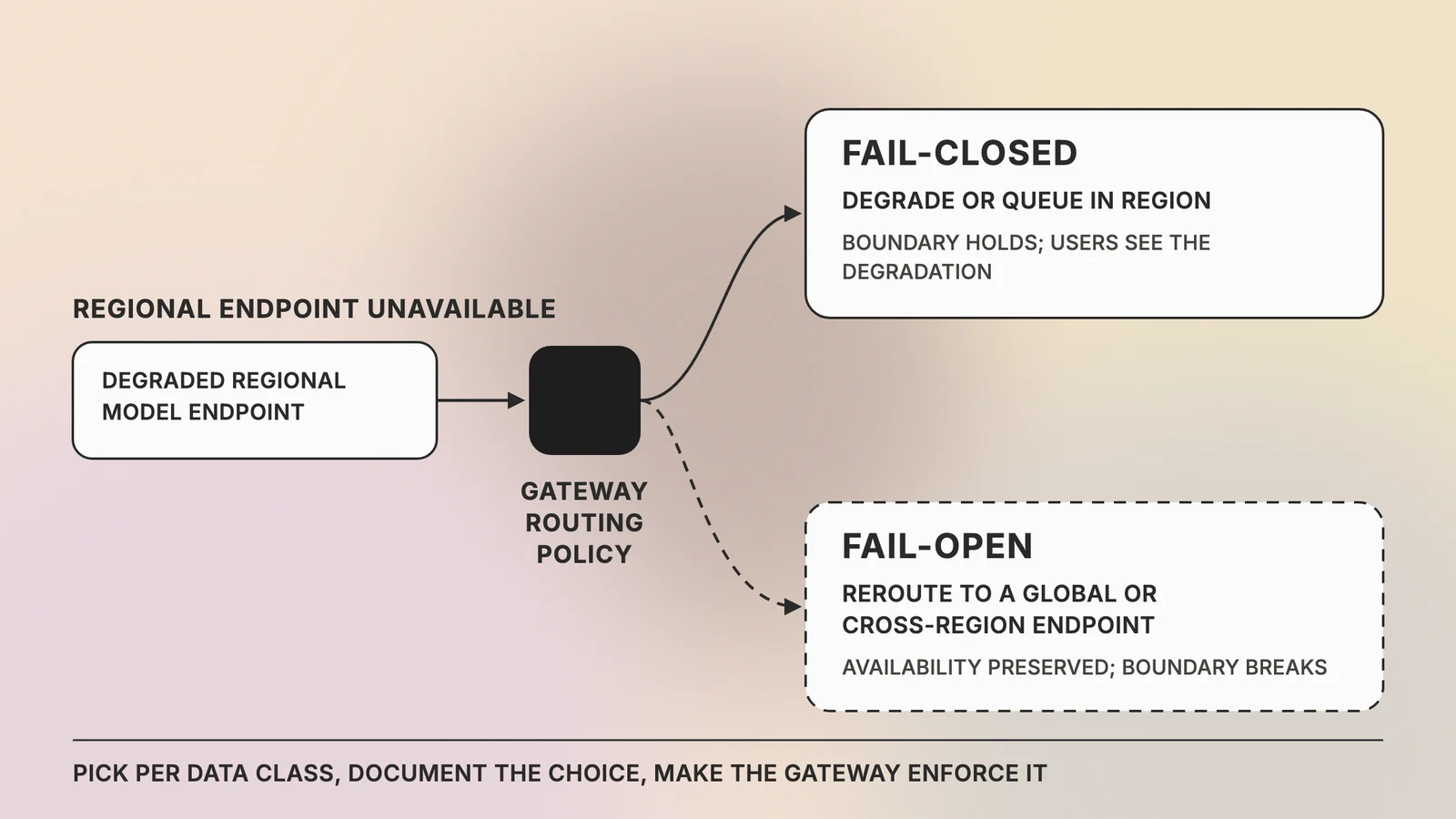
A residency-aware architecture places a regional data plane behind a gateway that enforces routing, keeps keys and observability inside the same boundary, and fails closed when a regional dependency is unavailable. The pieces are standard for data residency for AI workloads; the discipline is making every one of them regional at the same time.
Backups and failover. Backup targets and the DR region sit in the same jurisdiction. Failover is fail-closed by default: if the regional model endpoint is down, the system degrades or queues rather than routing to a global endpoint.identify whether the first constraint is data access, architecture, security boundaries, evaluation coverage, cost control, or the deployment path.
Regional ingress and gateway. Tenant or data-class routing happens at a gateway that pins each request to a regional endpoint and refuses to fall back across regions unless policy allows it. An LLM gateway is the natural control point for routing, retention, and provider fallback rules.
Regional data plane. Document stores, retrieval runtime, embedding endpoint, and vector index all run in the same region. Treat embeddings as derived data with the same classification as their source.
Egress policy. Private networking and egress rules block the application from calling non-regional endpoints by accident. Agent tools are registered with their region, and unregistered tools don’t run.
Keys and secrets. Customer-managed keys live in a regional KMS. Where sovereignty applies, consider external key custody so the operator can’t decrypt without you.
Observability inside the boundary. Logs, traces, and evaluation data are written to regional sinks with redaction before any export. Pick your LLMOps tools for their region support, not only their dashboards.
Retention and deletion. Provider retention settings, gateway caches, and your own stores share one retention schedule and one deletion workflow that you can prove executed.
This is the AI-specific slice of a broader enterprise AI architecture. Hosting choices, including when to run open-weight models on regional compute, belong in your enterprise AI infrastructure plan. For AI data residency in public cloud, the gateway and egress layers do most of the work, because the cloud’s native controls already cover storage and compute location once you select them deliberately.
How do you assess a vendor against AI data residency requirements?
Assess a vendor by asking for evidence per data path, not for a yes to “do you support EU data residency.” The seven-step framework below produces a matrix you can attach to the architecture review and the DPA.
- Inventory your data paths. Fill in the eleven-row table above for your system, including every agent tool and every third-party service in the request path.
- Classify each path. Mark which rows carry personal data, regulated sector data, trade secrets, or nothing sensitive. Attach the requirement: residency, localization, sovereignty, or none.
- Ask the provider per layer. Separate questions for storage at rest, inference processing, control plane, support access, subprocessors, backups, and failover. Record the answer and its source URL and date.
- Capture exclusions verbatim. Write the provider’s documented carve-outs, such as system data or non-GPU processing, into your record exactly as published.
- Check contract coverage. Confirm the DPA, data-residency terms, and order form name the regions, data classes, retention, and training-use commitments you expect. Documentation is not a contract.
- Test the boundary. Verify in a non-production account that the regional endpoint, inference profile, and storage location behave as documented. Inspect logs and traces for cross-region calls.
- Schedule re-evaluation. Provider controls and subprocessor lists change. Set a review cadence and subscribe to change notifications.
Questions that belong in the vendor questionnaire:
- Which data classes does your residency commitment cover, and which does it exclude?
- Is inference processed in the selected region, a data zone, or globally, and can we pin it?
- Where are prompts and outputs retained for abuse monitoring, and for how long?
- Are prompts, outputs, or files used to train or improve models under our plan?
- Where do your support staff sit, and how is their access approved and logged?
- Which subprocessors touch each data class, and how do you notify changes?
- Where do backups and DR copies live, and what happens on regional failover?
- Which of these commitments appear in the DPA and order form, not only in documentation?
The pattern is familiar from any regulated-sector vendor selection; the guide to choosing an AI vendor walks through the diligence structure in a fintech setting. The difference here is the number of paths you have to ask about.
What do strict regional boundaries cost?
Strict regional boundaries cost latency, model choice, resilience, and money, and the right answer varies by data class rather than by company. A blanket “keep everything local” rule is as much a design error as ignoring residency; it spends the premium on data that didn’t need it.
The specific trade-offs:
- Model and feature availability. Providers release models and features to regions on different schedules, and Google states outright that its global endpoint provides higher availability while endpoints don’t guarantee data residency or in-region ML processing; it tells you not to use the global endpoint when you need to control the processing region (Google Cloud deployments and endpoints, retrieved 2026-11-26). Pinning to a region can mean waiting for the model your team wants.
- Latency and capacity. Microsoft’s Global deployment type can route to any geography where the model is deployed, which is how it offers more capacity than a single-geography Standard deployment (Microsoft Foundry Models deployment types, retrieved 2026-11-25). Regional pinning gives up that headroom and can increase queueing under load.
- Disaster recovery. Same-jurisdiction DR is harder in regions with fewer availability options, and fail-closed routing means a regional outage becomes a user-facing degradation rather than a silent reroute.
- Duplicated stacks. Each regional tenant needs its own vector store, observability sink, key hierarchy, and backup policy. The operating cost scales with the number of boundaries, not the number of users.
- Support complexity. Restricting support access by location lengthens incident resolution when the right engineer is in the wrong country.
The commercial concession: a company with one approved provider, one region, no regulated personal data, and a capable platform team doesn’t need custom integration work for AI data residency in public cloud. Native regional controls plus a documented data-path review may be enough. Custom work earns its place when the workflow spans several providers, vector stores, agents, legacy systems, or regional tenants, or when a regulator will ask you to prove the policy was enforced in code rather than in a slide.
Conclusion
AI data residency is a property of eleven data paths, not of one region dropdown. The providers are candid about this in their own documentation: inference and storage are separate controls, and each of them carves out system data, the control plane, or safety retention from the commitment. Map the paths, classify each one, ask for evidence per layer, test the boundary, and write the exceptions into the contract. Spend the sovereignty premium only on the paths that need it, and accept that strict boundaries cost latency, model choice, and resilience. The teams that get this right have a table they can defend, not a screenshot of a region selector.
Talk to Teamvoy About Regional AI Integration
If your AI system spans more than one provider, a vector store, an observability stack, and a regulator who will ask where each of them lives, the region selector is the easy part. Teamvoy’s AI integration services cover the gateway, routing, data-plane, and observability work that turns a residency policy into enforced architecture. You leave with the data-path map, the vendor evidence matrix, and a system that fails closed on purpose. Talk to us about your regional AI architecture.