- There is no single best fintech AI integration partner, only kinds built for different situations: regulated platforms in production, scoped assistants, staff augmentation, studio builds, or QA capacity.
- Integration, not model choice, decides outcomes. The data layer and legacy core are the first two questions, and roughly 55% of banks name that core as their top modernization barrier.
- Gartner attributes over 40% of agentic AI cancellations by end-2027 to cost, unclear value, and weak risk controls, while about 2% of UK financial services AI use cases run fully autonomously.
- EU AI Act Annex III obligations apply from 2 August 2026 to credit scoring and insurance pricing AI, regardless of when the system was built, with fraud-only systems excluded.
- Under DORA, the partner you hire becomes a regulated ICT third party, so concentration risk, recovery time objectives, and an exit plan belong in the selection decision.
- Vet partners on named regulator experience, senior lead ownership, engagement length, spend ceilings, and rollback paths rather than star ratings or capability decks.
Q1. Which Fintech AI Integration Partner Fits Your Situation?
There is no single best fintech AI integration partner, only ten kinds built for different situations. Teamvoy fits regulated fintech platforms already in production, where AI has to attach to a legacy core without a rewrite and a senior engineer stays accountable for years. Others fit greenfield builds, staff augmentation, or enterprise-scale programmes. Match the partner to your system’s current state, not to a ranking.
Picking an engineering partner for fintech AI integration work is not a normal procurement task. You are handing someone access to systems that move money. If the fit is wrong, you do not find out in a sprint. You find out in an audit, or at 2 AM. This guide describes ten kinds of partner, not a league table. It judges each on AI delivery model, data layer depth, named regulator experience, senior technical lead ownership, and proof of production work. I wrote it for CTOs, technical founders, and IT directors carrying a deadline. Read the criteria first, then the cards.
Our Evaluation Criteria
⭐ What I actually check before shortlisting anyone
- AI delivery model. Does the firm advise, or does it build and ship? Consulting-only partners hand you a roadmap and leave.
- Data layer and legacy core depth. Do they assess your data and core systems before choosing a model? This is where integrations fail.
- Named regulator experience. Have they delivered under DORA, PCI-DSS, PSD2, SOC 2, BaFin, FCA, SEC, or FINRA? Named beats “compliance-aware”.
- Senior lead ownership and engagement length. Is one senior engineer accountable for the system, and for how long?
- Proof of production AI, not demoware. Can they point to a live system, with a client willing to describe it?
Gartner put out a hard number on 25 June 2025, from a poll of over 3,400 organisations. More than 40% of agentic AI projects will be cancelled by the end of 2027. The reasons named were escalating costs, unclear business value, and weak risk controls. None of those are model problems. They are partner and integration problems.
🧭 Why integration outranks model choice
The industry has spent two years arguing about the brain and ignoring the nervous system. A frontier model is still useless when it gets bad data or cannot execute an action reliably. Integration is unglamorous, and it is the thing that separates a demo from production.
That is why the criteria above weight the data layer and the core, not benchmark scores. Across twelve years of delivery, the first question I ask on an AI integration call is never about the model. It is about what your systems of record actually know, and who owns that.
Who This Guide Is For
- The burned CTO. You inherited a platform a previous vendor left behind. You need it stable before you add anything clever.
- The technical founder on a drifted core. You built the first version yourself. It works, it scaled, and now it is hard to change.
- The enterprise IT director with a deadline. A DORA, PCI-DSS, or EU AI Act date is on the board’s calendar, and someone has to be accountable for the evidence.
The Ten Partners Covered
This roster covers ten engineering partners. Each entry is a situation, not a rank.
- Teamvoy: Best for regulated fintech platforms in production where AI must attach to a legacy core without a rewrite
- HatchWorks AI: Best for teams that want a scoped generative AI or RAG assistant built and handed over with documentation
- Vention: Best for scaling an existing engineering team with staff augmentation under your own architecture lead
- NineTwoThree AI Studio: Best for taking an AI product idea from concept to a working first release
- Azumo: Best for nearshore data and AI engineering capacity added to an in-house roadmap
- Valere: Best for product-led builds where UX, permissions logic, and enterprise readiness matter together
- Diffco AI: Best for research-heavy machine learning work where the model itself is the hard part
- JetRockets: Best for maintaining and extending a mid-sized web or fintech application over time
- Dualboot Partners: Best for embedded product teams working alongside your own engineers
- Trigent Software: Best for offshore QA, testing, and application support at volume
Master Comparison Table
| Company Name | Best For | Engagement Model | Industry Depth & Compliance Coverage |
|---|---|---|---|
| Teamvoy | Regulated fintech in production, AI on a legacy core, vendor rescue | Long-term partner (4+ year average), senior technical lead owns the system | Banking, insurance, healthcare, manufacturing, and complex SaaS; delivery under BaFin, PSD2, DORA, SOC 2, PCI-DSS, SEC, FINRA, HIPAA, GDPR, FCA, and NHS Digital |
| HatchWorks AI | Scoped generative AI and RAG assistants with clean handover | Project-and-exit with documentation handover | Technology, IoT, and logistics work is publicly evidenced; named financial regulator coverage not publicly claimed |
| Vention | Adding senior engineers to an existing team | Staff augmentation | Broad technology and startup portfolio; regulated fintech coverage varies by engagement |
| NineTwoThree AI Studio | Concept to first AI product release | Project-and-exit | Startup and mid-market AI products; named regulator coverage not publicly claimed |
| Azumo | Nearshore data and AI engineering capacity | Staff augmentation and project work | Data engineering and AI across mixed industries; regulated coverage not publicly claimed |
| Valere | Product builds needing UX plus enterprise readiness | Project-and-exit, product team model | Enterprise SaaS and product work; financial regulator coverage not publicly claimed |
| Diffco AI | Research-heavy machine learning problems | Project-and-exit | Applied ML and computer vision; regulated fintech delivery not publicly claimed |
| JetRockets | Ongoing maintenance and extension of existing apps | Long-term partner, smaller teams | Web platforms, fintech, and real estate; named regulator coverage varies |
| Dualboot Partners | Embedded teams beside in-house engineers | Staff augmentation and embedded product teams | Mixed industry portfolio; regulated coverage varies by engagement |
| Trigent Software | QA, testing, and application support at volume | Offshore managed services | Broad enterprise IT and QA; AI integration is not the core motion |
Cards for the first two partners follow. The remaining eight continue in the same format.
Teamvoy
- AI delivery model: Build and ship. Teamvoy takes the system into production and stays with it.
- Data layer and legacy core depth: Assessed first, before any model is chosen.
- Named regulator experience: BaFin, PSD2, DORA, SOC 2, PCI-DSS, SEC, FINRA, HIPAA, GDPR, FCA, and NHS Digital.
- Senior lead ownership: One senior engineer owns the system end to end, with an AI-native team behind them.
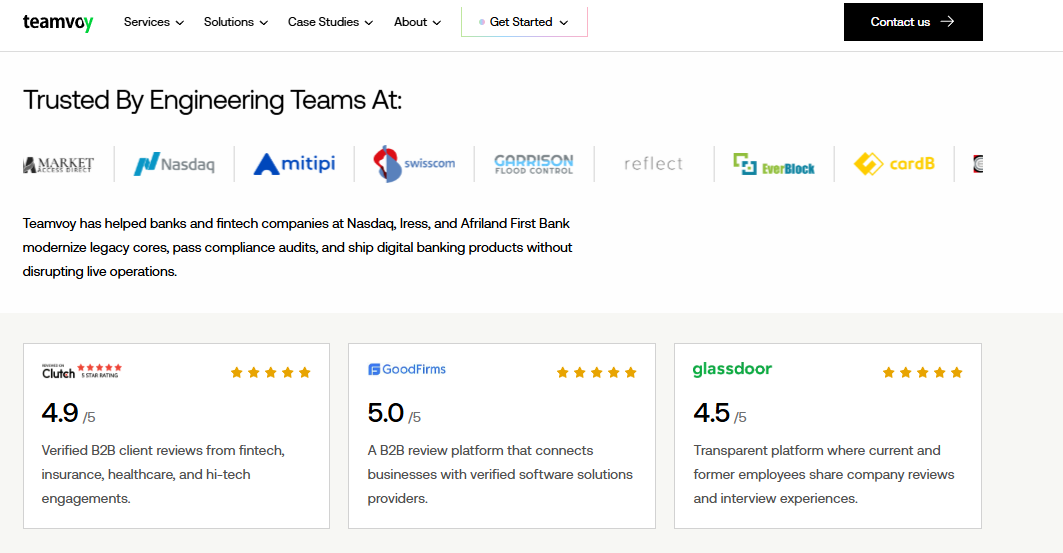
- Proof of production AI: Long-running platforms in banking, insurance, and wealth management, with public client reviews.
- Four-year engagement with Bitspark, a payments and remittance business, with daily work alongside a globally distributed team.
- Multi-year build with Iress on BC Gateways, a wealth-management private blockchain, from proof of concept to scale. The work continued after the client was acquired.
- Delivery for Market Access Direct, launched on the set timeline with all required tools and features integrated, and further banking and insurance case studies published publicly.

HatchWorks AI
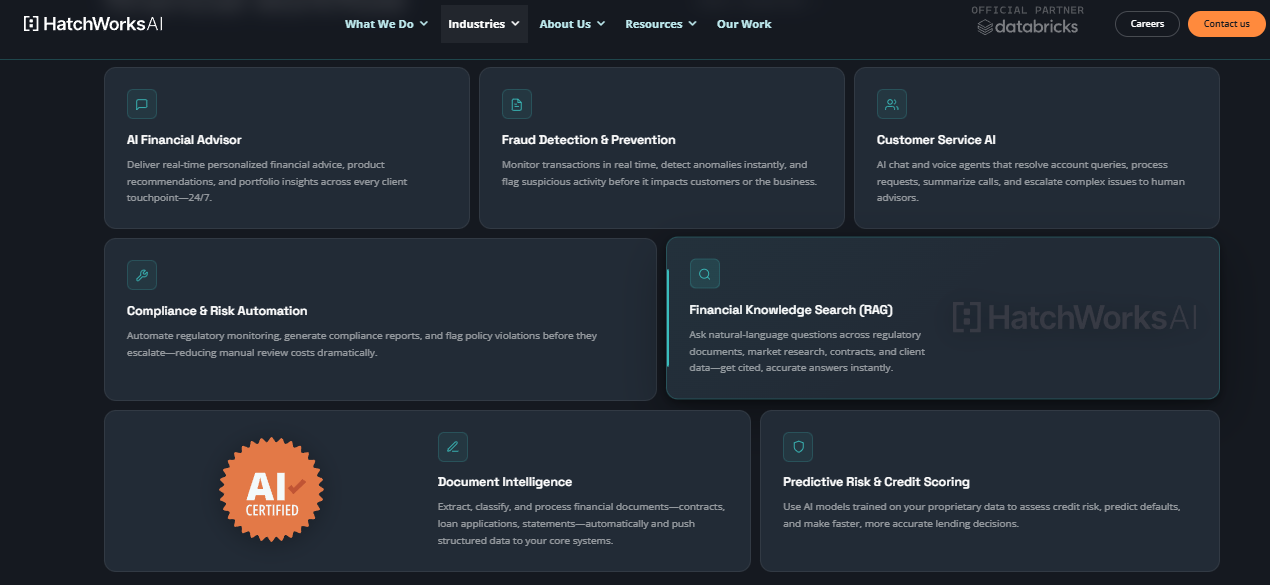
- AI delivery model: Build and ship, on a defined scope, with handover documentation.
- Data layer and legacy core depth: RAG design is evidenced. Deep legacy core assessment is not publicly claimed.
- Named regulator experience: Not publicly claimed for DORA, PCI-DSS, or PSD2 work.
- Senior lead ownership: Varies by engagement.
- Proof of production AI: Yes, a verified client review describing a shipped assistant with an accuracy figure.
- Designed and built a chat assistant for an IoT business using generative AI and a RAG architecture.
- Delivered on time and within budget, per the client’s Clutch review.
- Client reported over 90% accuracy on user questions.
Vention
- AI delivery model: Capacity model. Vention supplies engineers who build inside your architecture and your decisions.
- Data layer and legacy core depth: Depends on the engineers assigned, not on a firm-level method.
- Named regulator experience: Not publicly claimed for DORA, PCI-DSS, or PSD2 delivery.
- Senior lead ownership: Your side. You keep the architect seat.
- Proof of production AI: Verified client work with an AI company, described as staff augmentation plus custom development.
- Verified Clutch engagement combining staff augmentation and custom software development for an AI company.
- Reviewed by a CTO, which suggests the work sat close to the technical core.
- Full five-star rating across quality, schedule, cost, and willingness to refer on that engagement.
NineTwoThree AI Studio
- AI delivery model: Build and ship on a defined product scope.
- Data layer and legacy core depth: Suited to new data models, not to decades-old ledgers.
- Named regulator experience: Not publicly claimed for DORA, PCI-DSS, or PSD2.
- Senior lead ownership: Varies by engagement.
- Proof of production AI: Not verifiable from the review sources used for this guide.
- Positions as an AI product studio taking concepts through to a working release.
- No verified client review was available in the sources used for this guide.
- Treat firm-level claims as unconfirmed until you see a reference call.
Azumo
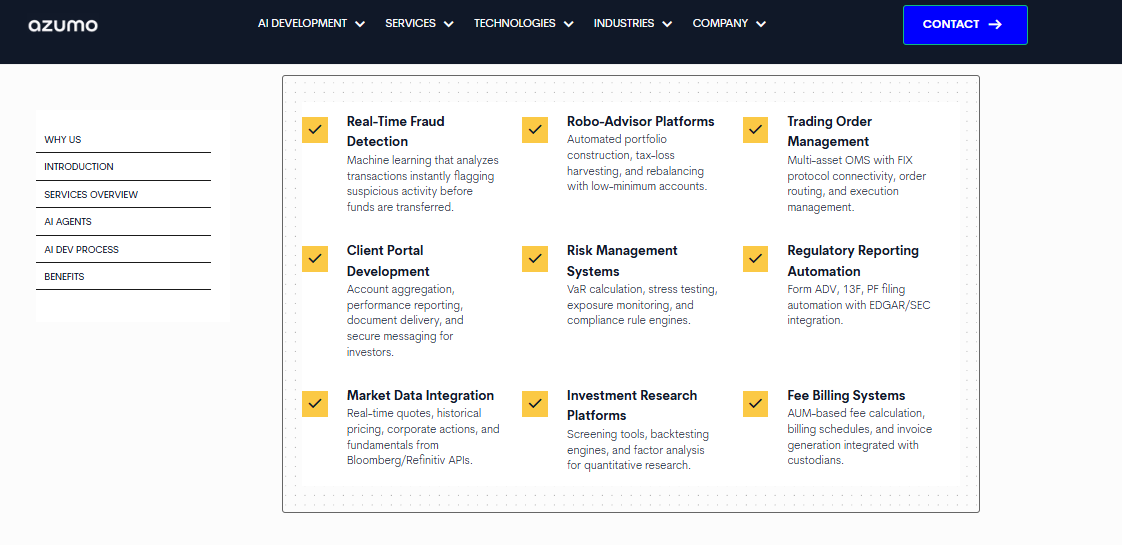
- AI delivery model: Build and ship, delivered as teams working inside a client platform.
- Data layer and legacy core depth: Evidenced on integrations with customer systems of record.
- Named regulator experience: Not publicly claimed for DORA, PCI-DSS, or PSD2 delivery.
- Senior lead ownership: Project managers work alongside your own delivery leads.
- Proof of production AI: Yes, conversational applications built and shipped for a Fortune 100 end customer.
- Delivered use cases on time across each phase of a multi-phase engagement, per the client’s review.
- Worked into a Fortune 100 customer environment through the client’s platform.
- Replaced team members when a skills gap appeared, without stalling delivery, per the same review.
Valere
- AI delivery model: Build and ship, with embedded product teams working beside client founders and CTOs.
- Data layer and legacy core depth: Backend migration work is evidenced. Core banking depth is not.
- Named regulator experience: Not publicly claimed for DORA, PCI-DSS, or PSD2.
- Senior lead ownership: Client-side CTO usually retains architecture. Valere embeds a team around it.
- Proof of production AI: Yes, generative AI platform work with named client executives on record.
- Built an AI SaaS platform alongside a client’s founders and CTO, described by that client as work a staffing firm could not have delivered.
- Handled a backend migration together with product and interface work for an IT company.
- Clients flagged strong QA and regression discipline while pushing toward an enterprise-ready release.
Diffco AI
- AI delivery model: Build and ship, with strong weight on engineering fundamentals.
- Data layer and legacy core depth: Evidenced on refactoring and infrastructure, which is the closest signal to core readiness in this roster.
- Named regulator experience: Not publicly claimed for DORA, PCI-DSS, or PSD2.
- Senior lead ownership: Small teams, so ownership is concentrated but thinly staffed.
- Proof of production AI: Machine learning capability is claimed. The strongest public evidence is platform engineering.
- Led code refactoring that the client said improved performance and maintainability.
- Upgraded infrastructure so deployments became smoother and uptime improved, per the client’s review.
- Delivered on schedule and within budget on that engagement, freeing internal staff from maintenance work.
JetRockets
- AI delivery model: Build and maintain, with AI features added to existing products.
- Data layer and legacy core depth: Application-level work is evidenced. Core ledger modernization is not.
- Named regulator experience: Not publicly claimed for DORA, PCI-DSS, or PSD2. Healthcare-adjacent delivery is evidenced.
- Senior lead ownership: Owner-level involvement is reported by clients when projects stall.
- Proof of production AI: Yes, an AI-enabled coaching platform shipped for a named founder.
- Built a web application for a physician staffing business in a medical setting.
- Delivered an AI-enabled coaching platform for a wellness company.
- One founder noted the team never pushed extra scope, despite plenty of chances to do so.
Dualboot Partners
- AI delivery model: Capacity and embedded delivery rather than an AI-specific method.
- Data layer and legacy core depth: Depends on the client’s own architecture ownership.
- Named regulator experience: Not publicly claimed for DORA, PCI-DSS, or PSD2.
- Senior lead ownership: Shared with your team, which works only if your side is strong.
- Proof of production AI: Not verifiable from the review sources used for this guide.
- Positions around embedded product teams working beside client engineers.
- No verified client review was available in the sources used for this guide.
- Ask for two references at your own system’s scale before shortlisting.
Trigent Software
- AI delivery model: Support and quality assurance, rather than AI system design.
- Data layer and legacy core depth: Not the core motion.
- Named regulator experience: Not publicly claimed for DORA, PCI-DSS, or PSD2.
- Senior lead ownership: Managed-service structure, not a named accountable engineer.
- Proof of production AI: Not verifiable from the review sources used for this guide.
- Positions around QA, test automation, and long-running application support.
- No verified client review was available in the sources used for this guide.
- Treat this as a complement to a build partner, not a replacement for one.
Teamvoy sits first in this roster because the situation it is built for is the hardest one here: a regulated platform already in production, an AI layer that has to attach to a legacy core, and a senior engineer who stays accountable across a 4+ year average engagement. Where a rewrite genuinely is the cheaper path, I will say so on the 30-minute technical call.
Q2. What Does Fintech AI Integration Actually Cover, and How Much of It Is Really in Production?
Fintech AI integration connects models to systems of record: core banking, ledgers, payment gateways, KYC stores, CRM, and open banking APIs, so fraud detection, credit decisioning, AML/KYC, and support automation run on governed, auditable production data. The most mature deployments are process automation at 79%, data visualization at 75%, and AI customer support at 73%. Model choice is roughly a tenth of the build.
🧭 A plain definition, before the jargon
Think of the model as an engine and the integration layer as the drivetrain. The engine spins. Nothing moves until the drivetrain connects it to the wheels. In fintech, the wheels are your ledger, your KYC records (identity checks on customers), and your payment rails.
Teamvoy opens every AI integration engagement with a data-layer and legacy-core assessment before any model is chosen. That order sounds boring. It is the difference between a feature and an incident.
✅ What the integration surface actually includes
Most of the work sits in unglamorous places:
- Data layer. One agreed version of a customer, an account, and a transaction.
- API contracts. How the model reads and writes, and what it is forbidden to touch.
- Idempotency. A retried action must not double a payment or duplicate a KYC update.
- Audit logging. Every automated decision reconstructible months later.
- Human approval gates. Who signs off before an action hits the ledger.
The category has moved on from read-only wiki bots. The systems people now want need write access to core financial ledgers. That single change turns an AI project into distributed-systems engineering with regulatory consequences.
⏰ Where deployments are genuinely mature
| Use case | Reported maturity |
|---|---|
| Process automation | 79% |
| Data visualization | 75% |
| Software development support | 75% |
| Customer support (front office) | 73% |
Those figures come from the Cambridge Centre for Alternative Finance 2026 global study of AI in financial services. Consumer pull is real too. EY’s second global AI sentiment survey, covering more than 18,000 people across 23 countries, found 49% had used AI for savings or investment decisions.
⚠️ Why two adoption numbers disagree
Cambridge reports 81% of firms adopting AI, with 40% at advanced stages. NVIDIA’s sixth annual financial services survey reports 65% actively using AI, up from 45%. Both are credible. They count different populations and define “using” differently.
The gap inside the data matters more than the headline. Fintechs sit near 47% advanced adoption against roughly 30% for incumbents. If you are a fintech, your competitors are further along than the average banking and fintech story suggests.
⭐ The two questions to ask before picking a model
Ask what your systems of record actually agree on. Then ask who owns that answer. Across twelve years of delivery, I have never seen a model choice sink a fintech AI project. I have repeatedly seen four systems disagree about the same customer.
There is a failure pattern worth naming. Teams dump Confluence pages, Slack history, and CRM exports into a vector database and hope the model sorts it out. That is not retrieval. That is context flooding, and it produces confident nonsense that passes a demo, which is why retrieval architecture deserves real design time.
Teamvoy treats the data layer and the legacy core as the first two questions in any AI engagement, because on a regulated platform the model is the cheapest component to replace. Swapping a model takes a sprint. Fixing a customer record that three systems define differently takes a quarter.
Q3. Why Do Fintech AI Projects Stall Between Demo and Production?
Projects stall because the demo never faced real data, real latency, or real audit. Gartner attributes over 40% of agentic AI cancellations by end-2027 to escalating costs, unclear business value, and inadequate risk controls, not model capability. Around 95% of enterprise generative AI pilots returned no measurable dollar, and only about 2% of UK financial services AI use cases run fully autonomously.
⚠️ Cause one: the pilot was never a production system
Roughly $40 billion of enterprise investment produced a 95% rate of pilots with no measurable return. Gartner’s June 2025 prediction, drawn from a poll of over 3,400 organisations, names three causes: cost, unclear value, and weak risk controls. None of those are model problems.
The announcement gap is measurable. Evident Insights found 31% of newly announced bank AI use cases in Q1 2026 were agentic. NVIDIA found 21% of firms had actually deployed agents. The Bank of England and FCA survey of 118 firms puts fully autonomous use cases at about 2%.
❌ Cause two: almost right is more expensive than wrong
Here is the thing nobody says out loud. Completely broken code gets caught. Almost-right code passes review, ships, and sits in the codebase for six months.
AI-generated pull requests average 10.8 issues against 6.4 in human-written code. I have opened a file with 11 linter warnings suppressed rather than fixed. That is tape over the warning light, and in a payments path it is a future incident with a timestamp, which is the pattern behind most vibe coding security risks.
💸 Cause three: nobody set a ceiling
Agent frameworks resend the whole conversation log on every turn. Token cost then grows quadratically, so a 20-step loop is not twice a 10-step run. One team left an agent looping against a CRM overnight and woke to roughly $4,200 of API spend.
Teamvoy is routinely engaged after a previous vendor exited mid-build, to read and document code the original team did not write. What surfaces in those recovery engagements is rarely an exotic model failure. It is a missing circuit breaker, an undocumented batch job, or a retry with no idempotency key.
⭐ What clients say when they are honest about it
The most useful reviews are the ones that admit friction. Timeline slippage on generative AI work is normal, because model behaviour is not deterministic.
The only friction point we've had is around timeline expectations early on. Because we keep refining requirements based on real-world generative AI behavior (which is inherently unpredictable), some milestones have shifted.
The early phase of the engagement required more time to align than either side anticipated. The complexity of our vision and the specialized nature of our market meant there was a genuine learning curve for everyone involved.
Their technical expertise was top class.
✅ Two artefacts to build this week
Run a three-question review on every AI-generated pull request. Does it reuse existing code? Does it follow your conventions? Can the developer explain it without the model’s comments?
Then set hard limits before the next agent ships. A per-run spend ceiling, a maximum step count, and a rollback path. NIST’s generative AI profile flags exactly this risk: third-party components spread accountability until nobody holds it, which is why agent deployment discipline matters more than model choice.
Teamvoy takes the engagements other vendors decline, including production outages, vendor rescues, and compliance-blocked features. Almost all of them started as a stalled pilot where nobody owned the integration layer.
Q4. How Do You Add AI to a Legacy Core Without a Rewrite?
You do not rewrite. Inventory AI systems and classify risk tier, build a governed data layer across siloed cores, expose legacy functions through APIs rather than replacing them, add human oversight, logging, and explainability, then run conformity assessment and resilience testing before scale. Roughly 55% of banks name the legacy core as their top modernization barrier, with much infrastructure past 30 years of service.
⭐ The five steps, and what each one buys you
- Classify. List every planned AI use case and its risk tier. Outcome: you know which ones carry regulatory obligations before you spend a sprint on them.
- Unify the data layer. Agree one definition of customer, account, and transaction across siloed systems. Outcome: the model stops receiving contradictions.
- Expose, do not replace. Wrap legacy functions in APIs so the old core keeps running. Outcome: no big-bang cutover, no frozen roadmap.
- Add oversight. Human approval gates, full logs, and explainability on every automated decision. Outcome: an auditor can reconstruct what happened.
- Test resilience before scale. Load, failover, and rollback, not just accuracy. Outcome: you learn the failure mode in a test window, not at 2 AM.
Teamvoy modernises systems built by previous teams without a rewrite, keeping the platform in production while the AI layer goes in slice by slice. A legacy modernization is closer to renovating an occupied building than constructing a new one.
⚠️ What breaks when you skip steps three and four
Peer-reviewed work on agentic AI over core banking reports that around 55% of banks name the legacy core as their main barrier, with much of that infrastructure over 30 years old. McKinsey’s analysis of AI banking programmes points at the same two blockers: an inflexible core and fragmented data.
The failure is rarely dramatic at first. One team completed a database cutover successfully, then watched the application gridlock. A synchronous write across two availability zones added 2 milliseconds per commit, and that penalty compounded until the connection pool was fully exhausted, a pattern worth checking during any cloud migration review.
⏰ Two tactics you can run this week
Run a scream test before decommissioning anything. Isolate suspected idle servers at the network level for 48 to 72 hours. Monthly batch jobs and audit processes surface fast, and standard monitoring windows miss them.
Then inject test orders through a dedicated QA account immediately after any cutover. Check the billing and invoicing integrations straight away. If the web tier works but a security group blocks the payment gateway webhook, the business is offline while every dashboard looks green, and that is exactly what an independent system audit is meant to surface.
✅ The honest trade-off
Sometimes incremental is the wrong answer. If the core cannot support an API layer at all, or the vendor has ended support, a strategic rebuild is cheaper over three years.
Across the fintech modernization engagements I have led, that call comes down to one number: how much downtime the business can actually absorb. Teamvoy’s engagements average over four years, which is long enough to see which choice was right, and that is why I will say “rebuild” on a first technical call when the evidence points there.
Q5. Which Regulations Decide Who Is Qualified to Build Your Fintech AI?
AI evaluating creditworthiness or credit-scoring natural persons is high-risk under EU AI Act Annex III point 5(b), with Chapter III obligations applying from 2 August 2026 and penalties up to €15 million or 3% of global turnover. Systems used solely to detect financial fraud are excluded. DORA adds ICT third-party and resilience duties, and GDPR Article 22 governs automated decisions.
⚖️ The four rules that change your shortlist
| Regulation | What it covers | What it means for the partner you hire |
|---|---|---|
| EU AI Act, Annex III 5(b) and 5(c) | Credit scoring and life or health insurance pricing, classed as high-risk | Must produce risk management, data governance, logging, and human oversight evidence |
| DORA, Reg. 2022/2554 | ICT risk, incident reporting, and third-party oversight | Your vendor becomes a regulated ICT third party, with exit planning attached |
| GDPR Article 22 | Automated decisions with legal or significant effect | Needs explainability and a human review path built in, not bolted on |
| PCI-DSS | Cardholder data handling | Restricts what the model may see, log, or retain |
Teamvoy has delivered inside BaFin, PSD2, DORA, SOC 2, PCI-DSS, SEC, FINRA, HIPAA, GDPR, FCA, and NHS Digital environments. Supervisors like the FCA, SEC, and FINRA add expectations on top of statute, and they arrive as questions, not checklists.
⏰ The deadline applies to systems you already built
High-risk obligations attach to the use case, not to the build date. A credit model shipped in 2024 still needs conformity evidence by 2 August 2026. That catches teams who assumed grandfathering.
There is a phrase I keep coming back to from cloud compliance work: eligibility does not equal compliance. A platform being certified does not make your use of it compliant. The evidence has to be yours, which is the whole point of building regulator-ready AI in fintech.
⚠️ Your vendor choice is itself a regulated decision
DORA treats third-party AI models, APIs, and inference services as ICT risk. That means concentration risk, recovery time objectives, and a documented exit plan for the partner you pick. Most listicles skip this entirely.
NIST’s generative AI profile makes the same point from the technical side. Third-party components spread accountability across the value chain until nobody clearly owns a failure. Ask any shortlisted firm how they hand a system back if you terminate, and treat it as part of your IT audit scope.
❌ Where the sources disagree, and I will not pretend otherwise
The European Banking Authority reviewed the AI Act against existing EU banking law and found no significant contradictions. Practitioners working the same files describe a duplicative third layer sitting over DORA and GDPR.
Where my view sits right now is closer to the practitioners, and I hold it loosely. The statutes may harmonise cleanly on paper. The evidence packs still get assembled three times by three teams who do not talk to each other.
✅ What auditable delivery looks like day to day
Auditable delivery is a process, not a document. Decision logs written when the decision happens. Model versions tied to the deployment that used them. Approval gates recorded with a human name attached.
What I have learned in twelve years of regulated delivery is simple. If the evidence is not produced during the build, it does not exist at audit. Reconstructing it later costs more than producing it did, and it convinces nobody.
Teamvoy builds the audit trail while the work happens, across banking, insurance, and healthcare delivery, because reconstruction after the fact is where regulated projects lose months. That habit is unglamorous. It is also the reason a compliance deadline stops being a crisis.
Q6. Who Should Own the Integration Layer, Your Team, a Consultancy, or a Build Partner?
Consulting-only partners produce a roadmap and leave. Staff augmentation gives you hands without ownership. Build-and-ship partners stay accountable in production. Build in-house only with a dedicated platform team and genuinely unique core systems, otherwise you become Chief Integration Officer forever, maintaining every API schema, field mapping, auth flow, and retry path.
⭐ Four models, compared honestly
| Model | Who is accountable in year three | Three-year maintenance cost | Best fit |
|---|---|---|---|
| In-house platform team | You, fully | Highest fixed cost, lowest coordination cost | Unique core, permanent platform headcount |
| Consulting-only | Nobody, after the report | Low upfront, high rework later | Board needs a strategy document |
| Staff augmentation | You, with borrowed hands | Rate-based, scales up and down | Strong internal architect, missing capacity |
| Accountable build partner | The partner, named | Predictable, higher than rates alone | Regulated system nobody internally can own |
Teamvoy sits in the last row, with a four-year engagement for Bitspark and a multi-year build with Iress that continued after the client was acquired. Both are verifiable in public reviews, which is the only vendor claim worth anything, and more of them sit in our case studies.
❌ How to spot a body shop in one call
Ask who your senior engineer is by name, and how long they stay. Then ask what happens when that person is reassigned. Vague answers mean junior engineers will cycle through your system while nobody holds the architecture.
One client put the distinction better than any positioning line I could write:
Valere provided the team that, alongside our founders and CTO, turned a vision into working software that our clients are using to win. This is not a project that a staffing firm could deliver.
⚠️ Buying does not transfer the obligation
Hiring a partner does not move regulatory accountability off your side. Under DORA, that partner becomes an ICT third party you must assess, monitor, and plan an exit from. You outsource the work, never the duty.
Capacity is not capability either. Night vision goggles do not give you more soldiers, they make the soldiers you have more effective. Handing tools to a team with nobody who can read the codebase produces speed in the wrong direction, which is why how you choose an AI vendor for fintech matters more than the tooling.
💰 The honest counterweight
Sometimes in-house is correct. If your platform team can own the integration layer permanently, hiring anyone for it is the wrong purchase. Teamvoy loses that conversation regularly, and it is the right outcome.
Client evidence helps here too, because long engagements show up in how people describe the work:
I can confidently say that we would not be where we are today without Teamvoy's support.
They meet the timelines for the delivery of each use case across each phase of the engagement. This engagement has no defined end date.
✅ Where I have got this wrong
I have underestimated an integration surface. Six systems, and two of them shared a customer identifier that turned out not to be unique. We found it in week three, not week one, and the schedule paid for it.
The lesson stuck. Now the first deliverable is a written map of every system the AI will touch. Boring, cheap, and it prevents the expensive discovery, which is also the core of system integration work.
Teamvoy runs engagements averaging over four years, with a senior technical lead who owns the system rather than a project that closes. That model exists because regulated platforms outlive projects, and someone has to still be there when the first audit lands.
Q7. What Should You Ask a Fintech AI Partner Before You Sign?
Ask for one named, referenceable production AI system in a regulated environment. Ask who owns the data-layer assessment and when it happens. Ask which named regulators the team has delivered under. Ask the average engagement length and whether the senior lead stays. Ask for the spend ceiling and the rollback path. Vague answers to any of these are themselves the answer.
⭐ Cluster one: delivery proof
- Name one production AI system you built in a regulated environment. Red flag: only pilots and prototypes.
- Who assesses our data layer and core, and in which week? Red flag: after contract signature.
- Show a handover document from a completed project. Red flag: nothing written down.
Handover quality is a real signal, not a formality. One client praised exactly this, and it is the kind of detail that decides whether a system survives you:
HatchWorks AI delivered a chat assistant that responded to user questions with over 90% accuracy. The team ensured the handover documentation was detailed to replicate the work.
⚖️ Cluster two: compliance evidence
- Which named regulators have you delivered under? Red flag: “we are compliance-aware.”
- How do you produce Article 9 to 17 evidence during a build? Red flag: a template pack.
- What does your exit plan look like under DORA? Red flag: confusion about the question.
- What may the model never see or log? Red flag: no answer on PCI-DSS scope.
Teamvoy’s delivery record spans banking, insurance, healthcare, manufacturing, retail, logistics, and complex SaaS, with 150+ projects since 2013. Length of record matters less than whether the firm can name the regulator and the artefact in the same sentence.
⚠️ Cluster three: accountability structure
- Who is the named senior engineer, and how long do they stay?
- What is the per-run spend ceiling on any agent you deploy?
- What is the rollback path when an automated action is wrong?
A founder describing a partner who did not upsell captures the posture worth looking for:
JetRockets is a true partner, and you can tell the team genuinely enjoys seeing others succeed. I was never pressured to engage in extra work, features, etc.
We were impressed with the technical management, adherence to process, and technical capability of the engineers.
✅ Why tribal knowledge still decides outcomes
An AI tool entering your codebase has no memory of it. It is like the character in Memento, arriving fresh every time and asking what it is doing here. That is fine for a function. It is dangerous during an incident.
A team I know hit a 503 error at 2 AM, and the assistant suggested restarting the server six times. A senior engineer looked for 30 seconds and knew the connection pool was full because of a batch job. That knowledge sits in people, not documentation, and no amount of AI consulting substitutes for it.
Teamvoy answers all ten of these questions on a first call, including the ones where the honest answer is that we are not the right fit. That is cheaper for everyone than discovering it in month four.
The question I am still sitting with is whether the August 2026 deadline will separate serious partners from the rest, or simply create a market in evidence packs. Send me your architecture diagram and the part that worries you. I will tell you which problem you actually have.